Birth to Net Worth with Kris Krohn
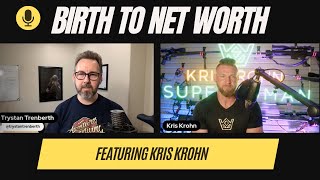
Kris Krohn grew up watching his parents fight over money, which drove him to build thousands of rental properties and a portfolio generating passive cash flow. He scaled from buying his first home in college to a system he now teaches through coaching and mentorship, alongside philanthropic work in Ukraine and child trafficking rescue.
Chapters
Join us as we unravel our deep-rooted relationship with money, from earliest memories to eureka moments and building wealth. Birth to Net Worth with me, Trystan Trenberth. Good afternoon and welcome to Birth to Net Worth with me, Trystan Trenberth. Today we have an amazing guest, um, met him over a year ago. At a convention, and it's just been amazing to follow his work, get to know him more deeply than most. And without further ado, I'm going to bring on my friend Chris Krohn. Chris, welcome here.
What's up? How you doing, brother?
Very well. Thank you so much for joining us today.
Yeah, great to reconnect.
Fantastic. Well, let's just crack on. So Birth to Net Worth, it's about bringing conversation about financial literacy how we become familiar with money and, you know, what we can do with money as our mindset and our understanding of money changes throughout life. So first question is, generally, what's your first memory of money? Was it an ice cream? Was it a toy? Was it a yes or a no to buying something? Tell us about your first memory of money.
I remember being, I don't know, maybe like 8 years old and listening to my mom and dad in a really kind of violent argument about debt. And I remember hearing things about not making enough money. We're in debt. We have to refinance the house. We have to pay off credit cards. And there was just a lot of anger back and forth. And I remember just thinking to myself, I don't know really what this money stuff is, but there's not enough of it. And it means fight. It means argument. And it means kind of bad negativity.
Yeah, that's quite a confronting first context really. So how did that develop from then? How did you, did you, you know, gesticulate on that for quite some time worrying about what something was or wasn't?
You know, it's interesting. Human beings, either when they experience something traumatic or perceived traumatic, they either run towards it or away from it. And I ran towards it. I became actually interested in money. I became fascinated by entrepreneurship. I became interested in my dad's business. He was a German immigrant. He had a roofing company and a general construction contracting business, would remodel houses. And so I remember having a lot of fascination, which made me very different than my 8 other siblings. The majority of them, it was college degree, worked for somebody else, safety, security. And I originally thought that would be my game too. I got good grades with a whole lot of effort, uh, because I didn't have the natural smarts there to become a doctor. And so I grew up just telling myself, I'm going to be a doctor and I'm going to do well financially.
Amazing. So looking at your perspective, was that the same or different from your siblings' perspective on money? Did they pick up the same things? Depending on whether you're an older child, younger child, different people perceive things based on either the leadership of an elder child or Maybe nothing.
As a middle child, as number 4, definitely the glue. And I felt a lot of stress over wanting to keep coherency, keep the family together. For me, that experience as an 8-year-old wasn't actually a very negative experience, even though it kind of sounded scary. I actually felt inspired by God. I had a God moment in it. And it was someday when you're older, you're going to take care of your parents. And so I just assumed the responsibility. And kids kind of do this sometimes. They, when they, when parents find out about stuff, they take responsibility for things that's not always theirs. But I felt really happy to take on this responsibility of someday I'm going to be really good at making money because I'm going to take care of my family and I'm going to take care of my parents. And that really became one of the original goals for wanting to do well financially.
Phenomenal. Wonderful. So you're interested in entrepreneurship. Did you have lemonade stands? Did you have that type of thing on the way up?
Not necessarily has to be that, but I had a, I mean, my first business was basically getting caught selling drugs. It wasn't really drugs. I made some homemade sugar fun dip out of my mom's pantry and I brought it to school and I had $2 small bags and $4 big bags and I was selling all morning long out of this satchel. And made like $44 by lunch by the time I got hauled into the vice principal's office for selling drugs. And she confiscated all my stuff and told me I couldn't do that. But for me, it was a huge win. I had a pure profit margin. I had no expenses. I stole my mom's stuff and I made $44 and I was hooked. I'm like, I need to do more of this.
Amazing. So doing well with grades at school, obviously some effort based on, you you know, what you shared. How did that take you through from high school to— did you do college as well after high school?
I did. I entered college wanting to be a doctor. I had a good GPA going in, and I remember standing in my first chemistry class in a packed room with a professor that got up on day one and basically said, y'all want to be doctors? My job is to fail the majority of you. You're not meant for that. So this is a wheater class and organic chemistry kicked my butt and I got a C. And, um, I remember going to my advisor and I said, hey, I wanna be a doctor, but I got a C. He says, we gotta retake the class. Yeah. And he discouraged me. He said, you really, this isn't, if you gotta see, this is probably not your natural path. Yeah. And I just said, no, I, I can do this. I signed up for the class again. I got a, a tutor. I worked harder than I had ever worked in my life because it was graded on a curve at the end of that semester. I was, I got a C minus and I went back to my advisor and this time I decided to listen to him and he basically killed that dream. He said, Chris, it's a decade of this. You're not built for this. What comes natural to you? And I didn't have an answer for him. And I spent the whole next semester and I was paying for college out of my pocket and I took all these classes. I'm like, do I want to be a teacher? Do I want to be a psychologist? Do I want to be a whatever? And I basically, after looking at every single degree available, I said, there's nothing for me. There's no way I'm gonna take care of two families. There's no way I'm gonna take care of me and there's no way I'm gonna be able to take care of my folks. So I'm, I'm screwed. And, and that's the very first time I decided to go against my dad's teaching. He said, don't be an entrepreneur. It's awful. It's hard work. And I remember bucking the system and saying, that must be the only place where I can find what I'm looking for. And so while I was in college, that's when I built my first business. That's, I became financially free by the time I graduated college and and when everyone else graduated and all my buddies were getting jobs, I never needed to get one because I quit mine.
Yeah, incredible. So what tipped you into that? That first business through college that bucked the trend with going into the entrepreneurship? Was that real estate related? Was that something else?
It actually was real estate related, but there was a make or break moment for me. 4 months after, you know, I got married young, like I found my, my wife-to-be on the third day of college. And so shortly after being married, I, I found out I wasn't gonna be a doctor and I was afraid to tell her. I thought that I was gonna, I told her I was gonna be a doctor and now I'm not. In fact, there's probably no degree for me. And she wasn't worried at all. She said she believed in me. But 4 months later, after a really nasty day of telemarketing, crappy job, I came home. I'm just feeling awful about, I'm in some, I, I'm taking all of these classes, but I don't know why I'm, I have this sucky job. And I came home and I found my wife in tears and I didn't know why. And I had never seen tears like this before. I'd known her for a little over a year and she cried like someone had died. So I reverenced the moment and I finally had the courage to say, Clem, what's wrong? And then she said something that made no sense. She said, well, tuition's due in 3 weeks and we can't pay for it. I'm like, okay, that sucks. But I mean, there's always like going into debt for college. We were taught to do that. And then before I could answer, she said, Chris, we have rent due in 5 days and we've already spent our next paycheck. And I thought, oh, that's a problem. But still, I was thinking, crying tears, really? And then she said, I walked 2 blocks down the street to Smith's to buy our typical week's worth of groceries. And I experienced for the first time a bounced check. And I couldn't pay for them. And I was so embarrassed. I didn't know what to do. And I just ran out of the store crying. And all of a sudden I realized my wife was hungry and we had no food. And I thought, is this the beginning of me fighting with my wife like my parents fought about money? And in that moment I felt, Trystan, man, I was so broken. I was so hurt. I felt like a loser. I felt like I'd let my wife down. I felt hopelessness. But in that pain, I also made a decision that I was going to do whatever it took to figure this out. And that was the moment that opened a door for me. And that's when my conviction rose from a commitment to this must be. And shortly after, I did find some mentors. I found 3 people that had each made over $10 million in real estate. I started following them around like lost puppy dogs as long as they would have me. And, you know, with their help, I worked through it. I found my very first house and I bought it. And my wife and I moved in and basically we lived for free because I bought it with so much equity below market. It had a basement apartment that covered the mortgage. And I thought maybe I didn't get lucky, maybe I can do this again. And a year later I took the equity in the house and I bought a second, and the house was much nicer, but I didn't move into it. I decided to rent it out. I made a $600 a month positive cash flow. It had like $90,000 of equity. So between the two houses, I had a net worth well over $100,000. I was living for free and I was getting paid. And I was like, that was that. There was this moment with my wife when she came in and she said, Chris, I need help. I said, what's wrong? She's like, the budget doesn't make sense. She said, what do you mean the budget doesn't make sense? She's like, Chris, There's like $600 extra every month and it doesn't belong to your job. On the budget, we have your job and all of our expenses. And I said, well, maybe we need to add new, new income line items. She's like, what's that? I said, well, our first house, we're actually collecting rent. I get that it covers the mortgage, but our second house has $600 left over and I got my job income. And so when she added those two lines, she turned to me, she saw how it affected the bottom line, and she said, Chris, how do we add another house? And in that moment I had her, I had her support. And a few years later, 25 homes later, we had— it was like $12,000 a month coming in passively. And that's when I had finished college. I quit my job. And, and that was the beginning of 25 homes becoming thousands. Yeah.
What a gift. What a gift out of that moment. And what a gift in that the commitment of your wife to—
well, that was— and one of the coolest days of my life still to this day was not just graduating college, but waking up one morning in this beautiful brand new 10,000 square foot house that I had custom built on the golf course. And I turned to my wife and I said, is today the day? And she said, Chris, you could have had this years ago. And that day I drove to work, went right into my boss's office. Back then, I got scared. I chickened out at the last minute. So I asked for a raise instead of quitting. I said, can I have a $70,000 raise? He laughed. And then I laughed too. I was like, no, no, listen, thank you. This has been The best 4 years. Thank you for supporting me. I've got my real estate thing going on. I'm going to do that. And we hugged and, and I left that day. And I remember having the top down in my brand new BMW convertible and driving home that day and feeling like I was breathing fresh air for the first time ever. I was off financial life support. I was in charge of my life. I was going to wake up the next morning and do whatever I wanted. And I felt free. Like this is the greatest freedom I'd ever felt in my whole life. Yeah. I'm a young man in my mid-twenties and I don't have any commitments other than to keep loving my wife and my brand new baby girl.
Fantastic. Yeah, I think that it's a big problem. You know, Rich Dad Poor Dad was my kind of realignment of asset liability and really now putting into place what is it to transcend that survivor relationship to money? To have all of your basic bills paid and then have that fresh air. And that's what, you know, you want to do and bring to many, many people, and you have done so far. I dream of helping people, you know, find financial freedom and whatever that means for each and every person. But I just think that's something that is incomprehensible until you get to that point from many backgrounds.
Well, and I feel Trystan Trenberth like so many people are living this dim life. The light switch is nearly off. They're sleepwalkers. Many of them are energy vampires. They're just— they're living off of negativity, but they don't know what they don't know. There's this life where society just breeds us into being cogs in somebody else's machine. And the government has an agenda and companies have an agenda and people feel like they're in some modern version of slavery. And it doesn't have to be that way. We have the greatest technology. We live in the greatest times. We have access to just everything. And I'm like, Man, you can rise out of that dirt. You can pull yourself out of that cesspool and really make anything that you want with your life. You know, I, I remember when I started just doubling my income every year, and at first I'm like, no way $100 can become $200 an hour. No way that can become $500 an hour. No way that can become $10,000 an hour. And it kept doubling and it was like, then I figured out that I can make $100,000 an hour. I can make a million dollars in an hour. And that there's no end to it because there's no end to value creation. So. Yeah. What started off as a real estate game has really turned into hundreds of companies, private equity, you know, consult for equity deals, buying and selling companies, trading companies, growing companies, acquiring. It, it's just become now this beautiful game where I've got my life situated just the way I want and there's balance between my family life, my health, my business and finances, right? The biohacking. Yeah. And, and then the philanthropy. And I'm like, man, I really genuinely feel like I can do anything that I want. And that's available to people, but until you've tasted that air, until you've breathed it, people don't know. Yeah.
Yeah. And even when people are reaching up, if those around them are like the crabs pulling them back down, you know, whether it's the news, whether it's the culture, whether it's the energy around them, we all experience that. And I think, you know, myself, it's almost like a fear of failure for being sabotaged for trying to get out the bucket. Further than I have before.
Yeah. Yeah, so true. So yeah, I'm helping, helping producers build wealth and strong economies and strong businesses is one of my purposes. Helping the vulnerable, you know, the people that have really been taken advantage of, the victims that are out there, finding them and helping them. You know, those are the two groups that I feel really called to. The third group are my growth warriors. These are my brothers and sisters that believe that the purpose of life is to intentionally have some type of system or process or network for growing. And growing for me brings me the greatest fulfillment. So there's got to be financial growth as health growth as, you know, family growth and all of these dimensions.
Yeah, sounds like a structure of accountability.
Yeah.
Yeah, it's something I've been looking at recently as well. You know, I've done 75 Hard. I've not done 75 gone soft and, you know, all of those things. So I'm really trying to align myself with that right now. But I think that, you know, looking at my kids, looking at my family, looking at all of my friends, I think that, that physical shape, yes, that health breeds wealth, but also the mindset as well. What we put in your stomach also affects your brain so much as well.
Oh, it's all connected, right? You know, I think 4 years ago I had a friend that died in a tragic paragliding accident, and he was my best friend at the time and a very— one of the top 100 YouTubers on the planet. Left behind a beautiful wife and 4 little boys. And at that time, I really started saying, Chris, you're so successful, but you're still not giving yourself permission to live the life that you want. It's as if you think that the next achievement will unlock permission. And in that moment, processing his death, I said, no, I'm going to give myself— I mean, he died a year and a half younger than I was at that time. And I said, no, I'm going to give myself permission to live the life that I want. And I felt that because he, 9 months earlier, he had exited his business. He still owned it, but someone else operated it and he basically was full-time dad. And that's how he spent more or less the last year of his life. And so I was so inspired. I was like, man, what if tomorrow I got hit by that proverbial bus? I wouldn't have had my last year the way he had his. I'm going to make changes now so that that balance in a world that says that we're too busy and balance is impossible, I just say that's a lie.. It does take discipline, it does take focus, it does take a system, but achieving balance has been the most important thing to me.
Yeah, yeah, yeah, we, we do prioritize, you know, taking care of our family in spite of not being with our family. And I see that in my recent past, and you know, it's one of those things also hiding struggle from family as well, you know, financial struggle and other things. I think that I look back and I think I could have shared more with my kids, not to stress them out, but if they think everything's perfect or everything's going well, they don't know that there's the dip before the crest.
Yeah.
And you know, I, I gotta look back at that too and, and just share that with other people too. So, so you got into real estate, one house became two, became four, became 100, became 1,000, and So you're now working in multifamily and a lot of, you know, equity partnerships now, is that right?
No. You know, so I did some kind of weird— I believe in niche and I believe in owning a niche. And I asked myself, you know, every time I tried to graduate from single-family homes to multifamily and commercial, I could never get the ROI to come out as strong as single-family. And yet I said, but Chris, the reason why they quote unquote graduate is because you can only you can only manage so many projects and the world, you know, with millions of views every week though, the world insists that I'm this social media real estate guy and I'm like, no, I'm a systems guy. And real estate was just a system for me. So I built a system that would scale single family. And as a result, I really don't have any competition in the space next to hedge funds. There's no one making real estate available to people wanting to build wealth the way that I've, I've mapped out. So that was $2 billion worth in transactions ago, 6,500 projects ago. And now I've been able to get my average ROIs in the mid-30%, which means that money doubles every 2 years. And until I can build a machine where another strategy in real estate can consistently produce that in up and down markets, totally passive, I'm, I'm just gonna keep doing what I'm doing. So I, I do have some multifamily and commercial and other projects, but my daily system has been found in a niche. And, and what I did is I went into a niche that no one was. And in the beginning people said, you're crazy. You can't scale that. And I said, then if it's impossible, it makes it worthy. And I love impossible challenges. The companies I pursue these days and that I'm acquiring, many of them are pursuing something impossible. Because that's where you find asymmetry. That's where you find the incredible upside. And that's exciting for me. So that's a game I really enjoy playing is give me Mission Impossible and let's see if we can make it possible. Yeah.
Excellent. So you're coaching people now in several different facets of business. What did you start out with? And was it, excuse me, this is an alarm to remind us of our call in 30 minutes. Which already happened. What, what was the, what was the calling for you to, to show other people how to do this?
You know, my, the president of my board marvels at this all the time. You know, sometimes when we have a gift, we can't see it because we take it for granted. It's nature to us. It's natural. And on a regular basis, he will point out and say, Chris, you find something that works, you prove it, and then you have to share it with everybody. And this is, this is just kind of my nature. I like hacking something. I like finding something really profitable. My, I generally, my rules are it's gotta require the least time, the least effort, the least risk, and make the most money. And if I can find something like that and systematize it, my natural inclination is to share it with people. And, you know, the reality is the world is filled with people that are resistant to growth and change and transformation. And those aren't my people. I'm looking for the people that say, no, I feel like I was meant for more. I am looking for a mentor. My mentors, I've had 30 mentors. They've gotten me where I am today. You know, over the last decade, I've been that mentor now for a great number of other people. And I find joy in it. Generally, I pursue something that produces fulfillment. So it's fulfilling for me to help someone do something really big that they previously thought impossible.
Yeah. So I'm sure you helped a lot of people before you started coaching. Was there any time that you felt you're a people pleaser, a bit of a helper, a bit of a— before you were actually realizing, like you said? I have people tell me all of the time, are you really good at that? Is this because I can do it and they want my help with it, that I can please them? And I get caught up in that from time to time. Or is it that understated unrecognized skill that I have, which is powerful, that can really support people? Was there a point when—
that might be the most bizarre, unique, and interesting question I've ever been asked on a podcast. So it strikes a chord with me because in the beginning of my journey, I was a people pleaser, and I actually view that as a bad thing. For me, it's like wearing a mask of inauthenticity, and it's permission to lie for the approval of other people. Because if you had been back in time, you know, 15, 18 years ago, you would have found a very different Chris Krohn. Yeah. You know, last month my wife and I just finished a bodybuilding competition. We just got back from Ukraine doing humanitarian work. Like, there's a different me in the world today than was then. And the then me had, I think, a lot more ego and needed people to like him. But when I, when I started, like, garnering a lot of views on social, and would read my comments. I got to the point where it was too painful. I said, Chris, like, if you want to stand out of the crowd, you will be loved and you'll be hated. And if you do something to be loved, then the same people can knock that pedestal out from underneath you. And, um, I began finding my people pleaser hood as like a, as one of the biggest human flaw weaknesses. And so I went through, I hired a lot of coaches to actually figure out how to take that mask off my face. So that I could figure out who I am, what my purpose is, what I'm supposed to do, and how to just stop caring. Care for people, but stop caring what they think about me. Yeah. And so, you know, it's been a, it's been a pretty wild journey, but I've been able to release that. And as I have, it's been, it's, it just makes it really easy to know who I am, what I'm about, what I'm supposed to be doing, whether I'm liked or not. Like a lot of that stuff just doesn't matter anymore.
Did that get away? Did that get away or in the way of your purpose? Knowing your purpose, trying to please other people.
Yeah. Yeah. Because I would pick up body bags. If you care what someone thinks, then the moment they don't like you, you emotionally fall apart. It's actually a tremendous load of emotional unintelligence to need the validation of someone outside yourself to feel okay with who you are, because you can never get enough of what you don't need. What you don't need never satisfies. So when you need someone else to love you, care for you, tell you that you did a good job and give you an attaboy, The moment they're not there, your self-esteem just shrinks and deflates. At some point, you have to learn that your voice and what you think trumps everyone else's, even a spouse, a family member. It's, it's, it's me and God. And that's the, that's the core that I'm trying to please right now.
And I think you've done a lot of research on this, as I understand from our other conversation here. You've got some people that you work with that, that help people in those, not just this situation, but overcome self-limiting beliefs and traumas and so forth.
Can you share? So I— yeah, so I mean, I, my family definitely wasn't perfect. I don't know if any family is, but there was a lot of trauma. There was a lot of abuse in the family I came from. And I saw how a decade of therapy didn't heal anything. And still to this day, there's grudges and there's disowning and there's no family reunions. And I am taking care of my parents. I've been doing that for 13 years. That's been a great blessing. But I've been, I've been, I've been on the sidelines just watching all this, you know, this black cloud that just won't leave my, you know, my family. And so it really, you know, after I became wealthy, I spent a couple million dollars traveling the world, hiring mentors, and trying to figure out something superior to therapy. And I ended up developing a technique, really a technology for transformation, a conversation that allows someone to be guided to go within. To figure out what their belief system is, to separate the positive from the negative, and then to figure out the origin of where this stuff comes from. And then how to, you know, I can sit down with a soul for 15 minutes and help them shift the paradigm on something they've believed for decades. And that's what a lot of people experience when they come to my events, is they go for wealth training, business training, and real estate training. But half the time is spent on the psychology, since that's where 90% of the success is housed anyway. And, you know, a couple years ago, my wife and I decided to put it inside a private foundation. And that foundation, you know, is what we contribute our money to as well as we've, you know, last year we raised on top of that millions of dollars and have been able to provide this technique with our certified coaching staff to people all over the world to help them face their traumas, their perceived traumas, their limiting beliefs, and rise above them and learn that they're enough and really learn how to believe in themselves and love themselves so they can get on with their life. And start stepping into a more positive world by their own creation instead of the negative one that most of us can't avoid through childhood.
I, I, from, from when we had that first conversation, uh, in the green room, my friend, my kids lost another friend to suicide last year. And I've met with a number of healthcare professionals, both, you know, traditional and non-traditional as well. Um, and one lady, Geri South, is doing some sort of coaching and I think understanding this as parents, what we can do to support kids, and it's not the parents that are necessarily going to create the space for the answers, but at least facilitate the right people, is, is really putting so much more out there. The better we can understand ourselves as adults, the better we can be supportive. And one of the most interesting conversations I had recently was with a new student, uh, friend in town Her son has had depression, anxiety since he was young. He's now 29. She's obviously in her forties or fifties. But for the first time I had a conversation with a mother and a child understanding both sides of that journey through teenage-dom, through adulthood, still struggles with some things, but having that clarity and the balance because with my kids and a lot of parents that have got teenage kids, They don't understand what's— the kids don't understand what's going on to explain it to a parent. The parents don't understand what's going on because they can't see. They're not trained to look for these things. And I think having that awareness would be, you know, incredible to share. So, you know, really pleased to see that there's research going on and alternative things, you know.
Yeah, we, um, this year we started putting on, uh, youth events and, uh, basically we invite the parents and the family and the kids and it's really teen-centered. And it's about teaching emotional intelligence, and it's specifically to address anxiety. There's so much social anxiety out there. Depression is so common, and of course that leads to suicide ideation. And, um, helping these kids discover— and, and here's a truth for me: I would trade all the knowledge in the world for the emotional intelligence that I've created, because it is a creation energy that allows you to manifest the life that you want. You can't create anything good unless you believe in yourself.
Yeah.
And a lot of kids just don't know how to do that. So we put on these, we put on these events and it's not just sit and lecture. Kids hate that. It's up and out of the chairs and it's breaking arrows on throats and board breaks and firewalks and, and it's giving them opportunities to challenge themselves to discover what's on the other side of pain, suffering, and to find self-confidence. And yeah, so that's become, uh, that, that's a huge passion of ours.
I appreciate you sharing that with us, Chris.
Thank you.
Yeah. So you do a lot of, a lot of other work for, you know, good causes. The Ukraine is one of the sort of maybe better known ones, you know, more publicized, but to bring more support to what you're doing. And it's something you don't have to do. It's something that you do and you've got a great support team around you, whether it's the, the employees that you have or the other donors, the other, you know, mentors and influencers out there. I say that in the best possible way. That are willing to get the word out further. You know, I don't think enough people talk about the good work that they do for causes. We talk about success and Rolexes and Lambos and that stuff. How can we get more people to talk about these things so that other people aspiring to become wealthy or build a legacy can understand that can be part of the process at day one, not just when you get there tomorrow, next year.
You know, I told myself for the longest time I want to get rich and then I want to give back. And I think I had the order wrong. And Bob Allen taught me, he said, Chris, the reason why you give back is because you're already rich. You know, the broader definition of wealth is your health. It's the love in your life, the relationships. It is, yes, finances and abundance is a part of that, but probably the least important of all of it. And, you know, when we've had the first opportunity to go to You know, we've— I've been to Ukraine 3 times now. And, um, on one of my last visits, um, I was directly in the war zone. There was indirect fire all around us and there were 12 people left trapped in a village with no roads. They had no vehicles. They couldn't get out. And so we had our off-road vehicles. We had, um, you know, um, you know, ex-military transport and we were, we were in there and pulling people from the wreckage and from their homes and getting them out of there. And that moment changed me forever. It grew my heart. I came back to the States and, you know, frankly, it took me a couple of months to kind of find my feet again. And I think when you live it, how can you not evangelize it? Because you become it. It's no longer just a token amount of money or token amount of time. It's enveloped my life. You know, since we've picked up a couple of safe houses in Mexico with kids, safe houses that are run by good people that are being closed down because they just didn't have the resources. And it's putting, you know, kids that are sex trafficked back on the streets. Yeah. So we've taken those over. And, you know, right now I think what's really beautiful about this type of work is it's endless. And, you know, my wife and I, more and more of our lives are just revolving around how do we make a difference, how do we make an impact, how do we give back. And so life is much less about, uh, earnings and profits and making money and things like that. And yet I'm still crazy ambitious. Over the next decade, I'm going to own 10,000 companies. I acquired 5 companies last week. So I want to be a trillionaire. I want to rotate a trillion dollars of wealth, but in the ways that my wife and I want to dictate that it can best serve the people we feel called to. If everyone honestly, Trystan, would become more wealthy, truly more wealthy, and learn how to be givers along the way, Then when you're entrusted with great wealth, then you magnify that wealth and how you re-rotate it out into the world and go help the people that you feel called to. A lot of this just sounds kind of cheesy, but at some point we're all going to die. And when we do, we're going to pause and we're going to evaluate our life and we're going to ask, did I do what meant something? Did I do something that was important? And I think there's a lot of people where the answer is no, and I don't want to be one of those. So You know, we're inspiring as many people to come on the journey along with us as possible, but it starts with whoever's listening. It starts with your leadership. It starts with you stepping up, and it starts with doing something bigger than doing what's easy or convenient.
Yeah, yeah. I mean, to reflect back on the children, we are the day. Jimmy Rex, I remember his conversation telling me about his wife, or girlfriend telling him, well, why does it have to be you? Why can't they do it? Well, we are the they. We need to do that, you know, and, and unless we do, and on the, on the topic of, of donation and, and wealth, it's almost like the universe is allowing us to be sharing our wealth and won't reward us with more wealth until we share what we have. And then as we give more, more will come to us.
There's definitely some positive karma out there in the universe and it's amazing how it rotates and moves around. But I think the real wealth beyond the money is the people. It's getting behind a good cause. You know, I think a lot of it starts with, you know, a lot of the success we've had in growing companies. There's a formula now for us and a part of that formula is the culture. And the culture means there has to be a reason behind what you're doing. And the reason can't be profitability. People don't get behind that. There's a huge disparity between business owners and the employees. And should a business owner be successful enough to grow and exit their company and have these, these great trappings that they've won, a lot of the others get left behind. And the world is, you know, employees are really aware of that disparity right now. They're kind of upset about it. And so part of our blueprint is profit sharing and saying, hey, we're going to grow this, and when we exit, everyone's going to win together. And this is a big part of our mission and purpose and what we do. And then it's also backed by our why, which is You know, creating something for the world that desperately needs but doesn't exist. And watch what we're doing with the money. Look at, look at how some of those proceeds are now going to bless so many people. So there's, there's so much good happening here and people are calling for that. They're calling for cultures that are positive and powerful and life-changing and, and it's out there and it's available and people can do it. But that's what keeps me in business right now more than ever before is, is waking up in the morning and asking, What problem is out there that looks impossible that I might be able to solve? And, you know, right now we're doing that with one of our companies that we're just preparing to launch. We've been incubating it for 5 months and it's a, it's the very first social media platform for families and kids because social media scientifically has been proven to be so destructive to the self-esteem of a child or a kid. And there's a version of the internet that if you don't have parental controls and you just give it to them, it really is going to mess them up while they're in their developmental phase. That's science, not me talking. I got 4 kids, by the way, oldest is 17. We've dealt with suicide. We've dealt with all sorts of things in our own personal family home. And just my own family experience inspired a version of the internet and social media that is truly safe and age-appropriate and inspiring and uplifting. And that doesn't exist in the world. And when we started it, we said, this is impossible. Like, do you know what it's going to take to be able to do this? We'll never be able to do this. And I said, that makes it worthy. And yeah, months later we figured out how, and now we're just putting it together.
Amazing, amazing. So what you said, in the next, next number of years you're looking to project, you know, trillionaire status, you know, and not from an egotistical point of view.
I can tell you, 100 years, I'm going to be 100 years, um, I'm gonna live a lot longer than I am right now with all the biohacking and modern medicine that's out there. It's not like this is a decade out or two decades. This is, uh, yeah. It was another one of those impossibles, right? Yeah.
So how, how are you knitting that into your family life as far as conveying financial literacy, understanding of business, how money works to, to your next generation?
Well, two things. One is now almost 5 years ago, we pulled our kids out of the public school system. We did that prior to the pandemic. We basically, I got to hire the perfect teachers for my kids and bring them into our home.. And, you know, basically we've taken school on the road. We travel and do school. We let the, the kids see the world and we hire truly inspiring educators that we really believe in. And it, it all kind of kicked off when, I don't know, it was like 5 years ago, I was doing a parent-teacher conference with one of the teachers, and this is gonna sound highly insensitive, but I looked at the teacher, the teacher looked like she was well over 100 pounds overweight. She looked drained. She looked, unhappy. And I just thought, she has a safe and secure job that she can't lose to teach my children algebra, by the way, a skill that's almost meaningless and obsolete, to teach them something that they don't need to know. But what she's actually teaching with all of her influence, sometimes spending more time with my kids than I do or my wife does, is her health habits, her belief system, her lack of belief in herself, and a myriad of other things. And I said, no more. So I pulled my kids out of the system and when we went and hired our own teacher, I said, well, I'm gonna, I'm gonna find teachers that are highly educated, entrepreneurial. They are well-rounded, they're fit, they're healthy, they're health nuts, they're physically active. And, and we just basically said, we're gonna create a, I'm probably gonna mess up my kids. I'm gonna create a school based on customizing everything around their strengths and abilities and ditching all the stupid stuff that who, who cares about. So that was the first thing that we did is we said, well, we gotta alter the way that we educate our kids. And all these years later, I look back and I'm like, oh man, like, not only do I feel that my kids are way further ahead, but more importantly, what I really want for them to learn from learning is to love learning. Yeah. And there's a reason why the average college graduate doesn't read 2 more books in their entire life. It's because they're done with learning and they think they're finished. But, um, man, the most important learning I ever got came after all of my formal years, right? So that's the first thing. Yeah. The second thing is just, I think, my example. You know, when my friend passed away, I said, I'm going to redo everything. I'm going to redo my schedule. And what it turned into was I make videos on Monday, Tuesday and Thursday. I work from home. Wednesday is my wife's day. We're going to spend all day together, just us. Friday is going to be kids' day. Saturday is my day. Sunday is God's day. And we built this, this week. And that was That was over 4 years ago. It hasn't changed since because it just continues to be balanced. You know, if I'm working more than 30 hours a week, I do not feel good. So what my children have is a more available dad, and then I get to bring 'em into my events 'cause I own an event space and do some of that. And you know, yesterday I was helping my son with one of his entrepreneurial projects of just, you know, cleaning out garbage cans as a 15-year-old for all of the neighbors.
Yeah.
You know, collecting $10, $15 a can. And my kids package out and ship all of my books out. I've written half a dozen books. They send those out to the world. They get paid to do that. So, so my kids are, rather than teaching them good grades, which they don't get grades, by the way, but instead of teaching good grades, college, what we teach them is that college is a path for certain careers. And that really the purpose of education is to love to learn learning and then also to figure out what you love. And then if you can turn that into some type of business that you really enjoy. And so that's really been the path that we've chosen.
That's brilliant. That's fantastic.
I don't know. I don't know. Maybe my kids will hate me and be like, dad, once in a while they're still like, dad, I want to, I want public school. I'm like, trust me, you do not want public school. Yeah.
Yeah. I mean, I grew up in a different country, of course, different education system. And it was what it was. I've seen it over here and my kids have been in class and then they've been sort of remote. The last few years. And yeah, it's just a very different experience than it was for me. I did a bit of college in hospitality management. I then didn't use college. I went into IT, um, you know, systems engineering and stuff for 20 years. And, you know, it wasn't my passion. I found that for the last 8 years I was very frustrated and stale about what can I do differently. Photography was a passion, but I didn't think that could really be a career as far as making me wealthy. And then I read Rich Dad Poor Dad. So, you know, then the rest is kind of history.
Yep. That's just beautiful. That's awesome. Well, I think everyone needs a financial education, that's for sure. Yeah. The financial illiteracy is, it's awful. And the default unfortunately is Dave Ramsey, meaning let's just keep people from making dumb decisions. But you know, the greater reality is there's a financial education everyone needs. I put on financial events because I'm passionate about teaching people Literally how to become a billionaire. I just came out with a brand new book called Have It All, and it teaches 5 financial choices that can take you as far as you want to go. You want to be a multimillionaire, you want more? The book says that's achievable inside of 5 or 10 years if you follow the system. By the way, I'm happy to give that away for free, Trystan Trenberth, today. If anyone wants a free ticket to one of my events, if they want to have a conversation with me and my team about financial choices that they could make, or if they just want to like get my book for free, Do you mind? Do you mind if I give that away?
Please do. I'd love for you to do that.
Thank you. Yeah. Anyone can go to freewealthgift.com/networth. freewealthgift.com/networth. All three of those gifts are there. And it's about— it's about empowering people and giving them financial literacy. And, and I love that because I think that most of society's financial blueprint is— it's not just old and dated, it's broken and it doesn't work. So I love helping people understand that you have options that don't have to equate to high risk. There's ways for anyone to become a multimillionaire with a couple of really important passive moves on the side. And if someone says, no, Chris, I want to take some healthy, appropriate, calculated risks, can I become financially free in under 5 years like you? And the answer is, yeah, I listen, I'd do it in under a year knowing what I know today versus the time it took me. So yeah, those are, those are gifts for everyone of anyone, anyone that's listening.
To this. Thank you. And the link will be at the end and it'll be underneath. So if you had a time machine, Chris, I think you referred a little bit to it earlier on. If you could go back to that day before you went, you know, you were at college on that day with your wife, what would you do differently? What have you learned that was life-changing that you would go back and tell younger Chris to? Yeah, we doubled the houses every year. We doubled the number of income. What would you go back that would even shortcut that even more and, you know, hockey stick sooner in life?
Yeah, I would go back and tell them that the strategies are going to be the easiest thing to find for building wealth. What you really need to focus on is your belief system and your positive psychology. I'd, I'd, I'd tell them you're enough and you're loved and I love you. And you're worth it. And everything you want is out there, but believing in yourself is where it's all going to start. And believing in yourself starts with love and knowing that you have infinite worth, that you're precious, that you're priceless, and that you can do it. And if I had more of that at the start of my journey, I think everything would've accelerated quite a bit faster. Yeah.
Well, wonderful. What else would you like to share with the audience? What have you got going on that's coming up that they should, they should be aware of? What can they get involved with? How they get involved with, you know, donating to your Ukraine fund or any of the other causes that they may be in alignment with?
You know, I, uh, I've been— I've had a 14-year goal to become a billionaire. I just— I, I, I announced that January 15th, 2009, and I can now count how many months out I am from, I believe, hitting that number. It's significant to me because I, I believe in manifesting, and that was a large gestation. I had no idea how long it was going to take. And now that I'm just about there, I know how to reverse engineer that and get anyone there. And while most people aren't— they're not crazy enough to have a need or a reason or a goal to need $1 billion, I do love teaching, especially audacious people, people that want to break free of the mold, that feel like there's really a much greater life for them to live. And so at my— at my next event that I have coming up in August, For the first time ever, I'm going to be revealing my Billionaire Blueprint, and I had a chance to teach it to a couple of very small masterminds, and it is the most transformational financial literature I have ever taught in my life. And so I'm excited about that. I feel like I possess the financial secrets of the universe right now to, to pretty much produce any result. It's just a matter of giving it the time it needs to gestate. So that's a big thing in my world. I love teaching people You know, and I'll put it to you this way, Trystan, there's different games to play, right?
Yeah.
There's, for me, I've cataloged about 25 different financial games and it took me 20 years to learn all of the financial games. And what I've learned is that some are better than others. Like I started with real estate because that was all I would like, that's all that was teed up. Yeah. And if I could do it all over again, real estate is one of the slowest ways of building wealth. I'll be a billionaire in my own right in my lifetime through real estate alone. But it is small compared to business. Yeah. And most people have the wrong approach to business. They want to start a business, and I don't believe in that either. I believe in acquiring businesses. I believe in rolling up businesses. Yeah, I believe in adding value to businesses. There's a number of approaches to business franchises that are shortcuts that can give people that— some people literally, if they just had an extra $8,000 or $15,000 or $30,000 a month, they feel like it would change everything for them. But they don't know how to leave their job. I love showing people how close they are to that world because it's most— it's a little bit of knowledge. It's definitely a healthy dose of some emotional intelligence, some risk, some bravery and making the right steps. But I love teaching people that right now. So building wealth, helping people build wealth is definitely like a tremendous passion. And then of course, it goes hand in hand we raise almost always over $1 million at every one of my events for our foundation. And I love to show people how the wealth rotates and that the money I make gets deployed to do good in the world. So teaching a complete system on what wealth really is so that you can enjoy every season of your life instead of, well, with accumulation, hopefully someday I'll have permission to, to do some cool stuff. It's like, no, that, that's today.
Yeah. Yeah, yeah. I had the pleasure of meeting Carl Allen in January, and he was telling me about rolling up businesses and things, and Cody's doing similar things. But yeah, I think, you know, real estate is, is amazing. Yeah, I, I am sometimes caught up with shiny object syndrome, but yeah, it's, it's just lovely to see so many opportunities for people that some align with some people, some don't. And just, there's just so much opportunity out there. Again, it comes back to mindset and, and, you know, making that decision.
Yeah, 100%. Well, everyone's got to find that thing that's for them, right? Yeah. They got to find their jam. They got to figure out what makes them tick, and they got to figure out what's going to create fulfillment, because fulfillment is not ever tied to an accolade. Yeah. It's tied to a feeling that you, that you create from making the right choices in your life.
Yeah.
And that's something we're all capable of doing today, which means we're all capable of living our wealthiest life now, and then the money tends to follow.
That. Yeah. Yeah. Well, Chris, it's been a pleasure speaking with you. Thank you so, so much for taking time out every day, sharing your wealth of knowledge, and, and, uh, I wish you a wonderful day.
Thank you. Listen, appreciate you, everyone. Great to connect with all of you, and, uh, best of luck. Live your best life. Thank you.
Follow Chris on YouTube, Instagram, check out his web links to see his family foundation, his education, and a look into his November mastermind in Utah. If you're going, I will see you there. See you on the next edition of Birth to Net Worth.










