Birth to Net Worth with Steven Crawford - Episode 2
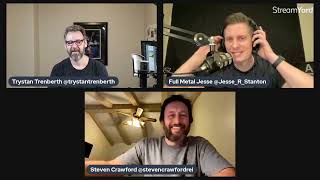
Steven Crawford got into real estate after Googling ways to get rich, learned wholesaling and creative finance through podcasts, and now uses tactics like driving-for-dollars and cold calling. He's been at it about two years and has kids aged 2, 4, 17, and 19 he's teaching about money and perseverance.
Questions this video answers
About 1.5–2 years ("about a year and a half", likely near two years by summer).
Approximately 2, 4, 17 and 19 years old.
Via Instagram DM at @SteveCrawfordREI (referred to in transcript).
Chapters
Good evening, and welcome to Birth to Net Worth episode two. This is Jesse Stanton.
Oh, I didn't know that's where I was coming in. We could almost just keep it. Just keep. It's almost. It's almost funnier and more legit if you have that awkward pause and then you're like, well, this is Jesse Stanton.
I don't know.
All right, let's just start over. I'll intro like that, and then I hand it over to you. You can say, this is Tristan. I'm Jesse. This is Tristan. And we'll be talking about whatever with Steve today, and we'll bring him in.
Okay. All right.
Hello, everyone. Welcome to Birth to Net Worth episode two. This is Jesse Stanton.
Hey, what's going on, Tristan? How are you, ma'?
Am?
I'm great, thanks. How's Alaska up there? Is it summer yet?
Oh, my gosh. It. It should be. We still got, like, 10ft of snow up here, man. I'm just. I'm over it. I'm done. I was talking to somebody else, another one of the other sub 2 students yesterday, and they were from Minnesota, and they were. I was like, what's the temperature over there right now? And they're like, it's 46 degrees. And I'm like, oh, my gosh, man. It's like an Alaska summer, dude. That sounds so nice. I'm so ready for 46 degrees, bro. I bet down there in Arizona.
Well, you should come down next week, dude. We. We'll get a room for you. We'll sort you out. Coming.
Hey.
Done, bro. Done.
All right, bro. Good. Love it. Well, this.
Tell us about this week.
Well, we've got a very special guest, one of our very good friends. He is a real estate guru. He's done some amazing things, and he's got really. Just a neat story, and I'm really excited to have him on here. But more importantly, he's a dad. He's a spouse. And so what we're doing in creating this. This legacy and showcasing our kids, you know, what they can do and. And how they can think about money and mindset and, you know, leveraging these different things that we're going to be talking about, it's really neat to kind of get his perspective and hear about what he's been doing and what he's leaving for his. His legacy.
Fantastic. Well, why don't we bring him in? Let's bring in Stephen Crawford. Steve Crawford. Welcome to Birth to Net Worth. How are you doing?
Good. How are you guys doing?
Very well, thanks. Very well. Well, Steve, we know you through real estate. Tell us a bit about your background and how you got into real estate, because I think that's a really awesome story.
Why? Well, I was working. I work in agriculture in a town. Town called Yuma, Arizona. And I was working one night and I had a rough day at work. I was passed up for a promotion I was looking forward to. And I googled how to get rich or quickest way to get rich. I don't remember what it was.
Something like that was playing the lottery. Did that come up?
No, no, no, but it was, it actually real estate came up. So, like, I just started to investigate, like real estate and how to get into real estate. And one of the things I, I ended up Googling was, you know, the job I worked didn't. I didn't get paid very well. So I googled how to get into real estate without any money, and that led me to wholesaling. And then I spent like several days on YouTube trying to wrap my head around why anybody would sell you their house at a discount. So, yeah, man, that's, that's. But that's the story. How the story went is I got into real estate by googling how to get rich.
Fantastic.
Interesting. So for everybody who doesn't know, real quick, just kind of give us a, Just a quick breakdown. Well, like what it, what is wholesaling and why can you get into it with no money down?
Well, it's where you, you get a house under contract for. You take a house under contract from somebody who wants this price, and then you take the actual contract with the contract and you sell the right to buy the house at that price to somebody else for an increased price, which is called a. I don't remember what it's called, but it's cash. So it takes about 30 days to get it done, and it puts, Puts money in your pocket pretty quick. So it's a, It's a real slick way to get into real estate. It's called an assignment fee. So you take that assignment fee and that's. That is the easiest and lowest barrier of entry into real estate that I know of.
And how did you turn your hand to that? First of all, Steve, what was your first experience of that? How did you find people that would sell the house?
Well, you can, there's an. Any number of ways you can do it. You can cold call, you can get. You can get a list. Cold call people you can drive for dollars is a fantastic way to do it. You can knock doors. There's. There's any number of ways you can do it. I, most people should probably start out driving for dollars and just pick out houses in neighborhoods that look a little more run down than the houses around them. And that's a real slick way to pull together your first list because it's a list that nobody else will have. So you can, you can pull a deal out of it, you know, pretty quick.
So what you're saying, I just want to clarify real quick. So you get into a car, right? Or maybe, maybe you're even on your way to Walmart or something. So you hop in a car, you're on your way to Walmart, and on your way to Walmart, you're just driving around and, and looking for a property that looks distressed or like fire damage or water damage or something like that.
Yeah, that's exactly it, Jesse. You just draw like wherever you're going. Like say you, you take the, you probably take the same route to work every day. We'll just take that route and take off 15, 20 minutes early and circle through like a neighborhood on there and just start taking down addresses. Maybe switch up the route after. You kind of take down a couple neighborhoods on your way to work and then up your route and start doing it like that and just make, make time the time you're driving to work. Part of your side hustle and get a list together. Take pick houses out that, where the grass doesn't look cut, people who have left their lights, their Christmas lights, broken windows, three or four, three or four cars in the yard.
You have some. You have something against Christmas, Steve? Is that what I'm hearing?
Don't drive past my house, bro.
Not. And I'm just saying, like, hey, those are the houses that's. They want to sell, man.
Interesting, but. Interesting. Sorry you were cutting out a little bit, but I mean, prior to getting into, prior to googling how to get rich without any money, did you see, did you think something like this was even possible before you did it yourself?
No, no, you know what? Like, I didn't understand anything about real estate at all or, or really like business at all. I didn't understand the difference between like an asset or a liability. I didn't understand any of that stuff. So like, like the last year and a half or so has all been that like, steep learning curve of, you know, what, what does and does not constitute good, a good investment. And how, you know, I guess that can apply to anything too. It's not just real estate, but then specifically within real estate, how things work. I Didn't know what escrow was. I didn't understand how interest worked or any of that stuff. So, like, it's all been a steep learning curve. A lot of YouTube video watching.
Interesting. Awesome, awesome, awesome. Well, I'm excited to hear more.
Yeah.
Well, that's great.
Yeah. So, I mean that basically.
Sorry, Steve, I interrupted. No, that's all right. I was just gonna listen to what you had. So after you did some wholesaling, what. What was your next move? Obviously, real estate investing is. Is quite a broad topic.
What.
What other things interest you in real estate investing?
Well, I think that actually, but I tried to. To figure out how to do it and get a deal, and I kind of got in mixed up in, like, trying to dispo a deal for another wholesaler, and it just really didn't work out.
I didn't make any money to sell a deal to sell a house.
Right? Yeah. So, like, yeah, I tried to. I. I contact a wholesaler that I found use it. I contacted him using his phone number off his. His little sign out there, the we buy houses sign. I called it and asked him if he needed help. So if he ever needed help finding a buyer, I'd help him find one. And then I tried to help him find a buyer and just didn't end up working out. So I just kept watching YouTube videos and I eventually trying to wrap my head around how to get it done. And I eventually came across they Steve Train podcast. And that's where I kind. I kind of like, really started to learn, like, how things got done and how successful people were doing it, so. Because before that, it was just kind of like bits and pieces you're trying to put together, like little videos. You know, people will tell you how to do this, how to do that, but they leave so much out. But I noticed in that particular podcast he would, like, go into depth about, like, what the person did to make their money, all the different systems. They were. You. It was just, it was real in depth. So I really, like, fell in love with the podcast and started watching it religiously. And that's how I came across the interview, one of the interviews with Pace Morby.
Nice. And. And was Pace one of the first that you saw on his. Steve's had some amazing people on his podcast, continues to do so.
Right. I, you know, I'd watched, I'd watched several people. But what interested me about Pace was like, I was still having trouble wrapping my head around, like, I had no sales experience or anything like that. So I was trying to wrap my head around like how to get people like to understand like the like positive things about selling their house at a discount, you know. And so like it was real hard to, to understand how you could get, you could convert somebody on a, on a wholesale. And what really attracted me to that particular interview with Pace Morby was the fact that he was talking about being able to buy people's houses with, at essentially at full price with utilizing creative finance, which I didn't understand, but I just understood like what he was saying just enough that I knew like he, I could, I took him serious like at what he was saying. And from, from then on I was like definitely looking to how to learn what he was doing.
Yeah. So how has that impacted you and your family since getting into that? Obviously the podcast is about how we always talk about leaving a legacy for our family, for our kids, but nobody really teaches the kids how to handle legacy. So what me and Jesse have come up with, the discussion on is how do we create something with our kids that's impactful and that could be starting at the age of 4 or 5. It could be starting at 10 or 11 or 15 or 16 to figure out what it is as parents that we can impart on children so they understand how money works, how money can work for us because there's debt with good debt and there's bad debt and we only really grow up learning that debt is bad. But we also need to know there's good debt out there, but also what a cash flowing asset is versus a liability. And like you were talking about changing your opinion on liabilities and assets. Rich dad, Poor dad was the book that I read that changed my view and opinion on that. And I think for probably about 60% in most real estate investment rooms, that's probably a book that had some major impact at a very early stage of people's careers in real estate. What are you able to do and how old are your kids? What are you able to do with them to let them know what there is to know about the value of money and not necessarily the love of money, but what money can do to be a vehicle and a help for us, to support us in our future and their future ultimately?
Well, I, yeah, it's, you know, like I said, I've only been really going down this path for about a year and a half. So I've been reading books and trying to learn as much as I can about, you know, about business and how to just kind of how to like achieve what you want. And I think that like he, like you said that book Rich Dad, Poor Dad's fantastic. And you know, there's several other books. You know, Thinking Girl Rich is also fantastic. I think that it's just about like the mindset and to achieve what you want. And even if it's not necessarily money, I mean, it's, those are the. You use those same concepts to achieve what you want. It doesn't have to be money. So I think the, the most important thing for me is to use these concepts to get my, myself where I'm going. Not so I can hand off a bunch of money or whatever it is I have to the kids, but to set the proper example of what you need to do and how much dedication it takes and how much knowledge you have to seek to get where you want to go. Say whatever it is. You know what I mean? Say you want to be a doctor. Well, these are, you're gonna have to, you're gonna have to use this, utilize the same amount of, of like inner strength, you know, and, and figuring out what you need to do to get it done as you would to be a successful businessman, a successful real estate investor. And what, what, and what does it take? It takes, it takes a vision. You have to have a vision to accomplish big things. And I want them to accomplish the big, the. I want them to take the big dreams that they have and I want them to focus them down into goals and I want them to achieve those goals and I want them to understand the steps to take to achieve those goals. And I, I think that you could utilize any of the stuff and it. That we're learning to do, real estate, to do in the pursuit of any goal.
Yeah.
So you got young, youngish kids at the moment, haven't you? You probably don't get allowances yet necessarily. I don't know. You know, what are you thinking that they're from.
I'm sorry. I have kids that are like, like 2, 4 and then I have a 17 year old and a 19 year old. So I got kids.
Oh wow.
All over the place. I got, I got little ones. So I got. And you know, I think that it's, it's unfortunate that like, you know, I, I didn't get to, to learn all this stuff when, when the older kids were younger so that, you know, know I could really ingrain in their upbringing what it is. But I still think it's important that they see what I'm doing as they're becoming adults and that they can, you know, utilize that example. And with the younger kids I think that it's like, something I really want to put into their, like, education. I want them to understand by the time they're, you know, but time young adults that they, they could already, like, accomplish everything I've accomplished in my life, they'll be able to accomplish that.
And I think the great thing with having older kids and younger kids is the older kids have seen us grow up in the way that we did, and in some cases, we've struggled through things. And, you know, I've noticed that when my kids were younger, I maybe disguised struggle from them. And I've realized as I got older, it's important for them to see the struggle because they need to understand that, like you were saying earlier, perseverance is an important thing that we have to have, and we have to push through things and figure things out. And it's even more important for the kids to understand and see us overcome obstacles and see the strength that we do have, which is going to obviously build in their own. If they just see everything being easy for us or appears to be easy, or it looks easy but something isn't quite right and they don't understand it, that's going to be a confusion for them when they grow up, and that's going to be, you know, disservice to them from us. But with your kids being older, they've come through growing up as you raise them now with your younger kids, and now your older kids, get a different perspective on how you now see, you know, investing or business or handling money. They are going to see a huge change in you and in their lives as an impact of you directly and very quickly. And they're going to be able to impact with their, you know, younger siblings. And you're going to be able to impart that different view with, with your wife, with your children as they grow up. So we can all evolve and develop in a much stronger way and with a much stronger relationship to money. And one of the things that Jesse and I talk about, it's not just how to handle money, but it's how to emotionally relate to money, the mindset around money. You know, we can grow up thinking we're poor, and then we've got an aversion to not having money. We almost push money away unconsciously because we feel we don't either deserve money, we don't have the right to have the money, or whatever that mindset is when we grow up that we need to overcome that. And, you know, I. I've certainly seen a huge shift in the Last, you know, six weeks, six months, you know, six years, particularly the last two years and three years since getting into real estate, you know, investing in reading. Rich dad, Poor dad, three, three and a half years ago. You know, I see my. I think Cody Cody referred to T. Harveckers, but my mindset of a million was it. Secrets of Millionaire Mind is a financial thermostat. We kind of get stuck at a level where we have a certain amount of money around us. It doesn't matter how much we go and earn, we're still kind of limited to have that much money in our life in some way, shape or form or that value, we're kind of restricted. But raising the thermostat from the $100,000 level to the $200,000 level to the million dollar level is just an adjustment of mindset and confidence around money. And knowing that it's. It's only another digit on a bank statement or a screen, it's really nothing more. Yes, there's a different value and a different level of power involved, those different numbers. But the more numbers that you get used to, the less people there are that have access and have the confidence to that level of wealth or that level of money. So that puts us in a different, ever decreasing number of people that kind of think like us and talk like us. And we've just got to look up the pyramid, if you like, or look up the hill to the people that are dealing with millions and billions of dollars and just kind of observe them and see how they relate to money. There's billionaires out there that are scared to lose everything and they've got a terrible relationship with money and they can't get through these different thresholds. They can't better themselves. I was listening to a podcast the other day, and money amplifies who you are. If you're a dick with money, you're going to be a dick without money. And if you're a great person with money, you're probably going to be a great person with money. If you're a dick without money and you start to understand, you know, energetically, the more you give away, the more come to you, you can kind of change that paradigm. It's not like we're, you know, Bradley says in his book, they say a leopard can't change his spots. I'm not a leopard. I don't care. So we can change. Some things won't change, but we can change. There's a great book. Personality isn't Permanent. I think Benjamin Hardy. I think wrote that one. It was talking about how we look at these personality tests, how we look at different, you know, INFJ or whatever the Myers Briggs test is, says that you're this type of personality, you're going to relate to different things in this particular way. People look at that and they live their life as though that is the Bible. They have to live their life that way. They subconsciously set their emotional thermostat to be an introvert. They set themselves to be whatever it is that that test says they are and they then, they then create their life of being that. But you know, you and I have got to know each other pretty well over the last couple of years, Steve. Now if we had met three years ago, never met, I'd have probably been a bit introverted, you'd have probably been a bit introverted towards me. But we know each other very well now. So just looking at that change, our personalities towards each other have changed. Your personality to your wife is different to your personality with your wife with your kids around and your personality with your wife with your mum and dad or your family around is different to when you're one on one with these people. You know, even me and Jesse with, you know, know the three of us together is different to each of us with each other on our own. Our personalities are fluid. They change based on circumstances, familiarity and it's confidence. It's stepping outside of our comfort zone in some ways to be more comfortable with more money and to be more comfortable with different people with different skills and in different aspects of life. Personality is, is just so fluid and flexible.
Yeah, I think that really that's like an interesting thing, like what you're talking about with the like the actual like level of what you're comfortable with as compared to like a thermometer and like raising the heat. I think that's something that's you've got to do if you want to. If you're. I read that in a different book actually where they're talking about that and it's like if you're comfortable at 70 degrees and then you get up to like 85 degrees, then your whole system is going to want to bring you back down to that 70 degree mark. It's going to want to bring you back to what you're comfortable with. So you got to raise that bar and you got to train yourself to be. And the only way to do it is to surround yourself with people who are also trying to raise the bar or who already have raised the bar. So if you want to be. If you want to be at a 99, you know, you got to hang out with people who are at 110. So that way you, you're playing keep up. And if you can't find anybody who's at 110, you find all the people who are at the same temperature you are.
Yeah.
Who be at 99, and you guys all buck up and go to 99 together. You know, you got to do it. And, and I also think it's like, I don't, I don't believe that you, that a leopard can't change his spots either. I don't, I don't fall for that either. That's like, that's something I believe at all. I think that your, your personality and your identity are like, totally, totally under your control. You can change it if you want. You can focus on what you want to change. You can find the resources to educate yourself and make those changes. And if you want to raise the temperature, that's a good way to do it too. Start, start educating yourself. Start reading books. If you can't afford a minute, find, find, find it in education and YouTube videos and get a digital mentor. You know, you don't, you don't have to have somebody you talk to one on one. You can, you could pick a book and reread the same. I reread the same book, at least two or three chapters of it a day. And, and I use. I've never met this guy, but that wrote this book. But he's a mentor of mine because I embody what he, what he did to become successful, and I try to utilize it on the climb up towards my success. So you can change who you are. You can, you can train yourself to become somebody better. You can raise your temperature. You know, you can do it.
You know what's interesting? You're, you're talking about. This is like, like, let's say, let's say, for instance, so I wake up at three in the morning. I love to start my day at 3 in the morning. I'm a total morning person. I love going to the gym and start my day, you know, that early. I feel like I get so much accomplished. But to a lot of people, they think that three in the morning, like, what the hell? Like three. Like, what does that even look like? But does that exist? You can get up at 3 in the morning, like, that's, that's even. That's a thing. You know, some people, they can't comprehend that. But, Steve, you're talking about this change Right. There's a change that has to happen to become that person that's capable of, you know, handling the heat at 110 degrees. Right, from 70 degrees. And so that 3:00am for instance, that may be at a level 80, but does somebody who's at a, at a level of 110 already, they've raised that bar up and they're sitting at 110. Do you think, do you think, you know, waking up at three in the morning is even something that's on their radar? Do you think it's something they look at now and they're like, oh my gosh, you know what? I, I can't do that.
I guarantee you that's. That high achievers are early risers, that most high achievers are early risers. I hear that.
And it's not even, it's not even on their radar.
Right?
It's not even a thing anymore. It's not even something they have to think about. It's not something that they wake up at three in the morning like, oh my gosh, it's three in the morning. They don't even acknowledge it. It's just, it's just a part of their day now. Like, it's just like the day just starts. You know what I mean? So it's part of, you know, raising that temperature. Like you're saying now, how long have you been doing this, Steve? Two years, three years?
Yeah, probably a year and a half to two years. I'm not sure. It's been, you know, maybe this summer it'll be two years.
Okay, so two years. So the things that you're doing now and where your mindset is, are you the level of conversations that you're having with people, Would you ever in your life have thought that you would be having those caliber of conversations with sellers, with other people doing big things in real estate? Would you ever even have, have fathomed that you would have done something like this?
Well, I think that the, the biggest change is that, like, I don't really like a conversation about money. Doesn't like, like the amount that we're talking about doesn't intimidate me anymore. So, like, that's, that's right. Mindset shift for me. It's like before, talking about $10,000 would have been a huge sum of money to me, but now $10,000 doesn't seem like that much money to me at all. And it's not because I'm making tons and tons of money, but it's, it's just the fact that I've become used to the conversation about money and talking to people about money. So I, I've definitely changed like you know, the conversations I'm having and the people I'm having them with because the, the conference I was having before had nothing to do with, with, with progression in my life. So you know, those conversations cease as I further and further dedicate myself to my life's progression and getting to the, the goals I want.
So here's what's interesting. 18 months you've been doing this, give or take, right? And look at what the hell you're doing right now. Look at the level of that you're involved with. How nuts is this? So imagine what we're teaching our kids, this mindset of having an abundance mindset and being a go giver and providing value and thinking about money and leveraging, you know, different relationships and leveraging money differently. Like, think about like if you like your 2 year old and your 4 year old, by the time they're in their early to mid-20s, they'll have, do. They'll have been doing this with you for 20 years, bro.
Right?
What is that going to do for them? Look what you've done in 18 months. What is that going to do for somebody and their kids 20 years later? How's that going to set them? How is that going to affect them and their legacy?
Well, I think the most important thing is, is that, you know, I know like a lot of people probably don't believe in like being able to manifest things, but I think that it's important that people understand like it, it's not just like, oh, I hope it happens. You've got to do what you got to do to make it happen. But I think that's the most important like legacy to leave is that like if you want something, you can, you what the mind can perceive, the mind can achieve. You know what I mean? That's important. That's the most important lesson that what is it? What is it you want? Decide what you want. That's what I want to leave them. And I want. And I think that, you know, I got like you said, the next 16 to 18 years to get where I'm going. So they know as they become men that they can go where they need to go, right? You know, I don't care where it is. I like whatever that whatever they choose, you know, it doesn't matter because they can choose it and they can achieve it and they'll have the, they won't be unlearning bad habits. They won't be unlearning 40 years of bad habits and understandings of the world that don't make any sense except to, you know, do remedial jobs. They'll enter the world as men who already understand that they can get whatever they want based on, you know, principles that, that they'll learn growing up. You know, that's, that's the goal. That's the main goal.
100, bro. Well, I appreciate that. In, in wrapping this up, I want to ask you a question real quick for people who are listening, who have no idea what, what, what wholesaling is, what creative finance is. They even may be on the verge of Googling how to get rich quick or with no. Or getting real estate with no money. If they're on the verge of doing that and they're listening to you and they're thinking, you know what, Like, I see all these scams and stuff on social media. Like, what would you say to somebody who's like, well, I don't know, is this a scam? Or, or what? Like, what. What would you say to them.
That do. Do some research. Find. Find somebody who's doing what you think you want to do? That's what I did.
Do research real quick. Sorry, I'll let you finish. But you, you brought this up. You said, reach out to somebody who's doing what you want to be doing. Well, you're clearly doing this right. If somebody wants to reach out to you, can they reach out to you?
Yeah.
Will you be a resource for them?
Yeah, absolutely. I, I talked to Guy. I don't even remember how I got my phone number, but I talked a guy through his first wholesale deal before I ever did a wholesale deal. I told him exactly what to do. And so, yeah, reach out to me. Like, I like Instagram a lot. I check Instagram every day. So if you want to, you can look me up and dme at Steve Crawford R E I on Instagram and let me know what you need if you need some advice. You want to know, you know what to do? Yeah. Let me know. I'll. I'll help you out.
Fantastic. So what would the. Be the biggest change of your vision for your kids that you've seen in the last year and a half of what you imagined their future would be like versus what you see as now?
Well, I, I think that it's. I think I always wanted the same thing for them. I don't think that. That it's changed. I think that I always wanted them to be able to do whatever it is that they wanted to do. But now I, I think for. What's changed is me. And now I want, now that I know that there these things exist and that these are things that people can do. I want to achieve my goals so that I can set the example of how like I always wanted, I always wanted the world for them, but I think now like I want to provide the, the roadmap.
You see a path that they can see through you and your achievements and accomplishments to find what it is that they want to do if and when they want to do it right.
So you gotta, you gotta have the, you gotta set your will for, to achieve your goals. You know, you gotta, you gotta, you gotta raise that bar so that they can, so they can see the intensity it takes to get there.
Brilliant. Rock and roll. Stevie, thank you so much for joining us tonight. Jesse, do you have any other passing words?
No, man, it's just been an honor and a privilege to, to get to know you and to be able to work with you and I'm looking forward to the future, man. I think you're gonna do some amazing things. You've done some big and amazing things that just the caliber and level that you've been able to build your business and, and your mindset and everything just in a matter of 18 months, man, like, I'm just, I'm freaking tickled pink of what another 18 months is going to look like for you, dude. Like, it's going to be insane. And I'm just, yeah, humbled and blessed to be able to be a cheerleader on the sidelines, you know, watching you watching, you know, hit these milestones and, and passing this on to your kids. And I'm gonna, I'm certainly going to be able to take a lot of what you're doing and what Tristan's doing and pass that on to my kids as well, man. It's really neat. Like you said, you got to surround yourself with the people that are doing what you want to be doing. And Steven, Tristan, you guys are doing what I want to be doing.
Yeah.
Community is the strongest part. You know, we, I grew up being strongly independent as a third child. I think somebody said a surprise, but I think they misworded it, that I was just an eight year delay before, you know, the greatest arrived. But, you know, so I was kind of almost raised single child after my kid. You know, my brothers left home when I was 8, 9 years old, but so I was doing most things on my own. It wasn't a problem. I was comfortable doing I still am. But I've learned that doing things with others is much easier. You learn from other people's mistakes. You learn the easy way. And, you know, we're going to make mistakes along the way, and I hope we do, because those are the foundation for change. You know, the. The golf ball is not just a one idea. The light bulb was never one idea. And they made it. It was like 20, 000 different failures that Edison had before he perfected the thing. And they're still improving it over time. So by falling over, getting up, you know, know, the quitter is the one that just doesn't stand up. That last time, we just need to get up and get up and get up. Look at what we did. Try not to make the same mistake again in the same way, even if we do it again, do something slightly different so we can learn something else from that next mistake. But, yeah. Thank you so much, Steve. It's been a pleasure. Always is. And I wish everyone a great rest of their day. Thank you so much, Jesse. Thank you, Steve. Take care.
Thanks, Tristan.
Bye.
Bye.
Bye, bye, bye.










