Deal Pitch Presentation with Oscar Setiawan
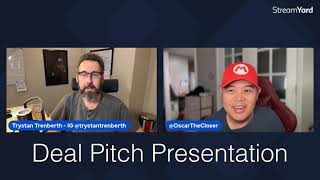
Trystan Trenberth pitches a $45k private loan for a Florida quadplex to Oscar Setiawan, a former restaurateur who lends through his 401k. The deal costs $375k, uses seller financing, and targets 12% interest-only for three years, with exit plans including a nurse-rental conversion and refinance.
Chapters
Good afternoon everyone, I hope you're doing well. Um, thanks for Oscar for joining me at short notice. Um, I, I've observed a lot of stuff in Sub2 and the community where people are asking for private money to fund their deals, and obviously hard-earned income is something that people are very protective of. And understandably so. And some people have, have got quite a substantial amount to lend. They're not necessarily going to let people know how much, at least at the beginning or ever. But some people are just lending a small amount of money as gators, where it's much more significant to them. So I just wanted to kind of go through, spend a few minutes with, with other lenders that have, you know, come forward as, as gator lenders or have experience with private money lending. To really go through the process of what might be not necessarily expected but appreciated from a lender when it comes to borrowing money and being asked to lend money. We're a great community, we're very close, but there are still some very key, um, key relationships to be built before really going and canvassing people for money. There are a lot of SEC rules about canvassing for money in certain situations And I'd advise you to be very, very careful how you go about it. But it's not necessarily a signed agreement that coming into Sub2 that you agree to have people ask you for money to invest into a business transaction. But just be very careful how you go about that. I've worked with Oscar before. We did a bit of a daily dial on a deal that I had come up some time ago. We did a little bit of content, but I thought, why don't we just do a little piece of content now? Where we can go over something where I've got an example of a pitch deck that I put together, which is based on the pitch deck that Oscar put together for us probably about 9 months or a year ago now. And it's just an example of a deal that I'm doing in Florida. I am looking for a lender on there. I'm not asking Oscar for money, but I'm just kind of going through what it is that I'm looking for and why and just get Oscar's feedback and have Oscar ask me some questions. That you may be expected to have to answer, or at least be prepared to answer if you're in the same position. I see a lot of Facebook posts which is, oh, I've got a deal, I need private money. That's not really helpful. Do you need $10? Do you need $100,000? Where is the deal? Is it you buying a pair of shoes? Are you buying a mobile home? What year is the mobile home? There's so many questions that, that can be answered and you should be prepared for. So, um, Oscar, what would you like to say on, on, you know, your little, a little background for the people that don't yet know you, um, and just sort of give a little bit of advice or, you know, foundation of what we're going to really talk about looking at the pitch deck?
Sure, sure. Um, so my name is Oscar. I'm from Chicago. Uh, I've been investing in real estate, um, since 2016. Uh, I've pretty much started— I, I used to own a restaurant, so when I get into real estate, my goal was to just buy and hold, right, for long term. Yeah. But as, as I get into real estate, I see a lot of potential to not only buy and hold, but, you know, to flip, to wholesale. And I also, at that point, I used to work for a tech company and and I resigned to open the restaurant. So what happened was I had a bunch of money in my 401k, right? And so, uh, after knowing real estate and how hard money works, uh, I came to realize that I could, you know, use or make my money work harder in my 401k instead of just putting it into mutual funds, stock, and whatever. So I also became a lender. Right? And, and it's perfect for my 401k because I can't touch the money anyway.
Yeah.
So instead of, you know, having a, uh, roll it over to a mutual fund where— which I did, which, uh, you know how we had a financial manager, um, you know, ran our basically retirement fund, and I saw what I get, which is— I think it's, it's a measly like 4 or 5% at that point, you know. And we have I think, I think we have like a quarter million dollars, right, almost from my time in Motorola because I maximized my 401k and they, they, they were giving, um, matching contribution and whatnot, right? So I saved a lot. And so when I, you know, when I quit Motorola, I had a good sum of money, right? So, and I can't touch it until I retire anyway, right? So, so that's what I, I did. And it also, I also did some strategy where you know, we, we did some loan swap and all those things. So it, it just kind of catapult my, my real estate investing to a higher level in a short amount of period of time, right? So, so yeah, um, so that's my background. And, you know, nowadays, um, you know, I'm still in Chicagoland. I'm also building in Southwest Florida. Um, yeah, but I do everything, you know, most, most things. I, I stay with the residential You know, but I do flips, I do rentals, I do new construction or doing it at this moment. I do some lending when the money is available. I'm not 100% a hard money lender, but, you know, when I find the same project and, you know, the borrower has, you know, piqued my interest and able to give me, you know, a good amount of return. And for me, is mostly also the values that they give. You know, it's not just the interest because, you know, I'm— I can, I can make more money in my, in my current operation. I just want to make sure I don't lose money in my 401k. And I use nowadays, I actually use my 401k to help people, um, you know, especially new people that I can trust their projects with., but then they can give values back to me. I'll give an example, right? When I first start using my 401 money, I needed a loan also. And because I am new, you know, when you're new, the hard money is going to charge you a lot, right? Points and 12% and whatnot. Everything that they can charge you, they'll charge you because you're new, right? So instead of doing that, I came up with a strategy. And nowadays people call it loan swap. But I found another investor that has similar 401 with me. And we basically— I lent money to him on a real estate project and he lent his 401 money to me. Right. And we charge similar interest, different amount, but it's totally legal and it's all backed with paperwork. Baked with security, mortgage, and everything, right? And we just did that, and we found another investors. Now we did a three-way, you know, so now it's like a triangle, like A to B, B to C, and C to A, right? And we just keep doing it. We just built our rental portfolio real quick. Yeah, we just return it, borrow it again, return it, borrow it again, similar interests.
Yeah.
Um, and now, you know, uh, after a while, you know, um we all kind of have different priorities and everything. One retired and now he can use his retirement money. I'm still in the middle. I still have about, I don't know, 20 years left before I can touch it. So now I'm looking for people that can help me in other ways more than just giving me interest, right? Yeah. I mean, it's okay as long as you give me enough interest, I'm okay. But for example, if I were to lend to Trystan Trenberth, right? What I say is to Trystan, hey Trystan, you know, like, this is, you know, this interest here, it doesn't make me rich, you know what I mean? Like, it doesn't make me rich. It's just enough for me just so I can see a growth in my portfolio, in my 401k. But what I want is I, I want to be able to call you, Trystan, and I want to be able to say, hey Trystan, I need your help because I don't know what to do with this. Can you help me with this? And you'll be like, Trystan will be like, okay, well, I'll do my best. To help you, and you actually help me in something.
Yeah, right. Yeah, absolutely.
When I started Sub2, um, I, I, I gave, uh, I, I lend my money to someone and I was able to ask him about all about Sub2, right? Like, how— give me, give me your paperwork, give me your— give me, give me how, how you did it and everything, right? And that's, to me, is worth it.
Yeah, yeah, absolutely.
Yeah, and that's a lot of people who has 401k and everything. Really, if you understand what they need, right, you know, it's not about the interest. Yeah, there are people with the reptile lending, you know, that will only ask for interest, and that's fine. But you'll find a lot of people that needs help that has money more than just the interest. They don't need— as long as they have good enough interest, you know, 8, 9, 10%, yeah, you know, and a secure position, but you were able to help him with the journey in real estate, for example, or even understanding like, how do I get property off market, or how do I, you know, become a landlord, or whatever that they need.
Yeah, yeah, for sure. And for those new people that are asking why would they lend each other money, there are certain rules around retirement funds and they vary on different types. You can't use that money for your own projects, you can only lend it to somebody else's project, which is why that reciprocity comes around. By Oscar's friend lending to him, him lending to his friend, and they're investing in each other's deals and getting us— getting a fair return on each other's investment, but allowing each other to grow at that same way.
Yep. And it's all done with paperwork, right? It's not just like, hey, I'm going to transfer $100,000 and you just— you know, it's all— they said there's a promissory note, there's a deed of trust, there's even— I even do personal guarantee, right? And then a promise that it's it's not for personal reason, it's for— I mean, there's a bunch of paperwork that we sign to make it legal.
Yeah, perfect. Well, that's fantastic. So let's take a quick look at this, uh, this opportunity I've come across. This, uh, a little bit of background to this, um, I bought one property seller finance from this seller already. Um, I, in my, you know, earlier part of my career, just use my own cash as the down payment. Again, probably a self-limiting belief earlier on in my career just to use my own money and just deploy it. But now, you know, now I see the benefits of scale by not using your own money. So what we're looking at is a second property. The first one was a duplex. This one's a quadplex and it's under contract. We're going to close in about 3 weeks.
Okay.
And I'm just going to share breakdown of, of the deal. Let me set the slideshow going just so we can see it from full size here. So can you see that okay?
Yeah, it's perfect.
Perfect. So I'm hoping that this Zoom thing is showing. So, oh man, it's giving me subtitles for the, uh, what I'm saying. So let me turn that off because we don't need that. So basically this is a little overview of the property. So you'll, you recognize the style of this, um, Oscar. It's just For some reason, PowerPoint was showing me these different options for styles, and that was kind of how it offered. So I just switched it up, which is brilliant. So picture of the front of the property. We're gaining access tomorrow to the property to get photos. So we'll get inside. It's a fourplex, two 2/1s, one 3/1, and a 1/1. So my acquisition company, or my holding company here is Gatorville Gardens— not holding, but the company. I've called it Gatorville Gardens, which I thought was a little humorous being Florida. And I've given a little profile of myself: real estate investor since 2019, full-time since 2020, private money lender since 2021, um, own and manage 4 properties of 5 doors, wholesale more than 10 properties— I can up that number now— flip more than 12 properties, currently have under contract— we've got 5 active right now here in Arizona. So it's important to introduce yourself and your credibility or lack of credibility. And it's not to say that a lack of credibility is a terrible thing, it's just being transparent with the person that you're, you're asking to help you on your project and just being very clear on the fact that I don't have a lot of experience, or I have some experience, or I have a lot of experience. That, that'll be very telling for that person as well, so they can, they can pinpoint the questions and get an idea of of, uh, of what level you are. And maybe they're of the opinion they're very experienced and they're willing to help you. Oscar, for example, it just gave a great example. It's if you can bring more to the table than just interest. Um, you know, I think I looked at— I was looking at something the other day where I was thinking about all of the books that these people write in business along the way. They're more, um they're more methodology books as people grow. So, you know, Ed Mylett, you know, I think wrote a couple of books on the business, but then later in life he's writing more books on biographical type things and the concepts behind what he's noticed over his career. So it's more historically looking at his life from a bigger perspective or whoever these people are, Richard Branson, for example. They're writing, this is what happened and this is why these things happened, rather than this is how infinite banking work and this is how different particular things work. They look back. So this gives them a little profile of you at what level they're at. And some people that may be lending money used to be investors like us, and they're happy to be able to hold your hand and bring you along and have joy in seeing somebody else grow, and, and that's a pleasure for them. Is there anything else that I might want to put on here, Oscar?
Well, I, I think this is good already. Um, like I said, you don't want to, um, overcomplicate it anyway. I think, you know, this is perfect because you are able to break it down. You know, you're, you're also a private money lender, so that also gives you sort of credibility that you understand, you know, the risk in lending. Yeah, um, real estate investor and you wholesale. I mean, that's fine, but the thing that we talked about is like there's a lot of people that will say, well, I don't have all this, what do I say, right? And it's— that's where the power of association comes in, right? You can say, you know, I belong to Sub2, for example, right? And in Sub2 is an environment when you can get resources. And for example, You know, if you don't have any experience at all, you can say— and if, for example, if I'm flipping in Arizona, right, and I don't have experience, you know, I would say I'm partnering with Trystan Trenberth and I'm going to, you know, pay him something or for his time or whatever, his expertise to help me so this flip is successful in Phoenix. For example. Yeah, right. You being boots on the ground and you being resourceful. And now you can say, and Trystan Trenberth has 5 active projects now in Arizona. So by association, I'm hiring someone who is safe and professional and experienced. So the risk of this project going wrong becomes really, really, really significantly less. Yeah, right. Like, for example, Florida, right? If I was— if you're presenting it to me, right, this is all good. I don't have problems with this. But my first question would be, well, Trystan, you're in Arizona, right? I know what it takes to flip a property. So how do you expect to get this done smoothly? That would be my question, because I like, you know, I like this project to be run, um, you know, smoothly, right? I mean, we know there's going to be some smack going on, you know, there's going to be like some, you know, hiccups and everything. I mean, that's fine, but how do you handle this, right? When there's a hiccup, is there a guy that is over there, or do you have to fly in there?
Yeah, absolutely.
Oh, that's, that's a great point.
Yeah, I, I've, I've failed my partner in this business that I haven't quite brought into the LLC yet, but I will be because of this project. I've got Nicole on the ground over there. She's, she's going to be joining my LLC.
Exactly.
And I failed her and my, my pitch here by not including her experience in here.
Exactly.
I'm a real estate investor based in Arizona. My partner is a real estate investor based in Ocala who is going to be managing the property. So that's fantastic.
Correct. Right. So, and that would say, oh, okay, well, he has someone local. Uh, you know, in a, in a sense, like, for example, for me I'm building in Florida, right? And so my lender in— that is somewhere not in Florida, that doesn't know anything about Florida, but trust me, it's like, well, how are you going to manage this? Well, for me, I'm committed right now to go to Florida every month. Yeah, right. And in addition to that, I have a general contractor that I'm hiring full-time and project manager. So I include them as part of my team. Yeah. Right. So when I present something Um, I, I'm giving security. Yeah, I have a team. Yeah, right.
So, so that's perfect. It's a team profile.
Yep. And that would be just not just you, you know, like you're— I think you, you can occupy the first 3 bullets, but the rest of the bullets can be your team.
Yeah.
And that's, that's really very important for virtual anything, right? You know, if anything's local, then you can occupy, you know, the whole thing, that's fine. But if it's virtual and they know you're not there, you know, that's, you know, you gotta, you gotta add that.
Um, so I can, I'll basically add in the number of doors that she has as well, which are under her management collectively.
Yeah, you don't necessarily need to, but as long as you can say, you know, she's, she's local, and, you know, she's— if, if she's a realtor, you can say she's a realtor. If she has done flips, you can say she has also done flips. You know, that's, that's pretty good. I mean, that's already enough, you know, because the main, the main guy is still you. I think you, you're still like the, the man in charge. It's just that we want to know if something goes wrong, who can you rely on over there? Perfect.
Yeah, fantastic. Yeah, so, so I'll leave it in this format because then it'll be easier. So we've got property description. This is a breakdown of the asset that I'm asking to, to borrow against. So this is a breakdown, um, it's a quadplex, 1982 build, number of bedrooms. I need to add in that we have, um, two, two ones. 1-1-1-1, because I'm also waiting for the rent roll information as well, so I can share that as well. Sure. And, uh, 1-3-1. I'll forward this in a better format because that's not a terribly great way, but just to outline that.
And the important thing, Trystan, is also knowing the background of your lender, right? I mean, you know, your target lender needs— like, for me, I'm okay with this. Like, I know, I know how to read this, right? But someone who's not in the business, which is, um, really the, the perfect lender is someone who trusts you but not really in the business, right? Because they'll be more flexible with your terms and everything, right? As long as, you know, it's relationship-based, right? This is the real authentic private money lender. Right. I'm not— I'm more like a professional money lender. That's what I say. Right. We're both professional money lender because we know what we're talking about and we know that we want to maximize our profit. Otherwise, we know how to make more money on our money. Right. But for real private money lender, they barely got— remember I told you in the beginning, I'm only getting 4 or 5% of my— on my 401. So now they should be happy with 8, 9%. While if I'm lending to you, I have a certain standard, even though they're, they're not a, they're not a, um, they're not a set standard. But usually I start with like, say, 10% to 12%, right? Because that's just because I know I can make that money work harder somewhere else easily, right? I have other options. That's what I'm saying. But for a lot of people, 4% against 8%, easy, they would go with 8% all day. Right, as long as they understand what they're getting into, right? Sure. And for people who doesn't know, you have to understand, you have to tell them what is a quadplex, right? Yeah, a quadplex. Maybe instead of saying quadplex, you can say it's a 4-unit building. Yeah, right. And again, it depends. If you tell— if you, if you, um, uh, presenting to me, I know what quadplex is, right? You can say 4-unit residential. That's great. Total of 8 baht, right? Or, you know, um, 4 baht, that's fine too, right? Yeah. Um, and you might want to say 2 baht/1 baht, 1 baht/1 baht, 3 baht/1 baht, you know, something like that, right? And again, this is repetitive, but to a lot of people that doesn't, you know, that, that, that hasn't seen this a lot like us, they'll be, oh, okay, well, I understand. Right. Um, yeah. Um, all unit renovated in 5 years, that's fine. In-unit laundry, people understand that. All air-conditioned units, that's fine. Gas heating— gas heating is actually rare, right? Because a lot of Florida, they're all, uh, electric. So yeah, being a gas heating, that's actually a— that's actually unique.
Yeah, it's unusual for sure.
Yeah. So, um, near major— yeah, so that's you know, that's, that's all good. Yeah.
So we got a bit of renovation details. We've not got a huge amount because the, the, um, the current owner did a lot, did, did a renovation on all of the units in the last few years. So we've just got a small bit of budget for interior paint, maybe a bit of outside cleanup, and some reserves as well. Okay. Just so we got something to set aside, um, you know, in the reserve account, which will Okay, just be there, which I think a lender would like to know that you're not just—
yeah. So for this one, um, again, this is being me being a professional lender. I would like to know if this is per unit or all, you know, all the units, right? I mean, landscaping $300, um, you know, I like to know if that's like per unit or is that like everything, you know, total, right? So yeah, yeah. Perfect.
So next one, I've got the breakdown of, of the, the numbers. Okay, not sure if you can see that clearly enough.
Yeah, it's a little bit small over here. So if you remember my original one, original one, I, I usually just do like a basic, really, really basic tab, you know. Um, I wouldn't even bother showing this, um, unless it's being asked for.
To be honest. Okay.
I like, at this point, I, I trust you, you know what I mean? Like, I don't really need to see the, the details, but I do need to see, you know, like what you, what you had like there, the renovation details. That's what I need to see. And I need to be like one more page of that, you know, having it more detailed. Got it. Um, and not this, you know, not this type of detail, but yeah, um, you know, you said it's a seller finance, right? Yes. Okay, so then you're flipping this, or are you keeping this as a rental?
I'm keeping this and holding it.
Okay, so if you're keeping it and holding it, and again, you might have this, uh, at the end, but for me, the first thing I want to know is, okay, is the security that you're giving me Number one is what is the value, right? That would be number one that I want to know, right? If, for example, and it's not even about the loan-to-value thing, you know, like, for example, if you're asking, how much are you asking right now? Yeah. Like, how much are you asking?
Oh, so I'm asking for $45,000.
Oh, okay. So you're just asking for $45,000. Yeah. So basically, you know, okay, so this, this number right here, I'd rather see this number than that. That spreadsheet, to be honest. Okay. Right. This number makes more sense to me because it's just more, you know, less clutter. Right. Yeah. But I would still like if you can say, hey, if you want to see if you're a numbers guy, if you're like a spreadsheet geek, I have a spreadsheet for you to see it if you want. You know, but this is for you to just see. This is my purchase price. Your down payment is $33,750. Closing costs, rehab costs, total entry costs $45,000. It's seller finance and I'm requesting $40,000, $45,000. That's basically it, right? Yeah. And it all makes sense. See that, how I, how I can get that based on that, based on like just looking at it for 5, 5 seconds, right?
Perfect. Yeah.
Um, yeah, you know, so this, this is a very, very important page. Like that, that one is, it's, you know, you have to make sure this page is very, very clear. You know, you're asking and you know, um, uh, and let me, let me just read it one more time, right? So you're, you're requesting it, uh, yeah, so $45,000, proposed loan interest is 12% annualized, loan terms, so basically it's $450 a month, you're asking for 3 years, um, monthly, quarterly, annual payments, but at best, okay, yeah, so that's good. You know, so it's clear to me that you're asking for a 3-year loan, 12% interest only per year, basically. Yeah. Right. Yeah. So that's, that's great. Yeah. And this is, you know, to me when I see that and I see that— can you go back one more time?
Sure.
Sorry. And you can see the important thing. And when you present this, right. Well, let's, let me, let me, let's do this. Instead of me talking, let me have you talk and explain this to me, and then I can give you feedback from this.
Fantastic. Well, thanks for your time, Oscar. Obviously we've been through the other information. We're paying $375,000 for the property. Um, we, we've, we've negotiated a 9% down payment, which, you know, you'll agree is a low, low down payment. Um, the seller was originally looking for a 6% interest with a 5-year balloon. We're actually paying him $20,000 more than the asking price. He actually had a cash offer at $350,000 from one of the local housing authorities, but they were going to take a very long time to go through the process. He was going to get cash, but he'd much rather sell and make an interest rate. So we negotiated 4.5% interest rate with a 30-year amortisation with a 15-year balloon. Which suited what the needs that he had. The monthly principal and interest payment is £1,780, and I'd have to refer back to the rental structure page for the income, but we're around £3,250, I think, was the gross income. We're putting 15% away for vacancy and repairs, so we're building up quite a solid war chest. The property's been renovated fully by the by the owner in the last 2 to 3 years. So there's no major work to do. He's very good at keeping on top of preventative maintenance, as I can refer to my already owned property that I bought from him 6 months ago. That's been in very good condition, looked after well, and we're getting inspection tomorrow. We'll get some pictures of the inside, but we're looking for 100% of the entry fee. Just allows us to scale instead of us putting our own cash into these things just allows us to buy more properties. Sounds like he's going to be looking to sell a few more in the next few months and years as he works down through his portfolio. And, you know, we're offering what we feel is a fair rate of 12% annualised, which ends up just being a nice easy figure of £450 a month for 3 years. Different lenders I've worked with have wanted monthly payments, quarterly, sometimes annual. So whatever that structure would look like for you as far as payments, we can certainly accommodate.
Okay, yeah, I mean, it's, it's, it's great. I mean, you know, you know how to say it, and I think it's, it's pretty, you know, it's pretty straightforward, you know. Um, just a couple of things I'm gonna, I'm gonna ask you questions now, right? Right. Number one is, um, I know the purchase price, $375,000. But what is really the ARV of this? Are you getting this at, at ARV, or is there some equity that, um, um, in the future? Because my, uh, my question is, you, you have a 15-year balloon, which is a long time, which is great, right? So you have 15 years for this property to appreciate, you know, right? So, you know, uh, but I'm just curious um, you know, in 3 years, right? For example, um, how would you be able to get my, my money or return my money in 3 years?
Yeah, we will be looking either to restructure the, the second position debt, um, but we're actually looking at underwriting with one of the units being a nurse rental right now and possibly more in the future. One of the leases is coming up in a couple of months and we're just looking at the possibility of making one of that unit into a nurse rental. We're not too far from one of the hospitals and I know there's a demand in the area for short to midterm rentals. We don't feel it's an Airbnb site and I do like Airbnbs in certain areas, but there is a level of volatility involved and this isn't one of those areas that I'd feel comfortable doing an an Airbnb-type situation, but for a nurse, um, or, you know, a medical service professional. I think this would be a great place for them to, to be able to stay for 2 to 3 months at a time. We've got contacts at the health facilities in the area, and we know there's interest, and it would certainly increase the income. Therefore, we could be— we would be in a position to provide a payoff at the 3-year mark, um, and, and maybe even sooner if that was desirable. Obviously, we'd love to leverage the money that you, you may lend us for a lot— the longest period of time to allow us to then maybe build out one or two of the other units in the same way and, and increase the, increase the revenue, you know, more so. Okay.
Um, and another thing I, I noticed is that, um, and Again, you probably have it on the other slides, but what I would add here is that your ability to make some money, um, after paying that $450, for example. Yeah. Um, so, so obviously you have expenses, and you just, you just put down your expenses there, monthly P&I. Um, you're missing the tax and insurance. Absolutely. So basically PITI, and you said 15% for, you know, like whatever the war chest that you're getting, right? Yeah. And plus you have Now you have a payment to me, which is the $450. So I would like— for me, I would like to be— I would like it to be a win-win, right? So I like to know that you're actually, after the 15% and after all the war chests, whatever that you have, I like to see that you're actually making some money. Yeah. So that's something that I would like to see because to me that's security for me, right? You making money is the security for me. Right, because if you're not making any money, then, um, it's not that secure. This investment is not that secure, right? Because anything happen, then we're all screwed. That's what I'm saying, right? Yeah, yeah.
So I, I can put the detail in there and it's slightly different, and you can make it very simple.
You can say, you can really say expenses which is the PITI, 15% war chest, and whatever it is. And you can say income is this. So our, you know, and so our net income after paying you is that $519, right?
Yeah, absolutely.
Yeah. Which is great. Now I know you're making money too. Yeah. And that's very important to me as a lender because I like to see my borrower makes money. That's, to me, that's more security than just like, oh no, I'm not gonna make any money because I have to pay you. Well, you know, Murphy's Law, right? Something happens, you know, something happens and now you don't have any money, uh, to even, you know, deal with the situation or pay me back. So that's less, yeah, for me.
So perfect.
And this is all for all lenders too, right? I mean, all lenders should want the best for their borrower. Absolutely. You know, that's, that's what makes it win-win. You know, you can't just say, oh, I want 15%. I mean, well, it doesn't work if you, if you want 15%, then, you know, Trystan's not going to make any money, and that's, you know, that's not going to work.
Absolutely, absolutely. So yeah, that's fantastic.
Yeah.
So I might put a little table in there, I'm not sure, but just to—
yeah, and you know, you can make it a little bit fancy with tables or whatnot, but you know, to me, if I can see, you know, gross expense, you know, basically it's, it's basic, uh, math, right? Yeah, gross income minus expenses equals net income. That's all I need to see. Yeah, you know, I need to see you making money, you know, and that's it, and after paying me. Right? Yeah, regardless if you pay me annually, monthly, quarterly. And you might be able to say, you know, um, ideally, in a, in an ideal situation, I would like to make an annual payment for the first year so we can definitely want to make sure that we can take care of all the, um, unknown expenses or whatnot that's happening as we build our war chest. And then on the second year if you, if you feel like you need monthly, then we can do monthly. Perfect. That will kind of train the, the lender to, to be able to say, okay, well, yearly is fine. And when they receive that money annually, especially for me, I don't really care if, um, if I get it monthly or annually because I can't use the money anyway. Yeah, you know, it's different than that. And some lender, some lender cares. Because some lender, it's all about, uh, trust issues, right? They'll be like, okay, well, why don't we do, uh, monthly for the first 6 months, and then afterward, you know, I'm okay with the last 6 months being annual, and after that everything's annual. So this is a case-to-case basis. I mean, for me, I've done a lot of lending and I know this is, you know, after I see that, that net income, you know, I'm okay with saying that, you know what, Trystan, I'm okay with like annual payment. I don't really care.
Yeah.
You know, so fabulous. Yep. Um, so yeah, I mean, that's, you know, so this is good. I mean, I think, I think this is a good deal. Um, if you can make like $519,000, um, obviously that's, you know, as an investor, that's, um, a little bit on the low side, but so you have a seller finance, which is great. And we know, you know, it's a 15-year balloon, which in 15 years this property will appreciate, so you can you can technically get a cash-out refinance along the way, you know, even, even when, you know, if your purchase price is basically, uh, $400,000-something, right, with the total entry cost and everything, um, you know, as when you get— we can— when the property is valued at $600,000, you know, you can definitely do a cash-out and, you know, you basically, you know, pay off everyone.
Absolutely, absolutely. And of course, I threw in the map as well, just so people—
that's very important because I like, I like to see the map, especially if I don't know Um, if I don't know the area, right? If you're, if you're saying me like, hey Oscar, I'm investing in Chicago, and you know, you just show me a map, I'll know if it's good area or not.
Yeah, right, absolutely.
And I only know Ocala, and you know, from a map, and you know, um, you know, and maybe another thing that you can add is, um, what type of tenants, you know, is in this area. Right? Are they like young professionals? I see. Yeah, working families. Are they, you know, kind of like a little bit of demographics, you know? Got it. What, what happened? And then that you're, um, that's currently right now, and what currently tenants that is perfect for this case when you, when you get a higher market rent, right?
Fantastic.
Yeah. And you already told some of them, like nurses and everything, right?
That's—
yeah, I think that needs to be put in there, you know, the type of tenants, because that's also for a longer, um, for a longer investment, you know, 3 years, I need to make sure that, you know, uh, the asset is well kept with the right tenant, right? So yeah, you know, for us, if it's a short term, I don't really care for a flip. You know, we know the exit strategy, we're gonna sell it anyway, right? So I don't, I don't really care about who's buying it as long as they're qualified. For a 1 year, uh, or more, um, I like to know if the area is a, is a decent area. It doesn't need to be A areas because I know a lot of rentals, they cannot be in an area, it doesn't make sense. You need to be in C, C+ areas, right? Uh, with the certain types of tenants. And, you know, we can say, you know, um, the tenants are young professional, in this case your nurses. If it's nurses, then show where the hospitals are, for example.
Yep, I was just thinking that actually, because I think it's just outside of the, uh, the realm of the map that I chose, right? And I think what I might do is maybe do a smaller map of here, slightly larger one than this, and then kind of where it is in Florida as well, right?
Yep. Especially if you know already your target client, like, you know, your target rental or tenant, then yeah, you know, it's, it's perfect to show it. Again, you know, all this is not just— there's a purpose in everything that we put in here, right? So that, you know, it's not just, oh, it's a map. Right? People just— oh, people just look at it, they say, oh, it's a map. No, the map needs to show something. Yeah, right. Map is— if, if, if you're targeting an, um, uh, hourly wage worker, for example, right, then you, you're, you're good because I can see Target, I can see Lowe's, I can see Walmart, and there's like 3 on this and that area on the other side of the highway. And you know, there's not a Walmart right there on the upper right, right? So definitely like Okay, well, you know, uh, you definitely got your, your, um, your target market there, you know.
So yeah, yeah, well, fabulous. Why, I appreciate you, Oscar. Thank you so much for, for taking the time to, to look at that with me.
Yeah, for sure.
Hopefully that can bring some people some value, and, you know, borrowers and lenders, potential of each, and, uh, really help them get more information. And, uh, I very much appreciate your time at dinner. Thank you.
Yeah, no problem.
How's little Lady Boss? Is she well?
Yeah, she's busy. She's busy with high school now. Um, yeah, and, uh, you know, she's trying— still trying to, um, uh, you know, get it— get her more involved in real estate. She's managing my properties now, you know, sending a reminder to tenants and like, hey, why, why haven't you paid? And all those stuff. Yeah, I get her to do all this stuff.
Excellent, excellent. So, well, good. I appreciate it. Thank you so much, Oscar. And, and I do look forward to seeing you again very soon, for sure. Um, but yeah, it's always great to catch up.
Yeah, I think that's— that, that investment is a, is a good one. And I think, um, you know, you'll definitely get someone in that, you know, even, even on an annual basis, you can always, you know, find another investor. Yeah. And if you're— and, and just another one thing is, um, You know, if you do have a real private money lender, I would suggest giving less interest, starting with less interest first.
Right.
Okay. I would say at this point, 8% used to work last year, but I think with inflation and everything, 9 to 10% is more general. Or even you can say 9%. And if you're able to do it annually, we'll kick 1% at the end.
Perfect.
You know, every year. Right? Then, you know, so, so give me 8% annual, uh, plus I'll provide values to you. You'll have my phone number. I promise to get back to you in 24 hours, you know, because now we're— we— I have fiduciary duty to you because you're my lender, right? I always say that, you know, for all my lenders, you know, you have access to me, you know. Any questions, you can ask me, yeah, right? Because I'm, you know, I'm responsible for your money. You know, I'm your financial manager, so feel free to call me, email me for anything you need, right? That's the best value anyone can give—
time, for sure, right?
Absolutely. Yeah, 1% doesn't mean anything to a lot of people, to be honest. Yeah. Um, so, you know, some people can say, okay, well, 8% and 1% kickback at the end, and that will make it annual, and you save money on monthly. Now you have more money at the end anyway. To, to do that, right?
So everyone's still—
absolutely.
Yeah, well, brilliant. Well, thank you so much. I appreciate you, Oscar. I'm just going to click end on here.










