Live with Marshall Sylver
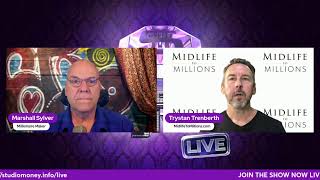
Marshall Sylver and Trystan Trenberth discuss money mindset and wealth building. Trenberth, a real-estate investor and host of Birth to Net Worth, teaches self-directed IRA conversions and infinite banking through his platform Midlife to Millions, arguing that many mid-life Americans lack retirement plans.
Chapters
Hey there, moguls! It's me, Marshall Silver, your personal millionaire maker. Getting very excited about my brand new show. 2 hours a day, 5 days a week, I'm going to broadcast live to you. The first hour of the broadcast, I'm going to give you content, information for better sex, more money, emotional, mental, physical, and even spiritual power. I'll also invite some of my cool multimillionaire and billionaire friends onto the show to give you more direction, more advice, more strategies and gambits for having it all. The second hour is what I'm most excited about. It's when I get a chance to chat with you. Yes, you. You can call in, talk to me, ask me questions, and if you say the secret word of the day, you could win $5,000 cash. At the very least, if you're the most interesting call of the day, you could also win 10 ounces of freshly minted Marshall Silver 999 fine silver. All of that and more. Brand new Mercedes-Benz sedan or SUV up for grabs. My personal Rolls-Royce Phantom up for grabs. All the knowledge to get everything you want and so much more. All you gotta do is log in to the show to get information about its release coming up 2 hours a day, 5 days a week, coming to you live from the bunker right here at Studio Money. I'm Marshall Silver, your personal millionaire maker. Let me bring in our hypnotist, Marshall Silver. It's, uh, Marshall Silver, ladies and gentlemen, the world's fastest hypnotist. Welcome home, everybody. Marshall Silver, your personal millionaire maker. Feeling better and better as far as the knees go. I'm grateful for that. Hey, how was your weekend? And more importantly, how is your week about to be? What we focus on expands. What we believe to be true is true for us. Nothing else. What the direction we're going is where we're going to end up. So it's important for you to figure out what direction you're going. I'd like to help you have better sex, more money, emotional, mental, physical, spiritual well-being and power. To do that, you got to open up your mind. You see, ultimately, your mind is everything. Communication equals wealth. And you communicate in two ways and two ways only. You communicate internally, the 1,500 words per minute that are going through your brain telling you who you are and who you aren't, what you can be, what you can do, what you can have. Internal communication is called programming. On a subconscious basis, it's every word you say to yourself, every truth you hold to be true that causes you to perceive your world and the way that you perceive it. Are you a people and a money magnet, or are you a pauper desperately trying to get by? Are you too sexy for your shirt, or are you lucky if some chick talks to you? The question is to you, and the answer is your choice. Some people say, well, it doesn't do me any good to live in denial. It doesn't do me any good to lie to myself. And I say, au contraire, mon chéri, it actually does you great service to believe what is in your best interest, to choose that the world is an awesome place, that you are indeed a people and a money magnet, that money comes easily to you, that your brain, the perfect computer of your subconscious mind, is actively working on your challenges, eagerly assisting you in going for what you want, and nonstop, relentlessly carrying you to the person you were designed to be, a unique, one-of-a-kind human being worthy of all the great things this amazing life has to give to you. It is your day. Today is the day you claim it. Today's also a remarkable day. As you know, we bring you amazing guests, and today's no different. Trystan Trenberth is a savvy real estate investor dedicated to philanthropic areas whose impact extends far beyond the boardroom. Trystan's strategic acumen in real estate has not only built substantial personal wealth, but also fueled his passion for making a significant societal impact through various philanthropic endeavors. Beyond building wealth, Trystan is deeply committed to giving back. On today's show, he's going to talk about his journey into philanthropy, highlighting key projects and initiatives that aim to improve lives and communities. We're also going to dive into his role as the host of the Birth to Net Worth podcast, where he explores the stories of individuals who have navigated their paths to financial success and personal fulfillment. With a nice big Marshall Silver Live welcome, Trystan Trenberth to the show. Welcome home, Trystan.
Good morning. Thank you so much, Marshall. It's a pleasure to be with you.
And I'm sure to have you with me. And I remember— where are you calling in from?
I'm from Arizona. I'm British, but I've been living in Arizona since 2005. And I remember Right Said Fred, I'm Too Sexy for My Shirt, when that came out many years ago.
Yeah, in fact, you could be one of the Right Said Fred players. You could be. You got the same smile and charm and charisma.
Well, thank you for having me today. I appreciate you.
Yeah, well, what I love about your brand is your brand is ever evolving. You keep up with the times. You deal with what emerges. You know, even right now, your screen, Midlife to Millions, is like so spot on. I think so many people are in a place— I certainly know that I am in a place where we realize the world has dramatically changed around us. And things that, that, you know, come as second nature to our children or to a younger generation, it's like we're, we're still figuring out and saying, Oh my gosh, how does my phone work? You know, my son that you met in the green room manages this show. And anytime I have any technical challenge, all I do is I turn to my kids or my bride for that matter, my kids especially. And I say, how do I do this? And they kind of roll their eyes like, you're an idiot, dad. Get it done. So why don't we start off, Trystan, by telling everybody a little bit about yourself and then let's dive in. I've got a lot of great questions I want to ask you. And I know that our audience is extremely excited you're here.
Thank you. Well, I was British-born. I started out in the hotel management business. I was interested in architecture and design, ended up just kind of falling into hotel management, sort of 4 and 5-star hotels, and then made my way into technology for 20-odd years. I became an IT manager in the hotel business so I could transfer my skills from hotel management into a better paying profession. And that's one of the careers that brought me to the States. 5 years ago, I picked up Rich Dad Poor Dad and that changed the way I looked at money and how my perspective on life changed through assets versus liabilities. And quickly found myself falling into the real estate business. And 3 years ago, I got laid off from the technology business, which was the biggest blessing. And I've been buying and selling real estate ever since.. And being somebody that was born in a different country, starting on in my midlife and having to pick up what is my retirement plan? Do I have a plan? Well, I'm realizing quickly that so many people around me don't have a plan. They're living the American dream of consumerism, buying everything right now, instant gratification, but they're living into the American nightmare because they're not planning for their retirement. And with the elongating of life lifespans, we could live to be 100, 110, maybe 120. And if we don't have millions set aside for retirement, then this is our midlife, $2 million. And I think from when we grew up, a millionaire was somebody that was very unusual. With inflation and the availability of money that's created through interest and other— whether we go into printing money or not, I'm not getting political, but the abundance of money that's now in the marketplace versus what it was when we grew up. People don't realize that they need to be a millionaire in worth to be able to retire comfortably and not greet at Walmart. There's nothing wrong with people that greet at Walmart, but unfortunately that's the, the last straw for so many people. And I want people at our age to avoid that. And by us living into that— kids don't listen to what we tell them, they follow what we do. And if we can change our approach to money, our relationship with money into something which is a healthy relationship, we then change every other generation past us because they see what we're doing. They understand, oh, Dad's buying real estate. Why is he doing that? And then we understand keeping more of our money from the taxman, putting it more into snowballing into investments is the thing that is going to be the key for the foundation of a future life. And Birth to Net Worth, as you mentioned, It's the— it's reliving the first memory of money and seeing how that relationship with money has evolved through life. If you were bitten by a dog at 3 years old, you're probably going to be scared of dogs for quite some time. But when you realize that not all dogs bite, then you can have a better relationship with dogs and love on them, and they can love on you. And it's the same thing with money. If the first memory is mum shouting at dad because he was an alcoholic and was spending all the money on drink instead of paying the bills that's probably something that you're going to unconsciously back away from. And with your unlocking of the unconscious mind, I think there's a great synergy between the conversations that we're having and just a different approach to looking at these things.
It's everything. You know, I don't know about you. My earliest recollections of money— this is a great place to start— were we had no running water, we had no electricity, we had no phone. I've got 10 siblings. Mom's working 3 jobs. And so money to the child in my formative years, it was magic. It solved everything. You know, it would, and it would solve the most important challenge that that kid was dealing with. And that was my mother's sorrow. And so I know absolutely that between 5 and 7, I made an absolute determination, whatever it would take to make money and solve my mom's heartache. I would do that. In fact, we didn't, um, we had a bunch of dogs. The local dog catcher came and took the dogs because we had too many dogs, and they took my dog. And my mom felt so bad that my personal pet was taken away that she allowed me to get a pet rat. And the local school had rats that they would use for doing labyrinth and, you know, maze experiments in their science class. So I got a pet rat, and at 6 years old, I named my rat Money Dollars because I knew subconsciously that that was everything. Now, that said, obviously, I could have really profoundly great programs about, hey, money's a good thing, let's solve this. There's also, though, that little piece inside of my subconscious mind that I had to get rid of that said money is hard. And it's not easy to make money. And you've got, you know, you got to squeeze every dime out that you can. And yeah, I think the majority of the planet, if all they solved was their money mindsets, their idea of what money is and their hypnosis around that, that it would solve just about everything for everybody.
So let's talk about conditioning, isn't it?
Absolutely. Let's talk about that. Let's talk about, you know, what, what are some powerful mindsets people can have around money that will help them deal with the challenges they're dealing with now and get on a better path?
Sure. Scarcity is one of those key things which you've experienced and so many of us experience is not enough. The guy collecting rent is the bad guy, the landlord. That comes up consistently during the podcast is not having enough money from the landlord. He's the bad guy because he's trying to get money from the family, but he's just doing his job to provide a home for you or your family, whoever's living there, and he's just trying to feed his family. So it's just a relationship at that point. But it's the scarcity of having a closed fist. You're only going to keep what's in your hand if you're lucky. But unless you have an open hand and allow money to flow onto and through you, it's not going to attract more money. And that's one of the key changes which, you know, there's always different levels of abundance that we come to. There's scarcity, there's scarce abundance, and then there's abundantly scarce. And, you know, all of those different areas we need to move through. And like T. Harv Eker said, it's a financial thermostat. If we're programmed to survive off $30,000 a year, we can earn $200,000 a year and still eliminate $170,000 and still be stuck at that level emotionally, and we won't be able to do anything more with it.
And even more than that, I think that the person that's got there, as Harv says, got their thermostat set at a specific level. My mother was that way. And when she got her first Social Security check, I was there the day she opened the envelope. I was there the day she looked at the amount. I was there the day she burst into tears realizing nobody could survive on that. Which nobody can. It's highway robbery. And I was there the day I promised my mother, don't fear, I will take financial care of you for the rest of your life as long as I'm able to do that. No matter how much I would give my mother on a monthly basis, I could give her $2,000, I could give her $20,000. Yeah. At the end of the month, it was gone because that's where her financial thermostat was set. And so how does a person go about changing their financial thermostat? How do they go about realizing that, that if you've got extra money, don't go blow it. You know, figure out a way to create, in the words of Kiyosaki, income-generating assets that then make money. Which, by the way, it's interesting you found the book while you're living in Arizona, only because obviously that's where, where the co-author, or actually the real author of Rich Dad lives. Yeah.
Yeah. I've had the pleasure of meeting him a couple of times, once in Vegas and a couple of times here in town. It's, um, so changing the mindset is, is, um, understanding that what you have is simply a perspective. It's your unique view, and there are 8 billion unique views. You go to a conference and there's 5,000 people, there's 5,000 different conferences going on because everyone is getting their own perspective on what's being shared with them. They have their own self-limiting beliefs that Oh, if I don't get that now, it's never going to be available to me, so I have to get it now and blow that money now to go. And it's not blowing, it's that survival instinct that's kicking in that I need to get that now so that I have it for later, where something better might be available. If we're not blinkered and focused on one single thing, we don't see what's around us. And there is abundance around us, even in a life of scarcity with scarce people. We are the average of the 5, the 10 people we spend most time with. And if we can be around people who have more money— now there's a lot of gurus out there that are, you know, inflating stories or exaggerating stories, which, you know, can be very encouraging for some people at that scarcest level and that survival instinct, but it's not truly taking people to a place of abundance where It's not about what you get, it's about what you give. But there's also a level of reciprocity. I mean, you got the Go Giver book, which I'm sure you've read, Marshall, where the first law is the, the law of where you give more than you receive in financial reward. Doesn't mean that you go bankrupt, that you're giving away yourself, giving from an empty cup, but there is, there is the expectation of some reciprocity there. And there's You know, my friend Matthew, he pulled together a study by an Italian guy, the four different types of people. There's the martyr who gives their own time and energy for the benefit of others and a loss to themselves. There's the people that are self-serving, that are taking and not giving. There's the people that are destructive, that cause losses for themselves and losses for others. And then there's the constructive person who is creating wins for themselves and wins for others. And if we can see, and innately we know, we have intuition, but we very much block that through that survival of what might be or what we might be taken away from by just not being aware of it. But if we just listen within, quieten the surroundings and listen, we can really know what we need to do without having to ask other people. But we can be supported by others that have already been down this journey. And that's where I've just benefited so much from, you know, whether it's mentors, friends, people that are encouraging and wishing to share because they know that there's more benefit in sharing with you how they got to where they were. And we're never behind or ahead of somebody else. We're just in a different place. And there are always elements that we can share with them that they may not have seen as a reflection in themselves along the journey.
You just hit upon. I read Think and Grow Rich for the first time when I was 12 years old. And I don't care whether you're 12 or 32, Think and Grow Rich is a hard read. It's dry. Napoleon Hill was extremely— he was so dry. No wit, no charm, whatever. Just very factual. And when I came across the concept of doing and giving more than you're paid for, my 12-year-old desperate brain, frankly, you know, my hungry brain that we didn't have enough, couldn't understand that concept. I said, how do I give you more than I get back? How does that work? And it took me a long time to realize that, that what's valuable to me is not the same thing as what's valuable to you. So I can give you more than you're expecting for what you give to me, but that It's different meaning to you. But that's also coupled with the concept that I absolutely believe most people don't live by. And I certainly know it's usually good people that give in a place that does not give back. Yeah, I see it in relationships. I see it in business. I see it in all sorts of areas that I teach people. Make sure you're casting your seed on fertile soil. Yeah, make sure you pay attention. The soil is barren and it's not giving anything back, you, you bow out gracefully. Don't be resentful. Just say, you know what, I, I realize that, that I cannot give to you anymore because if I do, I don't have anything left to give. Yeah. And it goes back to that Ayn Rand belief, and I certainly subscribe to the concept that you've got to be selfish and that the virtue of selfishness is not a bad thing, it's a healthy thing, because self-preservation is the basis of contribution.
And I think, I think the term selfish is very much, um, stereotyped with a negative. Where, you know, I was just in my mastermind with somebody who's, who's, whose dad was coached by Earl Nightingale, who was coached by Napoleon Hill. And, you know, the takeaway from this morning was put my own— set the intention to put my own needs first and foremost. And then use my remaining energy to be supportive of those who are supportive of me. And that's so apt to this situation. If we're not feeding other people that are feeding us— and coming back to your point of where we give, we don't realize that giving value— we take for granted so much that we have within ourselves that we don't see it as valuable to others. But coming back to the concept of the 8 billion different perspectives, there may be something that I can give to somebody else in a flagrant conversation that I don't think anything of, but it hits home and it really makes a difference in somebody's life without realizing. It just changes a context or a perspective for somebody, and that can change the game for somebody.
I would agree. So give me some more principles. Explain Midlife to Millions. What is that?
So Midlife to Millions, I've just Just started a Skool platform. Hormozy and Sam Ovens have been doing a platform called Skool. Sam started it about a year and a half ago. Hormozy has just bought into it recently and they're promoting the Skool games. And it's a platform to help people understand where are they now in their process of retirement? What do they have available to them? We're just putting a lead magnet together which is going to give a quick analysis of What do they have? Is it in a 401? Where is it stored? Do they have anything? And it's really to help people understand the options of maybe converting 401 from a previous employer into a self-directed product where they can pay a little bit of tax now but get a lot of tax-free or tax-reduced investments in the future where they can actually control what they're investing in. The 401 based on stocks is a gamble. We're not in charge of the stock market. We don't have any control over it. But if you were to self-direct the investment into a piece of real estate, maybe precious metals, other areas, those asset classes which are allowed in the self-directed IRA, we have much more control and have much better chance of return. If you look at, if you look at a 401k, it's mutual funds that are being invested in generally. So if you look at Facebook, Zuckerberg's going to make the most money. From Facebook, but he also has the most control. You've then got the angel investors that stepped in and helped him get to level 1 Facebook. They get the next level of control in return and say what goes on. Then you've got maybe general shareholders, then you've got mutual funds. And if we're 5 or 6 layers away from the center of Facebook, do we get any decision-making on Facebook?
No.
And do we get a great return? No. We're just little fluffing on the outside.. And if we then get to even invest directly in Facebook, we take two layers away from that and we get a better return because we're not paying so many fees. But Midlife is really to help people understand the whole landscape of what's available to plan for retirement, why paying less tax now is going to keep more in your pocket to allow snowballing into a greater return over time, and really put together a long-term plan. 35 years old, arguably midlife starts around 30, 35. If we can put a 30-year plan together, how great is that retirement going to be for somebody versus somebody that's 45, 55? Look at Buffett. They said if he waited 5 years to start investing, he may have less than half of his value now due to the power of compounding. And it's that compound which is so important. Compounding never truly happens with a 401k because it's volatile. Whole life, on the other hand, is something that's always going to compound. You may take loans collateralized against the value of your whole life policy, but it's always going to keep collateralizing, compounding through time. So we're looking to educate people. It's, it's also almost legacy education, financial legacy education, so that we help people understand what they're doing now is how it relates to the future. It's not to say buying things now is wrong. But how you buy those things and how you set up the future— infinite banking is a concept which has been around quite some time, and it may not affect us now as much, but if we can set a few policies up so that they pay out to a trust or an entity which is then a lending entity for future generations, they then go to the lending entity or the trust and borrow from that instead of going to the banks. I, I I think it might have been, um, I might be misquoting, so I won't say who I think it might be. They said if you're paying compound interest, you're— you don't understand it. But for those people that understand it, they're collecting compound interest or using it to their advantage. So I think, um, who was it said it was the 8th wonder of the world? Einstein, I think, said compound was the 8th wonder of the world. And it's either working for us or it's working against us. So if we can pay our own bank our family bank interest at a rate that we control, then we're in charge of it. And we're only setting that up for a greater future for future generations. And by setting that up and having all the family as part of that foundation, everyone's getting educated on what the function of it, the purpose of it. Nobody can come in there and say, right, I'm going to take everything out and spend it. And the worst thing that happens is if you're borrowing a collateralized loan against whole life policies, it just reduces the death benefit. It doesn't reduce the value of it overall as it would if you pulled money out of a bank.
So tell me about your business. Tell me about the services that you provide. You mentioned, uh, whole life, and you, you mentioned borrowing against those policies. Please explain to me what you do for your clients.
So I'm working on building a general agency with a couple of friends. They're, they're running the business and we're putting that together. Um, there are a lot of meetings going on right now. I've got my life insurance licensed a couple of months ago, and I'm just looking to have more conversations of the same conversations I'm having. I'm not going to be a salesman cold calling people, but I just want to have the ability to talk to everyday people up to, you know, family offices and beyond to see how they might be able to buy heavy equipment for their businesses. So we're just really looking to Midlife to Millions as the entry point for everyday people to put a plan together. And we'll be able to provide services such as self-directed IRA conversions, life insurance, but also offer investment opportunities to them that we and my team have vetted, that we know are going to be reasonable, risk-mitigated investments that make good sense to, to look into, or just advise people on how they can make their own investments with their own capital in their own life.
You've been doing—
your company is Hold Uh, Midlife to Millions is just a very new concept in the last couple of months, but I've been investing and doing fix and flips for the last 5 years. I help some of the— some people with, uh, where they lost loved ones, with mourning services. Where somebody passes away, sometimes there's somebody left behind. We need to refer them out to a placement agent for residential assisted living, but we take over the process of you know, going through the home. People don't want to be going through people's homes when people have died. If there's valuable things, we can take those out and put them in storage safely, and we can go and deal with the— quite often they're hoarder houses. When people are older, they've got a lot of things that they've scarcely held on to because they think they're valuable. But there's nothing wrong with that, it's just people's perspective and experience. So we just help the families lower their level of stress and make the transition a lot easier for, um, you know, that succession planning, helping people put assets into places with stronghold investments where they will help protect some of the assets from Medicaid, or at least plan the strategy where Medicaid might kick in for the family members at appropriate time without having to spend down every single asset or misunderstanding how that law works.
What made you come from, uh, the UK?
Um, I was married and, uh, since divorced, but I got two beautiful children and they're 17 and 19 and, you know, getting themselves out into adult life and finding their feet. And it's important for me to be able to be a, be a, a great dad as best as I can with what I've learned through life and be as supportive of them as I can whilst giving them, you know, letting, ensuring they feel independent and I'm a support on the side. Because when you tell anybody to do something, they don't want to do it. But if they ask for your help knowing that it's available, then that's a different relationship that you're having. And, and it's a— the relationship as a father changes every year. On my birthday in December, I said to both my kids, look, how do you want me to show up for you as a father this year? You know, this year is different from every other year. You're in a different place. Who do you want me to be for you and how do you want me to show up? Because if I show up how I think I should show up, that probably isn't going to add up very well. But one of those shared experiences— my kids are both amazing musicians. One plays drums, guitar, and bass. The other one's an amazing singer and bass player. I went and shot photographs with my youngest daughter of our— my eldest daughter playing on the biggest stage she's ever played in so far in, in March this year. So I'm, I'm also a concert photographer in my history. I love photography and shooting shows, so it's great to be able to— I've got a great passion for music. I was never great at playing musical instruments, but to be able to capture the energy of musicians, the performance, it was just an honor to be able to go and enjoy seeing my daughter living her best life. And I think she's going to go on tour this weekend with this, this summer with Pink Michigan around the United States and maybe the UK as well. And, uh, I'm just excited for them to be living their life and discovering whatever they can. And it's the experience of life that we allude to. It's the money that we want to create those experiences, but people get too latched on to having money but not realizing that the sacrifice along the way is actually impeding and pushing off the experience that they're actually looking for.
I would agree. Hey, I noticed the chat's kind of active. If you've got a question that you'd like to ask Trystan Trenberth, just put it in the chat and we'll get to it. What is the reason most people don't look at what their retirement is going to be? Is it just, are they, do they have blinders on? Are they falsely secure? Or what do you suppose is the reason most people don't plan for that? Can they not get ahead? Do they not have any means to get started? And if If it is that tight, what are some strategies or what are some things people can do if they're just going paycheck to paycheck to begin with and you're teaching them, hey, you got to put some aside, you got to get some income-generating assets. What— where do they start?
I think it's really a lot of complacency. People think that the 401 is the answer and they don't need to do anything. And they don't even know what stocks, you know, mutual funds are being invested in very often. They just think that that's the standard way to go, so they follow that. It's not ignorance in a bad way, it's just the lack of awareness and lack of education. So the first thing we can do is raise awareness of what the situation is right now, and then we can move forward to be able to then, if they're interested, help them understand what's possible from where they are now and put that roadmap in place so they can follow that and not be intimidated by that. I think other people are intimidated by the fact that it might not be what they want, but they don't know what to do, so they're fearful of finding out something they don't want to hear.
What are some of the biggest mistakes you've made financially?
Um, I've, I've had the pleasure of making some mistakes which, um, we can see from the perspective of Every piece of destruction is the beginning of creation, and every breakdown is the beginning of breakthrough. I made a loan of $20,000 a couple of years ago, and the house was foreclosed. It didn't sell. It was just probably a few months before the interest rates hiked a couple of years ago, and it was foreclosed. I realized that I didn't check the payoff date. It was due on sale, which I thought was okay at the time because the interest rates were still in a good place. And I didn't vet the borrower enough. So that was a $20,000 lesson. Thankfully, it wasn't a $200,000 lesson or a $2 million lesson. And I happen to know the president of the bank that foreclosed on the house, and we've had a few laughs about it. And it's business is business. I didn't protect myself in a way that I could have better protected myself. And that's been a great lesson too.
What have you— what are the epiphanies that you had? What were the turning points for you? And I look back in my life and I know the day I realized that we are who we think we are and we get to choose that was transformational to me. The day I realized that there is no better investment than myself and the second best investment I can make is in other people. When I started realizing, you know, and especially in the beginning when there isn't a lot of cash flow to be able to put in those other income-generating assets, I realized if I had nothing, that if I started there, I would be infinitely further ahead. What were a couple of the epiphanies or pivotal moments for you?
So taking the reference for, you know, the Rich Dad Poor Dad, I realized that I needed to be acquiring property to offset income tax. Um, and you know, I've gained a few properties in, in the last 4 years, 5 years that I, I have, um, some passive income coming from. And I've, I've referred to the Vegas trips that I've been to conferences. The only, the only person I gamble on in Vegas is myself because it's the only surefire return that I'm going to get, and it's an infinite return compared to blackjack or any of those other gambles that you could make. I, I don't gamble. But at the end of the day, it's so clear to me that with the investment in myself, it's possible to influence those around you without influencing them directly. It's my change. There was a gentleman I met last year, he wrote a book called The Coffee Bean. Have you read that one?
I've not.
So he went to jail and Before or after writing the book? Before writing the book.
Got it.
The, the jail, the jail term was, um, you know, the, the story which came from, um, from the, uh, the experience of being there. So the book was talking about, you know, if he was an egg. It was, um, I think it was by John Gordon. Um, here we go. Yeah, John Gordon. So the book was about his stay in jail. If he had been an egg, it's got a hard shell, and when you put it in hot water, it gets hard, harder than it was. If he was a potato and went in the hot water of the jail, he would soften and fall apart. But being a coffee bean in hot water he would just be a coffee bean and it would just change the water around him. And that changed the people around him that he was in jail with. And by him being his authentic self and remaining, you know, he obviously went through a roller coaster of ups and downs through jail, but once he found himself, like you said, he was so clear in himself. And it wasn't him changing others, but it was others changing because he was in that facility with him, and there are so many people that have changed. And that is really the, the big realization I made. By changing myself, I don't have to try and change others, but by me changing inherently changes those around me and how I relate to them. And when you meet new people, they don't know who you are. They might have found you on Instagram or Facebook or wherever it was, but how you communicate yourself to them is how they know you to be. And even if you had a best friend from 20 years ago in a different country, you don't stay in close touch, but, you know, "What have you been up to, Marshall?" That's your opportunity to change their perspective of who you've become, not who you were at high school. You know, maybe, you know, I remember a lot of people that are very different to who I knew them to be at high school, And thank goodness they are. We're all very different. We're different than the person we were yesterday, the person we were last year, incrementally different from the person yesterday, maybe. Very, you know, if we look at the 1% rule, changing 1% every day, or the Atomic Habits. But if I'm comparing myself to anybody, it's myself 6 months ago or a year ago. How different, how have I evolved? I'm not better or worse, I'm just different in how I relate to things is more peaceful, it's more prosperous, and it's more, more abundant in the way that I relate to myself, and therefore I can relate to others more abundantly.
If you had to, uh, say there were 3 primary personality traits of people that are financially healthy and mature, what would the traits be?
3 traits, um, I think honesty with themselves and honesty with those around them. Another one is, uh, let's call it the drunk monkey in the mind, the, the doubt, the survival, the thing that tends to be resistant to everything. They're not resistant of things, they're accepting of everything. Not condoning or condemning necessarily, but just accepting of what's around them. Again, being the coffee bean. It's not trying to change what's around you, but being accepting and being themselves in that context. And it might be removing themselves from that context if it's not healthy and abundant in their mindset. Coming back to putting your own needs first, you will absorb things around you that are negative to you, or at least not in alignment with you. And I think the third thing is, is in being, being in alignment with what you're doing and who you're doing it with. If you're not in alignment with people, it's very easy to try and force things and make things happen, make a relationship work. And, and let's look at the divorce rate in this country. It's not a, again, a political thing, but when we try and make things work so long, or even just try and make things work in the beginning, beginning, it's a manipulation of people to make something happen that isn't in alignment to happen, from a need of scarcity of, of friendship or you know, closeness to somebody, where unless we have that relationship with ourselves, we can't emanate that to others. So I think those are the 3 that I would suggest.
Awesome. Hey, before we wrap up, any, any last bit of wisdom you'd like to give to the audience?
Wisdom for the audience: take a, take a good look at your, your, your view of where your future you'd like to be and then relate that to where it could be and where it is going to be based on your current situation.
And I think— besides your website midlifetomillions.com, is there any other place that you'd like to direct people to?
Um, please take a look at, um, Birth to Net Worth. It's on YouTube, it's on Apple. This will be the landing page for, for the, the, um, the podcast. Thank you very much. And, uh, also if you want to put money to work, um, investwithtrystan.com. I'll take some information, we can have a conversation with you, see if some of the offerings are only available to accredited investors, other things where we can put money to work. We can help you with those things, but primarily Midlife to Millions and Birth to Net Worth. We'll get together, we'll have a conversation. And we'll see what we can do together and, you know, impact those around us in an abundant way.
Awesome. I love it, brother. Hey, thanks so much for being on the show. Until we meet in person, have an awesome day.
I very much look forward to that. Thank you, Marshall.
Me too. Yeah, Marshall Silver, you're totally loved. Make this the best day you've ever had, and I'll see you on tomorrow's show. Bye for now. Hey there, moguls. It's me, Marshall Silver, your personal millionaire maker. Getting very excited about my brand new show coming up 2 hours a day 5 days a week, I'm gonna broadcast live to you. I'm gonna give you content, information, emotional, mental, physical, and even spiritual power. I'll also invite some of my cool multimillionaire and billionaire friends onto the show to give you more direction, more advice for having it all, all the knowledge to get everything you want and so much more. All you gotta do is log in to the show to get information coming to you live from the bunker. Right here at Studio Money. So stay tuned.










