Winkel Capital - Mike Morawski
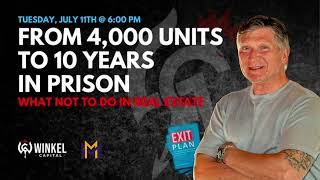
Mike Morawski, a former real-estate investor who served eight years in federal prison for fraud, shares how he built a $100 million portfolio, lost it in the 2008 crash, and rebuilt through coaching. He now teaches three fundamentals: relationships, underwriting, and capital raising, with emphasis on conservative lending and disciplined asset management.
Chapters
Winkle Capital presents Mike Morawski. Hear the story from 4,000 units to 10 years in prison. Mike, acclaimed real estate coach, multi-family investor, capital raiser.
Hear the breakdowns and more importantly, the breakthroughs.
And then I'd love to introduce Anthony from Avant Garde. Anthony, get up here, tell us a little bit about you.
Hi, my name is Anthony D'Augustine. I am the broker and owner of Avantgarde. We are a property management company local here in Phoenix. We specialize in under 100 units, uh, pretty much single family and up, and we just think this is an absolute great opportunity. This event today is just— blew me away when I heard about it. So I'm just here and super excited to, uh, see what you had going on.
Wonderful.
Yeah, so thank you.
Of course. So if anyone's got single-family properties, smaller multi-family, Anthony is your guy, um, whereas CalCap tends to specialize in those larger properties. So we got you covered tonight no matter what size you're working with. Okay, so what? No, you gave me that look. Yeah, no, it was too far.
Somebody else made the deck tonight.
Okay, all right. I haven't had any wine either. This is the real deal. Um, really quickly before we jump into the content, I do want to tell those of you who are new here tonight a little bit about Duane and I. We are Duane and Ashley Winkle. We run Winkle Capital, and we discovered multifamily about 4 years ago. We had started in the single-family space doing fix and flips like probably many of you in this room. And while we really loved spending every spare moment of our lives on a construction site, and in some cases living in the construction site as we were renovating it, we felt like there had to be a better way. And so in 2020, we discovered multifamily, and since that time, we have absolutely fallen in love with the industry. There's so many amazing aspects to this business. If you're new to multifamily, Duane and I would love to share more about it with you. But really what we do at Winkle Capital is we source and vet opportunities for investors to be a part of these large deals. Because unfortunately in this business, you do have to know someone in order to get the opportunity to be a part of, um, some of these apartment deals. And we would love to be that person that you know that can help bring you in to this incredible investment opportunity. Anything else you want to share?
Yeah, and just for those of you that aren't familiar with what multifamily are, they're big apartment complexes. This is one of the apartment complexes we own in Dallas. It's in a really great neighborhood and it's performing really well. So we're really proud to announce Target right across the street.
Hello, danger!
And this is a huge mall right there, The Galleria. Walk to the mall when we were doing our due diligence while we were down there. We're just proud to say that so far that this year since we've owned that property for 9 months, we're about $60,000 over our pro forma. So we're providing more money right now, which is nice.
Yes, you can clap for that. No, that's good. Let's clap for that.
Must be some of our investors in the audience. But that's the idea, right, is we're doing something, we're working on big properties like this because of the scale that the apartments provide, right? It's something different if you have just a single-family house. That's great, but if that one person moves out Now you're 100% vacant, right? So when 2 or 3 people move out, you're like, yes, now we can raise rents, we can actually do our business plan. So it's actually a good thing when that happens on those larger scale properties. So this is the kind of assets that we work on right now, and we really help people get into all sorts of different asset class types. We really look at ourselves as more of a real estate concierge, where you say, I'm looking for this, and you're like, oh, okay, you want to—
you want—
you might want a triple net lease. I know some people that do that, right? You want a vacation property and go visit once in a while? Okay, we know people that do that over here, right? So we connect people at any stage of life, wherever you may be, and really want to make sure that you're picking the right investment. Like Ashley mentioned, if somebody were to tell us that I would have been literally spray painting the side of my house in July a couple years ago, I was like, oh, that sounds Daryl, who signed up for that? You're like, well, somebody's got to do it. I was trying to save a dollar. You know, a lot of people just don't know that. We would potentially recommend, if you're not good at that, don't do that part, right? There are other opportunities and other alternatives that you just might not know about. So we can help and have those conversations. But as Ashley mentioned, we always like working with the best vendors, and we've already pulled up a couple people there for the property management standpoint.
So Property manager is going to make or break your, your project. I guarantee you that. So partnering with the right person at the property management level is everything. But of course, before you— oh, hello! We're just gonna wing it.
There's no saw that was working all night, right?
Um, but before— so, uh, when you're doing your underwriting, having a property manager as your partner is extremely invaluable in terms of vetting your rents, vetting your expenses. But another really valuable tool is CoStar. And so, of course, we have Jared here tonight from CoStar to talk to us a little bit about what we're— what they are seeing in the Phoenix market. I think, Dwayne, you two are going to tag team a little bit. So, Jared, I'll let you introduce yourself. Jared's on his farewell tour.
Yeah, so Ashley and Dwayne invited me to this event. I'm actually moving to CoStar's Los Angeles market, uh, next month, which means I'm in deal-making mode for CoStar.
So that's right, you heard it here.
Yes. Um, but yes, we'll give a quick— Dwayne will go through— we have a state of the market, um, specific information from CoStar, I'm sure. How many of you have used CoStar or at least heard of CoStar? There we go.
So there you go.
In any event, then I'll go through a brief run-through of what the product is, how it would be of value to you, um, and then we'll leave you with some information.
Yeah, for sure. And like Ashley was mentioning, there's nothing better than actually knowing— it's me, hello, there you go. All right, fair enough. Um, there's nothing more important than actually knowing the statistics, right, before you invest in something. And you look at a multi-million dollar property, you want to know the market, you want to know the surroundings. You can see here, this is a great chart that CoStar provides. You can see the vacancy rate over here, and you really want to check this and what the vacancy rate is doing. They also have the ability to forecast out in the future, which is always really helpful data. So you can kind of get an idea of what they're thinking. Sometimes it's not always what's happening because they can't predict the future either, but they're using all of the data that they have to be able to understand what it was doing historically and what they've seen over time. So this is— this slide here talks about the net net absorption. You can see over here on the left how many units are coming online and what the supply and demand is doing compared to the vacancy, right? When there are more units, more apartment buildings coming online, there are more opportunities for people to move around. There's— that increases the vacancy a little bit, right? So everybody kind of understands that, and that's something to look out for. Like I said, this is the other— I think I might have duplicated that slide. This is the forecast right here. So this shows up until— this slide is till current right here, and then we actually have the ability to forecast forward into the future. You can see this vacancy line and the trend right here is trending right around that 10% mark at the moment, and this is where we're at. So we want to make sure we're always keeping an eye on that. And when you're underwriting and you're looking at your business plan, if If you're underwriting something for 5% vacancy and we can tell that it's already 10%, like, all right, that's something that you can question. So anytime that you're going and you're looking at an opportunity, ask them where they got their data from. That's something that's really important. I can tell you right now, there are many investors in the room and many deal sponsors in the room, all of their Excel sheets and all of their PowerPoints look great. You're always going to make money, right? Yeah.
So except sometimes that doesn't happen. To add to this too, so this is just one, um, we have sensitivity analysis as you could provide here as well for a forecast. So this is maybe overly pessimistic with a recession, so you could do it for, you know, moderate upside, recession. So this is just, uh, one you can use.
That's a really good point. Yeah, so, and that would be a good answer for why you saw 5%. You're like, well, that's because CoStar in this example I was being, you know, super aggressive with that knowing what the market's doing at the moment. Again, something helpful that they do is you can check— I know we've been talking about Phoenix market a lot. I love the Phoenix market, but a lot of people are starting to look elsewhere. CoStar is a national agency that they have data from all over, and they can pull, and you can see like which markets you might want to invest in based on where the rents are growing and where they're contracting. Right now. I know you can see the orange scary line on there, and it shows Phoenix that we're retracting a little bit. However, I have a hypothesis, and I've seen this a couple times in the market: we're just first, right? Everybody else will catch up eventually, right? Like, I was, I was joking with somebody before, does Omaha even get the internet yet? I don't even know. They're like, oh yeah, we do. Yeah, we just figured out we can raise our rents a little bit. People are moving out here. So it's fine, but that's why you see some of the inland, like, kind of flyover states, if you would. They're, they're starting to pick up because people are moving and migrating towards the middle of the country. So I know a lot of people that are investing in those areas— in Oklahoma, Arkansas, big deal, just went down recently. So it's just something to make sure that you're aware of and you can predict. Just because Phoenix shows negative right there, again, it's year over year, and last year was crazy. So it's comparing it to a really crazy gangbuster year we had last year. It doesn't mean it's dire. You can still find an apartment complex that has an opportunity that they haven't been raising rents. So there are still opportunities out there.
You mean 20% rent growth isn't normal?
Not, not usually. Yeah, that's kind of an oddity. But again, we were the first ones to experience a really strong rent growth, and now you're seeing 6, 5, 4.5% rent growth in Omaha and Cincinnati, right? This, this shows the different rent growths based on their star rating. So the way CoStar works is they look at brand new buildings, get like a 5-star property— 4 and 5 stars are really nice properties— get into your workforce housing, that's kind of the 3-star, then you have your 2s and your 1s. It's really important to understand stand, what classification CoStar's given that. And like, that really is determined on—
and to add to that, the reason for the star rating system versus BOMA, which you all know, Class A, Class B, it helps you make national comparisons, whereas BOMA is very localized. The Class A building in Arizona may not be a Class A in New York, but a 4-star is a 4-star in Arizona, is a 4-star in Kansas City. There are no 4-stars in Kansas or 5-stars Kansas City, for example.
Yeah, go for it. So how do they do the star ratings?
Like, how is that?
There's a white paper on it and a methodology that we use.
Um, so to go into that, I mean, it's there for you to read it. Amenities, you can follow up.
Yeah, but there's a lot of stuff that go like the amenities and everything that go into the property. So if you add more amenities or it's a newer product, that, that also contributes to the star rating as well. But again, this is just— you can actually predict which star rating you have and then what it's going to be from a rent growth standpoint going forward.
And so I can speak to this again. So when you go into CoStar, again, we're tracking 7 million commercial assets nationwide, all multifamily. So we track down down to duplex level up to 500 units, some of the largest apartment buildings. And for every asset you're going to see this level of detail. You're going to see details about past sales, you'll see building details, market conditions. If we have loan details on a property, we'll have loan details on how that loan is performing, income and operating expenses. So it's all in here. We also pull in feeds from from apartments.com. So in Phoenix alone, we have 55,000 rents that are being pulled into CoStar, but it's not just our data from apartments.com. It's Yardie, RentCafe. Those are all going here and we're giving rents. And if you actually see, you can see the date that it was updated under the unit mix in terms of rent. So you'll see unit mix and then rent by unit mix. And if we go to the next slide, Again, we're just moving across the different tabs. So for every asset, we will also give you the true owner. So you go to the county assessor site and maybe you spend a lot of time there trying to figure out who actually owns the building, the LLC or the trust. CoStar has proprietary tools that help us pierce behind that corporate veil and then give you the true owner contact information. And it's not just, um, this property, we'll actually tie portfolios holdings. So if you want to understand what other properties this ownership group is the true owner to, we, we can show those to you. So, um, you can go to the next slide if there's another side. So again, main use cases— what, what do I think would be valuable for this group about CoStar? So CoStar is tracking 33 years worth of sale transactions. So if I want to understand the last time a multi-family family building that's— let's say we're focused on 25 to 75 units— has traded, I can filter out all those transactions that have happened in the last few years. Maybe I want to look at buildings that haven't traded in 10 years, 15 years, and I want to build a list to reach out to those individuals. So that's one thing that you can do. You could also take it a step further and then see and sort by portfolio size. As I mentioned before, we're tracking portfolios. So maybe you want to weed out the ones that are owned by Blackstone and, and, you know, Tides, because they're not going to call you back. Um, and use CoStar as a way to source off-market deals. Loan maturity dates are in there. Those are specific to CMBS, so we don't have Fannie Freddie, right? Um, and note that CMBS is a relatively small portion, but those loan maturity dates are interesting. We know that sellers are in a position with rates where they may need sell us or way to source. But again, yes, so it's really having— think about it like a Rolodex of properties that you can use to source and identify things that aren't in the market.
Yes, super powerful. On the next slide, you'll see that it is loading. Yeah, it's really powerful. On the last slide though that was showing, you could also see the star rating. So it's really important to like dial into what your criteria is when you're talking to the brokers. You're not really wasting their time, you know exactly what you're looking for. You're like, I want a 3-star property in Phoenix in this zip code with these certain demographics around it. So CoStar really allows you to get super hyper-targeted. Here's the star rating.
Well, it's here, and it's a great way to have productive conversations with your broker. So this doesn't replace your broker, this And you can give this information to your broker to help— to have him help negotiate the deal for you, do what he does best. Um, but again, your broker is not going to do this work for you. He's going to simply give you listings that are hitting the market, or if he has a relationship with an owner, a pocket listing, maybe he'll bring that to you.
Maybe.
But he's— maybe, but he's not going to spend the time to scrape CoStar, right, build these lists, and then go out and identify owners that may be in a position they want to sell.
Yeah, yeah, there's just a plethora of data here. One thing I pulled out, previous owner records too, so you can kind of track the history of it. And then also property management. Wouldn't it be helpful to know like which property management companies are running certain things? And if you're working with a certain property management company and you go look at it, you're like, that's not performing very well. Was it the owner said I should do this? Was it the property management company? You have a lot of data here. To really dig in and understand just more about it so you can be competitive. I think that's really your competitive advantage here is just doing your homework and owning a tool that has all of this data and using it wisely.
And if you'd like to schedule a demo and you'd like to understand CoStar, and I'd be happy to give you a demo anytime. I've got a few weeks, so I look forward to hearing from everybody.
Yeah, thank you. Projector fun tonight, it seems like. On the next slide, we're going to talk about actual transactions that happened here in the market because we always like to know what's going on in our local market. I think that's really important. So here is Co-Stars. I'm going to turn that back a little. Sorry for the feedback. So this is, um, from a brokerage actually that sends things out. It's called ADI. ADI is really helpful. And this is Q2, and this is for Phoenix specifically. So again, knowing your data and your numbers is really helpful just to see what the transaction volume was recently, what the median household income was across the entire Phoenix MSA. And this is for 10-unit properties or more. So this is all of Q2. While a low number, you know, you can see how many units are under construction. You can see how many units we have total inventory and some other really helpful data points. I know we keep talking about this really crazy recession-like thing. That number right there shows that it is a 2% or 3% unemployment right now. That basically means everybody that has a job or needs a job can go find one. This is a really good strong economy. You have to look at the actual renters themselves and what they're doing, and they're doing really well right now. Unemployment's as low as it's been. So some more, more here of just transaction volume and the average prices. You can see of the 100+ units over here on the left-hand side, the year that they were built on average was 1998. So that's why you can see that there were $355,000— that's right, yeah. Oh, that's Oh, here's the price per door. So it's really similar, actually. So per door is $331,000. And it's just helpful to know that information because when you see something, it comes across your desk, you say, hmm, is that a good deal or not? If you know what's trading historically, then you'll be able to kind of assess that quicker and understand that if you're looking at something between 10 units and 100 units, you're looking more at the $250,000 range. for properties built in 1986. So a little bit older. That makes a little sense, right? Look at Phoenix MSA here. This is just last month. So last month there were a total of 15 transactions. Total sales volume was $534 million, which is odd. If you actually look at the previous slide, I think the transaction volume total— $700 million? This is for all of Q2, so we're going to look at just this month. This month, last month, we saw 534 of that was recently, right? So you can see the wheels are starting to pick back up, right? I saw a couple heads of— oh, okay, that's pretty cool, right? I know we just lost out on a property. They were bidding going on here in South Phoenix, and we had a ton of different offers and we got way outbid. As you can see, people are coming back into the market. I know our single-family friends have had multiple offers and properties are going in a single day right now. It's just really low inventory. Not a lot of people are wanting to sell because if you sell your house or your apartment building and you had a 3 or 4% rate, now it's 8 or so, right? So it's a lot higher. So people are like, I'm just gonna hold on to this and stay here, man. I might even buy a second property. There just aren't a lot of those right now. So if you look at Tucson, our friends and brothers to the south, no big units were selling and they had 4 transactions for $9.4 million. Again, just helpful to know what's trading and if you want cheaper properties, it's only $111,000 a door down there. And this is all of quarter 2, more Phoenix, or sorry, Tucson statistics. Again, unemployment super low, 3.4%, which is really good. You can see the average price per unit sold in Phoenix— or in Tucson last quarter was $93,000 a door. That's pretty competitive, especially when you compare insurance and taxes with other markets. I know somebody— people are talking about Florida. Man, these insurance down there is crazy. You know, taxes in Texas, right? Everybody talks about that. That can be really a challenge. So there are a lot of positives here in Arizona. Speaking of positives in Arizona, recently, just like this was posted today, that they're building this brand new data center out in Goodyear, way out in Goodyear, and it's going to bring 3,000 more construction jobs. I know we talk about that a lot, is like Why are we investing in Phoenix? Because there are a lot of jobs coming here. The jobs are coming here because they're building products here because our government is really business friendly, which is great to see that all these technology jobs. This is a really powerful data center. There's going to be something like 178 million gigawatts literally generated from this data center and the power plants associated. So it's really, really pretty cool. Something else I thought was really interesting, this beautiful property. This is actually close to the place we eat breakfast up in Scottsdale. Yeah, this is off Ranchería. It's a brand new building they just built up there. 330 units, just recently sold, $141 million.
Oh, we didn't buy it though.
No, it wasn't— it wasn't—
I wish it had been at this time.
But the good thing, right, we always kind of joke about this when they're building these new assets, they're just going to get older. Might be a 5-star today, but in 20 years it'll be a 3-star, right? So there's more product constantly being built out there. And one thing I thought that was really interesting about the people that were buying this, this is an Ohio group and they have $4 billion assets under management, and they picked Phoenix because they— this is their first deal in Phoenix. Remember I was talking about before that we're first to the market? Just saying, transaction volume picking up. Big brand new properties are being sold right now. One thing that's really important to know, I, I can imagine— I don't know these folks personally, but I don't think they struck a check for $141 million. They probably worked with a bank, but that also means that the bank approved it as well. So they ran their business plan and said like, 'Bank, do you agree?' And they said, 'Yeah, we'll give you 50% of that.' So that's what's really powerful about a business loan in the commercial real estate space, you have to agree with the bank. If it's just looking at your income when you're doing a single-family house, they're like, how much money do you make at your job? Yeah, you can probably cover it, you're good. But here you have to actually go through the whole business plan, and the bank won't give you money if they don't believe in that business plan. So it's really powerful to know that you have the bank on your side as well when you're talking to your investors. Or who knows, they might have bought it by themselves, but Again, you can see that it's really powerful that they're coming back into the market, and you'll start to see some of these properties trade and move forward.
Oh, is that us in 20 years? We look so happy.
I actually sent this to Ashley's mom, and she's like, thank you so much for sending that to me. We're trying to convince her to move out here because it's so nice. It's a nice place to live. But it does— Arizona ranks 3 cities as the best place to stretch your retirement and kind of live out those later years in life. Look at all the golf that's happening out here. It's beautiful. So not only are we creating jobs for the younger working-class community, there are a lot of retirees that are moving out as well. So there's more need for new, brand new buildings. In fact, a golf cart almost hit me on the way to come here. Like, I live like just right over the way. It's this new community they built over here. Dangerous. I thought it was a a retirement community, but this young buck was like driving his go-kart from here. He grabbed some wine and he was headed back to his place. I saw the gates open and stuff and I was like, what a great life! Wouldn't that be so much fun? Just be like, you know what, I'm just gonna take my go-kart, grab some pizza, come back. It'll be great. But you can see that there are a lot of new buildings just all around us. As you were driving here today, I guarantee you passed 1,000 units that are new construction. Somebody's got to buy those eventually. And a lot of people don't want the hassle, right? There's— I want to move in, I want the pool, the spa, the grill. Somebody else is going to take care of it all. Walk my dog, be good enough, right? So there are a lot of reasons, not just working. Workforce housing is not the only reason to buy in the multifamily space. But next, for the main presenter for this evening, we're going to bring up— give a nice warm welcome He came all the way from Chicago, and I said, Mike, you know it's July. He got to pick the date. I didn't say I only have July. He's like, I think I'll come out in July. I was like, I don't know. And he was like, yeah, I can do it, Dwayne, I'll be out. No, I didn't say— I said people might not be here because it's so hot. It's 110 out. Yeah, let's give a nice warm welcome for Mike.
How's everybody doing? That's a tough act to follow, right? I mean, that's a ton of information, great stuff. So I learned a couple things, you know, as long as I've been in the business, I continue to learn, and I think that that's just really great. So tonight I'm going to talk about a couple different things. The first thing is, uh, I'm going to tell a story tonight that most people would think would disqualify somebody, but in reality it qualifies me to be able to share with you a way to think differently. You know, we all have a mindset or a way that we think about things, right? And a lot of times we prejudge, we think about things that we don't really have all the facts or all the information, and as a result of that, we make these stories up, right? Would you guys agree with that? You know, Tony Robbins said years ago that you have to visualize things and you have to paint pictures in your head. The clearer a picture is, the better you can realize that you can attain something, or something is going to happen for you, right? Would you guys agree with that? Yep. So if you're comfortable, I'm going to paint a picture for you tonight, and I'd like you to close your eyes, and I will tell you when you can open your eyes. But here's what I want you to picture: that, you know, beautiful spring morning, you're sitting out back of your house early in the morning drinking a cup of coffee, and just, you know, the birds are chirping and the dew's on the grass and the sun's coming up. And all of a sudden you start to hear some noise from the house next door, and it's getting louder and louder. Now it's piqued your curiosity and you want to go see what is happening. So you start to peek around the corner, and what do you see? You see 7 or 8 black SUVs pull up. A number of men and women jump out of those black SUVs in black flak jackets that on the back they say FBI, DEA, ATF, and you're wondering what the heck's going on. The next thing you see is you see the husband in that house being hauled off in handcuffs, shoved into the back of an SUV, and they drive off down the street. Now, what's going through your mind right now? You starting to wonder what, what was happening? Maybe you're saying something to yourself like, uh, what's his family going to do? As you watch his wife and kids stand in the garage in tears wondering what just happened in their life. You know, our lives can change like this, instant, instantly. But I want you to really consider, are you prejudging? You know, some people might say, oh, I knew he was up to no good. Some people might say, I wonder what happened. Some people really might have a compassionate heart and say, "Well, what's his family going to do now? What does this all mean for them, for the neighborhood?" Go ahead, open your eyes. I'll come back to the rest of that in a while. So let me start at the beginning. You know, I didn't grow up in a house of entrepreneurs, Matter of fact, my family didn't do any real estate at all. I always tell a story about being in the back of a car driving down the road and asking my parents, "Hey, who owns that big building?" And my parents, in their own way, and I don't know that they really knew, but said insurance companies. And that never made sense to me until a number of years later when I closed a my first, uh, multi-family deal, and an insurance company was my partner in the deal. So it kind of clicked, right? But I grew up not really knowing anything about real estate. I went in the construction business, and, uh, kind of a funny story, I was— I started out in the swimming pool business. You know, here in Phoenix, the swimming pool business is great, but in Chicago, it's only 3 months a year, right? So I would hire these guys in the springtime, I'd train them, and by fall there'd be no business anymore. So I'd have to put them on unemployment, think they'd come back the next year. And as an entrepreneur, I kept, you know, cycling through people and had to figure out a way to keep people employed all year long. So I started to do kitchen and bath remodeling, and that morphed into building about 25 room additions a year. So I had this construction background, but as an entrepreneur, I did everything. I did the sales, I did the marketing, I wrote contracts, I ordered material, I hired people, I fired people, and did the bookkeeping. Plus I was still in the market banging nails. And I was like, I can remember waking up one morning, sitting up next to my wife at the time, and I said, I can't do this anymore. I'm just burnt out. And so fortunately, I had somebody knocking on my door to buy my company, and I sold the company. I went in there and I said, well, I'm going to take a year off. And, you know, any entrepreneurs in the room? I think everybody's hand in the room probably should go up if you're here, right? I didn't take a year off. I don't think we had our mind or what we do, you can take time off. So I bought a couple of two-flats that I was gonna house hack. Now, this is long before house hacking was sexy, right? Today people buy houses, they live in them, they rehab them. But back then people said, what are you doing? You're crazy. So it wasn't a thing that people did then. But I house hacked a couple of houses, and I had heard Jim Rohn say years ago that that success leaves clues. And that was one of those statements that always stuck with me. So along the way, as a house hack, I met this real estate agent who was very successful. And I had gone to him, I said, hey, I think I'd like to go in the real estate business. And he encouraged me to. He said, I think you'd be really good at it. So I went and got licensed, went back to him, and I said, I'd like to shadow your team. And he said, No, I'm going to do one better than that for you. I'm going to make you a cassette tape. Now, I'm dating myself because I don't think we could find anything to make a cassette tape on today, right? Much less listen to it in some cases. But he made me this cassette tape, and on there he put some fundamentals and some systems and some ways to go build a real estate business. And I listened to that thing over and over and over again. You know, I equate it to podcasts today. You know, if you, if you like a podcast and you, you get some information from it, if you go back and you listen to that again, you pick those nuggets up, right? And you can go back and listen to something 3 or 4 times and hear something that you didn't hear the first time you listened to it. And that's what happened to me. So my first 9 months in the real estate business, I went out and I sold 78 houses. I was RE/MAX Rookie of the Year. I went on to build a team selling over 125 homes a year, and I did that consecutively for about 12 years. I'm a little bit of an overachiever. In 2005, I saw the market starting to soften and things slow down, and I wasn't really sure what was going to happen at that time, but I knew that I needed to go do something different. You know, I had about 7 people working for me at the time, and I didn't want to have to lay anybody off. Off, and I wanted to keep everybody busy. I'd always wanted to be in the apartment business, and it was one of those dreams that I had for a long time. You know, our dreams really turn into our vision, and our dreams really turn into reality if we think about them, if we focus on them, if we, if we build them into what we want to accomplish, right? Would you guys agree with that? So I I had always wanted to go in the apartment business. So 2005, I go out and I buy an apartment building, 11 units, and I am so excited, right? I buy this apartment building and I'm so excited that the seller's gonna sell it to me. I know absolutely nothing about the apartment business. Here's what I knew, that you raise private equity, you married it with a great real estate deal, and you stay in the middle, and as long as everything went well, Everybody makes money as a result of that. That was about all I knew. I, I watched a couple of large multifamily syndicators in Chicago build businesses over the years and, and grow those companies. Matter of fact, when I was in the construction business, I did a lot of work for those companies, so I understood that part of the business. Uh, buy this apartment building, and, um, I did it wrong. So I listened to everything that the seller said and the broker said, and they said, boy, you can buy this, you can resurface the parking lot, redo the units, put a new roof on the building, put a new boiler in the building, finish the balconies, and move new tenants in, and you'll be able to raise the rents $100 a unit. I thought, that's great, what a great model, right? Well, none of that happened. I bought the building, I put a new boiler in, I put a new roof on, I refinished the balconies, I refinished the parking lot, but I didn't do my homework. I didn't do my homework on demographics, on crime. You know, one thing that I always talk to people about is when you're looking at a market, to look at the crime rate in that market. And a simple phone call to the police department will give you a lot of answers. You know, if I would have called the police department, found out that they had a domestic dispute call at that property 27 times a month. That's perfect in February, right? I might not have bought that building at that time. So, but we learn by how we do things. You know, I always tell people, I say, you can get all the education you want to get, but if you don't take action, if you don't step into it, you don't progress. So I bought that first building. Over the next 30 months, I raised $18 million. I bought 4,000 apartments in 5 markets around the country, built a property management company managing 7,500 doors. Our company was valued at about $100 million. In 2008, we, we all know what happened in 2008. Country saw the worst economic crisis we've ever seen. It was like hitting a brick wall in a freight train at 200 miles an hour. The first mistake I made was I grew way too fast. Remember I said I'm an overachiever? Well, I have this vision of where I wanted to go as a company, and I didn't look to the side to see what was going on. And we grew really fast as a company. I had 100 people working for me, 4,000 units, managed 7,500 doors on top of that. And 2008 happened, and our whole world started to unravel. We were heavily vested in markets that only had one or two type of employers. So I was in the Ohio Valley. I'll give you a great example. I was in the Ohio Valley, and in the Ohio Valley at that time, two major employers: transportation. You had FedEx and DHL and UPS that were headquartered there, and you had car part manufacturers. So there were a number of manufacturers that made things like knobs for radios, dashboard liners, seat covers, things like that. And as soon as the markets got hit and the car business got hurt and the distribution business got hurt, these people lost their jobs. So in— as a result of that, we had a mass exodus on our apartments in those markets, which caused NOI to drop. So That, and growing so fast, we're very unstable as a company. Fast forward to 2000 and through 2008, my thought was this is just going to be a crisis on the residential side, in the residential market. And by 2010, the commercial markets had got hit pretty heavily. And as a result, we started to really come off of the rails at that point. So it had gotten worse over that 18 months. So I grew too fast as a company. The other thing is I was overleveraged as an owner-operator. I owned $60 million worth of real estate at 85% loan-to-value. And I don't know who was worse at that time, me for taking the money or the banks for giving it to me. But I tell people today, I say you shouldn't be in a deal, don't underwrite a deal unless you're underwriting it at least 65 to 70% LTV because you want to have that safety factor. You want to be able to have that margin. The third mistake that I made along the way was that I was undercapitalized as a business owner to grow that company. Had over 100 employees working for me. So now I have this company that's very unstable. I've not been able to pay my bills. I'm not being able to pay my investor distributions. I had probably 12 deals at that time I should have let go to foreclosure and a handful of investors get hurt, but I didn't want anybody to get hurt. So I wanted to save the whole company. So what I did was I started to move money back and forth from profitable companies to nonprofitable companies thinking I could shore it up. Now what I thought was, I thought this is a recession. I've been through a couple of recessions. Recession typically lasts 17 or 18 months. There might be a 10 or 12% correction in the marketplace. The markets bounce back, right? So I thought, well, let me move money back and forth. My accountant and my attorney both said it's okay to do that, just leave a paper trail. When the markets bounce back back, put the money back. Simple plan, right? It was fine, but that recession never went away. Went on for 7 or 8 years with a 47% correction in the marketplace. It's pretty hard to weather that storm as an owner-operator. I got charged on wire fraud and mail fraud charges because I didn't disclose to my investors the transfer of money. So in the business of syndication or joint ventures, and you're raising capital, you're partnering with other investors, you're held at a very high standard. You know, Julie, if you give me— if I ask you to borrow me a dollar and I take that dollar for you, I'm watched differently by everybody because I borrowed that money from you or used your money to invest. It doesn't matter the amount. You're held at this much higher transparency. So because I didn't disclose to my investors the movement of that money, I wound up being charged on wire fraud and mail fraud charges, and I got sentenced to 10 years in federal prison. Wow. In 2013, I did go to prison on that sentence. I served 8 years in federal prison. Now, most people might think, oh my God, your life's over. And actually, that's what I thought when I went into prison. So I'm in prison probably 3 weeks. I'm walking around every day wondering what the hell happened in my life, you know. And I always tell people, I say, hey, I never flew private. I didn't have a big boat. I didn't have a fancy car, big house. I was the neighborhood baseball coach. I was home every night for dinner, uh, you know. I had a great marriage at the time, and, um, I got ripped from that to live in a 20 12x12 room with 3 men I didn't know nor did I like, wondering what the hell happened. I was in prison about 3 weeks and my wife decided she was going to divorce me. At that point, it wrecked me. I actually thought, how am I going to get through today, much less 10 years? Um, every day was a challenge, you know. I felt like I, I, I lived in this place that I didn't know how to exist anymore. Walking the gym one day, about 6 weeks into this prison state, and I was just window shopping, by the way. I wasn't looking to work out, I wasn't looking to do anything. I'd gone from running marathons to being 35 pounds overweight. I absolutely hated myself, and I actually think I wanted to die, but I was just too afraid to kill myself. This guy walks up to me, and I'll never forget this. You know, we all have defining moments in our life, right? I mean, you might have multiple defining moments throughout your life, but what do you do when they show up in your life? Do you ignore them, or do you take advantage of them? This guy walks up to me and he says, hey, don't let these people beat you. All they want to do is take from you everything that you've ever had. They can take your business, they can take your apartments, they can destroy your family, but what they can't take is who you are and what you're made of. They can't take what's inside of you. They can't take what helped you to build that $100 million business. And I don't know what happened, but it was like somebody flipped the light switch that day. All of a sudden I started to think differently. He said, come to my office, come 'Come to this— come to the gym every day, start taking my class, start working out. You'll start to feel better. You'll start to look at things differently,' right? Physical energy causes us to think differently, right? Causes us to change a little bit. I don't know why I said yes, but he held me accountable, and I showed up at this guy's class every day, and I started working out. I started to feel better, and I started to lose weight. I wound up going to college. I got a bachelor's degree in theology. I wrote 2 books while I was gone. The first book I wrote is Exit Plan. This is your complete guide to multifamily investing and why you need an exit plan before you buy. You know, I've been to hundreds— I've spent hundreds of thousands of dollars on coaching and training and books and tapes and seminars over the years. Trystan Trenberth, you can relate to how much we spend on that kind of stuff, right? Um, only to find out some great teachers, some great trainers, but everybody teaches you how to find a deal, get in a deal, run a deal. Nobody teaches you how to get out. Nobody teaches you how to maximize your profit. And I wanted people to understand how and when you could maximize your profit. Anybody want this? Yes, gotta come get it.
So, Troy, Troy, Troy. Can I just buy it from you?
Yeah. Thank you. So I wrote a book called Exit Plan. I wrote a book on property management, which we'll have published next month, or should come out next month. I wrote a home study course. My goal was I was going to come home and go into coaching and training business. Wrote a home study course. I was on an outreach program. I went into the community. I told my story to small business owners and local college students. Wound up meeting a professor from the University of Minnesota, and he and I co-authored a paper together that we had published in the Business Journal of Ethics that gets taught today at the collegiate level for forensic accounting and sales and marketing classes. I came home in 2013. The week they closed the world down for the pandemic. So I went from my prison into your prison. It was a good thing though, because that, that next several months just kind of helped. It's hard to adjust when you come home from being gone for 7 and a half years. I came home, I went into coaching training business, started coaching and teaching people. Didn't think I'd ever raise capital again, didn't think I'd ever do deals again. Just thought I was going to help people learn how to do the multifamily business and not make the mistakes that I made. Well, I started underwriting, right? Because I was going to have to teach people how to underwrite, right? Very important fundamental. I think there's 3 key fundamentals in the multifamily business today. Relationships are one, uh, underwriting is a second one, and raising private capital. You have to be able to do all 3, even if you don't like one of them. Find other people that are good at them, but you have to know how to do that and you have to be good at a couple of them. I came home, went in the coaching and training business, started underwriting, started looking at deals because I knew I was going to have to teach people. I come across a deal in Florida, so I go to a couple of my coaching clients and I said, hey, I think we should buy this. We, uh, start to walk down the road of buying this property and our securities attorney says to me, hey, I think I can get you approved by the SEC to go back and be an issuer of securities and sponsor of deals again. I said, go try. So like, I didn't— we never talked about it again. So like 3 months later, she came back with a written approval from the SEC saying I can go back and do what I was doing before, what I love to do, be an issuer of securities and a sponsor of deals. Um, so we're actually back doing multifamily deals. I shouldn't say we— I'm back doing multifamily deals. Have a big property in Tulsa right now that we're doing. Let me just— I'll hold that to the end and talk about that a little bit. But, you know, your life can change just that quick. But it's what happens— what do you do with those changes? How do you think about things differently. You know, I tell my story today because I want to provide hope and inspiration. I want people to understand that you don't have to let your past define your future. You don't have to be a victim, right? I think there's a great saying that people say today, and it's, it's not what happened to me, it's what happened for me. You know, I think about that first multifamily deal that I bought, that 11-unit that I learned all those things about along the way. That was a great learning experience. You know, from that point, I sat down with my broker. I said, hey, we need to create a buy plan, a buy box, and design what it looks like for the best multifamily deals that I want to buy, which I did. And you know, today I know I buy workforce housing in, in certain markets. I'm a market-driven investor, so I don't just look at deals. You could bring me a great deal in a bad market? And I'd say no, it just doesn't work. So what do I look at in those markets? I look at population growth, job growth, household income— three top drivers in the markets. They all have to be growing. I look at crime rate. I look at demographics. Can I change the demographics? Can I change the crime? If I turn a unit over turn a property over with new tenant base? Is it going to change not just the property but the area? So we look at all those. We look at employment diversification. Again, I want to be in a market that has multiple employers, multiple industries, because if the market gets hit in one or two different sectors, those other industries will help keep that property property going. And so we want to be safe in our investing today, very conservative in underwriting today, because I wasn't before. And by being conservative in underwriting today and looking at things differently, you just, uh, take your time a little bit more in, in putting deals together. So, um, I tell my story because I want people to understand you don't need to let your past define your future. I think I might have been behind a wall in prison for a number of years. I might have lost everything in my life. I think there's people that walk around and they're trapped. They're trapped by addiction, whether it's alcohol or drugs. I think people are trapped by past abuse, sexual, uh, physical, verbal abuse in their lives. They let that stuff hold them down. And I don't think any of us need to let any of that hold us down. I think we can all move forward, and it's about having accountability. It's having people around you that can help you, help guide you through, help push you through, help you to grow and go to the next level. Um, in the midst of all of this that's happened, uh, I think, uh, you know, I still have a couple couple things in my life that aren't perfectly back to normal, but it's a growing process. It takes time, right? It's just like when we're learning how to do something new, it takes time, right? So, um, this deal in, in Tulsa that we're doing, we underwrote $1 billion in transactions between June and January of last year. 90 deals. Who would have given up at 80? Or 87. You know, if I would have given up at 89, we wouldn't have found this deal, right? So I think today, in today's environment— and I was— I had this conversation with somebody earlier— you, you have to keep underwriting. You have to keep looking at deals. There's deals out there, just go find them. You know, I'm a market-driven investor. I don't invest in Chicago. That's where I'm from, because Chicago doesn't make sense. The fundamentals aren't right. I need to provide two things for my investors: cash flow and long-term wealth. And if I can't provide both of those, the deals just aren't going to work and the market's not going to work. So I'm very cautious about that today. Very cautious in my underwriting. Remember I said that loan to value, you should be probably 65% loan to value. You should be using interest or rates today of somewhere around 6.5% if you're looking at putting a new deal together. How do you figure cap rates from your going-in cap rate to your exit cap rate? I think that you start to need— be adding about 15 basis points a year for your exit so that you increase that cap rate so that you are conservative in what you're doing. You know, a couple years ago, um, we could, we could look at a market and we could say, oh, the rents here are going to probably go up about 15% next year. I saw some reports, um, that rents were going to go up 28% in a year. Now, I would never underwrite like that, right? You should underwrite more conservatively than that. But those reports that that were out 2 years ago, 18 months ago, saying that markets the next quarter or the next year were going to go up 28% have all backed off now. And there are some good statistics out there for watching markets. So again, the 5 mistakes I made: grew too fast as a company, very unstable. You have to take your time. This is a marathon, not a sprint. The second thing was I was overleveraged. Way too much real estate, unstable real estate at a very low interest rate or a very low loan-to-value, which caused a lot of those challenges. Also undercapitalized as a company. And then number 4, I didn't pay attention to the details. You know, somebody asked me today, what's the difference between property management and asset management? You know, property management I think is a very not recognized business, right? These are the people that are on the ground every day dealing with the tenants, the trash, and the toilets. But asset management is making sure that all the key fundamentals are in place, making sure you have strong KPIs, that you're watching your property manager, that you're watching your on-site staff to make sure that, you know, occupancy is up, that rent growth is is happening. Repairs are happening, construction work is happening. Uh, there's a, you know, I have a list of 22 different, um, items that we, we look at, uh, on a weekly basis, on a monthly basis. If anybody wants a list of that, here, let me pass these out. And I know I don't have enough because Dwayne told me that there's not going to be a lot of people, so You can pass off that one. But if you, uh, if you don't get one, just— you can, uh, go on the QR code. That's, uh, my information. And you can, uh, request a list of the due diligence we do, the KPIs, uh, the different property management operational tasks that we look at as a company. So if that'll help you in any way. But we have to, we have to be conservative in our approaches on that. So the— I didn't pay attention to the details, and because I thought somebody else was, I thought I had a partner and a good company or people working for me that were handling all, all those day-to-day things, things got out of control and they got out of control fast. So today I watch those things a lot closer. I manage those things a lot more. More. Asset management is one of those things that you really need to get good at, especially in a changing market. And you know, here's the good news, right? The market's changing now, but it's going to change again, and it's going to get better. And anybody who invests today, whether it's actively or passively, and you are coming in front of the next bull run, you're going to be very successful. I believe that during these next several months that we're going to see the largest distribution of wealth in this country that we've ever seen. And you have the opportunity to take today to participate in that. So the 5th mistake I made was I didn't listen to people around me, people who were important. You know, we all have people in our lives that are watching what we're doing, and they're, they're maybe judging in their own way, but might say something to you. I'll tell you a quick story. So 2008, I'm in Cincinnati trying to close a real estate deal, probably the biggest deal we had done to that point. It was 287 units. And mind you, I bought my first multifamily was 11 units. I never thought I'd buy a 200-unit multifamily deal. And before we knew it, we were buying 200, 300, 400-unit deals. And it can happen that way if you're— if that's what you want to do. That might not be your goal, and that's okay. But if it is, it can happen for you. Just take your time. So I'm sitting in Cincinnati trying to close this deal, probably the last time I ever sat in the title office, because after that we just did everything, uh, by email and that. I'm waiting for my office to wire $500,000. And I'm waiting and waiting. I can't get a hold of anybody at my office. And finally, 10 to 5, I get my partner on the phone and he says, hey, I don't know how to tell you this. So what are you going to think right away, right? You don't know how to tell me what? Where's my $500,000? He said, he said, I had to move money from an escrow account into the business account this week in order to take care of some things. I said, we had this conversation, you're never supposed to do that. He said, I know, I thought I could have the money back. I said, fine. So I wound up dry closing, which just means I signed all the paperwork, said I'd have the deal funded by Tuesday. I went home over the weekend, I sold off all his equity in the deal, re-raised enough money, got that deal funded and done by Tuesday. But here's the interesting part. That was on Wednesday. On Thursday that week, I went to dinner with my wife, his wife. The four of us, we go out, we had this event planned. Now, I never talked to my wife about business. So husbands, I want you to listen to this right now. Uh, I think it's really important that we let our wives know everything. Let your spouse know exactly what you're doing, what your business is like, because they're the closest to you. So I never told my wife anything, but we're coming home from dinner that night and she says, "I don't trust him." And so I think I'm going to be a good husband at this point, and I say, "Oh honey, don't worry about it, I got it under control." I didn't have anything under control at that point. And, um, and what I should have said was, tell me more. What, what are you seeing that I'm missing? See, people around us see things that we miss because we're so close to it, right? But other people see it, so pay attention to that. About 5 days later, I'm at lunch with my outside legal counsel, and we leave lunch and we're walking through the parking lot. He puts his arm around me and he says, I don't know how to tell you this, I said, "What?" He said, "I don't like what's going on right now. I see some things happening with your partner in the office that I don't really think are fitting." I said, "Ah, Bob, don't worry about it. I've got this under control." So now two people within a 7-day period are telling me the exact same thing, and I think that I have it handled, and I really didn't have it handled. Pay attention to the details, listen to people around you, whatever it is in your life, because you're gonna, you're gonna be able to glean something from that. So ask the questions. You know, the better questions we ask, the better answers we get, and the better results we get. Hey, let me ask you, do you guys, uh, all have a cell phone? Can you guys pull it out? If you take a picture of me right now, my assistant would love you if you sent it to her. No, really, what I want you to do is go to my YouTube channel and subscribe. And if you don't like YouTube, you could go to my Facebook group, which is Multifamily Unplugged. And I'm always bringing out content, some information, some nuggets, some things to help you grow your business, to help you learn a little bit more, to encourage you. To do something else, to grow. So I want to leave you with this: don't let your past define your future. Don't get stuck in what the world and the news is saying right now about how bad things are. They're bad, they're probably going to get a little bit worse, but don't let that stop you. Take action. If you underwrite, pick up your pencil and start underwriting. If you're out looking at deals, go look at more deals. You know what? There are deals out there. Hey, if I would have quit at 87, I wouldn't have found a deal that has a 3.5% interest rate when in the market today the interest rates are over 6%. So you'll never know what you find until you look for it. But I want to thank you for having me out. Thanks, uh, Duane and Ashley.
Of course.
Anybody have questions?
Yes, anybody have questions for Mike? Now's your opportunity.
Yes, the story with the neighbor looking over the— oh, need a bookend for that. Just a story to, uh, make you really think about it. I was in prison with a lot of guys, um, that that happened to. I was fortunate enough to not have doors knocked in and to self-surrender, you know, just because I cooperated. And but just a story to make you think about what life could be like, what life is like for somebody else. You know, we live in a country that is the most incarcerated country in the world. I would guarantee that 90% of the people in this room have been affected by somebody being incarcerated either close to them or at arm's length.
So I just have a comment because while you were talking, and we never met before, but I read your charging documents and a whole bunch of other background information on you, and it appears the book was a little bit thrown at you for the funds that were lost. There were not that material in a big scheme of things. So, um, to your credit, that— I mean, as much as you paid a price, I think you paid a little bit of a big price.
So yeah, thanks. I, uh, I appreciate that. And, you know, people probably do what you did and they look at it a couple of different ways, right? Your way, or say, you know, I did a lot of damage. Listen, I don't feel good about what I did, right? I broke the law. I didn't tell my investors the movement of money. If I would have come to you and said, hey, you know, we can save this deal, or I think that this is what's going to happen, and you would have agreed to it, that's a whole different story. None of this would happen. Um, and then, uh, you know, So I appreciate your comment on it. Somebody else want a book? You guys all have questions?
Questions? Any other questions?
Tell us what came of the partner. You got the red flag from your wife, you got the red flag from your attorney, and then you end up in jail.
What happened to the partner?
Yeah, so we were friends for 25 years before we went into business together. He actually had lost his job, was unemployed. I said, hey, come on out. I was still selling real estate at the time. I said, come on, I'll teach you how to sell real estate. Brought him on my team, taught him how to be a listing agent. You know, we were selling a ton of houses, and then all of a sudden the markets changed or started to soften, right? And so I did this first apartment deal and I said, hey, let's just go in this business, we'll be 50/50 partners. Mistake. Um, I like teams today, right? So I'd love to have you on my team doing something, but I don't want to be in a long-term partnership with anybody. I got sentenced to 120 months, he got sentenced to 30. So you can— or he was home in 30, I should say. So yeah, you can figure figure that out for yourself.
Anybody else? Well, thanks again for coming out, Mike.
I really appreciate it.
Yeah, everybody give Mike a nice big round of applause. If you did not get a copy of his book, I would encourage you to go to Amazon and purchase a copy. It's an incredible book. I think you'll learn a lot from it. To Mike's point, I think a lot of people get excited about getting get excited about investing, start focusing on how many doors and how many assets under management, and, you know, what's my net worth. We start focusing on all of these numbers, and we're not thinking about the long game and what happens at the end. Something else that I just want to emphasize, he talked about his partner. There's nothing more important than validating who are the people that are operating this deal. What are their morals? What are their ethics? What do they do when it gets hard? I think, you know, many of you in this room have probably been in deals with people who you probably will never do a deal with ever again, right? Don't be afraid to ask questions. I think sometimes too when we're about to invest in a deal, we're excited, the numbers look great, we don't want to be too negative, we want to think abundantly, everything's going to go well, but it's a big deal and it's your job as the investor to be educated. That is exactly why we host this meetup. Meetup is we want all of you to be educated. We want you to be empowered so that when the right deal comes along, you feel confident taking action and taking that next step, but doing so with confidence and knowing the right questions to ask. So with that said, ah, thank you. Um, our next meetup is going to be another Tuesday. We are moving to Tuesdays in general going forward. Tuesday, August 8th. We're going to talk about property inspections. Um, not the sexiest topic in the world, I will say, but it's one of those steps in the process that is extremely important. And if it's something that you've never done before, or maybe you've only witnessed it from afar, there are details to this process that I think is really important for all of us to understand. So we'll have a property inspector here with us walking us through the process and teaching us? What are the things that maybe you don't know to look for that you should be looking for? So without further ado, that is the end of our evening together. Thank you so much for being here. We will have more networking. If you have glasses, plates, napkins, etc., if you could help us out and put them on the island over here, I would be so grateful. And we will see you all next month. Thank you for being here. Appreciate it.










