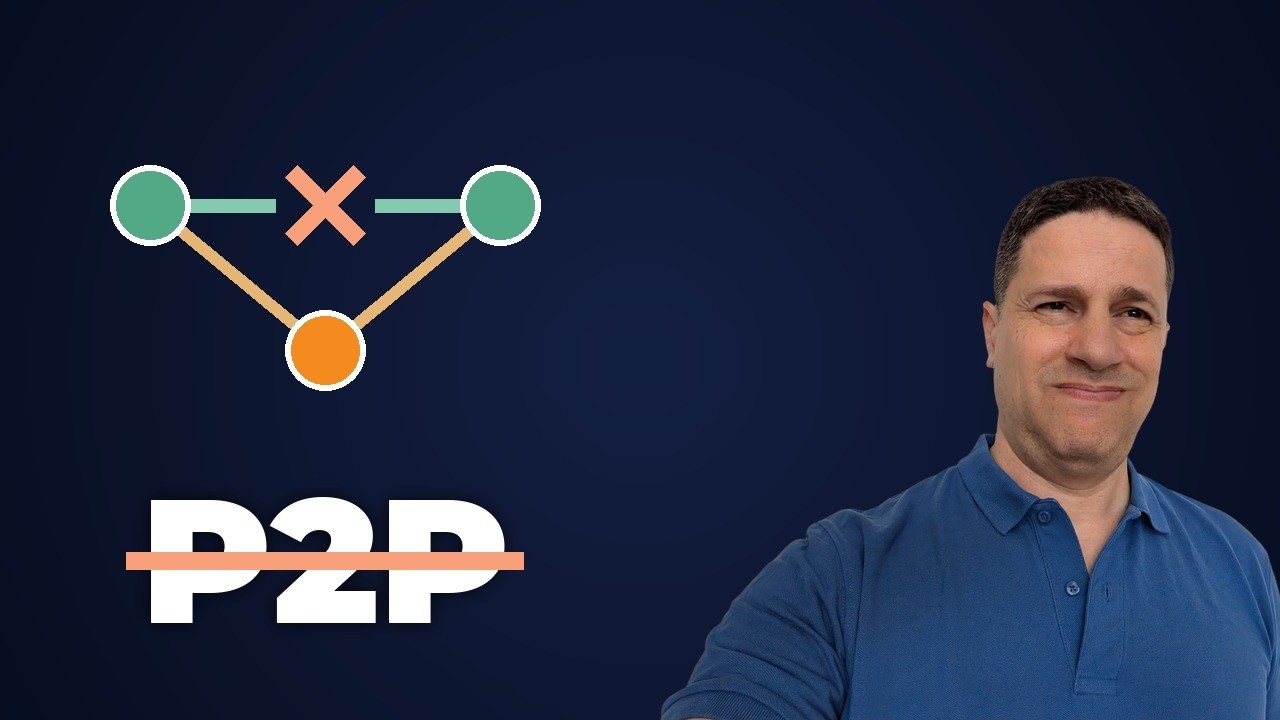
In this WebRTC Live interview, host Speaker A and veteran WebRTC engineer Tsahi Levent‑Levi discuss the resurgence of small, feature‑focused WebRTC applications—dubbed “micro apps.” Tsahi contrasts noisy one‑on‑one Zoom clones with genuine micro‑app use cases that leverage the WebRTC data channel for lightweight functionality, such as a teleprompter that controls text speed, local file‑transfer and machine‑control tools, and turning a smartphone into a PC speaker. The conversation highlights how the rise of voice AI and generative AI (e.g., Claude) makes building such prototypes easier, shrinking the problem size needed to justify WebRTC. They explore the tension between rapid prototyping and the need for scalable, best‑practice deployments in large enterprises, noting the “SaaS‑mageddon” trend where developers aim to replace SaaS with weekend‑built micro‑apps. Tsahi warns about the proliferation of low‑quality AI‑generated technical content that can mislead developers, citing an example of a flawed MQTT article. The interview concludes with speculation on whether micro‑apps will remain niche tools or become baseline features embedded in larger platforms, acknowledging institutional procurement inertia as a limiting factor.
Chapters
Thanks for joining me today, Tsahi. You're joining us today from a hotel room, so we'll see how our internet quality holds on here. But we were just talking about the resurgence in apps which are really just features. Tell us a little more what you mean by that.
I think when WebRTC started off, you saw a lot of experiments taking off. There was even the WebRTC experiment site from Mozilla. And a lot of others who just say, you know, here's how you connect the call, here's how you do this, here's how you do that. Now, in the past year, if you go to LinkedIn, search for WebRTC, you'll find a lot of people from certain countries— I'm not going to name names— go and simply say, we've built a Zoom application. At the end of the world, at the end of what they've done is simply build a one-on-one application, nothing more than that, without even a turn server. So that's, that's like noise. But what you see in parallel is new types of applications that are kind of small features that should go into a lot larger services. If I give two examples, we've got— we've, you know, we've showed that on Insights. One of them was the teleprompter app. You do teleprompting, it has nothing to do with the RTC, nothing to do with communications, but if I want to stand away from the machine but still control the speed at which the words go on the screen, well, I can use data channel for that. And then, it's build something to connect to it, either from a smartphone or from even a physical device. So, you started seeing these kinds of things. Is that an actual application? No. Is it a feature that can go into such an application? Yes. Another recent one was someone that said, well, you go into an event, you know, lots of people in there, you need to start replacing files, moving from one machine to another. How do you control machines remotely in a local setting? Data channel of WebRTC, obviously. Okay, so another something that is not exactly an app, but is there.
Yeah.
The last one I've seen was actually this week, where the person simply said, I'm in my home, everything's fine, everyone went to sleep, and the speaker, the Bluetooth speaker is out of battery. I still want to continue watching the movie, I can switch and use my phone. To listen. Not sure why or how, that doesn't make sense. But well, you know what, let's solve that with a use case that makes the smartphone the speaker for a PC. How do you do that? Well, WebRTC, you connect them and you simply send the audio over. And again, not an app, just something small that you can do with WebRTC. And it's not about that. It's more about the fact that today you start seeing posts that were here 14, 15 years ago, okay, of how to do things, right? Kind of refreshing and new, you know, what else can you do with WebRTC? Is it— have we done everything that we can up until now? Is there nothing new to do with it, any innovation? So it's heartwarming to see that.
There's a new audience discovering it perhaps, right? And I would assume, and if you agree, that that's due to kind of the increased attention on like voice AI more broadly. And then for a lot of use cases, WebRTC is going to come along with that. And so there's more people discovering that as a, you know, as like a transport layer, a communication method that they need in order to interact with voice AI.
There is that. I think that there is another small aspect of it. It's easier to build stuff with generative AI now because you use Claude code and it does everything for you and yay, you can do things. It's a tenth of what it took you before. Not really, but that's fine. It will come to that. But it kind of makes WebRTC more accessible than it were before, and it were very accessible before. So again, you start seeing people just, you know, dabbling with this technology, seeing what it can do for them.
Yeah.
And it makes— it shrinks again the size of the problem that you need to have in order to use WebRTC to solve it.
So all of these new people who are posting, you know, examples of their one-on-one apps and asking questions like, do I really need a TURN server in order to, you know, use to work with WebRTC. How many of them do you think are, uh, Claude bots, uh, out there building an app for someone and trying to figure out if they have to put a TURN server into it?
I think it's an— it's 100%, and it's usually from, um, let's say it is from new engineers in the market, the ones that won't get a job today because nobody's looking for interns.
Right.
So that's—
yeah, unfortunately. Yeah.
How do you get a job today if you're new to engineering is a tough question to answer. Sure. And this is an attempt to get there, I guess.
Yeah, yeah, yeah. Interesting. Well, I think it's an interesting area. And I mean, I think it's an example too, where, because there is so much complexity as well as, I'm going to say institutional knowledge, but I think there's a better term for what I'm trying to say of where you could have GenAI build a simple WebRTC application for you, certainly. But to have it scale and deploy and really use best practices, both of our companies are responsible for putting out a good amount of content out there that, you know, a GenAI might scrape and get some good insights from. But ultimately, you know, this is an example where you have things that are pretty niche. There's still a tremendous benefit to having just that knowledge of being a senior engineer who's done this in 4 different use cases and, you know, different companies, right?
Yes. I think what keeps me a bit worried less about my job is when I see blog posts where you understand that the person writing it was marketing and that parts of the content is purely AI slop because someone missed something in there. The last thing I read this morning was about MQTT. It was really, really good until the point that it said that there are different alternatives that are better when it comes to real-time stuff, which is WebRTC and something else. No, MQTT is signaling, WebRTC is media. They work really well together. Someone missed here, and it's probably not because of not knowing his material, if this is what he wrote. It is because AI filled in the blanks and no one took the time to look at it, if it makes even any sense.
Yeah.
So as long as that happens, I'm I'm happy.
Sure. Do you think that if we could call them micro apps, these apps which are really just features that are doing some very limited functionality, do you see that as a temporary trend then until, let's say, Voice AI plus WebRTC just becomes absorbed as a feature, as a baseline feature in every tool you can imagine? Or is there always going to be a place for some standalone micro apps?
I don't know. It's hard to say. If you take the trend of AI, people now saying you don't need SaaS, it's SaaSmagadon or whatever. We don't need SaaS, you can build it in a weekend with Claude and deploy it in your company. Okay. Is that the same here where you say everyone can build his own microapp and then have whatever it is that he needs? I, I, I find it hard to believe. I'm trying for the last couple of months to build, to take my own knowledge inside the courses, for example, put it in AI to train it and have people be able to chat with it. Mhm. So apparently it's not that hard to do with Na10 and a few more, you know. Building blocks relatively easy. I've done that. But then came the part of how do you integrate that into the WordPress application and how do you store the data and do everything around that small building block that says, let's use AI. I don't, I just don't have the patience for that anymore. So I went off and took a ready-made application to do that, paid for it, and that was the end of it.
Right.
So to your question, would people start doing microapps? Yes, sure, some of them, you know, the engineers of the world, maybe. The rest of us, no.
Yeah, well, and at least the way I, you know, understand the argument for the SaaS-mageddon is that if anything, it might encourage microapps like this, right? Because you're going to because you can recreate, you know, whatever SaaS application you're thinking of— accounting, HR, or whatever— in a weekend. You still need the component pieces of that. And so people have an incentive to create, you know, small companies that do just this one thing really well. And that one thing might be, let's say, you know, WebRTC plus voice AI for healthcare transcription or something like that, right? Just a a very niche application that you then, remarkably like SaaS, sell as an API to someone to use in their larger app.
Yes, but that though goes against the incentive of companies to go towards a single vendor. You don't want 200 microapps in your service, you want 1, 2, or 0. Going towards the 200 means that at some point the CFO is going to go and say, "The hell with that. You're going to reduce the number of invoices I need to pay a month, every month." Right, right.
And yeah, so here we have the natural tension between technological change and bureaucratic and procurement processes in large companies. So, so yeah, things are not going to perhaps, even if they should change as rapidly as some people are saying, there's some institutional momentum against that for sure.
Yeah. All right.
Well, thank you as always for sharing your insights, Tsahi. And as always, for those of you watching this, to learn more about Tsahi's work, you can check it out at bloggeek.me and look out for that potential Tsahi bot at some point. I'm interested to see if I can trick my way around that in the prompts. And to learn more about future episodes of WebRTC Live, check us out at webRTC.ventures. Thank you, Tsahi Levent-Levi.