547. Tyler Cowen, Author of Talent
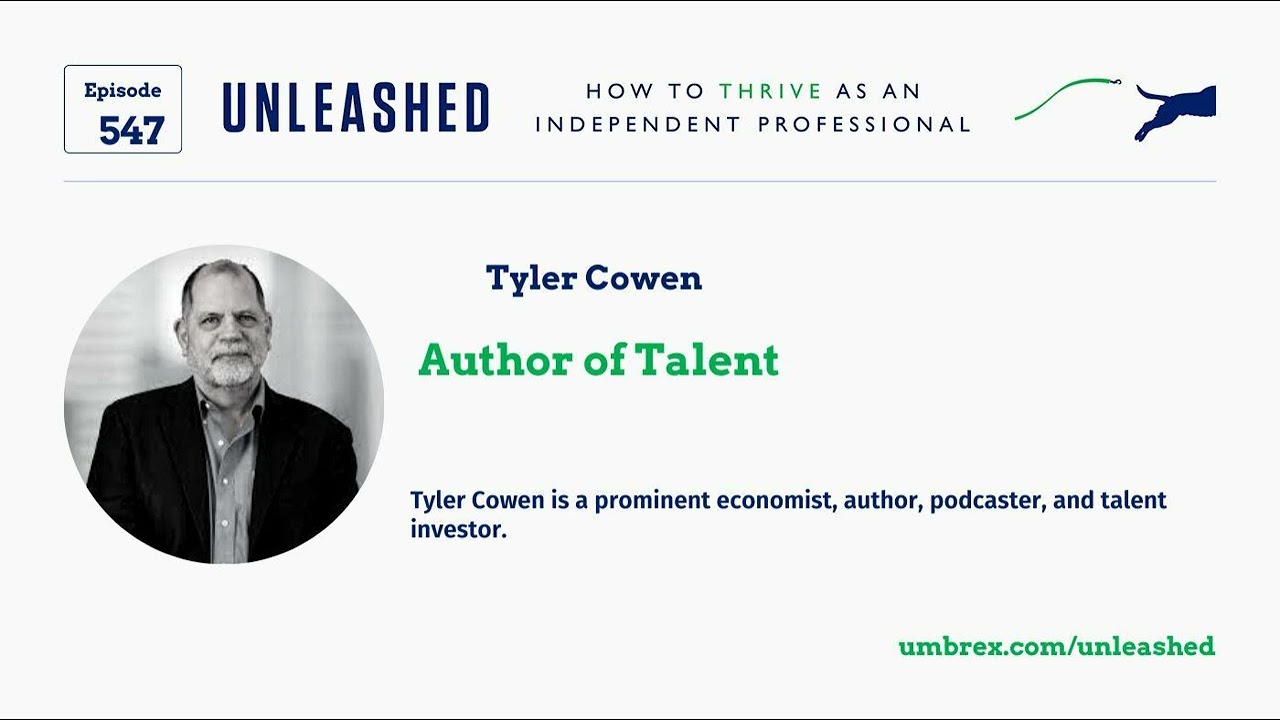
In this Umbrex Presents interview, economist and author Tyler Cowen discusses his book Talent: How to Identify Energizers, Creatives, and Winners Around the World. He explains why talent assessment has been treated more as an art than a science, cites historical institutions that excelled at spotting talent (the Florentine Renaissance, Jesuit schools, Mid‑American business networks, modern China and India), and outlines how modern firms can improve scouting by building soft‑network contacts and leveraging philanthropic ventures like Emergent Ventures India. Cowen offers practical hiring advice: prioritize track records and early‑stage projects, look for "honest signals" such as personal side‑projects or the open‑tabs question, and use take‑home, real‑world tasks to evaluate candidates. He discusses structuring interview processes, the value of writing tests, and the importance of onboarding through informal, speed‑dating‑style introductions. The conversation moves to managing independent professionals, cultural code navigation when evaluating talent abroad, and the role of mentors and personal knowledge networks. Cowen shares his own productivity habits, lack of formal knowledge‑management systems, and his view on business representation in media and the economic value of consultants. He concludes with reflections on ambition, his personal objective of becoming an "information trillionaire," and how he raises ambition in grant recipients.
Chapters
Hello and welcome to Umbrex Presents. We are here today with Tyler Cowen. We're talking about his book Talent: How to Identify Energizers, Creatives, and Winners Around the World. I'm your host, Will Bachman, and welcome to the show, Tyler. It is great to be with you.
Hello, thank you all.
So Tyler, I would like to start with a social norm. I'd like to propose one. I want this to be a fun conversation for you. So I'd like to propose that if I ask you a question that is boring, or that if you've answered before, that you just tell me— and normally this would be rude— but you just say, let's skip that question. What do you say?
Maybe I'll ask you a question back if that happens.
That is perfect. Fine. So you could say, let's skip, that's boring, or skip, I've written a Bloomberg column on that. So let me start with a question. So a couple observations: in your recent EconTalk with Russ Roberts, you told him that in writing Talent, you did read a bunch of articles, but you didn't find that many books on talent identification. Um, another observation is when I went to business school, I took zero courses and even had zero individual classes on how to interview or how to identify talent. As an economist, what's your model of why talent assessment has been relatively neglected?
A great deal of talent assessment is an art rather than a science. So there are books on talent, but they tend to be very thin in terms of content. And what you learn from the median book on talent is zero. So I set out with the practitioner Daniel Gross, venture capitalist, and I have a philanthropic role myself in spotting talent. And we were taking the lore of Silicon Valley but adding academic research to it and adding experience from management and academia and other areas and trying to produce like the book on talent. What— which single book should you read to figure out how to think about talent?
What institutions historically, let's say before the 20th century, were particularly good at identifying talent?
I'm struck by how well the Florentine Renaissance did in identifying talent. It's over a span of a few centuries, but you have Dante, you have Machiavelli, you have Boccaccio, you have Leonardo, you have Michelangelo, you've Botticelli, you have Galileo even. In one region that, you know, had 60,000 to 80,000 people, maybe 100,000 people at its population peak. So it was a competitive process. There were a lot of individual patrons. You could get glory from identifying talent. That to me was arguably the peak of the Western world for identifying and mobilizing talent. And it was hundreds of years ago. We're not doing as well as they did. What does that say about us?
That's really interesting. I was wondering if you might talk about the arts or music, or perhaps whaling ships, or military, or the Jesuits. You, you blogged about a book on the Jesuits recently. Any thoughts on other sorts of institutions outside the arts that have been good historically?
Well, those are all good examples that you cite. I think identifying American business talent in the Midwest through the core part of the 20th century is another very good example. That would be outside the arts. I think we've done a remarkable job of that. China more recently, they're moving backwards at the moment, but identifying CEO talent in a world where basically no one had an MBA, the educational backgrounds people had were irrelevant. They almost certainly didn't come from wealthy families and finding plenty of Jack Ma's who could actually run companies and take them to high levels. That would be another example. India today is the single hottest blossoming talent spot, in my opinion. And it may be Indians who are leaving India in many cases, but I view India today as like Central Europe in the early to mid-20th century. Just fantastic things happening. The region itself is not in every way doing well, but people there are really motivated to build better lives for themselves.
Are companies underinvesting in spotting talent overseas? Particularly, I mean, obviously multinationals are, but what about smaller companies?
This is changing rapidly. 5 years ago, I would have given you a definite yes. But with the pandemic and work from a distance, we have so many small companies, nonprofits, even just say you're an author and you need for someone to do the graphics for your graphic novel. The chance that you'll hire someone in Indonesia or the Philippines is much higher than it was just a few years ago. So we are fixing that, but it's harder to evaluate talent in other countries. You don't have the common cultural background. You're not sure what questions to ask. It's harder to interpret the references they might be able to give you, but I think this trend still has a long, long, long way to go.
Basically, talent is evenly distributed around the world, but opportunity is not, and that means you can arbitrage Now, many of the listeners of this show are independent professionals, many of them folks that were at management consulting firms and have now set up as, as independent professionals. And we've seen this trend increasing over the last 10 to 15 years of both more people going into that space as well as more companies being open to it. And I, I, I have a very rudimentary understanding of the Coase theory of the firm, but I think it's what it would predict as transaction costs go down. It's easier to find people and bring them in. It's easier to plug them in. How do you see that trend evolving of companies bringing in independent professionals, at least as part of their talent strategy?
I think what a lot of companies need to do is exist— to invest more in their pre-existing networks of soft contacts So if you just wake up in the morning and say, I want to hire a smart person in India, I mean, great, you might succeed. But who is it that you have who can recommend smart people in India? And who are the smart people in India who already know who you are? And if you're going to be very good at this, you need to have smart people in India now already knowing who you are. So on any given day, investing more in those preexisting contacts It will never seem like a priority. But if you think of talent as the number one factor probably driving the success of your venture, it's something everyone is going to start to do more of.
So say a little bit more about that. How would someone get started on that of building some talent scouts or some people that can help them navigate in different geographies around the world?
Well, just an example, I run a purely philanthropic venture. Called Emergent Ventures India. But we do also give grants to people doing for-profit companies. And if we just advertised in Indian newspapers, we would be swamped by all kinds of pleas for money. But in fact, I've written a blog in English, of course, for 20 years now. I hired an Indian person who is well-connected in India. On the blog, in the podcast, I try to put in material relevant to India.. So people in India know to some extent who I am, and I don't try to make this material too simple or too accessible. I deliberately want it to serve as a kind of filter. So we don't ever advertise Emergent Ventures India. That's on purpose, but we get quite a few good applications from India because some people there already know who we are, and that has worked for us, but it's a very indirect roundabout strategy. It's not trying to reach people too directly. It's counting on the smartest people to take step 1 in the game is finding out who you are.
So in the book, you focus in on the— you can almost start in Medias Res with the interview process. Let's back up a little bit to the place where, let's say you've posted a job and you mentioned if you posted it in India, you get many, many applicants. Let's say you've posted a job and you get 600 applicants. For a role. What's your thoughts around screening those applicants before you get to the interview process? What are your tips on that?
Well, it's really going to depend on the sector and the context. So, if these are people with established track records, I put really a lot of weight on the established track record that basically behavior and demonstrated preference dominate over talk. Or rhetoric. A lot of the problems I work with are with quite young people who really don't have established track records. The feature that I think is undervalued is simply people who started some project of their own at a very young age, no matter what it was, how weird or trivial it might be, I don't care. Weirder may even be better. I'm not very interested in people's grades. Often to me, those can be a kind of negative. They oversignal conscientiousness. And if you're looking for entrepreneurs— again, this depends on the job, right? You want people who both can work on their own but understand how they fit into a team. So simply having initiated things and stuck with them, I put higher weight on compared to credentials.
Okay, so for someone beyond kind of the idea of you know, very junior people. Let's say you're hiring for some mid-career, hiring a controller, you're hiring a director of marketing, and you have 500, 600 applications. Um, how would you think about doing that screening process? I mean, if you spend a minute on every one, it's going to take you 10 hours to go through them. So what kind of, uh, rules of thumb would you suggest for that initial screening phase?
The pre-existing soft network is very important. Who do you have that is in your company or you work with in some fashion who knows those people and can speak credibly about them? So I found that to be by far the highest yield way of approaching a problem where there's a large number of potential applicants. And it's also a signal that the candidate knows enough about you to grasp what you're doing and fit in. So I think if you're just staring at a bunch of Vitas and, you know, degrees where people went to school, I don't think you're going to do better than anyone else. I don't think there's a special secret to doing well in that process. I would stress the focus of our book is a more unstructured kind of hiring where you're hiring individual people for particular roles, and often you're not dealing with 600 candidates. But again, I would use soft connections, uh, to winnow down that field as much as you can. Yeah.
What are your thoughts about looking for, you know, honest signals? So, Bill, you talked about that a little bit already of what I've found when, you know, looking for people for project opportunities and figuring out who would be a good consultant for a project, it's looking at someone who has given some honest signal of interest in that topic or credibility. So if you have two individual candidates and they're both supply chain people and one has a podcast with 100 episodes on supply chain, even if you haven't listened to the show, they've given some evidence that they really care about that topic and perhaps know more about it. What are some of your thoughts around looking for honest signals when you're evaluating talent before you get to the interview stage?
That's very consistent with my emphasis of looking for people who have started something on their own, right? That's one of the very best signals. A question I like to ask during interviews is simply, what are the open tabs on your browser right now? It's not a question anyone is prepared for. It's very hard to fake because you could ask the person to talk about those open tabs, but it tells you how do they spend their time? What do they read? What are they engaged with? Who are they communicating with? And from that, you get some sense of their honest signals. Most questions you can answer in a somewhat fake way. You've sort of prepared, you've told your story, you have something very pre-packaged. Maybe you as an interviewer won't learn a lot from hearing that pre-packaging, but a flat-out question like, "What is it you do?" I find the answers highly informative most of the time.
Let's talk about the broader interview process. So, You listed as one of your top books that you recommended on the blog Working Backwards about Amazon, which gets into the Amazon interview process. So beyond just the single interview that you go into a lot of depth in the book about conducting, sort of the broader organizational process for passing someone from one to one and making a collective decision, what are some of your thoughts around the best ways to structure that entire process?
In a lot of companies, there are too many layers of no. I'm often skeptical of how human resources departments approach decisions. They are, of course, absolutely necessary. But they're often more loyal to their own processes than to the company. Again, it depends what kind of job you're hiring for. If you're looking just for conscientiousness, which is the case in a lot of jobs, some measure of intelligence and conscientiousness, I think it's fairly hard to improve on the standard practices of today's top companies. But if you're looking for people who in some way have the potential for promotion or who will be team leaders or idea generators for your company, I like to test writing skills in particular and also just how people address questions they're not prepared for. But I take clear writing to be a sign of clear thinking. And I'm very impressed by companies such as both Amazon and Stripe that emphasize writing skills and memos.
It's interesting that you mentioned that. One thing that we've done when hiring at Umbrex is giving people a practical exercise after— people that have passed through the interview round, giving a practical exercise. Um, so, and in some cases, if it's an extensive one, it'll be a paid exercise. So for example, when we hired a content marketing manager, we actually had, you know, paid the person— we paid 3 candidates to do a, a kind of diagnostic of our current content, write some recommendations, what are the gaps, and so forth. Uh, what— and one time when I helped a client hire a plant manager, we had multiple candidates do a walkthrough of the plant and then write up their observations, current state, what would they recommend for future state. What are some of your thoughts around develop, you know, kind of that practical exercise, a written exercise, some kind of take-home exam, not sort of just a general exam, but something specific that shows the person doing real work?
An actual task is always best when you can do it. And if you look at areas that are very, very good at judging talent, I mean, take something like chess, which is not a job sector, but how do you judge the talent of a chess player? Well, you play a game of chess with them, right? There's not really going to be anything better than that. You could look at their earlier games, how well they had done. So insofar as you can approach that model, that you have the time and money, it virtually always dominates the alternatives.
What are some of your thoughts around onboarding talent to make sure that they get accelerated quickly. So when I was— when I, I was, I was in the Navy for 5 years, and when I first arrived to my nuclear submarine, just like every, uh, new enlisted sailor and officer, I was giving about 100-page thick, uh, 100 pages of qual card, right, of every, you know, watch that I was gonna have to qualify for. And it was either, you know, each page would have a dozen signatures of either you had to observe something, explain something, simulate something, or do it under instruction. Rarely have I seen companies taking that sort of structured approach. And it was so helpful because it empowers you to know what's expected. What's your thoughts around onboarding talent and helping them understand what is expected in the role?
I direct a nonprofit which has close to 200 employees, not the same as the companies you're talking about. But what I found works is to introduce a person to a fairly large number of different individuals and just give them some open time for unstructured interaction. That if you give people written text, they don't really believe it. They become numb rather quickly. They're really looking for someone to tell them how things actually work. And if you have a healthy culture, you want someone to do a fair amount of that sort of off the record, things you can't quite say as boss, but will actually give the person a sense, what am I expected to do? What are the ground rules here? And you don't always know who will be the best person. So we'll kind of— almost like a speed dating exercise where they get to meet a fair number of different people in the company. This, of course, has been much harder with pandemic. It's one reason why I think work from a distance doesn't always work. But I found that's what often works best.
What are your thoughts around evaluating the talent that you currently have in the company and the best ways that you've seen of doing regular talent assessments.
Investing ex ante in high levels of trust. I think it's a bit like the soft network. On any given day, it doesn't feel like it's an emergency to do this. But if people trust you, they will come forward with either improvements or their problems. And you will learn much more about how they're doing. Rather than to focus on the exercise of the mid-year or the annual evaluation, yes, of course, that's important, but what is it you can do now when it feels like nothing is wrong so that people working for you trust you more? I take that to be the priority most of the time.
One question that you regularly post on Marginal Revolution about the, you know, what I'm reading now, so the books that you're reading. I haven't seen you provide a list of the newsletters or Substacks you subscribe to. And I can intuit some of them that, because you talk about Ted Gioia or Matt Yglesias or Scott Alexander, but what's, what's the, the list of Substacks or newsletters that you subscribe to?
Well, there's very few of them. I think you just mentioned them all. You said Ted Gioia, Scott Alexander, Matt Yglesias. Uh, I get Noah Smith. Possibly that's all of them. So. It's not the main way I consume contact, Substack. I would rather speak with actual humans, including those people themselves whom, you know, I spend time with, and go around and travel and read books and history rather than Substack. Now, that's only me. I'm not saying it's the right way to do it, but I find a lot of Substack to be quite repetitive.
Okay, so you brought up travel, so I wanted to ask you about that. You wrote a fantastic book about How to Find a Good Place to Eat, and I think it's Economist Gets Lunch, and you travel quite a bit. What are some of your tips, kind of analogous to your book on how to find a good ethnic restaurant? What are some of your tips on how to travel and really learn, uh, the culture and, and what a place is about?
My main tips are pretty simple. First, walk a lot. That's possible almost everywhere, not everywhere. Eat in places that are not in guidebooks. Try to speak to a broad range of people. One nice thing about being interested in food is you end up talking to people who are not wealthy and well-educated, but maybe who run restaurants or who cook for you. Go to places that appear to have no main attractions. Go to places you think you wouldn't possibly be interested in. And just go there with an open mind. Another tip I would give— I never used to give this, but the world has moved away from it— and that is buy a physical guidebook in advance and read it. People rely too much on the internet when they travel, and I find that a very constricting experience. So just get a good stupid old guidebook for wherever and read it in advance, and then listen to music of where you're going, read some novels, fiction, whatever, and just absorb it. Don't overplan your day. Walk, walk, walk.
My favorite professor in college was John Stilgoe, professor of landscape history, and he says when he gets invited to go give a talk to alumni around the country and they always ask him, "Oh, would you like to see some local site?" He always says, "Yes, take me to the town dump." I love to go see infrastructure. How do you ever kind of reach out to people that may be your readers or people that you know, or people that live in that area to connect with them, kind of walk you through a factory or kind of show you behind the scenes somewhere?
I do this a great deal. This gets back to the soft network point. I might just mention on the blog or on Twitter that I'm going somewhere and not ask for help. If you ask for help, you often get worse responses than if you don't ask for help. And then filter what you receive. And, uh, I think I'm at the point where almost anywhere in the world I can say I'm going there and I'll end up with some number of very smart people who will help me, talk with me, uh, and that's highly rewarding. It's one of the best things about travel, and it's not something I build on a given day, but if you're just there in the market of ideas for many years, again, building out your soft network You'll meet interesting people who can help you in all kinds of ways. And for some of you, it may be people you hire. For me personally, it's at times been people I end up giving money to philanthropically.
Yeah, tell us, tell us a story about a place that you, you went to that you met someone. I think you've talked about Ethiopia on the blog, but, but tell us a little bit more about someone that you've helped philanthropically that you met on one of your travels.
Well, before the pandemic, my wife and I— my wife grew up in Soviet Union— we went to Ukraine and went to Kyiv, and we met up with the Ukrainian-American economist named Timothy, who ended up supporting him and gave him a grant to write on economics in Ukrainian. And he ended up being named as the economy minister for the Zelensky cabinet with that time that had been freed up. And now he's one of the people running logistics in Ukraine for the war. So that's a connection and a grant that I feel has had a significant impact. And my going to Ukraine and being in touch with him, which again happened spontaneously more or less, but he had been reading things I was writing and decided he wanted to do a version of that in Ukrainian. That was again power of soft networks. And he is an amazing talent.
I'm curious if there was an idea about talent that was maybe too radical or not sufficiently supported by the evidence that you thought about including in the book but you decided at the end to exclude.
I'm never sure what's radical, but here's an idea that's not in the book that I was reluctant to put in the book. That there really are a lot of cases when successful small ventures are a bunch of people who are a lot like each other. So you look at early PayPal, they're all nerds, they all loved Lord of the Rings. You have Peter Thiel, you have Reid Hoffman, you have Elon Musk. They're different personality types, but in some way they're cut from the same bolt of cloth. And it's become unfashionable to just come out and say, well, some things work really well when the people are just a lot like each other. I don't think it's a radical idea. I think a lot of the world would just accept it straight up. But it's not in the book. And sometimes, not always by any means, it's true.
You talk about status quo bias and how Americans are moving less frequently, moving geography less frequently. How do you think about your own potential status quo bias and just challenge it? You've been blogging on Marginal Revolution for 18 years. You've been a professor at George Mason for a while. Do you have some kind of periodic process where you think, is this still the right decision for me?
I'm always trying to start new projects. So I think it's now 7 years ago I started Marginal Revolution University. That's YouTube videos. It's now the number one economics education site on the internet. It's zero revenue, zero ads. It's all philanthropic, given away for free. Fast Grants was a project I started with Patrick Collison that was to very rapidly funnel money to biomedical researchers. That involved a big fundraising and managerial commitment on my part. We funded anti-COVID research. Now it's about $60 million. We sent out most of it over the span of just a few months. My podcast, Conversations with Tyler, I think it's 4 years old. I couldn't say it's new anymore. To me, it still feels new. So I'm happy in my current job. I think I live in the best part of America. My non-complacency will take the form of new projects and emergent ventures and working more with talent and co-authoring with Daniel Gross, who's a private sector venture capitalist. That for me is another new collaboration, new project. So that's what I try to do. I don't doubt that in some key ways I fail miserably. I've lived in the same area for over 30 years, but I do try to be on the road a third to a half of my time. So that would be my partial remedy there. Do I still listen to the Beatles and Beethoven? I do. And in a way, that's terrible, right? But they're really good. I also still buy new music.
You talk about quite a bit about finding a mentor, and that's a guide. Give me an example of one of your mentors and what's the interaction like? You know, does the person— have you, you know, walked through the museum with the person? Let's say, let's find an art mentor. Give an example of an art mentor, for example. Do you walk through a museum together? Do they just tell you what galleries to go to? Do they help give you context on different artists? Like, Give me a little bit of that granular detail of what it's like for you working with one of your mentors.
An art mentor could be another collector who collects in the area that you do, and you go see their collection, you talk about individual pieces, how they think about collecting, what they've done to find pieces. An art mentor could be a dealer who's selling you art. Obviously, there's potential conflict of interest, but good dealers will try to educate you and not just try to trick you. They want you to learn more and be more interested so you feel more confident about spending money on art. There's always someone who knows more about a thing than you do, unless the thing maybe is yourself. So there are always mentors you can find. A lot of people want to mentor, are great at it. You should have a lot of mentors who are younger than you are. I have a number of tech mentors. My co-author Daniel Gross, he's 30, he's from the world of tech. He ran, you know, machine learning at Apple. In his mid-20s. So I learned an incredible amount about Daniel, not only about talent but also just about the world of tech. So you should never stop with this process, never let up. What makes ideas vivid to you is other human beings, not only reading them in books.
You talk about cracking cultural codes. I was wondering if you could give us an example of a cultural code and what it's like to crack it. And is it something that can be articulated in words, or is it more like learning a foreign language? Like, you couldn't just tell someone, here's the cultural code to Spanish, you have to learn Spanish. Or is it more like, here's the key to understanding this culture? Just give us an example of a cultural code that you've cracked.
I don't think you ever finally crack a cultural code. You just get a bit further. So I like to travel for reasons of business but also pleasure. I've been to a little over 100 countries. Very, very often I'm interviewing people from other countries. I do find it's a big help if I have been to that country. It's easier for me to bond with them. I can talk to them about the culture or the music or the cinema or the cities or something. When you've been to someone's culture, you often get a better sense when are they simply being too polite because they don't know what you expect of them. And you want to get out of that equilibrium. When people are too polite to you, too deferential, it's very hard to figure out what's really going on in their minds. And if you don't know anything about their world, odds are they're just going to stick with being too polite. I find this has happened a lot, especially when I have calls with Nigeria. Nigerians can be wonderfully polite That's a nice thing, great, but if you're evaluating them for a fellowship, it's not what you want. You want to hear how their actual thoughts are running. And if you can show them you understand something about Nigeria— I don't even mean that you've cracked any code— uh, you have a much better chance of getting through that wall. I'm doing what will be my 6th trip to India in August. Uh, I'm going to an event But I have multiple motivations. And I think just showing the people from India I talk to that I care about their country, their cultures, their religions, their food, whatever, that's very valuable.
You talk about one of the most high-leverage things we can do is to raise someone's ambition. Could you walk us through an example of how you've done that, maybe playback a conversation you've had with an Emergent Ventures winner where they were shooting for X and you— what did you say to get them think about shooting for X squared? Like, what were the words that you would use to help raise someone's ambition?
Well, there's one Emergent Ventures winner we had. He has started an online writing company. And I think at the beginning, he had the sense that online he could work with some number of people and simply earn enough money to live from, and that this would be better than going out and getting a job. This fellow is extremely bright, super personable, has the right look for what he wants to do, uh, just comes across well. And I just told him, look, I know a lot of people who are super successful, and you can do better than they can do. Like, you are more talented. And this person, he did not get good grades in school. He went to an okay but not top undergraduate institution. A lot of his friends, like, they were very smart people, but they weren't like major educational successes. And I just said to him, I know all these other people, like, you can beat them, you can do it. Like, and I spent some time with him, and I think he just saw that in conversations over dinner, things he said I genuinely thought were really smart, and I wanted to spend more time with him. And now this is a very valuable business he has. I'm not sure of the exact valuation, but it's some number of millions, which is like really pretty high. And I think he's 25, 26 now. And that just told him like, hey, don't think locally, you know, think globally. Just, you can do this. A kind of arbitrary pronouncement on my part, but it seems it worked.
It did. I think, I think I know you're referring to, and that is a fantastic course that he leads.
Yes.
Um, and, uh, we actually had his, uh, business partner on the show here.
Oh, great, great.
Yeah, fictional portrayals. So there's a lot of movies about TV, uh, on T— and movies and TV about police, about attorneys, about, uh, doctors. Um, you wrote a kind of an ode to big business, but there's few fictional portrayals that I'm aware of that actually give a sense of what it's like to be in business, at least in terms of TV and movies, and not too many novels that I can think of, but I might not be looking at the right ones. One, do you think that's true, and why do you think that's the case?
I'm fairly sure it's true. Maybe, you know, Coppola's Tucker movie would be one counterexample, but that's super rare. Look, a lot of business is routine. It's boring. It's not a simple good versus evil story. Spider-Man movies sell. There's a villain. If big business is in a movie, it tends to be the villain. I understand why that's the case, but it's easier to do than to have the business person be a hero. Heroes are Peter Parker and James Bond and Michelle Yeoh. And okay, this is one reason why the public doesn't respect business enough. Media doesn't treat business very well.
Okay. So follow up on that in terms of business journalism. So much of it is just this kind of surface exterior view of the business world. It's like earning results or mergers being announced. And so rarely do you see business journalism talking about what it's like to actually be inside a company. You know, what's it like to go through a successful ERP implementation or you know, what PE firms look like— look for when they're doing commercial due diligence, or, you know, how firms are optimizing their supply chains with lean principles. Why do you think that is?
I think that's a tough one because there's so much negative coverage. Businesses are reluctant to give access because they're afraid the person will take what they see and twist it into something negative. And to be clear, sometimes the actual story is negative, right? So if they don't let you in, there are plenty of writers, journalists, columnists who have a lot of access to what's going on in particular businesses, but they're not able to write about it because it was given on the basis of confidence. So I don't know how to solve that trust problem. It would require a very different world than the one we live in.
Let's talk about management consulting for just a minute. People like to make fun of consultants, and sometimes with justification, But nevertheless, organizations do continue to pay consultants quite a bit of money. McKinsey charges in the neighborhood of $150,000 to $200,000 a week for a team of an engagement manager plus 2 or 3 people. I can think of a few different reasons of ways that consultants add value, and I'm curious to hear your reaction or your model of it. So I'll list a few, and I'd like to hear your reaction. So one is you know, justifying a decision that the board has already made. I hear that a lot. Another one is offloading blame, you know, for cost cutting, for example. 3 is the butterfly. So, you know, bringing in ideas from outside, from other companies or the industry. Um, 4th, this is a roving reporter. So sometimes it's so hard in a company for the senior leadership to actually know what the front line is saying, and they don't have communication. And sometimes you just need a mirror to provide an outside perspective. But those are some ideas. What's your model as an economist of the value that management consultants provide and why they continue to, you know, be able to charge the fees they do?
I agree with all of those. Obviously, the variance of consultants is quite high. But if a consultant gives you one good idea, the value of that idea can be enormous. And I think another factor is that consultants embody ideas in living human form. And what makes ideas vivid and meaningful to people, getting back to an earlier point, is for a human being to tell you that idea. And that sounds silly, but even if the idea on the surface seems fairly trivial, like, oh, you know, make sure your workers have high morale, or you need to look more at this process, it might seem obvious, But just to have people tell you something in life is one of the most valuable services they can render. So, if you look at, say, how religions work, well, yes, there are some people who are converted like by DVD or through YouTube videos. But so, so often when people undergo a religious conversion, it's because they met and admired another person with that idea. And then, it became real to them. And good management consultants are living embodiments of their ideas in a way that only they can succeed in making vivid. So I would say the value of ideas underpins the whole enterprise, but of course there are many bad or useless consultants. Overall, the sector to me seems underrated, I have to say.
I'm glad to hear that. Um, what would you say about— as an economist, are you able to give any insights into the relative ability of management at kind of a country level, or is management just better in some countries than others?
Management is clearly better in some countries than others, but it does change over time. So a lot of British companies have become much more Anglo-American rather than British in the old 1960s, 1970s sense, where you could try to make a phone call in the country and it wouldn't necessarily work. That's a big change. So British business went from best in the whole world in the 19th century to being often fairly mediocre. And now again, it's high variance, but a lot of it is quite excellent. Indian business, parts of it are transforming itself to become far more productive. Chinese business, obviously. So it is fluid. But at a point in time, I am convinced there are national cultures to business.. And it's hard to simply break them by a mere act of will.
Say a little bit more on that, like what— in terms of what countries would you say right now strike you as doing particularly well, and which ones are in kind of the more development stage?
At the risk of sounding too patriotic, I'm super bullish on American business. I think it fits our national character very well. I would be very long Southern England and Ireland also, and Sweden. So I think we're at a moment where true fluency in the English language is worth much more than it had been. You have a lot of national business cultures. I was just in Denmark, obviously a successful country. Their 5 biggest businesses all date from the 1920s or earlier, and that works for them. But Denmark is not Sweden, so I think one has to know and internalize that when thinking about Danish business. Denmark, one of the best countries to live or work in, right? But it is really not like the American business scene. They are not that good at generating new dynamic companies. It might change. This is all fluid. A country that right now I worry about its business scene is Germany. They have potential to do much better. I don't yet see them doing it.
There is an organization you've probably heard of called Thinkers50 that creates a series of lists of the top 50 thinkers in the world on different topics. An idea that occurred to me recently was to come up with one's own personal Thinkers50 of, you know, what— not so much the what some outside organization says, but what are 50 thinkers that have impacted you. What would some of the people on your thinkers 50 be?
Patrick Collison, Peter Thiel, Marc Andreessen, Daniel Gross. They would be some of them. Increasingly people who are not academics. Magnus Carlsen is a big influence on me, the chess player. As a marketer, as a career strategist, as someone who has embodied excellence in actually a few different areas. For briefly, he was world number one in fantasy football. Now, how can you be world number one in fantasy football, slow chess, and rapid chess all at the same time? And now he's a very good poker player. So I study Magnus's career and try to learn from it. He is not only in my top 50, he's in my top 10, and he never seems to lose his equanimity. And that's important for what I do. It's probably important for a lot of you. He, for me, is a real role model in that manner. So many other top chess players are brilliant, but at some point they lose their temper, they screw up, they make bad personal decisions. Uh, we have never publicly seen Magnus do that, ever, even though he's been in the spotlight since, what, age 13, 14? And he's by far the most famous person in Norway, and he still always It's kind of kept on message, but in a way that is sincere and believable.
I am often just astounded by your productivity, and it seems almost superhuman. So it seems like you watch a ton of movies every year. You watch a lot of— you've been talking a lot about television shows. You read 4 or 5 books a day. You're also creating the you know, Emergent Ventures and teaching. Could you walk us through your schedule for a typical week? Like, what, what does a week look like for you? When you're waking up, like, how do you allocate your, your time?
Let's assume that I'm at home, right? Because that makes a big difference. I get up every morning at the same time, might be quarter to 7, give or take. Not late, but not super early. I start working and thinking right away. I go through my Twitter feed, my email. I actually still read paper newspapers. I try to have it so every morning I write. Saturday, Sunday, Christmas Day, my birthday, I don't care. If it's at all physically possible, that morning I am writing something, a column, a blog post, a book, whatever. If you write every morning, you will get better at writing, and you will get feedback on what you're writing. There's always a lunch. I like for that to be at the same time at noon. I love to have lunch with smart people and talk with them and engage. I'm on WhatsApp and email throughout. I don't manage interruptions. I would say I try to turn interruptions to my advantage. I don't recommend that for most people, I should add, but for me it has worked well. Afternoons can be teaching, can be meetings. Can be, you know, giving a talk or lecture somewhere, could be anything in an afternoon. But typically in an afternoon, I'm not writing that much. Any spare time in an afternoon, I'm reading. I take a break for exercise. Ideal time for that would be between 3 and 4, but that's highly flexible. I like to eat an early dinner, then I get back to reading. Maybe I'm writing again, and I just don't stop till I go to bed. At like 11:00, 11:30. I sleep well every night. Our daughter is grown. She now has a granddaughter. That's great. But I'm not full-time raising kids. The things I do externally, my wife likes to do with me, and she's fairly independent-minded. In some ways, being married to me is hard because I'm so obsessive. But I do spend a lot of time with my wife, talking with her. We'll go out to eat or exercise together or go see a movie. And, you know, rinse and repeat, just do it. I don't really watch much TV. Most of it I find a waste. I will watch major public events like a presidential debate, but maybe over the course of a year, like, there'll be 2 TV shows I watch and, like, watch through. No more. It's just a lot of time, and I can't do it faster than other people can do it.
You talk about writing a lot. Our last guest on this was Tiago Forte talking about his new book, Building a Second Brain. It was all about personal knowledge management. How do you keep all of the writing that you've done? Do you have a kind of an Evernote system, or do you save it as a Word document, or how do you keep that so that you can go back and refer to your past thinking?
I don't really keep it or refer back to it. I have no system. I do write things in either Microsoft Word or Google Docs, like I do. I have to use something. But I have no method of referencing, or you could say Marginal Revolution, my blog, which has a search function. That's like my personal encyclopedia, and I use that sometimes, but I have no methods. I just write, keep on writing. If it's important, I hope I remember it, or I can ask other people like, hey, what did I say on that? Actually, someone will know.
You've talked on your blog about not drinking alcohol, and that, that influenced me, so I was I was like a social drinker, but a couple years ago I stopped drinking alcohol thinking that, yeah, it was overall not a positive cost-benefit analysis. Did you never drink alcohol or at what point did you stop and how'd you make that decision?
Well, when I was younger, I would say maybe I would have a total of half bottle or bottle of wine a year, which is very small quantity. And I certainly very much enjoy red wine, but I would rather be more productive and not have that slight buzz or feeling of wanting to be more sociable, whatever it gets you. I just wanna be more focused and be working at a higher pitch. So that's meant zero alcohol for, I don't know, the last 15 years, maybe 20 years. And I just don't see a compelling reason to do it. Some people love some amount of drinking, don't want to give it up. Uh, I'm happier, you know, at zero. So it's worked for me, I would say. But keep in mind my work schedule— there's never a point where my day ends and I go to doing something else. Like, I'm always just getting back to work, and I want to be doing that like super refreshed and vital. So no alcohol.
I want to ask you a question about interviewing in terms of One thing to look for is that, and it's even in the subtitle of your book, looking for energizers. So that kind of character of relentlessness, of resourcefulness. There's a 100-year-old essay, Message to García, about sending someone into Cuba to go send a message to García. And the person doesn't ask like, okay, what's García's last name? What's his address? How do I find him? When does it have to get there? He just takes care of it and does it. What's some of your thoughts around screening for that relentlessness or resourcefulness? Someone that you can just trust to go get it done.
If it's an older person, obviously look at track record above all else. And if you need to put more time into interviewing references. But those people, they tend to already be capitalizing their full market value. So a lot of what I'm doing is looking for much younger people without much of a track record who have that relentlessness. And I try to get them talking about their weird interests and whether or not it shows up there. That's what I found is the most successful way to date, to get some sense of their resourcefulness. How strong is their weird interest?
Say a little bit more about that. So what are some of the questions that you'd ask and how would you dive into that?
Well, take someone like Peter Thiel when he was very young. He could tell you the name of any character in Lord of the Rings. And you might think, well, that's silly. But no, it wasn't silly. It's a sign of being obsessive and involved and really caring and wanting to figure out some world as a world in and of itself. And those same talents Peter later applied to venture capital, judging talent. He's maybe the greatest talent judge we have. So I like to just get people talking. I'll say like, what's your favorite book, favorite movie, favorite anything? And then ask them questions about it. So if someone really likes Star Wars, I'll ask them, well, Yoda, did he give good advice? Was he a good judge of talent? And when the people have no real response to that, I get worried. A lot of those people can be excellent employees for some functions, to be clear. But in terms of being the truly resourceful, relentless people, somehow they're watching this movie, which is their favorite, and it's not occurring to them to keep on asking those questions, talk about those questions with their peers. So to get them off prep, something they really care about, see how deep their knowledge of it is. That's what I try to do. But again, track record, when you have it, beats anything.
Yeah, I mean, Yoda was not very successful at convincing Luke not to quit his training, right?
And he never realizes, like, who's going to turn bad, right? He never sees impending danger. He has these vague platitudes. But I'm not concerned with evaluating the answer. So if someone says, well, Yoda's brilliant because by the time you get to Episode 19, it's all falling into place, it's really the level of detail in their answer that impresses me, not whether I agree with them.
You talk— what advice do you have for parents, uh, for developing talented kids? You've talked a lot about encouraging, you know, about weirdness and looking for people with deep interests. Uh, what are some of your advice to parents?
By the time your kid is 12 or 13, they will not let you influence them much more than you have, right? So you want to make a concerted effort to introduce them to your talented friends. In non-threatening ways, but with real free time for chat. Your friends who have different professions, different kinds of interests, bring them by. Let them meet your 13-year-old. Bring them to dinner. Have some kind of function. Do that as much as you can because they are willing to let those people influence them. Those people are not a threat to control them. You're a threat to control your kid, and your influence is already there, which is great, but like, you're done. So hand it over, pass the baton. To your friends.
What's your objective function? So, uh, 10 or 20 years from now, what, what are you hoping to accomplish?
If people say about me, well, that guy, he was an information billionaire, I will be happy. In fact, my aspiration is to be an information trillionaire, which may not be possible, but there's no trillionaire right now, but there are information billionaires.. And you can be richer than people who are, you know, US dollar billionaires. So if people— if I can continue that and to some extent have it recognized, I'm happy, you know, at least providing I have my health and my family's doing well.
Say more about that. What does it look like to be an information billionaire?
I want to learn as much as I possibly can about the topics that interest me, which are pretty broad, but they do have their limits. So I want to learn about economics, history, social science, travel, language, culture, food, how things work, business, political science, world affairs, the future, present, past course of history. Those are kind of my interests. But there's a lot of things like, do I want to learn how to build a sailboat? Like, that's great. A lot of people are into that. It's not my thing. I'm never going to try. It's a distraction for me. But the areas I mentioned, those are more or less my areas. Fantastic.
Well, Tyler, thank you for this time today. I loved your book Talent. It was very helpful to me, and I'm going to be implementing it. I like the set of questions on questions to ask. Thanks very much for being on the show today.
Thank you. And if any of you out there have a follow-up question, do feel free to email me. I try to respond to all emails. Maybe I succeed at 98% rather than 100%, but my email's online. And Will, very nice to meet you. Thank you for being such a careful and close reader of some of the things I've done.
It's been a pleasure. Thank you, Tyler.
Okay, bye.
And thanks to Digiminters who were the back end of this. Visit digiminters.com to check them out. Thanks a lot.
More from Tyler


#413: Tyler Cowen on Rationality, COVID-19, Talismans, and Life on the Margins





Tyler Cowen on Never Crying at Art, Why Rap is Dead, and Quitting Writing Books (w/ Nabeel Qureshi)


AI, Job Loss, Fertility Crisis and the Death of Careerism | ft. Tyler Cowen | PGX Ideas #4
