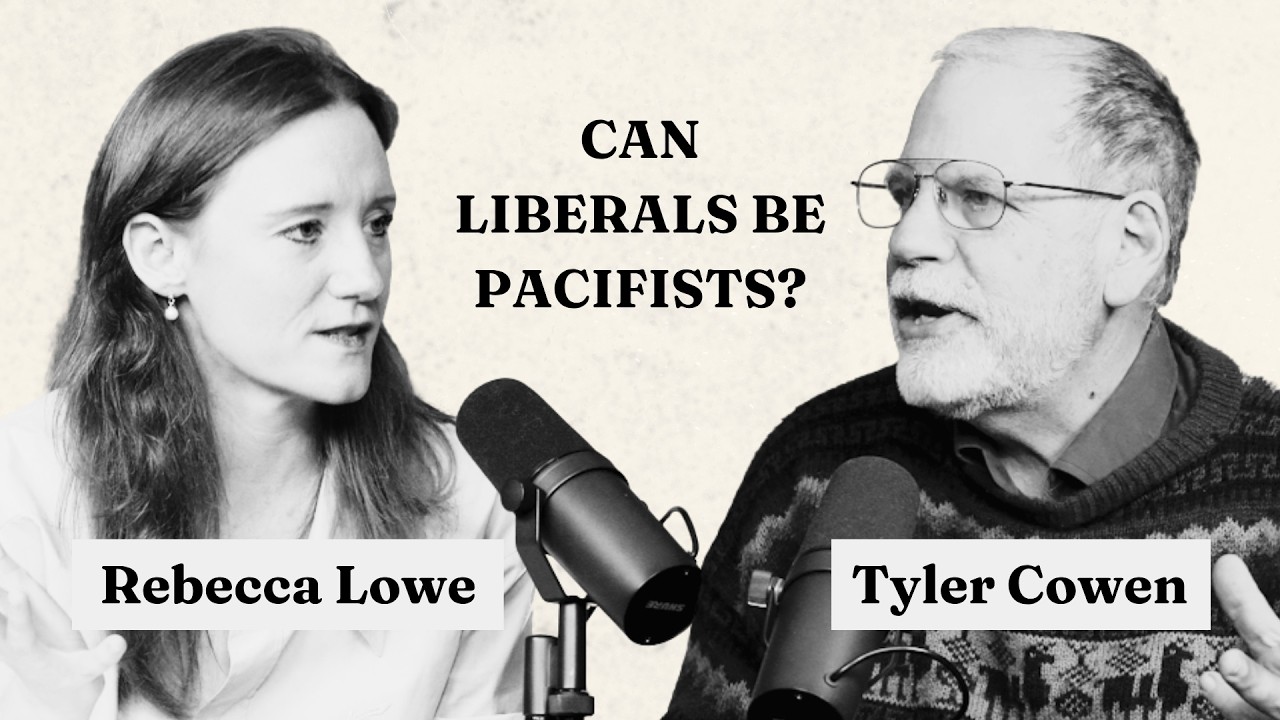
Economist Tyler Cowen predicts AI will cure most fatal diseases and let people live to 100, but warns the technology will enable pervasive facial recognition and surveillance that could drift toward China-style totalitarianism. He sees AI tools democratizing education and medicine while concentrating power in a few firms and governments.
Chapters
So clearly you are an AI optimist despite me throwing sort of the most drastic parts of AI into this conversation.
You will live to 100. Congratulations. Buckle your seatbelt. Don't ride a motorcycle. I'm serious. Riding a motorcycle's the worst thing you can do right now. Even I have a chance of living to 100 and I'm 64.
So what's the point you're making? Sorry.
I believe over the next, I don't know, 20, 30 years, we will cure every disease that kills people, or most of them at least. And something like cancer will almost never be a death sentence, and you will die of old age. Now, if you're 90 today, you probably won't see those benefits, but at what I'm guessing is your age, you will die of old age, and your children, grandchildren, whatever, incredible for them. So that's an amazing future. It's worth bearing some risk now to do away with your risk of Parkinson's, cancer, very long list of maladies. They're terrible once you get them. So that's part of the benefit.
That's definitely part of the benefit. Then if I to do some more sort of blackpilling in very simple terms, it's that AI is in the hands of very few, pretty much the people who are already very successful in tech and other industries. And it could well bring in a whole new totalitarian age. Yes, we might live to 100, but what's that society going to be like that we're living in? Is AI actually going to help us with the meaning crisis? Is AI going to solve the fact that now in Britain, for the 4th consecutive year in a row, we have the lowest ever for fertility rate, 1.49 now, it's even in Scotland, it's 1.25. AI might help in some aspects of society, but it's not clear what the new world order of where AI is a vital ingredient, what that's going to look like.
It's absolutely not clear. I fully agree. I'm not sure the word totalitarianism will apply anymore. There will be things about this new world I don't like, but there are features of the old world already. So a lot more surveillance, has already been increasing for a long time, especially in the UK, like closed-circuit television cameras. That will be easier with AI, and I think there'll be much more of it. In some ways, we'll be freer. There'll be less crime, for instance. Do I want to be surveilled all the time? Well, is anyone watching? Well, the AI is watching me. I'm not sure how good or bad that is. It's not Classic totalitarianism. And it's not that different from the way many systems operate today. I show up at Heathrow, I walk through the gate, they know I'm Tyler Cowen, facial recognition. In fact, I'm happy I don't have to wait in the line. So it's a mixed bag.
Sure. And for people who don't care about liberty, that might not be a problem at all. But it seems to me very clear, particularly in what's happened just in Keir Starmer's reign. I mean, this guy is sort of classic bureaucrat of the dying postwar period. Even in his time, you know, locking people up for Facebook memes, you fast forward to 10 years, it's not hard to imagine someone of his ilk, some of the globalist of his world view.
I agree, it's terrible.
Who will have surveillance, digital ID. Now you won't be able to go on the internet if you're under 16.
Terrible.
Which means basically that everyone over 16 has to have digital ID.
No more anonymous posting, yeah.
You are an enemy of the state because you did a hurty meme. You are going to be blocked off the internet. You're not going to be able to communicate with anyone.
Freeze your bank account like in Canada.
You're basically, it's going to thwart, that means that any actual totalitarian regime, even if it's a benign looking, very fluffy, pretty, we're going to help everyone totalitarian regime, they are going to be able to really clamp down on any dissent, however it looks. As we've already seen, and we might end up looking more and more like China. And China, this might be the endgame that we're sort of heading towards. They are very much closed down any dissent. And you might say, "Well, look how much prosperity they've had, look how much flourishing they've had in the last 10, 15, 20 years." But actually they lock up people regularly, they disappear people regularly. There are no dissent, everything's put down. There's not freedom as we know it. Which normally communist, but is actually fascist. Is that what we're heading to? That's to me the sort of more, that seems more clear that we're going in that direction than into some actual utopia. Not that I ever believe in utopias.
But I think that's a great example of the point. We're headed to some aspects of totalitarianism without AI, right? That's been going on anyway. What AI will do is empower individuals once again. Which can be dangerous, but individuals will be smarter than governments if they're using strong AI. Now what the final impact of that is, I agree, we don't know. But government and AI do not necessarily mesh well. I think what the groups that are best at using AI are small groups of individuals who work well together and are smart and technically able, Those groups can do good or harm. I fully grant that, but it could be a counterweight to the growth of the state.
It could be.
It could be.
Except that we also know, and this is the Pareto distribution, everything accumulates always. So everything accumulates to coalesces around the bigger, bigger thing. We're prone to, just as economies are prone to monopoly, we are always in tendency to going to the behemoth, going to the megalith, are we not?
AI favors the startup, not the large mature company. The large mature companies have legacy systems. They don't know how to inject AI into it. Startups are small and they're AI native. So, so far it's helping quote unquote the little guy by a lot. It may or may not stay that way.
So you have to persuade me on this, Tyler, because it is Google, who have got Gemini. It is big companies that were already existing. I know a lot of finance companies now, they're still nominally finance companies, but really they're AI companies now. It's really going that way. It's actually the big companies of old that are knowing that they have to keep up, that are taking AI and thus having and being on the avant-garde of that and having the power that comes with that rather than the new companies. I mean, there might be one or two new companies, But they get swallowed up, don't they?
But even Google is highly bureaucratic, and for most of its normal operations, they don't use AI. They've hired a ton of people who still do things the way they used to do. And it's the startups who are taking advantage of, say, AI agents to do their work. Small groups that are dynamic, starting from scratch. Even Google, which controls the third best AI system, is not taking great advantage of AI. For its own activities. So who will come out ahead and who not? Like some of my friends say, well, you look at countries, maybe Singapore and United Arab Emirates will be great with it because they're pretty coherent small groups, maybe. But is at least the possibility it's quite emancipatory that individuals, including poor people now, can educate themselves, get very good legal advice, get medical diagnosis as good as what the best doctors can give. And they can do this now. I'm not saying they're all doing it, but over time it's the people now who have scarcity who have this new gift. And it's not going to be free, but it's pretty cheap. And I think it will stay pretty cheap. And some of it will be free. Some of it's free right now.
Yes, that's clearly the case. I mean, if we can instill an entrepreneurial spirit into a maximum amount of people, With something like Grok, I mean, we use Grok for this show.
Of course.
Every single day.
And how many people are you in this company, quote unquote?
500.
Exactly. And you bet you use it great.
Yeah. And it is the case that if you want to learn something new, you can do so much quicker.
That's right.
I'll tell you an example of it actually. When I started interviewing people 4 or 5 years ago, it would take me 3 or 4 days to prepare for each interview 'cause I'd have to read all the books and I'd have to, you know, you just do it on the internet through scouring. Now I can do it through Grok. I can, it can organize for me how best to approach understanding it. And it's just, I mean, 10 times less time.
And that's empowering you, the individual. Exactly.
So that's a good thing. That's a good thing.
People are going to be learning banjo using AI, right?
I don't know if that would happen.
YouTube.
YouTube. Yeah.
No, you play, you record something, you play it for for the AI, you say, what am I doing wrong? It gives you feedback. I don't think it's set up at this moment to do that per se, but it will do it probably reasonably well. And if someone trained a particular program to do it, it would be one of the best banjo teachers in the world.
And that doesn't blackpill you a whole new generation of banjo players. That's even more terrifying, don't you think, than some sort of AI company that can penetrate our bank accounts?
I'm a Doc Boggs fan. It might be a lot of fun.
Thanks for watching this clip from The Winston Marshall Show. You can click here to watch the full episode. And for more clips like this one, don't forget to subscribe. And as always, be well.