Benjamin Britten, War, and Pacifism with Tyler Cowen | The Street Porter and the Philosopher
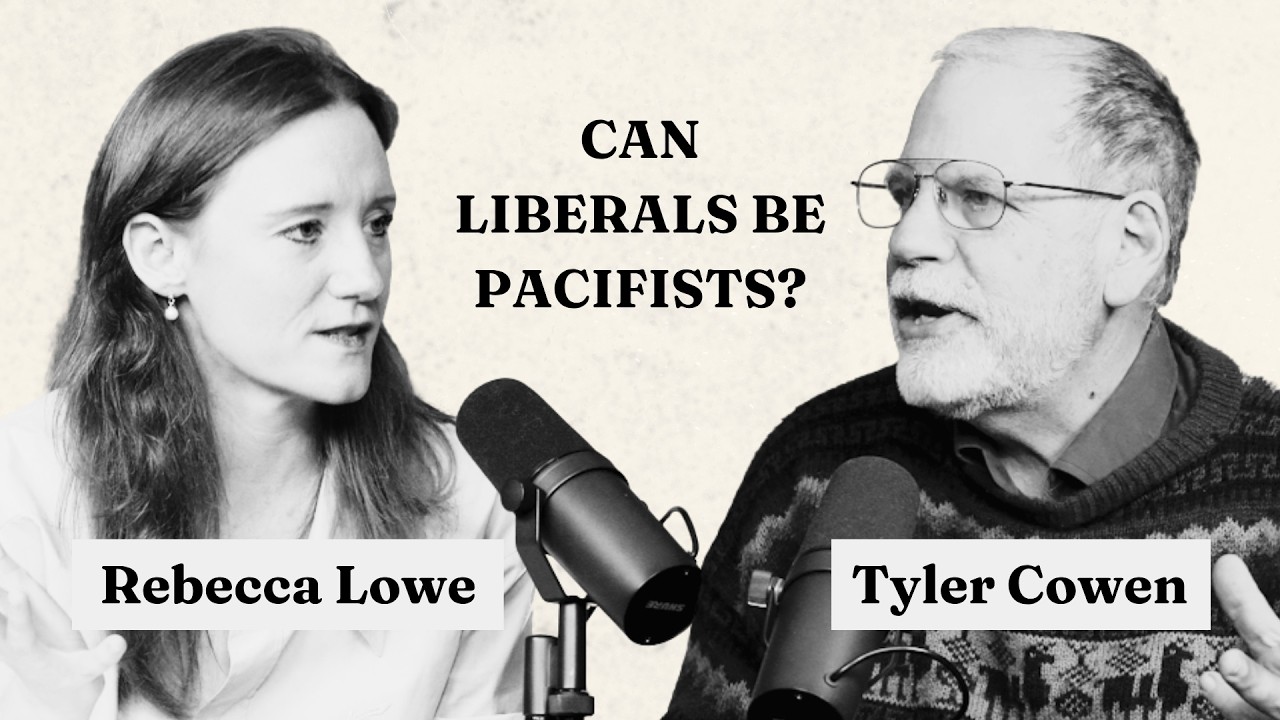
Tyler Cowen discusses Benjamin Britten's War Requiem, which weaves together Wilfred Owen's poetry, Latin Mass text, and music to create an anti-war statement. They explore Britten's pacifism, the homoerotic subtext in his operas, and why the piece rewards repeated listening.
Chapters
Welcome to The Street Porter and the Philosopher. I'm the philosopher Rebecca Lowe.
And I'm Henry Oliver.
The Street Porter and the Philosopher is part of our Substack project, The Pursuit of Liberalism, which is dedicated to refocusing classical liberalism on the arts and philosophy alongside economics. This is our first podcast season, and it's all about liberalism and the arts. We're covering everything from paintings to novels, the reading crisis to the future, and even the idea of liberal culture. We've applied a division of labor under which we each speak with some fantastic guests. We've got academics, writers, an editor, even a bureaucrat. And at the end, Rebecca and I are going to do a review episode. For a full transcript of this conversation, including helpful links to the references mentioned, you can click on the link in the show notes or description. And don't forget to visit pursuitofliberalism.com. On today's episode, I'm joined by Tyler Cowen, We're going to be talking about Benjamin Britten, about the War Requiem, which I think is one of the greatest musical works of all time. Tyler might not agree. And this is within the context of this season of our podcast on the arts and liberalism. So thanks very much for joining us.
Happy to be here, Rebecca.
Okay, so I'm aware that some of our listeners and viewers may not have experienced the War Requiem. One reason for this is it's pretty demanding to put on, both in terms of its scale in terms of potentially appreciating it. It's a complicated work. It comes with quite a lot of baggage. But also, I mean, we're recording this in America and people in America just don't sufficiently appreciate Benjamin Britten.
But it is playing soon in Erie, Pennsylvania in May 2026. So if Erie, Pennsylvania can put it on, that's pretty wondrous, right?
Yeah. So our goal here then is to try to persuade everyone to go and attend this performance. In Erie, Pennsylvania.
So it's from 1962. It's about 80 minutes long. I find the most difficult thing about appreciating it is that you have two different choruses and a number of different soloists and recordings obscure what's actually happening. So I found it very useful to watch an actual performance on YouTube. The music itself then made more sense to me. So the Corensis performance is the one that helped me the most on that. That's filmed very well. I don't think the music is that difficult to like, but at first it sounds like a big sprawling mess, and it's not.
Yeah, so this is a good point. So it's sort of locationally designed in some sense. It was written to be performed at the consecration of the new Coventry Cathedral. Uh, the previous Coventry Cathedral, some of which still stands, was pretty devastatingly bombed during the Second World War, and Britten designed it, I think, with probably the location in mind.
That's correct, explicitly. Right, so as you say, there are these groups.
There are sort of three groups, I think, aren't there? There's the chorus, the standard SATB chorus, accompanied by orchestra, pretty big orchestra. Triple woodwind. We get a big organ in the last movement and a soprano soloist who sort of attaches herself to the chorus. And then we get the second group, which are the baritone and the tenor soloists. And they're accompanied by a smaller chamber orchestra, an orchestra of sort of the same size almost exactly as some of Britain's chamber operas. So if you think of Albert Herring, um, Repeal the Crucia, that kind of size of orchestra. And then you get this boys' choir accompanied by organ. So you get these 3 sets of performers and they are allocated different parts of the text. So the text itself is also grand. You get the Requiem text, or most of it, interpolated with these Wilfred Owen poems.
Who was a great British poet of the earlier 20th century.
That's right. So he's a war poet. He's He started writing poetry in his teenage years, we think, and then he got to know Siegfried Sassoon when he was, I think, convalescing in Edinburgh after having been shell-shocked at the front.
It's also important, I think, to realize this is coming relatively late in Britten's career and life. It's a grand work. You can think of some of his other works as leading up to this. Many people would argue it's his most important work, but it's the coming to fruition of many other ideas he had been experimenting with. And it's a mature late-period work and can be understood as such.
I think that's a good way of putting it. I think if you also look at the kind of reception history of Britten, there was controversy, which we should talk about, in terms of him having been in America during the beginning of the Second World War. But then he comes back and incredibly successful with this first performance of Peter Grimes in, was it 1945, I think? This is sort of seen as Britain bursting onto the international stage. And then there are some things, some works in the '50s which aren't quite so successful. So even Billy Budd had some bad reviews. Gloriana, Prince of the Pagodas.
And Peter Grimes is arguably better than those. Peter Grimes saved his reputation.
This is right.
Because it was a big hit and it was very good. It's another piece you might put up as arguably his best work, maybe that or the War Requiem. And if not for that, his career might have really gone askew. And he was a conscientious objector, did not fight in World War II. That, of course, was highly controversial, and I think that's one of the points we need to discuss.
Yeah. So we should think about what it means for a conscientious objector to have written this work, which is supposed in some sense to maybe pay tribute to the soldiers. Maybe in some sense it's supposed to play some role in the British response to the war at a time when, of course, conscientious objectors had been seen as maybe betraying the nation. There are very interesting kind of tense questions about the choice of Britten to compose this work.
And Benjamin Britten himself, he described the work as a reparation paid to the dead soldiers.
That's right.
I think in some ways he always had World War I more in mind than World War II, but other parties involved, of course, didn't see it that way. But Wilfred Owen was a World War I poet, and that was the formative experience for him, was World War I, and also the Spanish Civil War influenced him greatly. So he wanted to do this work, and I'm not sure he ever found a way to make it succeed with World War II. That to me is one of the drawbacks of the work.
This is a good point. So, I mean, Britten was born in 1913. He grew up on the coast. He would've witnessed bombings, heard bombings as a little kid. This clearly had an impact on him. People say also Frank Bridge was his composition teacher in his teenage years. If you look up Frank Bridge on the internet, which I did last night, I mean, I'm a big Frank Bridge fan. I didn't need to look him up for that reason, but I was interested to see what people said about his pacifism. And you'll find this, he's often referred to as a composer and a pacifist. But then when I tried a little harder to find evidence of his pacifism, the thing that kept coming up is Benjamin Britten saying that Bridge was a pacifist and these big conversations that they had.
One of Britten's other best works, to interject a separate point, is Variations on a Theme by Frank Bridge, which is one of his better achievements, I would say, as well. Britten also worked quite a bit with W.H. Auden, who was somewhat of a pacifist, though I think a less complete one than Britten, because Auden basically fell in line for World War II, but he had been a pacifist up until then. And Auden converts to Christianity and Britten never does.
He went off and worked with the ambulances, didn't he? And I think Britten tried to persuade Auden not to do that. He said, no, no, we need you. You're better better off producing your art. And this is a bit of a tension too. We should talk about, you know, Britten's pacifism, what his reasons were. But often it seems as if maybe those reasons were he wanted to keep writing his music. I mean, I read something, I think in one of the letters where he's talking about his frustration wanting to come back from America. So he goes off to America in, I think, 1939. Some of his friends, like Auden and Isherwood, have already gone off there. He goes, I think, not really to avoid the war, but because he thinks he might get write some music for Hollywood. I think that's one suggestion.
Which paid very well, right?
Yeah. So that's one suggestion. But then he wrote something about how frustrated he was. He wanted to come back to England and it was quite hard to get aboard, you know, a ship to England because the ships were being used for military reasons. Although, you know, preference was being given to people for military purposes to travel. And he was very frustrated because he couldn't compose. He had these 6 months where he just couldn't compose. He's like, I need to get back to Britain to compose. And he finally does. And then he writes Peter Grimes and has this wonderful time. But, you know, You know, people thinking it's this great act of kind of moral decision. I'm going to leave, I'm going to go to America. I'm going to— one interpretation I think is sure he didn't like war, but really he wanted himself and Auden just to focus on producing great works of art.
Another way of reading Britten, not inconsistent with what you're saying, is at some point he just became a bit mentally rigid. Yeah. After, say, the late 1930s, and he had a pacifist mindset. He just genuinely didn't know how to reconstruct it. And he was of the generation that had at least implicit sympathies for Stalin in some ways. I don't think he was a Stalinist.
He visited the Soviet Russia quite a lot of times. I mean, people usually see that in terms of this great opportunity for artists to work together and collaborate. But there's another reading, which is this is somebody who was left-leaning. This is somebody who potentially had those sympathies, not really minding about feeling complicit going to this place.
And he writes this 1936 piece called Russian March, I think, It's quite terrible. It's for brass and percussion. And there is quite a bit of bad Britten, which mostly people don't hear. But so often when he tried to get didactic, he became a much, much worse composer. And this is a tension running throughout War Requiem. So there's that other piece he did in 1937. It's a short piece. It's called what? Advanced Democracy.
Yeah, you sent me this yesterday.
Terrible title.
And I thought this was a joke. I thought this was somebody arranging Britten. I had to look it up. No, it's actual Britten. It's Horrible.
It's not an AI version of Britten. He did it and it's embarrassingly bad. And the didactic element is part of what sent it wrong. So he's trying didacticism a final time in the War Requiem. And I think musically he definitely pulls it off, but you're nervous the whole time listening if you know the backstory of Britten, because none of it ever worked. And another thing I find quite interesting, doesn't get enough discussion, in 1940, He's asked to write a piece for the Japanese government.
Yeah.
And he accepts the commission. Now, he gave them something quite grim, this Sinfonia di Requiem, and they reject it. It's not glorifying the state of Japan enough. That's all understandable. Since he sent them something they reject, maybe you wouldn't say he did the wrong thing, but I certainly would not have done that. It was not obviously the right thing to take such a commission. If Putin's Russia wanted to commission me to do something today, I wouldn't think, oh, I'll take this, I'll send them something they don't like. I would just flat out say no. Now this is 1940, but China's invaded in 1937. Japanese military is quite brutal. It's a funny thing for him to have said yes to.
There's a wider point, I think also about him being quite establishment. So for all he's this conscientious objector, you know, he goes on, he writes stuff for the Festival of Britain that has a political element. He writes stuff for the coronation of the Queen. He receives the Order of Merit. Peter Pears, his longtime partner, was knighted. It's all very well saying, you know, he's this great kind of moral hero, but another reading is just, well, again and again, you could read it back to this just prioritization of the aesthetic. Maybe he just thinks he needs this kind of support, this kind of patronage, in order to be able to be successful and spend his time writing his music. So maybe it's just a kind of pragmatism.
I suspect though he believed it. I don't think it was cynical. I think he would have— he believed his pacifism.
Sure.
He would have passed the lie detector test.
Well, you can read, I think, parts of his statement he had to make in order to conscientiously be objected to, you know, to register as a conscientious objector. That said, there is, I think, some— there are some interesting questions about the sort of the strength of his justification, whether he'd be able to give you a good intellectual justification. There's some story I remember reading somewhere about him and Peirce being at some dinner party and and some argument coming up and they left abruptly and the suggestion was that they just weren't really into making the arguments for things.
And I think somebody said something like, "Oh, just Ben couldn't really make the intellectual justification for his pacifism." One thing he said was, "Oh, people should in Nazi Germany rebel against the Nazis and resist that," which is fine to agree with that, but if that's all you've got, you're not going to get very far.
There's, I think, also an interesting question about his choice of Owen as well, because there's some suggestion that maybe this is this great pacifist work, the War Requiem, but Owen isn't exactly a straight-up pacifist. I think he called himself in a letter to his mother, what is it, a conscientious objector with the kind of seared conscience. And also there are these points where he talks about, "I fought like an angel." He wrote this again, I think, to his mother just after he won the Military Cross. Yes, of course, he follows this general trajectory like the classic English war poets, British war poets, in which he goes from seeing the glory of war to being deeply disturbed. A lot of his frustration seemed to be with people not coming to help him though, God not coming to help him, the British people not coming to help him. I think it's definitely not straightforward to say that Owen himself is a pacifist in any sense.
It's interesting if you watch the Derek Jarman movie of The War Requiem, which I know you know.
Yeah.
That was a movie made in Britain where there's visuals accompanying a playing of the War Requiem by Britten conducting it himself. And Jarman makes the War Requiem only about World War I, all the imagery. And I suspect that's what Britten deep down really wanted was something only about World War I. He couldn't bring himself to deny that World War II had happened, but I think that's what he had in his mind emotionally. This is the thing about World War I.
World War I is probably easier just to deal with in terms of the complicated moral stance. If you're a pacifist, one of the hardest questions to address is what do you do about the Nazis? Whereas World War I, I mean, you know, this is about imperialism and trade and fighting for bits of the world.
And since the actual outcome led to the Nazis, it's easy enough to say, well, the pacifists were correct. It might have gone badly in some other way, but it can't have been as bad as the Nazis and the Holocaust, right?
Okay, so we should, I think we've now come up with some sort of some implicit reasons why we might want to think of Britten and the War Requiem as liberal matters. I think we've talked about pacifism. I think there's some sense about tradition and some sense about the establishment that we might want to address. But I think we should just talk a little more about the music and the War Requiem. We could also talk about the poems. What are your favourite parts? Like what are the bits that somebody should go to and listen?
The second, well, all of it, every part is wonderful. That's why it's a great work.
That's a cheating answer.
But Ad dies irae, the second part, is my favorite and the most dramatic and the most stirring by far. I worry about the ending parts the most, and we'll get to why, but not for musical reasons, for aesthetic reasons. And here would be my critique of the War Requiem. Let me give it to you, see what your response is. Britten also was not a Christian.
Yes.
Yet in the War Requiem, it's quite obvious that it's a Christian work and Christ is carrying the soldiers up to heaven. Do they all deserve to go to heaven? Well, depends on your theology, but I worry when they're all supposed to be going to heaven. And since we know he didn't believe, in some fundamental sense, I feel War Requiem evolves into being a piece of entertainment for British people. And it's using myths that Britten doesn't accept. If he had been a flat-out Christian the way many earlier composers were, he did a Christian work, I'd be quite happy with that, as I am, say, with Bach or, you know, Mozart, many others. But it feels mannered to me aesthetically, and it has to end on— there's sadness, but there's notes of glory throughout. And power and exaltation. And I don't feel it's a true critique of war. I'm back to thinking he did some very excellent musical and orchestral arrangements of entertainment for British people. That would be my critique, not entirely a negative critique, but that's how I think of the work.
I think it's a good critique. I'd push back on a couple of things. First of all, I mean, he was sort of agnostic, wasn't he? I mean, he set Christian texts throughout his life. He set the sort of the parables, he set the the canticle settings, Abraham and Isaac, which he reuses here. He does it in quite an educative way as well. It seems like he wants to teach children about Christianity. There's Neues Blüte there. Again, you can say it's good for its orchestration or its value lies in that. But again, I do think there is a kind of establishment Christianity, which is quite an English way of being religious, where it's not necessarily to do with actually believing anything. It's to do with So I think that would be point one. I think point two is something like—
But the telling everyone it will be fine for the soldiers eventually because they're carried up to heaven.
Yes.
That strikes me as a cheap way out for someone whose pacifism was under fire. Yeah. And whatever extent you might agree, disagree with Britton, if his defense is to choose the cheap way out, oh, the worthy dead get carried up to heaven when he himself does not believe that, then it seems to me it's going a level further than just, oh, he said Christian texts in the past.
Remember though, he is interpolating secular texts here. So we have the Owen poems to cut through it. That said, of course, that is—
But those weaken over time and the religious imagery becomes stronger.
This is true. There's also a vast precedent for that. I mean, if you look back to medieval and Renaissance settings of L'Homme-Armé, if you think about, of course, the Brahms' Deutsche Requiem, which is, it's using religious texts, but it's not using the Requiem text. So again, there is tradition, there is already precedent. For breaking up the religious system.
And Brahms in his Requiem, he's basically telling us death is good. He's siding with death. And that's a bold, controversial move, but it fits with the fact that he was not an orthodox believer at the time.
It's also, I mean, another way in which you can compare that, I think, with Britten is that Britten is experimental. I mean, he's experimental within recognizable frameworks. This again, I think, comes back to a sense of conservatism In Britain, what is it? I think Robin Holloway has some line about Britain's style renovating and conserving through boldness and simplicity or something like this. I think if you think about the most innovative moments or the surprising moments of the War Requiem, think about the Pleni sunt Caeli in the Sanctus where you get all of the singers in the chorus, at least free chanting. There's no set rhythm. It sounds like a chorus of wasps. And this is just before this glorious kind of Monteverdi-like hosanna.
Yes.
Where you get this astonishing downbeat and then you get this trumpet fanfare. But you've gone from this crazy, crazy, crazy little moment of experimentation. But that's quite structured within a set though, the same way as harmonically Britten pushes at the edges, but he's very much working within recognized tonal harmony, even when he interpolates modern practices. I mean, you think of Turn of the Screw and it starts with this 12-tone scale, but then it's still very recognizable tonal harmony. So he never really pushes beyond the frameworks that we already know orally or religiously or in an establishment sense. Is that fair?
Along those lines, I hear a lot of Mahler and Mahler's 8th in the War Requiem, which makes sense, right? And the scale of the forces, the complexity sounds like a mess at first, But there are ways you can make sense of it by seeing it or watching it on YouTube.
Yeah. Of course, you mentioned the Dies Irae. I mean, to me, the greatest part, I think, of the War Requiem is the soprano Lacrimosa. So I mean, this is very Mozart. I think it almost pretty much uses the string part from the introduction to the Mozart Lacrimosa from the Requiem. Soprano comes in with this, just this glorious singing, and then it again gets interpolated. You get the baritone coming in and you get these moments But this is like glorious Mozart. I mean, when I listen to it, I sometimes have to stop and just check and make sure I'm not listening to Mozart.
And Britten was a wonderful conductor of Mozart, as we know.
Of course, of course.
All right, that's on disc, the late symphonies. His are some of the best to this day.
This is the other thing we should remember about Britten. I mean, he is a very, very skillful composer and also a skillful pianist and a skillful conductor.
When he plays piano for Schubert's Winterreise and Peter Parris is singing, That's one of the all-time great recordings. He even conducts Bach's Brandenburg Concerti, and again, still one of the best recordings of those. There's something fluent in his understanding of the musicality of highly distinct composers that very few people manage to touch.
This is right. I mean, you look also at the Purcell realizations, the songs, some of the recordings of the songs.
But you expect him to be good at that, right?
Well, of course, because he's—
It's an English people thing.
But also, this is the great thing about Britain. He is the first good British composer since Henry Purcell, right? 300 years we've waited for this guy.
Elgar is very good.
I knew you were going to say that. And of course you hear Elgar in this. I mean, I think we should also make comparisons with Gerontius or Gerontius, depending on how you want to say it. Sure.
Absolutely.
Both in terms of playing around with the text. I mean, there's a whole big thing about, you know, skipping purgatory, I think that Elgar does, which Newman didn't. Again, that maybe comes back into your point around how does the work end? Does it end with the glory? Does it end on the question? And I actually do think— so one way I'd push against, I think, your suggestion that it ends in the way you suggested is it ends also with the tritone again. We get the tritone coming through from the beginning in this opening—
The C, F-sharp.
This is right. The devil's interval. What is it somebody said about the War Requiem? What is it that the devil stalks or something? Stalks it with the tritone. That said, I mean, the tritone has become a quite establishment way of pointing up and settlement.
But here's a contrast I would draw. As you know, not too long after the War Requiem, Britten does Curlew River, which is a very underrated work, and it draws from Japanese influences and world music a bit. And there is again some elevation at the end, hints at Christianity, but the music itself leaves you highly uncertain. And the original Japanese play it's based on, a mother, her child is kidnapped, she's not getting the child back, she ends up saying goodbye to the child. It's very sad and it strikes me as much more properly tragic than the War Requiem. And if you listen to Curlew River and you see, well, this is how Britten could have done it when he treated the work more as a throwaway, it's a much more honest piece of music. You wouldn't say it's as great as the War Requiem, but it's very, very good and it's much more in sync, I feel, the aesthetics, the story, everything.
So we should also talk about the international influences on his on his music making. So you said earlier that one criticism somebody might have of the War Requiem, and I think you were positing this yourself, this is, you know, something for the British people to enjoy. But of course you do see this sort of his commitment to universalism, at least in terms of interpolating styles from different music traditions.
British universalism.
British universalism. But yeah, I mean, you get the gamelan idea, which of course Britain was very interested in Indonesian music, the Japanese influence. We know that he's interested in that. We know he's interested also in Indian music. And from an early age, he was interested in these things and you can see this.
And he understood them very well too.
This is right. This is right. So you can see this coming through. You can see it in the War Requiem. I think it's in the Sanctus, isn't it? And also just with the percussion. I mean, the percussion in some sense, those instruments reflect the kind of gamelan sound. So another argument I think you could make for the War Requiem is that this is a commitment to universalism. And of course, the idea was for the first performance in Coventry Cathedral, you'd have the Russian soprano You'd have the German baritone, Discal, and you'd also have Pears, the British tenor. Of course, sadly, the Russians didn't allow the Russian soprano to come and take part, so a Northern Irish soprano had to sing.
That's right. Some replacement.
Yeah. Makes it slightly, slightly more parochial perhaps. But this recording that you mentioned, the great Decca recording, which sold, what, 200,000 copies in the first few months or something.
And it's still one of the best recordings.
I love it. I think for me it is.
Should we talk about a few different versions of the War Requiem?
Go on then.
Okay. The Decca version. Say some things about it, then I'll say some things.
I love the Decca recording. So this is the recording that Bredin himself conducted, organized, using the forces from the performance. And indeed, I think in this recording, of course, we do get the Russian soprano taking part. There is also, later down the line, they released these sort of outtakes from the rehearsals. They're recording, some of the rehearsals were recorded, and he says these very funny things, you know, "Boys, imagine you're running off into the front." And you don't, what is it? He says something like, "You're about to be stabbed and you don't want it," or something like this. There are these sort of jokey asides where he's trying to stir up emotion. He talks actually, I think, about that De Plany-Sinchelli wasp-like moment. He says something like, "If you're in the same rhythm as your neighbor, you're getting it wrong." But he hated the idea of anybody having access to that material. This was released and This did not go down well.
It's one of the two or three must recordings. It is 1963 sound, which is actually not as bad as it may seem to some performances.
It's a remastered version, isn't it?
Remastered, but it's still, uh, Dietrich Fischer-Dieserkau is an incredible talent, but I often find him objectionable. He brings too much of his talent to bear on many of his performances, and it can be a bit muggish or overdone. But still, it's an amazing recording and everyone should listen to it.
Piers's voice is a kind of an acquired taste, isn't it? It's quite nasal, um, British.
But it matches Britten very well.
That's why Britten writes for him very particularly. Uh, there are so many, many wonderful Britten songs which were written for Piers to sing. And of course, one thing we should say is that the, as opposed to, you get the, you know, the glorious big choral moments with the soprano soaring over the top, you get this writing like Verdi or Mozart's, And then when you come to the baritone and tenor solo parts, it's often much more recitative. Like I said, you have the small chamber orchestra oftentimes quite programmatic, so representing kind of pastoral sounds. You get these little sound effects coming in. And these singers like Dietrich Fischer-Diskau and Peter Pears, who are such wonderful song singers, they really bring, I think, this kind of personal element, this sense in which it's the words that matter in Britten, of course, is possibly the greatest ever setter of texts.
He is the greatest ever setter of texts, I think. And that the voice—
Would you just accept that?
I more than— I second it. But that the voices are not just lovely, I think, is exactly right for the piece.
I think that is right. It feels— there's a haunting ghost-like element oftentimes to Pears' voice. There's sometimes a quite harsh edge, nasty kind of element to it.
I think the best recording is the one from the early '90s by Richard Hickox. And that is incredible sound, perfect clarity. All the voices are amazing. It's hard for me to imagine a much better take than that one. And that would be my number one choice.
It's super clear. It's super beautiful. I mean, this—
It's culturally resonant also. Yeah.
I do think there is an element though, because this is such a particular work written for a particular time for very particular forces, that if at least if what we are interested in, in any kind of sense is the intention of the composer, in terms of understanding the artwork or seeing the value of the artwork, it's hard, I think, to move past the Britten recording itself.
But on that, I'll push back a bit. So Stravinsky recorded just about everything composed by Stravinsky. It's rarely the best version, I think, even by his own account.
What do you mean by best, though? You mean what, like technically accurate?
In any way best, most enjoyable. What would Stravinsky have thought is best? What would music critics think is best? They're not terrible, but on a scale of 1 to 10, they're like 6s.
I think what I'm saying though, that you might have this specific argument for the War Requiem because the War Requiem again is designed for a particular location with particular forces in mind.
But since it's somewhat of a phony piece, I'm not going to buy it all has to be genuine because it was by construct not entirely genuine. And Rachmaninoff, he recorded his piano concerti. Some of the better recordings of those pieces, they're very good., but no one quite thinks they're the best, and the sound is really not that good. So, uh, no, there's nothing sacrosanct about what the composer thought it should be.
I think I agree with that as a general point, although I'm very interested in this question about the relevance of the composer and the composer's intentions. Um, I just think if you were going to make an argument for a particular artwork, for a particular piece of music, to, to listen to some particular performance of it I think the Decca recording is the closest we get to the, you know, the original performance in Coventry Cathedral. And I think this just gives us some extra reasons to listen to that. I also just think it's a wonderful recording too.
There is a recording of the original performance in Coventry, which I've never heard. It's not— I couldn't find it online. You can buy it. People say it's not very good. I think just not enough rehearsal or they hadn't figured out yet what the piece means.
I assume just also recording in a non-recording studio. I mean, remember one of the problems about this piece are the the disparate forces. So the idea is that the boys are further away, so you get this sound of sense of distance. This just creates all kinds of coordination problems, not just in terms of getting together and balance, but even tuning as well. It's a very complicated thing to get right in terms of the audience hearing it well. And then if on top of that, you want to also get it such that the audience listening to the recording hear it well, those two things can often be in tension.
Now the Corentzis version, which I believe is only on YouTube, I think is truly excellent. It's less authentic than the others, so he makes it deliberately a less British work and more like a piece of 20th century music, which would not be my first preference, but he does that very, very well. He's famous for insisting on a large number of rehearsals, so technically it's, for a live performance, very high quality. And because you can see it visually, It has this element that the others do not have, that you see where things are coming from. It's very well filmed. I think it's a wonderful complement to the others, even though you're getting something less British. That would be the other one I would say everyone should sample.
What's your main reason for saying less British?
Well, first of all, he is not British. He doesn't try to do it as British music. He comes out of other musical traditions. There's the side story that he's often accused of accepting support from the Russian state and Putin. I'm not sure what's the actual reality there.
That might be quite appropriate in terms of these questions we had about Britain's own sympathies. Perhaps actually this actually adds to the authenticity.
There's some meta statement he's making by doing the piece at all, but it just makes listening to him doing it a more complicated thing than some of the other people who've recorded it. Uh, but again, for the visuals, for technical expertise, for just a different sense of what the piece should be. I don't hear it as coming from Mahler and Elgar and Britten's other works. I hear it as something in a way more unique. And that's just a nice way to be shaken up about the piece.
I like that. Now I want to talk a little about these songs.
Have you heard that? What do you think?
I haven't. I should, I should.
You should, yeah.
I do like your argument about the value of seeing it. One reason I watched the Jarman was in order to get some visual element, although of course you don't get the visual element.
Not of the music. You get other very good visual elements. That's a wonderful cinematic version of the piece.
I think some of the surrealism as well. You get the cows, that bit at the beginning in the opening poem about the cattle, and you see the cows walking around the sort of the first floor, the Americans would call the second floor of this military building with the soldiers down below. It's hard to forget that image.
But the Jarman movie, much as I like it, it does make the Britten work less universal. It makes it very British. Very much of a particular time about World War I. And in some ways, as I said before, that is the correct interpretation, but it belittles the piece as well. And you will come away from that movie, if that is all you know, thinking it is that one thing from a particular era and not quite seeing some of the other possibilities.
I think the opening bit with the nurse pushing Laurence Olivier in the wheelchair and he's trying to put the medals onto his jacket and he can't quite—
Just that it's Laurence Olivier, like, come on.
It's very, it's very kind of mawkish. It feels kind of oversentimental. It's such a British kind of, oh, it's like British people wearing the poppy. It does feel like it's playing into those cultural things. That's right. But let's talk a little about, so this season of Henry's and My Podcast, we're thinking about the relation between the arts and liberalism. So as I mentioned earlier, I think we've suggested some ways in which we might want to think of Britten as a liberal composer or the war requiem as a liberal art. It seems to me the most obvious of these is the pacifism. But of course there is this classic objection to pacifism if you're a liberal, or at least there is this pretty strong argument that suggests that pacifism and liberalism are deeply in conflict, that it might even be incoherent to be a pacifist if you're a liberal. And this is—
I agree with that claim.
Yeah. So at least to me, the strongest— I think there are various arguments. There are some weak points around things like kind of free-riding objections, not holding your part in the bargain. I think the strongest argument though, that being a liberal pacifist is incoherent, says something like, look, if you're a liberal, then you buy at least into some point of some kind of justification for the limited state. You think that it's not just within the state that you have the right to defend yourself, but also that you have some rights and obligations around collective protection. To the extent that if somebody comes and attacks you in the street, you can expect that other people should come and help you. You've got some kind of right to push back against that person. You might even expect that they'd be punished. There are laws about this stuff and these laws are enforced. But then all of a sudden, as soon as a whole load of people from some other nation come and attack you, well, you're not allowed to respond and you're not allowed to kind of preemptively push them away. This seems like, in terms of the liberals' commitment to this kind of collective rights and obligations around protection, that pacifism, if pacifism in its absolute form at least, is that no wars are justified, that even we have problems with enforcement, we have problems with any kind of aggression. This just seems like, well, if you're an anarchist, fine. But for the liberal, can a liberal be a pacifist?
I often make an argument like that to Bryan Caplan. I don't think he ever has a very good response, but I think the problems run even deeper than that. So someone can say World War II That's a single quite extreme example. There was of course self-defense. The war itself maximized liberty in the longer run. Those are all relevant and I think correct points. But the longer-term historical fact that my polity, United States, and your polity, Great Britain or the United Kingdom, they were built by force. And to get these nation-states large enough to create free trade areas for prosperity to flourish, took a lot of initiated violence to begin with, and it's not clear there was any other path besides that initiated violence. You can easily imagine an alternate history of the US where it's still something only a bit bigger than the 13 colonies, and France and Spain or maybe other powers have the rest, and they're like very strange parts, a bit more like Latin America, and the United States is not a very large or influential country, and very readily could have happened. I mean, think, you know, the, what we call the French and Indian War, you call it what, the Seven Years' War, who knows, like how contingent those results were. And then the revolution itself and so on and so on. Louisiana Purchase could not have happened. So it required so much aggression upfront and we don't, we're not even getting onto the British Empire. Right. So I think that's, a bigger problem than simply World War II, but it's the same problem.
So that's right. So we have several things here. We have one which is a point around, well, look, you can't really have the liberal state without some aggression. So that already means you are committing in some sense to aggression being justifiable. Then you have this sense about the persistence of the liberal state and some of the obligations that arise from being a member of the liberal state. Nonetheless, you want to say that liberals are supposed to be opposed to aggression. At least we're supposed to think, I mean, I've come myself at least, I think, to thinking that violence is only justified in defense. The problem is going to come though. You don't want me to be in charge of the army because I mean, I'm just going to be sitting there basically making you take the hits and then being like, well, I guess maybe we can try and help you. There's going to be no planning.
The army maybe you can have, but the air force, we need someone else in charge.
There's going to be no planning though. Oh, we hear these guys might do this thing. Rebecca's there sitting, no. Well, we just have to wait for them to actually be up in our faces with their bayonets. I'm going to be very, very limited in terms of my value of actually fulfilling my seeming like obligation to protect the other people.
But maybe there's some deeper unity here in a funny way. So art, so much of it is based on a kind of illusion or trick. And that's true of the War Requiem. Well, does he believe in Jesus? Is he really a pacifist? Should the music at these different parts sound so glorious? And ultimately, as listeners or even critics, we're okay with being tricked in different ways. Any Mozart opera is full of tricks and indeed celebrates them. That's entertaining. And liberalism itself has some tricks. And some of the tricks relate to coercion and they're unpleasant and they're nasty. But in each realm, you need to come to terms with the tricks and be maybe more Hegelian. So maybe Hegel is in some ways closer to the true liberal than many British people I know wish to let on.
I still think it's going to be hard to make this cohere with a commitment to pacifism, at least in the sense of absolute pacifism. Well, I'm not a pacifist. It's not going to work with pacifism. Right, this is right. So therefore I think this means that Britain's pacifism, whatever it is, can't really be the thing that we hinge a case upon for this being a liberal work.
I agree with that.
I also think there's this interesting question about whether music can can comment or can represent something like some abstract notion like pacifism. You get these kind of programmatic moments we talked about. I mean, for instance, you get the military drum, you get the snare, you get the bugle, you get the use of words. And as we already said, Britain is this astonishing setter of words. If anybody achieved the Gesamtkunstwerk, then surely it is Britain. And I think there's a sense in which maybe this brings us onto a second way in which we might think of Britain as being liberal. He's very accessible. He has a certain accessibility to his music by foregrounding the words, not in such a way that the music plays a second role. But if you go to hear a Britten opera, I sometimes say to people who say, though I know I've never been to an opera, what should I go see? Some people want to say, go see Mozart or Puccini. I mean, I love Mozart, Puccini's okay. I say, go listen to Britten because you're going to get what's going on. It's going to, the story is going to be there and exciting. The music is playing this astonishing role in enhancing the story. I think it's accessible.
I would not send them to Britten. I would send them to Rossini's Barber of Seville or Mozart's Figaro.
I love Figaro, but no way.
Both in Italian. But the first listen, it's better when people don't follow the words too much.
They're just going to be listening. They might still, you might still just give them a recording of some, some of a symphony or of a song cycle to get into opera.
Yes. Yes. I agree with that. Give, give them the song cycle instead, but Britten is not hummable. It's not memorable tunes. There's no Penny Lane in Benjamin Britten. So it's not where you want to send someone. Someone could come away and say, well, that sounded intriguing, but where were the melodies? It wouldn't quite be right. But you couldn't laugh at such a person, could you?
I think that's too reductive a way of seeing, seeing, A, the value of opera and B, of getting someone into opera. I think opera is a spectacle. I think it's something you need to attend. I think it is—
I agree, Carmen is another good place to start. Not one of my favorite operas, but a great place to start.
I think at least one thing I would say is if you had a friend who liked going to the theater, but didn't go to opera, then I, in that case, and particularly in that case, I would send them to Britain. Because Britain to me is the closest to going to see a play when you go to the opera.
But that's one of my objections to it.
Yeah, of course it is. So we get this accessibility. We already talked a little though about his, his establishment commitments. There's also a sense in which I think you can see Britten as being elitist. So you get the establishment stuff. Of course. You also get, you know, he's a middle-class boy who went to a public school. His dad's a dentist, but he's also quite pretentious from the sounds of it in terms of, you know, he calls himself a dental surgeon. I think this is the idea. Conscientious objection itself was seen as being quite an elitist thing. I read an article last night suggesting that, of course, there are ways in which this might just be quite bad counting, the idea that it's just middle-class people who are conscientiously objecting, not least that the reserve occupations were mostly filled by their industrial jobs for working-class people. So there may be some bad counting going on. Nonetheless, there is certainly this suggestion, particularly at the time when Britten is writing this, that conscientious objection was a kind of middle-class elitist kind of thing to do.
That's my impression from what I know of the history. It was a very intellectual thing to do. And you had to even know that such a thing was possible.
That's right. So I think there's a tension there between we might say Britten's accessible on some level, but we also might say he's this product of this elite education. He went to the Royal College of Music. He studied with these great people. He studied with Arthur Benjamin. He studied with Frank Bridge, as we talked about. He's just this astonishingly skilled composer who also is able throughout his life to organize things such that he spends his time composing.
You know, English classical music, it's so tied to the elite, much more than the Germanic traditions. So Byrd is in the court, of course.
Right.
Elgar, so much of it. It's only maybe Haydn and Handel who are not English who are coming and doing something just flat out commercial and not that elitist.
It's very interesting. I read this interview, I think it was with him in the New York Times from the '60s, or I forget when it's from, and he's talking a little about his frustrations that he says, oh, back in Mozart's time, the composer was kind of serving the audience. And then you got Beethoven coming along and Beethoven's so self-important and he thinks he's this voice of God. And what I really want to do, Britain. I want to serve the audience. But I think there's a great tension there, which is if you're not serving God as a composer, oftentimes you have been serving a particular patron. Oftentimes that patron has either been a rich person, maybe it's been a noble person. So it's a sort of nice idea, but again, we see this tension between wanting to maybe serve the people, but it's quite a noblesse oblige idea. That's the kind of thing someone who's got the Order of Merit would say, isn't it? I'm a composer who serves the people.
Here's a striking anecdotal fact. Everyone who's ever recommended the music of Britten to me, or a particular piece by Britten, is someone who has sung choral music or done more than that, which no one else recommends Britten. That means it's sophisticated, but it's a sign it's not that accessible, that you need to be singing it or playing it in other ways, conducting it, otherwise interacting with it. And otherwise, uh, the melodies aren't quite there.
This is an interesting point. I mean, for me, the greatest Britten works are the songs.
Of course. I agree with that. As someone who has not performed any of it or sung any of it.
Yeah. I mean, I think, and again, you could argue that some of this at least is he's writing for peers, isn't he? And some of the most beautiful songs, I think my favorite Britten song is Not Even Summer Yet, which is the setting of these words by his friend Peter Burroughs, who had just died. You're right. It's hard. I mean, I could, if you really wanted, I could hum the whole of the melody, but Nobody's gonna then remember those little bits because it is something that works as a whole. It's something— he uses quite angular melodies.
Well, try visiting the string quartets. I don't even like them. So many other composers, oh, it's among their great works. Or for Mozart, the string quintets. It's a chance to show off what you can do as a composer. Or the two cello sonatas. I don't think they're that good.
He's sometimes criticized for being only good with words. I think that's unfair. I mean, if you listen to some of the orchestral writing in the operas, for instance, I mean, think of the C interludes, which of course are also performed.
Which are excellent, right? Some of his best.
I mean, it's just such astonishing writing, isn't it?
But it's in a setting with words and moods. And when he's simply on his own writing abstract, you could call it chamber music, I don't think it's that impressive.
Yeah. I quite like some of the little early piano pieces, some of the juvenile ones.
I don't like them.
But no, I think the—
What's his best piano music?
I like those little early, what is it, 5 waltzes. I don't know. I played them when I was a kid.
His best piano writing is when there's also voice and then it's wonderful again.
Again, I love those Bessel realizations. Maybe there's another point we could make about—
But you know, the Blake songs or Winter Words or Michelangelo, all of that's incredible.
It is.
And there's much more.
It is astonishing. Another point on the accessibility, you might want to say something like he's quite a localist composer. So he isn't just composing in London and performing in London. Of course, he sets up the Aldeburgh Festival. He also is a great educator. He wants to bring children into music. Other controversial arguments make about that. But he is somebody who I think is trying to spread music beyond just, say, evensong. You're right, he writes great stuff. And yes, we British people who have come up through that kind of tradition, we love Britten. But Britten himself is trying to push beyond that, isn't it? I mean, he also wrote, he was a composer with the General Post Office film set. I mean, this is this most astonishing thing where of course most famously he wrote stuff with Auden. He wrote film music. I mean, the folk song stuff. So again, it's a kind of establishment British tradition thing, but he is trying at least, isn't he, to get beyond just the nave of the cathedral.
There's an important comparison with non-British composers. So if you look at other, what you might call anti-war works, take Schoenberg's Survivor from Warsaw. It's not a better piece of music than the War Requiem, but it's very harrowing. Essentially atonal. It makes sense as an anti-war, anti-, you could say anti-Holocaust work. It sounds like that. There's no resolution. There's no Christ at the end and so on and so on. And the other one I have in mind is Zimmermann, the German opera Die Soldaten, The Soldiers, which is also anti-militarist in a way that War Requiem is not. And that's another atonal work. And nothing charming happens. There are no moments of glory, uh, no Christ. And that is a much better anti-war opera than anything Britain could have done. So it's War Requiem. It's written from the point of view of the winners. It's a very important point. And it's trying to present itself as a universal take on war, but no, it's the winners. You listen to what the losers did. It's like, This is real anti-war, anti-militarist music.
There are even those, I think it's in the, you know, the big end bit of the Dies Irae, it almost feels kind of vaudevillian also. It almost feels a bit silly, some of these offbeat strings. It's kind of this grand glory and it feels certainly, although of course you could say in contrast to the pared down Owen poems. But I think actually on your point around, I agree about both of those. I think a closer to home example is probably Child of Our Time by Michael Tippett. And of course, Tippett himself paid more costs as a conscientious objector. He was thrown into Wormwood Scrubs, into jail. This is another work where you get a religious text broken up by secular writing. You get the African-American spirituals cutting through. It's glorious, glorious writing. And that's very, very, very beautiful, very, very tonally, very, very diatonic against some of the much more atonal moments as well, which I think is more hard-hitting. And that was written in response partly to Kristallnacht, And that's a wonderful work. It is a wonderful work, isn't it?
And that it's African American spirituals seems like a better match to the mood than anything Britten did. I wouldn't say it's a greater work, but some parts of it succeed more readily.
I think that's a good phrase. If you think of the opening of Deep River, for instance, is that— I think that's the first one, isn't it? I've conducted them many times, but it's a long time ago. It's so peaceful. It's so glorious. You get that descending bass line. There's a peace to it. Which I don't think you ever get in the War Requiem. There's this unsettling nature of the tritone throughout, whereas some of the peaceful moments— and by and by you get this joyful, but again, peace, it's light, isn't it? There are these moments of light, and I'm not sure we really fully see that in the War Requiem. Okay, so we have—
There's American anti-war music, right?
Yes.
So Country Joe and the Fish, Fixing to Die Rag, wonderful song. It was a hit of some kind. It's mostly sardonic in mood. It never switches out of the sardonic, and there's a feeling of chaos and bitterness. And in terms of mood, that works very well, and the mood and music are pretty successfully integrated.
So coming back to this point about whether music can represent things, there may be some sense in which pacifism can be represented by mood, can be represented through peacefulness, can be represented through maybe in Britten's sense, through unsettling harmonies. So here's a third sense in which we might think of Britten and his music as liberal. We've already dealt with the pacifism thing. We've kind of put that off the table a little bit. We dealt with the, you know, is he experimental or is he establishment? Where does he lie within that? Is he accessible? That may be another count. I think the third thing and the final thing we should think about is, of course, he was oppressed. I mean, he was oppressed as a conscientious objector.
And as a gay man at a time when that was far from acceptable.
This is right. Right. So he had a marriage, a non-legal marriage. He referred to this, I think Pears and he referred to their relationship as a marriage since the 1940s. They were together for almost 40 years. But I mean, I don't know, I think you've also been to the Red House in Aldeburgh. Is that right?
Yes.
Right. So you probably went to the Britten-Pears Library there. And if you go, sometimes they'll sort of show you around and show you some stuff. When I went a couple of years back, they showed me some of the accounts, the household accounts. And one of the interesting things about the accounts, of course, is how very careful both Britten and Pears are to not give the suggestion that they're living together, that they own stuff. They never owned property together in terms of houses. They owned separate houses. This is terribly sad stuff about them sort of reimbursing each other for staying at each other's houses when, to all intents and purposes, they were married. So you get this sense in which, because of course it's illegal, it's illegal in Britain until what, 1967, the Sexual Offences Act. And even then, it's just decriminalized private acts between men up to the age of 21. There are actually more limits put on acts outside of private situations, my understanding anyway. And then Britten dies a few years after this. So for all of his life, he's having to deal with this wonderful relationship he's in, this sense of clear happiness and stability and artistic expression he gets from this relationship, but he's a public figure. But he has to be very, very, very careful about that. So he's oppressed.
Martha Nussbaum praised that as a marriage where neither figure had to sacrifice his career for the other. She found that especially thrilling and positive. I have a nomination for the truly pacifist opera, and I want to see if you agree. Philip Glass, Satyagraha.
Oh yeah, 100%.
Which is about Gandhi. So the theme is pacifistic, but the music matches very, very well.
I think the music is glorious. I've never had a happier 5 hours in which I thought, oh my goodness, I'm going to have to sit for 5 hours. I absolutely loved it. I went to the ENO production. Maybe 20 years ago. It's astonishing. Yes.
I had the good luck to hear it with Philip Glass.
You're joking.
I was in row 2 and I looked ahead of me.
Does that count as with?
I count it as with. I said, this guy looks familiar. And it turned out it was him.
And of course, you know that Britten was first thinking of writing a Requiem for Gandhi, and then that became the War Requiem, supposedly.
Yes. So that's what I think.
Do you think it would have been a better piece if it had been a Requiem for Gandhi?
I think, no, he had to stick with entertaining British people because that's what he was very good at. Entertaining British people who sang choral works. He was the best in the world ever, and that's what he delivered in this case.
So you're really undercutting this universalist aim that he had through this.
Well, I don't believe in universalism, I would say, and maybe in that regard, I'm slightly less liberal, but Herder's point that things are always region or nation specific. I take very seriously.
I also think it's hard to be a liberal in the sense we think of liberal. And this is partly because I'm betraying my commitment to the philosophical social contract theory arguments. But I mean, I buy it.
Which did they just happen to come from John Locke, right? What a coincidence.
I don't know. I mean, there's that Rousseau dude as well.
Was he from Polynesia or was that Paraguay or might it have been England?
It might've been England. And of course he then came over here and he influenced, I mean, all of your stuff.
The Carolinas only. We're in Virginia, not the Carolinas.
No, no, I'm thinking about the Declaration of Independence. I mean, it's thanks to the essay.
Oh, that, yeah.
But he wrote constantly.
Constitution of North Carolina.
Yes, another controversial moment in his life.
I like to say all thinkers are regional thinkers and I'm going to stand by those words all the more so today.
I just think though that the kinds of commitments we have as liberals that are paradigmatically thought of as having as liberals are focused around the state. And liberals of course traditionally have been anxious around state power. And there are all kinds of practical and empirical reasons why it might be that if you care about these particular kinds of things, then the level of coordination, the highest level of coordination in this deeply formal sense of having the obligations and having the laws is going to rest at the state level. I mean, I buy that for mostly philosophical reasons, but they of course depend upon premises with empirical facts. Yes. But even we philosophers have to, we outsource some of that to you economists, some of it to the scientists.
But even using the word empirical marks one as fairly Anglo, right? That's very funny.
That's very funny. So just going back though, finally, to this point around whether Britten's status as an oppressed person could make him liberal. I mean, you probably want to say that seems terribly passive, doesn't it? I mean, there are great examples of gay men who have been very illiberal. I mean, Ernst Röhm perhaps is the most famous example of this. Being the subject of oppression does not make you a liberal, and it doesn't make your output liberal. Is there some sense, however, in which we want to say— so I mean, I think maybe the strongest argument to this end is Britten set a lot of gay writers. Britten is notable for setting the most astonishing writers. Oftentimes, if you look at the history of opera, composers have set bad writers. I had a lecturer at Cambridge who once said, "It's essential to opera. It's essential to opera composition that you set bad text." This is an English guy. But Britten completely goes against that. He sets Melville, he sets Shakespeare.
Melville having been gay, of course.
Melville having been gay. I made myself a little list, in fact. So of the people that Britten set who there are at least suggestions that they were gay, you get Auden, you get Melville, you get Forster, you get Henry James, you get Thomas Mann, you get Owen himself, you get Lytton Strachey. So some of these people are—
You pronounce it Strachey, is that correct?
Pretty sure. I'm English.
We say Strachey. Well, you all get the final word on that one.
But there might be some sense in which is what Britten is doing. He's furthering the works of other gay people. This may be an argument like that. There's probably a harder argument to make about whether homosexuality or whether tolerance to homosexuality can be seen in his writing. Sometimes people say things like Peter Grimes is a gay opera, but it's not.
Well, Billy Budd.
Billy Budd, yes, Billy Budd is beautiful. And there is this deep tension with how people respond to his beauty.
Um, but it's a homoerotic story.
Yes, this is right. So this seems like a clear example of it. You also get, for instance, people claiming these things about, about Turn of the Screw. Um, there are suggestions about the relation between Quint and Miles. People want to say this about Peter Grimes.
I'm less convinced with Turn of the Screw. Billy Budd to me is obvious.
I'm much less convinced too, but I think what I'm getting at is that there has been a bit of a, a bit of a kind of a trend, at least within musicology within academic musicians writing about Britten to suggest that you can find evidence of—
Oh, I definitely believe that. That makes sense to me. But my worry is with victims of oppression, that they're sometimes too ready to slide into a more general sympathy of what they perceive as victims of oppression. So Britten caring so much about the Spanish Civil War, he should have simply sided with neither. They're both bad. That's right. Neither side was pacifist. Spanish bombs.
You remember the great line in The Prime of Miss Jean Brodie where the girl has gone off to fight and Miss Jean Brodie has been trying to influence these girls. And then suddenly you hear this word, you hear back that this girl has died at the front. And she says, "But Miss Brodie, she was fighting for the wrong side." It's this terrible moment. Yes. But you're right. I mean, was either side the right side?
And now the thing we call Third Worldism is making a big comeback through Moamdháiní and others. Politics in Ireland is not always rational. They see themselves as the victim, which to be clear, they completely were. But I think it skewed their perspectives on many other issues.
So we could also, going back to something we talked a couple of times in this discussion, the suggestion that maybe Britain was overly sympathetic to left-wing authoritarian states.
Yes. And when you look at some of the Germanic takes on war, post-World War II now, to be clear, They see themselves as the loser, but not the victim. And that's the perspective you get in that music. And maybe those are the most genuinely anti-war pieces aesthetically.
I also think for me, actually coming back to this point about aesthetically, I just wonder if we're looking at Britten the wrong way. I just think maybe what he cared about was beauty. What he cared about was setting the texts. What he cared about was creating wonderful music. And yes, he did have these ordinary human concerns about war, and maybe he had deeper reasons than, "I just want to compose my music, not to fight." Maybe he did find it horrible. I'm sure he did. And maybe he was scarred psychologically from the bombs dropping in his coastal town when he was a kid. But we may just be looking for too much stuff here, mightn't we?
That's quite possibly true, yes.
So I think we should finish with you saying what your take is on the War Requiem. Is it a great work?
It's truly a great work. It is important to listen to multiple versions. It is very useful to watch it being performed, whether on YouTube or in person. And it is a work you can go back to many, many times, and each time it gets better. And that to me is a true mark of something interesting.
So to that end, uh, everybody should head down to Erie, Pennsylvania.
Or YouTube, or however you stream music. I still use compact discs.
I have this, I have this view that you can't fully know opera unless you experience it.
I agree. But it's often not possible, and then you do the best you can.
Knowledge through acquaintance, Bertrand Russell type argument. So Tyler, thanks so much for joining me. Thanks for putting up with me talking about Benjamin Britten. Thank you for talking about Benjamin Britten. This has been great.
Thank you, Rebecca.
To find more episodes of The Street Porter and the Philosopher and the full transcript for this episode, check out our joint Substack, The Pursuit of Liberalism. If you want to know more about each of our work, I've got a Substack and a podcast called The Common Reader, and Rebecca's got a Substack called The Ends Don't Justify the Means and a podcast, Working Definition. If you enjoy this podcast, please subscribe to our YouTube channel @streetporterphilosopher, or you can find us on Apple Podcasts, Spotify, or whatever your favorite podcast app is. For now, take our guest's great advice and listen to some music, head to the museum, Read a great book, and we'll see you next time.
More from Tyler


#413: Tyler Cowen on Rationality, COVID-19, Talismans, and Life on the Margins





Tyler Cowen on Never Crying at Art, Why Rap is Dead, and Quitting Writing Books (w/ Nabeel Qureshi)


AI, Job Loss, Fertility Crisis and the Death of Careerism | ft. Tyler Cowen | PGX Ideas #4
