Back To The Future — Tyler Cowen | #104
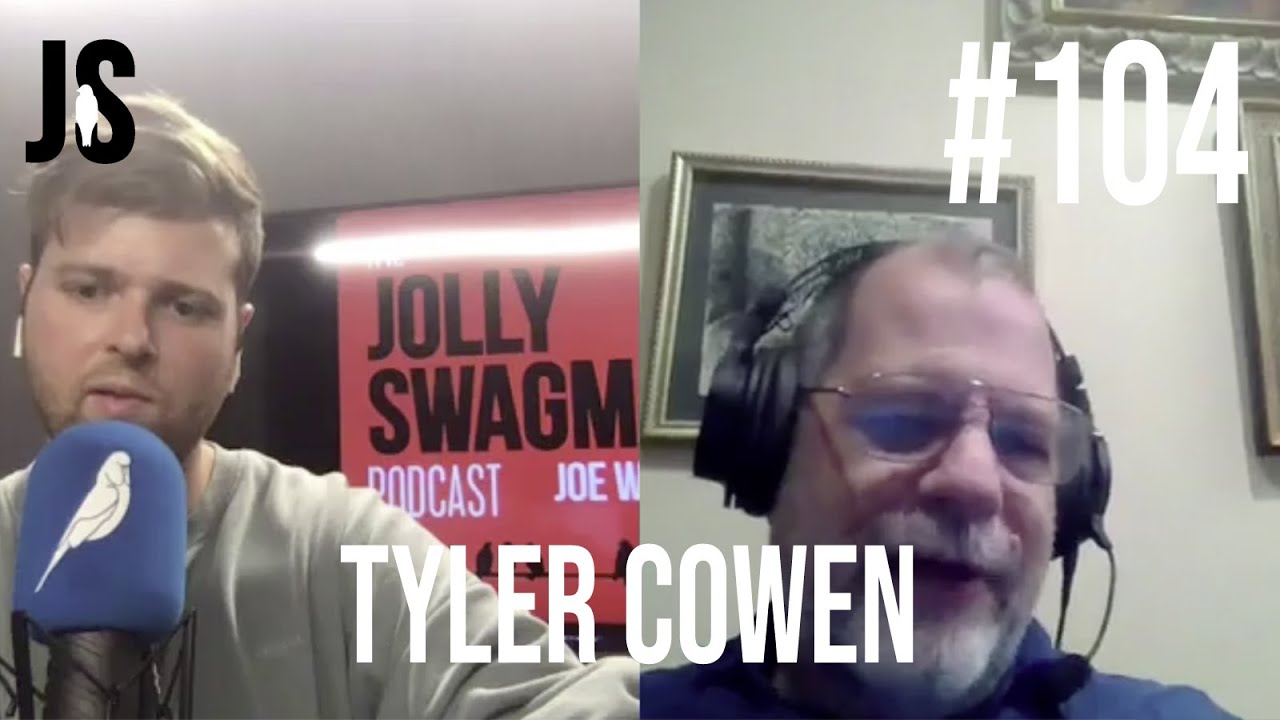
In this extensive interview, economist and public intellectual Tyler Cowen discusses a wide range of topics with the host. He begins by defending the intrinsic value of life against nihilistic arguments for suicide, then moves to intergenerational ethics, arguing that distant future welfare should not be discounted when considering utility, though cash‑flow discounting may differ. Cowen explores why some cultures, notably China, exhibit high savings rates, linking rapid income growth and precautionary motives. He outlines his "Great Stagnation" thesis, pinpointing the 1973 oil shock as a turning point, describing multiple overlapping causes, and suggests that rising real wages across several economies could signal its end, though the COVID‑19 shock obscures the picture. The conversation turns to housing, where Cowen challenges the conventional bubble narrative, proposing an "anti‑bubble" panic explanation and emphasizing the importance of well‑capitalized banks. He critiques the pandemic response in the United States, highlighting testing capacity versus follow‑up, and contrasts it with Asian countries' institutional readiness. On space, he expresses skepticism about large‑scale colonization, favoring Earth‑based development and self‑replicating probes. Regarding the Fermi paradox, he assigns a modest 1 % probability to alien drones, warning against over‑reliance on elimination arguments. Cowen shares his charitable practice of direct cash transfers to an Ethiopian individual, arguing low overhead and personal connection. He defends rule consequentialism as a useful societal constraint, recommends classic philosophical texts over recent articles, and comments on the diminishing prestige of the Nobel Prize due to proliferation and internet pre‑announcement. The dialogue also touches on political polarization, the role of scapegoating, the need for stronger social capital, and his personal habits for intellectual production, feedback, and audience building. Finally, he offers brief political predictions for the U.S. election and outlines what America needs both immediately (a vaccine) and in the longer term (social cohesion, better China strategy, freer markets).
Chapters
Tyler Cowen, welcome to the podcast.
Happy to be here. Thank you.
If God is dead, life is absurd, and there are no rules, why shouldn't we just commit suicide?
Life has some kind of positive value. Any argument for doing anything presupposes a kind of agency and an underlying nexus of values, and it seems that some form of life is a presupposition for that. The economist would ask the marginal question, "Are there particular individuals who perhaps should commit suicide?" And there the answer might be yes, but simply to obliterate all life seems to me as close to self-evidently wrong as we can find a proposition in ethics.
Why should we care about the distant future?
The distant future will be inhabited by a very large number of people And although they are distant from us in time, when their pleasures and sufferings come, they will be no less real.
Have you found any—
You're in Australia, right? You're distant in space. That shouldn't make you worthless, right? I'm in Northern Virginia. Time is not that different from space in this regard.
Do you agree that we should have a positive social discount rate of some degree over a short time horizon, say within a generation, But then a discount rate of zero over longer horizons, say across generations?
It depends what it is we're discounting. So there's the problem if you have different rates for short and long term, you can be kind of tricked into an intransitivity situation where you make inconsistent choices and you can be Dutch booked or somehow gamed. I would say the correct discount rate depends on what you're discounting across. If you're discounting across cash flows, whether for the near or distant future, some positivity of return is appropriate because there's an opportunity cost that you can invest the money and get something positive back for it, at least in some but not all circumstances. But if you're discounting happiness or utility or well-being or that kind of concept, I don't think there should be a discount rate across either short or long time horizons. And in that regard, we remain consistent across all these choices.
Caring about the distant future doesn't come naturally to most people. Have you found any framings or rhetorical lines to convince people to view the distant future as morally important?
I'm not sure the distant future is the problem. I think once choices are even a little bit out there, we discount them quite a bit. So how much we discount 10 years or 200 years I don't think is very different. It's things that are due in maybe in the next few weeks that we assign undue priority. So there are people who have induced themselves not to just obsess over the immediate present. Many highly successful people, many investors, countries with high savings rates. I'm not saying that's easy, but it's not so impossible that we don't see it. There are plenty of examples. So I do think it is not demanding the impossible, but I don't think I have any secret magic formula for how to get it done. Be born into a culture with a high savings rate is the best thing you can do. Now there's a chicken and egg problem. Where'd that come from? Well, those people were born into cultures with high savings rates. Some of it's demographics and so on. Uh, difficult problem.
Why do some cultures have higher savings rates than others?
I think the most common reason is if you take, say, China during its period of very rapid growth, they are accumulating income more quickly than they are learning to spend it. And at the same time, the Chinese situation in terms of jobs has been fairly uncertain, so the precautionary demand for savings is high. And those two factors, when they come together, tend to be what give you very high household savings rates. And we've seen it in other countries as well, but China is the most obvious and recent example.
Mm-hmm. So to come back to how we discount the future, the distinction in most people's minds is between now and then, the future, whether that is over a short time horizon or a long time horizon.
That's correct. People regard 100 years out versus 500 years out when you ask them, as more or less the same. That's in its own way irrational, but it's not the main source of problems. The main source of problems is a fixation on the very soon. What's bugging me now?
Does rule utilitarianism just end up prescribing the very same acts that act utilitarianism does?
There are different versions of rule utilitarianism. I would put it this way: the utilitarian proclamations are all asking people to maximize subject to a constraint. The best way to think about the difference between rule and act utilitarianism is that they specify different constraints, not that they give different instructions. So is there a single best way of thinking about how to specify the constraint? I'm not sure that there is, but I would say societies that can get themselves into a rule consequentialist frame of mind on average tend to do much better. So let's not discriminate against that. Let's try to lean into that as much as we can.
Years ago, I asked the philosopher Theron Palmer for book recommendations on rule utilitarianism, and he said to read Ideal Code, Real World by Brad Hooker. A book which I know you've read. But I was delighted in reading your works to see that you gravitated towards rule consequentialism as well. It's always nice to have your, your priors confirmed by a very smart person.
I like that book, but I would say most people should go further back, you know, and read Butler and read Mill and read Sidgwick and of course read Parfit. And the questions involved are so fundamental that I think a kind of basic philosophy will get you to where you're going more than trying to read the very latest journal article, which at this point I don't think will really settle it anymore. It's fundamental questions at stake, not a tweak on, you know, the latest definition of these terms. And even the Donald Reagan book, I think that's 1980, you know, on cooperation and utilitarianism, uh, that's still quite good, I think, and to the point. But it's 40 years ago. Amazing.
Yeah. Does that advice that we should go back to the original sources rather than the latest journal article apply to most topic areas in general?
Well, I think if you're, say, trying to estimate how well, say, the program of Medicare Advantage in the United States has or has not lowered premiums, you want the very latest and best journal article. You don't want to go back and read John Maynard Keynes. But so many philosophical questions, it seems to me you get better understandings from the classics, and that philosophy itself has become over-specialized and sort of twirling its own nose and less relevant. It's hard to see of younger people, like, who exactly are the great philosophers today who are having an impact? And I think that's because there's so much specialization, right?
Yeah, if you want to know what the weather's going to be tomorrow, you probably shouldn't go back to Pythagoras or someone like that.
But reading the classics has become underrated in my view, even in philosophy, which is somewhat obsessed with them. Yeah, or was.
How can we make any decision at all without succumbing to moral paralysis and total uncertainty?
Well, we make decisions whether we want to or not, and doing nothing is just as much a decision as quote-unquote "doing something." We're not even sure how to define the default. I mean, if I keep on breathing, and if I cling to the Earth as it hurtles through space, that's a kind of doing something, but we might typically call it a doing nothing. So you're gonna make a decision. Uncertainty should not paralyze you. Try to do your best. Pursue maximum expected value. And just avoid the moral nervousness. Be a little Straussian about it. Like, here's a rule, On average, I think it's a good rule. We're all going to follow it. Bravo. Go on to the next thing. Be a builder.
Get on with it.
Yes, because ultimately, the kind of nervous Nellies, they're not philosophically sophisticated. They're overindulging in their own neuroticism when you get right down to it. So it's not like there's some kind of brute let's-be-a-builder view and then in contrast to some deeper wisdom that like the real philosophers pursue. I think it's you be a builder or you're a nervous Nelly and take your pick. I say be a builder.
Why isn't the epistemic critique fatal to consequentialism?
Because you typically have some idea what is the better course of action., and then you should pursue that. There could be wide uncertainty. Any action you take, there'll be wide uncertainty. Who of us knows how the whole universe will turn out, right? Or even the history of planet Earth. If 500 years from now you read the Wikipedia page for Earth history, I mean, you're going to be shocked no matter what, right? No matter what you do. But that said, if, say, you pull away an innocent child from an oncoming speeding car, you've saved that child's life. You have no reason to think that child is the grandfather of the next Hitler, no more than under not saving the kid. So again, be a builder, do it. The kid might be the next Bill Gates or Marc Andreessen, whatever. Do it.
It took you about 20 years to write your latest book, Stubborn Attachments, and in many ways it's the capstone of much of your body of work. You gave all the proceeds of that book to an Ethiopian man you met on a fact-finding mission. Why not donate the profits to an effective charity like the Against Malaria Foundation and save more statistical lives?
Well, I'm all in favor of good charities. There are other ways in which I give money to nonprofits and charities. So part of it is a portfolio issue. But keep in mind, even very good charities have overhead. When I give money to Jonas, as I call him, I'm in regular touch with him. Overhead is basically zero because I have a lot of money in my checking account. The bank doesn't charge me for the transfer, and he gets the whole thing. Do I think we should only do direct cash transfers? No. But at the margin, I thought stubborn attachment said we should do more to help other individuals, and I was pretty sure if I gave the money to Jonas, he would be a responsible steward of it. And so far that's gone great. His biggest problem right now is COVID-19. No more tourists come to Ethiopia, so his business plans are on hold. Hmm.
How did you first meet Yonas?
He was my tour guide in a town called Lalibela of about 20,000. That's where the famous, uh, rock-hewn stone churches are in Ethiopia. They're very beautiful, and Yonas was and still is a guide. And he has been engaged in setting up a business to sell things to tourists and to sell vegetables to hotels taking care of tourists. But right now there are no tourists.
What were you doing in Lalibela?
Well, I had never been to Lalibela. These churches are beautiful. Ethiopia is a wonderful, lovely country. It's quite safe. It's high in the mountains, so you can go there. You don't have to worry about malaria and Central Ethiopia. I would say it's, COVID aside, one of the best places in the world to visit. Everyone should go. Most people don't get sick, uh, crime is pretty low. There's occasional political trouble, but, uh, it's a joy to go. I've been twice.
What is the Great Stagnation in the Western world?
Productivity Rates of growth slowed down about in 1973. Wages started going up more slowly, or in some cases not at all. It seems that science itself slowed down. Other than the tech sector, it seems pretty clear that innovation slowed down. A number of these trends arriving at once in the 1970s. Since then, those trends have mostly remained in place, with a few short exceptions.. And we have much lower living standards than if we had been able to keep the higher rates of economic growth. That I call the Great Stagnation.
Why was 1973 the breakpoint?
I don't think anyone knows. I was just discussing this with some people today. There was clearly an immediate shock in that year, the oil price shock, that hurt economies and hurt productivity. The oil prices fell a great deal later on and productivity really didn't quite come back. So I think that's one of the great mysteries in modern economic history. But the proximate cause was the oil price shock. That it didn't come back is harder to explain. Society is more regulated, people are more risk-averse, there are more veto points in decision-making in most Western countries. Those are all possible parts of the broader puzzle.
In terms of the ultimate causes, is the Great Stagnation overdetermined?
I don't think it's overdetermined, as the word is used technically. I think it's— you probably have at least 5 or 6 causes coming together, and they pile on top of each other. I think of overdetermined as, say, 4 people lifting up a feather. Any one of them would lift the feather the same amount. I doubt if that's the case here. It's a number of contributing causes all adding on to the final effect. That is my intuition.
When you interviewed Peter Thiel for your podcast, you asked him what one metric would he look at to tell him whether the Great Stagnation had ended, and he didn't really answer the question. He kind of got caught up in the hypothetical. So I want to ask you, what, what metric would you look at? Would it be total factor productivity growth, real GDP growth, growth in real GDP per capita? Growth in median family incomes, all of the above, something else?
I would say all of the above, but just as a brute force measure, if you have consistently rising real wages for most income classes over 5 to 10 years, odds are the Great Stagnation has ended. Is that the only measure? No. You would also want to actually look at science and technology itself. But odds are, if you got that result, you're making a lot of progress in some manner. It's not just that you got lucky, say, which is obviously possible, but not for so many years. Not likely.
So by that measure, the Great Stagnation persists.
Well, now is a tricky time. We actually had some period of time in the United States where wages were rising robustly for a year or two. As you know, in Australia and Canada, you've had that for a longer period of time. But I think in Australia and Canada, that just came from selling resources to China, not that you had really broken through some technological barrier. I think there's a possibility that right now the Great Stagnation is over. We can't quite see it because of the COVID panic. We're seeing actually a lot of developments, whether it be SpaceX or biomedicine, or the greater speed of vaccines, or the value of Tesla, or solar power and battery prices doing better than we had thought. Those are a bit all in abeyance or not quite delivered. But I do think there's a reasonable chance we're on the cusp of leaving the Great Stagnation, you know, as we are speaking. We're certainly not at that 5 to 10 year benchmark I gave you. But I've seen upswings in a way, say, I hadn't 5 years before.
Does Peter Thiel agree with you on that?
I don't think so. I haven't spoken to him about this for a bit over a year, uh, so I don't know his current view. I haven't heard him say that, and he didn't agree with it last time I saw him. Uh, but you know, Peter's views, they're a kind of bundle of hovering probabilities. Which is how it should be. So kind of, does Peter Thiel agree with fill in the blank? I'm not sure it's the right way to ask the question, period.
Yeah, that's a good point. Do you remember when and how you first became cognizant of the Great Stagnation?
Oh, I was thinking about the distant past and the present and the life of my grandmother, who was born, I believe, in 1905. And how much her life changed in her first 50 years. She used to talk to me about it when I was a kid. And then I just started thinking— this is around 2010, maybe 2009— well, how much has my life changed in what was then more or less my first 50 years? Clearly computers are a big, big deal, and they were not a major factor in my life when I was younger. But other than that, Like, a room is mostly the same. A car is safer, might have a better sound system, but fundamentally it does the same things. And you can go on through the list. And other than computers and now mobile, uh, I don't think there are that many fundamental changes. I live in a house from 1960 or so, and it's been renovated a bit, but I live in it just fine. It's as good as a contemporary house built today. It has some different properties. Actually, I prefer it. That to me is weird. My toilet, uh, is worse. My dishwasher is worse. That's because of regulation. My shower is worse.
Does science come before technology, or does technology come before science?
I don't think the distinction is always well defined. So there are clearly some cases like, well, you have quantum mechanics discovered early in the 20th century, for quite a while never used, and then voilà, it appears to be important for computers and it leads to great advances. In that case, clearly the science has come first. But if you look at, say, the development of algorithms in social media, or a lot of machine learning or artificial intelligence, it seems the technology and the science are kind of literally and identically the same thing. At the same points in time, you know, embodied in the same molecules and circuits. So I think it depends on the case.
Are ideas getting harder to find?
It depends on the area, but for the most part, the metrics we have seem to indicate that science has been slowing down. Moore's Law is tougher to keep up with. Crop yields are going up at diminishing rates, not at impressive rates. Uh, it takes more scientists to achieve a given amount of advance. So I think all those data are highly imperfect, but it is hard to find ones that overall scientific progress is speeding up. But I do see one in the last 9 months, and that is speed in developing a good vaccine. That has gone phenomenally rapidly. That is just n 1, but it is at least one reason to think Science is finally speeding up. Not a decisive reason, but a big, big factor that is likely to save many lives.
If we remained in the Great Stagnation for decades, the concern is not just that we miss out on having a better growth rate, which, you know, compounds and makes the distant future even better than it could have been. But it's also, on the other hand, that if we fall into negative growth or if we continue to stagnate, then our thinking in the West could switch from being positive sum to zero sum.
Or negative sum.
Or negative sum. How likely is that to happen? And, and is that something which could happen overnight in a sense?
Well, I think at the moment we're seeing it right now. I mean, most economies in the world are shrinking. Politics are nasty in many countries, and there's a sense of fighting over scraps at the table. And Benjamin Friedman argues this in his book on economic growth, that successful democracies require some kind of surplus that you use to get most people to agree and maintain consensus moving forward. And we're losing some of that right now.
Yeah, I had Joe Henrik on my podcast recently and I asked him about this, and he basically agreed with you that you can see the switch to zero-sum thinking occurring in some, uh, strata of American society at the moment already. Um, he also made an interesting point about how, uh, thinking was zero-sum in, um, like, I guess, pre-Industrial Revolution times, when, um, really, like, the main resource that people were trying to gain control of was land, which by definition is finite.
—And when wages would rise in the longer term, population would tend to rise, and wages would go back down, and there was a struggle over the means for subsistence. So I think it's one reason why liberalism didn't develop, and that liberalism and the Industrial Revolution, they don't exactly coincide, but to a considerable extent both come out of England and northwestern Europe. Over roughly the same 2 or 3 centuries, and I don't think that's a coincidence. Hmm.
Eric Weinstein has argued in public, including on my podcast, that our future lies in the stars or not at all. But his boss Peter Thiel believes that we need to be loyal to the Earth. Which side do you come down on? I agree with Peter.
You know, I often say when Nevada is full, I'll start thinking about Mars. If I lived in Australia, I would have better examples yet. Western Australia, Central Australia, they're much nicer and easier to live in than Mars. They have better food, the radiation doesn't damage your body, you don't have to worry about reentering the Earth's atmosphere. If you think there's some very valuable mineral up there, let's have robots mine it, great. But I don't see what people really have to do up there that adds value, or why many people would want to do it. They're vulnerable sitting ducks at the hostage of a highly hostile environment.
Isn't the value in diversifying our portfolio, so to speak, in ensuring that not all of our eggs are contained in, in the one basket of Earth?
I don't think we do diversify. I doubt if a Mars colony would be self-sufficient I don't think it could exist on much of a scale to begin with. If you could actually send out space probes and have sort of something like humans on 200 different planets scattered throughout the galaxy, I'd be all for that. I strongly doubt if that's possible. The best we can do maybe is self-replicating von Neumann probes and some kind of panspermia, which I would strongly be for. But just like putting humans into a rocket ship, I don't see it. And if something wiped out the solar system, Mars is also vulnerable. And the speed of light, it does seem to bind travel, even if it doesn't in your ultimate theory of physics, in terms of anything we have access to anytime soon. I mean, we can't even get close to the speed of light. And then there's time dilation effects, mass— I mean, it's a mess, right? Like, what's wrong with Central Australia? You could set up some more curry restaurants there and better air conditioning if people really need that.
Yeah, maybe, maybe we'll take you up on that. I've been to Central Australia. It is a very beautiful but largely empty expanse of land, so plenty of space for, um, American migrants.
And better governance than Mars. You know, in Central Australia, more or less everyone knows who's in charge— the government of Australia. It's a well-run place. People are always upset about whatever, but if you compare it to the uncertainties of living under Mars governance, my goodness, give me Australia anytime. Even a poorly run country you might trust more. You know, somewhere like Thailand maybe will be governed better than Mars will, because there are no focal points on Mars. There's no history, there's no established culture, so everything's up for grabs. To me, that's highly risky.
If you were put in charge of establishing the governance for the Mars colony, what kind of system would you establish?
Well, early on it's going to be something like almost martial law, like the kind of laws you have on spaceships, on space stations, uh, fishing vessels in very dangerous positions. And we know how little liberty there is in those situations. It's probably necessary to maintain safety and order, but it's not pleasant, and it's not a reason to do it. But I would say, uh, start by looking at fishing vessels and space stations. Plenty of data already.
Is the Fermi Paradox closer to being resolved now that the Pentagon has released videos of UFOs?
I have studied the information surrounding those videos. I am highly uncertain as to what is going on there. I am on record as saying I think there is a 1% chance that those items are something like alien space probes or drones. Uh, 1%. So yeah, there's a 1% chance the Fermi Paradox is resolved, or there could be aliens visiting and watching us which are not represented by those drones. We just don't see them at all, and the drones are some other weird thing. So the simplest way to resolve Fermi is just to say they're here. Another way to resolve Fermi is to Sight panspermia. They're here and we are they. To me, the chance of that is much higher than, uh, the moving objects in the footage being alien drones. But I think people dismiss the alien drones hypothesis just because they can't wrap their minds around it, and I don't think we should dismiss it. That said, I'm not crazy. I understand the direct evidence for it being alien space drones is not very high. The main argument for that is a kind of process of elimination argument, which in philosophy can be very dangerous if you don't know what you're doing. And it's like you list 7 things and you rule 6 of them out, you'd really better not say, well, it must be the 7th thing. Most of the time that will lead you wrong. And here the best argument for it being actual alien artifacts is the argument from elimination. And that worries me. But look, Harry Reid, who was in the U.S. Senate, has as high a security clearance in the United States as you can get. He thinks there's something going on there and that we shouldn't just dismiss it. And he claims there's evidence that hasn't come out. I don't know what that is. It gets me up at least to 1%.
1% is pretty high.
In expected value terms, it's high. But look, it's probably some weird explanation we haven't thought of yet.
Hmm. Back to stagnation. Tyler, what do you make of Dietrich Vollrath's argument that the growth slowdown is less to do with productivity and more to do with a decrease in the number of workers relative to the population, as well as a shift from being a goods-driven to a services-driven economy? In other words, that stagnation is actually a sign of our success.
I don't think there's any difference between those two arguments. They have different emotional affect. But if you want to say the shift of more of the economy into healthcare is one reason why there's been a productivity slowdown, I'm pretty sure that's true. And his book has a wonderful explanation of why. But to say it's a sign of our success, that's just saying our level is high. Our rate of growth is still miserable or mediocre, and we shouldn't be happy with that. Don't call that success. Did the people who put a man on the moon in the 1960s say, oh, we made it this far to 1957, there's a chicken in every pot, you know, what the heck, just forget about it, we don't need a man on the moon, we don't need whatever? No. So I agree with his claims, but I think he does not take the negative side of it sufficiently seriously.
Right, so you're interpreting the data differently?
Correct, but I don't think he and I disagree on either the data or the theory. Gotcha. And aging is also a factor behind the Great Stagnation. He writes about that. I agree, it's one of those 5 or 6 factors I mentioned earlier. Uh, there's good evidence for that. I'm not sure it's the main one, but it's a factor.
You mentioned you were impressed with the speed with which we're developing vaccines for COVID-19. In net terms, how has the panic— how has the pandemic caused you to update your Great Stagnation thesis one way or the other?
It depends a great deal on the country. If you just take the United States, Our institutions are much more dysfunctional than I had thought. And I was already considered a pessimist on those grounds. But that said, our biomedical research institutions are much better and quicker than I had thought. And our professional basketball league, the NBA, is also better. Uh, those are the institutions that have done really well in the US. So many other parts of the picture have been a bad failure. But I wouldn't say it's the same for every country.
Why haven't countries like the US or UK adopted mass testing as a third way, a way of avoiding choosing between death and lockdown? It doesn't seem that hard, does it? And you're the country that, that got the Manhattan Project going.
That was a long time ago. The US does now have a version of mass testing. If you look at tests per million, we're among the world leaders. The problem is we don't use those tests or that information very well. We have a splintered federalistic society, people who are often not very obedient. We're politically polarized. We don't have local government structures up and running to do an intelligent version of, say, trace and track. So we do test, test, test. Right now we're doing tests out the wazoo, which believe me is better than nothing, but it's not enough to stop it. And if at the end of the day, if individuals go out without a mask and mingle with each other indoors, you're gonna have a lot of cases no matter how much you test. And that's where we're at. So we have turned it around on the testing front, but I think the evidence from the countries that have done better shows you need more than simply testing. It's follow-up after you test, It's critical. And in the state of Victoria, and Australia is a great example of that, you've done a lot of testing, but you also have much, much better follow-up than what you'll see just about anywhere in the United States.
How strong do you think is the correlation between having large caseloads, failing to control the virus, and being a WEIRD society, to use Joe Henrich's acronym, Western, Educated, Industrialized, Rich, and Democratic?
I don't think that's the right way to express the correlation. So if you look at Africa, other than South Africa, most of Africa, for whatever strange reasons, is relatively untouched. I don't think it is mainly cultural. I don't even think it's mainly genetic differences. It is most likely that Africans have been exposed to other assaults on their immune system which give them greater resistance. That's a hypothesis, not a fact, but it's striking how well Africa has done. The real outlier is parts of Asia, Northeast Asia more or less, and they have governmental structures that A, are good at doing things, and B, were ready because of the earlier SARS crisis, and C, they have different notions of privacy and deference to authority. And you put all those things together, I mean, they kicked our butts. They're the outliers. Bravo to them.
Yeah, Tyler, you raised—
they may also, they may also have had better cross-immunities. So in the defense of the West, you look at Japan, which did not obviously do a good job, but they've gotten off pretty lightly. It could be those parts of Asia either had a less infectious strain as a dominant virus and/or because of their regional proximity, they had more exposure to related earlier coronaviruses that gave them more protection. You wonder, like, why have Laos and Cambodia done so well? Are their public health institutions so wonderful? I don't think so. I suspect this differing cross-immunities is a factor there too. But I don't mean to take anything away from the numerous Asian countries, plus New Zealand, that have had a great policy response.
So you don't think there's a lot of weight to the idea that their experience of SARS and MERS rattled them, made them more ready, it gave them better processes for dealing with a future pandemic, whereas the West was rendered complacent by swine flu?
No, I agree with that. It's just one factor. They have other factors. Mm-hmm. Gotcha. And also many of those countries, they are regularly familiar with the notion of existential threats to their existence. South Korea, they face North Korea, they face China, Singapore, and so on. They don't take macro success for granted the way the United States and Western Europe do. And that's another factor in addition to the earlier SARS.
Does that factor explain Israel's relative success as well?
I don't think we yet know how successful Israel has been. I think it explains their first round of success, but they've had a bad comeback in part because of very particular factors, namely it seems their Orthodox communities are fairly willing or even eager to defy instructions and they end up with a high rate of transmission for very particular reasons. And that's led to a second wave in Israel. They've now done another set of shutdowns, but they've done them very selectively, what seems so far to be pretty smartly. I would just say for a lot of countries, the final story, the final record is not yet in. And you heard people in July, August, even a month ago saying what a great success Western Europe was. And now you can't say that. France, per capita, has 3 or 4 times as many cases as the US, and hospitalizations and deaths are rising there too now. Netherlands, Belgium, Czech Republic, it's awful, right? So not until the very end will we know exactly who has done well.
You recently argued that the Nobel Prize is losing its prestige. Should we view that as a symptom of the Great Stagnation?
I don't think so. There's nothing sinister in this. But look, if you give out more prizes, the prize becomes somewhat common. It's less of a big deal. Scientists also have developed other ways of earning money, even just writing best-selling books, giving talks. Those markets are much bigger than they used to be. Prize is great, but you know, in the old days, there were like a dozen Nobel laureates in economics. It was like Paul Samuelson, Milton Friedman. It was like gods who walked the earth. Now there's dozens of winners. I would say they're really pretty much all deserving, very good picks. But at the end of the day, people don't care that much anymore. And furthermore, with the internet, sort of everyone knows who's going to win. So Paul Romer, people were saying for 10 years he would win. Good for him. He deserved it. When he actually wins, it's anticlimactic, like, oh, Paul, you finally won. We knew this 10 years ago. So the internet deflates the value of a lot of prizes because it all is pre-discussed for so long.
Should the committee give out the prize less regularly, say every 2 or 3 or 4 years?
I don't know. I suspect what's happened is inevitable no matter what they do. And I don't see it as a big problem. Like the total rewards to being great at science are still high. Probably they've never been higher. The rewards are just a bit more other things and a bit less Nobel Prize. So as long as the total rewards are rising, at least that part of the equation is fine.
Was there anything people in the past did better in terms of cultural practices that we need to revive today to help us get back to the future?
Well, they did almost everything better, right? I don't think we can revive though. We need to set out on new paths. American movies were much better in the 1970s. Rock and roll, I would say, was better in earlier eras. Some of this is a matter of taste, but relatively few things are at their peak right now. Now, maybe by culture you mean mores. Uh, the cultural mores, again, it's going to depend a lot on the region. But for the American middle class, they were in some ways better earlier than they are now. But I would say the cultural mores for educated Americans, they are at a true peak right now, and they've been rising for a few decades, and they're pretty stellar. And that's one thing we've been great at, but that's only part of the country, and it's a big problem. It's led to a kind of polarization by education and by norm adherence. Mm.
What do you make of Larry Summers' revival of secular stagnation, and how does it connect with your Great Stagnation thesis?
Well, Summers noticed that rates of productivity growth are slowing down, and he came along and reinterpreted what Peter Thiel and Robert Gordon and myself and Michael Mandel said, and he wanted to make it a big demand-side story that if we all would just go on a binge and spend more money, It could be over. I think that's quite wrong. I greatly respect Larry. He's one of my favorite economists. I like him a lot as a person. I have a good, you know, connection with him. But on that, I do think he's wrong.
Is the demand side story perhaps still correct, but for reasons other than the ones Larry posits? For example, I've been very impressed by recent work done by Amir Sufi, Artif Mian, and Ludwig Straub, who argue that growing private debt is putting downward pressure on demand.
I had an interchange with Sufi, I think on Twitter or on the blog, but I think private debt just transfers money. It doesn't drain money from the system. And the debt is paid to someone. And those funds are recycled. They may be recycled into venture capital. But in the Keynesian model, both consumption and investment are part of demand. And I don't see why he thinks demand should go down. So I guess I don't agree with Sufi.
I think the problem he identifies is that debt repayments transfer permanent income from borrowers borrowers to savers, and on average the savers tend to have a lower marginal propensity to consume.
But a higher marginal propensity to invest. I don't see why that should be bad.
Is that empirically true, that they are investing more?
Yes, sure. I mean, if they're consuming less, they're investing more. They're not burning their money. They may give some to charity,. But that actually tends to stimulate consumer demand again because people who work for nonprofits are not that rich.
Yeah, I should have been more specific in my question. Are they investing in productivity-enhancing areas?
Well, a low rate of enhancement, but I don't think less investment is the solution to that. I think ultimately you want more investment. So investment is not yielding zero or negative returns. It's just much slower than it used to be, which is bad. But at the margin, investing more will get you further than consuming more, in my opinion. So I think Sufi got upset when I criticized him, but I don't agree with him on the analysis of debt.
Should we view the Great Stagnation as the deep cause of the housing bubbles that occurred across the Anglosphere in the 2000s? As well as perhaps the continuing elevated price levels that persist today in countries like the US, UK, and Australia?
In part. So when people's incomes started slowing down, there was a tendency amongst policymakers to juice up credit using the central bank, stimulate the housing market using regulations, and that in part led to the real estate bubble. I wouldn't want to blame the whole bubble on that by any means. I think there was also a commonly held view, "Well, we're just going to keep on growing at whatever percent, 3%, 2.5%, so we can borrow all this money. You know, growth will make it good." And we didn't keep on growing at those higher percentage rates. And that was another contributing cause. But I've come around to a funny, weird, radical view that there wasn't much of a housing bubble, at least not in the US. Homes are worth more now than they were at the so-called bubble peak at 2006. I think they're worth about 30% more. So a few regions of the country, like near Las Vegas, near Orlando, had local bubbles that have not come back. But country as a whole, those were on average decent investments. We had a number of years of panic. The anti-bubble was the problem. We panicked too much. There are reasons for that. But those 2006 valuations were not insane. They were not all exactly correct, but they were not crazy. I think it's now wrong to call them just a bubble.
Well, it depends on your definition of a bubble. Perhaps they were a bubble back then because there was a divergence between market price and fundamental value being driven by speculation, whereas now, even though prices are higher than they were during the bubble years. Perhaps they're more in line with fundamentals, and there's also an absence of speculative behavior.
Well, if you want to say the bubble is a bubble because we had an anti-bubble panic, uh, I would still blame the anti-bubble panic. I mean, say you bought, you know, a painting, you paid a million dollars, and for a few years people thought it was a fake and it fell to nothing. And then people realized It wasn't a fake and it went back to its previous price or higher. You wouldn't say initially was a bubble. You would say no, you had this weird anti-bubble that was based on a mistake. And it seems that's what's true for real estate. Again, not every regional market, but for the country as a whole, especially for the coasts. And I, I don't know all the Australian data, but you actually never had the collapse. But again, COVID aside, Australian real estate can be pretty pricey, right? The Gold Coast and so on. And that's probably not a bubble. It's probably worth it. What could be better in life than like a coastal Sydney apartment?
Yeah, well, I mean, Sydney and Melbourne are in the top 5 least affordable cities in the world on— and they should be— the Graffier's analysis. And they are outstanding cities. I, uh, I'm in Sydney and I walk around the harbour, I walk around the beaches, and my breath is just taken by the beauty.
It may be underpriced, right?
Potentially, potentially. There is an argument that a bubble exists in Western Sydney where valuations are incredibly high, but you don't have, uh, the same level of access to the Central Business District as well as the kind of beautiful beaches. Um, but that is a topic of contention in Australia. I, I want to come back to this question of the anti-bubble. If there was an anti-bubble of panic in 2007-2008, what caused the panic?
People thought that our banking system maybe was going to collapse, and that was not a crazy view at the time. There were a lot of pointers in that direction. But it turned out the Fed was more heroic than we thought. The Fed actions were more stabilizing than we thought. A number of other things went better than we thought. And the panicking people turned out to be wrong and prices jumped back at varying rates of speed. But it looked worse than it was.
Hmm. The panic was in large part induced by subprime borrowers beginning to default on their mortgages. And that seems to be consistent with the idea that there was, like, over-lending to people who weren't creditworthy, which in turn must have been driven by incredibly optimistic beliefs about prices.
And that's true. And again, certainly in many particular regions, it was a true bubble. But that said, you look at the value of real estate for the nation as a whole and you ask, how did we get such a big shock as to cause such a big recession? A lot of the negative shock was itself the mistake and not the so-called bubble, I would say. But again, parts of it clearly were bubbly and out of control and insane, no doubt. And it's easiest to see again in areas like Las Vegas.
Yeah. Then I guess on the other hand, cities that are more illustrative of the anti-bubble thesis would include, for example, Detroit, which I think had a bust without a boom. Detroit too has come back.
The city is seeing a renaissance. So again, putting aside COVID, which is its own thing, but most of the economic value in the US is produced in parts where the value of real estate is considerably higher than it used to be. It's like people said Bitcoin was a bubble and it fell a great amount very quickly. So yes, of course the previous price was too high, but if it were just a bubble, it would have gone poof. And it's back again, and crypto prices are up quite a bit this year. I don't know what the right price should be. The current price could be wrong, but they too do not fit the obvious bubble story. They're just hard-to-value assets, and we've been getting it wrong in searching the price base, and we're still searching, but they're clearly worth something.
I think that's a straw man though, to say that the bubble story entails something going poof. Like, Bob Shiller is well known for arguing that bubbles can come and go in waves in the same way that viruses can spread through a population. Even within the same asset.
Shiller's been insisting stock prices are a bubble. Uh, he seems pretty clearly wrong about that. So, you know, Paul Krugman said, you know, Bitcoin was a worthless scam. Now, Bitcoin could end up being worth zero, but look, it's made several comebacks. The market has thought it through, cooled down, lost its froth and ardor, and it's still putting a decent value on Bitcoin. So I'll admit the previous price was wrong or too high, but to just think it's a bubble and a fraud, I don't see that. I think that view has been refuted. Hmm.
To come back to the connection between the Great Stagnation and house prices, the logic here is that if median incomes aren't growing, then the only way to consume more is through debt and capital gains. As you write in your book, The Great Stagnation. And I thought you would be interested to hear how this plays out in the Australian context. And I think I can pinpoint the earliest moment at which the Australian political class had kind of cottoned on to this realization. Former Australian Prime Minister John Howard, who was then Prime Minister at the time, was on radio in Brisbane in 2003, Tyler, and in response to a caller, he said that I haven't had anybody shake their fist at me and say, 'Howard, I'm angry with you for letting the value of my house increase.' So at least by that stage, they were very aware of the political importance of letting people, of like having their constituencies enjoy increased capital gains. And it's noteworthy that in that very same year, 2003, house prices in Australia increased by 20%.
I've had people telling me for 25 years that Australia's a bubble. Uh, it seems just wrong. So you've had a trade deficit basically every year. Your country was way undervalued 25 years ago. Maybe it's still way undervalued. You have tremendous fundamentals. I mean, I don't pretend to predict the future, but what's not to like?
Well, again, to go back to that year, 2003, lending to investors increased by 40% that year, whereas to owner-occupiers, it increased by about 1%. And I think there was a strong argument to say that there was a bubble during that early 2000s period. But again, it depends on how you define a bubble. And I think there are like serious epistemic issues with the whole bubble story. And, and there's like the lingering question of, can we ever call something a bubble ex ante?
But even that philosophical issue aside, practically speaking, you have an option on more factor endowments. You can anytime you want take in more labor, which will mobilize more land and in turn bring in more capital, right? So you can boost labor, land, and capital all at once just by snapping your fingers. I get your voters don't always want more immigration along all margins, but if you really need it, you can do it probably more effectively than just about any country because you have so much space. So it's hard for me to see the bearish case on Australia unless you think kind of water or climate change issues will prove totally insuperable. I guess that would be it, but otherwise, my goodness. So many positives. Such good food. And you've way outperformed. I remember when I lived in New Zealand, they all looked down on you as the worst governed country that would never really do that well. That was 30 years ago. Again, over those 30 years, Australia may have had better governance than New Zealand. But you had a longer history of being corrupt and kind of crummy local politics. Uh, somehow you got over it, mostly.
Yeah, Lee Kuan Yew famously ridiculed us as the poor white trash of Asia, and then Treasurer Paul Keating fretted that we might become a banana republic. But then the productivity reforms of the 1980s, which required amazing political dexterity on the part of Hawke, the then Prime Minister, and Keating, the then Treasurer, um were pushed through. People accepted the short-term political pain, and they've worked wonders for us, opening us up to the world, making us more competitive, um, and just opening our minds to the world in a broader, more sort of cosmopolitan sense. Historically, Tyler Cowen, housing bubbles tend to lead to nasty balance sheet recessions, and If we accept that premise for the sake of argument, should we try to preempt future housing bubbles to lean against the wind, so to speak, because under an expected value calculation, the one-time negative shock they could deliver to the long-run growth rate is just so bad? Or on the other hand, should we just focus on innovation, productivity, and growth and worry about cleaning up after if the so-called housing bubble does happen to turn sour?
I think it's hard for central banks to know when it's a housing bubble or when it's just a revaluation. But I do think the general point that you want your banks and other financial institutions to be well-capitalized so crises are not crises of solvency, that that would go a long way toward limiting cyclicality. And most countries have done that since 2008. And that's a good thing. The pandemic has come, it was an incredible negative shock. Financial systems, for the most part, have held together pretty well. So I would say we got that one mostly right.
Hmm. Tyler Cowen, two foreigners have been notorious for calling out Australia's housing market as a bubble. Um, the first in 2015 was the Nobel laureate Vernon Smith, who came to Sydney and said that we have a pretty good bubble in the Sydney and Melbourne housing markets. And the second was, um, investor and Rhodes Scholar Jonathan Tepper, who did a trip, like a fact-finding mission in 2016. And Tepper famously said that criticizing the Australian housing market was equivalent to slaughtering a cow on the streets of India. Um, that, that's kind of an indication of, of the media backlash he received after his trip. But what's most striking about those two individuals, Vernon Smith and Jonathan Tepper, is they're both self-diagnosed with Asperger's. And I know that's just a sample size of, uh, of two, but I wonder if there's some kind of correlation there. And, and maybe you could make a case for the power of Asperger's in being able to swim against the current?
Well, the investor who called the correct short position on the housing bubble, portrayed in the movie The Big Short, he also was autistic. Tyler Cowen. That's right, that's the name. So I think there's a tendency not to be swept up in social mania or fads with autistics, and in these situations where everyone else is going crazy, it's more likely they see the truth. I don't know that that's been proven, but I believe that to be the case, and it simply has to do with the social influences are different, and there are, in a number of other laboratory settings, greater objectivity of thought in autistic people.
Are there ways that people who aren't on the spectrum can hack their way into non-conformity?
Well, you can hang out with a better and weirder set of friends, including autistics. That may or may not make you a non-conformist, but like, why hang out with the conformists unless you're a contrarian and hanging out with the conformists makes you more ornery?
Hmm. Do you think reading widely might also help? Like, for example, I've found that, uh, non-conformity has become easier for me in the political sphere after I began reading a lot of different strands of political philosophy— libertarianism, conservatism, progressivism— which convinced me that there's wisdom in each tradition, which meant that I wasn't so beholden to any one tradition.
I agree, definitely, especially if you read history. If you just read about current affairs, often people become more conformist and more wrapped up in the events of the day, and the social pressures become stronger. Whereas if you start thinking about why did the Roman Empire collapse, whatever the reasons are, you probably don't have some peer group, you know, pushing you to some particular point of view. You're just trying to figure it out for yourself. And the more you get used to being in that mode, the more you'll be able to apply it to 2020. Hmm.
Thinking about politics in particular, how should radical uncertainty make us more tolerant of other people's policy prescriptions and less certain that our own tribe is correct?
Well, let's say there's a bunch of views out there and you hold the view you think is most likely to be correct. You still ought to think something like, Well, there's like 100 different views. The chance of each one being correct is 1%. I think my view is correct with 2%. So, of course, I'm gonna go with the 2% rather than a 1%. That's rational. But my goodness, if at the end of the day, you're only at 2% for being right, you shouldn't feel too good about yourself, even though you may think you're where you ought to be. And very few people are able to internalize probabilistic reasoning in that manner. They just think they're much more right than the other people, and the probability is very strong that they're much, much more right than the people they disagree with. And they just can't get out of that mindset. They need to be more Bayesian and compare like a 2% to a 1%, a 3% to a 1.5%, whatever the numbers are going to be, and realize they're probably wrong.
I mentioned earlier that it took you about 2 decades to write Stubborn Attachments. How much did the core argument change over those years, or how did it evolve, or did it not change at all?
Uh, it did change, but first, one point on the 20 years. I didn't work on it full-time 20 years or anything close to that. Each year I would devote like a month and a half to refining it and come back and let the ideas evolve. Uh, the main difference is this: the early versions of the book had a lot on existential risk and its importance. I still agree with what I wrote back then, I think, but just so many other books and other people have handled that, I ended up cutting it. It wasn't original anymore. So that's the main difference. Not really a change of heart, but definitely the core narrowed.
Earlier I asked you whether there were any sort of framings or rhetorical lines that you had found useful. Useful in encouraging people to think, to care more about the future. And one of the passages I liked best in Nick Bostrom's book Superintelligence was about existential risk, and he was sort of talking about, um, what we have to lose if we allow civilization to destroy itself or be destroyed. And, um, like Parfit, he assumes— and, you know, like you— he assumes that life has positive value. Um, either as it already is or as it's likely to become. And then in, in Superintelligence, he asks us to consider the number of planets that we might be able to colonize in the future, as well as the possibility that we develop conscious minds that can exist in computer oper— computer operations rather than in biological brains. And then, so allowing for those conscious computers, he gets to 10^58 possible mind lives that could exist. Um, and he writes— and this is the part that I love, that I share with friends to try and encourage them to think more about existential risk— Bostrom writes, if we represent all the happiness experienced during one entire such life with a single teardrop of joy, then the happiness of these souls could fill and refill the Earth's oceans every second and keep doing so for 100 billion billion millennia. And then he finishes, it is really important that we make sure these truly are tears of joy.
That's a beautiful passage. I like to think he might be right, but I can't say I quite agree. I've maybe a more naive biological perspective. I see there's a history of primate species on planet Earth. Most of them have gone extinct. Most of the ones right now are going extinct very rapidly, and we'll probably join them. My guess is we'd be lucky to have another 1,000 years left, and I think it will be spent on planet Earth. Now, 1,000 years would be great, but the chance we destroy ourselves eventually, to me, is quite high. So I don't think we're going to get to that. I'm sorry. I'm rooting for it. But look, we've had world wars, we have weapons of mass destruction. The chance they'll be used on a large scale is very small. But just let the clock keep ticking and write down the distribution and the cumulative probability density function and all that, and things go boom.
Does that pessimism undercut or strengthen the case for growth maximization?
Well, however much time we have left, I want it to be as good as possible. But I would say this: if you think we have like a billion years ahead of us with trillions of simulated minds, or whatever picture you paint, we then ought to worry a lot more about existential risk. Because you just want to hold on to get to this incredibly valuable future., and you just care much less about the next few hundred years. Whereas if you think we have, say, 800 years left and there's no weird science fiction-like scenario in the pipeline, you want to make those 800 years on Earth as good as possible. It, it is a different orientation. There's less to preserve, in my view.
Hmm. What's something that John Maynard Keynes got really right?
Well, he had so many different phases of his career, but if you read Tract on Monetary Reform from the early 1920s, it's one of the best books on monetarism ever written. It's mostly correct. If you read his book Indian Currency and Finance, where he argued that the Indian vision of a gold exchange standard was better than the British vision, I think that was mostly correct. Bretton Woods, it seems to me, while intrinsically flawed and temporary, was about as good as we could have done, and Keynes was a major architect of that. Uh, Keynes's short book, How to Pay for the War, I would mostly agree with. General Theory is a jumble of many different propositions. The key recommendation, socializing investment, I quite disagree with. But fiscal policy then was the right thing to do, and Keynes said that. Note how late to the party he was—1936. People forget that. He wasn't like the guy with that idea at all. But still, he was right about that. I think Keynes was not as right about the Treaty of Versailles as people sometimes make him out to be. The Germans never paid more than 2.5% of their GDP on reparations. And, you know, he thought it was the end of the world for them. I think he got that one wrong. So there's a lot of different Keyneses. He was right a lot of the time. He was wrong some of the time. Brilliant guy. I think he's to be admired. But he hardly had a perfect batting average. Indeed, no one does.
Do you think people need to hate less on Keynes and more on Keynesians?
I don't think people should hate any of that stuff. Keynesianism is a valuable contribution. It is very, very often overrated by its proponents. But it's part of this broader synthesis you should build in your mind. And Keynes, to me, is one of the greatest economists of all time.
Yeah, hate is perhaps too strong a word.
But I'm not trying to push him out of the canon, just to be clear. I think a lot of modern economists overrate Keynesianism and indeed don't even understand or know what Keynes actually said.
What's something that Friedrich Hayek got very wrong?
Oh well, there's again a long list. His predictions in Road to Serfdom that, uh, parts of the West through nationalization would become non-democratic were quite wrong. I think they were actually a reasonable belief at the time. I don't hold that against him, but he was wrong there. You had big growth of government, those countries stayed democratic. Norway is not even vaguely close to a totalitarian state. Keynes's book The Sensory Order, I don't think makes sense. Keynes on monetary policy and monetary theory of the trade cycle, he called for a strange version of NGDP targeting. That was pretty good. Around the time of Prices and Production, he was more of a liquidationist. It seems to me that was very much the wrong direction. So again, many different Hayeks. Brilliant in many areas. His best pieces are some of the best economics ever done. Use of Knowledge in Society. But again, on a lot of concrete issues, he was wrong.
Which one of his works, whether it's a book or an article like The Use of Knowledge in Society, would you recommend to the average educated person who's yet to read any of his works?
I don't know who the average educated person is. Maybe he wrote to Serfdom, that was a bestseller. But like his 5 best articles in that collected book, Individualism and Economic Order, that is the most important part of Hayek's contribution. And then some essays in his book, you know, studies— New Studies in Philosophy, Politics, and Economics, like Competition as a Discovery Procedure, Use of Knowledge in Society, Economics and Knowledge, his essays on the socialist calculation debate. Some of the greatest and most influential pieces of economics produced. And if you go ask someone like Jimmy Wales, co-founder of Wikipedia, "Where'd your inspiration come from?" Jimmy would say Hayek. And that's phenomenal. Such powerful, wonderful ideas. Yeah.
Tyler, I want to ask you about Tyler Cowen's production function, as well as some other miscellaneous Tyler Cowen-related questions. So you've said that everyone needs their equivalent of a musician practicing scales, and that your equivalent as an intellectual and an economist includes activities such as writing copious notes and essays that often never see the light of day, as well as writing opinions that you disagree with. But my question is, what is the feedback loop for those private essays and pieces of writing? So, you know, when, when LeBron James is practicing in solitude, he can see when he misses a shot because the ball doesn't go in the hoop or it bounces off the rim. So what's your equivalent of that? What are your private feedback loops when you're not publishing an article?
Well, one of the best of those is actually what LeBron James does, and that's shooting baskets, which I do all the time, every day when the weather's nice. And you learn that you can always miss. It doesn't matter how many years you've been doing it for. You can just flat out miss and be bad at it. And you do that every day. It's another way to practice is to do something you're not good at. I would add that to my list of how I practice.
Great. But when you're writing articles that you don't publish, how do you know whether you're writing something that's good or not?
I lose interest.
Or do you only get the feedback when you publish?
Well, you might try to publish and be rejected, but you lose interest in it, or you see why your argument wasn't correct, or you just see someone else did the same thing. It happens a lot. I don't think it's that hard, like, to see— like the people who came out with writings on existential risk before I published the Posner book. It was obvious to me I not much to say, if anything, in addition to what Posner was saying. So, I didn't feel it was some mysterious process. I just put it aside, did other things.
What about as a conversationalist and podcaster? How do you get feedback? Is it just a matter of observing the guests' reactions and body language and getting correspondence from the audience?
You can do them in front of an audience. I used to do quite a few in front of a live audience. I'm not sure it's good feedback. So the audience loves humor and entertainment, and it's great in the moment, but does it make for a better podcast? Maybe we have too much feedback. Like, I don't check how many people download each episode. It seems to me like too much feedback.
Yeah, earlier in the year in Melbourne, before the the pandemic changed everything. I recorded a nearly 2-hour live podcast with Peter Singer in a pub with a live audience, and we sprinkled a little bit of humor in, but it was a pretty dense conversation.
I'm not sure it was the right forum, and I don't know if the humor is still funny a year or two later, even if it's great. So, uh, by the way, my wife is telling me I have 10 more minutes, so if that influences your structure and speed. I will interject that.
All right, thank you. I will— it will change things. Um, what have Marginal Revolution and conversations with Tyler Cowen taught you about how to build an audience?
Uh, not to worry about building an audience. Like, do something you care about. Yeah. And really don't check the meter or whatever you've got.
Yeah. You've said that Peter Thiel may be the smartest person that you know. Um, why is that true?
Well, there's different notions of smart. Uh, Peter is probably the most original thinker. I'm not sure he's the kind of quickest, most blinding intelligence when it comes to just learning something from scratch. Like, that might be Patrick Collison. But Peter is kind of deep and profound and original on virtually any topic, and he's always thought it through, like, deeper than you think is going to be the case, even if you've spent a real amount of time with him. And that's pretty phenomenal. And people, most people just don't realize it. They think he's this guy who says a few provocative things. They have different opinions about those things, fine, but They don't get how smart Peter really is.
You reply to emails very quickly. What do you infer about someone from their email response time?
Sam Altman said this, and he and I agree. It means they're on the ball, they're paying attention, and they consider communication with the outside world and openness as a priority. And that's great. I get that not everyone can do it, or you might have family, or— but overall it's a big positive. Hmm.
When you're reading a book, do you take notes on the book, or do you just read it and let it sink into your psyche?
I read it, but I fold over pages I like. I don't even necessarily return to them. Somehow I feel I remember it better, but I don't take notes. It's just another thing to handle or manage. Seems inefficient. Yeah.
You think that most books are at best articles. Are there any articles that should be books?
Well, yes, but you need the person to want to write it, and the talent is what is scarce, not the idea. There's always another great idea for a book about some 18th century invention or whatever. But like, who's going to do it? So if you don't have anyone to do it, you don't really have the thing to begin with. But, you know, a great writer, thinker, person can take almost any idea, a tweet, and make it into a great book. That's what's amazing. Like, there's this richness to all of it, but talent is what's scarce.
When you're writing a book, how do you organize your research? Do you have research notes organized under different topics that you then draw on when it comes time to write?
I don't have notes. I don't have outlines. I read books and then I type things into a file, not necessarily well ordered. And then I revise and revise and improve the ordering. And eventually it becomes a book, but I don't have what you might call an efficient system. And I'm not recommending this for other people, but that's how I do it. Really no system. Read, type into a Word file, improve, one hopes.
Yeah. In The Great Stagnation, I noticed that you cited Peter Thiel, even though at that stage Peter hadn't yet published on the topic. I also noticed in Stubborn Attachments and in— the original journal article, Caring About the Distant Future. You tip your hat to Don Boudreaux for helping you to frame a point about thinking about how much living standards have gone up. Do you think on average public intellectuals give too much or too little credit to their peers and to thinkers who've come before them?
Too little. They haven't read widely enough. They think they're more original than they are. They underinvest in conversation as a way of learning things. You know, I, I get how it works and the incentives to be more original, um, but I don't think you actually get anything from that. You could credit people way more than you do, and whatever the world thinks of your originality is not going to go down. You could title your book All the Great Ideas I Took from Other People.— and it still could be judged as a highly original book. Like, it may or may not be, but I don't think that would lower its originality prize at the end of the day. Yeah.
I found it strange that Robert Gordon didn't mention you in The Rise and Fall of American Growth, and Peter Thiel barely credited a mention.
I think Gordon doesn't like me. I'm not sure why. You know, I once pointed out that Gordon for a while was a total productivity optimist, and he wrote several pieces in the early '00s saying like rate of productivity growth would be about 3% ongoing. We didn't have to worry about budget deficits. And he doesn't like to talk about that previous history of Robert Gordon. You get a kind of "we have always been at war with East Asia" version of Robert Gordon from Robert Gordon. I don't know that I've ever met him, or not face to face really, so it's not that there's hard feelings, but somehow I think he doesn't like me.
Hmm. Why do you encourage people to abstain from alcohol altogether? Why not encourage the occasional glass of red wine, but no more?
There are so many other encouragements out there, right? Advertisements, friends, but it's bad for you. Like, at least 10% of people will end up abusing it, so why not just not do it? It's a big external benefit to your friends, even if you are in complete control of your drinking. How many people would think of, like, having friends over and pulling out a bunch of submachine guns and bullets and, like, passing them back and forth across the table? It's not that you think one of your friends will pick up the gun and start firing. You just don't do it. I think people should think of alcohol the same way. It's ugly and destructive, and we should think it's like gross almost.
What makes Tom Stoppard one of the smartest people alive?
His plays, especially the better-known ones, are brilliantly constructed, fantastically witty, have perfect dialogue. They bring together ideas and history and drama and humor. In a way I just can't think of anything comparable. And he's truly a thinker of the Enlightenment, and he understands the value of liberty as a major achieving artist. It's incredible. Like a true classical liberal in a deep way. Comes from his Eastern European background.
Why is the Odyssey superior to the Iliad?
I don't know that it is. I prefer it There are more different parts to the story. To me, it seems more philosophical. It's not just fixated on war. But to write a very intense story with a fixation as important as war, uh, could in some ways be more profound or more important. But I prefer reading The Odyssey.
I have only 5 more questions. Do you have maximum 5 minutes? Let's go. So Election Day is tomorrow. Who are you predicting to win, and who would you like to win?
I'm not a good predictor. The betting— I got it wrong last time. The betting market says Biden. I see high turnout. I suppose I think that helps Biden. Uh, so I'll predict Biden. As director of a nonprofit, I don't feel I should take public stances, uh, on elections, but I can say I have not been happy with living under the reign of Trump.
What do you think Trump will do if he loses?
Make a lot of noise and go away and be a jerk. I'm not expecting some big catastrophe or like struggle for power. I think people overrate that chance.
If there was one thing you could change about the US electoral system, what would it be?
Well, it should be easier to vote. I don't think that would improve the outcomes, but I think it would be more fair. I think the US electoral system is much better than people think, and who's ever losing something at a given point in time will tell you how terrible it is, but fundamentally it works. Though there are all these ways in which people are discouraged or prevented from voting, and I don't favor those.
Is the Girardian scapegoat a cultural adaptation? And does America need more Girardian scapegoats at this moment of intense polarization?
America has so many Girardian scapegoats. It's all we've got, in a way. So I think we need other things. We need healing, we need tolerance, we need centrist figures of respect, uh, we need more religion, we need to be more philosophical, we need to wear more masks. It's a long list. We don't need more Girardian scapegoats. We're so good at like entertainment and storytelling that it turns out in our politics we overproduce a lot of emotions and narratives. It's like the negative flip side of Hollywood, like Bruno Moscheich has been telling us.
Why does America need more religion?
It's a social and community bond. I think it lowers the chance that you end up as an opioid addict. It raises the chance that you're raising your children in an intact two-parent family. It's a, uh, positive social externality on the whole, not in every case, but mostly. And religiosity in the last 25 years has declined greatly. It remains an underreported story. And to me, it's concerning. I'm not religious myself, to be clear. I think America's super educated, high conscientiousness people in a sense don't need religion, or you could say they have their own religion, however you want to put it. But most of the country isn't that, and it's as if the elites have foisted secularism on everyone for their own benefit, like so they can have more sex, whatever. Drink when they want, take whatever drugs they want to experiment with, and it's bad for much of the country.
Final question: What does America need most right now?
What does America need the most? A really good vaccine that is safe, efficacious, and approved by the FDA pretty quickly and distributed fairly effectively. We have a pretty good chance of getting that, but it is not yet in the bag as we are speaking. This is, I believe, November 2nd. We will know more very soon. I'm optimistic on that front, but it still remains to be seen.
And after the vaccine, over a longer horizon, what, what does America need most?
Stronger social capital amongst its less educated classes, a better sense of its actual standing in the world. A better strategy for dealing with China, uh, dealing with the fact that there are so many checks and no points and veto points in the system. Those would be some of the main things we need. Freer markets, less government regulation in most areas, and more of a willingness to be philosophical and learn from other cultures. We so rarely learn from other countries around the world. People are fighting coronavirus First thing they do is look at other countries and try to draw conclusions. That's not even the last thing we do. We just don't do it. It's crazy. We're screwed up. I'm sorry. I apologize to you, my Australian listeners. I hope we get better in this. I don't think we will.
Well, I will accept your apology, and you are, Tyler Cowen, always welcome down here in Australia, Sydney especially. But For now, thank you so much for your time and take care.
Thank you for reading so closely. Have a good day.
More from Tyler


#413: Tyler Cowen on Rationality, COVID-19, Talismans, and Life on the Margins





Tyler Cowen on Never Crying at Art, Why Rap is Dead, and Quitting Writing Books (w/ Nabeel Qureshi)


AI, Job Loss, Fertility Crisis and the Death of Careerism | ft. Tyler Cowen | PGX Ideas #4
