Glen Weyl on Fighting COVID-19 and the Role of the Academic Expert | Conversations with Tyler
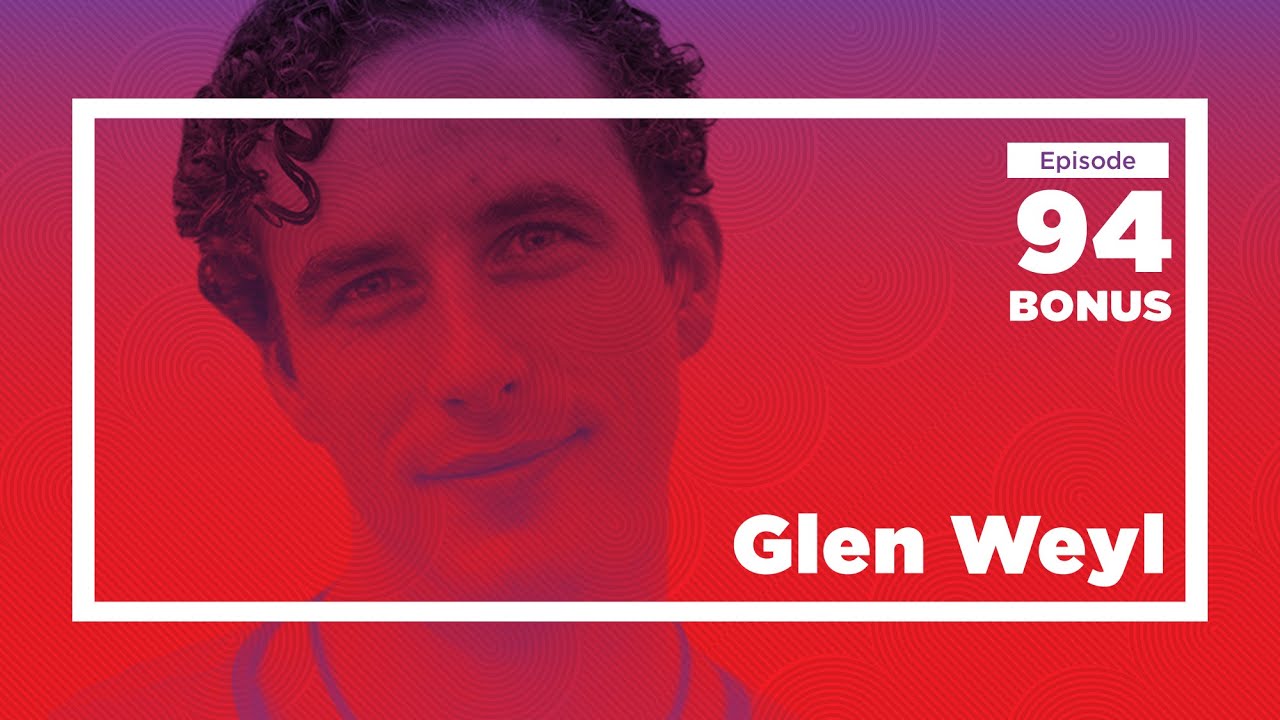
In this extensive interview, economist Glen Weyl discusses his and his co‑authors’ proposal for a national pandemic testing board that would enable up to two million daily COVID‑19 tests in the United States. He explains why current testing is hard to scale—supply‑chain coordination failures and intrusive, error‑prone nasal swabs— and argues for a three‑pillar strategy of mass testing, contact tracing, and supported isolation. Weyl emphasizes the need for public‑sector funding of the supply chain but for trusted local governments and private firms to execute testing, tracing, and communication, citing interstate compacts as a governance model. He evaluates test accuracy, noting false‑negative rates around 20‑25% (higher for poorly administered swabs) and very low false‑positive rates for PCR, and advocates less invasive spit tests to reduce human error. The conversation covers logistical questions (isolation facilities, labor needs, certification, liability), the role of digital tracing apps, and the trade‑offs between speed and precision in policy implementation. Weyl contrasts his plan with Paul Romer’s more aggressive universal‑testing approach, arguing that a combined test‑trace‑isolate regime is cheaper, less intrusive, and faster to deploy. He discusses targeted testing of essential workers versus speculative superspreader identification, and the importance of allocating scarce resources (tests, PPE) based on epidemiological impact rather than market price. The interview then moves to broader themes: applying radical‑exchange ideas to cultural funding, the limited relevance of blockchain, the pandemic’s likely lasting impact on corporate social responsibility, and reforms to the economics profession—greater public‑engagement metrics for tenure and prizes. Weyl also explores how mechanism‑design tools such as quadratic voting could improve pandemic deliberation, higher‑education peer review, and admissions. Finally, he reflects on his intellectual journey, the synthesis of Jewish‑socialist, libertarian, and market‑oriented influences, and his rebellion against singular identities in academia and politics. The dialogue blends technical policy analysis with philosophical and personal insights, offering a comprehensive roadmap for a coordinated, incentive‑compatible pandemic response and a vision for reforming economic institutions.
Chapters
Hello, today I am chatting with Glenn Weyl, who is one of the smartest and sharpest of all economists, and Glenn is, among other things, the founder and leader of Radical Exchange Foundation. Most recently, he is co-author of a significant study on how we should fight back against COVID-19, and he and his co-authors have come up with a plan, a rather ambitious plan, for a pandemic testing board and hoping to test as many as 2 million Americans each day. Ben, welcome.
Thanks so much for having me on, Tyler, especially at such short notice. It's really great to be able to talk about these issues with you.
We will have our usual wide-ranging chat, but also a lot of focus on COVID-19. Let me start with a simple question. Why is testing in America right now so hard to scale up?
I think we've got two basic problems. One is a coordination failure along the supply chain, and the other is a lot of small innovations that require a lot of regulatory engagement to get rapidly deployed that need to be really accelerated and coordinated. So if you look sort of deep into the supply chains where they're producing the reagents, where they're producing the test kits, there has not been a clear demand signal to those parts of the supply chain that we're going to aim for a really high level of testing like we're describing. And therefore, there's a real unwillingness to make the fixed cost investments to repurpose manufacturing to supply tests at that level. And we can go into why that's the case in a minute. If you think of closer to the consumer, the issues are actually quite different. They're not really about money. They're much more about the fact that the current testing technology is extremely intrusive and very volatile.
So that's the swab up your nose, right?
Exactly. Exactly.
Sounds scary. So you want to spit into a cup.
Exactly. Or a tube.
Now say I'm an individual American. We're in a world where tests are easy to get. Indeed, we're testing 2 million Americans a day. Do I in fact want to be tested if I'm afraid that information can be used against me, keep me away from my job, or remove me from my family?
That's a great point, Tyler. So that's the reason why the three pillars of our strategy are testing, tracing, and supported isolation. We need to ensure that isolation is accompanied by supports from the public that are sufficient to give people a strong reason to want to engage in isolation. Now, people have a lot of concern for their neighbors. They don't want to get people sick. They don't want to get their families sick. So there's already an inducement to isolation there. But especially for Americans who are, you know, have more limited economic means, it can be a huge hardship to be away from your job for that long, which is why we need public support for people who need to be isolated so that they can receive the treatment that they need, so that they can receive the food and income support that they need, and so that they don't get detached from their jobs.
Where physically will we put these people? Say I test as having COVID-19. Where does the truck bring me, so to speak?
I don't think a truck brings you anywhere. So the vast majority of people in the Asian countries that have been most successful in containing the disease have isolated at home. Sometimes being isolated even from their families, but, you know, overwhelmingly at home. Now, for visitors from abroad who have no clear residence in the country, there may be some dedicated facilities, particular types of hotels associated with isolation, but that's going to be a very small minority of all cases.
Is there enough trust in America to pull this off? So even if you write down the rules of the game and they sound fair, Even the people don't trust the federal government, they don't trust Donald Trump, they may not trust, you know, the Democrats and Nancy Pelosi. Won't people really still run away from the test like a plague? We don't know how long immunity lasts, if there's immunity, how long contagion lasts. I just don't want to know. I'll behave carefully enough that I don't feel guilty. Otherwise, I'm like, keep that test away from me, or not.
Yeah, I couldn't agree more that there is a systemic lack of trust, especially in federal government in this country. Which is why we believe that the most effective way to make this work is by drawing on institutions that have a lot more trust. A lot of the leading businesses in this country have a very high degree of trust. The state governments, local governments have a very high degree of trust. So we need a strategy that, you know, has a role for the federal government in funding and coordinating the parts of this that absolutely need the federal government in terms of the supply chain, But beyond that, we want to empower those localities and trusted businesses to be the ones who both execute on and lead the public communication around the strategy. And there's a well-worn tradition of that in something called an interstate compact, where the federal government can provide funding, but it's actually administered by state governments and often staffed by the private sector.
At what rate of false negative are these tests not worth doing?
Probably around 50 to 60%. Now, it depends a huge amount on whether those false negatives are what we call permanent false negatives or whether they're from poor administration of the test. If they're from poor administration of the test, you can just give a test multiple times. And it appears that most false negatives are currently from poor administration of the nasal swabs. Which, by the way, is another reason why moving towards a spit test is so desirable, because it's much harder to screw up.
But the spit test doesn't do better on false negatives, right? Maybe—
in the best case, in the best case, it, it could. So swabs are more sensitive if they're correctly administered, but they're very easy to incorrectly administer because they're a very invasive and complicated procedure. The spit test is much less prone to that sort of human error, and so may actually in practice perform better, even though the nasal swab has the potential to do better.
What do you think is the rate of false negatives right now?
Probably about 20%, 20 to 25%.
At what rate of false positives are these tests not worth doing?
I think that even a relatively low rate of false positives could create a huge problem here. Because the disease prevalence is not that high. And so if you start getting a lot of false positives, pretty much everything that's gonna come up is going to be a false positive. Luckily, the PCR tests have shown a very low rate of false positives so far.
But is our data on false positives very reliable? 'Cause we don't have another test to test the test, right? There's never been a control group and we subject people to all the different tests and then find out if they really had it. We have a lot of uncertainty about test quality.
So I think that that's true. I also think that we're not getting a huge dragnet coming out of these PCR tests in countries where prevalence rates are low. And you would expect to see that if the false positive rate were non-trivial. So, you know, in Korea, they're administering a lot of these tests and they're getting about 2% of tests coming back positive. If you look at countries where we know that there's very low prevalence, you would expect that even if there's zero prevalence, you would be getting a significant false positive rate. The fact that some countries are really getting close to zero tests coming back positive suggests that there's a very low false positive rate.
If we look at Singapore, which has done a lot with testing and track and trace, It seems at least superficially they did many things right. Now they're back to having over 900 cases a day, and they're about the size of Fairfax County and have incredible governance. So what did Singapore do wrong, and how will we avoid that same mistake?
So the truth is I haven't followed the Singaporean case recently closely enough to figure out what went wrong recently. My impression is that they put too much confidence into a particular digital tracing system which turned out to get very low take-up. And they pulled back on their manual tracing efforts before there was reason to be confident that they had the ability to pull back on them. There's also a big problem, which is that manual tracing efforts do a poor job of covering public spaces. And I think that the Singaporeans believed that, that these Bluetooth-based tracing technologies would cover those public spaces well, and they failed to do so. And they therefore allowed redensification of their public spaces too quickly. And I think that's something we need to be very careful about.
But whether or not we make those exact same mistakes, the fact that such a high-quality government made mistakes, shouldn't we really truly fear the United States with 50 different state governments, a barely competent federal government if that, will make a lot more, you know, possibly quite different mistakes? I mean, how confident are you about how this is going to run?
Well, look, I think that there is likely going to need to be some capacity for states or localities, probably through some sort of identity certificate or something like that, to potentially limit travel across jurisdictions. In Canada, they've done that across provinces.
So this would limit travel across some US states?
Yeah, I think so. I mean, I don't know if it will come to that. There's a possibility that we get very successful here in a very uniform way. But for the reasons that you're saying, because of the federal structure, I think we're going to face a choice between centralizing power more than I think we should want to, and in a way that would reduce the scope for desirable experimentation, and allowing some restrictions on travel across localities.
Say I look right now at New Zealand, Hawaii, and the Faroe Islands, in fact also Taiwan. They're all doing a great job. We're all like islands in some way, or they're literally islands. Yeah. Isn't so much of the gain just from reducing the travel? And if we reduce travel, not worry so much about the tests, we get most of the gain, or no?
Well, there's plenty of islands that have restricted travel, at least at some point and have failed. So the UK has had a terrible experience and is also an island. So I don't think being an island is enough. It's a really big island, right?
I mean, if you're in Hawaii, it's pretty carved up even within Hawaii, and there's not much mobility.
I mean, look, I think you can certainly achieve a lot if you don't yet have the disease in-country that way. There are not that many places in the US that have low enough prevalence that I think that that would really succeed. But it would probably succeed for some localities. I just think it's not a comprehensive strategy for most of the population centers of the US where prevalence is already high enough that trying to treat yourself as an island is not really going to accomplish a lot.
Give me a sense of the timeline of what you're proposing. What do we get the rate of transmission down to? How quickly do we get tests available? And then when do we reopen the economy? What's the— ticking of the clock.
There's one really critical element of this plan that I don't think has been widely discussed, which is that there are 40% of people in the essential sector who are still out there doing their jobs. And there may have been some improvements in sanitation. There probably have been, though there have been a lot of issues with getting the PPE required to do that. But those people are basically transmitting the disease as they always have been. And so by far, our first priority has to be not, quote, reopening the economy, but rather stabilizing that sector of the economy so that transmission is not taking place within that sector. Once we've accomplished that goal, it will actually be relatively easy to reopen the rest of the economy because it will, you know, given that that's 40%, it's just a doubling to get to everybody being in a disease-stabilized situation. So I really think the focus has to be on stabilizing the essential sector. By building up this regimen. I think we can do that by the end of June. And once that's accomplished, I think we can, over the course of July, reintroduce most of the rest of the economy and have the confidence that because we haven't seen reemergence of diseases within the essential sector, that reintroducing everybody else will proceed in a similar fashion.
I think if people are not paying their rents and maybe more importantly, not paying their mortgages, I worry, say, within 4 to 6 weeks, the whole banking system will be insolvent. I don't mean illiquid, where the Fed can prop it up. I just mean flat out, permanently insolvent. So isn't there some very rapid, irreversible, nonlinear deterioration going on, and we'll need to reopen more than we would like to pretty soon, no matter what our level of testing is? What do you think of that claim?
Obviously, you have thoughts. I think it's a little bit extreme, but I'm certainly inclined in that direction. The problem, Tyler, is that if we reopen under the current conditions, we're going to see, and this is expected by all the epidemiological models, a resurgence of the disease probably sooner rather than later, and we're gonna have to lock things down again. And I think as problematic as it is to keep things closed for another month plus, it's gonna be much more problematic to suddenly and unexpectedly every so often have to shut everything back down again. It will completely destroy the capacities of businesses to plan if that is looming out there. Whereas if we can plan for some period of bridge loans, some period of, you know, the Fed bailouts, etc., then at least we can get that into a bill and get ahead of it, rather than relying on people to just have to deal constantly with new crises emerging.
Let's say we never soon figure out the puzzle of immunity, how immune you are and for how long. And we're not sure how long contagiousness lasts. And you get a test, and we learn that you've had COVID-19. We're not sure if you're immune or you're contagious for 2 months. What do we do with you? What box do you get in?
So I think serological tests, if we get them working— and they're not really working very reliably yet— can be quite helpful for that because there's one of the antibodies, I always forget which one it is, MmM or MmG, but one of them is an indication, indicator of convalescence and at least temporary immunity. So serology is very useful in that case. It's also widely believed that if you've had a period of symptoms and no longer have symptoms and Though this is not known for sure, because we have seen some returns of it in South Korea. But it's believed that during that period when you don't have symptoms, the amount of the virus that you're shedding is low. So I don't think we can quite say that those people are immune until they get a serology test. But I think at least they can go back to sort of being in the same condition as the rest of the population, unless we see a resurgence of symptoms.
Now, what are the labor requirements for following up on people who test positive? You track them down, you call them up, you text them reminders, whatever is going to be done. How many people do we need to hire and train to do that work?
Somewhere on the order of a few hundred thousand. Precisely how many depends really on how quickly you want to follow up on the cases, because, you know, you can have one person on each case, or you can have multiple, but some— somewhere in that range. And by the way, the Australian government managed to train 20,000 people in a week who had been laid off from Qantas. So, we definitely have examples around the world of this being done, and I'm hopeful that we can replicate this in the US. Even a county in rural East Texas has managed to do this quite rapidly, as well as the state of Massachusetts. So, we already have some success— success stories on that.
And the party ultimately making this work, is it the federal government or the state governments?— or if there's a disagreement, who or what's the final adjudicator?
So I think it's going to be many different things with many different roles. But if you're talking about the pandemic testing board, that would be the coordinating body. I prefer, though— it could be a national forum, or it could be an interstate compact. But I prefer it to be an interstate compact, in which case it would be consortium of governors who would be the final authority. But they would appoint— the pandemic testing board, which I think would be mostly staffed by retired generals and business leaders, as well as probably someone representing labor and so forth.
And say my employer tests me, maybe it's George Mason, and the test is wrong, false positive, false negative, can I sue them or is there a complete liability waiver here?
So I think employers should have a responsibility to use the best test.
It's still a pretty high false rate, right?
So, high false negative rate, at maximum 1% false positive rate because—
The total rate could be over 30%. So, if result is wrong and you can sue your boss, bosses won't want to test you.
So, I think that they should have a negligence requirement to use the best tests available, but I don't think that they should have a strict liability requirement that if anything goes wrong, it's their fault.
But we'd have to get through all the different court systems of the country some kind of agreement on liability, right? And just for going back to work.
Yeah, I think that's fair.
During the work— testing regime.
I mean, I think the pandemic testing board should have some authority to set guidance about that. And my guess is, under standard common law, approaches, that there would be a fair bit of deference to that by most reasonable courts. I can't say that that would happen everywhere, but that would be my guess.
Let's say I love taking the test. I take the test every week. It clears me every week. Do I get a certificate?
So we believe that taking the test frequently enough— and I don't think once a week is enough, it should probably be twice a week— but that that should give you an equal status to someone who's been shown immune.
And I get a certificate proving that, and it's like—
Yeah, for both of those cases. So both for immunity and for if someone takes frequent tests, we don't think people should have the right to do that until we have enough tests to do the more basic regime for the whole population. But eventually, we would like to make them available through a more standard price mechanism like you're describing. And then, especially in essential sectors, I expect, yes, there would be a certification process like you're describing for people who are either known to be immune or for people who take frequent enough negative tests, get frequent enough negative tests.
Do we end up with a segregated nation?
I don't think so, because I think that, first of all, we will not make that available, the immunity certificates or these ones that you're talking about. The frequent negative tests, until we've already managed to really control the disease enough that we feel comfortable for people going back into most public amenities, just based on the fact that we're tracing down most of the disease. So really, the only reasonable purpose of those types of things, either immunity or frequent negative tests, would be for jobs in extremely sensitive professions where you're close to people who are in a very vulnerable part of the population.
But if I can't get a certificate for a long time, doesn't that mean I just don't want to take the test? There's no benefit for me.
So until that time, all the tests are being used in a test and trace regime. And if you test positive in the test and trace regime, you will go into supported isolation. So both— you'll end up having your health protected, but also you'll get the support so that you can receive the— so that you can actually be just as well off as if you didn't get the negative test.
Seems to me trust there will be very weak. I wouldn't believe they're gonna send me enough money. If they tell me they're gonna send me a nurse, I worry about rate of contagion amongst healthcare professionals. What's the support I get that's so valuable?
I mean, I think that getting the precise parameters of that right are really critical, Tyler, and I can't say that I've gotten down to the level of precision necessary, because there's obviously a real trade-off there between not inducing people to voluntarily get the disease in order to obtain the support, but also not getting, you know, so low that people don't want to go into that regime. I think there is an incentive-compatible place between there. I'm not sure precisely how to set it. We do know that in the East Asian countries with a wide range of government structures, it seems to have worked out reasonably well, and they've managed to induce most people to isolate. I also think there's a fair bit of sort of altruism and desire to protect your family, which doesn't go all the way, but it helps broaden the range of incentive compatibility there.
What do you think of the Robin Hanson point— and this is not a question unique to your system at all— that many young people will want to expose themselves to limited doses in order to get immunity at some point, get a certificate, re-enter normal life? And can that be a feature of a system rather than a bug?
I mean, I, I think that that is not desirable because during the period— we don't know how asymptomatic and presymptomatic transmission precisely works here. And I think a lot of young people, if they do that, would be putting their more vulnerable and elderly relatives into a lot of risk. So I think that's something we would like to discourage, but I don't think it's something that we should have more than social sanctions against.
If you were estimating a benefit-cost ratio for your plan, what would that number be?
Well, it depends on what the alternative plan is, but I think the most natural alternative—
A continuation of the mess we're in.
Yeah. I don't even know how to describe it. I would say 10 to 1. So the costs we estimate of our plan are on the order of a bit less than a month of continued freeze in place.
What percentage of Americans do you think will download tracing app?
I think it'll depend a huge amount on what part of the country you're in. So in suburban rural areas, I don't think many people will download it, and I don't think there's any reason for them to. I think in areas with a lot of high-density public amenities, a lot of people will download it, and some of them, especially some of the private amenities, may choose to require you to show that you have the app before you enter that amenity.
We all know when doing policy, proposals go through the Washington, D.C. meat grinder and the state and local government meat grinder. What do you think about the trade-off between getting this done quickly and getting it done the way you want it to be done? Let's say your version's the best version. You want speed more importantly or getting it right more importantly?
Well, look, there's a clear trade-off between the two of them. And there are sort of minimum requirements that are needed to get this working at all. And I would say those things have to be met. But the fastest possible, subject to those being met, is probably going to be much more important than getting it all precisely right.
Now, how do your views on testing differ from those of Paul Romer, if at all?
So overall, I think there's a lot of similarity between us and Paul. Paul believes in mass-scale testing, and we do as well. Paul thinks that tracing is so problematic that he would rather see universal, very frequent testing rather than tracing being used to reduce the number of tests necessary. His plans, correctly calculated, would require something like 10 to 20 times the number of tests that ours would, and therefore has costs much closer to something like $500 billion. Rather than $100 billion. It would also be much more intrusive because there would be a much greater reliance on these negative test certificates that you were talking about earlier, Tyler. And therefore, I think from both the civil liberties and a cost perspective, I strongly prefer a regime that also involves tracing. But look, Paul's plan— and the other thing I would say is because it's so ambitious, Paul's plan, in terms of the number of tests required, it will take much longer to ramp up to that point. So we'll end up with 1, 2 more months of freeze in place. So overall, I think that there's a strong case to be made for test, trace, and supported isolation instead of just testing. But on the other hand, I think it's great that he's advocating an ambitious target, just as we are.
What do you think of the plans that say we should try to predict who is a superspreader and then test them incredibly often? And maybe we won't get that far in universal testing, but we'll get most of the gains testing nurses, testing people who shake hands a lot, testing the extroverts, whoever people are at these nodes. Maybe they work in nursing homes. Whatever we find, say, from analyzing big data, how effective would that be?
So I certainly support some forms of that. I think testing essential workers, especially in long-term care facilities where there is a possibility not just for a lot of spread, but for a very dangerous spread, makes a lot of sense. I think having a very top-down regime of someone analyzing a bunch of data and on the basis of some probably pretty tenuous statistical correlation claiming that such and such a person needs to be tested and then sort of coercively going in and testing them on a government basis, it does not seem to me like a very robust regime. So I think that there's, there's some robust elements of this that I would love to see implemented. Probably largely through private demand, you know, for I want my person taking care of me to be tested. And then there's other things that seem to me sort of problematic and potentially, you know, authoritarian.
Here's a question from a reader, and I quote, "What are the best ideas for applying radical markets to the COVID-19 crisis?" End quote.
Okay, so I think some of my favorite ideas actually aren't necessarily on radical markets, but on radical exchange ideas more broadly, but those are related. That's fine, yeah, absolutely. So like, for example, I think a huge problem we have right now is that cultural industries are struggling to survive or thrive in the internet world. And we're now suddenly completely in the internet world. So all the possibilities of doing, you know, in-person gigs that were really supporting a lot of the music sector are gone. So I'd really love to see a pool of funding be put into the sort of matching mechanisms that we've been emphasizing to sort of improve the environment for things like Patreon and Kickstarter to fund cultural innovation that will help sustain morale during the times when people are separated from each other. So that's—
They could write better incentive-compatible contracts by drawing on your other insights, and that would help these people raise money and support themselves.
That's the idea.
More generally about the crisis, should we allow price gouging, say, for masks? Or reagents.
So, I think—
I don't like calling it price gouging, by the way.
Yeah, I think the problem I have with the price mechanism here is not the usual, quote, price gouging or variable pricing, but the fact that there's so many externalities in the allocation of some of these critical inputs here. And in principle, we could try to price those externalities, but in practice, trying to get such a pricing mechanism and sort of the information required for it in place quickly is going to be very hard. And so therefore, I think we need to have a lot of non-price allocation, not of the whole economy, but just of the like really critical elements like testing and certain types of PPE, because I think otherwise we're all going to be harmed by that not being allocated to those nodes, as you were talking about, where they have the largest costs associated with it.
If we need to do 2 million tests a day, or whatever is the number, and if you're a little skeptical about targeting the super spreaders, don't you just want high prices, mobilize elastic supply as quickly as possible?
Yeah, you definitely want high prices to the suppliers, for sure, absolutely. I just don't think the best way to do that is by on the demand side allocating according to the price mechanism. So I absolutely agree with Alex Tabarrok that things like advanced market commitments that throw a lot of money at the supply chain make a ton of sense, but whatever comes out of the supply chain, I don't just want allocated by the price mechanism to a bunch of rich people who want to go out and have dinner somewhere. I want it allocated to the people who are going to spread the disease the most, because that will let everybody go out and go back to normal life at a much lower cost.
But it seems a lot of the rich people have been big spreaders, right? Prince Charles, Boris Johnson, Tom Hanks.
Yeah, I mean, I'm not saying that there wouldn't be some of that, but I wouldn't say that on average that's going to be the case. I mean, a lot of the long-term care facility workers who are some of the most dangerous spreaders are not people of a lot of means.
Now, in economics, why has price theory so fallen out of favor?
I think price theory is actually making quite a bit of resurgence in the last, you know, couple of decades. Raj Chetty, Amy Finkelstein, Jon Levin, people like this who've won the John Bates Clark Medal recently have really drawn on it a lot. I think it fell out of favor in the '80s and '90s, largely because of a lot of the rise of the mathematization of economics, the rise of technocracy, within the profession, the increasing focus on sort of refinement of methods as opposed to engagement with the public. So I think that those were some of the underlying reasons. There's also an association with the University of Chicago and a particular ideological view there, which sort of mixed it all up with politics. And that's something that I think has become less and less true with this new wave that I was describing. Describing.
Now, you're a reformer. How would you reform the economics profession, which you've seen from a number of different vantage points, right?
Yeah, so I mean, I think one of the most important failings of the economics profession right now— and I think this is something you're doing a great job of trying to rectify with the engagement work you do— has to do with the lack of accountability to public discourse.— and this is something that's really systematic across American society, not just in economics, but there's a very unhealthy relationship to expertise, where either there's sort of a total disregard of and distrust of expertise, or a deference to it, rather than the notion, you know, if you look at someone like Milton Friedman, that the way you judge an expert is by their ability to distill things down and convey a message that becomes part of the public discourse. I think that's hurting us in the COVID situation, and I think it's been a disaster in the economics profession.
What's the mechanism design you would implement to get us there? We might all agree with the outcome, but what do you change? In your procedures? Your review? Yeah.
I mean, I think that one thing we need to change is the way that universities evaluate professors for tenure and the way that we evaluate people for prizes. I think it needs to be— there needs to be a much, much greater emphasis on your ability to bring things into public discourse in evaluating people, rather than just the esteem of your colleagues. And getting the right metrics on that is a really tricky thing. I bet it's something you've thought about, actually, Tyler. But I think we need to be bringing that public engagement and delivery of things directly to the public much more into how we evaluate people. You look at someone like Henry George, Henry George was one of the great economists, and he ran for mayor of New York, and he actually beat Theodore Roosevelt. So, I'd like to see more economists living that sort of a life. And Milton Friedman obviously had a bit in that direction, John Kenneth Galbraith, we need more of that. Here's another reader question, quote, "How have the events around COVID-19 changed Glenn's views on radical exchange and related issues?" Well, it's actually kind of interesting because the first thing I wrote about COVID was not the stuff that I'm doing now, but it was about Taiwan's experience and how much better Taiwan had done. And it appears this is still going than even places like Singapore and China. And I think one critical reason for that is that Taiwan has this really rich democratic technology tradition in which citizens are engaged in making them, you know, technical tools that then help scale up and govern the country. And I think in China and in the US for different reasons, the technical elites are quite divorced from those who their technology is meant to serve. And therefore they've been very poorly responsive to the emergent issues on the ground. The signals have not been reaching them from the local knowledge very effectively.— and so that actually makes me believe that radical exchange ideas may be a very powerful mechanism for warning us about future crises. It's very hard to innovate in those fundamental ways in the midst of a crisis, which is why at some level the proposals I've been pushing for this have been sort of conservative in nature. They're like drawing on things we really know have worked in the past rather than experimenting with new things. But I think as an early warning system for this type of thing, I'm I believe all the more in that type of democratic technology.
You may wish to challenge the premise here. Why do I see so little talk about the blockchain during this pandemic? Just doesn't seem that salient.
Well, so first of all, I don't think blockchain is very salient, period. You know, if you think about the conversations around technology and society, AI is way up there, Internet of Things is way up there. Blockchain is pretty far down in terms of the broad public imagination. Within the blockchain community, obviously, that's a bit different. Within that community, I think there has been quite a bit of focus on what are the best ways to do things like contact tracing. Now, if you call that blockchain or not is a bit of a question, but certainly, privacy-preserving cryptographic technologies, if anything, I think are getting more attention now than they were getting before. Because of the emphasis on trying to do contact tracing in a privacy-preserving way.
Other than possibly the adoption of your plan, what do you think will be the most enduring economic or social change from this pandemic?
My guess is that there will be a lot of large corporations that take on important social responsibilities because of the trust environment that you were talking about. And that it becomes increasingly illegitimate for them to be run under a pure shareholder maximization perspective once they're taking on that role. And so I think we're going to see fundamental shifts in some of the corporate governance parameters as a result of the social role that a bunch of companies end up taking on.
In the middle of these dialogues, we have a section, overrated versus underrated. I have some easy ones for you. Are you game?
Yeah, sure.
Rio de Janeiro, overrated or underrated?
About correctly rated, I would say.
What do you like most about it?
Best place in the world to be as a tourist, but a very challenging place to live and be productive.
Song by Don McLean, American Pie, overrated or underrated?
Oh, that's one of my favorites, Underrated.
Underrated. What's so good about it?
It manages in a very accessible and catchy way to be just sort of elusive enough about historical events that you can make sense of it and yet still appreciate the poetry and complexity of how it's speaking to things.
Why didn't Don McLean have a better career, right? There's Starry Night and then it seems to end, or am I missing something?
So, I actually don't know much about the dynamics of his career, and I like a couple of his other songs, but I agree, it is kind of remarkable that he's such a one-hit wonder.
How much people respect law in Latin America? Does the typical educated outsider underrate or overrate that? Law-abidingness. The Latin countries?
I think that they think people respect law more than they actually do. Because I think that they don't really see the favelas and the informal settlements very much on most standard trips. And they don't realize how pervasive the fact that people are living sort of outside the law is to the way that everyday life works in Latin America.
Julius Crine, overrated or underrated?
Underrated.
Your co-author, right? Tell us the story there.
So, first of all, Julius and I disagree on a great many things, but I have a huge amount of respect for his intellect. And I think he's one of the people who really challenges a lot of the ways that people have fallen into thinking. And he did it really at a time when I think that was incredibly necessary. So, I'm a big fan of his. I really like collaborating with him, even though in some ways we're sort of polar opposites. I mean, he's a nationalist, I'm very much an anti-nationalist in my basic outlook.
What was Milton Friedman most wrong about?
Monopoly power.
Tell me just a little more.
Yeah, so Milton Friedman, if you read Capitalism and Freedom, it's beautiful, it's one of my favorite books, and I actually think it's very similar to Rawls. It's funny, because a lot of people on the left love Rawls, but they hate Milton Friedman. I actually think their visions are very similar. I think both of them dramatically underestimated the importance of increasing returns phenomenon. Friedman says, "Well, there might occasionally be a temporary monopoly, but it'll go away because of competition anyway, and we need to try to just avoid it becoming too permanent by the government getting involved in it and so forth." I don't think he perceived that increasing returns phenomena that tend to create monopolies are really the foundation of what creates the possibility of civilization. He had in the back of his mind this sort of decreasing returns model that's dominant in economics. I think that that colors his whole worldview in a way that leads him to sort of miss a lot of the key questions, even though he was right on a lot of the things that he spoke about, actually. I'm actually largely sympathetic to a lot of Milton Friedman's ideas on the things he focused on. But the problem is the things he focused on weren't the key problems, I don't think.
Speaking of increasing returns, what's your favorite movie?
Memento.
Why?
Because it captures a really critical philosophical issue in an extremely engrossing thriller fashion. And it's sort of like Don McLean, you know, it's sort of like, it's getting at something deep and rich, but in a way that's broadly accessible.
What makes for a good movie critic? You were a movie critic.
I once tried to be one. I once tried to be one. I don't think I was all that successful. And, you know, I don't read nearly as much movie criticism as I used to in the past. I think what I like in a movie critic is when they're able to capture the emotional feeling of a film and what it would be like to experience it without talking too much about what actually happens.
Galápagos Islands aside, what's the best place in Latin America to go see turtles?
You know, I love turtles and I love Latin America. And so, but I don't feel I have a definitive answer to give to that. I do have the place that I've enjoyed seeing turtles most, which was Puerto Escondido, which is just a relatively small beach town where we saw some nice turtles. But I don't— I'm sure there are better places. I've heard that some of the islands off of Venezuela are some of the best. But my wife got banned from going to Venezuela because she wrote a critical report on the government. And so we've never been able to go to Isla Margarita, which is supposed to be— Magdalena, I believe— which is supposed to be one of the best places.
So— Now, one of the ideas you pushed earlier in your career, not that long ago, was quadratic voting. Which would place greater weight on more intense preferences. Let's say we take the current pandemic, and right now we had some form of quadratic voting. How would that change the nature of our response?
Whew. So, I'm a big fan of quadratic voting still. I think the question is quadratic voting for precisely what? The things I'd most like to see quadratic voting be used for in the pandemic response is eliciting from people sort of informed and rich feedback about what things they value or what elements of the response they value most. And I think it could be quite powerful there in allowing basically large-scale deliberation in a remote fashion. I think we would learn a lot more about what elements, for example, of the social distancing are hurting people the most, and what elements people are most willing to accept. And we might get a much richer picture of sort of the cost-benefit trade-offs that we're facing, which I don't think have been very well factored into public policies.
Do you think we as a collectivity would value human lives more or less with quadratic voting?
I think probably quite similar. But I think that a lot of the more rich and nuanced things, like for example, restrictions on parks versus restrictions on theaters, I think we'd learn a lot about what's most important to people there.
Let's say you're applying your ideas on mechanism design to higher education in general. What would you change?
Well, I mean, one thing I've thought about quite a bit has been the evaluation of people for tenure and some of the publication stuff. I don't know if that's higher education really though, because that's—
Part of it. I'll ask you about students next, but what's your idea for that?
Yeah, so we've been working for a while at RadicalxChange on trying to create a new system of sort of peer review and journals, where rather than having a set of authors and then referees and editors, instead there's just an ordered list of people who sign on to the article. So that, you know, authors would have the first chance to sign, and maybe editor next, and the referees next. But I think this would be a much more incentive-compatible way to get good quality referee reports and to actually allocate credit in proportion to what people have contributed to making an article work, as compared to the current system where there's a very binary division between the authors who get credit and everybody else who gets very little. And I think you could add into that some really rich stuff around having some quadratic voting in there, and then maybe having sort of individualized views of how many citations or how much respect someone gets from a journal based on who you respect and who they respect and how that filters through. So those are— I mean, I'd have to go in into more of it, but I think that those are some ways you can put these elements together to get a much better approach to understanding how you evaluate a scholar.
How would you apply mechanism design to improving admissions, right? It's been very controversial. It seems unfair. Some people would say intensity of preference being counted is the problem. Do you agree?
Um, so I think it's really critical in admissions that we and this is a really different element than intensity of preference, but that as the American system does, at the point when people need to make a lot of costly investments in figuring out what places they like, that they have a sense of who might let them in. So, if you think about the medical match system that, you know, Al Roth is very famous for being involved in, and, you know, Gale and Chapley, they have a system where you rank all the institutions before you know which ones are going to admit you. And that requires you either to do a huge amount of due diligence about all the different institutions, or to make guesses about where you're going to get into. And I think that's not a very effective process, even though it has some other properties that people have highlighted. Something more like the way that we admit students in the university— undergraduate admission, I think, is more sensible. And I think there are ways to further improve on that, to add more stages of letting in the top matches first, like the people who most want to go to someplace and the schools most want them, and allowing those parts of the market to clear, and then doing the other things later. That's a little bit like early admission, but actually making it much more finely graded.
As I'm sure you know, at a school like Harvard or Princeton, you can't just buy your way into getting a graduate admission. It's run by the faculty, correct?
Yeah.
Could we do undergraduate admissions the same way? It would be a lot of work, of course, the faculty.
I think it's interesting. I mean, I think you'd probably have to filter a little bit, so like maybe it should be graduate students who should be helping admit undergrads or something like that. I think it's a very interesting idea.
You wrote a paper in 2009 called "Whose Rights? A Critique of Individual Agency as the Basis of Rights." Do you think now, standing in 2020, are individual rights ever an appropriate concept to invoke to argue for or against a policy?
So I think almost any moral concept is a useful concept in certain contexts. Because all our ideas are proxies for some deeper truth that we don't fully understand. So I often make arguments about individual rights, individual liberties, even though I ultimately think we need to get past our standard conception of individuals as atomized and understand individuals more as being sort of an intersection of different social circles that they're a part of. But of course, you know, the more sophisticated these ideas are, the more true to reality, the more complicated and foreign they are. And we always need to strike a balance between clearly communicating and, you know, verisimilitude to the reality we're trying to describe.
You still think in principle that either group rights can be meaningful or even a component of an individual could have rights and that there's no particular reason to necessarily stop at the level pinpointed by methodological individualism.
Yeah.
Is that a fair description? Yeah.
Yeah, I would enrich that story a little bit because I— and I alluded to this in that original piece, but now I have a clearer sense of it. I think often the parts of individuals that we're talking about actually are associated with various groups. So I think we should think of individuals as being made up of group identities to a large extent, and group identities as being made up of individuals to a large extent. And so I think we should be moving towards a dual perspective on these things. Rather than a grounding that sees one as sort of the end point that composes the others.
So this would be one foundational reason why you're less libertarian than maybe you might have been before you wrote the paper.
Yeah.
A practical reason would be increasing returns, correct?
Yeah, and those are, I think, actually just two different ways of expressing the same thing. So I view the fundamental role of groups as— you know, just a different way of expressing the notion of increasing returns.
Do you have a unified theory of you and what you believe?
Uh, you know, I don't often have time enough for the meta-rationality that that requires. David Foster Wallace was one of the most remarkable people at doing that sort of thing. I aspire to it, but I haven't had quite enough time to figure it out.
Here's a unified theory of you I toy with. I'm not at all sure it's correct, but maybe you can nudge me a bit on it. At heart, you come out of the Jewish socialist tradition. Through a matter of biographical accident, you first became a libertarian, needed time to find your way back to the tradition you belong to, along the way did economics, so you believe in some notion of markets. Albeit correctly adjusted by regulation and mechanism design. You've moved away from methodological individualism. So you're this weird person of a Jewish socialist, believes in markets, and had this path leading away from libertarianism. And like no other person in the world probably is that, but you are. Is that a unified theory of you?
Well, the thing that throws a little bit of wrench into that is that I was actually a Jewish socialist before I became a libertarian.
Does that strengthen or weaken the theory?
Well, the thing that's funny is that it's certainly the case that I came back to identifying with my Judaism at around the same time that I was starting to move away from libertarianism. I don't know if that's because of the entanglement between sort of the collective element of religion and the ideological element of this other stuff. But, you know, I think from my unified theory of me on those lines has always been that I've been someone who's hugely about Hegelian synthesis and trying to find things that seem persuasive and to find a way to simultaneously fully embrace them both in my mind by finding some syncretic fusion of them. And so, you know, intellectually, that's something that is quite important to me. And I actually saw from my senior year of high school, I had a, I had like a capstone project, which was about conservative liberalism. And actually, if you read it, it reads a lot like what I've been writing recently. So the reality is, I think I have these themes of trying to find syntheses of of different things, and those keep recurring and getting nuanced by the more I learn about different fields.
As you well know, there's a longstanding historical connection between Judaism and socialism. Karl Marx, Moses Hess, Edward Bernstein— one could go on with this.
Yeah.
What do you think ultimately is the foundational reason for that historical connection? And yourself as well, right?
Well, I mean, I also think there's a deep historical, maybe even stronger historical association between Jews and capitalism. You know, and I think it really has to do much more with just abstraction and the ways in which Jews have engaged with the economic world, coming from the ways in which they've been able to express their political voice, the fact that there was literacy much earlier in the Jewish community than there was in many other communities at a broad scale, that, you know, I've actually written about that issue and why Jews have been so engaged with economics. But I don't think it's really socialism in particular. It's both socialism and capitalism. If you look at the Nazis, they often depicted one Jew of socialism and one Jew of international capitalism sort of both eating the German nation. And so Jews have always been put in that position of sort of representing these abstracted economic systems rather than one or the other in particular.
Our final segment is about what I call the Glen Wild production function. This is about you. Simple question: at Princeton as an undergraduate, why did you rollerblade to class?
So, I had always been into rollerblading since I was very young, and I thought it would be a good way to get around Princeton, though the hills ended up playing a having a big challenge for getting around on rollerblades. But I pretty quickly abandoned it for that reason. I didn't really like biking like other kids did. And luckily, it caught the eye of my future wife, so that was great.
What's your own account of why you were so successful before the age of 27?
I think I developed intellectually much more quickly than a lot of my peers. And I developed physically and emotionally a lot more slowly. And eventually I had to balance those things out. But as it turned out, that made me very unsuccessful until I'd gotten to high school, very successful from high school through the very beginning of my career, and then I faced a number of challenges because of it after that. So I think there are just different times in life where different forms of development are more important than others.
If you're looking for talent in young economists, other than the obvious, like people who work hard, what is it you look for?
I look for people who have an ability to see beyond the ways in which the field shapes them to see, while at the same time internalizing it, who can sort of live within the world of economics and then also see it from the outside.
What do you view yourself as rebelling against? The foundational level. Oh, let's look at Robin Hanson. Robin, me, is rebelling against hypocrisy. I think he even might agree with that. What are you rebelling against?
I think I'm most deeply rebelling against the separation between the role of the expert and the role of the politically engaged, you know, person. I grew up wanting to be a politician for long periods and also wanting to be like a physicist for long periods. And I'm deeply frustrated by the ways in which these things are these separate and contradictory roles in our society. And, you know, I'm sort of struggling to straddle the divide.
But that's a good answer. But if you had to boil it down to something more foundational, —what institutional failure or what personal quality lies behind that? What would that be? Why do we screw that thing up?
I mean, singular identity is one way of putting it. Many people who are economists think they're an economist. Many people who think that they're a libertarian think they're a libertarian. Every identity that I've been part of, that I thought I believed in, ended up having so much corruption entwined in it. And ultimately, like, it's the plurality and intersection of those things where I find meaning. And so it's that sort of singular definition of, you know, what I am, who I am, that I think I find most constraining.
So people aren't Hegelian enough, and there's a lot of corruption out there. And that's a big part of what you're rebelling against. Yeah. So let's say I'm a young person, maybe I want to do economics, or maybe I want to be a politician, or I'm conflicted, and I go to you and I say, "Glenn, what can or should I do to become more Hegelian?
What's your advice?" Travel in different circles, take them all really seriously, and don't let yourself totally compartmentalize them. Ask why there are contradictions and what it means, and don't get intellectually lazy about just writing it off to people being different. Glen Weyl, thank you very much.
And again, for our listeners and readers, I recommend you all read Glen's new paper co-authored on how to fight the pandemic.
Thank you, Glen. Thank you so much, Tyler Cowen.
More from Tyler


#413: Tyler Cowen on Rationality, COVID-19, Talismans, and Life on the Margins





Tyler Cowen on Never Crying at Art, Why Rap is Dead, and Quitting Writing Books (w/ Nabeel Qureshi)


AI, Job Loss, Fertility Crisis and the Death of Careerism | ft. Tyler Cowen | PGX Ideas #4
