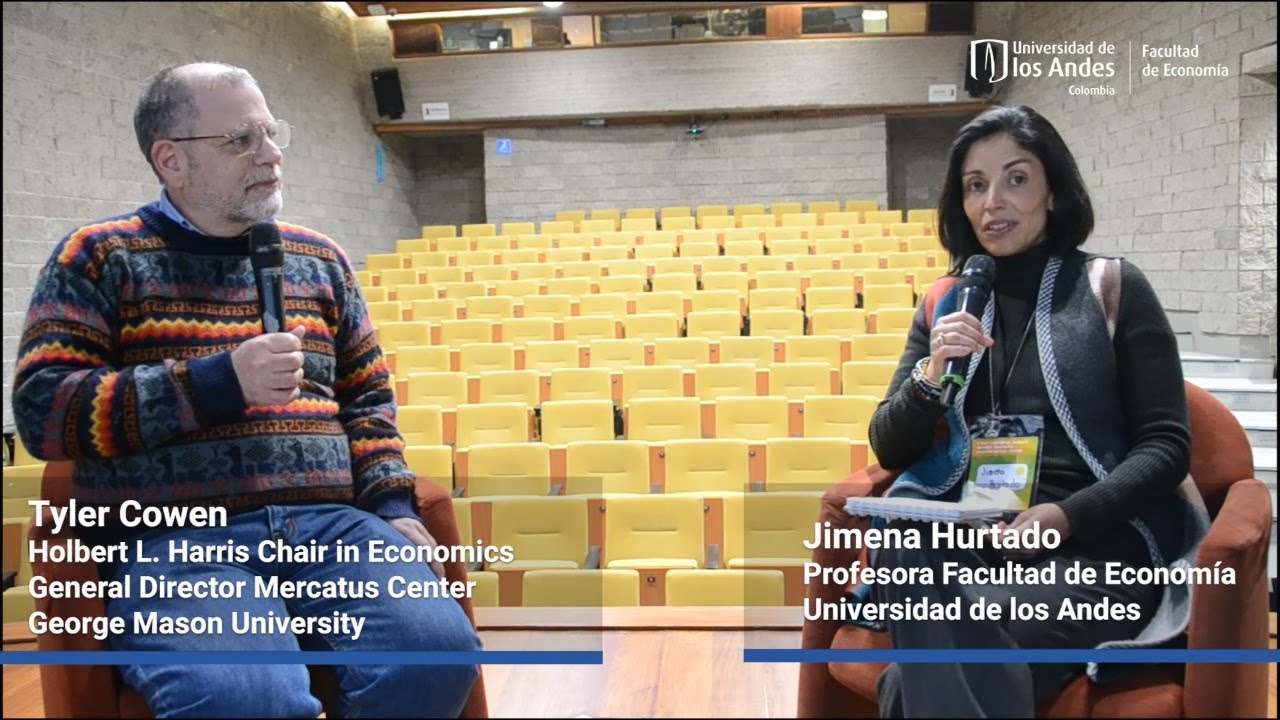
In this interview at the 2022 International Adam Smith Society Conference in Bogotá, economist Tyler Cowen discusses his early exposure to Adam Smith’s works, recalling that he first read The Wealth of Nations at age 14 after a childhood spent playing chess. He describes how the book’s explanation of market prices as information‑transmitting mechanisms and the balance of supply and demand sparked his fascination with decentralized economies. Cowen later attempted to read The Theory of Moral Sentiments around age 17‑18, finding it poorly organized and less compelling, though he acknowledges its insightful passages. He explains Adam Smith’s surprisingly progressive stance on a standing army, arguing that such an institution underpins nation‑building, enlarges market size, and secures public order, contrary to the common view that standing armies are oppressive. Cowen reflects on the apparent tension in Smith between decentralized economic/social interactions and the need for strong central institutions, suggesting that Smith saw them as dialectically unified. Applying Smith’s ideas to contemporary Latin America, Cowen expresses cautious optimism for Colombia’s political stability but greater concern for Peru and Brazil, noting that effective capitalism and institutional strength are crucial. The conversation concludes with Cowen promoting his public‑facing platforms – the Conversations with Tyler Cowen podcast and Marginal Revolution University, a free online economics education resource that also covers Adam Smith.
Chapters
It's a pleasure to be here with Professor Tyler Cowen. If I present him, that will take me about like 10 minutes, so I'd rather not. I'll just say quickly that he is a very well-known economist, but not only for his academic career, but also for his public career as a public economist participating in current debates and in other ways of communicating with a broader audience, which has made you been called the, like, one of America's hottest economists. And one of the great thinkers in economics. But your interests are broader than that. And actually, you're here in Bogotá because of Adam Smith.
That's correct.
So let's talk a little about Adam Smith. And today you said you read The Wealth of Nations for the first time when you were 14.
That's also correct.
How come?
When I was much younger, age 10, 11, 12, I was a chess player and I played chess very avidly. But at some point I was like, "I can't do this for my life, this is terrible." So I thought, "Well, what else could I do that was more interesting and would allow me to actually have a job where someone would pay me?" And I thought, "Well, economics or philosophy." And I started reading a lot of famous books. To learn those two areas and to figure out whether I wanted to be an economist or a philosopher. So reading Adam Smith fit all of those, and it was in the public library. I read a lot of Plato, I read many other classics at that age, and it was my way of trying to figure out, like, what's economics? And there was no internet then, so you couldn't just Google and learn. You had to go to the library, bring home a book. What better book than Adam Smith?
How did you choose The Wealth of Nations?
Well, I read many other books at the time, but it seemed to me that was the most famous economics book and I should read that one. And it was also a kind of philosophy. Probably I had read other things saying how wonderful it was. I don't remember all the details, but—
What did you think about that book at that time?
The parts that impressed me the most were the pure economics. Not the social theory that I talked about today. So the notion that there were market prices, and prices would balance supply and demand, and prices would communicate information about scarcity, and that this was how the whole capitalist system hung together, that was a revelation for me. And I was reading Hayek at the same time, Smith, Hayek, different words but more or less saying the same thing. And it all just, my goodness, this is one of the greatest things I'm ever gonna learn, is what I thought.
So like you told us today earlier also that this idea of decentralized economy was something that caught you, which is a bit what you're saying now, and the idea of spontaneous order also. When did you get to read the Theory of Moral Sentiments, and do you see a connection regarding decentralized social interactions?
Sometimes my memory fails me, but I believe I tried to read Theory of Moral Sentiments when I was 17 or 18, and it bored me. I didn't really like it. To this day, I'm not sure how much I like it. I think it's poorly organized, and the ways in which people still disagree about what it means shows there's a flaw in the book. Many parts are brilliant, many observations are highly insightful, but I don't think it hangs together nearly as well as Wealth of Nations does.
So maybe David Hume was right when he wrote to Adam Smith saying, I'm so sorry for you, my friend, that your Theory of Moral Sentiments has had so much success. Like, public success would not be a good measure for a good book.
David Hume was always right.
And just, you talked today about the importance of A standing army.
Yes.
And which relates very much to Colombia's reality and its history, at least over the past century. And so you said this was like Adam Smith's most progressive and modernist view. Could you synthesize that like in a nutshell?
For Adam Smith, a standing army helped you build a nation. It helped you create a larger market size. It brought public order. It gave your government the security to allow dissent and difference of opinion. It was the very foundation of a modern capitalist economy.
Which is really interesting because that's not the way you normally think about a standing army, right?
That's correct, and Smith realized he was saying something different. Many of his peers said, "Oh, a standing army, that will oppress people." It will tax them too much, it will make their lives miserable, it will be like a new Julius Caesar.
And it's like the opportunity cost of a standing army also.
It's expensive, of course.
People think about today, it's very expensive.
But I think Smith turned out to be right in the sense the societies we want to live in today are societies that either have a real military or maybe they rely on a nearby ally. But basically that's the model that has succeeded. Not the citizen's militia.
Just to end this very brief conversation, I wanted to ask you about these two big ideas in Smith, like the decentralized economy and decentralized social interactions, and at the same time having this big institution in some way, unifying and centralizing institution. So how do these two come together?
As I read Smith, he is a fairly dialectical thinker, and that Hegel so loved Adam Smith to me makes perfect sense. There's an apparent contradiction, but in the actual practice, there's a unification where all of the forces of economics and politics work together and feed each other to make each other stronger.
Do you think that there's always this idea when you read, like in a very popular reading of Smith, that in The Wealth of Nations, you have the invisible hand, which sorts kind of in this very broad reading, takes care of things. And in the Theory of Moral Sentiments, you have this sympathy process that allows people to communicate and in some way like converge to certain moral rules and justice and law. And, but what we are seeing today is at least in Latin America mostly, social unrest and political turmoil. So you think, what would Smith say nowadays with this very broad reading of spontaneous order and the sympathy process?
First, I would admit I don't understand the Theory of Moral Sentiments. But as I read the book, I take Smith to be saying sympathy isn't actually that strong. He's hoping it's enough, but I think underneath he's a little worried that it's not. And in some parts of the world, that seems to be the case. Colombia, I'm actually relatively optimistic about, but if you talk about Peru or Brazil, I would be more worried.
Yeah, so we could continue on this and see how maybe institutions are needed, and one of them would be a standing army, right?
Correct, but that's by no means the only one. You need a well-functioning capitalism that delivers standard of living gains to all the major income classes. Sometimes, but not always, that happens in Colombia, but it could function better, and that would make political order stronger as well. Let's hope we get more of that. I would say that's an open question, though.
So this will end our very brief talk. Thank you, and we invite all of you to Listen to your podcast, Conversations with Tyler Cowen, and go to your blog, Marginal Revolution. Maybe let us know a bit about your venture on online education, as we are in a university right now.
It's called Marginal Revolution University, mru.org, and it is free, no ads, online economics videos to teach you the basics of microeconomics and also macroeconomics. And we even talk about Adam Smith.
So the more reason to go visit, right?
Correct.
So thank you very much, Professor Cowen. It was a pleasure having you here, and thanks for talking to us. Thank you.