PSW 2312 What Do We Really Know About Economic Growth? | Tyler Cowen
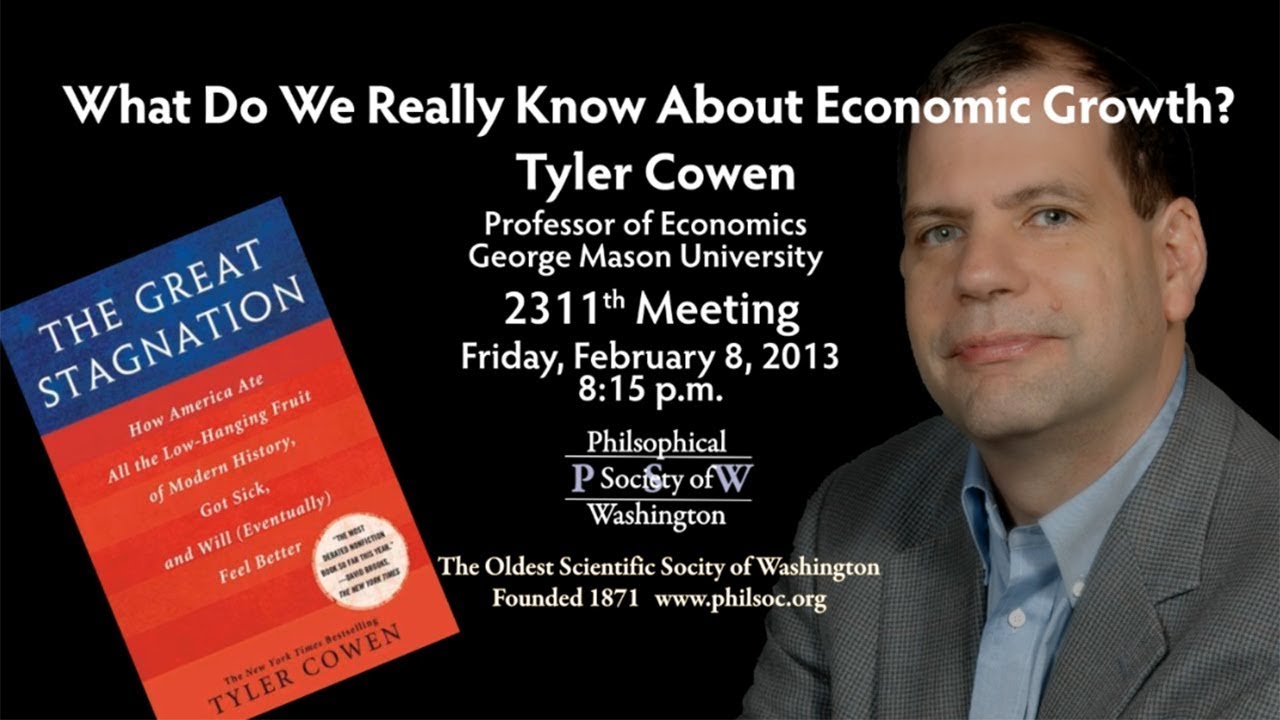
Tyler Cowen challenges the idea that the U.S. grows at a steady 2-2.5% yearly. He points to a middle-income trap where countries hit $16-17k per capita income then drop from 5.6% to 2.1% growth, and asks if America faces the same slowdown. Computer innovation has barely moved productivity since the 1970s.
Chapters
And now let me introduce the speaker. Tyler Cowen is professor of economics at George Mason University. He earned a PhD in economics from Harvard University. He is the author or editor of numerous books including Public Goods and Market Failures, Explorations in the New Monetary Economics, Markets and Cultural Voices, In Praise of Commercial Culture, What Price Fame, and Creative Destruction, among others. His writings appear regularly in the media and he publishes two daily blogs, The Marginal Revolution and the Washington, D.C. Ethnic Dining Guide. And I said, my dad, since we have Chinese New Year, I asked the author to maybe recommend some good Chinese place to enjoy the upcoming New Year, Chinese New Year, that is. And with that, please join me in welcoming Professor Cowen to deliver his lecture this evening. Tyler.
There are really two kinds of lectures. There's the feel-good lecture, and there's the scare-you lecture. And I guess tonight we're gonna do a bit of the scare-you lecture, I suppose. So what I'm gonna do is really give you some afterthoughts from my earlier book, The Great Stagnation. Tyler Cowen, which put forward the hypothesis that over the last 40 years, the United States has been a lot less innovative than it used to be, and a lot less innovative than we like to think. This is what we always tell us about ourselves, that we Americans were so phenomenally innovative, and we pull out our iPhones, and we think about Facebook, and we feel, you know, we're just marching forward at this incredible rate. But I've actually been pretty skeptical about how far we've come. But tonight I'd like to tackle a broader question, and that is, how steady is the rate of economic growth at all? How steady is the rate of economic growth, period? How predictable are rates of economic growth? And what can or should we infer from the rates of economic growth we've already seen? Let me just start by telling you, if I think about my own profession, we're up against a pretty solidly established view. I call these people the 2.2 percenters. And it's pretty clear to me why they believe in 2.2%. The number can vary depending on the time frame, or, you know, how you adjust for inflation, or how you want to deal with population growth. But this is US history. This is economic growth. It looks pretty steady. Down here, there's the Great Depression. That's not steady, but we pop back up, we kind of make up for it, and we get back on this basic trend line. So the mainstream view is that there's some core underlying rate of growth to any economy, including the U.S. economy. For us, it's somewhere between 2% and 3%. And you get pushed out of it by cycles, but once the cycle is over, you get back to that core rate of economic growth. That's really been mainstream applied economics for a long time. It's also been a foundation for public policy. If you look at CBO projections, if you look at how we plan to spend money, if you look at budgeting, also at state and local levels, very deeply built into these policies is the notion that there's some steady underlying rate of growth to our economy. I don't mean to blame anyone here. If you're involved in government budgeting, there's really nothing else you can do. You can't put out your white paper where the front page is an image of a guy throwing up his hands and a big question mark and saying, "Who knows?" Right? That's not feasible. But anyway, this is the 2.2% view, and the argument for it is really strong. The argument for it is this picture. It's like, my goodness, what a regular machine is the US economy. And again, that's the picture, so keep that in mind. I want to really stress, the view opposing mine is extremely formidable, and it's simple to present. And grasp. Now you might be wondering already, if you're philosophically inclined— this is, after all, the Philosophical Society, right? So we're all philosophically inclined. You might wonder, where does that 2.2% come from? Like, did someone pull it out of a bag? Did the Founding Fathers write it into the Constitution? Is there some kind of biological nature to human beings where somehow we generate 2-point-whatever percent each year on average? Like, what is this number? Like, you know what pi is, that's 3.14. You know where that comes from, right? The ratio. 2.718, etc., you know where that comes from, right? Natural log. So you get that. 2.2, where does that come from? The funny thing is, no one really has an extremely satisfactory answer to that question. And so, with that initial doubt, being part of the Philosophical Society— they just elected me a member, I was told, this is great— but, you know, you get this nagging doubt, a kind of Lieutenant Columbo doubt. Like you're Lieutenant Columbo, you've left the room, and then you knock on the door, and you're like, "Ah, one more question." Where does the 2.2% come from? And then it gets a little dicey. So let's proceed to chip away at this view just a bit, and I'm going to tell you in advance, there's nothing in my argument, there's nothing in these future slides that's going to defeat this view. So if you want to walk out of here, leave this room today, go home with this like stuck in your memory and thinking I'm wrong, you will be able to do so. I will have no knockdown refutation of this view. But let's just chip away at it a little bit more. You know, this is one way of scaling a graph, right? It's a nice way. Here's another way of scaling a graph. What's this? This is U.S. real GDP growth. We're graphing the same process as this, We're using different scale, and we're using a later time horizon. And in the later time horizon, there's actually more volatility. So, let's say I never showed you this, being sneaky, like I just wanted you to agree with me, and I only showed you this, and I said, "U.S. growth, it's really steady, it's built in, written into the Constitution." And all you did was see this picture. I think you'd be a little skeptical. So there's this picture, there's this picture. Which one's really correct? There's not any factual answer to that question, of course. We need to think more deeply about the rest of the data and what are the underlying processes generating real GDP growth. So let's go into this just a little more deeply, but now I'm gonna leave behind the United States which, like, if you look at this too long, feels like a really boring country. This is like the suburbs, right? Doesn't change that much. Even Washington, kinda boring compared to New York. We're gonna leave that behind and look at the rest of the world, and I'm gonna consider something called the middle-income trap. The last 6 months of my life, I've thought a lot about the middle-income trap, and I wanna write about the middle-income trap because The middle-income trap has been scaring me. And when things scare me, it bugs me. And when things bug me, I try to get some better explanation for them. But when it comes to the middle-income trap, right now I'm stuck. Let me just explain to you what's the middle-income trap. The middle-income trap basically says that most countries are clustered in two groups. Actually, three or four, but— We're only going to talk about wealthier countries. Two groups. The first group is basically U.S., Western Europe, kind of various colonies thereof, like Australia is European offshoot, right? And parts of East Asia. That's the first group. We all know these countries are wealthy, and very likely they will stay wealthy. That asteroid next week, it's not coming isn't coming close enough to change that. So that's one group of countries. They broke through. At some point in time, they were all poor. In the case of East Asia, more recently. In the case of U.S., Canada, Europe, less recently. But they all broke through. They all are clustered at the top in terms of income. And they've been world leaders for some time. The other observation is that virtually all the other countries do not break through. They get at some point stuck. And that is called the middle-income trap. You see it in this picture. I know it's kind of messy, all these different lines and colors. You could add in a lot more. But the basic point is most other countries, they have a period of acceleration,, and then they reach a critical point where they slow down. That is, they do not have a steady rate of growth for their whole history. So, for instance, very common is you'll have a developing country, and for some period of time, it grows like 6 to 8%, and then they reach a critical level. On average, this critical level is between 16,000 and 17,000 $16,000 a year per capita, on average. There's another point of getting stuck between $10,000 and $12,000. But $16,000 to $17,000. And then countries, on average, when they get to that level, which is not really developed status, but it's, you know, quite wealthier than much poorer countries, they get to that level, and then their growth slows down. They kind of go kaput. That's the middle-income trap. Who's been suffering from the middle-income trap? Well, actually, most countries in the world. There's some countries which are just very, very poor, like North Korea. It hasn't even gotten close to the middle-income trap. There are the wealthy countries, which we've already talked about. And then most of the developing world, most of Latin America, a lot of Eastern Europe, Central Asia, the poorer parts of Asia, A country like Malaysia, which is not a poor country. Malaysia is a nice country. You go there, there's a lot about it that's great. It's safe, there's great food, people are friendly. It's like Kuala Lumpur is pretty built up, but Malaysian per capita income, it's kind of stuck, and it doesn't really seem to be breaking through like Korea has done, Japan, earlier Australia, New Zealand, other places. Russia, we have a— I know there are some people from Russia in the audience, and it is believed that Russia is right now a classic instance of middle-income trap. It's not clear they're on the verge of breaking through. Most people do not expect this. So, like, already I'm worried. But I'm not just worried about Russia. I am worried about Russia, but I'm worried about the United States. Because just to go back, like, Just two slides ago we had this theory, 2.2, right? Like forever. That's the theory of us. Like we're steady and stable. Then we have this theory. That's the theory of them. They get to some point and then they kind of, I'm not gonna say fall apart, but like slows down. So there's the theory of us and the theory of them. And whenever I hear there's two theories, a theory of us and a theory of them, and I put on my philosopher cap, as I do at this society, I get worried. Because so many times in my life when there's a theory of us and a theory of them, like, there shouldn't be two theories, there should be one theory. So like, all those people are in traps, and we're like steady and stable. So I'm getting more nervous, and then I think back that I couldn't even tell you where that 2.2 percent comes from, 'cause I kind of just read it off that graph. I didn't have an explanation. So I see this, and I wonder, I guess, if there's a middle-income trap, might there not be a trap, or traps, at higher levels of income? We don't know. I mean, we really don't know. We haven't gotten there yet. But it seems like a very fundamental fact about growth. Is that at various plateaus, when you look at the thems, there are all these instances of countries getting stuck. And then you've got to ask, "Well, if all those people can get stuck, what about us getting stuck? What's going to stop that?" And again, I'm back to getting nervous myself. So the middle-income trap, let's, uh, just to put up the numbers, it's really quite striking. On average, at $17,000 per capita, growth falls from about 5.6% to 2.1%. That's a big drop. Like, maybe you thought the middle-income trap was growth falls from 6% to 5%. That wouldn't be so bad. But to fall from 5.6% to 2.1%— but, you know, being at this lower level, It's like you've stopped playing catch-up. That's another way of putting the middle-income trap, is to note that a lot of countries in the world had an extended period of catching up, and then at some point that period of catch-up goes away. And in terms of living standards in the proportional sense, they're not really getting closer to the United States. One other point, I hope this doesn't make anyone nervous, But the middle-income trap, for whatever reason, in the data, it's especially likely in aging societies. It's not hard to think why that might be true. Uh, what do we know about the wealthy societies in the world today? Every single one of them is getting older. We're getting older the least fast, actually, uh, in terms of population proportions. Japan and Italy maybe have the most serious issues with aging and demographics and public finance. But the fact that it's more likely for aging societies, I think again makes you wonder, what about us? Is the theory of us and the theory of them, should it really be so different? So now you might wonder, you know, to go back to processes, middle-income trap. Like, what goes wrong? Why do all these countries get stuck? We know a bit about this. I don't think it's very well understood, but I think it's sort of partially understood. And these are some of the extant explanations. One is simply, you know, wages rise. So you're a country like China, which so far has not slowed down, by the way,. But it's also not at that critical level. So this theory, if you believe it, predicts pretty soon, like 5 years, China— Chinese growth will radically slow down, if not sooner. But anyway, if wages rise, it used to be so cheap to set up shop in China, and you would pay the workers virtually nothing. That's not true anymore. Chinese wages are much higher, which is great for the Chinese, great for everyone. They can buy our products and products elsewhere, all good news. But wages get to a point where a country is no longer such a significant source of cheap labor. And maybe then foreign capital doesn't quite come in at the rate it used to. The country holds its own, but again, maybe you're falling from that 6% to the 2%. Another factor cited is that maybe labor migration runs dry. And here I mean people leaving the countryside for cities. And this has been a major, major driver of growth in poorer countries. Most of all China, but not just. Essentially, if you look at China, what has happened over the last 20 years is that we have witnessed, maybe without even being very conscious of it, the greatest mass migration in the history of the human race ever. By an order of magnitude. Just a phenomenal migration of people. It's within one country, but they are traveling across the centuries. You basically have almost 400 billion people moving from the— sorry, million people moving from the Chinese countryside to Chinese cities and skipping at least a century in terms of standard of living. Accelerating by moving. You bring labor into cities, people work in factories rather than, you know, tilling the fields by hand. Are they much more productive? Yes. It's a huge gain, it drives growth, it's driven Chinese growth. But at some point, there just aren't that many people left in the countryside, or the people who are there don't want to leave, or they're too old, or too sick, or too something. And the migration slows down. And then too, your growth is going to slow down. Maybe one analogy in Western economies would be large numbers of women entering the labor force. So it's very interesting if you look at the U.S. and you look at wage performance. Let's compare 1969 to today. 1969 is a long time ago. It's, uh, well over 40 years ago. Women today, as you all know or suspect, earn much more than they did in 1969. They work more, but even for a given job, they earn more. There's less discrimination, and women are much better educated, and you could cite a lot of other factors, but that's a blindingly obvious fact. If you look at men since 1969, the median male wage in 1969, believe it or not, was higher then than it is today. This is a fact which is hard to grasp, that basically 44 years ago, the median male worker, this is adjusting for inflation, earned slightly more back then than now. It doesn't mean that men today are worse off. There's good things about today that don't show up in measured income. Facebook is free. There's less prejudice in society. A lot of social norms have improved. The environment, for the most part, is cleaner. So there's a lot of things that have gotten better. I'm not saying there's been no progress. There's some medical gains which I think are not measured in these statistics. But it's shocking. Let's say you took an economist in 1969, you sat down with Paul Samuelson or Milton Friedman, Friedman, it's not a political question. And you just said, "Paul Milton, 44 years from now, what's gonna be up with those male wages?" They would have thought it's a stupid question. And then you say, "Look, there's not gonna be a nuclear war, communism will fall, the world will move closer toward freer trade, a lot of nations will deregulate, we'll win the Cold War, and China will start growing really rapidly, and the whole, like, New World Hemisphere will remain totally peaceful." and Canada will, like, do really well, and so on, they would say, "Well, of course male wages will go up." But they didn't. Measured male wages at the median are somewhat down. So economic growth in this country, when you're looking only at wages, at the wage share, so much of it has been driven by women. Which is great. And again, it's great for women, it's also good for men. But this one-time move of a lot of women entering the labor force, getting better educations, fighting prejudice and discrimination, all good stuff, it can't really happen again. It's already happened. I'm not saying there won't be any more advances, but there was this huge one-time shift of labor, mostly female, Previously living in one environment, moving into a more advanced, better, fairer environment, huge gain. But the men, who in '69 already didn't really face discrimination, maybe had it working in their favor, they've just been stuck. So when I think about that, that makes me worry about the 2.2. Because I start to fear, and I can't prove this, But I start to fear that some chunk of that 2.2 has been driven by this one-time event, women working more, longer hours, harder, getting better educated, a one-time event that we really will not be replicating. And it's a bit like rural Chinese moving into the cities. It's a kind of labor migration that you can keep them there, but in terms of a new burst, it runs dry. Third—
oops.
A third factor behind the middle-income trap: demographic slowdown. I mentioned that. And these two are important. It can be hard for a country to keep on moving up what's called the value chain. Or maybe growth depends increasingly on innovation. These two are different versions of the same idea. So here's a way to think about it. There's a lot of stuff that many different countries can make. Like, take carrots. How many different countries can make a carrot? As far as I know, they all can. Making a carrot isn't that hard. You have to know how to plant seeds, and pull it out, and you need to get it to market. Countries may have better or worse carrots, But all the countries I know of, they can make carrots. How many countries can make automobiles? Fewer than can make carrots, but actually quite a few. So if you take Mexico, if you take Brazil, and they make autos, and you ask, "How good are their autos?" Their autos are really good. What country is the number 4 exporter of automobiles in the world? Does anyone know? It's Mexico. Probably they will, in less than a decade, be number 3. So Mexico makes really good cars. A lot of countries can't make competitive cars. But then, like, let's bring it up a notch. How many countries can make really good, top-rate, sophisticated military aircraft? Much smaller number. So there's some kind of chain where stuff gets harder to make, and fewer countries can do it well in a competitive way. So maybe what slows down growth is you start growing, then you're like pretty good at making carrots, and then you move to some harder stuff, like eventually you start making cars. But eventually maybe you get to a point where to grow more, the stuff you then need to tackle your economy just can't do. Maybe it doesn't have enough trust, or enough decentralization, or good enough institutions, or we don't know what, but something is missing, that same whatever it is that keeps a lot of countries from being able to make, say, really good sophisticated aircraft. So again, it's a story of countries getting stuck. But what it tells us is there is meaningful central phenomenon that large numbers of countries get stuck, that it can be the technological problems facing them, the institutional problems facing them, they can't really solve. And then you have to go back to the us and the them. We kind of know it's true about the them. Might not it also be true about the us? Now, this thing about the middle-income trap, I'd just like to talk for a moment about a few of the countries that have gotten over it recently. And this I also find unsettling. I'm not sure what to make of this. But if you ask, "Which countries recently have broken through the middle-income trap?" Let me just talk about two of them. One of them is Greece.. And the other is Portugal. So, say, in 1960, Portugal was very poor. It was an underdeveloped economy, essentially, closer to the Third World than to, say, England or France in terms of living standards. Portugal now is poorer than most of Western Europe, but it had a period of 25 to 30 years of pretty sustained growth. It essentially achieved developed country living standards at a somewhat lower level, as did Greece. But what we now see in today's world, you know, this is for Greece, actually it only goes to 2010, but if you were to tack on 2 more years it would look a lot uglier. The Greek economy, like for 4 years now, every year shrinks, and it's shrinking a lot, pretty rapidly. There are different theories as to why this is happening. Everyone has their pet theory of the Eurozone. Also, the economy in Portugal. If you look at it, it's shrinking. Portugal in the year 2000 was wealthier than it is today. And some of that is the recent Eurozone crisis, but not just. Portugal has some pretty deep, longer-term structural problems. So, what worries me when I look at a few of the economies that appeared to break through the middle-income trap, and I now see them regressing. So the standard view is something like, "Well, Greece and Portugal, that's too bad, it's awful. We need some kind of plan for the Eurozone." I would agree with that. But like, once we put in this plan and make it good enough, Greece and Portugal will turn around and they'll climb back to where they were. And to me, it's far from obvious that that is true. I think it's actually quite possible that for Greece and Portugal, and even Spain, I think it's quite possible that their longer-term equilibrium is to be something like 20 to 30% poorer than they were at the peak of their boom, let's say in 2006. And here's the way I think about that. You know, if you look at Spanish data, by the way, like retail sales in Spain, they're already below the level where they were 20 years ago, like per capita retail sales. So, in terms of like what people consume every day, you're already at the point where they've lost 20 years' worth of growth. And this to me is stunning, that you have significant countries, they appear to be going in reverse. But here's a way to think about maybe what's going on here. Two visions. First vision I already mentioned. Eurozone is messed up, which we all know. Like it needs some kind of fix. The fix will be applied. Everyone will go back to where they were. It's quite possible. There's no way to prove that's wrong. But here's another vision. That for some countries there are what economists call multiple equilibria. Multiple equilibria means that how well things go depend on expectations. So, like, think of this in terms of a friendship, or a relationship, or a business partnership. There are, like, two ways it can be. Like, the first way, you both trust each other, and things go great. The second way is that seeds of mistrust develop and feed upon each other, and neither of you trusts the other, and things go terribly. That's just like common sense. There's like a high-trust equilibrium and the low-trust equilibrium. And in a friendship, relationship, partnership, you can be in one or the other. And if you go from the high trust to the low trust, it really hurts. It's terrible. You lose money, you lose friendships, whatever. It's very bad. It seems to me something similar might be possible with countries. That you might have multiple equilibria. Based on expectations, and you look at a country such as Greece and think of foreign investors, they're weighing two views of the world in their mind. The first view is, "Well, Greece is basically a Western European country that just needs to catch up." The second view is, "Greece is basically a country of the Balkans which will never really catch up." To me, those are like plausible competing views. You might favor one or the other, but that someone today might be unsure seems to me like common sense. So, imagine in 2006, when the Greek borrowing rate was the same as the German borrowing rate, and there was a boom, what did people think? They thought Greece is like a Western European country, it just hasn't quite caught up yet. Today, what do people think? You've had revelations of corruption, lying about public finances, all kinds of underlying problems with the banking system, with defense spending, with the military, with racist groups. You could, you know, give a whole talk on the problems which have come out about Greece. And many more foreign investors, they don't trust Greece anymore. They tend to think maybe Greece is actually a Balkan country which isn't going to catch up anytime soon. That it's more like— it's not really a clear parallel, you know, sort of like a Croatia. It will be wealthier than the poor countries, but will not be knocking on the door of the wealthy Western economies. So, if people have switched their expectations, and then confidence goes down, trust goes down, foreign investment goes down. I think it's possible there's been this flick of the switch. Greece, possibly Portugal, possibly also Spain, they're in— living in some new world where their fate is to be 20 or 30% poorer than where they were. So they're not in a world of 2.2%. They're not even in a slightly bumpy version of that. They are in a world where they have tripped and they are like falling down the stairs and they will not stop until they reach the bottom of the stairs. That is what it looks like to me, that it is not simply a temporary problem that will blow over. They are not going to become really poor, but they are going to be kind of sent back to a starting point. The same may be true for places in Eastern Europe like Hungary. You also see this a bit in Latvia and Estonia. They've had some pretty good reforms in those countries, and those countries have some very real strengths, but they still haven't gotten back to the output levels they had in 2006-2007. So, it's like they got the— they pulled out the "start all over again" card, which is scary. So, if that can happen to some economies, We might also wonder, can in some ways that happen to us? Going back to this point about the us and the them. So for instance, think about this. What do people think about US government? 20, 30 years ago, they thought we had a pretty good system. Most investors, they still kind of think that. But do you ever think that maybe that expectation is being eroded? That people no longer are sure we have such a good system of government compared, say, to Canada? So there's the possibility, at least, for multiple equilibria where the U.S. not only doesn't get its 2.2, but at some point may do a bit of bouncing down the stairs. Here's a scary picture: high school graduation rates. This is for us. They were higher in the late 1960s than today. What does this say about us? Nothing great. College graduation rates. I don't have a picture, but they've been stagnant for decades also. U.S. used to be the world leader. Now we're in the middle of the pack. US income. Sort of a complicated picture, but these are different income classes. So let's look here, 1950 to 1960. Like all the different groups, their incomes are going up a lot. The '60s, all the different groups, their incomes are going up a lot. '70s, not so great. '80s, better, but like not like the '60s. '90s, mixed picture. But with some, like, progress. Last 13 years, how does that look to you? Kinda looks like we're giving something back, doesn't it? Here's another way to put it. If you take median household income, income of the typical household, since the end of the recession— I'm not talking about the recession— since the end of the recession, That's fallen by 7 to 8%. That's what recovery looks like. And when I hear that, I start getting, again, a little worried that we might be coughing back up some ground. And you see it in this picture pretty clearly. You really would rather it were the other way around, wouldn't you? Like this was 50 years ago, and this was the world today. But it's not. Here's a measure of innovation. This is a little technical and complicated, and I'm getting toward the end of my time. If you want, we can cover this in Q&A. But it used to be the case we were innovating at this rate, and starting around 1973, we're innovating at a slower rate. You know, we're still flying airplanes designed in the late 1960s. And if you had told people that in the '60s, we would still be flying them. They would have thought you were crazy. They made shows like The Jetsons where you have flying cars. I don't have a flying car. I have a car. It's a lot like the car I drove 33 years ago. It has a better sound system, like CDs are better than 8-track tapes. It has side airbags. It's a much better car, but it's still a car. It's nothing like getting a car from not having a car, which is like what my grandmother saw in her life. So the numbers, and I would say the anecdotes, suggest progress has slowed down. You look at crop yields, how fertile is the land. Crop yields are still going up, they're going up at a lower pace for some time now, since the 1990s at least. Crop yields, those gains are slowing down, food prices are higher. You see this in a lot of the supermarkets. This is the aging of the U.S., in case you had any doubt. By 2030, this country as a whole will be as old as Florida is today. It's not that far away. Ah, for those of you who are younger in the audience, If you're graduating from college, what are the entering wages of college graduates? Well, in the year 2000, they were here, and in 2011, they're here. They're down. How's that for progress? Very scary. And you look at this, and you see people starting, like, at lower-paying jobs, and they're also investing less in human capital. I still get worried about that 2.2. I'm worried that we're shifting from 2.2 or 2 point whatever to 1.2. I see all these indicators of us being stuck, possibly, in some kind of trap. In general, you look at the past. Growth is lumpy. Like, does anyone think the 2.2 model applies to all of human history? I don't think so. What I see are like big breakthroughs. You then ride those waves, you consolidate, you slow down, you get another breakthrough. What are big breakthroughs? Brain size, right? Language, hunting, farming, Industrial Revolution. Those are awesome. But you don't get breakthroughs all the time. So you look at the big picture. You know, don't focus on this one, but look at all of human history. Clearly it's not smooth. So maybe this is just some kind of wacky, delusional American island. That we've been living in for a century and we can't quite rely on because it's not necessarily really there. We don't know. If you want to stick with this picture, that's fine. There's real evidence there. But I'll close my remarks, and anyway, that's what I'm worried about today. Thank you all for coming and listening.
Thank you very much. We have time for questions. We have two microphones, one here and another one. Raise your hand, state your name and your affiliation.
Let me just say you can ask questions about anything.
Yes.
It doesn't have to be about this.
Pierre, we're going to start on this side. All right. Go ahead. Thank you.
Yeah, I've heard some of the statistics before, particularly the 20% net income that hasn't moved in 20— not the 20%, the 20-year stagnation of American incomes. But I've never known, and perhaps you could tell me, is that total compensation or is it wages? For example, does it include fringe benefits, healthcare, and stuff like that, or does it include— or is it total compensation?
It is not total compensation, but keep in mind full-time jobs today are less likely to come with full benefits. Than they used to. If you look at total compensation, that too is slowing down. It's harder to measure, and we don't know what benefits are always worth.
But is it the same as it was 20 years ago, which is true for income as you stated?
No, it is somewhat higher. Even income, median income is somewhat higher. It's just not a lot higher.
Like what, 5% or— I'm not trying to dicker with you, I just would like to know the number.
If you're comparing 1973— and today, today it's about 20% higher. Now, medians are tricky. There are composition effects. Immigrants come, it shifts the median. More women entering the labor force, sizes of households are changing, Facebook is free. It's a lot of complications. I'm just saying if you went back to those days and you told everyone it's only gonna grow a little, people would have thought you were crazy. Sure, sure.
Okay, thank you.
You do the calling or do I do the calling?
No, I do the— yeah, I have to pass the microphone. Make sure you state your name and affiliation.
David Rosen, myself. I don't know, I have a little— I think you said something that the 2.2 percenters would take heart to, which I'm not— think you might want to clarify. You said Well, if we look at these multiple equilibrium, we can see that sometimes you can't go back because there's a— because people lose confidence. And so I've heard logic, Ronald Reagan type logic. Well, the thing is, confidence is an unlimited resource. If you just keep on pushing that confidence, then you can keep on increasing. Can you talk about the limits of confidence?
It's a very good point. Confidence gets us into human psychology. It's very difficult to predict human psychology.
But even if you could change to give people confidence, I mean, could you really keep on going with 2.2% if you could brainwash everybody that it's confident to be 2.2%?
We don't know, but here's the regularity which I do see. It's much easier to smash trust than to rebuild it. Okay. Right. Let's say you're in business and you're honest for 40 years and one day you're caught with your hand in the till. You are done. So Ronald Reagan would say, well, just give everybody, you know, it's not a symmetric process. So we had our build up with Reagan. There's some good years in the '80s. People now worry more, and I don't think it's necessarily easily reversed. It's not impossible, and like I said, there is no proof that we're now in this lower growth rate era.
But is confidence the thing that really determines it, or is it just a symptom of what's going on?
Confidence is one factor. It's both a symptom and partly a cause. We don't know how much of one and how much of the other, but it's there. I've got a parade wagon.
Oh, wait a minute. We have— sorry. We got another gentleman there.
Terry O'Brien. I'm retired from the Environmental Protection Agency. Would you tell us a little bit more about what your graph on innovation is based on? Because it doesn't seem to take account of computer-related innovation since the 1970s.
This is called total factor productivity. And the way it's computed is basically you take GDP and then you subtract how much of the new output came from supplying more labor and more capital. And the residual is a measure of innovation, like the new ideas. What's striking about computers is for how long they don't show up in productivity statistics at all. Computers are very often overrated, in my opinion. I would say we've had an economy with one or two fantastically dynamic sectors. I would call it like computer, smartphone, internet communications. Sort of blended together. That stuff has been phenomenal, we all live it, there's no denying this. Most other sectors, you look at energy. Energy is way more expensive today than it was 40 years ago. And energy powers a lot of stuff. A lot of other sectors are relatively stagnant. A sofa today is only slightly better than a sofa 40 years ago. I cook in a kitchen. I live in a house which is a 1950s house with modest renovations. It's fine. I cook in a kitchen. Other than its microwave, it's a 1960s kitchen. My wife can verify I don't I don't really know how to use the microwave to this day. I say, "Darling, can you turn on the microwave for me?" 'Cause I don't know how to use it. So I'm cooking in a '60s kitchen. It's fine. We've had one fantastic sector, but I would even say this. A lot of the gains from that sector have gone overseas and not to the US. Nothing against that, but I think you cannot run like a third industrial revolution on just one really strong sector, and that's all we've had.
The back there.
Hi, I'm Zachary Bartsch from George Mason University, PhD student, first year. Mises advocated that there was a natural rate of interest, and Milton Friedman advocated there was a natural rate of unemployment given the barriers to trade in the economy. I'm very sympathetic to these one-time bursts in growth, Tyler Cowen, and I'm not a 2.2er, as you said, but is it not possible that our rate of growth is determined by the quality of our institutions? The one graph you showed being the growth in incomes until 1970s was doing fine, but it was only 2 decades. But do you think we've had institutional degradation since the 1970s in America that can cause the lack of growth that we've had?
I'm not sure if we've had institutional degradation. You can argue that either way. So you look at D.C., it's much more polarized in a bad way. In a lot of ways, government is worse. But in some ways, government is better. There's much less prejudice. In a lot of ways, there's more transparency. At state and local levels, I think a lot of politics is much less corrupt. But here's a challenge I would offer to any explanation which puts too much weight on institutions. If you sit yourself down in 1960, look at all the countries, pick any quantitative measure of institutional quality you want, you can manipulate it knowing what's gonna happen. You can mess around with it. You can data mine. Do what you want. You cannot come up with a measure that will predict cross-sectionally the growth of different countries since 1960. It cannot be done. Just look at China. They have some of the worst institutions in the world. They're growing. They've been growing. I don't completely get it, but I think institutional theories are somewhat pushed too far. Institutions clearly matter, but they don't matter as much as we might like to think as economists. It's a puzzle. I wish I could explain it all for you. I can't. Stuart Reuter, the Navy League. What rate of growth is necessary just to keep up with the growing population, forgetting that the population comes from all sources, mostly immigration and its results? If you said there was absolutely no growth, in an economic number, it sounds like everybody therefore would have to be a lot poorer. It's a complicated question. I'm not sure I can unpack it all. But here's another point I would make. It's not even clear anymore how much the U.S. can expect a growing population. So 4 years ago we had a fertility rate, it was about 2.1 I think, or somewhat over 2. And we now have a fertility rate at about 1.8. A big shift downward, quite suddenly, unexpected. It may or may not be permanent. Uh, net migration from Mexico is now toward Mexico for illegal immigrants. So the expectation we had that population here would always go up, complicated. It's not as much a sure thing as it used to be.
Ille—
cheap illegal immigrants are actually rapidly becoming scarce. And you look, say, just at the population of Mexico. A family used to average over 7 in Mexico. It's now at about 2.1. So with Mexico moving from 7 to 2.1, how many more Mexicans are coming to this country? I mean, you can do the math, but that era has come to an end. I'm not saying no Mexicans will come here, but it will never be as it was. A lot will depend on our immigration policy choices, which even if this new bill is passed, it's just like a small nudge. A lot will depend on whether our fertility rate stays at 1.8. I have no expectation one way or the other on that. But we may even start shrinking. Unexpectedly. So we don't know.
Hi, I'm Matthew Zivitt. I'm a cognitive psychologist. You said Facebook is free, but I feel like you're not fully appreciating the value of new technology. If I had an extra $10,000, It wouldn't buy me any more of the entirety of the world of information that's at my fingertips. It wouldn't buy me any more YouTube videos. It wouldn't buy me any more navigation or information while I'm walking around the city.
Is—
has the availability of information through the internet made increased economic growth less important?
I think it has. I actually once wrote a book on exactly this topic called "The Age of the Infowar." But I would stress this point: probably all of you here are what I call "infowars." You love information. In a way, you're all crazy. You took off your Friday night, no one paid you, to sit in a chair and listen to some guy try to scare you. So you value information a lot, and you think, "Oh, the Internet, it gives us more information." That to you feels very valuable, and it is. But to the median individual, I think the relative value of that information is much lower. There's a sense of Facebook is more fun than TV, so it is a gain. But don't extrapolate from your own mental pictures of yourselves. When you look at studies like willingness to pay for Internet connections, Like, how much is the Internet worth to people? It's like a few percent of income, which is a lot, but it's not that much. You're not going to get like trillions of unmeasured value out of looking more deeply at the Internet. Maybe we could make more of them into a cult.
Maybe we could make more people like us. Everybody's like us.
The better is the Internet, the stronger is the incentive to be an infovore. So maybe next time I give this talk, more people will come. But still, people have temperaments, and that elasticity is kind of sticky. You do see movement toward people caring more about information, and that's a good thing. We'll see how far that goes.
Brad Cave, also at George Mason University. It strikes me that it's much easier, or it was much easier, to industrialize when we were doing it than it is now, and that that could in fact— the fact that we have an advanced industrial society and we were part of that first wave— could be driving some of the difficulty with which other countries find industrialization. Can you comment on that?
First, I'll just say that the GMUers here, you all especially don't make sense since there's a for-free version of me back there. So you're like really the infovores. But I think your point's a very good one. Dani Rodrik takes this even further. He worries that with manufacturing basically being automated, poorer countries may not have catch-up chances at all. Like, we know you could be a poor South Korea, and if you did everything right, get a foothold in electronics, autos, whatever, and make it to the top. Like, it happened. Not every country did it, but we saw it. We know it can be done. When things are automated, more higher tech, require more decentralization, even better management techniques, already existing global empires, marketing savvy, whatever. Rodrik's hypothesis, I stress the word hypothesis, is that the age of catch-up may be over permanently, and these cut-off countries may just be stuck, if not literally forever, for a very long time. We don't know, but I don't think that's a crazy idea. That somehow the skill set is so high, countries don't see it close enough where they can make that leap across a generation or two.
That could actually be good for the US.
Absolutely, but bad for the world as a whole.
Martin Panek, University of Economics in Prague. I also think that you've shied away a little from the role of government. Maybe that's because it's not very popular. In Washington to talk about it. But isn't it striking that in all of the examples that you've talked about, the role of government correlates negatively with the innovation? There is virtually no regulation in the info industry, in computers, internet, iPhones, and there is a big regulation in cars and airline industry. Could you comment on that?
That's very true. It's an important factor. I'm never sure how important. I'm sure it's important. Like, the striking thing about innovation in the numbers is how much it drops off after 1973. And there wasn't some big change in government policy in '73. There were some changes. You're getting an EPA around then, but it's highly unlikely that's driving it. It seems the initial shock maybe has to do with energy prices. And you see a lot of countries, you know, with pretty big governments at times growing rapidly. So, I don't know how to sort out all the data into like a big theory of small government grows more rapidly, big government grows slowly. I would tend to think a bit more in terms of quality of government. And it seems to me that both through government, but also through private attitudes, we're at margins where there are too many people who can say no to any innovation. Like if we wanted to do something like nuclear power to be totally green with respect to global warming, like we just literally cannot do it. There are too many veto points, there's too much NIMBY, too many liability issues, environmental impact issues, levels of government where things just don't happen. And there's something about the aggregate of that process which I tend to think is at fault. And it's connected to size of government, but I'm not sure size of government per se is the most useful way to think about it. It's somehow a mix of risk aversion and increase in the number of checkpoints as something which gets carried along with having bigger government. I don't know, it's a very good question.
Hello, yeah, Craig Yan, retired. I think the increase of data is how much it helps your efficiency. I think that's overrated because I think the understanding of the data is lacking. We have plenty of data, but they're in pieces, and how we're going to We are thinking things very shallow, not in very deep sense. How you put them together, I think that we are lacking comparing with generations before. I think that's the— Another thing is, has anybody ever compared the number of lawyers and the number of engineers, their ratio? To get things done, you know. So—
That's maybe one way of getting at this issue of veto points, ratio of lawyers to engineers. I don't know if you want to look in the general population or just look in the legislature, right? But either way, we don't do that well. In terms of what the numbers mean, I agree completely. We don't have a good enough sense, but one reason— Like a bunch of these numbers I give for the U.S., I try to pick out a bunch of separate things and find a common trend. So here's an education number, which is flat. Here's an income stuff, which is ugly. Here's like productivity, which is getting worse. Here's crop yield, something separate. That too is declining. They're not all measuring the same thing. Like we're quite uncertain maybe about each number. Aging, but when I see a bunch of them somewhat separate pointing in the same direction, that to me carries a little more weight than—
Jack Musser, retired real estate agent. I've read somewhere or saw it on TV, I forget which, that one of the interesting things about the income is that a smaller percentage of our income is spent on food and clothing.
Sure.
So that even if our income has not increased, somehow its buying power has increased in such a way that we can afford a lot more luxury with the same amount of money than we did in the past. And it would seem to me you'd have to take that into account. Now, I don't believe that's going to continue. But I think today, and looking back 40 years, you know, even if we're not making more money, we are doing extremely well.
Keep in mind the categories you selected: food and clothing. Even food, that's gone up recently. Clothing is much cheaper. Flat-screen TVs, better yet. Or really fast computers. In the '80s, you couldn't buy one at any price, right? It cost infinity. Now it costs a few hundred dollars. Ask a simple question: What is the percentage increase in the cost of a home in a better-than-average school district in the U.S. today? And that's way up. Healthcare, education, way up. Energy, mostly up. And those are big parts of consumer budgets. Some things way up, Some things weigh down, but when you look at these figures on income, they take all that into account and add it up very imperfectly, but the end result of that, you know, is not as pretty as we would like. And I agree these numbers are not like the underlying truth, but still that this here looks like this and this here looks like that, I don't think that's all measurement error either.
Hi.
My name is Will Reinhardt. The International Center for Law and Economics is where I'm coming from. I was wondering if you could go to the long-term graph. And I don't necessarily mean the long term, because it only starts, I think, in 1950 or so, which really isn't particularly long term. I mean, we think it's long term, but if you chart this out, essentially 400 years or so, the graph looks much, much different. I'm just wondering if you could talk about then long-term projections, I mean the next 100 years, 200 years, not just the next 10 or 20 or 30. Because in fact, when you look at a lot of these long-term growths, from my understanding, that you actually see, I mean you see basically poverty for a couple million years, for our species, and then you see this massive growth. So I'm wondering if you— what your actual long-term projections are in the sense of what's your 200-year, what's your 100-year?
Well, I don't really have predictions per se, but let me try to unscare you a bit and say that— let's say you've agreed with every single thing I've said. It's unlikely, but let's just say you have. You then will also believe there are most likely some very big bursts of progress before us. It's not that the world is being destroyed. There's plenty of science going on. It may not every day be translated into products that you want. We're not yet living to 120. A lot of things are in the works. You don't yet have a driverless car. But I frequently say, and absolutely mean, that across a 20-year time horizon, I am quite optimistic about North America in general, I think software, artificial intelligence, communications are already major breakthroughs which will reshape our lives a lot pretty soon. And we're actually entering— starting to enter into another positive burst. But we don't know that, and we don't really see it in the numbers yet. When you see what's in the pipeline, there is a lot you can be optimistic about. And we need to see, like, how many— are there too many veto points that it all gets stopped? Or will a lot of it come to fruition? So I'm a pessimist about the past, a worrier about the future, but an optimist about the possibilities. That's one way to think about it. Like, just a simple example. Like, this I know will happen. Within 5 years, the best education in the world will be available online and free. Like, we know that. Not the best in every way, not like, oh, Harvard, you sit around the dorm and like you marry someone else from Harvard, but like some really good stuff, and it'll be free. And that'll be a huge gain. And it's happening now. That's just like one thing. That's like the most certain of them all.
One last question, the gentleman here in the front.
Thanks. John Guillory, retired from George Mason University. From the very distant perspective of plasma physics, where the system is complex enough that it has many competing modes of behavior, and a microanalysis of any one mode doesn't tell you very much about the behavior of the whole until you can do lots and lots and lots of microanalyses. But we stand back and we look at the phases of evolution of nonlinear systems from something approaching an equilibrium at one point to something approaching dynamical behavior much later, we always seem to see two phases of evolution. The first, each mode looks like an exponential growth because the processes that drive it are self-reinforcing, more or less linear as they say. And then with different great rates of growth, different modes proceed. And every one of them saturates sometime. They don't all saturate together. And they all interact with each other once they've grown to a certain magnitude so that the nonlinear situation becomes much more difficult to analyze. But I think when you're looking at the 2.2 growth rate, It looks to me very much like you're looking at the exponential phase. And the fundamental fact is that all exponentials saturate. And the second fundamental fact is that if you have large numbers of interacting modes, what they do when they saturate, how much they bounce, how much they continue a second phase of slow growth depends on the nature of this open system. Called a set of economies, a planet full of economies. They're like competing modes. There's a certain amount of energy coming in. They're not in absolutely static equilibrium because their populations are growing. The population growth itself determines some of the economic mode competition. But the long-term result of these things is a mode competition that requires a great deal of analysis to predict the details of, but only requires global conservation laws to look at the long-term cumulative global behavior of. One economy may do very differently from another economy, and those details have to be studied in terms of trade policies, trade balances, and so on. But if you look at the global picture, certain simplifications, great simplifications, can arise just on the basis of physical principles. What is available to extract? What is incoming? What is outgoing? And the energy balance is roughly equivalent to an economic balance.
You're clearly not a 2.2er. Those are very good points. Let me just make 2 points in closing. Less than in your field, we don't have these accurate global laws in economics. So we're quite a bit at sea. Just the other thing in closing, I have my own online education project which I would encourage you all to visit. It's online, it's free, there are no ads on the site. And the name of the website is mruniversity.com. That's mruniversity.com. And the goal of the site is to create like a Khan Academy for economics, where we cover the fundamental insights of economics in short videos intended for an intelligent audience wanting to learn more, part of it from me. And that's mruniversity.com, mruniversity.com. So if you're interested in more on other topics, I would encourage you to visit that. There's even a video there on The middle-income trap. But anyway, thank you all for listening. It's been a pleasure and honor to present here, and thank you to my guest host.
Thank you very much. In appreciation of your lecture, we have the announcement framed and signed by the members of the General Committee for you to keep.
Oh, thank you.
Thank you.
Okay.
The speakers will be around during the social hour to answer questions, other questions. I'm sure there'll be many more. Go ahead.
More from Tyler


#413: Tyler Cowen on Rationality, COVID-19, Talismans, and Life on the Margins





Tyler Cowen on Never Crying at Art, Why Rap is Dead, and Quitting Writing Books (w/ Nabeel Qureshi)


AI, Job Loss, Fertility Crisis and the Death of Careerism | ft. Tyler Cowen | PGX Ideas #4
