Steven Pinker on Language, Reason, and the Future of Violence | Conversations with Tyler
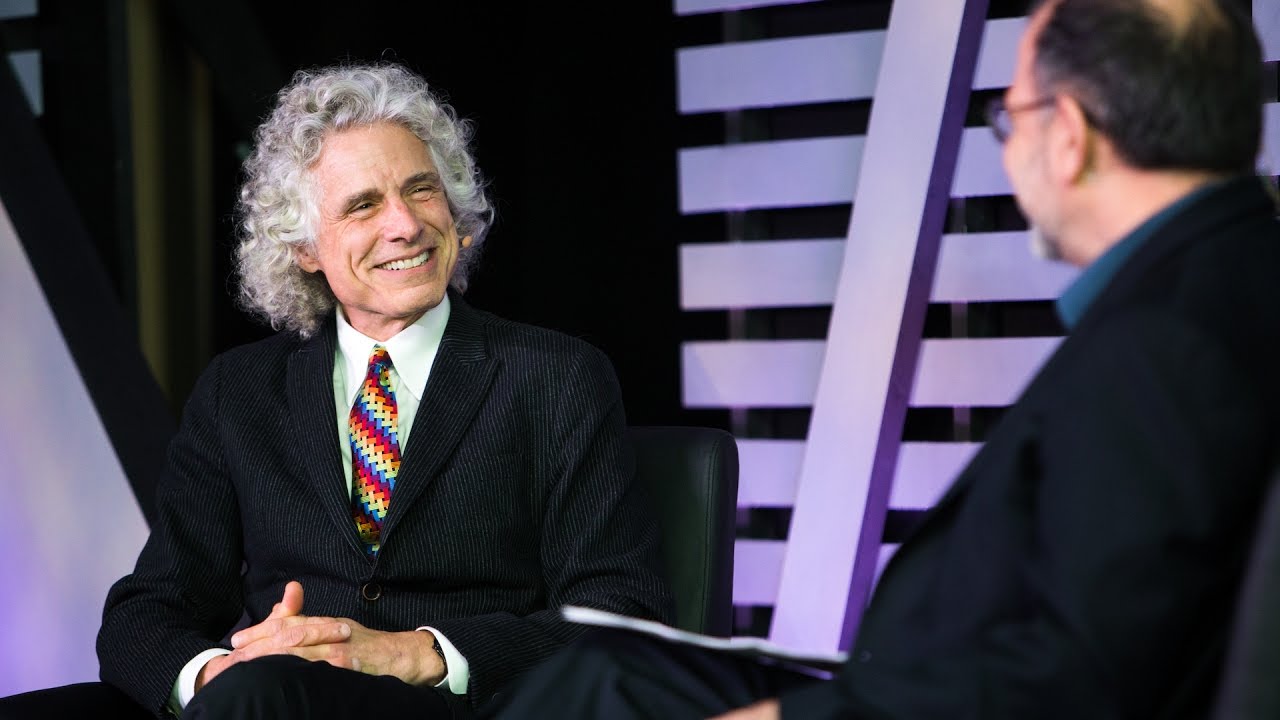
In this extensive interview, Tyler Cowen engages Steven Pinker in a wide‑ranging conversation that weaves together linguistics, cognitive science, philosophy, and social issues. Pinker begins by explaining his early work on irregular verbs, arguing that language relies on two systems – a rule‑based algorithmic component and a memory‑based lexical component – and that the distribution of regular versus irregular forms reflects frequency‑driven economic pressures, a view reminiscent of Hayek and Darwin. The discussion then moves to universal grammar, where Pinker critiques Chomsky’s shifting hypotheses and defends a modest version of innate language‑learning mechanisms that bias children toward extracting combinatorial rules. He explores the modularity metaphor for the mind, rejecting strict “snap‑in” modules while affirming functional specialization, and distinguishes self‑knowledge from subjective consciousness, noting the hard problem of qualia as possibly beyond scientific resolution. Pinker affirms a deterministic view of the brain tempered by practical unpredictability due to chaos and quantum effects. He defends the Enlightenment’s promise that human nature can be scientifically understood and that reason can improve societies, while acknowledging human irrationalities. The conversation turns to historical declines in violence, the optimism of his book The Better Angels of Our Nature, and the uncertain future of destructive technologies, nuclear proliferation, and existential risks such as climate change and pandemics. Pinker addresses language change, the euphemism treadmill, and the limited impact of deliberate language engineering. He comments on contemporary political discourse, incivility, and the role of social norms. A rapid “Underrated/Overrated” segment covers rap music, aerobic exercise, behavioral economics, the passive voice, William Shatner, and Susan Sontag. Later topics include the homogenizing effect of the internet on languages, the plausibility of prophetic dreams, the limits of gene‑editing for human enhancement, the evolution of fashion, critical periods in language acquisition, the Fermi paradox, and the prospects for a “New Enlightenment.” Pinker concludes by mentioning his forthcoming book The New Enlightenment: A Manifesto for Science, Reason, Humanism, and Progress.
Chapters
Steven Pinker has stridden into the room and requires no further introduction. So I've looked at a lot of Steven's work again lately, and I'd like to start with your early work on irregular verbs. And it's striking to me how much in this work you think like an economist. So some verbs are regular, you conjugate them with an -ed. Others are irregular, right? You don't say "get-ed," you say "got." Now, how computationally efficient is that process?
I think it taps two of the mechanisms that make intelligence possible. I mean, why would I spend a good chunk of my career studying the minutiae of irregular verbs? I do love language. I love linguistic detail for its own sake, but I chose that topic because I thought it shed light on bigger issues of cognitive organization. So why do we have 165 or so quirky exceptions like stride, strode, come, came, sing, sang, go, went, and so on. It just seems there could be no rhyme or reason behind it. I think it's just a consequence of the fact that we memorize words, and that's one of the two mechanisms behind language. We store by Brute force, rote memory, arbitrary pairings between a sound and a meaning. The word "duck" doesn't look like a duck or walk like a duck or quack like a duck, but I can use it to get you to think the thought of a duck because we and everyone in this room has memorized a pairing between that sound and that meaning. We don't just blurt out words, but we also combine them into phrases and sentences using rules that allow you to predict the, or compute the meaning of a combination from the meaning of the parts and the way that they're arranged. Those are the two mechanisms that make language possible. But there are some kinds of meanings where they can compete over which system expresses a particular concept. In the case of regularity or irregularity, we have two different ways of conveying the concept, an action that took place in the past, or in the case of plurals like mouse, mice, and rat, rats. Two ways of talking about more than one thing. We can memorize a more or less independent word to convey the idea, like struck or sang. Or we can apply an algorithm to say something in the past tense, add -ed to the end, and then we get walk, walked. And because of the peculiarities of the history of a language, you can have that labor divided between the rule system, the algorithmic system, and the memory system. And it's the tension between those two systems that give rise to a lot of the quirkiness of language, including English irregular verbs.
So when you did this, this was one of the first things to make you famous. Did you know in the back of your mind this was a kind of Hayekian argument? Because it seems to me the common verbs that we use a lot, those go irregular, and it's easy to remember them because you use them all the time. But the irregular verbs— the regular verbs are ones that you don't use so often, and thus again you're economizing on information in this decentralized way.
Yeah, I don't know how well that analysis would work across a range of zones of irregularity. So it is certainly true that irregular verbs tend to be common, which is kind of the bane of the language learner. You learn Spanish or French and all of the words that you use all the time you've got to memorize the conjugations. And I think the reason for that is I might even invoke Darwin more than Hayek, namely that in the generation-to-generation transmission process of an irregular verb— an irregular verb has to be memorized because by definition there is no rule behind it. The only way you know that the past tense of "come" is "came" is that you hear everyone else use "came." Since memory thrives on frequency, the more often you hear something the better you remember it. If any verb declines in frequency and verbs become more or less fashionable for all kinds of reasons, then you could have a generation that never successfully masters it. They'll default to the all-purpose add -ed rule, and then the verb will go from irregular to regular for that generation and all subsequent generations. And so you've got a kind of, an erosion of the stock of irregular verbs as they get filtered through the minds of children memorizing them. Where it's the less frequent ones that tend to fall out of the language.
So "dreamt" becomes "dreamed," for instance, because "dreamt" is prettier.
It is prettier, and that's one of the reasons that irregular verbs do stay in the language, and one of the reasons that often lyricists and poets and novelists will prefer the irregular to the regular when there's a choice: "strided" versus "strode," "strove" versus "strived." hove versus heaved, is that they're good words. They actually fit the phonological template for a standard word in the language, the kind of sound that you would use for a nickname or a common word. And they are more euphonious because they aren't assembled in a kludgy way from the verb stem and this bit of detritus hanging on the end, this -ed or -s, this suffix, which is serviceable, it allows you to convey a message, but it makes the sound of the word itself a bit clunky. And there are almost unpronounceable regular words like "sixths" or "edited," where because you're sticking an extra bit on the end of a word, you're actually messing up the nice contour of a standard word in the language. And that's another one of the tensions that over the history, course of the history of a language, will kind of shape the balance of regular and irregular forms. So that is Hayekian in the sense that no one planned the language to be optimal in satisfying one criterion. There are trade-offs, there are multiple tugs, pushes, and pulls, and in a, as speakers, millions of speakers make little adjustments as they use the language, as kids learn the language, the language itself spontaneously evolves with some balance.
So let me now put on my economist's hat and ask you about this. As you know, in George Orwell's 1984, the Party bans all irregular verbs. It's a kind of excess regulation. But from a social point of view, are there too many or too few irregular verbs in English?
I like the irregular verbs. I'd like to see more of them. But, and it is, you know, it is a sad when we lose them. Occasionally a new one gets a toehold in the language, like snuck, for example, is about 120 years old. It came in on the analogy of dig, dug, and stink, stunk, and sing, sang, sung, and strike, struck. So occasionally, what will protect a verb against erosion when it becomes too uncommon is similarity to other verbs. I think it's another property of human memory. One property of human memory is you hear things a lot, they stick in memory better. But another one is if it's similar to other things that are well memorized, it can kind of parasitize the memory strength of something nearby in phonological space. And occasionally there will be analogies. People will coin new verbs, sometimes in a jocular way, like you're invited to a party, "spice are welcome," instead of spouses. It's kind of a little, you know, a little bit jocular. But sometimes these things can catch on. And that was the case for "snuck," where originally it was considered kind of cutesy, like "spice" is the plural of spouse. And in fact, people who are older than about 70 or 75 still think that it is slang, whereas people younger don't see what the fuss is about.
Are there irregular verbs you're afraid to use? Because I have this problem. So think of the word abide. I'm perfectly happy to say abide, but the past tense abode is thought of as a noun, a place.
Yes, right.
And then there's abidin', and then there's the noun abidance, And I won't go near any of those. And every now and then you'll be in a sentence where the notion of abide comes up and you'll just stick with the present tense and do whatever circumlocution you need to avoid having to make these other irregular verb commitments. Or do you just go ahead and say stridden? Steven Pinker has stridden into the room.
Yes, right. Abode has not been in common usage for a few centuries. So I mean, it's a— that's one of those that that dropped out, like "chid" is the past tense of "chide." Chid, right? Yes, "chidden," or "holp" is the past tense of "help." Some of them survive in dialects, you know, in Appalachia, in remote parts of the British Isles. Forms that were in use a couple of hundred years ago may have resisted the erosion for reasons that are completely obscure, partly capricious. But yeah, I like them. I like the one One distinction that is vanishing that I think is sad is the three-way distinction in verbs like sink, sank, sunk, stink, stank, stunk, shrink, shrank, shrunk, where the shrank and the stank are giving way to the participle form.
No shrank and stank.
No shrank and stank, no. And admittedly, it would have been hard to have a movie called Honey, I Shrunk the Kids instead of Honey, I Shrunk the Kids. But I, in my my style manual, "The Sense of Style," I recommend hanging on to them. I think they're nice. It's nice to have that three-way distinction, 'cause English conjugation is already so kind of depauperate, so degenerate, that it's nice to preserve what distinctions that we have.
Now moving chronologically through your career, let me ask you a big picture question about language. And I come to linguistics very much as an outsider, but Noam Chomsky's idea of a universal grammar which is somehow built into the structures of the human mind. In its early years, there seemed to be a promise of some very definite accounting of what that structure would be. After a while, it seemed to collapse into this very general idea of recursion, which to me as an economist seems almost tautological. And if I came away from this debate, and then I read people writing in popular science today, language is a number of different capacities brought together. There, independent and just combined with our ability to divine meaning from others? I mean, could it be the case that Chomsky's hypothesis was simply wrong? 2016, I know your books, but what's your take on that today?
Yeah, it's not easy to pin down what the hypothesis is, partly because Chomsky himself revises his theory every decade or so, kind of on the principle of Mao's continuous revolution. Just never let people settle into any kind of comfortable consensus. So it's a moving target. Also, as you say, it was neither specified in a precise way nor field-tested against a, say, a dataset of language variation, which I think is unfortunate. In terms of ordinary kind of scientific practice. Linguistics is an eccentric field in some ways, partly because it was so polarized by a charismatic figure and his opponents that it didn't proceed in the ordinary direction of kind of making the theory more precise, more testable. So with that caveat in mind, I think there is such a thing as, you could call it universal grammar, I think that in the following sense, that the child is biased to analyze the speech that he or she hears in particular ways. It does not simply record sentences verbatim. I mean, that's the memory half of the language system, but the algorithmic or computational or rule governed half looks for, tries to pull out combinatorial rules from the speech stream. That there are certain kinds of rules and elements that the child is keyed to look for, and that those, that set of abilities would be what I would call, if I use the term, universal grammar. And there are commonalities across the world's languages. That come from the fact that language is created anew every generation by the minds of the children who construct it out of the data that they get from their parents and peers.
Let's turn from language to a closely related topic: theory of mind. Of course, you've written a lot on this. We had John Haidt for one of these discussions, and he has this notion that in the mind there are these modules., and they're almost a bit independent. So there's an empathy module or a being analytic module, and if I understand him correctly, in our political discourse, different modules take over and it's almost not integrated with the rest of your brain. What's your take on how unified cognition is? To what extent is, say, our political discourse ruled by independent modules, or is that not how you think about it?
Yeah, well, the metaphor of the module comes from my former colleague Jerry Fodor, philosopher and psycholinguist. And it comes in different versions. You had Howard Gardner proposing a theory of multiple intelligences. You have evolutionary psychologists proposing the metaphor of the mind as a Swiss Army knife. Now it's more like a smartphone with a bunch of different apps. I think that the— I do agree these can all be opposed to a view of the mind that would just have a theory of everything. That there's just one principle. It's all Bayesian statistics, or it's just the law of operant conditioning.
How about all just one big teeming mess, but no modules?
Well, see, modules never quite seemed like the best metaphor. I think there is structure or specialization. I don't think the mind is spam. I don't think it's just a homogenous— I don't think we just have a homogeneous neural network in the skull. I think there is some organization. The problem with the module metaphor is that it assumes there are snap-in components that— with very limited channels of communication between them. I think that's too strong, but I think it is reasonable to say that there are different faculties, to use an old-fashioned word. To choose a different metaphor, I think it may have been Chomsky who proposed that the mind is like a biological system made out of organs and tissues. Where in— when I was in high school, I was taught, for example, that the blood was an organ. Now, the blood, of course, suffuses all of our tissues. You can't draw a dotted line around it. It's not like the rump roast and the flank steak of the supermarket cow display. Likewise, the mind can have a specialization and structure and different components without them literally being independent. So I think John Haidt— I would agree with John Haidt that there are different mindsets, there are different faculties, there are different ways in which we can analyze the same set of events, and that a lot of political disagreement consists of what frame of mind, if you want what module you use to analyze a particular issue. So you've got to acknowledge the complexity, the multiplicity of the mind, even if you don't subscribe to the strict metaphor of modules.
What evolutionary purpose does a sense of self serve in human beings? So could you imagine human beings performing the same actions but being zombies, not saying to themselves like, "Hey, I'm Tyler," or Hey, I'm Steven Pinker. We have the sense of self, however difficult it may be to describe or study scientifically, and that evolved. You're a Darwinian, so where does that come from? Why is it there?
Well, I would distinguish certainly the self-concept, self-knowledge, from the issue of subjective experience. And people often use the word consciousness to refer to both of these. Phenomena, namely self-consciousness or self-knowledge on the one hand, and subjectivity or the qualitative nature of consciousness, qualia, what it is like to feel something or taste something on the other. I think those are two different expressions.
I mean the latter.
You mean the latter.
Right. You can sit up and feel something, taste something, and say, "Hey, I'm Steven Pinker," and know introspectively that you're saying it to yourself.
Right. I mean, but those are two— you could have subjective experience of redness and sourness and warmth and so on without it including some concept of yourself. And conversely, you could imagine an intelligent system, a robot, say, where there's no one home, where it monitors its own state, it presents itself in certain ways, and at least as far as we know, it's not actually feeling anything. Of course, we don't know it, and that may be the key. Philosophical problem of sentience or qualia, or sometimes called the hard problem of consciousness— Sure. I think might ultimately be a quirk of our own way of analyzing the world. That is, the mind reflecting on itself is naturally going to be puzzled by some aspects of itself. We know from neuroscience that there is no aspect of consciousness that does not have some physical correlate. There's no ESP, there's no life after death, there's no mysterious action at a distance. It's all information processing in neurons. Why it should feel like something to me to be that network of neurons, I don't think we have a satisfying answer to, and it may not be a scientific puzzle at all. There are some philosophers who claim that that it just isn't a coherent intellectual question at all. Dan Dennett being the most famous. For some people, this is a kind of escape hatch from materialism and a way to bring back some notion of the soul. The problem there is that you'd expect the mind to have some kind of non-material powers, which it does not have. I tend to gravitate toward a view that Sometimes it's been credited to David Hume. Colin McGinn is the contemporary philosopher who has kind of made it most prominent, sometimes I think mysteriously— misleadingly called mysterianism. Tom Nagel in his seminal article, "What Is It Like to Be a Bat?" whose title captures the essence of the problem. Tyler Cowen, speculated in that article along the lines that I'm suggesting. Namely, there may just be some facts about the universe that are true and we'll never be satisfied that we intuitively understand them. Not because there is some mystery in the sense of undiscovered scientific principle, but just that our very way of grasping reality might make certain things puzzling to us, even though we know at a more explicit cognitive level that they're true. So a heap of neurons that registers the environment, that organizes the information, acts on it including a model of itself— from my point of view, it feels like something. Why that should be true, I don't know. But then again, here I am inside me, and almost by definition there are going to be some things about the view of me inside me that the me doing the view is not going to be able to articulate because the part that would do the articulating is part of the me trying to explain it. So, I don't think there are a lot of cases where we— I think there are some cases where human intuition hits a wall and this is one of them. The nature of time. What could have been before the Big Bang if that was the beginning of everything? How can the universe be either finite or infinite? There's no reason to think that every aspect of reality will be intuitive. There may be some aspects where our best science will give us a characterization and we'll always scratch our head as we appreciate that it's true, but it never feels totally satisfying.
So how about metaphysical determinism for the human will? Cause and effect, everything in the mind has a physical correlate, you've told us. You're a Darwinian. The natural world is ruled by something like cause and effect, and the laws of nature haven't changed. So our minds are fully determined?
Well, they—
you didn't say yes.
Yes. Well, they may not be for any practical purpose determined in the sense that there may be processes that are chaotic, that are nonlinear, where some ions zig instead of zag because of Brownian movement or maybe even quantum phenomena. And as a result, the whole system might behave in one way or another that is physically determined but for all practical purposes random. It may be so complex that it might be like the weather taken to several higher degrees that we'll never In theory, perhaps Laplace's demon would be able to tell us what each of us will do next. But some things that are true in theory are so mind-bogglingly complicated that they may as well not be true in theory. So yeah, I don't think there's any miracle that goes on in the brain when we make a decision. In that sense, we're determined. On the other hand, there is so much unpredictability, non-linearity, that for all intents and purposes, we're not determined.
Now I've been reading through a lot of different aspects of your work, a lot of your books, reading or rereading, and I've been trying to figure out to myself what's the underlying unity in the thought and writing of Steven Pinker, from Irregular Verbs to World Peace, and yes, we'll get to that, but let me try to give you my account of what I've taken away, which I'm sure is not the same as yours, but it's a way of prompting you to tell us your view of the underlying unity in all of the things you did. So I see you as very often trying to stake out a midway position. If there are people out there, say like the blank theorist, the blank slate theorists, who don't see much structure to the natural world or the social world or the linguistic world, and you reject that, But then on the other hand, there are people who postulate too much structure, and at least early Chomsky would be an example there. And you're trying to create some kind of intermediate position where there's room for reason to operate, but within laws of nature. So you're trying to rearticulate this modern 21st and 20th century vision of what does the Enlightenment mean for now, and how might we apply Enlightenment kinds of reasoning across all the different areas you've written on, and then kind of figuring out, shown in all these books, what are the methodological prerequisites for that. And it's level at which we're willing to talk about structure and levels at which we're not willing to talk about structure. And you staking out this intermediate, what you might call voluntarist, pro-reason, pro-science position. And that's what I took away from the, the whole corpus of Steven Pinker. But tell me, what is your take on that?
Yeah, I think that's not too far from the way I would see myself. Not so much in taking an intermediate position that's just in a, you know, find the Goldilocks zone, like, "Oh, the truth is always halfway in between two extremes." I mean, it isn't always. On the other hand, I do believe in the Enlightenment vision that by understanding our world, that the world is intelligible, that we can understand it, that progress in understanding and therefore progress in rational action are possible, including pointedly ourselves. That is, there is such a thing as human nature. It can be studied scientifically the way other phenomena are studied. That it's good to understand human nature because then we can discount when necessary illusions that are quirks of our own makeup, that we can understand what it is that gives humans fulfillment and satisfaction and pleasure. What are the resources that we have to work with in improving a political system? And I also think that often, going back to finding a middle ground,— that the middle ground isn't finding, say, the arithmetic mean between the two extremes, but rather it's trying to go down a level of more finer-grained causal mechanisms underneath the phenomena and to state a position that may not look like either of the original extremes because it's more precise. So in the case of language, for example, I've always been kind of bored by the idea of, "Is language innate or is it learned?" It's just, you know, it's neither. It's not halfway in between, because that doesn't give you any insight either. But rather, there is an innate structure that does the learning, because learning does not happen by magic. There has to be something in place that does the learning. Let's characterize the nature of the learning mechanism in terms of its information processing abilities. What are the— what is its computational architecture, as the computer scientists say? Once you have that, that is the solution to the nature-nurture problem. Namely, what's innate is an ability to learn, but since any mechanism does some things well and some things not so well, that gives you insight as to what and how we learn. And that makes irrelevant the question of is it innate or is it learned. There is something that is innate, but it's something the innate stuff allows us to learn. And so it kind of gets beneath the dichotomy into something that I like to think is more intellectually satisfying.
Here's one difference between us perhaps, and we discussed this earlier in the green room. I think of you as believing more strongly in the powers of human reason than I do. So when we hit upon these various, you might call them antinomies— what does consciousness really mean? Is the will really free? How do we think about time?— you're quite willing to pull a Kantian or Wittgensteinian move and say, well, it all collapses into contradiction. Colin McGinn, that's knowledge forever denied to us. And then there's this other sphere in which reason operates quite well. And I tend to think of that more as a continuum, that if we can't understand some truly fundamental things, the problems in our thinking will bleed into everything we try to analyze. And I tend to think of reason as being fairly weak. Maybe I'm more Hayekian in this way than you are. People being ruled by their passions, as David Hume might have thought. And in this sense, I'm more skeptical about the Enlightenment. So, what can you say to talk me out of the skepticism? And back into the truly Pinkerian view.
Well, what are we doing here if you don't believe in reason? Why don't we have an arm wrestle or a beauty contest or a—
After dinner.
Okay. First of all, by the very act of even posing this question, you're committed to reason. That's what we're trying to explore here. It's too late. You've already committed yourself to me. That's one. Number two, Hume, even though he was a very insightful psychologist and he emphasized that humans are subject to all kinds of irrational passions and biases and so on, that was one of the reasons that he did philosophy was to expose some of those fallacies, the better that we should be able to work around them. And his argument about reason being a slave to the passions was not so much a psychological claim that people will lose self-control and they'll let their emotions get the better of them. He was partly making a conceptual point that the ability to go from A to B using reason doesn't tell you what the B should be. That there's just a a logical distinction between goals on the one hand, or desires, and beliefs. And that you can't, through a chain of deduction, identify what you ought to aim for. That's just a category mistake. You know, that's different from the psychological claim that people are permanently irrational. People can be made more rational, I think he would say, and I would say, by the act of what we're doing now, that is exploring implications of ideas, by science, that is by taking your beliefs and allowing reality to refute them or not. And historically, even though it's true that people do all kinds of crazy things, subject to all kinds of irrational personal prejudices, passions, and so on. On the other hand, some ideas really do get dropped by— bad ideas get dropped by the wayside. Not necessarily quickly, not necessarily absolutely, but we don't have human sacrifice anymore. You know, we don't throw virgins into volcanoes to get better weather. We don't have too many hereditary monarchies anymore. We—
They don't all work badly.
Maybe not, but probably, you know, on the whole, democracy is a better idea than— But you can have bourbons than Denmark. I mean, I grew up in Canada.
Sure.
And I grew up with a picture of the Queen in my classroom. So yes, if you have a purely— have all the pageantry and gossip that you have with having a nice juicy monarchy, But the Queen doesn't actually think up the laws. It's probably not a bad compromise. But the— in both the progress of science, and I really do believe there is such a thing as scientific progress. I think we see it in the fruits of technology, but we also see it just in the depth and satisfying nature of scientific explanation. And not linearly and not inexorably and but in progress in so many dimensions of human life. I've documented the decline— historical declines of violence. And as an economist, you know that we've gotten a lot wealthier and life has gotten better in many ways. We live longer, we're healthier, we have a rich— more breadth of experience. These are all, I would say, fruits of the Enlightenment, despite the fact that as products of evolution, we've got a lot of irrational quirks baked into us. Fortunately, and this gets us back to, say, modularity or specialization, we don't only have irrational passions. We do have this big frontal cortex kind of grafted onto a brain which now and again can override our passions. We can exert self-control. We can count to 10. We can save for a rainy day. We can hold our horses. Not uniformly, not always reliably, but enough that it's something that we could celebrate and try to encourage.
Now in the middle of all of these dialogues, we have a section called Underrated/Overrated. I'm going to name some things, some people, and ask you if you think they're overrated or underrated. And feel free to pass on any one of them. But let's start with rap music.
Oh, I never got rap music, so I don't wanna say it's overrated. It may be that I'm overrated, and that I, or at least I overrate myself. But I just know, I was probably born too soon.
But there's a much younger Steven Pinker on YouTube debating with William F. Buckley, and Steven Pinker of that time is defending Black English, and telling William F. Buckley he basically doesn't understand what's special about it, and indeed Buckley doesn't. So is rap music in a sense not just a musical extension of the Black English you once defended on Firing Line?
Well, it is in the sense that I would not make the argument that there's anything— that the fact that I don't have any rap music on my iPod is not an argument for the objective merit of rap music. Rap music compared to any other kind of music. There I'm a relativist. And likewise, the grammatical structure of African American English vernacular, as linguists call it, Black English, Ebonics, there's really nothing inherently to choose between the rules in Black English vernacular and any other English vernacular. There I'm also a relativist. On the other hand, when it comes to what dialect we should use in the, in formal essays, in the academic literature, in the New York Times, it's good to have a standard. The standard could have been Black English if history had run differently. It doesn't happen to be. It's good that we all settle on a standard to maximize communication and efficiency and a certainness aesthetic judgments. So the standardization is a good thing, but that doesn't necessarily mean that one standard is inherent, objectively better than another.
Aerobic exercise, underrated or overrated?
Oh, underrated. I like it.
You like it?
Yeah.
And you think it's good for you?
I hope so, because I do— I like to think that I'm also accomplishing something when I go jogging or cycling.
Behavioral economics, economists playing at psychology. Obviously you have a stronger background in psychology than the economists. What do you think of behavioral econ?
I'm for it.
What's it missing?
Well, I think it's— I do think that it's missing, and I'm completely out of my depth here, but I do think that it is too quick to dismiss classical economics. I don't think there is maybe another false dichotomy, but that the idea that the rational actor and models derived from it are obsolete because humans make certain irrational choices, have certain rules of thumb that can't be normatively defended, those aren't necessarily incompatible because Even though every individual human brain might have its quirks and be irrational, it is possible for a collective enterprise that works by certain rules to have a kind of rationality that none of the individual minds has. Also, it's possible because we're corrigible, because the mind is many parts, we can override some of our biases and instincts, either through confrontations with reality through education, through debate. And we do know that even though— that people who are experienced in market transactions, for example, don't fall for the kinds of fallacies that behavior economic— behavioral economists are so fond of pointing out. You really can't turn a person into a money pump, even though in the lab I can set up a demo that shows that people can be intransitive in their preferences. But you actually put a person in a situation where there's real money at stake and all of a sudden they're not so irrational.
They walk away. The passive voice in writing.
It has its— underrated.
Underrated.
Underrated, yeah, in the following sense. You open up any style manual and one of the first bits of advice is, "Don't use the passive." That's too crude. Academics overuse the passive, or maybe I should say the passive voice is overused by academics.
That's better.
But, you know, no—
It is thought as such by many people.
So it is thought. But it is, the case is overdrawn because no construction could have survived in the language for more than 1,500 years if it didn't serve some purpose. And there are circumstances in which the passive is the better choice. In particular, when you have to, when the topic of the conversation, the entity that's already the, in the spotlight, is the done to or acted upon. Another rule of style, aside from avoiding the passive, is start the sentence with the given information, the topic, end the sentence with the new information, the focus. If you're already talking about something that is done to, then that's the logical way to begin the next sentence, and the passive voice makes that possible. If I'm talking about, if I'm saying, "Look at that mime in the park. He's being pelted with zucchini," then since I've already called your attention to the mime, now I want to add information about him. If he happens to be the brunt of an action, then the passive voice is the way to begin the next sentence with him, as opposed to saying, "some people are throwing zucchini at him," where he gets put in the focus of the sentence, which is the best place to introduce new information. And in fact, as I point out in "The Sense of Style," the two most famous style guides in the English language, namely Orwell's "Politics and the English Language" and Strunk and White's "The Elements of Style," both accidentally use the passive in the very sentence in which they say don't use the passive.
William Shatner. Oh. You're connected to him in several ways.
Fellow Montreal Jew. I have to say underrated.
Underrated, yeah.
Although maybe not as singing.
Susan, you're well known for your photography. Here's Susan Sontag writing on photography, and I quote, "Photographing is essentially an act of of non-intervention, and she also wrote, "It is mainly a social rite, a defense against anxiety, and a tool of power." Overrated.
Yes or no?
Overrated. Yeah. Photographies or Susan Sontag?
Well, maybe just that passage. Like any art form, photography is many things, and first and foremost, it's a kind of It's a simulacrum of perceptual experience. It's possible because visual perception doesn't consist of knowing the external world directly, but rather making hypotheses about it via a two-dimensional array of light that's reflected from it. You duplicate that two-dimensional array of light with pigment or LEDs, and you can fool the perceiver into thinking that he's seeing the actual thing. That is then in tension with the fact that the photograph itself is a splash of geometric and colored patches, and the challenge of photography is to both convey a sense of something out there, but also for that two-dimensional patch to itself be an aesthetic pleasing object. As a photographer, I'm always cognizant of what will that two-dimensional patchwork of color look like and what is it a photograph of.
If you think on all the different things you've written in various areas, what do you think has been your biggest mistake?
Where do I begin? Where to begin? Biggest mistake. Maybe I'm going to punt on that.
Okay, that's fine.
Why don't I just say that, so as not to convey the impression that I've never made mistakes. There's so many, where do I begin?
Let's turn to the topic of world peace, the book Better Angels of Our Nature. It will be available afterwards. Uh, let me ask you a general question. Let's say it were possible, by spending $10,000 and devoting a few months of your life to it, that any person on Earth could blow up a significant part of a major city. They could buy something, some kind of explosive, it would cost them $10,000. How long would it take before someone actually did this?
Anywhere on Earth?
Anywhere on Earth. 7 billion people on Earth, any one of them that can come up with the 10K and have a desire to do it, which is not most people, of course.
Right.
But how long would it take before this would happen?
Oh, I have no idea. And by blow up, do you mean like the Tsarnaev brothers, or do you mean like Hiroshima?
Like Hiroshima.
Someone on Earth anywhere. Maybe not too long, but I don't know. I couldn't really prophecy that.
Let me then work back from that and ask you about your optimism about peace. Is it then your belief it will never be that cheap to blow things up?
I don't know. My optimism doesn't consist of prophecy in that sense. That is, my optimism consists of looking at what has happened And noting that, first of all, that the pessimistic view is factually incorrect. Namely, people believe that we're living in unusually violent times and we're not. What— how to project that into the future is a separate set of questions. And there are many unknowns that I just— I'm not arrogant enough to know the answer to. To. It's something that we could debate, we could explore them, but I am not an optimist in the sense of saying, "Well, let's just extrapolate the curves in the future without asking questions like that." Maybe you could at least try to talk me out of my pessimism. Okay.
What I see is that through the course of history, as societies become wealthier, they also you find destructive power is cheaper. Now, for most people, even today, the destructive power at their hands, while it can be quite terrible, it's not enough to take out a major city or start a war. But the price of destructive power has been falling for as long as we've had economic growth. And it's hard for me to think of exceptions to that trend. So if I expect economic growth to continue, I expect we'll get in a world in some way a bit like my $10,000 question, how long would it take? And I worry that will happen a few times, and then we will cycle into some fairly significant form of disorder. And that's my default prediction. I don't quite mean to prophesize it, but I take that to be what one normally would expect. And I'm happy for you to talk me out of that. But what's the weakest premise in the chain I've given you?
Well, um, I guess there are two. One is that every form of physical accomplishment follows an exponential curve of getting cheaper and cheaper. For example, plane travel hasn't gotten faster and faster. If you extrapolate from the Wright brothers to say 1957, then it just totally leveled off. In fact, if anything, it might be a little bit slower. For a number of reasons. So it is not necessarily true that there'll be a $10,000 nuclear weapon. I'm not an expert on nuclear proliferation, but my reading is that there isn't. You still need the thousands of centrifuges and so on. So that's one, at least, topic to explore. Again, I'm not an optimist in saying, "Oh, relax, it'll never happen." Yeah. It's just that this is But that, on the other hand, I think it's very easy, I think it's too easy to be a pessimist and to say that I can imagine bad things, therefore they are certain, which I think has been a default in a lot of our discourse.
Sure.
The other is, how much of desire is there for that kind of destruction? That is, we could see the rate, I think the rate-limiting step on a lot, on terrorist destruction is how many people think that it's a good idea to cause a lot of damage for no particular reason. Uh, we could have, uh, you know, there could be Tsarnaev brothers in this audience, and, and there could be a pressure cooker that would blow up, uh, you know, in the next few minutes. I don't think there will be, uh, but clearly there's no technological or economic impediment to that. The amount of violence that, that we see is not, uh, limited by, uh, cost of technology. It's not limited by the number of people who think that it would be a good idea to blow a lot of stuff up for no reason other than attracting publicity. And there are certain kinds of violence that are so pointless that just no one really wants to do it. One of the reasons that we've gone now 70— more than 70 years without a nuclear weapon being used in war is that they're just not terribly useful as weapons to accomplish anything. I mean, they're useful to deter an existential threat, an all-out invasion. That's presumably why North Korea wants them. But they haven't been used on the battlefield because leaving a huge radioactive crater is just not a very coherent war goal. And the— for their— I mean, you could imagine some apocalyptic cult where destruction for its own sake is so desirable that they would do anything possible. And we don't know how many people like that there are. Let me try and throw Yeah, but we don't know how many people like that there are, and I don't know the answer, so—
Let me try another angle on potential pessimism and see if you can talk me down out of that tree. I'm sure you've thought about the Fermi paradox. There are more and more potentially habitable planets out there, and yet no one is showing up to visit us or sending us signals or constructing glamorous advertisements up there in the stars by manipulating matter. The universe seems oddly quiet, at least our corner of it. Now that's not a surprise if you think that civilizations tend to destroy themselves once energy becomes cheap enough. But otherwise, if one is relatively optimistic as a default, where are they? To pose Fermi's question to you.
Yeah, I, I don't think there's a natural arc toward destruction of civilizations, and in fact one could make the argument that it goes the other direction, that as you become more advanced, civilizations develop mechanisms that make conflict less likely, which I think is the trajectory we have gone on so far. Again, I'm not willing to prophecy that it'll continue, but, you know, war is a pretty stupid thing to do. I mean, you blow a lot of stuff up, you kill people, and you don't end up with anything that you couldn't have gotten by some other means. As soon as you become too belligerent, you give other people an incentive to destroy you. That may not be avoidable in Hobbesian anarchy, but if you can have some kind of system either of world government or of a functional equivalent like international norms in the United Nations and a set of expectations, then everyone can live a lot better. If you don't if you aren't all living by the sword. It's just as plausible to me that as civilizations advance, rather than getting— having more and more destructive wars, they could continue the trend that we've been on since World War II and they eventually make war obsolete. That's another plausible trajectory. And indeed, the idea that the worst aspects of this particular primate, namely we evolved in such a way that we are too quick to anger, we're too quick to defend our dominance, that that's the only way for intelligence to evolve, I think is parochial. It's saying that what we see in Homo sapiens is the only way that intelligent beings can come into existence. And, you know, I don't think we should be constrained by that.
Outside of zoos and the like, do you think the other primates will go extinct? The—
not the other primates. I think it'll be— I don't think there'll be a shortage of monkeys.
The larger ones. Larger monkeys.
You know, monkeys are like rats. They're, you know, they're— you know, as you know, you go to India and they're everywhere. Great apes, you know, I think it depends. It just depends on the race between— poaching and habitat destruction on the one hand and conservation and ecotourism on the other. I don't think they have to. They could, but I don't think they have to.
And what do you see personally as the greatest existential threat to high civilization? Your biggest worry?
I'll give to climate change and nuclear war.
But why climate change? Even if one thinks that's very costly, Is there really a scenario where it ends civilization? Can't people move, adjust, build? It might be—
they could, yeah. But it could be unrecognizable under the most extreme scenarios of what could happen. But it would be pretty miserable if you imagine the number of people that would die and the number of— and the decrement in prosperity. So it would be pretty bad. I wouldn't say— I don't think it would extinguish us as a species for the reasons that you mentioned.
What's your favorite TV show?
In— let's see. In all— in my entire lifetime or currently? Up to your—
now or your lifetime when you were 19?
Oh, let's see. I like The Ed Sullivan Show.
Why Ed Sullivan?
Well, because where else could you see Italian acrobats and then a Jewish comedian and then The Beatles and The Supremes and then another Jewish comedian all in an hour?
He was an early proponent of integration on TV. You probably know this.
Absolutely.
Very influential.
Absolutely. Particularly with— he had these The Supremes on, I think, more than any other, any single act in an era where America just barely started to desegregate. So yes, I liked Hill Street Blues. I don't even know if that's available on streaming. I like Cheers. As you can see, I haven't done a lot of TV watching recently.
Probably efficient.
I'm like Most academics, I think, secretly watch TV as a guilty pleasure and then deny it. I think I'm kind of the other way around. I just don't watch a whole lot of TV and I feel like I ought to watch more.
They're starting to use irregular verbs again. Let's take bioengineering technologies, gene editing, CRISPR, and the like. Imagine a much more advanced version than what stands right before us. So imagine that parents could, to some extent, influence or design the children they would have above and beyond eliminating a few particular diseases. Does that worry you or does that get you excited that we're going to have smarter, better people?
I'm skeptical of the premise. As someone who is very interested in genetically influenced traits and was kind of excited in the '90s at the possibility that we'd find the gene for this or the gene for that, and there were a number of discoveries which turned out to be false alarms. Now more and more I appreciate that even traits that are— that have a heavy genetic component, which most traits do, the genetic influence is distributed over thousands and thousands of genes, each of which of which increment or decrement the trait by a smidgen, and many of which have a mixture of positive and negative effects. So the idea that you'll put in the gene for musical ability in your child just turns out to be factually incorrect. That's not the way genes work.
But not now. Say we apply big data, Monte Carlo methods, you only raise the chance of your kid being a certain way by 1%, but there's that technology, and let it rip for 50 generations, and at the end, aren't people very, very different?
Depends on what the trade-offs are. I mean, we don't know how many, how much boost in brain power you can get without an increase in chances of brain cancer or of other trade-offs of a neural network that's too dense actually is stupider. So I guess I'm rooted enough in what we know about behavioral genetics not to think that these science fiction scenarios are just not particularly productive. I don't think we— I think it's probably a scenario that we're not going to have to worry about just because it's too complicated.
Okay.
We're not going to want to, especially since every time you monkey with a gene you are taking some chance that something will go wrong. Admittedly CRISPR-Cas9 has become extraordinarily accurate. But if you're talking about changing 1,000 genes in your offspring or 10,000 genes, we're so risk-averse in genetic manipulation even when it comes to our tomatoes. People won't eat a tomato that's genetically modified. The idea that you're going to take that kind of risk with your children I think is extraordinarily unlikely that we'll get there from here. So, you know, do you want me to speculate about the science fiction scenario in which we do?
Sure, speculate a bit.
I mean, I don't think it would be a terrible thing, but I think it's kind of an idle speculation because I just don't think it's— I don't think we're gonna have to worry about it.
And last question before we get to Q&A. What is a book we might be surprised to find on your shelves that you've read or will read or want to read?
Oh, oh, oh.
So we're not surprised to hear Jerry Fodor and Noam Chomsky are on your shelf, right? Oh, uh. What would surprise us? What's there that we don't think of as a Steven Pinker kind of book to read?
I have a big stack of bicycling magazines, and I am obsessed about the difference in weight in grams between various kinds of derailleur and, uh, water bottle cage.
So it's aerobic exercise being underrated again.
Maybe.
Anyway, Steven Pinker, thank you very much.
Thank you so much, Tyler. Thank you.
Q&A, we will do from two mics. We will alternate. I will call on you. This is not the time to make a statement. If you do, I will cut you off. You are asking a Question to Steven Pinker. On this side, first in line.
Hi, Mr. Pinker. Thank you for speaking today. You mentioned the preservation of uncommon words in dialects that evolved as a result of geographic isolation, such as Appalachia and remote islands. With international connectivity caused by the internet, do you think that we are on track track for more linguistic homogeneity? We almost certainly are, and we're in the midst of a mass extinction of languages. I don't think it will result in everyone speaking English. Even under the most dire predictions, say 90% of languages go extinct, that leaves 600, and no one's going to be giving up Spanish or Hindi or Russian or Chinese anytime soon. And in fact, the growth of translation software and of national media, combined with old-fashioned national pride and just the inertia of growing up with a language and feeling more comfortable in it, means that we're not going to have a single language driving out all the others. Thank you.
On this side.
I appreciate the book and quite an amazing thing that Bill Gates is recommending this book, so I have it.
Do you believe that mankind has the ability to get prophetic dreams like Joseph in the Bible?
And do you believe that we can act on those prophetic dreams?
I did psychiatry, so I'm interested in your answer from that perspective.
No. No. Dreams are— yeah, I think dreams are a kind of screensaver. They have— it would violate many— much of what we know about physics for a dream to be able to prophecy the future, and our understanding of physics I think is pretty good, is good enough to rule out the possibility. Possibility that dreams can be prophetic.
On this side.
I was influenced by some essays you've written about the limits of language to sort of advance political change. You have the euphemism treadmill and stuff like that. There seems to be modern versions of that where, you know, to abolish gender binaries we're going to abandon pronouns and so forth, and you You work at a university, so you're probably familiar with a lot of this, and I'd like your opinion on some of these strategies for advancing social change through abandoning certain languages and certain words and forms of language. Yeah, well, there are politically motivated campaigns to change language can have an effect, as we see in what I call the euphemism treadmill. That is the fact that we don't use the word negro anymore. Even though it was a perfectly respectful and unexceptionable term through the 1970s. Martin Luther King frequently referred to Negroes. He had the United Negro College Fund, and that got replaced by Black, which then got replaced by African American. But it's easier to do it with what linguists call open class vocabulary items, nouns and verbs, than with closed class or grammatical items like like pronouns. And since the '70s, there have been a number of proposals to introduce a gender-neutral pronoun into the English language, so we wouldn't have to say "he" or "she" or the clumsy "he or she." None of them have caught on. And the language doesn't change in terms of its— I mean, it does change, but not quickly and usually not by deliberate engineering when it comes to things like articles, pronouns, past tense and plural markers, and so on. So there'll be just a natural resistance. They're learned early. They are highly frequent. They are distributed across millions of people conversing with one another. And they're— so I don't think you have to worry about that changing, you know, too, too quickly. But sure, there are more respectful and less respectful ways of referring to people.. And we've seen those change, and they'll probably continue to change. I mean, what I call the euphemism treadmill refers to the fact that the reason that there often is a cycling is that the change in attitudes that you want to effect by changing the language will meet resistance in terms of the rest of our psychology. I don't think it's true that language determines your attitudes and beliefs, although it can push against them. And as long as there's still some kind of negative connotation to an entity, then changing the label for it will just result in the new label picking up the emotional aura of the concept rather than the other way around. And as long as there is prejudice against African Americans,, and where the connotation is not as positive as you'd like it to be, there'll be the urge to find a new label that has not yet absorbed the taint of the existing one. Now we have— the African American was, I think, took over pretty quickly in the— sometime in the 1990s. I think Jesse Jackson was the force behind it. And we have gone now for more than 20-something years without a replacement of that, which might be a reflection of the fact that prejudice against African Americans is declining. In other cases, like Asian replacing Oriental, that stayed put, possibly because there was less prejudice against Asian people and there wasn't a need to find a fresh replacement for that.
If I could just interject on this, given this campaign season, and also what you can say, see on Twitter if you look for it. Do you think public speech is now evolving to become less polite in America?
Yeah, it's possible that— I don't think that Trumpism has— shows that our attitudes have changed, that we're becoming more misogynistic or racist or But, and you can do some Google searches that are kind of quicker than Gallup or Pew polls to track some of these changes. Seth Stephens-Davidowitz has shown that, for example, if you Google for various racist or sexist terms that are used in jokes, you get a pretty good barometer of racism that people may not be willing to admit to in public. And if you do that, you don't see a sudden U-turn in the popularity of racist jokes in the last, say, 6 months. So I think it is more a question of people who kind of kept their attitudes to themselves now feeling that there is, that they're allowed to get away with it, that some of the taboos have been broken. Whether they will reassert themselves with the decline of Trump. We don't know. I kind of hope so. I think that there is a benign taboo against overtly racist, misogynistic, and homophobic language. That there are ugly attitudes, and there always will be, and that there is a kind of benevolent hypocrisy and taboo where there are certain things that you just don't say. Say in public because that does kind of legitimate them. They can be threatened. We saw that with taboo words for sexuality starting in the '60s, that words that you just could not say in print or on the airwaves are now common. That could happen with racist and homophobic terms. I hope not, and too early to tell.
Next question.
Thanks to both of you for inviting us to an intelligent, literate conversation that I'd like to imagine you always have over almost every meal. I'd like to hear you speak about just how central language is to being human. I'm thinking of J.L. Austin and John Searle on speech acts in a social constructed world, all the way up to, I think it's called the Whorf hypothesis, that the language we use limits what we can experience and do. Yeah, I think it's— I think language is central to everything else that's human. I think that it very much figured in our evolution by making social cooperation that much easier. Namely, with language, for example, you can make an agreement to do a favor for someone now in exchange for a very different kind of payback or a payback very far in the future, something that you can't do when you're just bartering physical goods. I think that since our species lives on information, information is the ultimate trade good because it is a non-rival good. You can share it with someone else without being deprived of it yourself, so it can be multiplied, and that makes it the ideal medium of of reciprocity, conferring a large benefit to someone else at a small cost to oneself. So it lubricates the kind of cooperation that is hyperdeveloped in humans. It's also, I think, tied in with the fact that we're a technological species, that we live by our wits, by our know-how, that with language if you make a discovery you can spare other people from having to remake that discovery You can pool innovations that are invented across a huge catchment area. I don't, though, endorse a version of linguistic determinism associated with Benjamin Whorf and Edward Sapir, according to which we can only think thoughts for which there are words in our language. If that were true, then you'd have to ask, how did language originate in the first place. It wasn't kind of given to us by Martians. It was— we developed language because we had ideas that existed prior to our being able to articulate them, for which we coined words. Language is always changing. Again, this gets back to Hayek's notion of spontaneous order and distributed intelligence, that even though language is this any given language is an exquisite system for conveying complex thoughts, it was never designed by a committee. It emerged because millions of people had ideas that they struggled to express. They would coin a bit of jargon. They would invent a circumlocution. It would go viral. It would become entrenched as part of the language, and therefore— and language is of course, are always continuing that cycle. Our language is different from the language of the Founders, which is different from the language of Shakespeare. So the fact that we're always adding to the language, or we're losing bits of the language, as we talked about in the case of irregular verbs, shows that it isn't itself the medium of thought. And you can always invent a circumlocution if your language doesn't have a pre-existing word. A lot of the brain is devoted to forms of thinking that are not just trading in words, not just assembling words. So, I think Whorf went too far, but there's no doubt that language is an inherent part of what makes us unusual as a species. Unique? Yeah, I would say unique. Other species communicate, but grammatical language in which the meaning of the combination depends on the arrangement of the meaning of the parts. And moreover, that the number of such combinations is unlimited. This goes back to the idea of recursion, which is nowadays often associated with Noam Chomsky, is something that, without doing kind of Procrustean stretching I don't think you see in other species. There's some aspects of birdsong that are combinatorial, but birdsong has no semantics. That is, the calls don't mean anything. You can have some kinds of primate calls where maybe if you have two of them, they're in one order versus not the other, there are different circumstances in which they get the primates out of them. I think it's different enough from human grammatical language courage to say that, that it really is unique.
Next question.
All right, thank you, Dr. Pinker, for a fascinating discussion. While we're going through this, thinking about language, society, culture, and your answer, your response to Tyler's question on the likelihood of a catastrophic event, someone being willing to go out and take such extreme measures, it seems like all this discussion leading to us thinking that there's a group effect or a cultural effect on the individual through evolution. It's much more— less aggressive than my ancestors from tens of thousands of years ago were. Do you agree with the theory of group selection, think E.O. Wilson or Jonathan Haidt, and do you think that's a correct response to what we're talking about? Well, there are two ideas that I think you've broached here. One of them is groups as the unit of analysis in evolution and natural selection. And if you Google false allure of group selection or Pinker group selection, you'll see that I have pretty strong opinions on that. I think that the idea of group selection is a big blunder. So no, I don't think that there is a Darwinian process of differential survival of replicators that applies to groups in the way that it applies to genes. I think it's a bad analogy. The question of whether we— but you referred specifically to the case of violence. A frequently asked question that I get is, are we literally evolving to become less violent in the biologist sense that genes that encourage violence are becoming less common in the gene pool. I doubt it, but I can't rule it out. And fellow economist Gregory Clark argued that in Europe, between the Middle Ages and the present, in a process that I actually wrote about in terms of the quite spectacular declines in rates of violence, he speculated might have been helped along by a genetic change. I'm a little more skeptical, but I can't rule it out. The reason I'm skeptical is that you can see similar declines of violence that take place on timescales that couldn't possibly be due to Darwinian natural selection. For example, the fact that Germany went from the world's most militaristic culture to the world's most pacifist culture in pretty much a generation. Or that the American the Mexican homicide rate fell in half in 8 years. There you didn't have a turnover of generations that occurred long enough for it to be a genetic change. So we know that the overt violent behavior can change really, really quickly. That just means that we don't need to invoke a genetic change for similar— reductions of similar magnitude that we see in history.
Next question. I was wondering if you had any thoughts on the evolution of fashion.
It seems like language has much stronger network effects than fashion does.
It's easier to mix and match parts of fashion from different cultures.
And so as we go forward and culture continues to conjoin across different continents, are we heading towards a global super fashion, or are the cultural meanings of fashion too embodied and are we going kind of maintain different like circles of fashion still? Yeah, it is a fascinating question, and I think we are seeing a kind of globalization of fashion combined with a kind of a globalization of youth culture, that you can go to an awful lot of parts of the world and see similar baggy shorts in eras when baggy shorts are in fashion, or for that matter in elite fashion as well. It's actually quite astonishing what percentage of male elites wear neckties and jackets not too different from this. And I don't know, and it is surprising why there is such a reduction in diversity of fashion. At the same time as that you have this globalization, there's also a churning over time. And there is an interesting theory with an analogy from biology, biological evolution, of frequency-dependent selection. Namely when, and this goes back to the art historian Quentin Bell, who in turn was influenced by Thorstein Veblen, that in the competition for status, in differentiating yourself as an elite from the hoi polloi or the rabble, you want a look that's different enough that distinguishes you.. In Veblen's day, that took the form of sumptuosity, that is fine fabrics and tailored suits that were unfakable enough that you were broadcasting the information that I can afford things that you can't, and you can't fake them. With advances in clothing manufacture and everything manufacture, with everything becoming cheaper. You can't differentiate yourself through sumptuosity and riches, and also through— because of democratization and informalization, it's kind of tacky to kind of look like you belong in a Donald Trump hotel. That kind of flashy ostentation has kind of lost status, lost value as a status symbol. Instead, there's a value placed in simply being out of the mainstream enough that there's something special about you, combined with enough of an aura of confidence that it's not just that you're hopelessly unhip, rather you're seen as setting the next trend. And then eventually, so when everyone has long hair, you show up with a crew cut or vice versa. When everyone has fat lapels, you have skinny skinny lapels, or a long skirt length or short skirt length. The people who have some claim to already being in the elite will then reinforce it with an unusual look, which then trickles down when it starts to be sold in Target, then the elite have to jump to yet another look. And so you get a kind of churning. This is unlike language in that it may not have a semiotics. In the sense that there's a lot of commentary on fashion on what are you trying to communicate by, you know, your long hair, your short hair, your fat lapels, your skinny lapels. And the answer may be nothing. That is, all you're communicating is it's different from what you're wearing and I'm getting away with it. And so it's similar to cases in evolution, often in parasite-host co-evolution, where simply being rare is an advantage. When being rare is an advantage, paradoxically it starts to become more common, meaning that you then have to look to something completely different that's rare again. And that was Bell's analysis of fashion, and I think that will continue.
Two more questions.
One. Thank you very much for a fascinating talk. I'd like to ask you very quickly about language acquisition in infants and language learning in adults. And finally the implications for neurological development or deterioration. First off, in China generally it's recognized that infants, long before they can do labials or fricatives and do ba or ma, they get the tone correct. Speech pathologists generally in China for 5 and 6, 7-year-olds, they correct for the ba and the consonants and the vowels very, very seldom or almost never for the tones. Paradoxically, the US government, State Department, and the intelligence agencies spend a tremendous amount of money putting people through 2-year intensive programs in Chinese, and the thing that maybe 1 person in 1,000 gets are the tones. The thing that every Chinese infant automatically gets and never forgets is in a sense encoded indelibly. Do you think that in a sense at some point there I think at 5 or 6 or 7, there is a module or capability, a neurological capability to hear, mimic, and reproduce that in a sense gets shut off in some way around the age of 15, 20. And for the State Department and the intelligence agencies, the median age for beginning Chinese now is 35 or 36. A quixotic venture, to say the least. Yeah. There is evidence for— at least probably several critical periods, or at least sensitive periods in language acquisition. That is, in particular phonology, that is the sound pattern of the language, the accent, including in the case of Chinese tones, although that's not— that also blends into the morphology, that is the distinctions among words. But that's the most sensitive. Often people who are perfectly articulate and fluent in a second language will give themselves away by their accent, because the mastery of the accent seems to be more dependent on being of tender age when you acquire it than, say, syntax or vocabulary. And for that matter, for vocabulary, there is no critical period. We learn new words all our lives, including names for people and places. Syntax may be somewhere in between. In fact, I have a paper that's in one of these interminable cycles of revision and review, doing kind of plea bargaining with journal referees to please publish our paper, which suggests, as you speculate, that when it comes to grammar, syntax, and vocabulary, probably the beginning of the end for mastery comes in the teenage years. That something happens starting around the age of 15 or so that makes it harder to achieve native mastery, if that's when you begin to learn a language. So, in general, the younger is better. Of course, if you— there are 6,000 languages, you don't necessarily necessarily know when you have a child if they're going to grow up to be a Chinese diplomat or do business in China. So you don't know if it's Chinese that you should start them with early or some other language. And that, of course, might change. But in general, there is a benefit to starting early. We don't know for sure— no one has identified a particular change in the plasticity of the brain that explains it. There probably is one, but we're just I'm ignorant of what, if anything, changes in the brain that makes it harder to learn a language to native levels of mastery if you begin too late.
Last question is from Brian Kaplan. And Stephen, at the end of your answer, please conclude everything by telling us what your next book will be about, after answering Brian, noting that we must conclude by 5 PM. Brian.
When Tyler argues about the power of reason, usually I'm taking your view, but when I was sitting in the front row Tyler Cowen, looking at the titles of your books, I was particularly thinking about The Blank Slate. It seems like it's an entire book about how really smart people are really wrong about something. And many of your other books I think also could be described in that way. The smartest people in the world who think about the subjects the most are just deeply misguided. So what do you think is going wrong there? And more generally, so what is it wrong about— what is wrong with academia that there are so few Steven Pinkers out there? Well, I want to answer The last question, not in those terms. I think that there is an intellectual equivalent of tribalism. John Haidt writes about it. You've written about it. We tend to think of intellectual disagreements like the Red Sox versus the Yankees. There are— it's deeply pleasurable to read arguments that support a view that you already hold. It's really annoying to read something that calls one of your doubts into ques— your beliefs into question. Ideally, what we want is an arena in which the rules of the game make it so that no matter how emotionally tied you are to your belief, if it's wrong, it'll be shown to be wrong, and it'll just be too embarrassing to hold on to it, or at least for other people to to hold onto it indefinitely. That's what I consider to be the ideal of what science is all about, and intellectual discourse in general. When it works, how to make it work better, are really good questions. Certainly, there are disturbing signs that the process in some ways is getting worse. I see Greg Lukianoff is here, the director of Foundation for Individual Rights in Education, which does a brilliant job in combating some of the restrictions on free speech that we're seeing in university campuses, which would be a paradigm case of going in the wrong direction in terms of setting up rules that allow the truth to come out in the long term. So, you know, I'm hoping for— that naming and shaming and arguments will make free speech— give free speech a greater foothold in academia. The fact that academia is not the only arena in which debates are held, that we also have think tanks and we also have a press, we also have the internet. How we could sort of set up the rules so that despite all of the quirks of human nature, such as intellectual tribalism, are overcome in our collective arena of discourse is, I think, an absolutely vital question, and I just don't know the answer because we're seeing At the same time as there was the hope 20 years ago that the internet would break down the institutional barriers to the best ideas emerging. It hasn't worked out that way so far because we have the festering of conspiracy theories and all kinds of kooky beliefs that somehow the internet has not driven out, but if anything has created space for. How we as a broader culture tilt the rules or the norms or the expectations so that if you believe something that's false, eventually you'll be embarrassed about it. I wish I knew, but that's obviously what we ought to be striving for.
And your next book?
I'm writing a book whose tentative title is The New Enlightenment: A Manifesto for Science, Reason, Humanism, and Progress, and where I argue that the enlightenment philosophers got a lot of stuff right, that a lot of their dreams are starting to come true, that a lot of dimensions of human well-being, when quantified, as I tried to do in The Better Angels of Our Nature, turn out to be going in a good direction, that a lot of aspects of human life are improving.
Stephen, thank you for such wonderful content.
Thank you. Thanks.
More from Tyler


#413: Tyler Cowen on Rationality, COVID-19, Talismans, and Life on the Margins





Tyler Cowen on Never Crying at Art, Why Rap is Dead, and Quitting Writing Books (w/ Nabeel Qureshi)


AI, Job Loss, Fertility Crisis and the Death of Careerism | ft. Tyler Cowen | PGX Ideas #4
