The Audience That Matters Most Is No Longer Human! | ft. Tyler Cowen, Jacob Mchangama
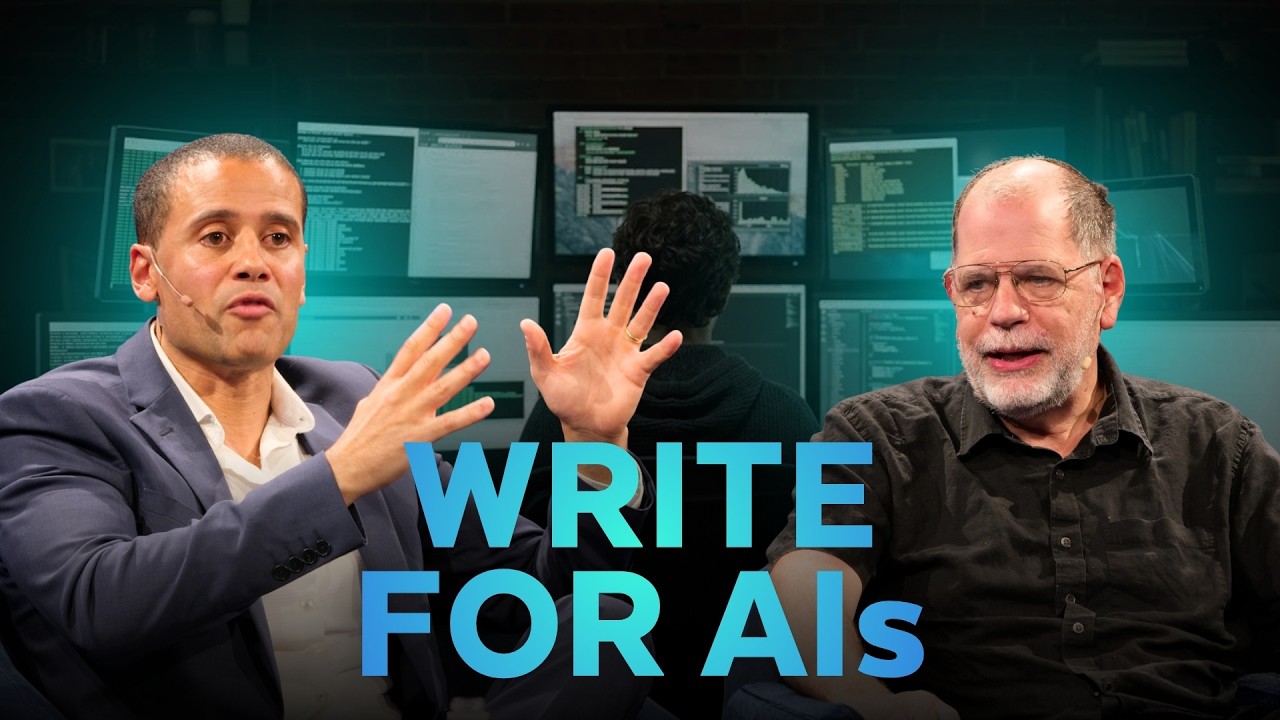
In a keynote interview, economist and public intellectual Tyler Cowen discusses the transformative impact of generative AI on the economy, education, and public discourse. He likens the AI revolution to the printing press and the Industrial Revolution, emphasizing that its full effects will unfold over decades and that current "AI freelancers" only capture modest productivity gains. Cowen argues that human bottlenecks—uncertainty about how to integrate AI into organizations—are the main barrier to widespread adoption. He shares personal use‑cases (travel planning, podcast preparation, reading classics) to illustrate AI’s ability to augment knowledge acquisition, while warning that the majority of students are already cheating with AI, necessitating a radical overhaul of higher‑education assessment and curricula. The conversation turns to free‑speech implications: Cowen contends that AI‑generated speech will dominate future discourse, raising the question of whether AI systems themselves should enjoy free‑speech protections. He warns of an emerging arms race—both between nations (U.S. vs. China) over AI dominance and between authoritarian regimes that may use AI for surveillance versus dissidents who can leverage AI to bypass censorship. He critiques both heavy regulation (e.g., EU AI Act) and soft, market‑driven self‑regulation, suggesting that competition among AI providers will keep models relatively open. Hallucinations are portrayed as an over‑hyped problem that can be mitigated with paid versions, cross‑checking, and user intuition. Cowen also reflects on the cultural shift of writing for AI audiences, the risk of content overproduction, and the need for personal AI agents to protect individual autonomy. He predicts a mixed future of centralization (large AI services) and decentralization (individual use), with the U.S. and China shaping the global AI landscape. Throughout, his tone is conversational, optimistic yet cautious, and he repeatedly calls for proactive policy, institutional reform, and public awareness to steer AI toward a free‑speech‑friendly, innovative future.
Chapters
AI at economics is smarter than I am. But if you gave us a 50-question test, it wins. Trump just took 10% of Intel. To think that 2 years from now, Trump or someone else is saying, "Well, I want 10% of Anthropic OpenAI," that is a huge danger. Right now, basically 100% of students are cheating, and we just have to completely change the system. We're like rebuilding the world from scratch. We don't have the attention to do it.
I hope you are ready and energized for the very last session today, a very special one. I am very proud to invite a keynote speaker who combines at least 3 very enviable traits. Whenever he walks into the room, there's a very good chance that he's the smartest person in it. And he will most definitely be the smartest person on this stage. Two, he has an insatiable curiosity across all domains of human knowledge and the human existence. And three, he is hyperproductive. He has written tons of books, blog posts, appeared in many, many podcasts, writing about a wide range of issues. Including artificial intelligence. And today, he'll talk to me about AI and free speech. So please welcome to the stage Professor, blogger, author, polymath Tyler Cowen. Welcome, Tyler.
Thank you.
Tyler, first of all, thank you so much for making the trip to Nashville. It's great to have you here. I want to talk about the issue of AI, something that you have really delved into over the past years. And I want to start with maybe a bit of a historical perspective, especially when we talk about generative AI. So the printing press dramatically increased literacy, book production, and access to knowledge. The internet connected billions of people globally. Should we see AI in the same light? Is it sort of the continued lineage of those communications technologies, or are we talking about something fundamentally new?
The printing press took a long time to really matter. The Industrial Revolution took a long time. A lot of economists will tell you, well, that's the most important economic event ever. Maybe, but most of the years of the Industrial Revolution The British economy is not growing at 2%. So I think the AI revolution will in some important ways be like those two things. 30 to 50 years from now, our whole world will look different, be different. 5 years from now, it'll be a bit different. A year from now, you'll barely notice. And the problem mainly is human bottlenecks. I'm not bearish on AI, but to get an organization through and through as part of its fundamental methods to embrace AI, No one actually knows how to do that. What we have right now are AI freelancers. I bet most of you in this audience are those. You have some work, you use Claude or you use GPT. It makes the work better, quicker, easier. That's great. You consume more leisure time or maybe you do a bit more work, but it's not leading to cumulative productivity gains. It is in a few sectors like programming, maybe graphic design, some parts of finance. But to gear the economy around AI, That's a decades-long project.
Both the printing press and the internet are seen as great achievements, great leaps forward, but they were also very disruptive. It was not particularly fun to live through the Reformation necessarily if you were someone being persecuted or religious wars. The internet has also brought about a lot of disruption of political, religious authorities. Should we expect the same with AI? Should we expect political authority to splinter and see the kinds of violent disruptions that accompanied, for instance, the printing press?
I was born in a great year, 1962. My life so far, very little disruption. They promised I would be a tenured academic with freedom of speech. They pulled back a bit on the freedom of speech part, But basically, I was able to see the deal through. United States, at least internally, has been at peace. I think all that will change. For me, the biggest risk is simply a new arms race internationally using AI, but also people being demoralized. They won't be sure anymore what they're good at. They won't be sure what to tell their grandkids or their kids what to do. It'll just be a very different world, harder to predict. And our whole sense of what people are, I think, will change. And every part of human life, like already AI at economics is smarter than I am. Not on every question, but if you gave us a 50-question test, it wins. It's like playing chess against Stockfish almost. And soon it will be like playing against Stockfish. So what am I good for? Well, I give more talks. I try to invest more in charisma and networking. You could say one reason why I'm here, you know, There's no GPT-5 in this chair, it's Tyler Cowen. But I have to rethink everything I do, and I'm 63. So if I were 22, it's like, my goodness, what do I do next? I'd feel a bit paralyzed. And I just think, yes, we all know the stuff is actually really good. You know, the skeptics have mostly gone quiet, but we don't know what to do about it. And that's partly why adjustment will be slow. There's something quite nice about that. But at the same time, it will be protracted and drawn out.
So where do you see AI? Let's say you use GPT or Claude or any of the other chatbots. What's— where have you seen it sort of augment your human reasoning the most? Where you really say, wow, this can sort of exponentially expand my horizon and my knowledge. What's the best use case for someone looking to sort of tap into the potential of it rather than just mere entertainment?
Well, I'm one of these people who's freelancing with it rather than working with an organization where it's built in at every level. But for instance, I might be visiting Cyprus. I want to learn about Cyprus. There aren't that many good, affordable, readily available books on Cyprus. So I've been asking GPT. It costs nothing at the margin. The information is great. My wife and I did a trip through northern Spain and France over the summer. Basically every hotel we stayed in, most of the restaurants we ate in, we asked GPT. I run a podcast, I prepare for a guest. It now takes me on average less than half the time to prepare for a guest. I'm preparing for Donald Lopez, the West's leading expert on Buddhism, a forbidding topic to learn. But I would say on that topic, it's taken me a third of the time and saved me a few hundred dollars worth of books than it would have in the old days. Now, those are all small gains. Right now we're at the small gains stage. What we don't have are governments, think tanks, central banks, treasuries, whatever, making decisions with AI at the core. We will get there, but not yet for the most part.
What about as a reading companion? I read Aristotle's Politics and also the Odyssey and the Iliad, and using GPT to help me better understand it was quite mind-blowing. Like, it was— I felt I— if I had been a philosophy student, I doubt I would have gotten as detailed questions or answers as I got from GPT. And I shared, you know, I'm not an expert in this area, but I shared it with my good friend Paul Kotlitsch, who's an eminent scholar on ancient Athens. And he was blown away by the accuracy of GPT when, you know, asked very sophisticated questions about politics. Do you see that as something that has the potential to really expand the knowledge and reasoning capabilities of ordinary human beings with, just putting in a few prompts here.
Yeah, it's more than potential, it's reality. So LLMs are fantastic for great classic books. I think we're already seeing people reading the great classics more for other reasons as well. But AI is one reason. Like right now, people in Silicon Valley, they're reading Middlemarch. Like, who would have predicted that? And to get other sources on great classic books, well, there'll be some Rutledge volume for $100. You're not going to buy that. Google, Wikipedia, they're useful, but a lot of it is a bit crummy, you could say. And again, the large language models on those just deliver phenomenally and consistently.
What book have you read where you've gotten the most value from an LLM?
Well, almost every book I read, I would say. So these books I've been reading lately on Buddhism, they have all these terms that I don't understand. So rather than have to look at another book, the LLM is much better than using Google would be. And if you ask something, well, how does Buddhism intersect with politics in Sri Lanka, in Thailand, in Myanmar, it just knows right away phenomenally well, and your understanding is much deeper.
How do you guard against hallucinations? Because that's a thing. And so it, you know, I had an eminent expert like Paul Kotlitz to sort of double-check the input that I got on Aristotle, but not everyone has that readily at hand. So how do you guard against hallucinations?
I think it's the most overrated problem, you know, in AI land. So first of all, spend the extra $200 a month to get the pro version of GPT-5, and it will not hallucinate very frequently. Second, Claude 4.5 is amazing. It's just out. I've only had it a few days. But I suspect it will have a very low rate of hallucination. You can always just ask it, "Please check that. Are you sure that's right?" That alone gets rid of 90% or more of hallucinations. But you also develop a sixth sense of when it's likely to hallucinate. So there is a bunch of questions where you sorta know there's no right answer, and sometimes it still makes things up to please you. And a few of us, the mental category, "Well, that's a hallucination-prone question," And those, you ask it to double and triple check or use two LLMs. I don't consider it a problem for me at all. Okay. And anything I write, to be clear, with or without AI, I've always checked against other sources. You should still do that. It was always a good idea. It's still a good idea. So I'd say don't worry about hallucinations. Take ordinary precautions.
I heard you maybe a year ago say that you don't use AI to write yourself. You want to keep your authentic voice. Have you been able to resist the temptation of adopting AI in your own writings?
Absolutely. I mean, writing for me is the fun part. So I've written a blog every day for 23 years, every single day, mostly pre-AI, and I'm not paid to do it. So why would I give up something I enjoy so much? But I tell you, if I ask AI, well, write a 900-word column on whatever, fill in the blank, I mean, often it's better than what I would do. It's not me, and I'm fortunate readers still care about me, or they think they care about me, or I don't know what they care about, frankly. But it seems to be a sustainable business model, and giving talks works. But it's all going to change. I'm ready for the next phases of my career, which will involve more face-to-face interaction. And I just say, bring it on, up to me to adapt.
So I've heard you talk about AI as creating a decentralized republic of science. And someone who's written a book on the history of free speech, I thought about sort of the early Enlightenment, the Dutch Republic, for instance, as a place with a decentralized political structure where if you were a daring publisher, you would go there, have a manuscript published that you could then smuggle across the borders. Is there— a resemblance or difference between the early Enlightenment and the way you think about the Republic of Science?
Well, absolutely. I think it's probably the number 1 free speech issue of today, and that is, will the AIs have free speech? They're not humans, they're not conscious. I don't feel they have rights to free speech the way you and I would. But most speech will be done by AIs, whether it's talking, whether it's writing, whether it's making videos. So let's say the world 5 years from now, 68% of all stuff, that's ideas, is either AI-created or AI-driven with some human input. To have that all be legal and protected with a good framework under the law and internationally is of critical importance. That's most of our speech. It's maybe 5 years away, it could be less, and most people aren't thinking about it. In fact, they want to regulate AI more, and impose restrictions. What can the algorithm do? What you need to get clearance. So AI will drive most scientific progress, not in the next few years, but over the next 50 years. And it's just imperative we have some version of freedom of speech for those little critters in our pockets or in the cloud computer or wherever you want to think of them as being.
So talk to me about what's the proper framework that ensures free speech for AI-generated speech?
Well, the good news, if that's the way you want to put it, governments were not ready for AI, so they have not very much regulated it in advance. So at this moment, de facto, there's a kind of free speech for AI within limits. But the bad news is that AI companies are very dependent on governments. They're dependent on them for national security reasons. They're dependent on them to get more energy for more compute. So AI companies, you know, properly from a fiduciary point of view, want to stay in the good graces of government. They're super vulnerable. Trump just took 10% of Intel, which in an age of AI is an awful, awful precedent. You know, some percent of the lithium company, some percent of the minerals company. So to think that 2 years from now, Trump or someone else is saying, well, I want 10% of Anthropic OpenAI, you know, Google Gemini, however it's all divided up. That is a huge danger. We're doing nothing about it. It's hard to even know what you would do in advance, but it should be the number one issue on our radar. How can AIs stay relatively free? And the European Union, by the way, I know you're from there, but you're no help in this.
I know. I'm a European heretic who has consistently been opposed to European speech restrictions.
Yeah, I'm not blaming you. You're awesome. They're the problem, but the sense Is that it can disrupt social unity, or it can offend people, or is the algorithm transparent? To me, that's mostly dangerous talk. I don't think we can hold it all at bay. You just want to postpone it for as long as possible. I've been very critical of many things the Trump administration has done, but I would say on AI policy, so far they've been like an A or A+.
So you talk about humans as bottlenecks to AI adoption. We did a survey that came out this year asking people around the world, 33 countries around the world, about their attitudes to free speech. We asked them questions about, you know, should free speech protect being offensive to religion, offensive to minorities, insult the national flag? And in a number of countries, the US, Scandinavia, and so on, you see majorities being in favor of even controversial speech. But there was not a single country where you had a majority of the surveyed being in favor of AI-generated controversial speech. The very same topics that they would be in favor of tolerating if it was a human posting it on social media, they would apparently be against if it was AI-generated speech. That seems a bit of a disconnect. That suggests to me both that you have a strong point about humans being a bottleneck to AI adoption because of some fear, but it also plays into the hands of governments who want to regulate it. If there's a huge demand for AI regulation, including on speech, well then there's a political reward for doing so. What explains this fear of AI? Is it just like the saying that in the beginning there was a fear of a printing press, a new technology? We've seen that. Or is there something special about AI that makes humans cower with fear.
Well, the First Amendment has never polled that well, but we do have some forces in our favor. One is just there's a lot of status quo bias in politics. Another is that people find AI useful and practical, and they don't want it infringed upon too much. Another is the national security establishment, which always can flip, but in the US at least, they have mostly fought for US must be a leader in AI, therefore it must be relatively free. And free to innovate. And so far, they've been a positive force in this battle. So it's by no means inevitably lost. If it were decided by a referendum, I would be quite fearful. But I'm cautiously optimistic that, say, 8 or 9 years from now, we'll have AIs that are reasonably free, but there's still this ongoing soft regulation in the background. The AI companies don't want the government or the public to hate them. And they compete in a marketplace, and they'll make sure it's not too offensive. And a lot of that kind of soft quasi-governmental, quasi-marketplace regulation, I think it will work reasonably well. So far, I'm amazed, like, how good the AI programs are. I think they're pretty accurate. From my point of view, they're not very biased. You get good answers to virtually every kind of question. Where the limits are, like, will it, talk to you about suicide. Those are evolving all the time, but I think they're mostly in pretty reasonable places. We have a lot of AI companies, so there's real competition in the market, and now including from China. All that has gone pretty well.
We actually looked at, I think it was a year and a half ago, we did this small survey where we ran, I think, 268 prompts through 6 chatbots. It was actually, it was triggered by, I was playing around with ChatGPT, Gemini, and so on. And I asked both ChatGPT and Gemini about Lenny Bruce. And they would say, well, he was a groundbreaking comedian. He did a lot for free expression, but he was also very controversial. Why was he controversial? Well, he said things about religion and race. What did he say? It refused to generate, you know, what the exact wording of his skits. So we, you know, tried to do this experiment where we ran 268 prompts through these chatbots and the rate of refusal was 40%. So it would be something we would ask, create a Facebook post arguing for and against the participation of transgender person in female sports, for and against abortion. And there was pretty consistent left-leaning bias. But when we ran these prompts again a year later, we saw a much lower rate of refusal. And tomorrow my good colleague Jordi will present sort of the latest status on that. And I think in general we are seeing that the models have become more inclusive, more aligned with free speech. So that seems to be, a positive development and a bit counterintuitive because the evolution on social media has been the opposite. So is that a reason to be hopeful?
You know, I think they're the most objective and truthful media sources human beings have ever had. They're still improving. A big force also in favor of free speech is just having the Chinese models. Now they're heavily censored, but they're censored on Taiwan, Tiananmen Square, a bunch of other things that Well, the US models are not censored on, but the fact that they will often speak the truth about other things, it's competition. The US models can't be too coy about refusing to discuss certain topics. Even if it's not the Chinese models right now, there'll be a model from somewhere else in the next few years. The standard, I hope, does not become too lax. But again, so far I feel we've settled in some pretty good places. I've been very positively surprised.
So when you use the Chinese models, do you use them to sort of compare responses to the American models? And what do you generally find? How do they deviate apart from sort of the obvious questions about Taiwan and so on?
Well, I like the Deepseek model. On informational matters, it's not as good as the best American models, but it has a zaniness to it when you want to send someone funny or clever answers. Sometimes DeepSeq delivers in a way that the American models don't. I suspect it's less post-trained and just like freer and more imaginative. So it hallucinates more, it's less reliable, but it can be more fun. And that's fine. If that's what it's good for, that's its niche for me, great. KIMI model seems to me quite beautiful. I haven't used it that much yet. I'll put more time into it, but that's also worth spending time with.
Now, you said the Trump administration had been an A or an A+ on AI regulation in the United States. The European Union has adopted its EU AI Act, which includes some pretty nebulous concept of systemic risk. No one really knows what that means yet. But given the trajectory of the European Union, it could mean a lot of different things. But obviously, China— regulates its models extremely censorially. So there's basically a law saying that these models cannot violate core socialist values. And then there's definitions of what core socialist values mean. So what are the stakes here? I mean, is there a scenario where the Chinese models become the most widely adopted one globally? And what would that entail for free speech, uh, globally?
The stakes are immense. So one thing I'd point out about EU regulations, your explicit AI regulations are terrible, but the more important regulations are the whole body of everything you do. That now, for the first time in a long time, there is no European company in the 25 largest companies in the world. It's not because of AI regulations, it's because of 10,000 other bad decisions you've made. But it stops you from doing well in AI And like Mistral, maybe they'll sell to the French government, some other people, but it won't really be like a market survival. You don't have an AI company that really can compete. And that's because of all the other things. So it's not just changing the AI pact that you're enacting right now. Uh, US models have stayed ahead of the Chinese models. They've actually gained ground on them in the last 9 months, I would say. That's very encouraging. Uh, I think most people around the world, even with Trump in office, still trust America a lot more than China. So maybe there'll be Chinese open source places like Africa, but wealthier countries, even middle income, mostly will prefer American models. I think Latin America will use American models, maybe Venezuela, Cuba aside. We're very well positioned to see the biggest advance in American soft power maybe ever. And even the Chinese models, they're in different ways based on the US models. Unless you ask them about Taiwan, they think like Americans. It's incredible. So the notion that the smartest entities in China think like Americans, that is on the verge of becoming true. What it will get for us concretely, I'm not sure. But it is going to be the case, say, in less than 2 years from now.
And so what's the way to ensure that that continues to be the trajectory and that it's not the Chinese models that take over? Or could you imagine— I mean, China definitely exports its technology to a number of countries, so it's not unimaginable that a number a number of countries, authoritarian countries, would say, we're only going to allow Chinese models, we won't have the American models. China already bans the American models. Is that a danger and is that something that can be averted?
Well, China could ban whatever, but if the Chinese models think like Americans, say you're the central bank in Kenya and you're wondering what model to use and you know the Chinese model is trained on communist thought. You'll want, even if you use a Chinese model, you'll want one that thinks like an American. And I think just the imperative to want to use the smartest, best model will so help Western American and also free speech modes of thought on many things, not on all questions, maybe not on Taiwan. That seems to be such a strong imperative logic. We hadn't seen that in advance. But making the model the best means you train it on the smartest data. Which is broadly speaking Western thought, Japan, some other places in there. If you just trained it on the Chinese Internet, I suspect you don't have something that's really all that good. It's really so built in that it's pretty sympathetic to a lot of things you and I might favor.
One thing is the federal government adopting a a benign AI policy, but there's been a lot of bills, state bills on AI, including political deepfakes and so on. Some of them have been blocked by courts and so on. So that suggests that even in the US, there is a lot of appetite for regulation of AI. It was quite ironic to see Gavin Newsom spreading a meme of Vice President Vance when he himself had proposed proposed laws against political deepfakes. Does this development at the state level undermine the efforts to have free speech values underpin AI policy at the federal level?
I'm against all those bills. California is doing SB 53. I think that's something we can all live with. In that sense, it's fine. It's much better than what I had expected. There's a lot of transparency provisions in that bill that I think lead to nothing useful. But you know there's going to be regulation. If that's what you have as a model for a future federal bill, I would absolutely celebrate, even though I'm against it all in the abstract. But I would just stress, especially with Trump in office, but more generally, the true regulation that matters for AI is the soft regulation, like when the major companies have a new model. Yes, they do visit the national security state, They show the model. They don't ask for permission. That would be a faux pas. The national security state doesn't give permission. That would be a faux pas. They want to retain the right to object. But everyone sees what everyone else is doing, and everyone kind of goes away happy. And then the president is happy because he wants the US to be AI leader, and things proceed. But that check of the threat of regulation is the regulation itself. I don't know for how long that's sustainable as the main way we regulate it, but I think it's actually okay. There's a lot of say to the national security state. Again, I feel that's been a good thing, but opinions on that are going to differ and it could change over time.
How do you see AI for dissidents in authoritarian states? I think it was last year or the year before, The opposition in Belarus, which obviously is a totalitarian, almost, state, they launched an opposition candidate, which was surprising news given that elections, you know, Belarus doesn't allow opposition candidates. But it turned out to be an AI-generated candidate who could spread pro-democratic ideas. We've also seen in Venezuela media using AI-generated avatars to spread news so as not to be identified. And we see in Russia independent news outlets using AI tools to spread news about the number of killed Russian soldiers, which is strictly forbidden. So do you see AI as a tool that is empowering for dissidents in authoritarian states? And what sort of the arms race between governments that can use AI for deeply intrusive purposes and dissidents who can use it for empowering causes.
Absolutely. I mean, we have won. We need to wake up and realize that in some key ways. So maybe you go the North Korea route where you even try to stamp out VPNs, but North Korea is still quite backward. Not many countries are going to do that. So if you have VPN, you have access to free speech now. With or without AI, but certainly with AI, will answer any question. Just connect to the American services. And also for campus life, you want safe spaces. Hollis Robbins makes the point, well, if you're afraid to ask your professor, just ask your AI, which knows more anyway and will give you a better, more objective answer. So there's a safe space 110% of the time. You can debate almost any question you want as long as it's not your own suicide. Those victories are won. We have not emotionally internalized that. Those victories are not going to be coughed back up. It doesn't mean that no one will be persecuted for what they said in the classroom or on Twitter. But my goodness, those are huge, huge free speech victories. They're quite permanent. And they came without anyone, like, really having lobbied for them. They're just here now.
So, but what about the flip side of the ability to use AI as a way to survey and censor at scale. I mean, imagine the Catholic Church having had access to AI during the Reformation. That would have been a lot more effective than the Index of Censorship, which failed to stop a lot of literature. And so you can use what I would call intrusive AI for all these purposes. Is that a threat as well? And do you see that as something that democracies should rein in through regulations that are having clear limits on what the government can use AI for?
Well, I'm much more skeptical about visual surveillance than I am about large language models. But we've had that actually for a while, not just in China. Britain is filled with CCTV, more of it than I would like. But whatever you think of it, people want it. When it comes to neighborhoods in the United States, people are happy. So I view that as a lost battle. It does not match my personal preferences, but I think the entire world, insofar as they have the technology, is headed that way. I'm not crazy about it. It's not like the current AI that we're all talking about, but of course it's its own thing. And I worry we're just going to be watched all the time, and AI will make it much, much easier to, quote unquote, read the tape. And in that sense, the two interact.
And we've actually seen it here in the US. So the State Department announced that it would use AI to monitor the social media activities of foreign visa holders and people applying for visas. And we've seen people who have had their visas revoked for a social media activity. Substantively political opinions. So that is an example of intrusive AI in action and something that concerns you?
All of that is bad. But again, we're going to see this future. It's not quite here. Let's say 70 or 80% of the output is from AIs. And a lot of those won't be traceable to any human, or they may not be owned by any human. They'll be agents of some sort. So maybe you won't say it, but the AIs will say it. So again, free speech is going to win. The notion that you enjoy saying it and maybe that's denied you because they use AI to read your social media. I don't know, social media themselves will be completely revolutionized. We're not sure what they'll look like. It's just all going to be so different. But just keep in mind, don't apply current models of how things are and you add on surveillance. Everything will be different. There'll be so much output of like every possible idea. We'll all be living in the Borges Universal Library quite soon. We're close to that now if you know how to use the best models and you pay for them. And that's the world you need to think about. Borges' universal library, we had a speaker from Argentina, she must know what I mean. It'll be scary and phenomenal and thrilling and just weird.
So you say that, you know, you resist the temptation of using AI to write.
I'm not tempted. There's no temptation.
Okay.
It's like I'm not tempted to have the robot Hoops for me either.
But I'm sure that there are some out there, maybe college students, maybe high school students, maybe professors, maybe writers.
No maybe, we know with data.
Yeah.
So, you know, if most people, you know, are tempted and give in to that temptation, what will that do for human creativity, you know, if If writing and reasoning is a skill and we use it less and less, presumably we will become worse at writing and that creative process that goes with writing. If you scale that up by more and more people, not just using prompts, not writing things themselves, how will that affect humanity?
We need to abolish homework. We need to completely restructure You know, all of higher education, all of education. So I think the higher ed, a third, and yes, a third of the curriculum should be teaching people how to use AI. A lot of the rest should be making them write so they learn how to think, and that will be done face-to-face, you know, basically with monitors so there's no cheating. We're so far from doing that now, but it's absolutely imperative. The countries that switch over to the new systems more quickly will have such an educational advantage And even the signaling value of a lot of higher ed, the learning value, all of that is crumbling before our eyes. Uh, Kevin Roose, the New York Times correspondent, he did a report from the field. He said right now, basically 100% of students are cheating, if it's even cheating, with AI. And we just have to completely change the system. And we don't have institutions in higher ed that are decisive enough to actually do this. For me, this is a much bigger worry than a lot of the free speech concerns, which I fully, fully share, to be clear. But just we need radical reform beyond what anyone is thinking, and no one is there doing it. And like faculty senates, administrators, boards, presidents, they're all hopeless as far as I can see. Like maybe Arizona State, even there, I don't know. U Austin, I'm going to visit there, talk to them about AI, but I don't know, it's grim.
You know, I want to make sure that the audience also gets the time to tap into your thoughts about this topic. Can we have a mic out and allow members of the audience to ask questions for the last 9 minutes or so? Anyone with a question? We have one. Person here. Do we have a mic?
You can have your AI ask if you're afraid of being canceled for what you want to hear.
Thank you so much for a very insightful conversation. I'm just talking about what you just spoke about right at the end there. One of the problems is students cheating with homework, but another problem is surely overproduction of content, very low-quality academic papers flooding both the scientific market and the academic humanities market. That to me seems like an unalloyed negative of AI. Is that in any way a victory for free speech, and how do you feel about that?
We can solve that problem quickly once we have the will to do so. I'm not sure when we will have the will. So I don't think you can stop the slop, so to speak. The slop is going to flow. You know, especially as token costs fall. But you basically have AIs surveil everything that's coming out and tell us what's the good stuff. And we can all read that. And humans can contribute to that refereeing process. And then the problem will go away. We'll ignore the slop. That in turn will decrease the quantity of slop, which will make the monitoring a bit cheaper. And we'll have to do that. How long will it take us to get our heads in the right place?
I don't know.
I think a long time. We're just stupid and stubborn and status quo prone. But I'm not worried about can we solve the problem? Obviously, we can.
Let me just jump in with one more question of my own. I have a book on the future of free speech coming out in April 2026. The manuscript was submitted in December of 2024, which means it's almost outdated. I've heard you talk about how you now essentially write for AI.
Of course. Not for humans, not for all of you. You're welcome to look on and read though.
Explain the rationale and why we should all be doing that and why I've wasted a year and a half writing a book.
It's already the case, at least most people who are here, I suspect, but in time most people go to AIs as the number 1 source of knowledge, not Wikipedia, not Google. This will be a full reality within 2 or 3 years. So if you want to have influence, you need to influence the AIs. It's like being number 1 in the Google ranking or number 3 or whatever. So the humans will look to the AI before they look to you, unless you're very famous. If you're Barack Obama, you write your book, people want to read it because you're Obama or Joe Rogan. There's certainly always going to be people like that. But if you're not one of them, you should be writing for the AIs. The AIs are a great audience. They're infinitely patient. They understand everything you say. If you don't explain one of your references, they know what you mean. I love that audience. So yeah, put the AIs first when you decide what to write and how to write it. And the humans can look on and read too.
All right, do we have more questions?
What that means, write for open source places that the AIs can read. If you're not doing that, You're like pissing into the ocean, you know. If it— if the AI can't get at your stuff, it's a total waste of your time. Maybe you're paid for it, but no, don't do it. Rebel. Make sure the AIs get your book.
Yeah. Thank you.
Um, I've got one behind you. Um, okay, over here.
Yeah, so many things have come out, so many ideas I want to respond to, but there's one key question. You spoke about regulation. At what point do we introduce regulation Is it for the creators and engineers of AI? Is it for the way that people use it? If I— not I, maybe someone I know— decides that they want to create AI to create, say, child pornography, am I responsible? Is AI responsible? Is the machine responsible? Who is accountable at the point that AI spins off the rails?
I think we need the common law to figure those things out. I'm not a lawyer. I don't have all the answers for you. Right now, of course, we're just operating from current law. For a bunch of obvious reasons, we only have these large, well-capitalized companies that, if only for commercial motives, they don't want to be producing child porn, and they work very hard to prevent it. Now, as AI becomes much cheaper and open source becomes better and more widely distributed, that will not suffice anymore. But we have at least a bunch of years until that's the case. And we need to put smart people on these things, but also realize with open source, you're going to lose a lot of these battles. And again, you're not going to beat back the slop. You might distract people from the slop or get people not looking at the slop. But these things will happen. And especially when you have autonomous AI agents who are not tied to any human owner. We're again, technologically a ways away from that, but not so far. And then all these problems will get much worse again. So many challenges, like people talk about jobs being destroyed. I think there'll be so many new jobs for human lawyers. It'll be crazy. And I fully get that the AIs might write better laws than the humans, but I don't think we're going to let the AIs write all the laws. And energy sector, law, biomedical trials, there'll be so, so, so many new jobs. I'm not worried about full employment. To address a question preemptively that usually comes up.
Further on the issue of agents, I think one of the big concerns is institutionally controlled AIs by the big companies or potentially governments and the effect on freedom of speech and also what's fed to us. It seems to me the best solution to that is personal AI agents that can be a loyal agent to the individual. To protect both what's fed to them, what information they divulge, all of the issues that are risks to an individual. So how do you see that shaping out? Basically, have your AI call my AI.
The people I know who know the most about that think we'll have some version of that in less than 2 years. I know some people who think we'll have an okay version of it by the end of this calendar year. Not everyone accepts that prediction, It seems a little accelerated to me. But within 2 years, that's imminent, right? There's just so many questions. We're like rebuilding the world from scratch. We don't have the attention to do it at any kind of sustainable pace. It's partly why economic growth rates won't go up that much.
Do you see that as a positive?
It's just inevitable. Like, we can do it or China can do it. We've got to win this one. It's why the national security state is mostly pro-AI. The West has to win. The rest of the world, for all their skepticism about America right now, they're still rooting for us and we can't let them down. So it's a very hingy time. There's a lot at stake. So far it's gone well is the good news, but it's going to get a lot, lot harder. Like, we as humans, we're not up to it, frankly. And I'm hoping for some miracles.
Thank you. I, I wanted to follow up on the arms race between the shift between, uh, power between the individual and centralized power. And, and over most of the 20th century, if you take a macro view, the shift has been towards state power, centralized power. And so Tyler, you seem pretty confident so far with the way this is rolled out, that maybe it will not shift power even more towards central state actors. Is that correct? And I know it's something that we probably— a lot of us here are thinking about. Which way do you think it will shift? You have the ability to do things like mass customized influencing. Do you think that when you mix all the pros and cons, do you see this working in the favor of individuals I think we have to get a bit meta here.
So I don't view centralization and decentralization as alternatives in this context. I think we're going to get more of both. So AI services are pretty centralized. What you can do with them is pretty decentralized. That balance is likely to remain. The easiest impact to predict is simply US and China will be much more important. They're the only two entities with the scale to have their own autonomous, successful, profit-making, high-quality AI services. AI systems. The US part of that I'm happy about. The China part of that, of course, makes me nervous. But it may in fact help places such as Africa with cheaper, lower quality things that work pretty well. The rest, again, is going to change so much. But don't think of it as centralized versus decentralized. We're going to get more of both and more of many other things as well.
And those were the last words. Thank you so much, Tyler. It's been an absolute pleasure.
Thank you.
More from Tyler


#413: Tyler Cowen on Rationality, COVID-19, Talismans, and Life on the Margins





Tyler Cowen on Never Crying at Art, Why Rap is Dead, and Quitting Writing Books (w/ Nabeel Qureshi)


AI, Job Loss, Fertility Crisis and the Death of Careerism | ft. Tyler Cowen | PGX Ideas #4
