The Return of Tariffs - Incidence, retaliation, and the return of protectionism
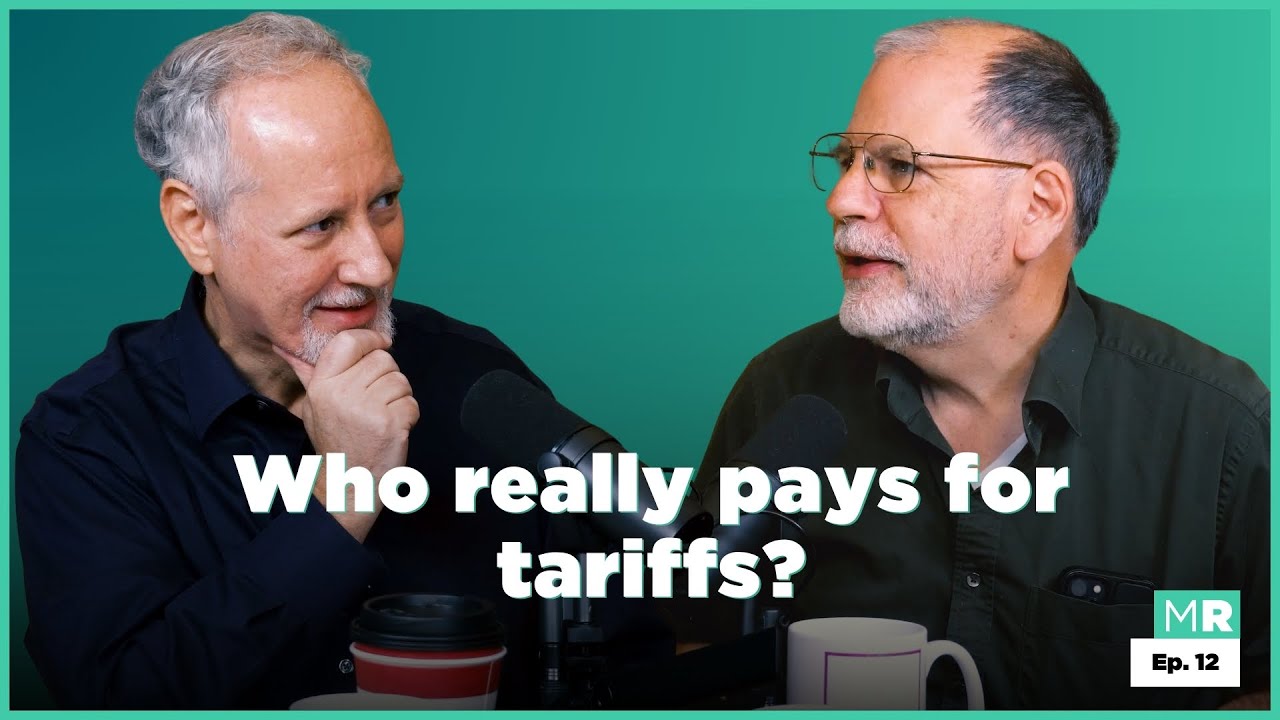
In this November 2025 Marginal Revolution podcast episode, economists Alex Tabarrok and Tyler Cowen examine the resurgence of U.S. tariffs under the Trump administration and their broader economic and geopolitical implications. They begin with a brief history of post‑World‑War‑II trade liberalization through GATT and the WTO, noting how tariff rates fell to historically low levels before jumping back to an average effective rate of about 18 % after a rapid series of Trump‑era hikes. The discussion then turns to the economic incidence of tariffs, applying the standard Econ 101 rule that the side of the market with the more elastic response bears less of the tax. They argue that U.S. import demand is relatively inelastic, so consumers and domestic importers absorb most of the burden, a view supported by empirical studies showing near‑full pass‑through for many first‑round Trump tariffs. They explore sectoral differences – pharmaceuticals, oil, and branded goods can generate surplus that can be “screwed” for revenue, whereas unbranded agricultural commodities cannot. The hosts debate the macro‑level effects of tariffs, including exchange‑rate adjustments, Lerner symmetry (an import tax is equivalent to an export tax), and the resulting impact on U.S. export competitiveness. They note that exchange‑rate movements are volatile and their net welfare effect is ambiguous, contrasting a tariff’s direct cost with a currency depreciation’s relative‑price effect. Retaliation is examined both in overt trade measures (China’s soybean ban, rare‑earth restrictions) and in subtler diplomatic or policy responses. Beyond pure economics, they discuss political and strategic arguments: a “contagion” effect where poorer countries imitate tariff‑heavy policies of wealthy nations; the idea of “friend‑shoring” or using tariffs to force allies (e.g., Canada) to increase defense spending; and the risk that tariffs increase correlation among adverse macro variables, amplifying systemic risk. They also touch on distributional aspects – land‑rent capture in agriculture, Georgist perspectives, and the emerging role of AI‑related data‑center investments (including speculative outer‑space facilities) as potential export sectors. Finally, they reflect on the paradox that neoliberal trade liberalization created the political environment for the current protectionist backlash, concluding that while tariffs are largely harmful, the debate reveals many unresolved theoretical and empirical puzzles. The episode ends with both economists acknowledging confusion about the precise outcomes but agreeing that U.S. consumers are likely to bear most of the cost and that the current tariff regime is moving the economy in an undesirable direction.
Chapters
Good morning, Tyler.
Good morning, Alex.
So today we're going to be talking about tariffs. They're back in the news.
Unfortunately, it's a topic I find so, so confusing, however, and I know you're the greatest clarifier and I'm the greatest confuser, so there's going to be a war as to whether we can clarify this topic or make everyone at the end more confused. I think you're going to win.
Well, we'll see. We will see. We're mostly going to talk about the economics of tariffs today, but I thought it'd be useful just to put it in some historical context. You know, after we had World War I, we had the Great Depression, World War II, and a lot of the world leaders sort of looked around and said, you know, we screwed up, you know, we've been in a big mess for a long time, let's fix this. And one of the things they did, they said, we gotta bring the world closer together. So through a whole bunch of institutions like the General Agreement on Tariffs and Trade, the GATT, and the WTO. They started to bring tariff rates down.
And bilaterals were very important, and the EU, right?
And the EU, they created the EU, absolutely, absolutely. So this is all part of bringing the world together, globalization, and in reducing war. And it worked, it worked. We really did bring tariffs down, and they came down so much beginning in the late 1940s, that by the 1970s, tariffs were hardly considered an economic problem at all. And 1980s, 1990s, I mean, when we came to write our textbook, people said, why are you spending so much time on things like tariffs and price controls? Nobody believes in that stuff anymore. And yet here we are. So in fact, At the beginning of Trump's term, the average sort of effective US tariff rate was 2.4%, and it had been that way for decades, really. And then under Trump, we had this— in a matter of weeks and months, tariff rates jumped to 50%, 100%, 25%, 10%, jumping all over and around. We're now at an average effective tariff rate at 18%. So 18% on average is not that bad. But going from 2.4, you know, to 18% in a matter of weeks is crazy.
And to be clear, we're recording in November 2025. The Supreme Court may strike down some of those Trump tariffs, it looks like. But for the time being, we're well into the upper teens, mid to upper teens. On the tariff rate.
Exactly, exactly. So that's the situation where we are right now. Now let's try and unpack a little bit who pays the tariffs, who pays the tariffs, the tariff incident.
Sure, we're gonna get to that, but let me just tell you rather proudly, I have a new best argument against tariffs.
Okay.
And it's very soft, I think it's hard to prove, but it might actually be the very best argument against tariffs.
All right, let's hear it.
And if you think about COVID policy, the wealthy nations did a bunch of things, some of them were quite bad, and the poorer nations all copied that. They didn't have to copy it, but there was some kind of contagion effect, or that seemed like the high-status thing to do. And I believe with tariffs, something similar goes on. So there's a huge literature about retaliation. Of course, retaliation is a cost, that's bad. But simply the copying effect, that it was high status for the wealthy nations to have tariffs. They can afford it better. But then places like India had their own version of the same thing. That was just terrible for India at a much higher human cost than, say, it was for the United States. And again, it's hard to trace or prove, but that, I think, could actually be the best argument against tariffs, simply that poorer countries will copy what the high-status nations are doing.
Yeah, yeah, yeah. For a long time, the developed countries tariffs were considered, you know, passé.
That's right. Yeah, yeah.
And I think you're right. There's a lot of copying does go on and it could be very bad, very bad for the world.
Okay, so incidents. Now let's get to the things I don't understand.
Well, I think I understand them at the beginning of the conversation. At the end, I'm not so sure. But let's start.
Incidents will actually create some arguments for tariffs in wealthy nations. And this is what worries me.
Sure.
But the contagion effect on the poor nations saves the day. It still makes free trade look much, much better.
So a tariff is a tax, right?
Absolutely.
And so we can just apply, just to begin with, you know, the Econ 101 rules for what is the incidence of a tax. It's really exactly the same thing. So we know that from Econ 101 that the incidence of tax depends upon elasticities. And in our textbook, Modern Principles of Economics, we give a simple way to remember the rule. And the rule is: the side of the market which is more elastic can escape. Elasticity is escape. So the side of the market which is more elastic can, to a greater extent, escape the tax. So, let's take the US and its trading partners. If the supply of goods to the US is very elastic, then the suppliers can escape the tax, and the US residents will end up bearing the burden. Now, let's fill this in a little bit. What makes a good elastic— what makes the supply curve elastic? Well, the supply curve is going to be elastic if the suppliers have substitutes. If they can sell their goods elsewhere. If they have other buyers that they can sell their goods to, then they won't accept a drop in the price, and the US residents will then have to pay the higher tax. Now, that I think is actually a pretty good description of the US. You might think that, oh, the US is, you know, so important, such an important market, but really the United States It's about, I think, 14% of import demand in the world, you know, maybe even a little bit lower, kind of falling. So there's actually lots of other markets for most other goods.
But it's more important than that. It's a market where if you've made it, you spread to many other markets. So I'm a little worried this analysis, while I agree with what you've been saying, creates a case for tariffs, at least if you're not a moral cosmopolitan. So as you well know, the firms that export, not in every case, but they tend to be large firms, right?
Yeah.
That's not coincident with market power, but it tends to be branded goods, especially outside of agriculture. There's a profit margin, especially in the United States where people are keen to pay more for nice brands because we're wealthy. And if we put a tariff on them, my best guess after looking at a number of papers is that like a third to half of the burden is just put on the foreign company. Now, as myself being a moral cosmopolitan, I'm not thrilled about that. But if you take the way economists usually analyze these problems, they just say, well, that's efficient taxation. You export like at least a third of your deadweight loss to other parts of the world. And like, yeah, why shouldn't we do some of that? That's my worry.
Yeah. Yeah. Well, I think that's— it's going to vary by good for sure.
Sure.
Right. There are probably some goods that we can turn the screws and grab up some of the surplus from foreign suppliers.
Pharmaceuticals would be an example.
Pharmaceuticals, a great example.
Produced well above marginal cost.
Exactly.
Basically MC is zero, it's near zero at some point. And there, if you put on the tax, you just reap more surplus for your government, and at least your country is going to be better off.
Exactly, yeah. I think we could turn the screws on pharmaceuticals.
I don't want to, to be clear, but in terms of short-run incidents, we could.
Yeah, yeah, yeah. I mean, the price is so high in the US markets, and you can't get that price anywhere else in the world. So the companies definitely want to sell in the US, and we could tax away some of those profits.
In the 1980s, there was an import tax literature saying the US could tax oil from Saudi Arabia, low marginal cost, we were a very important buyer. I think most people then accepted that conclusion.
Yeah, so—
May not be true today because the oil market has changed a lot and we're the Saudi Arabia and the Saudis sell much more to China than they used to, but still, at one point at least, it was true.
So let me finish on pharmaceuticals. Of course, that is entirely equivalent to just cutting back the patent. Right? So if you believe in patents, then you really don't want to tax the pharmaceutical companies. So we're not saying that we should do that. On oil, yeah, I did argue that we ought to have an import tariff on Russian oil, because what are the Russians going to do, right? I mean, they got to sell the oil, right? And if we could probably— at that time, we probably could have gotten most of the rest of the world on board with a tax on Russian oil?
I don't know. Trump's been trying on India and China. I'm not sure where it's all at at this moment, but it's not obvious that he's going to succeed. Yeah.
Well, in that case—
And those are pretty big markets.
Yeah.
China in particular.
China, China, we probably— China would have been the hard case. I think India, we could have turned the screws a little bit.
It's hard to turn the screws on India. That's part of their policy attitude, you might say.
So, there are some cases there where you— where a cleverly designed tariff could export most of the tax— not most— could export a bunch of the taxes on foreign suppliers. They would have to lower their price, in other words. Right.
Yeah. Now, for these unbranded agricultural commodities, that won't work. There's a lot of suppliers. They're sold more or less at marginal cost. There's just things, you know, sent by the shipload to the United States. Maybe we don't grow the thing in our country, that's why we import it, but there's not significant market power, right?
Exactly. And I think the econometric, the statistical evidence on, for most goods, is actually that the cost will be borne by the US resident, either the US importer or the US consumer. You know, there were a bunch of papers on the first round of Trump tariffs. Trump won, you know, and most of those tariffs—washers and dryers and steel—all of those things, the price ended up being passed through mostly to consumers. Not instantly, not right away, but over time most of that price was passed on. I think that is—
This is one of my big worries about the literature though. So the first Trump tariffs, as far as I can tell, pass-through was close to 100%, which is remarkable, actually. If you look at the literature more generally, average pass-through, as far as I can tell, or maybe median would be a better way of putting it, it's about 50%. So the variance is something like 2x. Now it could be the elasticities are just bouncing all over the place, or there are tariffs on different sectors. But I suspect it's weirder than that. It seems in different periods of time, you just get different adjustments, just like with real exchange rates. They move around a lot. They can violate purchasing power parity by like about 2x. And it's interesting that when it comes to tariff incidence, we have this wide range of results by about 2x. And that to me is a puzzle. So it could be we pay half the burden, but the first Trump tariffs, it seems we paid virtually all the burden. I don't really understand what causes that difference.
Uh, I mean, I think the big fact is just the US is not as big a buyer as many people think. I mean, the US, as I said, is maybe like 10-12% of world import demand. And so firms, they have other places to sell their washers and dryers and chips and things like that, including China, of course. But as both buyer and seller. You know, I mean, China, we again think about China as purely being an export-driven economy, but the Chinese economy now is so large that their own consumption, you know, they also want washers and dryers. They're not like a poor country which is just exporting to the United States. But they can say, look, look, if we don't, we can't sell to the US, that's fine. We'll just keep it at home.
But that 12% figure, that's misleading. We're so often the marginal buyers. The Chinese want cheaper home appliances than we do. The gravity equation really matters. So there's a lot of nearby nation to nearby nation trade that won't come our way or things we buy that won't go their way. So when you look at actual trade that's up for grabs, we're hugely important in many areas. And the stuff we buy, we're more than 12%. We're 12% in the aggregate because there's a lot of other nation-to-nation trade we're just not involved in. So I think it's— think of us as, say, being 40% in terms of effective heft would be my better guess.
I mean, I'm not so sure about that. And certainly the tariffs which have been imposed, there's been no thought whatsoever to which are the ones which we can, you know, tax.
Of course. It's just been absurd. Yes. If only it were random, you might say. Yeah, yeah. There's that t-shirt circulating with like the list of tariffs in different countries to show how ridiculous it is.
Yeah, yeah. So I think on average, I think the American consumer is going to end up paying, and that certainly seems to be the direction we're going in. It does take time, which actually is a little bit surprising how long it takes for the price to work through the supply chain.
But that doesn't surprise me so much. Okay. For one thing, the tariff might be reversed. Yes. And indeed, the current Trump tariffs, the Supreme Court Right now, is it about 80% to strike them down? We'll see what happens. But also, you're not sure how much you can make other adjustments in terms of delivery times or changing the quality. And it takes you a bit of time to learn that. You don't know other strategic reactions. So a lot of times it takes about a year. That to me is actually remarkably short. There's so many adjustments in the economics literature that counterintuitively take 5 or 10 years. Remember those old papers on money demand where it takes 20 years for money demand to— I never believed those papers, but when it's only 1 year, I'm like, whew, economics is paying off here. 1 year is nothing.
Yeah, I suppose. I always find that it seems a long time to me because if you tell the person in the street, look, the price, the tariff on wine has gone up, How long will it take for the consumer price to go up? They say something like, well, the company's got a bunch of inventories, and they'll sell those until they sell those inventories down. As if the idea is that because the company bought some wine at the old price, it won't raise the price until that new wine, you know, comes through.
But things do seem to work that way. I know it makes no sense. But it's like how businessmen are often convinced they're pricing at average cost, which in some equilibria is sort of true, but it's not the actual correct theory of how to price things. And maybe this is a bit like that, that they have these rules of thumb and they just don't give up the whole rule of thumb only because one thing changed, because they know if they had to think it all through, they'll catch up to the actual reality within a year.
So for whatever reasons, either because they're making a mistake or because There are strategic considerations, as you're bringing up. It does seem to take about a year for the price to pass through. And so far, we're on track for that, I would say.
It's been about 20% pass-through. But this is— it's all hanging— there's this huge cloud hanging over it. The tariffs, at least some of them, may be struck down. So 20%, to me, is not counterintuitive. It sounds like what it should be for an economist. But here's my other worry on incidence of tariffs. That in most but not all cases, if you put a lot of tariffs on a country you trade with a lot, the exchange rate adjusts. So you might put 10% of tariffs on China. I think it was estimated once that led to a 3% appreciation of the dollar. So you gain that back to some extent. And the 3% appreciation, it's not just on the traded goods, it's on everything, like American tourists who go to China. Well, for them it's 3% cheaper. So how much of it you get back, I'm not sure, but you get quite a bit of it back. But I would say the exchange rate adjustment is highly indeterminate, and as you know, this time around, Trump did Liberation Day. The dollar, I think, has fallen about 11% since then. So it's the opposite result. But that gets back to the incidence. I wouldn't quite say it's indeterminate, but it's driven by things that are not just elasticities, because the exchange rate The real exchange rate we don't understand.
Yeah, so I get a little worried when you say that with the exchange rate—
I love it when you get a little worried. I want to get you a lot worried. We're working on it.
With the exchange rate adjustments, we get it back. I don't think that's true. I mean, you have to follow through on the real prices, the real economy, and there's no getting back the tariff. I mean, the tariff is just a— there has to be an increase in the relative price of imports relative to other goods like exports.
Oh sure, but you know, going to Sichuan Province and having a fine meal, that's now cheaper. And in the aggregate, I'm not sure how much you get back, but you get quite a bit back.
No, no, no, it's more expensive.
More expensive. No, not right now, it's more expensive. But in general, when the US would put tariffs on China, the value of the dollar would rise. That's the typical classic case. It did not hold true this year, but it's usually what holds true.
Well, wait a second, because we know that, that because of Lerner symmetry, right, that a tax on imports is equivalent to a tax on exports, so there should be fewer exports And that's one reason why the— one mechanism by which that happens is the rise in the exchange rate. We get fewer exports.
If you're trying to tell me our theory of real exchange rates does not make sense, I will gladly run into your arms and embrace that conclusion. But that's exactly my worry about tariff incidence. Okay. That over the long run, like, all relative prices in a sense are tariffs. And if real exchange rates seem to be indeterminate within these broad bands, You have to work backwards and think, well, these more marginal changes in the longer run, they're quite indeterminate too, because the whole thing's bouncing around. And I asked GPT-5 this.
Yeah. And it agreed with me.
It's like, yes, Tyler, you're on to something.
Yeah, well, we know that way madness lies.
It doesn't mean tariffs are good, but it means the things we think about incidents that we understand in these micro studies When you look at longer periods of time, when the real exchange rate is very difficult to understand, we're really quite at sea trying to figure out what's going to happen.
So I think the way I would put it is there's always a lot of things going on at the same time. So if you try and, you know, pull things out at a macro level, it can be difficult. But at the individual level, I think it's pretty clear that the tariffs impose a relative price in imports relative to exports. And as I said, because of Lerner symmetry, that means that exports become more expensive. That's a little bit confusing, so maybe we ought to talk a little bit more about Lerner symmetry, try and unconfuse things a little bit. Yeah, let's do that.
Let me just tell you my other new argument against tariffs. I don't think it's new, but it's It's sort of new to me because I was thinking about it, that at least the current round of Trump tariffs, they seemed to have increased a lot of covariances in the global economy. So as I said, it used to be the dollar would rise after some tariffs. Now the dollar fell and it fell quite a bit. Yeah. So the more assets for us that move together, like tariffs, bad policy, dollar falling, all other things equal, that's bad. The more these different bad things are correlated, the worse it is for the United States as a nation. And it seems our current tariffs are making us much more correlated with our own mistakes, that more bad things are bundled together. And like, we're a wealthy nation. Oh, chocolate from Madagascar becomes more expensive. Boo-hoo. Like, I'm against that. I'm sure you are. But at the end of the day, maybe you're buying from Guatemala or Ghana and it's not that big a deal. Or you have to eat less chocolate. Is it really good for you anyway? But when things get more correlated, that's the real risk for a very wealthy country. And I just think that's underplayed a bit, and I'm seeing that more and more in current tariffs. But anyway, Lerner symmetry. Yeah. You don't disagree with my correlation argument, do you?
No, I think it's true that all bad things tend to come together.
But they're coming together more than they used to. Yeah. You even see it with debt and equity. Yeah, it used to be when equities fell you'd get some of it back on debt, but now at least currently they seem to often be falling together.
Yeah, I mean, of course the tariffs are a signal that Trump is moving away from the rest of the world. That's right. And not just moving away from China, but moving away from our friends. Yes. Right, so there is a a sense in which the tariffs are merely a signal that we're on the path to an entirely different equilibrium, entirely different system. Right, of course. Right, so yeah, and probably a worse one. Yeah. So yeah, all of the bad things are coming together, which does make it hard to parse them out. So Lerner symmetry. All right, Lerner symmetry, yeah. This is a lot of, this is puzzling to people because If you say yes, a tax on imports, that's equivalent to Trump taxing our export companies, okay? Taxing like Boeing, taxing soybeans, you know, taxing everything we export. So how do we see that this is in fact true? Well, statistically you can see it, that imports and exports move together. I mean, we spend a lot of time, you know, thinking about the deficit. The trade deficit. But if you look over the long run, what jumps out at you in the data is not the deficit, but the fact that over time, imports go up and exports also go up. Now, here's a way of seeing why that must be the case. How do we pay for our imports? You know, we pay for our imports with exports. So, of course, if we import more, People want something for that. Okay, well, they're sending us goods and services. What do they want for that? Well, they want goods and services in return. So that's why when we import more, we must export more. The way I think about it is, to simplify, is just think about it on a personal level, right? So you consume as an individual. Goods and services, and you pay for those goods and services by exporting labor, right? Now think about tax— about a tax on imports. That's a consumption tax. You're taxing the goods you consume. But notice that a consumption tax is entirely equivalent to a tax on your wages, right? So that's a deep result in public finance. That there's a basic equivalence between taxing consumption and taxing wages. It's two different ways of doing the same thing. But what is true for you as an individual is also true for the country as a whole. That is, a tax on imports is equivalent to a tax on exports. So the Trump tariff, you might think that they're only hurting the people who consume imports, but actually in the long run we are making it more difficult to export as well.
I'm not going to disagree with that, but there is a complication here, especially when we're talking about China. So as you know, we run a systematic trade imbalance with China. I'm not one of these people upset by that, but it does modify Lerner symmetry because think of T-bills as our export. We're selling them something like rule of law services. Haha. But still, we are. And we just keep on doing that. I mean, does Lerner symmetry apply to the T-bills which we produce? Like, what's the marginal cost of producing those? Isn't it sort of like a free thing, seigniorage? We just send paper to China and we get goods, and it doesn't completely come back to bite us in the bum in the Lerner symmetry kind of way? I've never understood this. Well— And this is only true for China, I suspect, but—
I mean, let's again go back to thinking about it as an individual. Yes, I said that a tax on consumption is equivalent to a tax on wages, that if you consume more, you must labor more, you must export more. But of course, it's also true that as an individual, we could borrow, right? We could even get a gift. You know, from our parents. And if you borrow, then at a particular point in time, yes, it is true, you can consume more than you export, right? Because you're borrowing a little bit. But eventually you got to pay that. You got to pay your debts. Oh, I don't know. And then you export more over time. So yes, it doesn't have to— your imports and your exports, they don't have to equal at every single moment in time. But if we import more now, we don't export now, We're going to have to export more later.
But there's a way in which you could say the T-bills are the export. The trade is balanced now. Here's a way to put the parallel that if I'm a legal private counterfeiter, you could tax me. I could tax me. I don't care. I just print more money and buy things I need. And maybe it's a bit of that, too.
Yeah. So I think the T-bill is not the export. You might say, okay, that holding the T-bill, the safety is the export, you know, we're exporting— Liquidity. Liquidity, exactly. We're exporting some oil, not oil, little oil, but some way of reducing frictions because a lot of trade is in US dollars, so people like to hold dollars. This is what is called the exorbitant privilege. Right.
Okay. We'll see how exorbitant it turns out to be. I'm just saying this muddles my intuitions about Lerner symmetry and many other things, and I'm not sure what's exactly the right model here.
I just say that we can't live on exorbitant privilege forever. And we're killing exorbitant privilege, right?
We might be, but surely you can imagine an equilibrium where our government is saner and we just keep on exporting T-bills And trade measured in the narrow sense never has to balance, just like it didn't balance for Australia for a long time, and maybe that's just fine. Now you could say over infinity things change, but that's true about any claim. There's not some transversality condition embedded in the current course of action that means it all has to flip back.
I think mostly it has to flip back, but in addition, I would just say, look, the Again, if you go look at the data, what you see is that imports and exports rise together, and the amount of imports and the amount of exports is much bigger than the difference, right? So the deficit, the trade deficit looks large, but it's actually not that large relative to the base of imports and exports. So I think that the The big lesson is imports and exports move together. The deficit is a kind of a secondary, you know, approach. And of course, as you know, we say we're exporting T-bills, which is the same thing as to say that we are importing investment. Sure. Right. So the United States is a great place to invest. And looking around, you know, where is anywhere in the world doing more investment in AI than the United States. Correct. So it's not too surprising that there's a lot of people in the world would like to get a chunk of, you know, OpenAI or a chunk of Anthropic or Groq and invest in the United States.
Now, let me tell you another of my worries, and I'm sure you can clarify it quickly. Okay. And all will be clear. So if the— If the United States puts a 10% tariff on goods and services, we're all upset. We know the arguments. We agree about most of it. It's bad, right? Let's say the value of the dollar exogenously depreciates by 10%, and I know that the word exogenously is doing a lot of work there, but I do think there are semi-random movements in exchange rates. We're like, ho-hum, no big deal. But what's the big difference? Why are we so upset by one and so indifferent to the other? Don't they just both make us poor? Not by exactly the same, because they're different in other ways— signaling and temporary and permanent and many other ways— but in some first-order sense, why do we treat them so differently? Please explain.
Well, one reason, of course, is that the exchange rate means that is a relative price, and so we are gaining— what we're losing on one end, we're gaining on the other— while a tariff is a net cost, right? A tariff means that, you know, we are making it more expensive to engage in comparative advantage. We are making it more expensive to buy goods at their lowest possible price. I mean, that's a real effect, right?
But in the dollar numeraire, we're worse off with a weaker dollar, right? No, why? No. It's harder for us to buy the wealth of the world, for instance. It's harder for us to buy foreign goods and services.
It's easier for other people to buy our goods and services.
Sure, but we come out worse off. No, no, no. You have to think about the wealth effects here. We hold most American wealth in terms of dollars, and we're way worse off. If you only look at flows, eh, but the wealth effect, my goodness, maybe the dollar depreciation is much worse than a tariff.
No, no, no, no.
At least with a tariff, the dollar might appreciate.
There's no wealth effect. The only wealth effect is on— is literally on holding dollars, which not very many people do.
There's not a real— No, dollar-denominated assets. No, no, no, no. They're worth less compared to other countries.
No, no, no, no, no. Yes, yes, yes, yes. No, dollar-denominated assets will simply— the price of those will change. To some extent.
Yeah, I mean— But not that much. The exchange—
I admit the exchange rate is confusing, but I think that the exchange rate is a veil and you got to look beyond the veil towards real changes. So I think the—
yeah, I think— I wish it were just a veil, but real exchange rates seem to shift relative prices. So when exchange rates move, there's imperfect pass-through. On average, it seems to be about 50%. Again, it's not identical to a tariff, but to think in both cases pass-through is about 50% on average, though sometimes much more. And then if the Trumpers say, like, "Well, here's a tax. We need some taxes, and half the burden goes on foreigners." Again, other than invoking moral cosmopolitanism, I think that argument's just a little underrated because the Trump people have been so bad on so many other things, but people don't want to grant there's something to that.
Yeah, I mean, there is something to the idea of being able to tax foreigners. Of course, the foreigners don't like that. Of course. And they turn around and they retaliate.
But it's striking, actually, how few retaliations we've seen. There may be retaliations under the surface that we're not seeing. So rather than put a tariff on us, they cooperate less in foreign policy. That's still a retaliation, right? It's sort of invisible in the economic numbers, but those might be much higher than they look. But still, Canada, China are retaliating. Most countries aren't. The EU mostly is not. We'll see.
We'll see. I agree. I mean, China has retaliated very strongly and successfully. I mean, China stopped buying our US soybeans, right? Right. And that put a huge amount of pressure on Trump. To take the so-called tariff revenues and then give it to the farmers. It's ridiculous. Craziest policy I've ever heard. And then China quite successfully turned the screw on the so-called rare earths. Now, I'm not worried about that in the long run, but, you know, they have plenty of tools with which to retaliate. And, you know, the Europeans do as well.
Do we sell our soybeans at above marginal cost? I was wondering this a while back. Brazil has an awful lot of soy, right? Yeah. And they sell a lot of it to China. Brazil's not colluding with us. Presumably there are multiple soy farmers in Brazil as well as here. Maybe that's just, well, the interest group doesn't like it. But do we gain that much from selling soy to China?
I think we must because— but we gain it not in terms of a markup of price above marginal cost, at least on the marginal cost. But we gain it because the US land is so productive that there's a lot of rent, literal rents as well as— To the land. Yeah, to the— well, which is mostly owned by the farmers.
Well, now the Georgist in you can reemerge and say it's a relatively efficient tax because a lot of it is falling on the American landowners, right? Yes.
Yeah. I mean, yes, fair enough. But of course, politically, that is not going to happen. And that's exactly why we saw Trump trying to send all of this tax revenue, tariff revenue, you know, to the soybean farmers. I mean, so we're not going to tax them. But if we could tax land, yes, maybe there's an argument for taxing land. But that's not going to happen.
It's an interesting question how many of these different taxes actually fall on landowners. So a lot of US exports, as you know, they're super high-quality services. You mentioned AI, that of course will grow as an export. Where exactly AI is produced is a little complicated. It's produced like in the Bay Area, it's produced in server farms, data centers. But those are often on pretty highly valued land. Even Loudoun County now is pretty high rents.
And maybe, you know, the Georgist in us, you know, I don't think the land rent could be that high for AI because you do have quite a bit of options for where you put it, right?
In the long run, you do. Right now, it's a bit of a surprise how well AI has gone. And getting the data center set up in Louisiana looks like it will happen, but it will take some time.
Yeah, but I mean, literally, I mean, this is amazing, but literally as we speak, you know, Microsoft and Google are planning to put AI in outer space. Yes, it just sounds insane, but there's plenty of land in outer space, so I don't think that there's a big land rent coming from AI.
To say there's plenty of land up there, that's complicated. I get all these Emergent Ventures proposals for eliminating congestion in the satellite belt. Yeah, I'm not sure how big a problem it is. I've never studied that area, right? But it's quite fragile. People worry about collisions. It seems also, I worry about this, you might be increasing correlations. If you put data centers up there, well, for the Chinese to bomb a data center in Loudoun County, like, they're not gonna do that, right? But to take out a data center up there, it feels like less of an act of war. You can't just nuke Beijing 'cause they took out your data center in space.
I did not predict that we would be talking about outer space data centers when we began our conversation on tariffs. And tariff incidents.
But it could be a major vehicle for U.S. exports. AI? No, data centers in outer space. I mean, I expect they will be, right? Yeah, yeah, yeah, yeah.
The compute. Yeah. I mean, solar power is cheap. You get a lot of compute up there and then just beam it down to wherever you want in the world.
And the solar power is so intense. Yeah, because it's not being filtered through the atmosphere.
24 hours a day. Yeah, yeah, yeah, exactly. Yeah. So let's try and rein ourselves in a little bit. We began by talking about sort of the price effects and elasticities, but we should also talk about how those price effects are translated into like wages and capital rent and, you know, Heckscher-Ohlin and Samuelson-Stolper. You want to talk a little bit about that, Tyler?
Well, let's start with Heckscher-Ohlin and Samuelson-Stolper, two theorems in economics. Closely related. One thing they tell you, taken together, is that immigration and investments are substitutes for trade. You have to allow them to be, and to make an obvious point, which is not exactly what we're doing now, certainly not on immigration, but on investment it's a big part of at least the Trump rhetoric that in lieu of trade we're getting all these investment deals. I'm pretty skeptical as to what is enforceable or legible or even agreed to orally in the meeting. I think a lot of it's just made up. Absolutely. But the point is true nonetheless, that if you say put tariffs on Japanese cars, as Reagan did, that, well, Toyota puts a plant in Kentucky and you get some of the trade back, and you might think it's better for American workers. So I think the Trumpian view is we're going to make this all up through investment, and that's a better way to have things because they think it makes the world less correlated rather than more correlated. I think in the back of their minds, maybe without knowing it, they have this Nassim Taleb argument against globalization that you're too reliant on the rest of the world, risk of conflict is going up. If you have things more domestic investment or centered in the New World, maybe Mexico, you're much safer and it's better for your workers. So, I'm not convinced, and again, I don't know what the boost in net investment will be, but I think it's a serious argument.
Yeah, so here's the question which the Trumpers or other people never really answer, is what are we gonna have less of, right? So, you know, yes, we'll have more investment. Let's say we get another auto plant, but the unemployment rate is, you know, 4%. So it's not like we have a lot of free resources, you know, around. We're in— most of the time, we're in full equilibrium, you know. So if we have more auto plant workers and more cars being produced in the United States, we're going to have less of something. So I think it is incumbent on people who want tariffs in order to get more employment in manufacturing or something like that.
To say, "Well, what are we gonna have less of?" But the more sophisticated ones of them, I think, would say, "Well, the US is super high on the consumption scale, even relative to our very high per capita incomes. And if we end up spending some of that consumption on boosting real wages, it's actually a good investment, if only in political sanity, stability, fewer opioid deaths." It's a very indirect chain of reasoning. I would say I'm skeptical, but again, it's not a crazy argument. It's a kind— a weird kind of industrial policy where you channel resources away from consumption into investment and higher wages. A lot of those plants are automated. They're going to be automated much yet, so it's further stuff maybe to other robotics companies or the AI companies. But again, I think that's what they would say. I don't think they would say that. The more sophisticated ones. Are there?
I haven't seen too many of those. But I don't think it is industrial policy in the sense of there is a trade-off, and I don't see the trade-off coming from consumption. I see the trade-off coming from other goods and services. You know, with Lerner symmetry, as we talked about earlier, we will export less. It's making it more difficult to export not just soybeans, and maybe you say soybeans are not that important, but it's making it more difficult to export Boeing aircraft, and it's more difficult to export, you know, our automobiles. Tesla's gonna have more difficulties exporting cars. So I don't see that the— certainly the tariffs are nowhere near well-targeted enough to make me think that we're going to change the industry consumption mix at all.
And we'll become more like Brazil, which has had a remarkable shift away from manufacturing, both domestically and its exports, toward agriculture, which has done very, very well there. And to think the US ends up as a richer Brazil in terms of its trade patterns, that too has external costs, right? There's something about agriculture where maybe too many of the gains go to the landowner, as we said before, Manufacturing at least used to build more of a middle class. Again, with robotics, that may no longer be true. But just what is— what are the exports you want that help build and sustain a middle class? Is this genuine question? I don't feel I have a good answer for it. Things that get exported seem to be more AI-intensive, more robotics-intensive in the near future than maybe is good for the US in every way. Is that possibly true?
Yeah, I mean, well, that's comparative advantage. I mean, so let's go back to, you know, Samuelson-Stolper and think about that a little bit more, because it's not just the case that when we tax, you know, imports, say we tax auto imports, so we get an auto factory. I mean, what this means is you can't just say this is pro-worker. It's perhaps pro a certain type of worker, but it's anti a different type of worker. Sure. Right? So you get a shift. And in fact, the worker that it's pro for is probably the lower-skilled worker, if there's any argument for it whatsoever. While our export industries, precisely as you say, are in the high-skilled, you know, the AI and high-tech. Finance. Finance, pharmaceuticals, the design of the pharmaceuticals and so forth. So really what we're doing is we are We're taxing our highest quality workers and we're making it less desirable. We're reducing the incentive to get an education.
Some would say that's efficient to tax the highest quality workers. You can't just boost income tax rates in, say, New York and California. They're already so high. But through these very indirect means, if you do it, Maybe the elasticity of response is small, but in fact you get some of the effect you wanted. Now another argument I hear the Trumpers make for getting investment rather than trade is just you hold a hostage. So if China invests all these resources in the US— again, I'm skeptical that will come out of this trade deal, but let's just say— we can nationalize those, we can broadly tax them in a wide variety of ways, and those resources Mostly are stuck here, and maybe that's a better place to be, especially with China, is to have more hostages. And the market doesn't take the costs and benefits of that trade-off into account.
Yeah, I mean, there's always an argument, a national security argument, which of course the Trump administration is pulling out on every possible margin. Of course, including chocolate from Madagascar. You know, famously, you know, we had a national security argument for taxing imports of mohair because we use that, you know, for the uniforms of people.
Even Phil Gramm supported that one. Yeah.
Still, I think that's a pretty weak argument. I mean, again, yes, you could— if these were targeted, then I think that I might accept some of that argument. And if we weren't taxing our friends so much, I mean, it is ridiculous. I mean, if we're talking about hostages, a hostage in Canada or Mexico is just as good as a hostage in the US, right? I mean, there is no better friend of the United States than Canada. They're not going to, you know, go off and do something crazy. So having Canada, you know, up north is a huge benefit to the United States. We don't have to worry about being invaded, not since 1812. You know, we need to think on the margin here.
This is the Marginal Revolution podcast. So it's absolutely true that on the whole, Canada is super nice to us. But there's one or two things we want from them to actually spend real money on defense and to do much more to protect the Arctic. They're failing miserably on those two counts. At the margin, maybe we need a hostage with Canada to get them to do that.
There are much better ways of getting them to do that than to have some blanket tariff at 25%, 50%.
But all those other ways have failed in the past, right? I don't think that's— I don't think Canada spends 1% on defense. I think it's— and that used to be fine. But with Russia nastier again and eyes on the Arctic and the Arctic ice is melting, Maybe Canada needs to spend 3%. And Trump, it seems, has gotten a lot of the EU countries to spend more. They may not spend it well, but it's worked on other friends.
I mean, Putin has gotten the EU countries to spend more.
But not only Putin. Trump saying we're going to abandon you if need be has been somewhat effective there.
Maybe.
We can't say to Canada we're going to abandon you. That's not credible. But we might need other hostages. To get them to plug the Arctic Gap?
Ah. Ah! Look, I mean, the way to do that is through friendly relations, not by making Canada think that it has to divorce itself from the US. And that's what Canadians are thinking right now. They're thinking, we thought for a very long period of time that we'd get a free trade deal with the United States. We'll integrate our economies. We'll integrate national defense with the Five Eyes. You know, that's what Canada thought. And now they're thinking we need to pivot, and we may need to pivot to China. So Canada— I mean, pushing Canada away is not helping our national defense and certainly not helping our economy. So look, if Trump had come out with a set of tariffs on China on strategic industries, okay, along with this idea of friendshoring, that we are going to build the democracies up, okay, we're gonna create a free trade area among democracies, you know, we're gonna unite Europe and Australia and New Zealand and Canada. If we're gonna unite them in a democratic bloc, then I would have applauded or said, you know, that's not a terrible idea. But to come out against our friends at the same time as being against our enemies, I think that's been a— national defense has been a negative for national defense. Okay. It's reduced American security, not increased American security. Okay.
So we've had some clarifications and also some confusions. Where do you think we stand overall?
I think we're pretty confused. Look, I do think going back to what I said at the very beginning, that we had World War I, we had the Great Depression, we had World War II, and then the elites of the world engaged in a program to unify the world, to globalize, to bring tariffs down, to unify not just economically but politically. And if you look at what happened, it worked. It worked. Neoliberalism worked. The EU worked. Reduced tariffs worked. The United States is— and it worked not just for other countries, it worked for the United States. The United States is the world's richest large country by far. The world's richest large country. Not just now, but ever. It is the world's richest large country in all of US history, in all of history, and it is the most powerful country. And it is kind of amazing to me that somehow people have been convinced that of all the countries in the world, the richest, most powerful country is the one which has been harmed by globalization. That's crazy.
But there's somewhat of a paradox in what you're saying. I largely agree, but on one hand you're saying neoliberalism worked. And then you're saying, well, these Trump policies are terrible, but then you have to admit at the end of it all, well, neoliberalism led to these Trump policies, and one throws up one's hands and calls that a great mystery. But Trump and those policies are endogenous, and there must have been something about neoliberalism that didn't work if it brought us to where we are today. We're both quite unhappy about current trade policy, right?
Yes. So understanding why we have come to the point we are I think is a good question. I honestly, I mean, I do think that Trump is a unique political character. I've never seen anything like it in my history. And of course, it's not just the United States. A lot of countries have moved in this direction. Maybe we just got bored. Maybe we just said, you know, being fat and happy.
We're not bored anymore. Satisfied, yeah.
It's too boring. We're not bored anymore.
Here would be my summary. I think there's enough very good arguments against tariffs. I'm still quite happy to be against them, but having had to rethink them so much over the last fraction of a year, I've realized that I understand them much less well than I used to think.
Okay, I'd say the consumer is in for a rude shock. We've got 20% has been passed through already. Most of the other 80%, I think, has been borne not by foreign suppliers, but by the domestic importers. You know, I think they've cut probably about the— probably about 60%, leaving 20% being borne by the foreigners. And then we got retaliation. So I think the American consumer is going to end up very unhappy, and we're going, as you said, in the wrong, in the wrong direction. I don't think we're that confused. By the time this is all worked out, I think we will be quite unconfused and also quite unhappy about the situation we've muddled ourselves into.
And here's for rooting for the Supreme Court to help save the day. Alex, thank you very much. Thank you, Tyler.
More from Tyler


#413: Tyler Cowen on Rationality, COVID-19, Talismans, and Life on the Margins





Tyler Cowen on Never Crying at Art, Why Rap is Dead, and Quitting Writing Books (w/ Nabeel Qureshi)


AI, Job Loss, Fertility Crisis and the Death of Careerism | ft. Tyler Cowen | PGX Ideas #4
