Tyler Cowen: Economic Growth & the Fight Against Conformity & Mediocrity | Lex Fridman Podcast #174
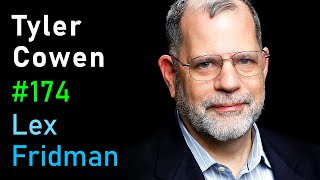
A long-form interview between Lex Fridman and economist Tyler Cowen covering the character of economics (art, science, and “magic”), existential catastrophe risks (nuclear/bioweapons), immigration and the American Dream, capitalism vs. alternatives, the cultural role of science and celebrity, prizes and recognition, big tech and Clubhouse, and optimism about renewed technological-driven growth. Cowen mixes economic analysis with cultural observations and personal anecdotes, arguing for the creative benefits of ‘weirdos,’ the practical strengths of big business, cautious optimism about sustained innovation, and concern about catastrophic risks over long horizons.
Chapters
The following is a conversation with Tyler Cohen, an economist at George Mason University and co creator of an amazing economics blog called Marginal Revolution, author of many books including the Great Stagnation, Average is Over and his most recent Big Business A Love Letter to an American Anti Hero. He's truly a polymath in his work, including his love for food, which makes his amazing podcast called Conversations with Tyler really fun to listen to. Quick mention of our sponsors Linode, ExpressVPN, SimpliSafe and Public Goods. Check them out in the description to support this podcast. As a side note, given Tyler's culinary explorations, let me say that one of the things that makes me sad about my love hate relationship with food is that while I found a simple diet, plain meat and veggies, that makes me happy in day to day life, I.
Sometimes wish I had the mental ability.
To moderate consumption of food so that I could truly enjoy meals that go way outside of that diet. I've seen my mom, for example, enjoy a single piece of chocolate, and yet if I were to eat one piece of chocolate, the odds are high that I would end up eating the whole box. This is definitely something I would like to fix because some of the amazing artistry in this world happens in the kitchen and some of the richest human experiences happen over a unique meal.
I recently was eating cheeseburgers with Joe.
Rogan and John Donagher late at night in Austin, talking about Jiu Jitsu and life, and I was distinctly aware of the magic of that experience. Magic made possible by the incredibly delicious cheeseburgers. This is the Lex Friedman podcast and here is my conversation with Tyler Cohen.
Would you say economics is more art or science or philosophy, or even magic? What is it?
Economics is interesting because it's all of the above to start with magic, the notion that you can make some change and simply everyone's better off. That is a kind of modern magic that has replaced old style magic. It's an art in the sense that the models are not very exact. It's a science in the sense that occasionally propositions are falsified. There are a few basic things we know, and however trivial they may sound, if you don't know them, you're out of luck. So all of the above.
But from my outsider's perspective, economics is sometimes able to formulate very simple, almost like E equals MC squared general models of how our human society will function when you do a certain thing. But it seems impossible, or almost way too optimistic to think that a single formula or just a set of simple principles can Describe behavior of billions of human beings with all the complexity that we have involved. Do you have a sense there's a hope for economics to have those kinds of physics level descriptions and models of the world? Or is it just our desperate attempts as humans to make sense of it, even though it's more desperate than rigorous and serious and actually predictable like a physics type science?
I don't think economics will ever be very predictive. It's most useful for helping you ask better questions. You look at something like game theory. Well, game theory never predicted USA and USSR would have a war, would not have a war. But trying to think through the logic of strategic conflict. If you know game theory, it's just a much more interesting discussion.
Are you surprised that we, speaking of the Soviet Union and United States and speaking of game theory, are you surprised that we haven't destroyed ourselves with nuclear weapons yet? Like that simple formulation of mutually assured destruction. That's a good example of an explanation that perhaps allows us to ask better questions. But it seems to have actually described the reality of why we haven't destroyed ourselves with these ultra powerful weapons. Are you surprised? Do you think the game theoretical explanation is at all accurate? There's.
I think we will destroy each other with those weapons eventually. Eventually. Look, it's a very low probability event, so I'm not surprised it hasn't happened yet. I'm a little surprised it came as close as it did. You know your general thinking, realizing it might have just been a flock of birds or it wasn't a first strike attack from the usa. We got very lucky on that one. But if you just keep on running the clock on a low probability event, it will happen. And it may not be USA and China, USA and Russia, whatever. It could be the Saudis and Turkey.
And it might not be nuclear weapons, it might be some other destruction, bioweapons.
But it simply will happen is my view. And I've argued at best we have seven or 800 years and that's being generous.
At worst, how long we got.
Well, maybe it's asking for a friend arrival process. Right. So tiny probability could come anytime, probably not in your lifetime, but the chance presumably increases the cheaper weapons of mass destruction are.
So the Poisson process description doesn't take in consideration the game theoretic aspect. So another way to consider is repeated games, iterative games. So is there something about our human nature that allows us to fight against probability reduce like the closer we get to trouble, the more we're able to figure out how to avoid trouble. The same Thing is, for when you take exams or you go, you know, and take classes, the closer or paper deadlines. The closer you get to a deadline, the better you start to perform and get your shit together and actually get stuff done.
I'm really not so negative on human nature. And as an economist, I very much see the gains from cooperation. Yeah, but if you just ask, are there outliers in history? Like was there a Hitler for instance? Obviously. And again you let the clock tick. Another Hitler with nuclear weapons doesn't per se care about his own destruction. It will happen.
So your sense is fundamentally people are.
Good, but trembling hand equilibrium is what.
We would call it, trembling hand equilibrium.
That the basic logic is for cooperation, which is mostly what we've seen, even between enemies. But every now and then someone does something crazy and you don't know how to react to it. And you can't always beat Hitler. Sometimes Hitler drags you down to push back.
Is it possible that the crazier the person, the less likely they are and in a way where we're safe? Meaning like this is the kind of proposition I had the discussion with my dad as a physicist about this, where he thinks that if you have a graph, evil people can't also be geniuses. This is his defense, why evil people will not get control of nuclear weapons. Because to be truly evil, but evil meaning you can argue that not even the evil of Hitler we're talking about because Hitler had a kind of view of Germany and all those kinds of. There's like I. He probably deluded himself and the people around him to think that he's actually doing good for the world. Similar with Stalin and so on. By evil I mean more like almost like terrorists where they want to destroy themselves and the world. Like those people will never be able to be actually skilled enough to do to deliver that kind of mass scale destruction. So the hope is that it's very unlikely that the kind of evil that would lead to extinctions of humans or mass destruction is so unlikely that we're able to last way longer than 700, 800 years.
I agree, it's very unlikely in that sense. I accept the argument. But that's why you need to let the clock tick. It's also the best argument for bureaucracy to negotiate a bureaucracy, it actually selects against pure evil because you need to build alliances. So bureaucracy in that regard is great. Right? It keeps out the worst apples. But look, put it this way. Could you imagine 35 years from now the Osama bin Laden of the future has nukes or very Bad bioweapons. It seems to me you can. And Osama was pretty evil, and actually even he failed. Right. But nonetheless, that's what the seven or 800 years is there for.
And there might be destructive technologies that don't have such a high cost of production or such a high learning curve, like cyber attacks or artificial intelligence, all those kinds of things. Yeah.
I mean, let me ask you a question. Let's say you could, as an act of will, by spending a million dollars, obliterate any city on Earth and everyone in it dies. And you'll get caught and you'll be sentenced to death. But you can make it happen just by willing it. How many months does it take before that happens?
So the obvious answer is, like, very soon. There's probably a good answer for that because you can consider how many millionaires there are. How many. You could look at that. Right, right. I have a sense that there's just people that have a million dollars. I mean, there's a certain amount, but have a million dollars, have other interests that will outweigh the interest of destroying the entire city. Like there's a particular. You know, like maybe that's a hope.
It's why we should be nice to the wealthy too. Right?
Yeah. All that trash talking as Bill Gates, we should stop that because that doesn't inspire the other future. Bill Gates is to be nice to the world. That's true. But your sense is the cheaper it gets to destroy the world, the more likely it becomes.
Now, when I say destroy the world, there's a trick in there. I don't think literally every human will die, but it would set back civilization by an extraordinary degree. It's then just hard to predict what comes next. But a catastrophe where everyone dies, that probably has to be something more like an asteroid or supernova. And those are purely exogenous for the time being at least.
So I immigrated to this country. I was born in the Soviet Union, in Russia. And which one?
Which one?
The important question which. You were born in the Soviet Union, right?
Yes, I was born in the Soviet Union. The rest is details. But I grew up in Moscow, Russia.
Yeah.
But I came to this country and this country, even back there. But it's always symbolized to me a place of opportunity where everybody could build, like, build the most incredible things, especially in the engineering side of things. Just invent and build and scale and have a huge impact on the world. And that's been to me the. That's my version of the American ideal, the American dream. Do you think the American dream is still there, do you think? What do you think of that notion in itself? Like from an economics perspective, from a human perspective, is it still alive and how do you think about it? The American Dream?
The American dream is mostly still there. If you look at which groups are the highest earners, it is individuals from India and individuals from Iran, which is a fairly new development. Great for them, not necessarily easy. Both you could call persons of color may have faced discrimination also on the grounds of religion, yet they've done it. That's amazing. It says great things about America. Now if you look at native born Americans, the story's trickier. People think intergenerational mobility has declined a lot recently, but it has not for native born Americans. For about, I think 40 years it's been fairly constant, which is sort of good. But compared to much earlier times, it was much higher in the past. I'm not sure we can replicate that because look, go to the beginning of the 20th century. Very few Americans finish high school or even have much wealth. There's not much credentialism, there aren't that many credentials. So there's more upward mobility across the generations than today. And it's a good thing that we had it. I'm not sure we should blame the modern world for not being able to reproduce that. But look, the general issue of who gets into Harvard or Cornell, is there an injustice? Should we fix that? Is there too little opportunity for the bottom, say half of Americans? Absolutely. It's a disgrace how this country has evolved in that way. And in that sense the American dream is clearly ailing. But it has had problems from the beginning for blacks, for women, for many other groups.
I mean, isn't that the whole challenge of opportunity and freedom is that it's hard? And the difficulty of how hard it is to move up in society is unequal often. And that's the injustice of society. But the, the whole point of that freedom is that over time it becomes better and better. You start to fix, like fix the, the leaks, the issues, and it gives us, it keeps progressing in that kind of way. But ultimately there's always the opportunity, even if it's harder. There's the opportunity to create something truly special, to move up to be, to be president, to be a leader in whatever the industry that you're passionate about.
We each have podcasts, right, in English. The value of joining that American English language network is much higher today than it was 30 years ago, mostly because of the Internet. So that makes immigration returns themselves skewed. So going to the U.S. canada or the UK I think has become much more valuable in relative terms than, say, going to France, which is still a pretty well off, very nice country. If you had gone to France, your chance of having a globally known podcast would be much smaller.
Yeah, this, this is the interesting thing about how much intellectual influence the United States has. I don't know if it's connected to what we're discussing here, the, the freedom and opportunity of the American dream or like, does it make any sense to you that we have so much impact on the rest of the world in terms of ideas? You know, is it just simply because the English is the primary language of the world, or is there something fundamental to the United States that drives the development of ideas? It's almost like what's cool, what's entertaining, what's, you know, like meme culture, the Internet culture, the philosophers, the intellectuals, the podcasts, the movies, music, all that stuff driving culture.
There's something above and beyond language in the United States. It's a sense of entertainment really mattering, how to connect with your audience, being direct and getting to the point, how humor is integrated. Even with science, that is pretty strongly represented here. Much more, say, than on the European continent. Britain has its own version of this, which it does very well. And not surprisingly, they're hugely influential in music, comedy, most of the other areas you mentioned Canada, yes, but their best talent tends to come here. But you could say it's like a broader North American thing and give them their fair share of credit.
What about science? There's a sense higher education is really strong, research is really strong in the United States, but it just feels like, culturally speaking, when we zoom out, scientists aren't very cool here. Most people wouldn't be able to name basically a single scientist. Maybe they would say, what, EINSTEIN and Neil DeGrasse Tyson, maybe. And Neil DeGrasse Tyson isn't exactly a scientist. He's a science communicator. So there's not the same kind of admiration of science and innovators as there is of, like, athletes or actors, actresses, musicians.
Well, you can become a celebrity scientist if you want to. May or may not be best for science. And we have Spock from Star Trek, who is still a big deal. But look at it this way. Which country is most comfortable with inegalitarian rewards for scientists, whether it's fame or money? And I still think it's here. Some of that's just the tax rate. Some of it is a lot of America is set up for rich people to live really well. And again, that's going to attract a lot of top talent. And you ask the two best vaccines. I know the Pfizer vaccine is sort of from Germany, sort of from Turkey, but it's nonetheless being distributed through the United States. Moderna, an ethnic Armenian immigrant, through Lebanon, first to Canada, then down here to Boston, Cambridge area. Those are incredible vaccines. And us nailed it.
Yeah, well that's more almost like the, I don't know what you would call it, engineering, the sort of scaling. That's what us is really good at. Not just inventing of ideas, but taking an idea and actually building the thing and scaling it and being able to distribute it at scale. I think some people would attributed that to the general word of capitalism. I don't know if you would. What in your views are the pros and cons of capitalism as it's implemented in America? I don't know if you would say capitalism really exists in America, but to the extent that it does, people use.
The word capitalism in so many different ways.
What is capitalism?
The literal meaning is private ownership of capital goods, which I favor in most areas. But no, I don't think the private sector should own our F16s or military assets. Government owned water utilities seem to work as well as privately owned water utilities. But with all those qualifications put to the side. Business for the most part innovates better than government. It is oriented toward consumer services. The biggest businesses tend to pay the highest wages. Business is great at getting things done. USA is fundamentally a nation of business and that makes us a nation of opportunity. So I am indeed mostly a fan, subject to numerous caveats.
What's, what's the con? What's what? Are some negative downsides of capitalism in your view or some things that we should be concerned about maybe for long term impacts of capitalism?
Again, capitalism takes a different form in each country. I would say in the United States our weird blend of whatever you want to call it has had an enduring racial problem from the beginning, has been a force of taking away land from native Americans and oppressing them pretty much from the beginning. It has done very well by immigrants for the most part. We revel in trinpetarian creative destruction more so we don't just prop up national champions forever. And there's a precariousness to life for some people here that is less so. Say in Germany or the Netherlands. We have weaker communities in some regards than say northwestern Europe often would. That has pluses and minuses. I think it makes us more creative. It's a better country in which to be a weirdo than say, Germany or Denmark. But there is truly, whether from the government or from your private community, there is less Social Security in some fundamental sense.
On the point of weirdo, that's kind of a beautiful little statement. What is that? I mean, that seems to be. You could think of a guy like Elon Musk and say that he's a weirdo. Is that the sense in which you're using the weirdo like, outside of the norm, like breaking conventions?
Absolutely. And here that is either acceptable or even admired, or to be a loner. And since so many people are outsiders and that we're all immigrants, is selecting for people who left something behind, were willing to leave behind their families, were willing to undergo a certain brutality of switch in their lives. Makes us a nation of weirdos. And weirdos are creative. Yeah. And Denmark is not a nation of weirdos. It's a wonderful place, you know, great for them. Ideally, you want part of the world to be full of weirdos and innovating and the other part of the world to be a little kind of chicken shit, risk averse and enjoy the benefits of the innovation and to give people these smooth lives and six weeks off and free ride. And everyone's like, oh, American way versus European way. But basically they're compliments.
Yeah, that's fascinating. I used to have this conversation with my parents when I was growing up and just others from the immigrant kind of flow. And they use this term especially in Russian, as you know, to criticize something I was doing that was suggest normal people don't do this. And I used to be really offended by that. But as I got older, I realized that that's a kind of compliment because in the same kind of, I would say way that you're saying, that is the American ideal. Because if you want to do anything special or interesting, you don't want to be doing in one particular avenue what normal people do, because then it won't be interesting.
The Russians, I think, fit in very well here because the ones who come are weirdos. And there's a very different Russian weirdo tradition. Like Alyosha, right. In Brothers Karamazov or Perelman the mathematician. They're weirdos and they have their own different kind of status in Soviet Union, Russia, wherever. And when Russians come to America, they stay pretty Russian. But it seems to me a week later they've somehow adjusted. And the ways in which they might want to be like grumpier than Americans, not smile, think the people who smile are idiots. They can do that. No one takes that away from them. Yeah. What do you.
On a tiny tangent, I'd love to hear if you have thoughts about Grisha Perman turning down the field's metal. Is that something you admire? Does that make sense to you, that somebody. We have the structure of Nobel prizes, of these huge awards, of the reputations, the hierarchy of everyone's saying, applauding how special you are. And here's a person who was doing one of the greatest accomplishments in the history of mathematics. It doesn't want stupid prize and doesn't want recognition, doesn't want to do interviews. It doesn't want to be famous. What do you make of that?
It's great. Look, prizes are corrupting. After scientists win Nobel Prizes, they tend to become less productive. Now, statistically, it's hard to sort out the different effects. There's regression toward the mean, there's. Does the prize make you too busy? It's a little tricky.
But there's not enough Nobel Prizes either to gather enough data.
Right, But I've known a lot of Nobel Prize winners, and it is my sense they become less productive. They repeat more of their older messages, which may be highly socially valuable. But if someone wants to turn their back on that and keep on working, which I assume is what he's doing, that's awesome. I mean, we should respect that. The. It's like he wins a bigger prize. Right? Our extreme respect. Yeah.
Wow. Grisha, if you're listening, I need to talk to you soon.
Okay?
I've been. Been trying. Trying to get a hold of him. Okay, back to capitalism. I got to ask you, just competition in general, in this world of weirdos, is competition good for the world? You know, this kind of seems to be one of the fundamental engines of capitalism. Right. Do you see it as ultimately const or destructive for the world?
What really matters is how good your legal framework is. So competition within nature for food leads to bloody conflict all the time. The animal world is quite unpleasant to say the least. If you have something like the rule of law and clearly defined property rights, which are within reason justly allocated, competition probably is going to work very well, but it's not an unalloyed good thing at all. It can be highly destructive. Military competition. Right. Which actually is itself sometimes good, but it's not good per se.
What aspects of life do you think we should protect from competition? Is there some. You said the rule of law. Is there some things we should keep away from competition?
Well, the fight for territory most of all.
Anything that involves violence, like actual physical violence.
Right. And it's not that I think the current borders are just, I mean go talk to Hungarians, Romanians, Serbians, Bosnians, they'll talk your ear off. And some of them are probably right. But at the end of the day we have some kind of international order and I would rather we more or less stick with it. If Catalonians want to leave, they keep up with it, let them go.
But what about a space of health care? This is where you get into a tension of like between capitalism and kind of more, I don't want to use socialism, but those kinds of policies that are less free market.
I think in this country healthcare should be much more competitive. So you go to hospitals, doctors, they don't treat you like a customer, they treat you like an idiot or like a child or someone with third party payment. And it's a pretty humiliating experience often. Yeah.
Do you think a free market in general is possible? Like a pure free market? And is that a good goal to strive for?
I don't think the term pure free market is well defined because you need a legal order. Legal order has to make decisions on like what is intellectual property more important than ever? There's no benchmark that represents the pure free market way of doing things. What will penalties be? How much do we put into law enforcement? No simple answers, but just saying free market doesn't pin down what you're going to do on those all important questions.
So free market is an economics, I guess, idea. So it's not possible for free market to generate the rules that are emergent, like self governing.
It generates a lot of them right through private norms, through trade associations. International trade is mostly done privately and by norms. So it's certainly possible. But at the end of the day I think you need governments to draw very clear lines to prevent it from turning into mafia run systems.
You know, I've been hanging out with the, with other group of weirdos lately, Michael Malice, who espouses to be an anarchist anarchism, which is like I think intellectually just a fascinating set of ideas where taking free market to the full extreme of basically saying there should be no government, what is it? Oversight, I guess. And then everything should be fully like all the agreements, all the collectives you form should be voluntary, not based on the geographic land you were born on and so on. Do you think that's just the giant mess? Like do you think it's possible for an anarchist society to work where it's, you know this in a dis, in a fully distributed way, people agree with each other not just on financial transactions, but, you know, on their personal security, on military type of stuff, on healthcare, on education, all those kinds of things. And where does it break down?
Well, I wouldn't press a button to say, get rid of our current constitution, which I view is pretty good and quite wise. But I think the deeper point is that all societies are in some regards, anarchistic, and we should take the anarchist seriously. So globally, there's a kind of anarchy across borders. Even within federalistic systems, they're typically complex. There's not a clear transitivity necessarily of who has the final say over what. Just the state vis a vis its people. There's not per se, a final arbitrator in that regard. So you want a good anarchy rather than a bad anarchy. You want to squish your anarchy into the right corners. And I don't think there's a theoretical answer how to do it. But you start with a country like, is it working well enough? Now, this country, you'd say mostly, you'd certainly want to make a lot of improvements. And that's why I don't want to press that get rid of the constitution button. But to just dump on the anarchists is to miss the point. Always try to learn from any opinion and what in it is true.
I'm just marveling at the poetry of saying that we should squish our anarchy into the right corners.
I love it.
Okay, I gotta ask. I've been talking with. Since we're doing a whirlwind introduction to all of economics, I've been talking to a few objectivists recently. And just, you know, Ayn Rand comes up as a. As a person, as a philosopher throughout many conversations. A lot of people really despise her. A lot of people really love her. It's always weird to me when somebody arouses a philosophy or a human being arouses that much emotion in either direction, does she make. Do you understand first of all that level of emotion? And what are your thoughts about Ayn Rand and her philosophy, Objectivism? Is it useful at all to think about this kind of formulation of rational self interest? If I could put it in those words, or I guess more negatively, the selfishness, or she would put, I guess, the virtue of selfishness.
Ayn Rand was a big influence on me growing up. The book that really mattered for me was Capitalism, the Unknown ideal, the notion that wealth creates opportunity and good lives, and wealth is something we ought to valorize and give very high status. It's one of her key ideas. I think it's Completely correct. I think she has the most profound and articulate statement of that idea. That said, as a philosopher, I disagree with her on most things. And I did even like as a boy when I was reading her, I read Plato before Ayn Rand. And in a Socratic dialogue, there's all these different points of view being thrown around. And whomever it is you agree with, you understand the wisdom is in coming together at the different points of view. And she doesn't have that. So altruism can be wonderful in my view. Humans are not actually that. Rational self interest is often poorly defined to pound the table and say existence exists. I wouldn't say I disagree, but I'm not sure that it's a very meaningful statement. I think the secret to Ayn Rand is that she was Russian. I'd love to have her on my podcast. If she was still alive, I'd only ask her about Russia, which she mostly never talked about after writing we the Living. And she is much more Russian than she seems at first, even like purging people from the Objectivist circles. It's like how Russians, especially female Russians, so often purge their friends. It's weird all the parallels.
So you. You're saying so. Yes. So I assuming she's still not around. But if she is and she comes into your podcast. See, can you dig into that a little bit? Do you mean like the pers. Her personal demons around the social and economic Russia of the time when she.
Escaped the traumas she suffered there.
Yeah.
What she really likes in the music and literature and why literature, huh. And getting deeply into that, her view, relations between the sexes and Russia, how it differs from America, why she still carries through the old Russian vision in her fiction. This extreme sexual dimorphism, but with also very strong women, to me is a uniquely, at least Eastern European vision. Mostly Russian, I would say. And that's in her. That's her actual real philosophy, not this table bounding existence exists. And that's not talked about enough. Yeah, he's a Russian philosopher. Yeah.
Like she.
Or Soviet, whatever you want to call it.
And if she wasn't so certain, she could have been a Dostoyevsky, where it's not that that certainty is almost the thing that brings her the adoration of millions, but also the hatred of millions.
He became a cult figure in a somewhat Russian like manner.
Yeah, yeah, it is. It is what it is. But I love the idea that again, you're just dropping bombs that are poetic, that the wisdom is in the coming together of ideas. It's kind of interesting to think that no one human possesses wisdom, no one idea is the wisdom, that the coming together is the wisdom.
Like in my view, Boswell's Life of Johnson, 18th Century British Biography. It's in essence a co authored work Boswell and Johnson. It's one of the greatest philosophy books ever, though it is commonly regarded as a biography. John Stuart Mill, who in a sense was co authoring with Harriet Teller, a better philosopher than is realized, though he's rated very, very highly. Plato, Socrates, a lot of the greatest works are in a kind of dialogue form. Goethe's Faust would be another example. It's very much a dialogue and yes, it's drama, but it's also philosophy. Shakespeare maybe the wisest thinker of them all.
In your book Big Business, speaking of Ayn Rand Big Business A Love letter to an American anti hero, you make the case for the benefit that large businesses bring to society. Can you explain if you look at.
Say the pandemic, which has been a catastrophic event. Right. For many reasons. But who is it that saved us? So Amazon has done remarkably well. They upped their delivery game more or less overnight with very few hitches. I've ordered hundreds of Amazon packages, direct delivery food, whether it's doordash or Uber Eats or using whole foods through Amazon shipping. Again, it's gone remarkably well. Switching over our entire higher educational system basically within two weeks to zoom. Zoom did it. I mean, I've had a zoom outage, but their performance rate has been remarkably high. So if you just look at resources, competence incentives, who's been the star performers, the NBA even just canceling the season as early as they did, sending a message like hey people, this is real. And then pulling off the bubble with not a single found case of COVID and having all the testing set up in advance. Big business has done very well lately and throughout the broader course of American history, in my view has mostly been a hero.
Can we engage in a kind of therapy session? I'm often troubled by the negativity towards big business. And I wonder if you could help figure out how we remove that or maybe first psychoanalyze it and then how we remove it. It's it. It feels like, you know, once we've gotten wi fi on flights, on airplane flights, people started complaining about how shitty the connection is, Right?
Yes.
They take it for granted immediately.
Yeah.
And then start complaining about little details. Another example that's more. That's closer to like especially as. As aspiring entrepreneur is closer to the things I'm thinking about is Jack Dorsley with Twitter. You know, to me, Twitter has enabled an incredible platform of communication. And yet the biggest thing that people talk about is not how incredible this platform is. They essentially use the platform to complain about the censorship of a few individuals as opposed to how amazing it is. Now you should also, you should talk about how shitty the WI fi is and how censorship or the removal of Donald Trump from the platform is a bad thing. But it feels like we don't talk about the positive impacts at scale of these technologies. Is there, can you explain why and is there a way to fix it?
I don't know if we can fix it. I think we are beings of high neuroticism for the most part. As a personality trait, not everyone, but most people. And as a compliment to that if someone says 10 nice things about you and one insult, you're more bothered by the insult than you're pleased by the nice things, especially if the insult is somewhat true. So you have these media, these vehicles. Twitter is one you mentioned where there's all kind of messages going back and forth and you're really bugged by the messages you don't like. Most people are neurotic to begin with. It's not only taken out on big business, to be clear. So Congress catches a lot of grief and some of it they deserve. Yes, religion is not attacked the same way, but religiosity is declining. If you poll people, the military still polls quite well, but people are very disillusioned with many things. And the Martin Gurry thesis that because of the Internet, you just see more of things. And the more you see of something, whether it's good, bad or in between, the more you will find to complain about, I suspect is the fundamental mechanism here. I mean, look at Clubhouse, right? To me, it's a great service. May or may not be like my thing, but gives people this opportunity. No one makes you go on it. And all these media articles like, oh, is Clubhouse going to wreck things? Are they going to break things? New York Times is complaining. Of course, it's their competitor as well. I'm like, give these people a chance. Talk it up. You may or may not like it. Like, let's praise the people who are getting something done. Very Ayn Randian point.
As an economic thinker, as a writer, as a podcaster, what do you think about Clubhouse? What do you think about. Okay, let me just throw my feeling about it. I used to use Discord, which is another service where people use voice. So the only thing you do is just hear each other there's no face. You just see a little icon. That's the essential element of Clubhouse. And there's an intimacy to voice only communication. That's hard. That didn't make sense to me, but it was just what it is. Which feels like something that won't last for some reason. Maybe it's the cynical view, but what's your sense about this, the intimacy of what's happening right now with Clubhouse?
I've greatly enjoyed what I've done, but I'm not sure it's for me in the long run for two reasons. First, if you compare it to doing a podcast, podcasting has greater reach than Clubhouse. So I would rather put time into my podcast. But then also my like, core asset, so to speak, is I'm a very fast reader. So audio per se is not necessarily to my advantage. I don't speak or listen faster than other people. In fact, I'm a slower listener because I like 1.0, not 1.5x. So I should spend less time on audio and more time reading and writing.
Yeah, it's interesting because like you mentioned podcasts and audiobooks. I, you know, the, the podcasts are recorded and so I can skip things. Like I can skip commercials or I can skip parts where it's like, this part is boring with live conversations. Especially when there's a magic to the fact when you have a lot of people participating in that conversation. But you know, some people are like this topic, they're going into this thing and you can't skip it or you can't fast forward. You can go 1.1.5x or 2.x, you can't speed it up. Nevertheless, there's a tension between that. So that's the productivity aspect with the actual magic of live communication where anything can happen.
Where Elon Musk can ask the CEO.
Of Robinhood, Vlad about like, hey, somebody, like holding a gun to your head. There's something shady going on. The magic of that. That's also my criticism of like, there's been a recent conversation with Bill Gates that he went on platform and had a basically a regular interview on the platform without allowing the possibility of the magic of the chaos. So I'm not exactly sure. It's probably not the right platform for you and for many other people who are exceptionally productive in other places. But there's still nevertheless a magic to the chaos that could be created with live conversation that gives me pause.
Maybe what it's perfect for is the tribute. So they had an episode recently that I didn't hear, but I Heard it was wonderful. It was anecdotes about Steve Jobs that you can't do one to one. Right. And you don't want control. You want different people appearing and stepping up and saying their bit. Yeah. And clubhouse is 110% perfect for that.
The tribute, I love that, the tribute. But there's also the possibility, I think there was a time when somebody arranged a conversation with Steve Jobs and Bill Gates on stage. Right. I remember that happened a long time ago. And, you know, it was very formal. You know, it could have probably gone better, but it was still magical to have these people that obviously, like, had a bunch of tension throughout their history. There's, it's so frictionless to have two major figures in world history just jump on a Clubhouse stage.
Putin and Elon Musk.
Putin and Elon Musk. And that's exactly it. So there's a language barrier there. There's also the problem that in particular, it's like, like Biden would have a similar problem. It's like they're just not into a new technology. So it's very hard to catch the Kremlin up to, first of all, Twitter. Right. But to catch him up to Clubhouse, you have to have the.
Elon Musk has a sense of the.
Internet, the humor, the memes and all that kind of stuff that you have to have in order to, to like use a new app and figure out, like the timing, the beat, what is this thing about? And, you know, so that, that's the challenge there. But that's exactly it. That, that magic of have two big personalities just show up. And I, I, I wonder if it's just a temporary thing that we're going through with the pandemic, where people are just lonely and they're seeking for that human connection that we usually get elsewhere through our work.
But they'll stay lonely, in my opinion.
You think so?
I do. So it is a pandemic thing, but I think it will persist. And the idea of wanting to be connected to more of the world, Clubhouse will still offer that. And all the mental health issues out there, a lot of people have broken ties and they will still be lonely post vaccines. Yeah.
I, from an artificial intelligence perspective, have a sense that there is like a deep loneliness in the world, that all of us are really lonely. Like, we don't even acknowledge it. Even people in happy relationships. It feels like there's like an iceberg of loneliness in all of us, like seeking to be understood, like deeply understood. Understanding us, like having somebody with whom you can have A deep interaction enough to where you can, they can help you to understand yourself and they also understand you. Like I have a sense that artificial intelligence systems can provide that as well. But humans, I think, crave that from other humans in ways that we perhaps don't acknowledge. And I have a hope that technology will enable that more and more. Like Clubhouse is an example that allows that.
Are Turing bots going to out compete Clubhouse? Why not program your own session? You'll just talk into your device and say here's the kind of conversation I want. And it will create the characters for you. And it may not be as good as Elon and Vladimir Putin, but it will be better than Ordinary Club has.
Yeah. And one of the things that's missing, it's not just conversation, it's, it's memory. So long term memories, what current AI systems don't have is sharing an experience together. Forget the words. It's like sharing the highs and the lows of life together. And the systems around us remembering that, remembering we've been through that, like that's the thing that creates really close relationships, is going through some shit like go struggle. If you survive together, there's something really difficult that bonds you with other humans.
And this is related to immigration and the American dream.
In what way?
The people who have come to this country, however weird and different they may be, they or their ancestors at some point probably have shared this thing. Right. Us is not going to split up. It may get more screwed up as a country, but Texas and California are not going to break off. Yeah, I mean they're big enough where they could do it, but it's just never going to happen.
We've been through too much together.
Yeah.
That's a hopeful message. Do you think? You know, some people have talked to Eric Weinstein. You've talked to Eric Weinstein. He has a sense that growth, you know, like the, the entirety of the American system is based on the assumption that we're going to grow forever, that the economy is going to grow forever. Do you think economic growth will continue indefinitely or will we stagnate?
I've long been in agreement with Eric, Peter Thiel, Robert Gordon and others that growth has slowed down. I argued that in my book the Great Stagnation, appropriately titled. But the last two years I've become much more optimistic. I've seen a lot of breakthroughs in green energy and battery technology. MRNA vaccines in medicine is a big deal already. It will repair our GDP and save millions of lives around the world. There's an anti malaria vaccine that's now in stage three trial. It probably works CRISPR to defeat sickle cell anemia. Just space. Area after area after area. There's suddenly the surge of breakthroughs, I would say many of them rooted in superior computation and ultimately Moore's law and access to those computational abilities. So I'm much more optimistic than say, the last time I spoke to Eric. I don't know. He moves all the time in his views. I don't know where he's at now.
He's not at. He hasn't gained. That's really interesting. So your little drop of optimism comes from. There might be a fundamental shift in the kind of things that computation has unlocked for us in terms of it could be a wellspring of innovation that can, that enables growth for a long time to come. Like Eric has not quite connected to the computation aspect yet to where it could be a wellspring of innovation.
But you're very close to it in your own work. I don't have to tell you that the work you're doing would not have been possible not very long ago.
But the question is, how much does that work enable continued growth for decades to come?
For all their problems, some version of driverless vehicles will be a thing. I'm not sure when. You know much better than I do, maybe only partially, but that too will be a big deal.
Well, one of the open questions that sort of the Peter Thiel school area of ideas is how much can be converted to technology? How many parts of our lives can technology integrate and then innovate? Like, can it replace healthcare? Can it replace the legal system? Can it replace government? Not replace, but like, you know, make it digital and thereby enable computation to improve it. Right? That's the open question. Because many aspects of our lives are still not really that digitized.
There was a New York Times symposium in April, which is not long ago, and they asked the so called experts, when are we going to get vaccines? And the most optimistic answer was in four years. And obviously we beat that by a long mile. So I think people still haven't woken up. You mentioned my tiny drop of optimism, but it's a big drop of optimism.
Is it a waterfall yet? I mean, is it just.
Well, here's my pessimism. Whenever there are major new technologies, they also tend to be used for violence, directly or indirectly. Radio Hitler, not that he hit people over the head with radios, but it enabled the rise of various dictators. So the new technologies now, whatever exactly they may be, they're going to cause a lot of Trouble. And that's my pessimism. Not that I think they're all going to slow to a trickle.
When was the stagnation book?
2011. 2011, yes, it was the first of the stagnation books, in fact, it's very interesting. But even then I said this is temporary. And I was predicting it would be gone in about 20 years time. I'm not sure that's exactly the right prediction, like 2030, but I think we're actually going to beat that.
So you think United States might still be on top of the world for the rest of the century in terms of its economic growth, impact on the world, scientific innovation, all those kinds of things?
That's too long to predict. But I'm bullish on America in general.
Got it. Speaking on being bullish on America, the opposite of that is we talked about capitalism, talked about Ayn Rand and her Russian roots. What do you think about communism? Why doesn't it work? Is it the implementation? Is there anything about its ideas that you find compelling or is it just a fundamentally flawed system?
Well, communism is like capitalism. The words mean many things to different people. Yes, you could argue my life as a tenured professor comes closer to communism than anything the human race has seen. And I would argue it works pretty well. But look, if you mean the Soviet Union, it devolved pretty quickly to a kind of decentralized set of incentives that were destructive rather than value maximizing. It wasn't even central planning, much less communism. So Paul Craig, Roberts and Polanyi were correct in their descriptions of the Soviet system. Think of it as weird mixes of barter and malfunctioning incentives and being very good at a whole bunch of things. But in terms of progress, innovation and consumer goods, it really being quite a failure. And now I wouldn't call that communism, but that's what I think of the system the Soviets had. And it required an ever increasing pile of lies that both alienated people, but created an elite that by the end of the thing no longer believed in the system itself or even thought they were doing better by being crooks than by just say, moving to Switzerland and being an upper middle class individual like you would have a higher standard of living by Gorbachev's time. Not Gorbachev, but If you're number 30 in the hierarchy, you're better off as a middle class person in Switzerland. And that of course did not prove sustainable.
And so it's, what is it, a momentum, a bureaucracy or something like that? It just builds up or you lose control of the original Vision. And that naturally happens. It's just people.
And you can't use normal profit and loss and price incentives. So you get all prices, or most prices set too low. Right. Shortages everywhere. People trade favors. You have this culture of bartered bribes, sexual favors, or, you know, family, friends, and you get more and more of that and you over time lose more and more of the information and the prices and quantities and practices and norms you had. And that sort of slowly decays and then by the end, no one is believing in it. That would be my take. But again, you're the expert here, the Russian scholar.
Well, I perhaps know more an expert than Ayn Rand. It's more personal than it is scholarly or historic. So Stalin held power for 30 years. Vladimir Putin has held power for 21 years, where you could argue he took a little break, but not much.
He was still holding power, I think.
And it's still possible now with the new constitution, that he could hold power from longer than Stalin. 30. Longer than 30 years. What do you think about the man, the state of affairs in Russia in general, the system they have there? Is there something interesting to you as an economist, as a human being about Russia?
Everything is interesting. I mean, here would be part of my take. As you know, the Russian economy starting what, 1999, 2000, has really quite a few years of super excellent growth. And Putin is still riding on that. It more or less coincides with his rise as the truly focal figure on the scene since then. Pretty recently they've had a bunch of years of negative 4 to 5% growth in a row, which is terrible. The economy is way too dependent on fossil fuels. But the structural problem is this. You need a concordance across economic power, social power, political power. They don't have to be allocated identically, but they have to be allocated consistently. And the Russian system under Putin from almost the beginning has never been able to have that. That ultimately his incentives are to steer the system where the economic power is in a small number of hands, in a non diversified way. The system won't deliver sustainable gains in living standards anymore, ever. The way it's set up now, though, if fossil fuel prices go up, they'll have some good years for sure. And that is really quite structural, what has gone wrong. And then on top of that, you can have an opinion of Putin, but you've got to start with those structural problems and that's why it's just not going to work. But he had all those good years in the beginning. So the number of Russians, say, who live here or in Russia who love Putin and it's sincere. They're not just afraid of being dragged away. That's a real phenomenon.
Yeah. I'm really torn on Putin's approval rating. Real approval rating seems to be very high. And I'm torn in whether that has to do with the fact that there is control of the press or if it's, which is the people I talk to who are in Russia, family and so on. A genuine love of Putin, appreciation of what Putin has done and is going to do with Russia.
But a lot of that would go away if the president.
More from Tyler


#413: Tyler Cowen on Rationality, COVID-19, Talismans, and Life on the Margins





Tyler Cowen on Never Crying at Art, Why Rap is Dead, and Quitting Writing Books (w/ Nabeel Qureshi)


AI, Job Loss, Fertility Crisis and the Death of Careerism | ft. Tyler Cowen | PGX Ideas #4
