Tyler Cowen on Culture, Autism, and Creating Your Own Economy 09/07/2009
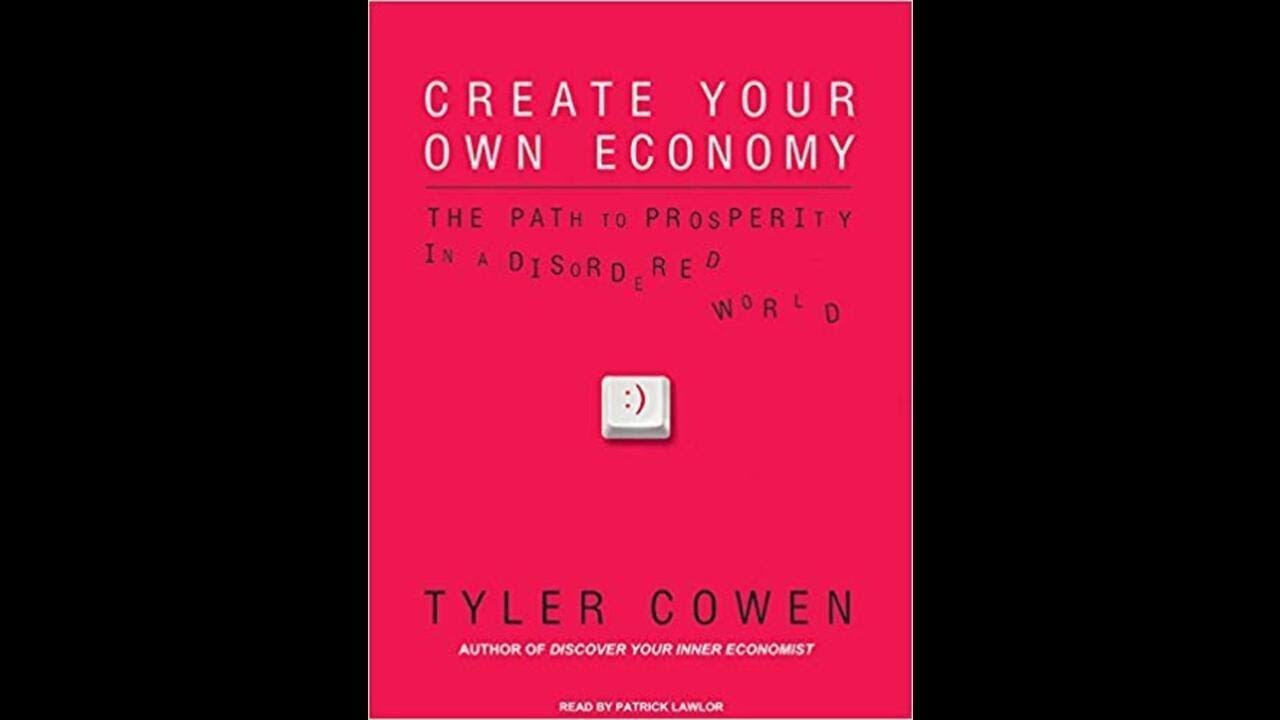
In this EconTalk interview, host Russ Roberts talks with economist Tyler Cowen about his book Create Your Own Economy. Cowen explains how an email about autism sparked his interest in the autistic cognitive profile, emphasizing high variance in strengths such as pattern recognition, information ordering, and deep focus. He argues that the internet amplifies these strengths by enabling cheap, rapid information sorting and “cultural bits” – small, modular pieces of art, humor, and knowledge that individuals recombine into personal narratives. The conversation explores the paradox of multitasking, the shift from long‑form cultural experiences (e.g., opera, theater) to fragmented digital consumption, and the role of interiority—how each person builds a private, subjective economy of meaning. Cowen defends contemporary culture against critics, compares Mozart’s Don Giovanni to modern web experiences, and discusses Buddhism’s critique of desire‑driven information consumption. He revisits Nozick’s experience‑machine thought experiment, reframing it as an economic question of “at what margin” we trade reality for fantasy. The dialogue also touches on virtual worlds, the future of television and live events, the influence of photography, the relevance of behavioral‑economics concepts like framing, and the broader implications for economics, philosophy, and future projects. Throughout, Cowen balances optimism about the web’s capacity to enrich lives with caution about over‑indulgence and loss of depth.
Chapters
Welcome to EconTalk, part of the Library of Economics and Liberty. I'm your host, Russ Roberts, of George Mason University and Stanford University's Hoover Institution. Our website is econtalk.org, where you can subscribe, find other episodes, comment on this podcast, and find links and other information related to today's conversation. Our email address is mail@econtalk.org.
Econtalk.org.
We'd love to hear from you. Today is September 2nd and my guest is Tyler Cowen, professor of economics at George Mason University. His latest book is Create Your Own Economy: The Path to Prosperity in a Disordered World, which is the subject of our conversation. Tyler, welcome back to EconTalk.
I'm happy to be here.
Your book, Create Your Own Economy, has an unusual origin. Explain how it came about.
Well, the origin of this book, I think like all my books, it's not unusual, it has to do with myself and questions that I think about. Uh, but I began pondering my own ability to absorb and process a lot of information rapidly, and I received an email from a woman named Kathleen Fasanella which had to do with autism. And it turns out that autistics are very often the people who can process and digest a lot of information in favorite areas very rapidly. So to figure myself out better, I started digging deeply into this topic. That's really the proximate origins of the book, but I don't think that's unusual at all.
Well, it's not unusual for you. It might be a little unusual for the world at large to get an idea from a book, from an email, that you might have autistic tendencies. Now you talk a lot through the book about the autistic mindset, and you try to fight against a lot of stereotypes. Some of them being just the fundamental disability of autism and Rain Man is the— Dustin Hoffman's role in Rain Man is a popular culture view of autism, of the idiot savant. What do you mean by the autistic mindset?
I'm not sure I would use the word mindset. I would refer to a cognitive profile, and I think one key feature of autism is what I would call a high variance of outcomes. So autistics tend to have cognitive strengths which are extreme in some areas and often cognitive weaknesses which can be extreme in other areas. So it's that variance in autism which varies across each and every autistic person that's hard to come to terms with. Also, everyone wants to give the concept its label as a disorder or a sign of genius or one particular thing, and they're very loath to yield that label to other people who have a more diverse sense of what goes on in autism, but the key point of my book, or one of the key points, is to look at what autistics do well and ask what can we learn from that. The point is not to say autistics do everything well or autistics have no problems, but once you see autistics very often do a lot of things well, you're led away from the simple view that it's just a pure disorder and to this more sophisticated diverse account.
And what, what are the cognitive strengths that you think we ought to be mindful of?
Well, the one I first mentioned is this ability to process and digest a lot of information, at least in some areas. Pattern recognition, attention to small detail, a kind of phenomenally strong or powerful mental ordering in preferred areas, organization of information, collection of lists, putting things in terms of categories in some structured manner. Very often autistics will be much better at this than non-autistics would be.
You suggest that the web has made all of us a little bit autistic or has brought out that strength in us to some extent, right?
I wouldn't say that people have become more autistic. I would say they are mimicking some things autistics can do using capital goods and technology. So if you have an iPod and you put together a playlist and you order your songs in some manner, or if you write a blog, or if you keep a set of tags, for instance, or write a Twitter account, those would be some straightforward examples.
Talk some more about that ordering because that's an important theme in the early part of the book. This idea that what the internet has encouraged us and allows us to do is to do a much more advanced form of ordering.
Search is much more powerful, obviously. So if you have a long or thick order of things, you can get to what you want very quickly. So people write blogs or they write tweets or they set up a list of favorite things or they use bookmarks Basically how we approach information, which is the other key point in the book, information processing, we impose new kinds of structure on it that people were not doing 15 or 20 years ago. In my view, that's a very fundamental change in human affairs that's hardly been noticed, is these new abilities of information processing.
There's a certain paradox and I mentioned it before we started the interview off air. There's a certain paradox which I notice in you, and I guess when I think about it, I do it as well. I have the paradox as well, though I think it's more pronounced in some folks than others, which is we are trying to order an immense span of information relative to somebody 25, 30 years ago. So we bounce around across an enormous array of experiences and information when we're on the web, which is very unfocused, right? Which, as you point out, I think, in the book, you check your— you might be checking your email every 5 minutes in between doing 9 other things. So that's very, in one sense, not very autistic. And yet, at the same time, we can focus in and hone in on the small detail and sometimes be addicted to it or be obsessed by it.— as you talk about it in a positive way. And of course, it's not always positive. But what do you think about that paradox?
I think there's a lot more structure and focus in multitasking than people often realize. It looks very random. Stuff is coming out of nowhere. The TV is on. The cell phone rings. You're getting a text message. You're checking your email. It's happening all within a narrow time span. But I think what all that has in common is that people are following narratives they really care about. And they want to flood themselves with that stream of information about the narrative. And they can now absorb it all much more quickly, much more effectively. And so we're soaking it up. We're enjoying it very intensely. I think most of us are enjoying it more than we enjoy most great novels. And it's educating, it's entertaining, it's delightful. It can be sad, it can be tragic, it can be misused. But that to me is what contemporary culture is, is that process of the multitasking flow of information that's probably coherent to you, but maybe wouldn't be coherent to anyone else.
It reminds me of the phrase, sometimes when you ask somebody how they're doing at work, they'll say, "Oh, I'm drinking from a fire hose," meaning they can't handle it. It's just too much. And yet I think for many of us, and I want to emphasize many of us, and I want you to talk about how many of us you think this is, for many of us, that fire hose, it's more like bathing in it. It's like cavorting in the fire hose. We're out in the street with the fire hydrant open and we're just splashing around in all this different kind of stuff. And, you know, for many of us, it's the most exhilarating experience of our lifetimes, especially those of us who had a before where to go research a topic or experience something, you had to make a long trip to the archives or the— and now Google allows you to span the world in such a small period of time.
That's exactly right. And you turn the fire hose on. If you want to turn it down or turn it off, it's actually pretty easy to do. Maybe it would be hard to go through life as a professor without email. But you don't have to be on Twitter. You don't have to be on Facebook. There's a whole set of ways in which you could cut back, and maybe some people do, but most people don't. They want more. Turn it up, I say.
Yeah, exactly. More— I want the showerhead with the maximum flow. I don't want that little water saver. You say you can turn it down. Of course, you also talk about the addictive nature of it in the book quite a bit, and I find it very hard to, quote, "go off the grid" and to step away from the flow of that hose. Although I observe the Jewish Sabbath, so for 25 hours, I'm literally off the grid. And yet for the other 6 and, you know, almost 6 days of the week, a vacation is very difficult for me in certain ways. And I think many of us find that to be the case. Do you find that to be true? You allude to it in the book.
When I go on vacation, I do spend a fair amount of time on the web. I'll spend a few hours a day. But I actually find it meshes pretty nicely with what I'm doing. That if I'm on vacation, I'm not literally exploring 24 hours a day. And for a few hours, at whatever time in the day, to come back to the hotel room and answer email and blog and whatever, to me it's fun. It makes the blogging richer. I blog about what I'm doing. It makes the vacation richer because I'll pursue information about what I'm seeing or what I'm doing. And it's worked pretty well for me. I've blogged every day now for over 6 years. I'd say—
Every day?
Every single day.
You've not missed a day?
Not missed a single day. And I guess of that 6 years, I'm just guessing, but like 8 months of it I've spent out of town or more. Probably more. Probably a full year of that 6 added up I've spent on the road out of town. And it's all been fun. So, you know, maybe at some point it's unsustainable, but I'm waiting.
You talk in the book about the joys of completion when you're as a collector. I wonder if you would find a day without— it reminds me of the Cal Ripken consecutive game streak. You know, at some point, I think he just sort of felt he had to keep going. Do you— could you go? I think we should pick a day, Tyler, where especially as a competitor, as a vlogger, I think we need to pick a day or maybe a year. But I think we'll start with a day where you would— we would maybe— do we need to pay? I guess we need to compensate you to not vlog.
I've thought of this as a kind of interesting experiment, but I'm actually worried that so many people expect it, that I would receive so many emails of people worrying about me, like, "What's wrong?" You could be kidnapped, God forbid, yeah. Or hit by a car, whatever, that it would be more trouble than it's worth in a way.
It would be a news story though, you could get more coverage. I want to come back to your point you mentioned a minute ago, which I find the most perhaps the most controversial and thought-provoking idea in the book and it's a theme you've written about elsewhere. It's I think a very interesting theme which is the triumph of modern culture. You make the claim in the book that this is a great time for culture and most people would say it's— we're at the nadir, not the apex. We're at a time when popular culture is degraded, it's juvenile, it requires a short attention span, it's not contemplative, it's not inspiring. People have been saying this for a long time about popular culture, of course. So you come along and you defend it. I'd like you to talk about your comparison of, say, Don Giovanni in another time, the watching of Don Giovanni, to what you were others experience on the web and the relevant comparison, the relative comparison.
Mozart's opera Don Giovanni has been a personal favorite of mine since I was 19, and what I've always loved about it is that it has everything. It has beautiful music, it has humor, it has tragedy, it has pathos, it has characters, it has witty dialogue. It has many qualities that we look for in sublime culture all in one work, and it's fantastic. Nothing being produced today is like Don Giovanni. But at the same time, when you think about Don Giovanni, it takes about 3.5 hours to hear. Depends how you count intermission, but it's a long opera. It's very expensive. You need to find a performance. You need to get there. It's a very costly activity. And my vision of what goes on in culture today is people take pieces of those qualities—humor, pathos, tragedy—and comedy from different places, and they stitch them together in their own minds. So they assemble what I call cultural bits. And in my view, this is also an extremely rich process. It's making us more authentic, more real, more emotional, more human. And it's a new kind of activity. Maybe you can even debate whether or not it should be called culture, but it's like culture. It's performing cultural or culture-like activities, and that's a big part of where contemporary culture is.— that wasn't true even as recently as 15 years ago, even 10 years ago.
Yeah, and you talk about interiority. Talk about what you mean by that and the creating of your own economy inside your own head and how it relates to this cultural theme.
You take the cultural stream of Russ Roberts, which probably involves a lot of economics, maybe some baseball. Is that fair? Yep. You go to YouTube. Music. Music. Uh, all that stuff has meaning to you. It relates to your life. It relates to who you are. Photos. I'm guessing most of it makes perfect sense to you. It fits into a pattern. But that said, it doesn't necessarily make sense to someone else. So, if I was fed your stream for a day, well, I'm sure I'd like a lot of it. I wouldn't really see how it hung together, because even though I know you, I don't have access to what's in your mind, and that's interiority. It's the notion that there's like the cultural me, which we all create. We're co-creators with artists out there in the world. And culture now is much more interior.
I like the— one thing it made me think about is just a strange example of it. We were in Yosemite a few months— a few weeks ago, and my wife wanted to do a particular hike that we had done last year, and I wasn't as interested in it. One reason I wasn't, I think the main reason is that I, I'm the family photographer. I have looked at the photos of last year's hike hundreds of times and enjoyed that hike over and over again. So I'm ready for a new hike. But I look at photos more than my wife does online. I have 2,000, 2,500 photos of my own on my computer, not so much online, but on my computer. And they're a huge part of my interior life is just sampling and looking at those and just remembering things and That narrative is really extremely powerful and important to my daily existence. That's right. In a way that it's not to her. You mentioned— I think it was Facebook you mentioned. Facebook has 10 billion photographs?
Sounds about right.
Flickr has— it had 2 billion a while back. They're a little higher quality, fewer cell phone photos, but what an incredible time to explore the visual.
I think if you had to pick one area that's central to contemporary culture, it's actually personal photography. And the fact that some of it is bad, in the sense of bad as formal photography, it's not as relevant as the interior narrative and understanding and interpretation you construct with this. So mine's actually a very Austrian understanding, Austrian school of economics, of where contemporary culture is at. Why? It's about the subjective. I use the phrase interiority, but the Austrian emphasis on the subjective from Lachmann and Schutz and Schäckl, it's very much a similar point but applied to a different context.
Explain why marriage is unlike a Picasso or Don Giovanni, because that's another interesting analogy you make.
Well, if you think of Don Giovanni, it's something you visit every now and then. It's extremely exciting. It's hard to get there, and once it's over, you don't come back anytime soon. It's like a particular kind of romantic affair, which is not renewed very frequently.
Long-distance relationship is the example you use. That's right.
And that can be great. It can be thrilling. But marriage, at least the way most people live it, or I think the way you and I live it, you're with your spouse most of the time. You live with them. You see them almost every day. You have many small interactions. To an outsider, it may look somewhat dull or uninspiring, but it's quite beautiful and romantic and meaningful. And that is not always evident to observers, but you take these small bits and you weave them into some rich emotional brocade and narrative, and it's in some ways like what we're doing with contemporary culture. It's like mimicking what makes a marriage valuable.
Yeah, I like your point about the highs and lows, right? The highs and lows of Don Giovanni are extraordinary. The lows could be that, you know, you go to the— you wait 6 months to fly to San Francisco for this incredibly anticipated performance— and it's a bad performance. I mean, it's devastating, which reminds me of the addictive nature of email or your spouse, you know, the little thrills you get every day, which you actually celebrate rather than criticize.
That's right. And I know every day there's something there for free waiting for me and it's going to be excellent no matter what.
There's always stuff. —on email from somebody you didn't expect. I can browse my Twitter feed.
Go to YouTube, type in Les Paul. It's going to be phenomenal.
It's there. Of course, some people say that's an enormous waste of time. What do you say to them? And let me preface it by saying that I don't have web browsing on my phone because it bothers my wife when I check the Red Sox box score every 45 seconds. And I understand that, and I'd like to. I'd like that thrill, but I've cut that out of my life as much as possible. So what's your thoughts on that? What are your thoughts?
If I'm out with my wife, speaking with my wife, out for dinner, doing whatever, I don't check my email. I don't check box scores. I don't check whatever. I don't find it that hard. And if people want to check, it's fine, but I take breaks from it too. And people say it's a waste of time, but what do they mean? We're learning from it. A lot of us are becoming more productive. We're entertaining ourselves. Very often we're giving to the world. It's a very important part of this. You're not just taking, you're giving. People read you, right? People listen to the podcasts and so on. So the sense that you're a giver and a taker is extremely rewarding. And if you think as giving is one of the ultimate human activities, which is not a waste of time, now all of a sudden we have hundreds of millions of people who've become cultural givers. What about that as a waste of time?
But another criticism is that this small bit, these cultural bits you're talking about, these doses of small thrills, uh, have created a shorter attention span, and we— because this multitasking obsession, we don't focus. And you refer to an article that we discussed here at EconTalk with Hal Varian, chief economist at Google, —this article, I think it was in The Atlantic, that is Google ruining our mind?
Making us stupider. Making us stupider, yeah.
You don't think so? I don't think so.
If it's about information, clearly Google is making us smarter. If it's about patience and time horizon, I view it this way: what most people do with Google or other web tools is follow long-running stories of interest. So again, to go back to the Russ Roberts cultural feed. It's about photography, it's about hiking, it's about baseball. What's your favorite team? Red Sox. Red Sox. How long have you followed them for? 1957. That's a long time.
I was 3 years old, maybe 4.
'58. Okay, that's a long time. That's a lot of years. It's 50 years. It's rich. So it's allowing you to have a very long time horizon. What you're impatient to do is to get back to your chosen program of patience, which is to learn about the Red Sox or follow your favorite musician. It's an interest that's dear to you. It's close to your heart. You followed for a long time. It's what people want from the web, not to hear a song once and then it means nothing and then they go off and just browse randomly. People have interests and they want to feed them.
It's a really interesting idea. How would you— how would you answer the skeptic who says, "Oh, you're romanticizing something that's just people fooling around." I mean, I agree with you. I'm very sympathetic to your argument, but a lot of people are very critical of it. What's your—
I love people fooling around. If I could be seen as romanticizing people fooling around, I'd consider that an immense triumph. Play is such a central aspect of human existence. It's not all there is. If you ask, "Does Google and the web contribute to science?" That's more obvious. I don't really argue that in the book because I think in a way it's too obvious to argue.
I'm just thinking as a social scientist, putting on your economist hat, how you would persuade someone of the virtues of this other than these kind of arguments.
I'm not sure I've persuaded anyone because the point of the dialogue is not necessarily about information. I think people in choosing their points of view want to affiliate with certain values. —and people when they criticize the web are perhaps subconsciously affiliating with values of a previous culture. And the fact that there's some argument that the current culture is good in a way makes them more nervous, I think, in some cases. So I'm not sure I have any particularly effective method of persuasion.
What about the age divide? Talked about this a little bit with Paul Graham a few weeks ago. It's harder for older folk to understand some of these new technologies. I don't mean just in the practical sense, which it is, but I mean in the neurological sense. My favorite reaction of folks to Twitter is, "Who cares what somebody's having for dinner?" You know, as if that's what Twitter's about. It's just, you know, the minutia of people's lives, which of course part of it is the minutia of people's lives. But an older person said that to me and I thought, well, he doesn't get it. And by the way, we're twittering @EconTalker if you want to follow us, this podcast, EconTalker. But it is harder for older people and it raises the possibility that you and I will be left behind sooner than the people today who are left behind by the changes. The pace is very intense.
I'm probably already left behind and I don't even know it. Yeah. If you look at my family, the one of us who's on the internet the most is my father-in-law, and he's 80. So I think the, the age gap has really narrowed. If you look at Twitter, young people are not on Twitter. The average Twitter user, I think, is in his or her late 30s. Facebook is becoming much more something for people who are older. A lot of young people are— they're not leaving the network, but they find it not useful anymore. It's somehow not perfectly scalable. So I think we're seeing the very rapid spread of these ideas or methods or services to older people. Obviously there's a limit to that. At some point fluid intelligence declines, or if people are sick, whatever, they're not going to learn something new, but it's really surprised me how much people who are not in the younger generation have embraced all of this, and they use it for very different things.
Photographs online, But it is, as you point out, in many ways a different mode of communication with many, many pluses and minuses. You talk about IM as an example of that or texting, how it changes what you have to worry about or not worry about relative to a phone call. In many ways, phone calls are just such a relatively— remarkably unimportant part of my life compared to what they were 10 years ago. And what takes place on a phone call is very different than it was 10 years ago compared to email or texting. And I just, I wonder how easy it or difficult it is for people to change those modes of communication as we get older.
You know, I hate phone calls. To me, they're attacks. And to be partially liberated from phone calls is one of the greatest benefits of the New World Order. I agree. But if I think of I am, like I am Natasha and I, our daughter Jana, she's living in Paris now, and I am with her pretty much every day. And I amming is actually better than the phone call. Because with children and parents, there's an awkwardness to the question like, how are you? In some sense, the kid can't and shouldn't tell the truth. Right. Like, Mom, it's awful. I'm about to break out crying.
Or how dare you think I'm not having a good time, right? How could you ask?
But with I Am, the fact that there's in some ways a distance actually lets a new kind of intimacy be created. And a lot of critics, they see only the distance and they don't see what it enables. Yeah, that's a great point.
It's a great irony or paradox, right? That's right. Less emotion around the words, even without the emoticons or the symbols, right? And yet there's a chance for the dialogue to be better overall.
And she and I, we both have Skype. We could do Skype. It's like, no, let's do an I Am. 'Cause we— not always, we sometimes think this will be better.
Let's shift gears. You talk about the Alchin and Allen theorem, which is a folk theorem going back, oh, I don't know what, 30, almost 40 years now, 40-ish years. What was the Alchin and Allen theorem? And apply it first to goods or services and then apply it to the internet, which is, you claim, a much more appropriate application.
There are different versions of the theorem. Let me first give you my intuitive version, then I'll give you the formal version. My intuitive version is that if you're taking a 3-hour trip to go see a concert, you expect a concert that's pretty long and pretty good and pretty spectacular. If you're just crossing the street to hear your neighbor, you know, strum a song on his guitar, you might just get one song. And that that makes economic sense, I think it's intuitive to a lot of people. The formal version of the theorem says that when you add a per-unit tax to a high-quality good and a low-quality good, that the relative proportion of consumption will shift in favor of the high-quality good. That's actually a lot tougher and trickier, and it may not be true, as you pointed out before we started recording.
Yeah, the first version of this was shipping— one of the first versions that was discussed in literature was this idea of shipping the good apples out. The idea that if you want good apples, you don't go to Washington State, or if you want great shoes, you don't go to Italy because The fixed cost of the distance that the goods have to travel means that the willingness to pay of people farther away for the higher quality, higher cost version is going to be higher. And therefore, if you want good apples, you go to Boston. If you want good Italian shoes, you go to California because the demand for Italian shoes in Florida is so high relative to Mexican shoes that that's where the profit and demand is going to be. So that's where there's lots of choices, etc.— and that makes some sense. There's all kinds of problems with that, though.
You and I know the reality is the best lobster is in Maine, not in Nebraska.
Well, they don't travel so well. Shoes are a better example.
But when you look— even shoes don't travel well. The best shoes are near places where customers have the highest standards, and that tends to be Italy. It could be Italy.
Of course, there's differences in income which mess up the argument, which I always found strange. The part that always worked for me is when my wife and I realized that we should not go out for a movie, right? You go out for a movie when you first have kids. You don't realize— you love movies. I love movies too. And I like movies in a theater. I like them. Actually, I like them on my phone if I could get them, but my phone doesn't get them. But I'm happy in all kinds of dimensions. But when you go to a theater, when you first have kids, Going to a theater to see a movie is like a $100 evening and you realize, "Well, if I'm going to spend $100, I'm going to go to a play because a play on my iPhone isn't nearly as good as the movie on my iPhone." So we would go for these things you're talking about, these extraordinary things. But what's the application now to the internet?
The internet makes things very readily available to you at low cost. You could call it a low transportation cost. You just need to buy a connection and a computer. Once you have the computer, it's basically free. And you're gonna sample a lot of small bits. You're gonna engage in a lot of serendipitous discovery. You're gonna sample a lot of things. Your goal is to feed into your long-run narrative, but you'll experiment, you'll try things. Not everything has to be a big grand glorious spectacle, because you don't have to hire the babysitter, you don't have to pay the $100. You don't have to take the 3-hour journey.
Simple stuff. My empirical confirmation of that would be the number of times I tear up during the day listening to music or watching a video compared to a world without the internet where, you know, as you say, a great performance of Don Giovanni could bring you to tears or near tears, but I get it every day if I want.
Sure, go to YouTube, get your favorite aria. Yeah, it's, uh, it's just like how it's the song now and not the album in music. You see this in many different areas. People will read a blog post instead of a book, they'll listen to a song instead of an album. There's a kind of deconstruction or breaking things down into smaller bits and consumers then recombine it on their own. It's more like joint production where the consumer is a co-creator of the meaning.
One of the challenges of this, I'll come back to the social science issue, is that You're not normal, Tyler. I'm not either. But how prevalent is this narrative we're talking about? You, you enjoy it. I enjoy it. That's two of us. Is it— are there 200 million? Are there 2 billion of us living this interior life with this incredible stimulus? Are we just peculiar?
I don't know the exact number, but in wealthy countries we see that most people are doing it And of the younger generation, virtually everyone is doing it. So I think that over time, at least provided countries have enough wealth that you have a computer and a connection, it will be almost everyone. And there will be some percentage of people, 5, 10%, whatever, who choose not to, and that's fine, just like there's the Amish or whatever. And those people will have very meaningful lives in some other way, in some ways better lives, in other ways worse lives. Subjective. But yeah, I'll put the long-run percentage at 90% in the wealthier countries.
How do you know that they're having this richness and brocade of woven together small bits relative to what it might otherwise be? How would you know whether that's true? I mean, they do spend— people spend a lot of time on the web.
People do it. I don't regard that as proof, but we've seen the most rapid cultural migration in history to a new medium. Billions of people within 10 years, uh, pick up a new medium as their favorite medium for engaging with culture, and they stick with it. I don't consider that proof that it's good or fun or productive, but it's a strong prima facie case that it's at least pretty good. And then when you think about the theory, the diversity you can get, and some of the other points we've been discussing, To me, I think in general we should be a lot more optimistic about this process. What do you have to say about Buddhism?
You have a chapter on Buddhism. Talk about Buddhism and mindfulness and how that fits into this conversation.
There's a lot in Buddhism, and Buddhism is a very diverse religion or philosophy depending on how you view it. But one aspect of Buddhism is this idea of concentrating on a small number of items and not really seeking to own or order them, and to be pure in a certain way in this focus, and to cleanse yourself of desire. And to me, this is very interesting. It's not how I live my life, but it seems to me to be the most sustained philosophical critique of what we are doing right now. So, if you're part of this cultural stream, as you and I are, And you wanna know, you know, who's the big critic? To me, it's actually the Buddhists, even though they don't generally write about the internet, but that's where to look. So if I'm having an optimistic vision of a web-based society, I figure I need to engage with the number one critic, and that's this particular angle in Buddhism. And what would their critique be? That it is somehow a self-frustrating process that it is alienating, that it doesn't yield satisfaction, that satisfaction comes from the renunciation of desire, and that a lot of what we're doing on the web is related to the basic human propensity to want to own and order in some complex way, and that's the opposite direction of where we should be headed. That would be the critique.
I guess the other part of it would be the, the peripatetic search for fun and the momentary stimulus rather than a a longer, deeper, more meaningful serenity, happiness, etc.
And I take this critique very seriously, but my response— It gives you pause.
Yeah. Should give you pause anyway.
But it's the classic economist response of "at what margin?" A lot of what I'm saying in this book is just reiterating questions about "at what margin?" At some margin, we should be more Buddhist. At some margin, we should be more in this other way.
So dinner with your wife, more Buddhist.
Yeah, maybe I should be a bit more Buddhist. I take that very seriously.
You've already said, you've claimed you're pretty Buddhist at dinner. You don't— yeah, whereas others I think do check their email, etc., and text during dinner conversation with their significant other.
So, but a good friend of my wife, she just entered a Buddhist monastery for a month in Thailand, and she gets up at 4 AM and doesn't have any possessions, presumably no web connection there, and that seems to me to be a margin way too far.
Yeah. A non-bridge too far. Yeah, an island too far.
I'll also point out you can use the web to be Buddhist. It's not necessarily what people do, but it is one possibility. Sure.
That's an interesting— that's, I think, the right way to think about it, the margins. Talk about Robert Nozick. You bring up in the book, uh, you could think of it as a different kind of critique. Uh, talk about his experience machine and what, uh, and your take on it.
Nozick had this philosophic construct called the experience machine. He asked people, if you could give up your current life and plug yourself into this machine, and have any dreams and fantasies you wanted. Maybe they would last the mental equivalent of 200 years, but you had to give up your whole life, but the dreams could be phenomenal. Would you do it?
They feel real at the time.
They feel as real as anything does.
You're President of the United States, you cure cancer, you get the Nobel Prize, you're a rock star, whatever your—
All in sequence. And Nozick's point was the fact that people will say no to the machine means we're not fundamentally about pleasure, we're fundamentally about authenticity. Now, in my book, I give a very different angle. I go back to this key economic question: at what margin? In my view, we already plug into a lot of different experience machines. It doesn't have to be virtual reality. We watch TV. Maybe we just self-deceive about our own lives. People take different kinds of stimulants. Uh, there are all sorts of different ways in which we opt against authenticity. And you can argue, do we do it too much, do we do it too little? But I try to restructure the whole question into the economic question of: at what margin should we renounce reality and opt for more fantasy? And then it's not so clear what the right answer is. The right answer is not zero fantasy. I've never known anyone who lives that, nor would it be much fun. So, I think it's about balance of some kind and that Nozick's example doesn't refute the idea of fantasy. And role-playing and dreams. It just shows— don't have too much of it.
As you point out, the interiority is— we all have an interior life by definition. It's the essence of being human. It can be a very lonely, solitary interior life or an incredibly social one, but it's always— there's a big interior part to it that we can't access from the outside.
If I were either starving in Burundi or about to die of cancer, I would take the machine in a heartbeat. When Nozick wrote that bit, he was in his late 30s, tenured at Harvard, a rich man, was like swarmed with beautiful women, and he's like saying, I don't want to plug into the machine. It's like, great! That's fine, Robert.
Easy for you to say. Yeah. Yeah, well—
Had a best-selling book, won awards, was the youngest person to get tenure at Harvard.
Yeah. We talked on here with Edward Castronova about virtual worlds and one of the appeals of virtual worlds is to escape your life which is obviously a life historically always very appealing for an enormous number of people who've had very bad lives. Unfortunately, the person in Burundi doesn't probably have as much access to Second Life as you and I have. Sure. Absolutely not. That's part of the problem. Do you think those— how do you— what's your take on those virtual worlds? Are they growing? Do you think they're going to continue to grow if they are?
I don't think they've taken off yet. I think in a way they're too literal. I've spent some time on Second Life, which I found bored me and at times frustrated me working the controls. I think those virtual worlds underestimate how effective we are at creating in our own minds this narrative flow. Through the stuff we choose ourselves, and they're trying to centrally plan the flow for people. And some people like it, but most people just say, "I can do it better on my own." Talk about the more traditional cultural mechanisms and delivery systems.
What are the implications for the future of television? What are the implications for the future of Don Giovanni in the 3.5-hour form?
I think TV is a big loser in a lot of ways. The TV you can watch on the web, there's a gain there. So complex TV shows with a lot of interrelated episodes like Battlestar Galactica, that's only possible because you can catch up on the web and also with TiVo. Wouldn't have been possible if you have to be home, you know, every Friday night at the right time. Or the TV show Lost is the same way. You need technology to make it work. But for the most part, a lot of people are watching less TV. TV is less fun. Not always, but a lot of shows and TV revenues are falling. And I think internet's the big reason why.
Newspapers are the same. Yeah, it's the same problem. But what about the, uh, those long-distance relationships, uh, those big weekends with Don Giovanni or, uh, the Broadway musical, etc.? Those more visceral, uh face-to-face encounters? Are they gonna make it or they're not gonna make it?
I think they're going to do increasingly well over time, and this is the point: the more you sit at home on the internet, that's great, but everyone gets cabin fever, wants to get out, wants to do stuff. So the idea of an art exhibit, a live baseball game, a rave, something real vivid, visceral, in-your-face, uh, is overall, the recession aside, I think becoming more popular. And the more the internet gains the more the visceral in-your-face experience will gain as a kind of complement or counterpart. It's the stuff in the middle that will get cut away, I think, like a lot of TV.
You have a chapter on heroes where you talk at length about, among other folks, Sherlock Holmes, who isn't real, by the way.
That's right.
But is quite real. And one of the things I really loved about the book is, besides the incredible richness of the provocative, unusual ideas, is it really forces you to think about this distinction between reality and fantasy. And Sherlock Holmes is not a real person, so one could argue that wondering whether he's autistic or not is a little on the absurd side. And yet, as you point out, We cry when characters in movies die, have heartbreak, and we rejoice with them. They're not real, and they're a real part of our lives. In many ways, more real than many of the real people we know.
Very often I cry in movies, and it's not that I'm tricked into thinking it's real.
Right.
But if we ask the question, can we learn from fictional characters? You more than anyone should know that we can. And that's one reason why you write works of fiction, because it's not that you literally think those people are real, but they are real in some way, and they bring ideas to life.
Yeah, and when I'm writing the books, they do follow me around. That's right. As you know, you have, I'm sure, the same experience when you write a nonfiction book. You're living with those ideas, those concepts, those people. It's a little bit It's a little bit overwhelming and stifling, a little bit unhealthy, I suppose, but it's what we do. One of your heroes that you mention is Adam Smith. You suggest he has some characteristics of autism and you relate it to the theory of moral sentiments. So talk about that.
Well, I would first of all stress that by reading biography, it's very hard to figure out who was either autistic or Tourette's or whatever other quality. We don't know. But I think one can look at the past and usefully say that successful people had particular traits, and then also say that if autistic people have those same traits, that autistic people may actually be able to be much more successful than is commonly thought, without necessarily diagnosing Adam Smith or anyone else. But if you read the extant biographies on Smith, he sounds a lot, actually, like some autistic people I know. And the important thing is not figuring out whether or not he was autistic, but it's another window onto autistic cognitive strengths that I think can help economists see that autistics are not some kind of weird people that have nothing to do with, you know, whatever it is they care about. That all of us know a fair number of autistic people, most likely, and maybe we're inspired by them.
Although it could be just that If you're an economist named Smith, you have a relationship with autism. You mentioned that Vernon Smith self-described himself recently as having Asperger's syndrome, which is related to autism. But I want to come back to the Theory of Moral Sentiments. That was a bad joke. I want to come back to the Theory of Moral Sentiments. What's your— you said you reread it recently and I'm curious what your thoughts were and you saw a lot of— you framed your rereading of it through this autistic lens to an extent. Well, I had a good chat with Alex Plank lately.
He's someone here at George Mason, you should meet him. And Alex Plank and I were saying that every autistic person is a sociologist, or has to be, because it's coming from a different set of cognitive patterns and strengths. A lot of things in the non-autistic world are puzzling or confusing, and autistics sort those things out by developing theories about them. And they may be good theories, they may be bad theories, but in a sense, every autistic is an amateur sociologist. So, when I read Smith's Theory of Moral Sentiments, the notion I could come away with it from, and this is purely subjective, is that it's Smith being a kind of amateur sociologist trying to figure out sympathy, which is something he sees as very important, but doesn't himself intuitively understand. And the book is his attempt to grapple with that, and he ends up understanding it extremely well in many ways. But it's an outsider looking at a strange culture, trying to make sense of it. The Martian. The Martian. Yeah. Not Martian in the sense that Smith wasn't human, but— No, no, no. —that he was a cultural outsider to a lot of practices. And it doesn't mean he had to have been Autistic with a capital A, but he was in some way a very different guy. And a theme again in the book is this notion that people who are different are not only creative, but they become more creative by allowing themselves to be more different.
Do we have any evidence that Smith— actually, it's kind of interesting. He was friends with David Hume. But my sense is a lot of their friendship was long distance via the equivalent of texting of their day, right? They wrote a lot of letters back and forth. Did they spend a lot of face time together? I don't know.
I believe they did. Uh-huh. I'd have to check, but I think so. But they were also apart a lot of time as well, like you said.
The idea that he had to figure out sympathy as someone who was not very sympathetic or had trouble reading signs of sympathy is interesting because the book's obsessed with it.
Yeah, I think he was sympathetic in the sense he cared about other humans, but he couldn't read signs well. And he had to figure it out and it was this driving passion in him and the result was that he ended up teaching all of us a lot about this phenomenon.
I mentioned earlier that we're on Twitter @EconTalker. This question comes from a fellow Twitterer, Stuart Speak. He asks, what kind of responses has Tyler gotten about his book from autistic people? What has been the response you've gotten from the autistic community, because I assume the book's made something of a splash there.
I've had a large number of autistic people or parents of autistic people or those who teach autistic people write me and tell me they very much like it, they very much agree, they're very enthusiastic about the book. I've had 3 people write me and tell me the contrary, and their point of view is something like autistics cannot succeed, or my child can't do anything with these cognitive strengths. This isn't something you should be saying, that your portrait is an incorrect one. So on that, the response has been very favorable. But I would stress, my point is not that everyone can do, you know, whatever, but that a lot of people can, and that there's something we all can learn from the strengths.
You're not suggesting that that autism per se is a virtue, but that certainly some aspects of autism are very virtuous. Would that be a correct way to phrase it?
Virtuous is a complicated word.
Yeah, that's a— well, it's a Smithian word, sorry.
Abilities rather than just disabilities, I would say. Are you a behavioral economist? If by behavioral economist you mean an economist who assigns psychology a central place in his or her thinking, I would say yes. If by behavioral economist you mean someone who fits into a, you know, Matt Rabin, Daniel Kahneman, Richard Thaler point of view, I'd say not so much. I think they emphasize the imperfections too much and they tend not to see how those imperfections actually blend into ways that we make our lives more meaningful.
Talk about framing in the behavioral economics traditional context and then Give us your take on it.
Well, in traditional behavioral economics, there's a lot of talk of framing effects, that how a choice is framed affects what you do. And this can happen in ways which are irrational. You can be led to make mistakes and tricked by puzzles or problems which are set up. I have no doubt this is true. Uh, what I stress is that's not the most important thing about framing. The most important thing about framing is we use framing to give our lives meaning. To help us care about things, to put things in an order, to give it context. So framing effects are overall a kind of cognitive virtue. They can mislead us, but the current portrait in the literature, the economics literature, is quite unbalanced. And framing effects are there for a reason. They're not just silliness. They're part of how you care about things.
What do you mean by that, though, in terms of how we use it as a way to organize things? I don't I don't fully understand that.
So you go to a restaurant, and the question is, how good does the food taste? Well, it's really quite important how nice is the restaurant, how do they treat you, are the lights on when they serve the food, is it colored blue or purple, in which case it won't taste good, even if it's been cooked very well. And you could go all the way down the list. You could call these a kind of framing effect. Those are negative framing effects, but what the market tends to do is to produce positive framing effects. That make the food taste better. There's an advertising campaign, there's a marketing buildup, there's a polite waiter, there's a sense of anticipation, and the framing effects are on your side for the most part. I'm not saying they never trick people, but I'm trying to bring more balance to this debate.
Are there any other aspects of behavioral economics that you think, uh, are particularly important or need a different perspective like that?
Well, to look at all of behavioral economics in a market setting— it's so often done in the lab, which is a fine place to start, but then to realize there's competition out there, like the claim of Barry Schwartz that there's too much choice, which I think you and I both reject. If you look at the retail outlets that are gaining over time, they're the ones with all the choice. What those outlets do is figure out ways to present— They're tormenting us. But they present the choices to you in a manageable fashion. They give you like a search function, a sales assistant, whatever it is you need.
Well, like you bought the DVDs. Yeah. I mean, there's wonderful filters.
And it works great. So it's— the excess of choice is framed in a way to make it work and not framed the way it would be in an abstract lab experiment. So I'm very critical of the Barry Schwartz view and I think it's the same basic point that behavioral economics interacts with the market and we're focused too much on the lab experiments and not enough on the interaction.
Yeah.— I think the market forces that respond to those things are often neglected, obviously, and certainly in the policy discussions. What parts of behavioral economics do you think are going to persist and enter the mainstream of teaching economics?
Well, I think a lot of it will. Right.
If you take— if you're at a top-20 program right now and you take PhD micro. I don't know how much of that's getting in, right? So where's it coming in and how's it going to get in in the future?
I think it comes in in the second-year sequences. So if you're doing industrial organization, will you read pieces like a behavioral explanation of corporate dividends? Probably. I don't think it needs to crack the first year. A lot of the first year is technique. But what you do with the techniques, I think it's already behavioral. And I think that will just grow. So I think it's here to stay. I don't think it's a fad. I think a lot of the particulars may be fads, but it will get better.
As we talked about with Dan Klein in the Theory of Moral Sentiments podcast, in many ways Adam Smith was a behavioral economist, right?
In almost every way, I think he was the behavioral economist.
We're just returning to our roots.
That's right.
Finally, I'd ask you, Tyler, you know, it's bizarre to label folks. Obviously, you're a behavioral economist and you're not. I mean, you're more than a behavioral economist. Reading this book and thinking back on other formal work you've done outside of your rather prolific blogging and essay writing, you're really a cultural critic in the full and positive sense of that word, a cultural observer. And that's the way I've come to see you now having read that book. Do you think that's a fair assessment? Is it something—
I think that's true, but the way I think of myself is as an information collector. It's not inconsistent with your description, but that even more than economist. Economics is an area you can collect information about, but I find information collecting to be phenomenally fun. Not in every area at all, but a lot of different areas.
We do have unparalleled access. It is a rather remarkable time.
The thought that it will, you know, all be over when you and I and others have passed on, over for us, to me is a crushing thought. Just terrible. You know, we self-deceive and forget about the prospect of our death, as Smith and Hume both wrote, and we get on with life and step back out into the world. But Smith and Hume were the guys who realized this.
I'm surprised to hear you say that, given that Marginal Revolution will live for a long, long time. I don't know how long after you pass away. It presumably will be up on the web and accessible. As bandwidth continues to fall in price, I think our— I'm a religious person, so I have a potentially different view of the afterlife, but even a non-religious person today would seem to be cheered by the electronic legacy you'll have. Although why you should care about it after you're gone is another puzzle. We've mentioned it here before. It's as strange as crying when Lassie dies, right?
But I care about me being gone, even if I think I'm headed somewhere, which I don't rule out. I won't be here anymore for sure, right?
Well, you won't be, but your thoughts and words are going to be available to people. You won't be able to enjoy their enjoyment of it the way you do now. You won't get those emails.
I think of myself as a consumer, though.
Yeah, you are. And that will come to an end.
As a consumer, I won't be here.
Yeah. Well, on that cheerful thought, I'm not going to end. I'm not going to— I was about to end, but I was going to ask you one more thing, which is your last chapter is called "The Future of the Universe," a modest title for a final chapter. Why don't you tell us what's in there or what you're going to work on next, which is, of course, the future of Tyler's universe.
I don't want to give away the conclusion of "The Future of the Universe" because it is something really quite specific. But I do make a very specific prediction as to where everything is headed, and I adduce what I consider to be very strong evidence for that prediction. To find out the prediction, you need to read the book. I'll just say it's extremely optimistic and it's not a lot of worrying about my goodness, when I die, blah blah blah. I have two projects which are in the works. One is a systematic book on the philosophic case for a free society. And why that case is a sound one. In my view, the Nozickian view of absolute rights fails and utilitarianism fails, but that there's a synthesis which can succeed and answer a lot of the hard questions. And the other project, which I've been working on for some time, is a book on the economics of food. So those are the next two things, plus more blogging every day, and I hope someday another podcast with you.
My guest today has been Tyler Cowen. Tyler, thanks as always for being part of EconTalk.
Happy to do it. Thank you, Russ.
This is EconTalk, part of the Library of Economics and Liberty. For more EconTalk, go to econtalk.org, where you can also comment on today's podcast and find links and readings related to today's conversation. Sound engineer for EconTalk is Rich Goyette. I'm your host, Russ Roberts. Thanks for listening. Talk to you on Monday.
More from Tyler


#413: Tyler Cowen on Rationality, COVID-19, Talismans, and Life on the Margins





Tyler Cowen on Never Crying at Art, Why Rap is Dead, and Quitting Writing Books (w/ Nabeel Qureshi)


AI, Job Loss, Fertility Crisis and the Death of Careerism | ft. Tyler Cowen | PGX Ideas #4
