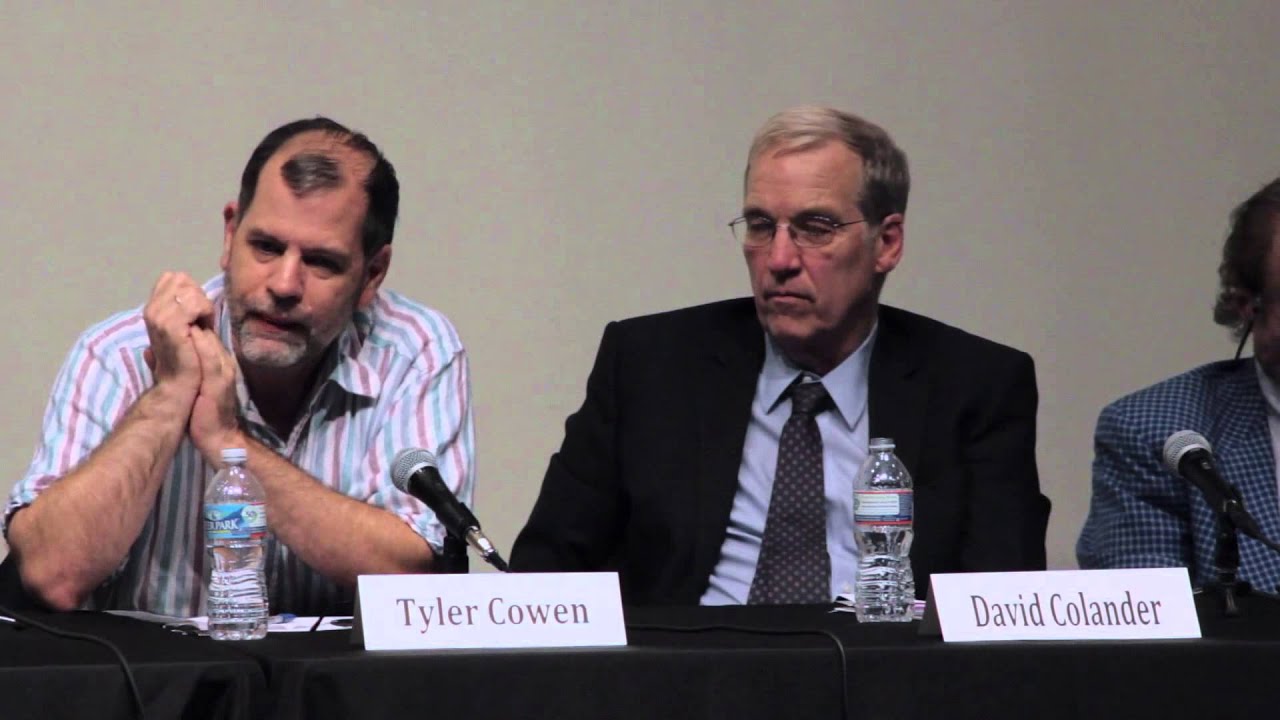
In this solo lecture, Tyler Cowen argues that Paul Krugman occupies the role today that Milton Friedman once held. Both have Nobel Prizes and large popular audiences, but Cowen highlights key differences: Friedman was a classical liberal who spoke politely in a gentlemanly era, whereas Krugman is a progressive left‑wing voice operating in a more impolite, polarized internet age. Cowen traces how the core economic issues have shifted—from Friedman’s focus on communism, high taxes, union privilege, floating exchange rates, and privatization—to today’s dominant concerns of climate change, healthcare, inequality, and the financial crisis. He compares Krugman’s public influence and writing energy with other contemporary economists such as John Taylor and Greg Mankiw, concluding that Krugman’s reach and vigor surpass theirs, making him the clear modern analogue of Friedman. Cowen then reflects on the “economics of fame,” noting that iconic figures (e.g., Warhol, the Beatles) become rarer as fields diversify, and suggests that Krugman may be the last economist of his kind, with no obvious successor. He also observes that Krugman’s policy impact has been limited compared to Friedman’s lasting influence, reinforcing the idea that Friedman’s intellectual legacy still overshadows Krugman’s ambitions.
Chapters
Speaker is Tyler Cowen. David may be the token leftist here, but I'm the token contrarian, and that is perhaps a bit more dangerous. I'll hazard the claim that there is a Milton Friedman today, and his name is Paul Krugman. Milton Friedman had a Nobel Prize. Paul Krugman has a Nobel Prize. Milton Friedman had a large popular audience. Well, Krugman has a roughly comparable large popular audience through newspapers, television, and so on. So there you go. We have our Milton Friedman. Now, what are some of the differences? Friedman, I think, could have won more than one Nobel Prize, as could have Coase, had they allowed individuals to win more than once. I think Friedman could have won at least three. And Krugman, I think, fully deserves a Nobel Prize, but I think he really only deserves one. But again, this isn't surprising. So earlier economists are more fundamental than later economists. Adam Smith is more fundamental than Friedman. Friedman is more fundamental than Krugman. Maybe Krugman is more fundamental than David McFadden— Daniel McFadden, right? So as science progresses, you will get economists being more specialized. And being less dramatically top-down important. Krugman is not as important theoretically as Paul Samuelson or Ken Arrow. But again, that's actually consistent with Paul Krugman being today's Milton Friedman. I'll suggest that he is. Now in terms of their popular presence, I think you can say Friedman was unfailingly polite. Though as a side, I find it quite interesting to watch those old videos on YouTube and try to decide when was Friedman actually getting quite irritated. I think I can tell. I'll never know if I'm right or not. But to some extent it was a facade. But Friedman lived in a very polite age. So someone who was kind of a peer of Friedman, like Thomas Schelling, also extremely polite, very much always a gentleman. It was a gentlemanly age, in good ways and in bad ways. Krugman, to his intellectual opponents or political opponents, He is less polite. This is fair to say. But I would say today we live in a less polite age. Goddammit, right? Partly because of the internet, partly because political polarization has gone up, other reasons. So you have a polite man in a polite age, and you have a less polite man in a less polite age. I would say that again means Paul Krugman is the Milton Friedman of today. Now what's another small difference between the two men? Well, Milton Friedman was a classical liberal. Paul Krugman, I think I would call him a leader of the progressive left, is maybe the fairest term. But it's certainly different points of view than what Milton Friedman had. We would all agree with that. But again, I think you have to compare the errors. So think of some of the core issues of Milton Friedman. Communism. I don't mean that Friedman wrote on Communism with a capital C so much, but it's clear what he thought of Communism, and it's pretty clear he was completely correct. Tax rates being too high. They were. The disadvantageous consequences of giving unions too much political privilege, especially in the United Kingdom. Floating exchange rates, whether you should nationalize industry or privatize it. There's some exceptions, some particular issues, but pretty much I think Friedman was close to completely right about all of those things. You read Friedman on the Eurozone, you know, he thought it wasn't going to work. He had a pretty consistent point of view, and on the issues of his day, he A, was right, and B, was perceived as being right, not at first, but over time, I think, for the most part. A few of you mentioned capitalism and freedom. It's very interesting. If you go back and you read that 1962 book, you look at what issues are covered. For instance, there's remarkably little about healthcare or the problems of the elderly. A bit, it was just less of an issue then. It's hard to imagine a comparable book today from any point of view that would afford those issues so little space. Now let's consider what some of the big issues are today. Uh, here's what, 4 really big ones. First, climate change. Second, healthcare. Third, inequality. And fourth, the financial crisis. Throw in unemployment if you want. Now in my talk, I don't want to debate these issues politically, like who's right, who's wrong, left wing, right wing. But let's just say, I think we can all agree, those are perceived mostly as being left-wing issues. Whether or not they should be, maybe healthcare should be a market issue, whatever, but if you ask the citizenry, they're perceived as left-wing issues. I think even if you polled professional economists, for the most part, those would be pinpointed as left-wing issues, and even a lot of professional economists will have somewhat leftish points of view on them. They're seen as cases as market failure or maybe that the market doesn't meet some kind of external ethical standard. So those aren't all the issues today, but communism is a less big issue. A lot of Friedman's issues, in part because of Friedman, have become less big. So we have all these big issues, they're perceived as left-wing, and voilà, what do you get? You get a left-wing Milton Friedman. That left-wing Milton Friedman, I submit, is named Paul Krugman. And there you go. So the parallels actually are fairly uncanny. It's just that maybe not all of you in the audience like those parallels. I think it's quite striking if you read some of the other— I don't know if you should call them right-wing, free market, libertarian, market-oriented, classical liberal— economics writers today. I don't want to make this too personal, but take someone who's a very smart economist, highly accomplished. He may win a Nobel Prize. I wouldn't bet my life on it, but he has quite a good chance, and that's John Taylor. Tenure at top schools. He's in the popular eye somewhat. But if you just compare, like, the popular writings of John Taylor, the popular writings of Paul Krugman, Again, put aside who is it you agree with, but who writes with more dedication, more energy, more insight, more oomph? I mean, come on, clearly it's Krugman. Krugman wins that one. Greg Mankiw, brilliant guy, there's an awful lot you could say on his behalf, best-selling textbook ever perhaps, but look, Mankiw basically gave up blogging, Krugman has kept blogging. You might agree with Mankiw, again, not my point. The point is Greg Mankiw did not make that big push to be the Milton Friedman of his generation. So you could go through more names. Again, I'm not here to deliver some kind of running judgment on everyone out there. But I think again, when you actually compare Krugman to the alternatives, left, right, center, it's clearly Paul Krugman. I don't even quite see a close second. So this to me is interesting. The main change really is the political change. Politeness change is less important. And there you go. So you might ask, who will be the next generation's Paul Krugman? Or Milton Friedman? I don't know. I think one thing interesting when you look at the economics of fame— David Hume pointed this out in the 18th century. He said you have a lot of periods that coin people as being very famous or very iconic. And then they're followed by people who are maybe no less smart, no less energetic, but they don't become iconic in the same way. So if you look at like American painting, there's Andy Warhol. There's still a lot of people today like who paint really well. Maybe they paint a lot better than Warhol, right? You can debate that. But Warhol's the famous guy with the image on the shopping bag and he painted Jackie O and all that. Roy Lichtenstein, Jasper Johns, Andy Warhol, they're iconic. Today's American painters, whether you like them more or less, they're not iconic. There's more of them, they're more diverse, they're more niche-oriented. 1960s, you have the Beatles, the Rolling Stones, Bob Dylan, they're iconic. Rolling Stones are still together, it's hilarious, right? Like, who of today's musical groups is going to be the next Rolling Stones? Groups are lucky, you know, like if they make an album at all. Maybe they make 3 albums, they're gone. There's data on like tracking how long groups last. It's amazing. That durability drops off. Like there won't, you know, maybe U2 a bit of time ago is like the weakest, lamest runner-up to who's the next Rolling Stones. That's a long time ago and like we're not even managing a new U2. So you turn these corners where at some point, you can debate when it starts, all of a sudden even with a lot of talent, the achievers are less iconic. So there's proven today, I don't think we've quite hit that turning point. But I actually think there won't be a next Paul Krugman. I think Krugman is sort of the end of that line. It's interesting when you read Krugman writing about Friedman. I'd love to have a psychoanalyst write a short essay on this. But there's no economist who so gets up Krugman's gander as Friedman. Like, you read Krugman, that lengthy essay in the New York Review of Books on Friedman. Read that piece, Krugman on Friedman, and then read Harold Bloom, The Anxiety of Influence, and then sit down with a bit of Freud, and you're gonna laugh for a good 5 or 10 minutes. Because it's very clear what's going on. Krugman, like, sees Friedman as his rival. He's afraid he hasn't topped Friedman. And in terms of influence, he's not even close. Like, the hugest difference, like, in what way is Krugman not the Milton Friedman? Is that Friedman either personally or through students or through ideas, so many of his ideas came to reality. Look at Krugman. He calls them the very serious people because they have more influence than he does. They're like the Austrians. They're like the people who won't listen and Obama's too right-wing. The stimulus should have been twice as high. Go on and on, whatever it is, what we should do, tax rates like France, agree or not, but we haven't done it. Even the Affordable Care Act, Krugman preferred to not doing anything, but it's not really what he wanted. He wanted single-payer. Even government provision of hospitals like the VA system. So Krugman's kind of gotten none of what he wants, and in that regard he's not the Milton Friedman at all. And in part, Krugman has gotten none of that because Milton Friedman still has influence. So Milton Friedman of today, first pick Paul Krugman, second pick Milton Friedman. Thank you all.