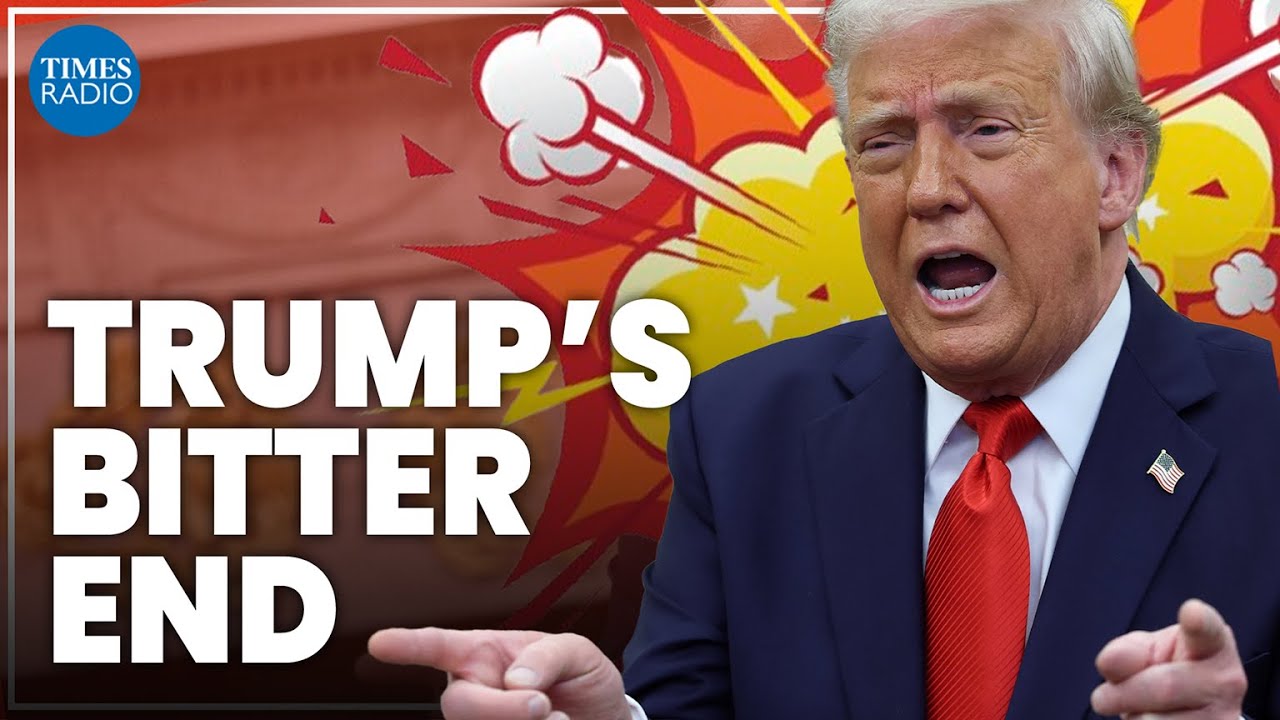
In a Times Radio interview, economist Tyler Cowen discusses a range of political and economic topics. He argues that the U.S. courts have turned sharply against Donald Trump, viewing his attacks on the judiciary as a power grab, and predicts Trump will exit politics in an embarrassed, ineffective manner. Cowen links the recent decline of liberal ideas to a cascade of crises—9/11, the 2008‑09 financial crash, and COVID‑19—that have fostered negative emotional contagion, higher mental‑health issues, and a loss of faith in democratic optimism. He questions the usefulness of the term “populism,” suggesting the Trump coalition is a heterogeneous group held together mainly by Trump himself, and that the New Right’s economics are actually left‑leaning. Cowen condemns Trump’s tariff policy as one of the worst economic decisions a major government could make, calling it a massive tax increase that will not revive U.S. manufacturing. He revisits his “Great Stagnation” thesis, noting that growth slowed after 1973 but argues that recent breakthroughs—autonomous vehicles, AI, and mRNA vaccines—signal the end of that stagnation and the start of a new era of productivity. He is cautiously optimistic about AI’s potential to raise productivity, improve bureaucracy, and even safeguard democracy by combating misinformation, while acknowledging unpredictable social side‑effects and the risk of over‑reliance. Cowen describes his own daily use of AI for research, fact‑checking, planning, and creative tasks, noting a trade‑off between autonomy and efficiency. He stresses that AI arrived at a crucial moment given demographic decline, fiscal pressures, and slowing productivity, and warns that bad ideas like protectionist tariffs keep resurfacing—a phenomenon he calls the “great forgetting.” Regarding the future of American democracy, he expects continued court resistance to Trump, a nervous Republican Congress, and a period of policy uncertainty, but does not foresee a return to pre‑Trump politics. He comments on Silicon Valley’s mixed relationship with Trump, noting a small “tech right” faction but overall limited support. Finally, Cowen critiques the notion of running government like a corporation, arguing for greater meritocracy and efficiency rather than profit‑and‑loss metrics, and concludes that AI is more likely to help democracy than to replace it.
Chapters
The courts have very much turned against Trump. They are resentful of his desire to seize power from them. They strongly dislike the fact that he attacks them all the time and threatens judges with impeachment. They're keen to reassert their power. Trump is less popular with the public. Doge is not popular. The Republican Congress is increasingly nervous, though they're afraid to say anything.
Tyler Cowen is an American economist, columnist, blogger, the Holbert L. Harris Chair in Economics at George Mason University, and he's also been described as Silicon Valley's favorite economist, and he joins me now. Tyler Cowen, welcome to Times Radio.
Happy to chat with you.
Very nice to have you with us. Look, you've described yourself as a classical liberal. Why have those ideas, liberal ideas, a belief in capitalism, democracy, and free markets, lost currency recently, not just in the US, but really across the world, across the West, at any rate?
I think we've had several bad events more or less in succession. So for America, the first was 9/11. Which was a major shock. Then of course in 2008, 2009, we have the financial crisis. You all have your own version of that. And then we have COVID, which struck the whole world. And I think people respond often badly to negative events, especially when there's not always a clear external enemy to unite against and fight against. And some kind of negative emotional contagion has set in, and you see it in many countries. Higher rates of mental illness amongst the young, more negative politics. And to me, it's highly unfortunate.
And is it an idea that we are suffering from a surfeit of freedom? Too much freedom has been bad for us?
I don't think it's so much too much freedom. I think we've had some bad governance. We made some bad decisions. All of a sudden, the world is changing rapidly again. We're not used to this. China, of course, has done well, so that makes autocracy look better. I think autocracy is considerably overrated, but I understand that response. And your own country, the United Kingdom, you know, you haven't had much productivity growth since 2008, and it's just hard for people to keep faith in a better future under those conditions.
Well, you've talked about the, the new right, which includes people like JD Vance. So we might talk about populists. We talked a lot about populists before we talked about the JD Vance, the New Right and people like JD Vance. Are populists and the New Right the same thing?
Well, first, I'm never quite sure what the word populist means. A lot of politicians are popular. I take populism to mean something like a rejection of experts. But JD Vance, you know, has a law degree from Yale. He's a bestselling author. He's plausibly in some ways viewed as an expert. So a lot of it is a kind of play-acting at being populist by people, for better or worse, they're not really populist at all. So I think the Trump coalition is extremely diverse. It's not held together by very much other than Trump itself. It's always at the risk of just bursting open and collapsing. And they're quite unpopular right now in the United States and of course around the broader world. So I don't view them as populist. Are they the new right? I mean, the economics is actually quite left-wing. So I feel we're at a time of rapid change where all these labels are a bit off.
I take populism to be, I suppose, something close to majoritarianism or a rejection of systems where you can justify anything with mandate and mandate alone. Is that fair?
Well, I think that's what it's been for the last 6 weeks. But I wouldn't say that's what it is historically. So again, we're just in a time period of flux, and I think we need to push away a lot of these older categories to see what's going on.
Well, perhaps the most obvious evidence that Donald Trump isn't a liberal, at least in an old-fashioned sense, he wants to rebuild American industry via tariffs. Speaking as an economist, will that work? Is there any chance of it working?
It's one of the worst policy decisions I've ever seen by a major government. It would be the biggest tax increase in American history. It will restrict and limit trade. It will further break our relations with our allies. And most manufacturing simply is not coming back to the United States, whether we do those tariffs or not. So it would be a huge own goal, as we say.
Why do you think— why do you think he thinks it's a good idea? Is it a simple misunderstanding of the economics? Is it a different version of economics? What do you think?
Well, on YouTube you can find a tape of Trump. I think the year is 1988, but he's speaking to Oprah Winfrey on the Oprah Show, and he's saying he thinks tariffs are this great thing, that other countries are ripping America off. You need a favorable balance of trade. So I suspect he just believes it all, that it's the right thing to do and that it will work, and he thinks people will thank him sooner or later.
You've written about a period of great stagnation. A sort of long-term, a long-running crisis of lost growth. The UK economy certainly has been stuck in a low-growth doom loop since the financial crisis, as you mentioned. America's actually had sort of considerably more growth than quite a few other places, certainly than Europe. But it still sort of, it still seems to regard itself as suffering from this idea of stagnation. Explain to us precisely what you mean by the Great Stagnation and how it relates to growth. Because I mean, can it— are we still stagnating when we do have some growth, albeit at low levels?
Well, if you look at the data for most Western countries, growth slows down considerably around 1973, and in many cases it never quite picks back up. A more anecdotal way to put it would be to compare my grandmother's life. She was born in 1905. In her first 50 years of life, the whole world changed in every way. In the first 50 years of my life, well, we got the internet and things were wealthier and more comfortable, but my car, my kitchen, most stuff, it's still the same, the basic materials of life. Now, the Great Stagnation, especially in the United States, it's now over. I rode in a Waymo car last night. There was no driver. It's clearly superior to having an Uber with a human driver. Artificial intelligence along most metrics is smarter than human beings. We have not worked it yet into our major institutions, but we will. And mRNA vaccines, which come also from your country, of course, are a miracle, and they saved millions of lives. And we, you know, approximately designed them more or less in the span of a day. So I would say, starting with the vaccines, we're now entering another era of truly major technological breakthroughs. And you can genuinely and sincerely say you really do not know what kind of life your children and grandchildren will be headed for. And that was not the case 20 years ago.
Will that lead to that kind of sort of runaway growth that past technological revolutions have led to? And if, if it does, will it lead to growth for everyone, or will it just lead to growth for people who control those new technologies?
First, I don't think we know. It's very hard to predict how AI will change the entire world. The early evidence is that people who are poor performers benefit the most because now all of a sudden they can create or write a good essay. I'm not sure that's the longer-term effect. And then it depends also on what countries do about this. So the European Union is quite slow to let AI in the door. I think that's a big mistake. United Kingdom, the signs are more positive, but you still have major debates. And whether your bureaucracy actually follows the principles you've outlined for AI, we'll have to see. To see. So far, the United States is quite eager to do as much as it can, but we're very, very early in this. I would be reluctant to make too many predictions, but there's certainly— the odds are that 20 to 30 years from now, our world will look very, very different in a way that no one is used to. But the main winners and losers, we still don't know.
Do you use AI yourself personally frequently?
Every day, dozens of times. It's the single main thing I do. I learn more that way typically than reading books or even reading a lot of media.
And you use it for what? To summarize information, to gather information?
All of those things. Or if I write something and I want it fact-checked, I'll use it for that. I use it to plan trips. I use it for advice on where to eat in a restaurant. You can use it to translate languages. It is truly a fairly general intelligence, and it's hard to think of what it cannot do. Now, the new version 4.0, it creates these beautiful images. I've been playing around with that. That's, you know, only a few days old, but it's quite miraculous.
Do you worry you're losing anything in using it? You're losing a bit of autonomy. I read a line in an interview with you in The Economist where you used, I think, ChatGPT to ask it where you yourself would recommend going to eat. Which I thought is philosophically fascinating.
Well, it's much better than Yelp. That's what people did before. So am I losing autonomy or gaining? I think it's some mix of both, but no one makes me use it. I use it because I feel it gives me better answers. A lot of times I just prefer to go out and walk and look for a place on the street. That's what I did the other night. That's fine, but plenty of other times you want to ask. Or you're confronted with a strange menu, take a photo of the menu and you ask it, what should I order? It's highly useful.
I mean, you wrote on your Marginal Revolution blog that you think LLMs, large language models, have been invented at the right time. What do you mean by the right time? What makes now so special?
Well, you know, we've had this productivity slowdown. We have declining birth rates. Most of our nations have pending fiscal problems with no obvious solutions in sight for any of these issues. We don't know how to get families to have more children or how to put social spending on a more sustainable trajectory. And AI is going to raise rates of productivity growth. And I hope it's just in time. I think it will be. If it had come 20 years later, we'd be in a big, big mess. I mean, we are already to some extent, but they came just in time.
Do you have any fear that AI might make us stagnate more, might make us rely on AI for stimulation, for entertainment, for functions that in the past we'd have relied on human beings for, meaning we'll have less functional economy, meaning we'll have less desire even to procreate and live what in the past would have been traditional lives because our whims are satisfied closer, you know, in a more simple way.
Again, these things are hard to predict, but keep in mind, I grew up in an America where the typical household had the television on for 6 to 7 hours a day. And if we move away from that and toward YouTube and AI, I strongly suspect that's a big plus. But these things have nonlinear second-order effects, right? Many social norms change. If you drive using GPS, you know, you do forget where all the streets are. So I don't think it's just all positives. But I look at it this way. If we cannot handle having more intelligence in our lives, I mean, how are we going to cope, right? That's sort of the thing you would most root for having is more intelligence. So it will be a big challenge. We will need to be up for it. And people need to learn how to make their lives better with it rather than worse.
You've also talked about what you call the great forgetting. Why do bad ideas keep coming back?
Well, they never went away to begin with, but our talk about tariffs a few minutes ago is a good example of that. Really, all economists believe those tariffs are a bad idea. There's not a good argument for them, and yet we're on the verge of doing it. And there are people who spring forward, the Oren Casses of the world, who have their rationalizations, and we've just forgotten that it's a bad idea. I don't think there's anything unusual about the present time, but bad ideas keep on coming back. They're still with us and probably always will be.
Do you have any sort of intuition about what the next, uh, the next 4 or 5 years look like in, um, in American democracy? Do you expect Donald Trump to rewrite the Constitution so he can stay in power Do you think American politics generally will revert to being how it was in a pre-Trump age, or has everything changed?
I don't think it will revert, but I'm not an extreme pessimist. I think the courts have very much turned against Trump. They are resentful of his desire to seize power from them. They strongly dislike the fact that he attacks them all the time and threatens judges with impeachment. They're keen to reassert their power. Trump is less popular with the public. Doge is not popular. The Republican Congress is increasingly nervous, though they're afraid to say anything. So I think he will leave the scene in an embarrassed, kind of pathetic way, maybe making some anti-democratic noises going out the door, but won't have the chance to put up that much of a fight. And things are already, you know, somewhat of a sprawling mess. And I think we'll just have to deal with that, not having effective policy and having a high level of uncertainty for some number of years. And it's all very bad.
You've been described yourself as Silicon Valley's favorite economist. Many tech bosses seem very keen on Trump. You yourself are obviously less so. What's happened there? Have they just not been reading you closely enough?
Well, I'm in San Francisco right now. I'm not sure how much buyer's remorse there is. I think there is some. A lot of people in the Bay Area, they're considerably younger than I am. So I think I have a good longer-term historical perspective. But it's never been the case that most of Silicon Valley supported Trump or favored Trump. There's a faction, it's sometimes called the tech right. They've been very much on board. We'll see how it goes. I do think Trump is doing some good things, and I hope those are what matter and what stick. I think it's very good that he's in favor of permitting reform. I do think the bureaucracy needs to be reformed. And there's a general attitude of we're going to grow and we're going to do things and we're going to build out the energy infrastructure and let AI flourish and get rid of DEI. And I'm very strongly supportive on all of those. So I'm not one of these people who hates what Trump does no matter what. It just seems to me the balance has turned much worse over the last month, really, and we need to recognize that.
Much of the tech right are also supporters of what some call the Dark Enlightenment movement or neo-reaction, the idea that we should replace democracy with some kind of techno-feudal state, that democracy itself is antithetical to freedom generally, and that the state should be run more like a corporation. What's your view about that?
There's a lot of different ideas in what you mentioned. I don't think I know anyone who supports the end of democracy, whether from the tech right or not, like maybe some of my Chinese friends would. But I do think there's this pessimistic outlook that is fundamentally different from my optimistic version of classical liberalism. And it's a real difference. And I think the pessimistic look, it feeds on itself and it's very hard for it to succeed. That if you feed people pessimism, you make your own policy environment worse. And the more optimistic approach of, say, Ronald Reagan or, you know, any number of British politicians has a better chance of sustaining itself longer term.
But the idea of running government like a corporate, like a corporation, which seems to be very much Elon Musk's idea, the idea of thinking of government in those terms, of thinking of government budgets in those terms, of thinking of successful government in the same way one would think of a successful company. Does that make sense? What do you think of that?
I've never met Elon Musk. I'm not sure exactly what his view is. I strongly suspect a business is the wrong analogy. But the notion that it's much too hard to fire people in government bureaucracies and periodically you need to do a batch of it, I very much agree with that. Now profit and loss should not be the metric for assessing bureaucracies. In that sense, it's not at all like a business, but you need much more organizational efficiency. You need much more meritocracy than what we've had in America. And those parts of Doge I very much agree with. It has not always been executed well. But I think it's mostly the correct idea.
Coming back to where we started, do you think, is there a chance that AI will be the death of democracy? Because if AI can make much better decisions than humans can, even at scale, why would we be relying on people at the ballot box when we could simply rely on an AI to tell us what decisions we ought to make?
I think it's more likely that AI saves democracy. It's a very good way of spotting misinformation. And AI can help our bureaucracies work much better. And then people will like their governments more. Again, there's no guarantee it goes that way. But I have a much more optimistic expectation of how it will all play out.
But I mean, if people, the simple, I don't know, the simple process of asking an AI how you should vote is a sort of a sacrifice of democratic autonomy. If everyone does that, we might as well not bother.
Well, again, what is it you're comparing this to? In the earlier world, people would look to their friends or they would look to Oprah or they would look to someone on talk radio. So if you ask the AI, you know, oh, will the vaccines kill me or are the vaccines an effective means of protection against polio and measles? The AIs give you the right answer. They're more objective than mainstream media. Now, again, that too can change. But I think people are worried about the wrong things. I find in the US cable news much more problematic, for instance, than AI. And I think it's going to improve our discourse.
Well, look, finally then, Tyler Cowen, if the Great Stagnation is over thanks to inventions like AI, when do we start getting rich again?
Well, who's the we? I mean, Americans have been getting rich again for some while. And at least until the last 6 or so weeks, things have been going great. I don't quite understand why the United Kingdom is so stuck. It seems to me you're wonderful at producing amazing things that mostly benefit other places. So it's not that you've stopped being creative or innovative, but a lot of your best contributions, it's hard to charge people for. It's a lot of conventions and norms, the English language itself. I mean, even your role in the vaccines, fantastic for the world, but not a huge money maker. Uh, your key role in helping to build out early AI, uh, fantastic contribution, but your country won't make much money from it. So how you monetize your creativity, I think that's a very difficult problem. But the good news is you have not at all stopped being creative. In fact, you've upped your game.
Well, that's, that's some optimism. That's a nice way to leave it. Tyler Cowen, thank you very much indeed. Pleasure to speak to you.