Adaptive Planning and Leadership Load
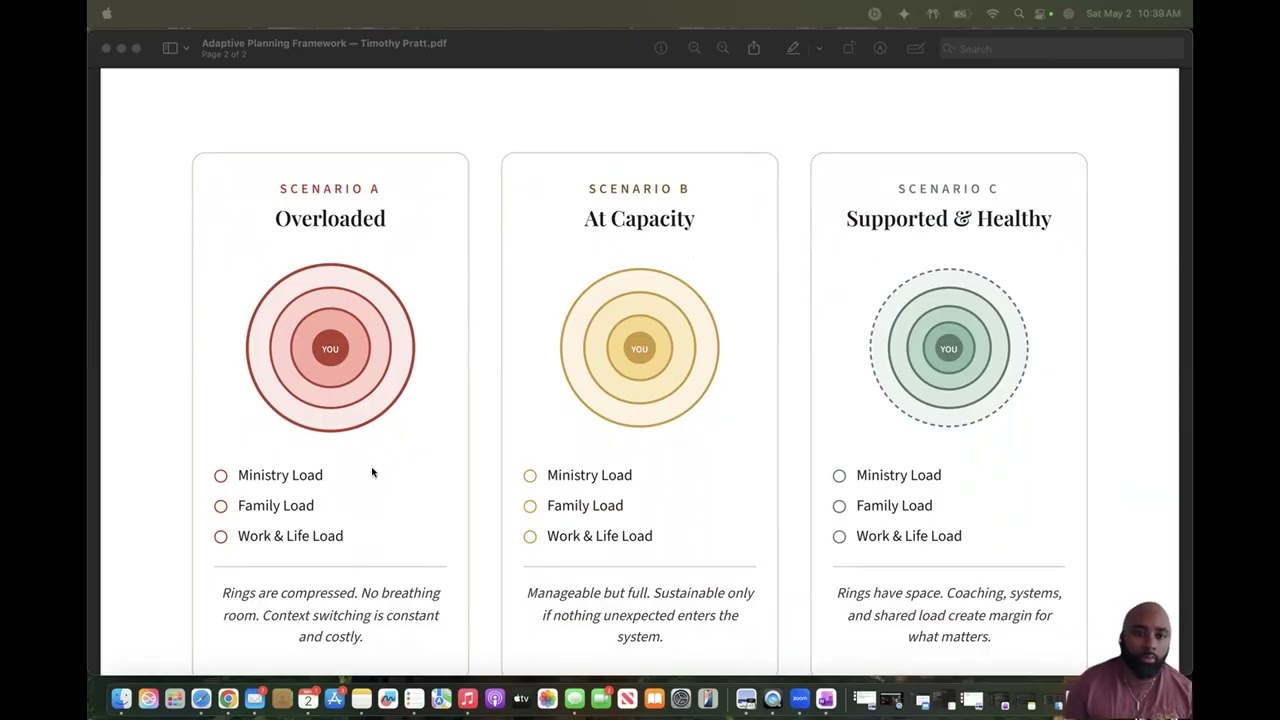
A framework for quarterly planning that prioritizes outcomes over tasks and builds in a 25% buffer, plus a three-tier system for tracking leader load so you know when someone is overloaded, at capacity, or has healthy margin. The goal is creating space for leaders to serve without burning out.
Chapters
Yo, what's up? So I want to talk about two quick topics real quick, and maybe I should stop saying quick, but I want to, I want to address two topics that are really near and dear to my heart when it comes to just helping ministries, uh, become a little bit more healthy, uh, because we talk a lot about systems, but I want to go deeper into some of the practical side of things on the administration. So I'm not going to really touch like a lot of the, the spiritual things right now. This is just typically looking at structure and systems. So one thing that I would highly suggest, if you're not doing it, or to consider, whether you're in a small business, mid-sized business, or whatever, or just any type of small, mid-sized, large organization, um, is to consider what they call adaptive quarterly planning. So this is nothing new per se. It's very popular in especially like a lot of project management, agile portfolio frameworks, even business books and all of that. But everybody kind of like what a lot of this stuff, you see framework after framework and a lot of frameworks comes down to contextualization. Like best practices, they, yes, they're very important, but also too best practices still sometimes have to be contextualized based on where you are in your practice. So you don't want to just throw out best practices and then like you're maybe in a chaotic stage or you're just all over the place. Like the first thing is a systems level approach. We'll say, okay, no, let's stabilize first and then we'll start thinking about best practices and moving up to that. But anywho, uh, you just, you just want to be more healthier. So all this terminology is interchangeable. It's just spend a lot of time with it, having that experience, and just kind of knowing now how to work with the person and making it fit in with the acts. And so this is very general. Even what I'm saying now still have to be contextualized to your particular ministry organization that you're leading or supporting. So adaptive quarterly planning, uh, so it's how healthy ministries plan with purpose, protect capacity, and stay aligned to what matters most. So with adaptive quarterly planning, like you still have that 1-year to 2-year roadmap that's out there that somebody is keeping up with. Like somebody is being a visionary and they're looking and they're praying and that is what's driving this. And even that's changing. But this is more closer to the people that are actually doing the work. So a lot of times the pastor and his senior leadership team would kind of sit in the middle of both of these or executive board or whatever. And what tends to happen is Uh, because the nature of change is just so much faster now, especially with all this AI adoption, um, right or wrong or whatever, it's just speeding things up a lot faster. Um, like, so you can't just really kind of keep bringing people to and trying to stay true to a year or two year plan is down the road. So this is just a little bit more digestible and we know clarity comes in degrees. And so this is why I like the adaptive quarterly planning. To kind of keep the whole entire ministry focused on what we're doing quarter by quarter. And so as you start Q1, you might be in like what we call a discovery phase for Q2 and Q3. And all this stuff is continuous planning because you want to be transparent and inspect and adapt. So as Q1 is, is like, you know, for example, I know we're not in Q1 right now, but let's just say this, we were or getting ready for Q1 as we progress in it. Then it's informing Q2. And so someone is kind of looking at Q2 and say, okay, how does this look in the context, in the grand scheme of things, and where we're going? Because you just want to make sure everything talks to one another. So with this, let's just say if it's like a leader, a pastor, or an executive leader or whatever was meeting with, was meeting with the team and they said, okay, this is what we're going to present for this quarter. And the outcome, not goal, not task, but the outcome is kingdom impact, making disciples who make disciples. Uh, so when you have an outcome, the reason why I like outcome-based planning is because a lot of times is, uh, it gives you a lot of adaptability in itself. It's like, so for example, just real quick before we get into the 75-25%, let's say for instance, like, um, I have an outcome to connect the youth, connect the youth and families or whatever, and it's an event coming up and we've planned, we've been sitting there. They said it was going to be 85 5 degrees outside, cloudy or whatever. And so we've got goals out there, flag football, all this type of stuff. We're going to be doing just races, water balloon fights, and then a thunderstorm is coming. And so if I don't have that adaptive hat, unless it is really, really true, I'm not saying that we can't do that eventually, I might just shut down the whole event. And it's like, because I'm more so, that was a task-driven, because the outcome was just to reach the youth. And so connect to you. So again, it's like, okay, can I leverage a Life Center? Can we switch from water guns to Nerf guns? Can we still do flag football, um, in a gym or somewhere? Can we— you do basketball in gym, switch it up and do tournaments or whatever, or just play different games like Out or King of the Court, whatever, that type of stuff? Because it— can we feed and listen to music and play cards and whatever, dominoes? Like, because that's the outcome. So this is what this, this helps you do. So you have a plan in your heart, but then it's like, okay, because things change, it's a lot of unknowns. We want to stay true to the outcome rather than just the task. And this is what sometimes a lot of leaders get caught up on, is that they're more task-driven than they are outcome-driven. So anywho, when you think about this from a quarterly standpoint, what tends to take place is you never want to plan things to 100%. Like, I just don't think it's a good idea. Some people go 70, but a 30% buffer. Some people go 80 to 85%. With a 20 to 15% buffer. But again, it's just kind of like, okay, this is what we're committed to, what we know we are, are going to do, and then here's a buffer with, you know, things that might come up. So in the 75%, just staying in the heart of thinking about ministry is non-recurring and planned ministry commitments for the quarter. So you're going to have your Sunday services, you're going to have your Bible study and discipleship groups. Then you might get into again like the community outreach. You're probably gonna have some monthly alignment meetings there that's going to take capacity. They can be a combination of virtual in person. Uh, you got to have a youth event. You might, you might have a marriage and singles event. You might even want to throw a men's and women's, you know, whatever in there. Uh, family and friends day. And then your ministry might be helping, like say this is a ministry that's doing something in the community and they're calling other churches to support them and help serve so they can serve the community or whatever. Uh, so you might say, okay, we're going there. Or somebody might be speaking, or your, your pastor or something might be going on. So it's putting it on there. Your pastor could be speaking at one of the graduations or something. So it's just on there knowing that you can get like into the details just with dates and all that and be, you know, like a happening now. I love that. I actually got that from New Life Church here in Conway. I love that they do this happening now thing. So again, it's just kind of taking people month by month and so people can plan and organize and again in their life. So you have that and then you go over to this 25% buffer and this is reserve capacity for the unexpected again. So a team member absence a vacation, you know, pastoral care demands. It could be someone sick, not just the pastor but the pastoral team or ministry team, because it shouldn't be just flowing through one person anyway. And so unexpected community needs, like again, someone could be sick, someone can die, which now is a funeral in place. Uh, leadership margin of risk, and we don't know those dates again there because they're unexpected. But if, if you kind of plan things up to 75%, It's kind of just 25%. If any two of these things happen over here, then it's kind of like still like your ministry, that the one that you're leading or you all are leading, they don't feel like they're going 100 miles per hour because it's okay, these are the days and then you all were clear with us like these are things that may and may come up. And so it just kind of have helped and it's not going to be perfect, but again, it's just kind of people are seeing like, man, like we're really trying to, you know, yes, we want to do ministry and serve people and do the work of the Lord, but also too, we, you know, space, and there are unknowns and things that even could come up in our life. So this is essentially, as a ministry, uh, this adaptive quarterly planning helps you do. And, uh, like I said, again, it is inspired by someone looking long-term, and typically, like, the Passion leadership team kind of sits in the middle of these both. Uh, so essentially, adaptive planning principle, uh, you don't plan everything, you plan with intention. You protect your buffer, you commit to your outcome, and you let the work support the mission rather than consume it. Again, that is so essential. You let the work support the mission rather than consume by it. And a lot of times ministry become overly consumed. And that is a good segue to go into our load management thing. But it happens, man, because it just, it just consumes you, it consumes your life. And I don't believe that that's even biblical nor healthy. So understanding leader load. So this one right here is very near and dear to my heart. So I work as a senior agile coach now. I have kind of come up through project manager, senior project manager, Scrum Master, agile delivery manager, senior, like all these different things. So what I'm trying to say is like, I live and breathe this whole hybrid project management and agility and being flat out just pure out coaching. Like I'm an agilist at heart and I'm also a project manager at heart. And I just hold the same intention of both because I think it's so much stuff that we can learn from, from both disciplines. And so that being said, but one of the things that I really, really try to stay aware of is before we ask more of the people that we're leading or serving or helping steward or whatever, we need to understand what they're already carrying. As a leader, you have to sit with your people and have conversations with them. You have to get to know the person in front of you, because if you don't, I would truthfully say you are not leading people to the best of your ability. Now, again, no one person can do this. This is why you want to have structure in place. Uh, and like I say, it's no hierarchy in the kingdom of God per se, but it is one in the context— healthy hierarchy, however you want to call it— in the context of ministry operations, because you have to have some type of structure in order. Now, I'm not talking about— again, I'm not getting biblical here. I'm not— we can go to the book of James, so some of you might be inspired to pull up James right now and challenge me. That's not what I'm saying here. I'm just strictly talking about in the administration side of things because you have to have that structure. So, uh, as a leader, uh, Scenario A, uh, just imagine if I am a leader and I'm sitting with an A, and, uh, but I'm treating this person as a Scenario C. And they never say anything. Like, that is going to crush my heart. So as a leader, uh, let's go through scenario A. This person is overloaded. So they have the ministry load, they have their family load, and they have their work and life load. And as a leader, you might be saying, why they just didn't say anything? Some people don't. Some people are very non-confrontational. Some people gonna let you know what it is. Like, it's just— but again, as a leader, you should just have that context. But anywho, back to the example. Uh, so scenario A, like, this, this person, they are they are just overloaded, like they are compressed. It's a lot of context switching. And truthfully, like they aren't really doing anything with excellence because they're trying to do everything. So it's just, it's a nightmare. So we, as a leader in a team, we should be embracing, like, how do we at least get them back to the yellow scenario B? Like, how can we get them just at capacity and then, you know, possibly get them where they're at scenario C? So Again, scenario A, person, it's a danger zone. If this person or two people are in a senior leadership team to you, this is like high risk. Whatever you have going on, you need to figure it out as a leader. And we also have to start, as leaders, we have to know how to create and build what I call speak up cultures and psychological safety, but that's a whole nother conversation. You have to intentionally build that. You just can't live on the expectation of why people aren't saying anything, because some people just aren't. And that's just the way it is. So scenario B. This is the person where everything is manageable, and a lot of people sit here too. Um, and this person might slip over to the red, they might slip over to the green, it just depends. Because again, as a leader, you should be talking to, uh, the people that you— God has entrusted you to lead with. So this is like manageable, uh, but full, uh, like it's, it's sustainable only if, if nothing else, uh, it's like put on them. Yeah. So what happens is if nothing else enters the system, this person is like, okay, like, hey, I'm good. Like, I'm not bad and I'm not just— like, it might not be just perfect and it's not just bad, but I'm good. But again, like I say, they also might switch between the two. If you see them in a constant state of yellow, we should be having conversations because again, they're at capacity. So the moment something— like, the overload person is just— trust me, like, it's that, that's just, it needs to be dealt with. This person is just like, it has to be monitored because like, if one or two things get dumped on them, it could be like, you know, like it could be, okay, this is not a season, this is more starting to become a cycle, a way of life. And so that's what you have going on there. And a lot of times we think things are seasons when they're actually cycles. And we have to confront and kind of change the way that we do things. So Scenario C, supporting healthy leaders. So again, this is the person with, you know, pretty fair ministry load, seem like everything's going on okay with the family load and work-life balance. So again, with this work-life load thing, it's like traditional, we know work takes up for most people 40 hours minimum. Life, like I say, family, either they can have kids, be a great uncle or auntie to, you know, it can be taking care of their parents, it could be doing something. Everybody doesn't have to be married and kids, but they're carrying some type of family load. They might be taking— helping with their nieces and nephews or whatever. But in the green space, in Scenario C, it's again, these people have space. They have kind of like— they know how to— they have margin for things. And that's what you want with most people. That is the sweet spot that you strive. And this is why we have to look at things again and going back to the whole systems level awareness and just knowing people and sitting with them and making sure that we're designing a healthy culture Uh, maybe our ministry can't take certain things on because again, this kind of gets into the danger of again, contextualization. Uh, like it'd be crazy for, um, let's say I'm talking to like, if I knew Torres Roberts and they have access to just things I don't have access to, like that's just the reality of it. And so if he's pouring into me and I'm not contextualizing it, I could literally destroy the ministry. That God has entrusted me with. So again, like I say, like I tell my wife sometimes, I was like, hey, I want to— I'm trying to slow down. I want to move at what some people say is called the pace of grace. Like, I know there are going to be moments that is tenseful, whatever, that I have to stretch. But again, I don't want that to be a way of life. I want to be stretched and going through things like that because it's compelling, it's marching to do it. And this is something that I believe that God is compelling me to do. So Uh, the question isn't whether people are, uh, willing. Most leaders in ministry absolutely are. Like, let me, let me say something like legit, most leaders in ministry absolutely are willing. The question is whether we're building systems and structure that give them the margin to actually lead well across every area of their life, not just in a local ministry context. So it is about helping people integrate. Like, wherever they are is kingdom everywhere. Have we took that margin from them? Thank you, Holy Spirit. Have we took that margin from them as a local church where now they can't really do kingdom everywhere? Or are we helping build and create that margin in their life so they can reach souls? And when I say reach souls, I'm not just saying like trying to get people to come to this local ministry or our local church. It's just, hey, this is about kingdom. And wherever you go, wherever you're connected with, I have margin and capacity because what I'm being poured into at my local church I'm trying to pour it into you by the grace of God, and it is only through the power of the Holy Spirit. So this is what we have to look at. And I just think as leaders going forward in the context of ministry, if we just kind of think about, you know, these two things, man, we might learn a lot and you might literally just almost start switching the direction of your ministry if you're embracing these thoughts and practices, man. So hope that helps. Feel free to connect to have a conversation offline. I would love to sit with you. Be blessed.










