Agile Coaching: AI & Automaiton
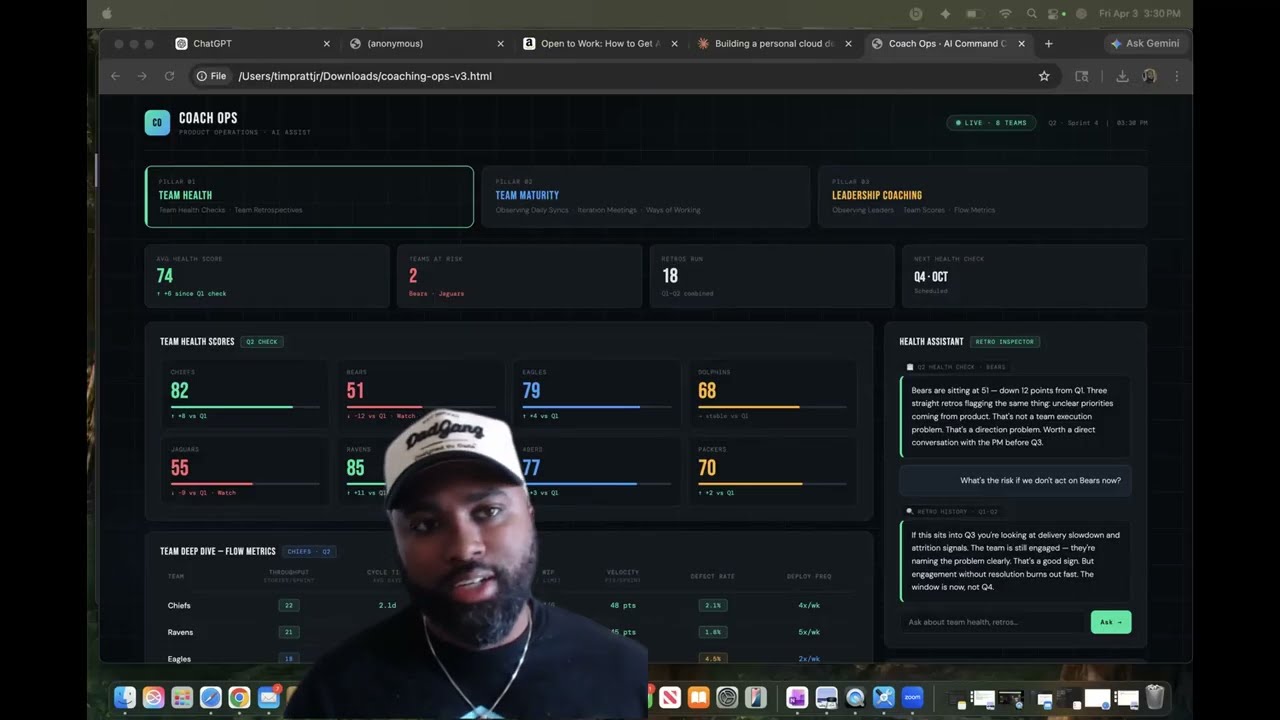
Tim Pratt Jr. built AI assistants that ingest meeting data and generate reports to monitor team health across multiple product teams, freeing him to focus his coaching on conflict resolution and empathy. He uses a three-bucket framework to decide what can be fully automated, what needs human-machine partnership, and what must stay human.
Chapters
Yo, what's up? Uh, so I just want to jump on here, kind of maybe talk to like coaches, product managers, product owners, uh, project manager, technical project managers, just to kind of in that space in any type of domain, even probably some administration leaders within the, uh, church. We can have that conversation offline. Uh, so just for transparency, and then get into this, make it real quick. I've been on the technical engineering side pretty much my whole adult life. My role was dissolved. I was more of like an agile growth manager, kind of coming up through that Scrum Mastery, technical project manager, senior technical project manager route, senior, senior agile delivery manager. And then I started overseeing ADMs to certain ADMs. And like I said, that was dissolved, so it was like, you know, optimized or whatever. And now I've moved into like what they're calling a Systems Delivery Coach, or they might switch it to Product Operations Coach. So I'm on the product side now. So this would be fun, um, uh, just being, being in that area. Uh, so anywho, um, that's what kind of happened. So man, every so many like months, probably even shorter than that, I'm consistently having to re-evolve, learn. Thank goodness I've always kind of had a learning posture. So it's not really hard. I'm used to change, been in this space. But what I want to get to is, so I wanted to kind of talk about a little bit like how I leverage AI and automation. And of course, this is all made up, but it's how I use it at work. Now and continue to evolve it. So I just jumped in cloud and just had to kind of build out a demo of how I use it. Because of course, like, man, I can really kind of go crazy at work. Their budget is a lot bigger than mine. So that being said, as a— in this new role, I'm now having to look after all teams in the areas of team health, team maturity,, and then coaching product and technical leaders and maybe even zoning into the team sometimes and working with tech leads and QA leads and things like that. And so as these three areas kind of become my specialty, one of the things is for that is that they want me spending more time in the conflict management, conflict resolution areas, just a lot of coaching, bringing things together in the name of, hey, we got to get things done, we got to make money, we got to get things done. And I have to do that like in a deeply humane way. And when you're coaching people, especially from a performance standpoint, trying to help people maybe learn a new way of working or adapt or just be a sounding board or whatever, that applying that systems thinking to bring things together, like most of us know that that, that can be very— it could take a lot of mental capacity. I mean, like, depending on how many coaching sessions I have a day, how many meetings I sit in. Sometimes, like, it's just, you know, things build up. So you get a to-do list for the to-do list and then you're looking at it. So, so anywho, I was like, okay, a while back, and I think it's in a new book that just came out, Open to Work. But we learned this concept of the 3 buckets and it was like, okay, what can I fully like credit agent for that can do, just do that, like just tasks because we see ourselves more as just, hey, instead of like, I just do this thing, like, no, I'm— I actually have these capabilities and I can kind of, you know, be in and adapt to step into whatever those capabilities are in order to meet the need. As long as, you know, I'm competent in that area and, you know, have some type of expertise or whatever. So I asked the question like, okay, can I create an agent or agents to help do XYZ, like can it do it 100% without— with minimum input from me? Then I start to ask the second bucket is, okay, what still needs human oversight? So I want to partner human and machine. And so again, like it can give me sometimes 50% there, 80% there, 90% there, just depending on it. And but it still needs that human insight because I have to just make sure before, you know, I put my name on it or whatever. And then the last one is just like it's a no-go. Like I just don't trust yeah, to really touch that, I'll leverage the other first two buckets, but this one is just deeply human. So this is where it gets into like the contextual coaching and adaptive empathy, all this type of stuff for me. And so I just kind of move between those three buckets and that's kind of how I typically shape things up as of now. So what I want to demo real quick is how I'm using it at work. Again, and again, this is just made up numbers, NFL teams, stuff like that. So I have my team health part, and basically, like, I just look at health checks and team retrospectives, like iterations or whatever, with teams. And then I have what I call, like, team maturity and then leadership coaching. So that's just observing leaders. I look at team scores, like flow metrics and things of that. And then, of course, you know, like, with the team maturity, I'm looking at ways of working, iteration meetings, and just observing what we call— most people are familiar with daily scrums. Some people are moving towards the terminology of daily syncs. And then so what I do, I kind of keep up with like the average team health. So I kind of want to keep a pulse on that because senior leadership, that helps. Like, are our teams healthy? So I'll look at that, then I'll see, okay, it flags based on these scores because I've shaped these up and Basically, I oversee these, these surveys and things of that. So then I look at, like, based on those metrics and all of that, I can quickly see, like, the Bears and the Jaguars are two teams at risk. So that's already flagging me as a coach. Like, I don't want to— like, teams just kind of have a good thing going, I might just really monitor them. But these two teams, I'll probably start my zoning in and take a deeper stance, start looking at data, and I'll put it all together. So Then it's like retros. So are these things being ran? So I forgot how many teams we have. I know it's a lot, but I can't be in all those retros at once. So I have to work with people to, you know, and they really have to help me. And I just make sure again that I get the data from those and I'll try to jump in and observe because again, you know, things move off of relationships as well. And then it's just kind of like the next one. So we don't want to be death by survey and teams like, oh, another survey. So this just lets me know, okay, hey, like, you ran this 3 months ago, might be time to kind of run another one to see if some of the things work. Uh, so then like, it'll get into like, um, all the teams. So you can see like the 2 teams are at risk, the Bears and Jaguars. Like the Chiefs and the Ravens, I probably again just might touch to, uh, like going and look at those teams once a month. Eagles, 49ers, not overly concerned. Then the Dolphins and Packers, again, I might start monitoring a little bit more, but then I'll switch my attention to the Bears and Jaguars because something clearly is going on. And then what kind of balances that out are these flow metrics. So in agility, you know, it's like cycle time, lead time, velocity, like, you know, defect rate, deployment frequency. So again, this kind of helps give me that holistic picture because I can't be in all places at once. And then I run like some observing assistants. So I'll kind of run like what I call like a Scrum Master assistant. And that, that agent is just kind of shaped up to kind of follow that Scrum Master feel, feel. So as those meetings are recording or I turn on facilitator, it's kind of giving me that daily report. You know, I did not get into like a weekly report and monthly report and it feeds into something else I have built in. And then I have more of like a project management assistant. Whereas more so approaching the meetings as if like with a project management hat, like the action items, getting into like other things that's not really in the Scrum Master lane per se. And then I have like signals, so just things that jump out. And so anywho, man, like this is just one of the ways, of course there's a lot of other stuff, but that I leverage AI kind of in that coaching space. And even, you know, to the point where I'm starting to kind of build out some things from especially for like executive pastors, associate ministers, associate leaders based on that local church context. But I would just say, you know, like as you get into this, man, like developers that I work with, the few that I talk to, one, just yes, look at the videos, do a lot of training, sit with the SMEs, but don't be afraid to just jump in there and start playing with it and learning as you go. Then the biggest thing is just, you know, always keep in mind for me what has served me well is just that systems thinking hat. So that's just something that I can't turn off, you know, understanding the way data works. I like all these things like that, the cloud, just, you know, these different type of frameworks and stuff. And then just a basic understanding of computer science, like fundamentals. And then, like, you know, because I do like, you know, even in agility, one of the things is scalability. So once things start to scale up, you know, whatever I'm building, How does it withstand that? And of course I can go on and on, but, but that's just again, at a high level of how I'm leveraging it. And it might give you some ideas depending on what you do at work on kind of some things that you want to build out, because this is what helps me get into the deeply human things. Because back then, like, I would just spend all my time just analyzing these numbers and trying to determine, and then these teams are moving faster and faster. And so it's like right back. And, you know, I used to always ask this question, like just 2 years ago, I was like, do you want me to spend time reporting on my team and coming up with reports? Do you want me to spend time being with my team? And now we're in this shift where I'm actually getting the opportunity to spend more time being with my teams. So anyway, just hope that helps. I just wanted to kind of share how I'm using AI and automation to be a better coach.










