Ministry Team Alignment and Execution
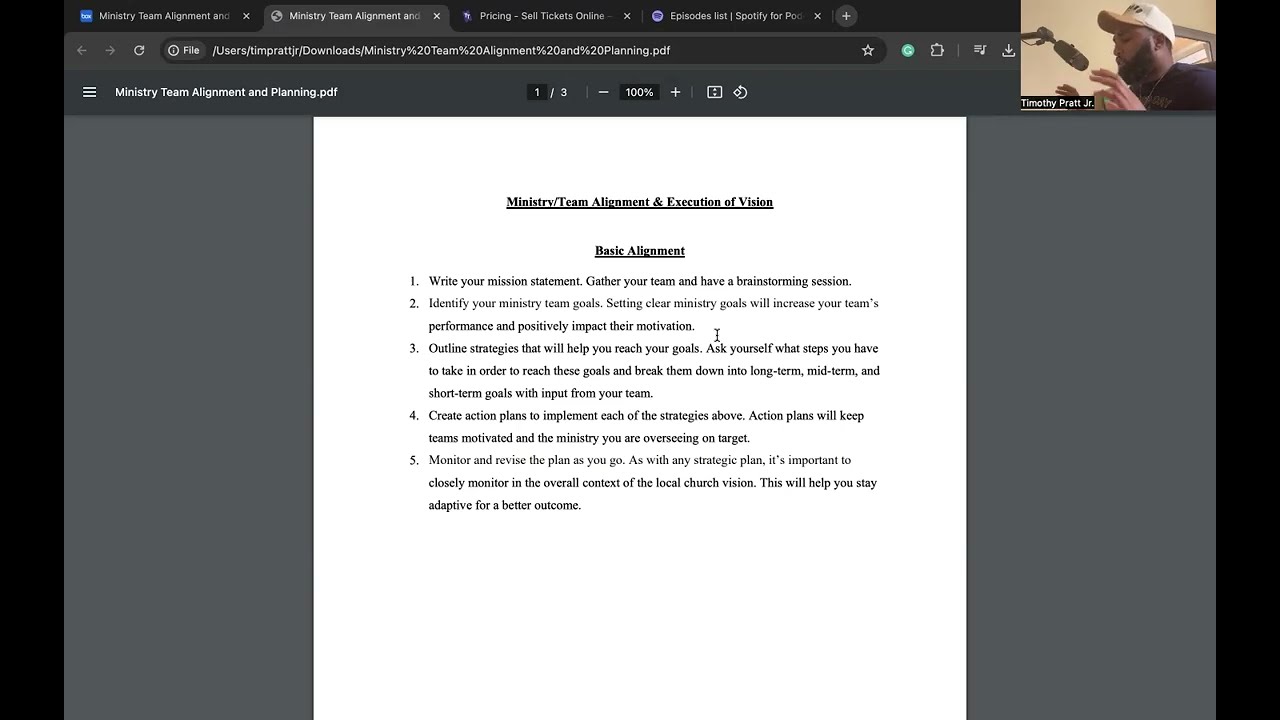
In this solo YouTube presentation Tim Pratt Jr., a senior agile delivery manager, leadership coach, and servant‑leader, shares a practical framework for aligning ministry teams and executing a shared vision. He begins with a brief professional background, then contrasts traditional “manager‑by‑title” approaches with his philosophy of managing processes while leading people. He outlines the essential steps for ministry alignment: crafting a concise mission statement with team input, defining clear ministry goals, developing SMART goals, and creating an actionable plan that includes task identification, resource allocation, and people assignment (emphasizing people as people, not resources). He stresses the need for prioritization, adaptability, and regular monitoring, recommending coaches or facilitators to guide the process. Tim then walks through a concrete quarterly roadmap example for a men’s ministry, detailing Q1‑Q4 objectives such as accountability groups, a one‑day men’s gathering, outreach projects, home‑renovation service, and a year‑end review. Throughout, he highlights communication, accountability, and the role of coaching, offering his own services and resources (PDF, podcast, website). The talk concludes with a call to leaders to assess their current effectiveness, consider coaching, and intentionally level up their leadership for 2024.
Chapters
Hey yo, what's up? So I'm Tim Pratt Jr. and let me make sure this is shared because I just recorded this and I wasn't in presentation mode. Um, so I'm doing it over again and this time it's gonna be a little bit more quicker, uh, but I'll try to pace myself. But this is YouTube so you can slow me down, uh, if needed. Uh, but just real quick to go ahead and get into it, um, so this is Ministry Team Alignment, uh, and Execution of Vision. Um, and basically, uh, just give you a little bit of background about myself. So I'm a senior agile delivery manager for 360 Insights, do a little bit of, uh, consulting and coaching. Uh, but essentially what that is and what I do is a leadership and team coach, uh, at the enterprise level, at the team level, as well as the individual level. Uh, so like I said, a lot of facilitation, a lot of coaching, uh, just project management in between technical project management. Through agility and things like of that nature. So all that said is that my primary thing in the secular environment is to just help, you know, I need to stop saying, you know, my primary responsibility is to help drive the execution of goals just from the executive team. That's including the CEO, of course, senior VPs on down to product, I mean, directors, VPs. Product leaders, as well as technology leaders and cross teams and all the above. So I'm kind of like that middle person where it's just like, hey, okay, you drive the vision. This is what we want. This is what we want to see. Now you help bring all this together and drive that. So I see myself as a servant leader, transformation leader, and coach primarily, as well as facilitator. And I believe a lot of those principles work. So now I'll switch gears and just only focus on the ministry element. Of this. So, um, this is just a basic alignment, uh, one to, uh, a basic alignment when it comes to— when you think about your team, uh, as a leader, your primary thing is to teach, facilitate, mentor, coach, as well as a few other things. But leadership is not how it used to be. Uh, you are there to champion your team and help set the goals, help drive alignment with your team. It's completely different. A lot of people are leaders by title only, uh, and it's sad. And a lot of people masquerade as managers, and you have to have both. You need managers and leaders, but a lot of people don't really know how to lead. Uh, they, they take a very dictator and management style approach, uh, and they try to manage people. But my philosophy is that you manage processes and procedures and things, and you lead people. Uh, but that's another topic for another day. I actually have content on that on my podcast, Student Life Podcast, as well as this YouTube channel, or you can go to www.timothyprattjr.org. Um, so let's jump into this. Let's— I want to stay focused on this. So basic alignment, uh, one of the things that you have to do— so when I say team, just automatically think about your committee that you're leading, auxiliary, uh, team, ministry team, whatever it is, board of whatever it is. Just think about that in that context, like that, that's what it is. So, um, you want it— you want to have basic alignment in anything that you do. And in order to do that, you have to have a mission statement. Um, you can read this, you know, more for yourself, but you have to have a mission statement, just something simple that you all can point to. And I love John C. Maxwell when he says It's not about me. It's not about you. It's about the bigger, bigger picture. So in the context of your team, you can say, it's not about you. It's not about me, but it's about our mission. It's about our mission statement. What are we going after? And as a leader, invite the whole team to have input on this because that's how you create buy-in. If you're the leader and it's just everything that you say goes, you're not going to have a lot of buy-in. So you want to do that as a leader, create the mission statement with your team. You want to identify your ministry goals, your ministry team goals. They have to be clear. They have to be very clear. And I'm gonna get unpack this more. You want to outline strategies that will help you reach those goals, basically like an action plan, uh, that leaks into number 4. So that's what's going to help you implement each of these strategies above. So whatever things that you put down, just things that you're throwing out there as you're brainstorming as a team, you have to have a clear action plan. And that's really going to be the bulk of it. And then you have to be able to monitor and revise that plan as you go. Things change. I think Mike Tyson got coined for the phrase, what is it? Everybody has a plan until they punch in the mouth or punch in the face or something like that. And that's true. So we have to be willing to adapt. We have to plan accordingly, but don't plan so deep and like just to the T where you're trying to plan the whole year and things come up and you can't really be adaptive. So Plan accordingly. And that's going to come time, which is having like someone that can guide you through this, a coach or a facilitator or something of that nature. And like, again, I'll be more than glad to help as I am certified in the Rise and Team Coach. So what is the action plan? So action plan, I like to think of this as an outline, simple framework for lack of better terms, but more so outline. It has to be SMART. So you want to create SMART SMART goals: specific, measurable, achievable, realistic, and time-bound. So for example, if I say, hey, I want to gain 20 pounds of muscle by March 31st— it's December 22nd— so that's a specific goal. I want to gain 20 pounds of muscle by March 31st. That's specific. It's measurable. Like, I can actually measure that. I can go to, you know, fitness coach or get on these scales, these high-tech stuff, and say, hey, did I gain 20 pounds of muscle? It's achievable, it's realistic, and it's time-bound. It has a date. Uh, again, so with our goals, when we're setting them up, we have to have those things. For example, now going back to ministry, I want to start a book club. What type of book club? By when? How many people do you want to try to have in that book club? Like, is it realistic? You know, it's December 22nd. I want to start a book club with 500 people in it by December 23rd. I mean, unless you, you know, have the reach of someone like Sarah Jakes Roberts or Michael Todd, maybe, maybe, but that's not a realistic time goal. So you just want to think that through as a leader. And these are things as a leader, again, you want to focus on., but you have to come out of the weeds and empower and trust your team, train, coach, motivate your team. Uh, so as a leader, create SMART goals, help create that synergy and point towards like, man, we all understand, um, the goal. They're SMART goals. You want to identify the task after that. So these are the steps that you need to take. Let's talk about kitchen committee. Uh, again, like I want to feed 50 people by X date, home-cooked meals by X date, snacks. Like, I want to go out and drive, like, I want the kitchen— I want to go out and hand deliver, I want to go, uh, deliver 100 meals to the Salvation Army, I want to sponsor 10 families, and we're going to help. These are things that we have to again think through as leaders and then start putting the tags together with who's gonna, um, I mean, what are the necessary steps that we're going to take? What are the necessary tasks that we need to have labeled on this thing to make that come to pass? Then after you have those tasks, now this is where you start allocating people and resources. People are not resources. Resources are things like budgets, equipment, and all of that type of stuff. People are people. And as a leader, again, you, you have, you have that responsibility. Who's going to own what? If we go back to the book club. Okay, who's gonna pick the book? How many days are they going to have the research and pick the book? Who's gonna— are you gonna market this? Who's gonna help set up the meetings and, and have the recurring meetings? Or are you going to bring speakers on that's familiar with the book? Um, are you gonna have people to divide and conquer? You know, who's going to, um, um, again, like, market it? Market this. Like, you, you have to know the book and the dates and, you know, all that type of stuff, uh, before you can actually put the flyer out. So these things help you allocate, um, the necessary people, but you have to have those tasks done. And that, that's, that are what— that's what leads into number 4. You can prioritize those things. So as a leader, like, when I look at things, uh, so if I have all my tasks I have the necessary people. I know the resources. Like, do we have the budget? Do we need to take up or raise money? So these are things like I have to know, and this is what's going to have to help me prioritize because it might be something that I want to do. And I say, man, we might not have that in budget, but we probably get it X date. So I might have to lower that task and raise something else up that's a little bit more budget friendly, or I might not have the necessary people right now to do XYZ task, so I have to move those things around as a leader. This is where adapting comes into play that we kind of pointed out, monitoring things as a leader. So if we don't have this in place, if we don't have those first 3 things in place, then we can't prioritize. Because that's the thing, if everything is on fire, nothing is on fire. If everything has to be done, nothing gets done. So we have to have all of these things identified as much as possible. So we can prioritize and help make the right decision in the context of our team, but also in the context of the ministry, the overall ministry, the overall organization. Uh, because the pastor might come in and say, hey, change the direction, you know, we're going to have to do this. Well, as a leader, I, you know, I can— if I can challenge it, hey, respectfully, in private, talking with that pastor, not galvanizing other leaders, but just having a conversation. But if that pastor says Hey, you know, I wasn't privy to that. We're going to go back to this. That might help him, but again, it has to be in decent order. Or he might say, I understand that, but, you know, I believe that the Lord is leading in this direction, yada yada yada, for lack of better terms. Um, okay, we have to come together and reprioritize some things in order to make that happen. Uh, set deadlines and milestones. Again, when does it need to be done by? Hey, we want to have a men's one-day men's conference or one-day men's event by June 1st, 2024. Okay, that's one. Now what is all that going to look like? We have the date, but what is all that going to look like? And then monitor and revise the plan. So now I don't want to be redundant here, but this is what really helps us drive that. And I'm not going to go very, very long-winded with this because like I say, most of the stuff is in here, but I just wanted to kind of like touch these points in a real quick video and I'll work with the, you know, necessary pastors going looking forward to kind of really drive and unplug this, uh, even more, like answer questions. Uh, I'm willing to coach and work with each auxiliary or department or team lead or ministry lead and that nature to just kind of help restructure those things, because all this is going to help feed into a roadmap that I believe every ministry should be responsible for producing, because this is what's going to help us see, uh, this is what we're committed to as teams that rolls up into the ministry. And this is what we're committing to as a ministry, um, as if we're going to help, you know, reach our community and build things within this local church as well as outside this local church. But that monitoring, revising, we have to have these things in place because again, if things come up, then I need to— I have to talk to the people that I'm accountable to, to talk to the pastor, the board, uh, my team, the community, all of these things. Like, this is what helps me. Having this stuff is what drives accountability, is what helps get results, uh, in this proper context. So this next page that I'm gonna hit on is that it's not necessarily— I'm not the men's ministry leader at, uh, neither ministry that I have, neither the ministries that help support, but I'm just using this example, uh, if I was the leader. And I'm also thinking like if I had a coach, this is how I would coach that person. I'm kind of looking at this from two different perspectives. Um, so create an example of a roadmap. So this is a high-level roadmap if I was the leader presenting just to the pastor or to, uh, to all leaders or whatever, a vision dinner or vision meeting or whatever, whatever of that nature. Uh, so the, the ministry vision or a mission statement or whatever, to provide opportunities specifically for men to fulfill 5 purposes in their lives: worship, Fellowship, Discipleship, Ministry, Mission. And our tagline will be Equipping Men Serving God. Uh, Men's Ministry Roadmap. So, uh, goal: end of Q1 2024, want to create accountability groups where each man is responsible for building relationship with a man in the community at least twice a month for 15 to 30 minutes. That could be on the phone, in person, on a Sunday here and there, through Zoom. Whatever, because I believe that you have to build relationships with people. Uh, you have to have relational equity with people if you want to invite them to do things. And a lot of times when it comes to the local church, our relational, uh, bank account is empty or negative with people. So we have to keep in mind, okay, what type of relational equity do I have with this person? Because when I invite them to something later on, it's not manipulative, but it's when I invite them, I might have some equity in there with them that it increases my odds of them coming when I invite them because I took time to spend with them. I poured into them so they might be more willing to come to something that I put on later on down the road. We would have to plan a plan in place for a 1-day Q2 men gathering event. So, so January through March, end of March. We're planning for the second quarter of the year, so that's, uh, April through the end of June, to have a one-day men's gathering. So just a men's conference or whatever it may be. We're gonna, like, we're gonna know everything that we have to have to execute this plan in the next quarter. Then we might have to re-establish a monthly men's meeting to pray, plan, and execute effective men's strategies and, uh, ministry in the ministry. So these are just, like I say, things to just think through. This is what we as a men's ministry will commit to at the end of Q1 2024. And again, like I said, I'm gonna drive this, make sure it is very, very clear, work with my team as well as the pastor, uh, the board, and all that type of stuff, however the ministry operates, uh, is aware. And then if it changes, I need to let them know. I need to communicate. I need to communicate. That's a big thing and a big challenge in a lot of organizations, uh, not just ministry. But, um, in a lot of stuff, marriages, whatever, communication, communication is key. It really is. Q2. Okay, here we go again. End of Q2, so the end of June, completed the men's gathering. So we should have had the one-day event, um, men's breakfast with the men we have been building a relationship in the community with. So inviting them out, just talking with them. Now all, all of us are coming together, so they should be connected with at least one man in that ministry, which will make it easier for all all of us to connect because everybody kind of has someone that they have took time to spend with. Uh, plan a sports day, you know, show up at a local game and help serve and connect with the younger men. Um, like I say, find out, are the younger men in sports? Have you ever showed up to at least just one game to show them that you care and support them? Uh, planning to help single mothers with boys, like, like an outreach day, going to get those boys and say, hey, I'm going to help pour into them, I'm gonna be a male figure, a father figure, uh, in their life if they don't one. And if they do, hey, I'm gonna come alongside and I can help, because it does take a village. It's a lot of men that help me with my kids. My, my, for one, my father, my father-in-law, I have uncles, all these type of things, coaches. They, they pour into, they help. And so as, as men, you know, we, we can think of that, um, as we, you know, like say, plan our roadmap, um End of Q3, Operation Help Renovate 2 Homes for Families in Need. So just some light stuff, light touch-ups, as men like come together, identify, talk with them and say, hey, part of the men's ministry here, we're going to help do some renovation work to your home. We see there's a need, and take pictures and capture it. Have someone that's skilled in that area and do that and promote it. Like, not for like just promoting it to say, hey, look at me, look at what I'm doing, but promote it because this might help people sow into that and say, man, like, they're doing it. I want to sow a part of this. I want to be— I want— because sometimes, like, there's a difference from bragging and trying to ignite people. So we just have to know what is the motive behind it, you know. If you want to get just praise, then that's not a good motive. But if you want to— hey, I'm trying to champion and ignite people, um, to give and, and, and see that we are about kingdom business in the community. I'm trying, like I said again, trying to inspire others to take this on. A men's game day outing. Go to a football game, a basketball game, and just fellowship with one another. Baseball, whatever. And just love on each other, fellowship, take pictures again, and show that, man, we can do things outside of the four walls. Uh, and then in Q4, we're going to review. We're going to review 2024. We're going to start doing some planning for 2025. And then we're going to complete another, uh, men's day Gathering. So that would have— we would have had two. So again, like I said, just a very, very simple framework. This can work for women's, youth, um, young adults, all that type of stuff. But it's just, as a leader, it's forcing you to just think through those things to help drive execution. Like, again, food pantry, uh, praise team, you know, choir. Are you putting on a concert? Would you have been putting on a Christmas musical? Uh, will you put on, um, something, just a musical or workshop next year? Like, these are things that we just, like I said again, have to think about as leaders, and we have to pull out of the weeds with being so deep in the trenches on stuff and say, okay, now if I can focus on this as a leader, then All of this should feed into— with me helping champion my team, coach, teach, mentor— this should feed into the overall roadmap for the ministry. So we'll have a holistic system view of understanding not just what my team is responsible for, but I'm also seeing what other teams are responsible for. Because a lot of times in smaller ministries, for sure, um, a lot of people sit across different teams. And if we're not careful, man, uh, people will be committed more to the ministry than their family. Um, and you know, when they have a job on top of that. So because no one really has a plan, like no one is really looking at and thinking how all of these things work together, uh, to bring God the glory. And I'm one person where like, I just like to see stuff on paper. I know that it can change, but that's what's wrong with a lot of us now. So we try to keep up with things in our head and say, yeah, yeah, you know, we're going and And it's nothing to measure. And again, because a lot of people— yeah, yeah, reading books and all that stuff is good, but a lot of people lead from a theoretical place versus an applicable, uh, proven place. Uh, because with me, like I said, I'm tested and tried in this every day. I've been doing this, uh, I've been in the leadership space since 2017 and more of a senior leader responsible for others, a leader of leaders, uh, for the last 3 and a half years, I believe, uh, if not 4. So, um, I just want to, like I say, just challenge you as a leader, like, just really start thinking of alignment and how can I bring this together. And you might need a coach early on or for a few sessions to help you drive this on. I mean, and that's another thing, like I say, I, I focus on, and if I don't know it, I can recommend another coach, or I can work with other coaches to help me help you. That's how I, like, do things in the secular. Um, so don't, like I say, shy away from just, you know, really learning your team, spending time and knowing your people, knowing the people that you work for. And remember that you lead people, but you manage processes and procedures. I don't believe in managing people. I don't. I feel like that you can only lead people because if you can't lead yourself well, you have no business leading a team. Let alone trying to lead an organization or a ministry of that nature. So you have to lead yourself well in order to lead your team well and to lead your organization or your ministry well. So I hope this has helped. Again, this was very, very light. I didn't want to be, you know, just too deep into it. Like, this is going to require a lot of conversation, a lot of facilitation, and just helping, coaching, facilitating, and working with, uh, department or team ministry leaders, auxiliary leaders one-on-one or maybe a few at a time and just helping unpack and build this, uh, but to aggressively get this up in Q, uh, 2024 and then just keep iterating on it, revise, make it better. But just like use this as a guide to start like scratching that itch or just getting that thought process going to say, man, you know, as a leader, let me have an honest assessment of what I've accomplished and what I have been delegated the authority from my pastor or whatever to lead? You know, has it been successful? Has it been stagnant? Does it feel like it's stalled out? How can I turn right this ship? Because it's possible. And that's another area, uh, that I focus on. Like, I have walked in what's probably considered challenging and dead teams, uh, and I've had to help turn the ship around. It's actually a book out there that's titled that, that's really, really good, that helps you, as well as many others, um,, you know, doing that, Five Dysfunctions of Teams and all of that type of stuff by Patrick Lencioni. So, uh, again, I'm very skilled and versed in those areas, not to brag by any means, but I'm just letting you know that it's possible. But you might need help and you might need some coaching. Uh, coaching is what helped me take my game to the next level. All athletes, LeBron, Michael Jordan, all of them had great coaches. As great as they were, they had coaches. Tiger Woods, it was his— nothing was wrong with his shot. But he got a coach to still improve it. So just consider that. And again, um, I really hope this helped. Uh, and like I said, I have the PDF, we'll get all of that out. But again, man, just level up. I hope you have a very, very prosperous 2024. Merry Christmas, Happy New Year, just all the above, man. I love you all. And again, man, let's really level up in our leadership to carry the things of God forward. Love you all, be blessed.










