Personal Finance: Kingdom Stewardship
In this 40‑minute solo presentation Tim Pratt Jr. shares his personal financial journey and frames personal finance through a "kingdom stewardship" lens for ministry audiences. He recounts how, starting at age 21, three books – Rich Dad Poor Dad, The Compound Effect, and Dave Ramsey’s The Total Money Makeover – sparked a disciplined approach that led him to pay off his car, become debt‑free in his mid‑20s, and build a six‑figure net‑worth through 401(k)s, Roth IRAs and early investing. Tim then grounds his story in Scripture (1 Tim 6:10, Proverbs 6:6‑11, the Parable of the Talents) to argue that money is a neutral tool, not an idol, and that Christians are called to be wealthy enough to bless others without making wealth their god. He warns against the common pitfall of ignoring biblical financial counsel, stresses the importance of seeking multiple advisors, and critiques the “money‑first” mentality that can trap believers in bondage. Practical advice follows: budgeting methods (zero‑based, percentage‑of‑income, automation), debt‑snowball/"baby steps" tactics, increasing income through overtime or a second job, and the necessity of short‑term sacrifices for long‑term freedom. Tim demonstrates the power of compound interest with simple calculators, showing how early, consistent contributions dramatically outpace later, larger contributions. He concludes with a call to develop a legacy that blends spiritual discipleship, generous giving, and prudent financial planning, urging listeners to start now, seek counsel, and align their financial decisions with kingdom values.
Chapters
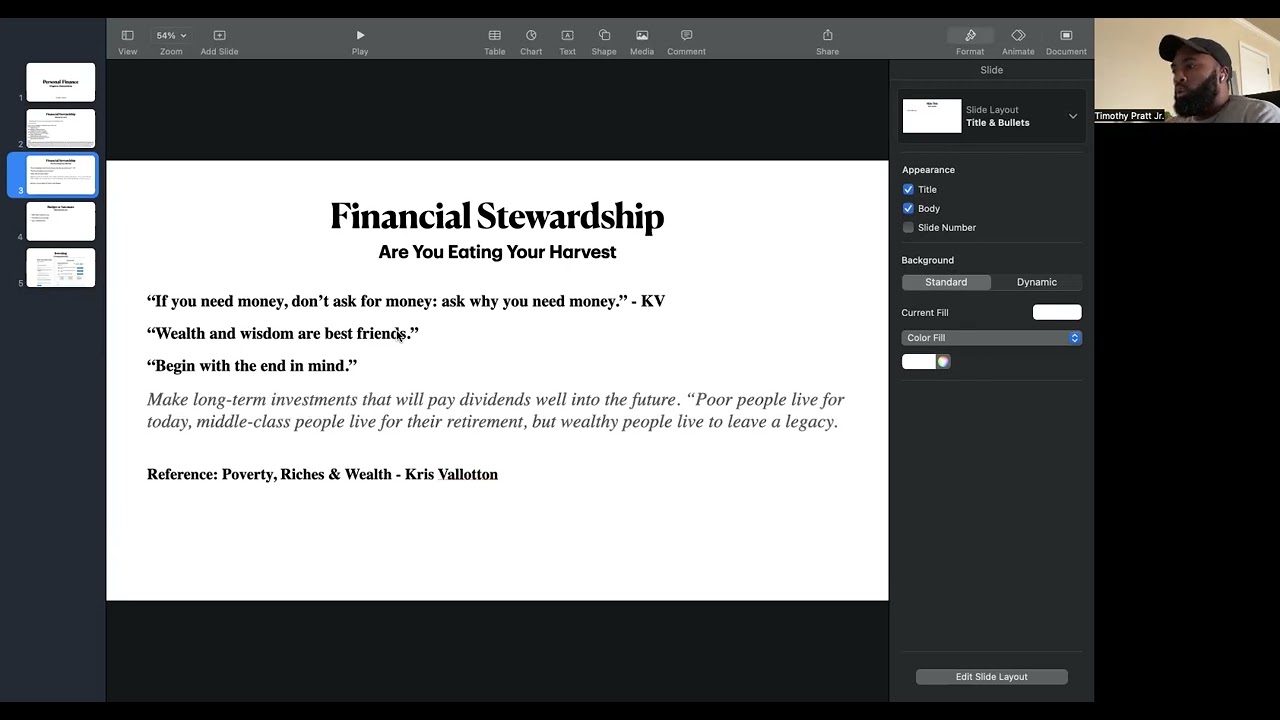
And what's up, so this is Tim Pratt Jr. Uh, and man, I want to just like do this, um, like personal finance, uh, just through the lens of kingdom stewardship, uh, here for the ministries and stuff. So this is definitely tailored to, um, a few different ministries that I'm trying to just help support and put things in the context. I'm gonna keep it very neutral Uh, but I think this is just be a good kickoff. And then I think, you know, I can say starting January, um, I'll be moving forward, like I say, just teaching this more in depth, um, you know, and just trying to help coach and drive things like this. So just kind of give you a background, uh, so, uh, when I was about 21 years old— I, I'm 33 now, so what, about 12 years ago, I think, uh, almost 34— so a little bit, almost 13 years ago. But our two book— well, three books that I, I actually came in contact with. So Rich Dad Poor Dad, uh, Compound Effect, and, um, Rich Dad Poor Dad by Robert T. Kiyosaki, uh, Compound Effect by Darren Hardy, and The Total Money Makeover by Dave Ramsey. And that led into Financial Peace University. And, you know, basically financial— I'm sorry, um Rich Dad Poor Dad is a way different mental philosophy than Total Money Makeover. But for the most part, they both teach, you know, pretty good principles when it comes to money and finance. And then The Compound Effect, it was just more so just a great book with just winning in all areas of life, just to be honest, and just teaching us how things compound, why we should stay consistent no matter what. It's better to say I'm going to commit to something for 15 minutes, over the course of consistency versus saying, hey, I'm gonna do something 3, 4 hours here and there. And you know, I'm doing 3, 4 hours, whether I wanna do it 3, 4 hours here or do it a day, miss it by a couple of months, do it a day. It, it doesn't work even if you just go high intensity. Um, and so just through those 3 books being 21, man, I learned a lot. Um, and I'm just thankful that I seen the information, don't even know how I got into it like that, but I seen it. I went to a workshop, and then those 3 books, man, I labored and poured into so much, which led to other things. It's just really studying success and finance. I mean, I— it became so bad that truthfully, uh, it almost— it might have become an idol, you know. And I had to repent, of course. Thank God that course correcting through his faithfulness and conviction. But what I'm trying to say is that I learned a lot, even to the point where I was going through the rigorous training before it, like, you know, it really became popular. But I was going through, like, financial classes, financial coaching classes, and I started a business where I did, like, a lot of coaching of various people from all walks of life because I had a mentor. And then I got out of it because it was just— it was too much. And to this day, sometimes I was like, man, I wish I would have kept it because there's no telling what it— what it evolved into. Uh, but it led to me like pay off my car, start investing early, you know, through retirement and investment vehicles. Like, like I said, paid off my car, invested over a net worth of $100,000, was debt-free, uh, all in my early to mid-20s. And it was just this, this track record. And, you know, some of those things are still compounding and working today. And a lot of that was in retirement, uh, so that money is still growing. It's 401s and Roths and things like that. So, uh, then time went on, you know, of course got remarried, you know, kids, uh, and things like that. So I had to make adjustments, uh, and— but I'm thankful that that seed was planted back then. And of course I still stay consistent with it. I'm not putting as much as I used to in it, but, uh, I was able to do a lot of that, that work. And I'm seeing the fruit of that as I pay attention, you know, year over year, a quarter over quarter, you know, how this money is growing. And hopefully through the power of God and faithfulness and staying just good, proper kingdom stewardship, uh, it ends up, you know, helping alleviate a lot of things and helping my wife and I change, uh, just certain things with our family tree when it comes to just, you know, leaving a legacy that's spiritual but also leaving a legacy that's, you know, financial, uh, and, and mindset and everything. Uh, so all of that to be said, just kind of give you a little background and why I'm doing this. Um, So this will be in the context of ministry. But let me just start with this disclaimer. This is not financial advice, so to speak. This is more so just to get the ball rolling. The market is flooded with a lot of different people that contradict one another. So I'm just very— say very, very basic. I want to put that out there. This is not financial advice. This is just a something to get the ball rolling. And then hopefully, you know, in due time, you might see me at your local church or you might see me through Zoom workshops or whatever, helping you understand and most importantly rightly dividing the word of God when it comes to personal finance. So that being said, let's, let's get into it. So personal finance, kingdom stewardship, Tim Pratt Jr. Today is November 30th, 2023. So the first thing that I want to address, and I'm not going to read all of this, like you can pause the screen and read it, take a screenshot. There's plenty of verses when it comes to managing money in the Bible, especially the Book of Proverbs and Ecclesiastes. But 1 Timothy 6:10, you know, for the love of money is the root of all kinds of evil. This is often misquoted. The love of money is the root. I mean, money is the root of all evil and it's not. It's the love of it. It's because basically, like also in one scripture, we can't serve God and mammoth, which is money. It's when money becomes our God, when we chase the bag, when whatever the latest terminology is out there today, it's when we say everything that I'm doing is for money, like nothing else matters. I, I have made money my God. Uh, and then Proverbs 6, uh, and 6:11, it's just more so talking about how we should consider the ways of an ant, how it works the ground you know, it puts up its stores. It's— this is in Proverbs, like it stores for a future harvest. And then there's some notes down there, you know, how we are to be wise with our money. So I encourage you to read these and study these in this contextual, uh, fact, but just use it as a guide. Uh, but I want to just say this in the context of our financial stewardship: money isn't evil. Money is a tool, and it is a tool that's used in this world to just help get things going. I mean, it's, it's up there with just, you know, the quality of life and so on. Now, now again, I'm not talking about you spiritually. Like, yes, you are valued by God. You have— you, if you've accepted Christ and you live for him, awesome. It is the greatest thing you can do because why would you want to be successful in financial stewardship or whatever and lose your soul. But what I would challenge you, if you are a person of faith, why would you want to just have your soul saved but live in financial bondage in this world when God has placed us here to be a blessing? Now, I'm not saying everybody should be rich and have millions and millions of dollars and multi-millions and billionaires and things like that. I'm not saying that. But I do believe that we should aspire to be wealthy in the context of scripture. Uh, I don't see nothing wrong because a lot of times we like to put one against the other. I don't do that. I'm like, okay, why can I not be saved and on fire for God but at the same time have aspirations to be wealthy so I can be a blessing to the very prayers that a lot of people are praying? And truthfully, you know, outside of a miraculous healing or something like that most of the stuff people are praying about involves money. Like, I, I, that's something, the correlation I've always— yes, God, he, he has always worked through people, whether it's somebody that's buried in debt, they need food, they need a car, they, uh, trying to make ends meet, they need a house. I mean, a lot of these things revolve around money as being the primary tool. If they are sick and they need a doctor and they don't have good health care money touches that. Now, can God touch someone's heart and they do it pro bono and God work? But I can guarantee you, somewhere along the lines, with a lot of things, God has touched somebody's heart and it involved money to get something done. It's a tool. Like, so we have to stop teaching in a way that puts one against the other. And, and that's really just, just from my perspective, it's just, it's, it's poor leadership from the Bible. Uh, now the— yes, the priority from any pastor or any spiritual person that's responsible for souls, it should be teach the gospel, teach that, hey, your soul needs to be saved and you need to become a disciple of the word, you need to be plugged in. That is true. But I, I have to be very careful that I don't put one against the other. And I like what one video said when this guy was like, man, you know, people think just because they come up there and all their life they sold to the ministry, they sold to the ministry, and they were faithful, so— but they No one never taught them biblical finance and proper financial stewardship, proper kingdom stewardship. We know the verses in the Bible with the servant and the talents and things like that, the master giving the talents to the servants. But the thing is, is that they never were taught how to come out of debt, how to get their income up, how to make a sacrifice for a few years in order— as Dave Ramsey say, live like no one else so you can live like no one else. So doing these things doesn't mean that it's evil. It's biblical. But we just can't let the accumulation of wealth or trying to become rich or whatever, we can't allow it to just be our God. So you can have aspirations to be wealthy, you know, whether it's 10, 15 years from now, putting yourself in position, but also being that one to say, hey, I am going to change. I don't know if Jesus is going to come back today or tomorrow or 100 years, 200 years from now. What? But I'm going to plan. Like, I'm 33, so I'm— I have— I've said this a while back, if it was just about me— excuse me, guys, excuse me— if it was just about me, oh man, I had a Tesla, the Range Rover truck, probably would have been staying in a condo. Now, lifestyle would have probably changed when I met Naisha, um, because I mean, you know, it's a family, I'm a family. So we probably would have had the A— the A— whatever, the, the biggest Uh, SUV that you can get. I would have— we, we probably— like, that's kind of how I probably would have been living, you know, and wanting to do for my wife. But thank God she's not even like that, you know. She's a, um, she's a saver, and she, she wants to learn more and more about this. So we make decisions and try to find that balance, you know. How do we do what we supposed to do, like, not rob God of blessing us and growing the wealth in the future, but at the same time still enjoy life and make those sacrifices. So I can't get into all of that right now, but I just wanted to say that to just give you some context, uh, and, and what I'm saying primarily in Proverbs 6, uh, and 6— Proverbs 6:6-11. Uh, so money isn't evil. I just want to say that before we move any, uh, down to this end anymore. It's only 5 slides. Um, so financial stewardship. Are you eating your harvest? Now I'm going to read these. If you need money, don't ask for money, ask why you need money. Uh, wealth and wisdom are best friends. I would say typically best friends. Wealth and wisdom are best friends. I know that this world is corrupt. I know, I know all of that, but people like Dave Ramsey have been preaching for finance preached about finance for over 30-something years. Um, make long-term investments that will pay dividends well into the future. Poor people live for today, middle-class people live for their retirement, but wealthy people live to leave a legacy. And it referenced the book Poverty, Riches, and Wealth, uh, by Chris. Uh, so I want to spend some time on this slide for sure. Um, Again, this world is very corrupt, man. I'm not even gonna lie to you. Uh, we're in a situation now in 2023 where inflation is whooping people's tail. And I, I just— I'm not going to say his name, but I just had a conversation with the financial advisor, and I was just asking him some questions, you know, about people that are getting up in age. And he said, man, you don't know how many times— uh, actually, I consider him my financial advisor. He was like saying, Tim, you don't know how many times, like, people have walked in my office and they are crying because they didn't steward well. Sometimes they're people of faith, they believe God, but they never took a— took time to write a plan down. Um, they never took time to partake in wise counsel. They never reached out to a financial advisor, uh, when the Bible clearly teaches that about a multitude of counsel and things like so. It's easier for these people to say, well, this, this world system, which is again, is bad, but God knew this world system was going to be this world system before the, before the foundation, before he even spoke a word. And his word taught us that we should seek these things out. We should seek these things out. So it's really no excuse. And talking to my therapist the other day, he was like, man, that's, that's the thing. He was like, some of us were just completely ignorant. But I just believe I have it. I have a hard time to believe that people that are in their 60s or 70s now didn't hear not one person talk about savings and investing, you know. And you might say that's harsh because people come up and, you know, different mindsets and things like that. And no matter how much you show them that someone could come from the same condition, but how did they go on to be successful in certain avenues and things like that? They reject it because truthfully that is a poverty mindset. I understand that we all come through different walks of life and, and different challenges and backgrounds, but if we have a poverty mindset like this third one, begin with the end in mind— if I can't see through the power of God and through hard work and self-discipline and going around and getting around people that are, uh, doing things that I'm aspiring to do Even if they— I believe you can sometimes study people that might not be so for God, but God can teach you through them where he can say, okay, I don't want you to do it that way, but I'm still going to allow and use them to teach you what you need. But I want you to go back and do it with a pure heart. This is the God that we serve, and this is just how my mind work and my relationship with him. And like I say, that's just me. Like, through the power of God, I believe that I can learn from anybody. And because I'm dedicated to the word of God first, I just believe that he will teach me. And then it might be some people like, no, no, that's too toxic. It's somebody way more better you can learn from than that. Just yielding to him. But I have to plug in and study his word. I apologize for my sinus is messing up, but I have to plug in and study for his word, study his word to know how to navigate those spaces. So if you need money, don't ask for money, ask why you need it. If, if something is propelling you— because see, what I'm afraid of in the body of Christ is that we look at verses and we quote things about a leap of faith. And there was times that, you know, I can go point to Abraham where God told Abraham, leave, and Abraham left everything. But God told him that. And I believe that in today's time, you know, I believe that we have deep convictions, and sometimes we— this is why I always say, I believe God is saying But anytime that I believe God is telling me something, I am going to spend so much time. My wife can tell you that when we literally paid off one of our vehicles, I believe that the Spirit of the Lord had spoke to me and said, pay it off. And I'm like, man, this is a pretty hefty thing. And now keep in mind, I didn't know COVID was about to happen, but it— I didn't know like the situation with our daughter coming into the world and our kids and having to be at home and teach them. But God knew, and I believe when God spoke and told me that, I'm like, Lord, you want me. And so I had— then I had to go to my wife, and I love it because, man, my wife blessed me because she was just like, babe, if that's what God told you. And I had never really pulled that card with my wife, but God told me and she was in agreement. We paid it all, but we didn't know all this stuff was about to come. And so my wife had to be at home, and thank God that I work a pretty good job in technology where that income, it allowed us, man, where my wife could be at home and help get the kids and just never help us navigate through a very difficult time on top of having a daughter. So, but I had— I, like, I was like, Lord, is this really you? I was sure because I didn't want to take a leap of faith without a leap of wisdom. And a lot of times in, in the church, man, you know, we, we make these moves and we say, well, God told me. But I'm one— I, I understand God can refine us, he can prune us, uh, but a lot of times this is what happens. Thank you, Holy Spirit. We take a leap of faith without God's leap of wisdom. It's us, it's— we want to produce and manufacture this, and then that's what happens, because now we're getting bondage. And then now we're in a situation where it— we start to do things that's— I'm not saying illegal, but it's outside of God's order. Like, how, how— why would God lead you into an area but then at the same time now you're in bondage when his word is all about freedom? I, I don't believe God works like this. So I will hear what people say, but then I just say, man, you know, did you consult a multitude of counselors, or were you so full of yourself that you did do it? Did you consult experts? I'm not saying they have to make the decision, but did you talk to them and lay out the facts? Counseling, where maybe a financial advisor would say, you don't have enough, this is not a wise decision. Or they would have said, hey, let's think this through to make sure, man, you're not going to do something that's detrimental to you or your family, or it's going to change the way— man, really, truly, this is going to take you from God. Because you gotta have to work so much that you're not even going to have time for the most important things that God said should be first. So why would God put you in the situation and do that to you? Like I say, that's me. This is not to beat anyone up, but I just— I really want to start challenging our narrative when we say God told us when it comes to financial stewardship or kingdom stewardship. But this leads us to eat our harvest. So if we need money now, you know, of course if you need someone, someone can loan it to you, but do the deeper work. Why am I habitually asking for money? Maybe I need to get my income up temporarily. Dave Ramsey, you know, when people, uh, are doing a debt snowball, a lot of what a lot of people don't know is when I first came to the game, I was only an intern on the hourly rate. And when I caught this stuff, you know, I didn't go deliver pizzas, but what I did do— I would have, but What I did, I asked my job at the time, like, because I was just a drafter technician, so, you know, working between the floor and doing drafting and coding, like, I mean, not coding, but, uh, 2D, uh, sketching and stuff on the computer and 3D modeling. I had access. I was like, man, I'm willing to take on anything. So it was just so much overtime, and I was using that overtime to pay my car note at the time. Was like, I had just got a Camaro, so it was like $4 something, but I was paying like $800 something a month because I was like, dang, if I pay this— and then finally got down like $4 or $5 grand, I was like, here, here's— because I was saving and I was like, boom, it's done. Same approach with my student loans. And so I became completely debt-free at like 27, 26 maybe. No, it was earlier than it actually— yeah, it's like 25 or 26. Oh, sorry. So the thing is, is that when it, when it comes to these things, uh, I believe God had taught me through other people. I was able to grasp it and see it. I spent so much time with it. Then I went back to scripture and, you know, and, and just kept going back and forth because Dave Ramsey is a lot more scripture-based, where The Compound Effect and Robert T. Kiyosaki wasn't. But you still see kingdom principles in their writing. And so I had to work. I had to do things that was outside of the norm. So for 3 years almost, man, it was like just continuous overtime to change the situation. My income had to go up because that just wasn't enough money. But then finally I was able to let it go. And I think at that time, I believe it was God, like they were like, hey, you know, overtime was a lot more stricter. Then, you know, I changed. I ended up changing jobs, going salary. And stuff like that. And so then that led to a whole nother different career, but I was debt-free. I was able to take those risks. I was able to take less money to end up making more money because my financial situation didn't dictate the opportunities that I could and couldn't take. And that's how I still live my life today. So ask, ask yourself, if you need money, don't ask for money, but ask why you need money. Do the hard work. You might be in a situation where it's not— you have to let go of the pride and say you know what, I got to go get this second job. I got to go get my income up, man, to start this debt snowball. And I'm not going to get into it because you can just go look at the Baby Steps from Dave Ramsey and Financial Peace University. But I'll be more than willing to work, walk you through it, teach on it if you need me, if, you know, for whatever reason you can't afford those resources. But a lot of his research is out there. You just have to do it. And so when it comes to finance, you know, we can't keep teaching people to sow, sow, sow, sow, sow. But at the same time, without teaching them like, hey, you, you gotta do some stuff too where you can be a giver, you know? Because a lot of people have sown and then it's like, why? I, I, I'm not— I'm seeing some spiritual things. I do believe God is going to take care of his own. Let me back up and slow down. I do believe that there's a principle of sowing and giving, and God is going to use that, whether it be spiritual, financial, however he chooses to distribute based off of your sowing. But that still does not negate the responsibility to be a proper steward just because you're sowing. Money is a tool. Because what I'm trying to say is a lot of people think just because they sow, then they don't really have to still do the work and manage your money properly. And then finally, when they catch up and they say, well, I've been sowing all this time, but I never took the same energy to manage my— manage to steward over the money that God entrusted me properly, Oh, it's the church fault. The church took all my money, or those people took all my money. No, no, no. You just didn't manage or steward properly. And so we have to just accept that once we come into that realization. So, okay, I was ignorant. I've come into the realization. Change now. Make the change right then. Get with a counselor. Reach out to someone like me. Like I said, I used to be a financial coach, uh, so I could help to up until a certain extent. But then I can point you— I have, I have relationships with pretty good financial advisors, and most of the time You know, like, I feel like they are needed, but I can help coach you and prepare you. And most of the time when I sat down with, you know, various financial advisors, they were just shocked and amazed. And I'm not trying to beat my own drum or whatever, but they were just shocked and amazed. It's like, wow, you do— because I took the time to study. Anybody can do it. So you want to make long-term investments that will pay dividends into the future. That's where you need to position yourself. Even being a believer. But poor people live for today. So if you have a poor mindset, what's the point of having a rich mindset in the things of God but being poor when it comes to living on this world? It's like being a saved soul but a wasted life. A saved soul but a wasted life. You couldn't impact nothing else. I don't even believe that that's kingdom. That's not kingdom-minded. That's selfish. Now, you might say that's harsh and extreme, you know, and I understand that some people, that might just be their situation. That's why we have to define what success looks like to us, and so on and so on. Because someone might get a job at McDonald's, and they have, you know, a 15-year-old car and an apartment, and they're able to do things here and there. And, you know, but primarily keep up the necessities, that could be a huge success for them. And there's nothing wrong with that, especially if they're saved. So we have to define what it looks like for us, not letting someone else or social media dictate what success looks like. Uh, so long-term investments, man, we have to make sure that we have wealth. And wealth and wisdom are best friends. I would even go as far as say faith and wisdom, if, if they best friends, then faith and wisdom are brothers and sisters. They like, they just siblings. So don't take a leap of faith without taking a leap of wisdom, you know. Don't do that. Don't, don't destroy your family. Because going back to that financial advisor, he was like, man, because of inflation, because of the things like people— what people are coming in terms with now is that they are seeing that, man, I played with time. I didn't invest. And even to the point where he was sharing with me, man, like, now this generation coming after me, they almost have to start investing at 18. Soon as they turn 18, they need to start investing. It's going to take projected $5 to $6 million for my wife not to live comfortably in retirement due to inflation. So we, we live in our life, but also too, we're investing. We're— I'm not, I'm not a rich person. I'm not even gonna try to live like that, you know. Like, we, we are pretty good And I do believe that things are going to hit, and we, we, you know, we are working. I believe in due time those things are going to hit, you know, some side projects and our salaries continue to go up. But I'm not going to live like I'm LeBron James when he's a billionaire. I'ma stay within my wages so, you know, uh, so I can live a life and lead my family well, so I can be a giver within my means, and I can get sacrificial when God calls me to it. Tithing, and so on and so on. Uh, so you just want to make sure, man, you're not eating your harvest and then using the Bible out of context to justify the eating of the harvest, is what I'm trying to say. Uh, budget or automate, what should I do? You got to find what works for you. Uh, but again, you know, some people might say, well, you know, I'm not in a situation where I can save, or if I go to the Dave Ramsey thing, $1,000. Okay, then we have to start step one. You got to get the income up. Like I was saying in the previous slide, you, you, we have, we have to get your income up. And like I say, that might be temporarily for you to pay off some debt aggressively. Don't play with it because then you find yourself in a job for 10, 15 years. No, set a goal and say, hey, all the extra income that I didn't have, now I'm going to sacrifice time away from my family, my kids, probably have to give up some things I like doing because I want to live like no one else so I can live like no one else. And as much as my wife say, no, no, you're not getting a second job, I promise you, as much as I love my wife, that's one time I probably will pull that card and say, babe, I'm not asking. If we were in bondage, this is a man, I'm going to get a second job. Now I would, you know, of course hear my wife pray and things like that, but I'm not going to sit back. I'm going to do whatever I have to do. I don't care about pride. I'm like, man, I hope this is only a 2, 3 years. Let's work this thing. And then once it's all paid, now it's by the grace of God, still living and all that type of stuff. Now I can live like no one else. So now we have got out of that financial bondage, um, and now I can spend more time with my wife and my kids and my family, take them places and do things. But I had to make a sacrifice in order to have more time on the back end. Why would I want to live in that bondage and carry that if I'm still living through the grace of God? Why would I want to carry that for 20, 25, 30 years when I can just get up off my butt and say, man, I'm going to sacrifice sacrifice in the short term. I gotta do what I don't want to do. I have to do what I have to do so I can do some of the things I want to do, or what I need to be doing. So yeah, I might have to sacrifice a lot of time with my wife and my kids, but I'm explaining the plan to my family, let them know, and, and how they can understand that this is what Daddy is trying to do. This is what Daddy and Mommy is trying to do. And I'm gonna make sure that once it's done, I'm not gonna get tripped up and get caught up in like letting it become my God. Say no, no, this is it. Now I'm gonna get back to the things that really matter. Thank you all for allowing me to sacrifice so I could position and lead my family and steward over my family well through the power of God. So yes, you might have to start there in order to even budget, because you might say, man, I'm, I'm not even paycheck to paycheck. Like, I'm paycheck to the next week hoping that the next paycheck here again— you might be somewhere in there. Gotta get the income up, gotta make those sacrifices, and it had to be tough and hard conversations. Especially if you're married. If you're single, it's a little bit easier, but if you're married, it has to be some tough conversation that we're not gonna— hey, we— I understand that you trust in God, but at the same time, do you really believe God want us like this, or is this something we're doing? That's what we have to figure out. A house should be no more than 30% of our, uh, 30% of our budget. The whole entire house. I mean, in property taxes, insurance, the mortgage, all of that. Like, we have to go study those rule of thumbs. They out there. So find what works for you, determine a percentage, and stay consistent. So either, like I say, it's all the same. Some people like doing a zero-based budget, and some people, um, they like to just automate. Say, hey, loans at 10% going here, as long as the other 10% going here. That 20% going here, or 10, 10, 10, and then I'm— the 70% covers everything in between. Hey, I'm good. Then some people like to say, no, no, I want to get more detail where every dollar has a name. Every dollar has a name. Before the month start, it has a name. You have to find what works for you, and it's going to take time. You're not going to get it right the first time, and that's why a lot of people don't stick to it. But, uh, and then like I said, the biggest thing is once you find it and you keep Inspecting and adapting, stay consistent. You have to stay consistent. Consistency compounds. And that leads me to this next slide, um, investing compound interest. So I'm just going to play with this for a little bit. So you can see here, this is the age 23. If this person's at 23, uh, started investing with $1,000 and put back $150 a month, and I'm going off of, you know, what the latest data said, that annual returns 10 based on the market over the last couple, uh, couple of years. Uh, but yeah, $151,000, 23.67%, $150— I mean, I'm sorry, $1.5 million. $1.5 million. But like I said, don't get so much caught up, but look at the contributions. This is the power of compound interest. $79, uh, almost $80,000, but the growth is 1.4%. And all they did was started with $1,000. So just imagine if you were investing, just you stayed at $150, and most of the time we're not going to even stay there. And I want to share something else just real quick. Where am I at on time? Um, let me pull this calculator up just to show you these numbers. So this is live. Just want to show you something, uh, here. So let's get Zoom back up and running before my computer goes dead. Let me plug that up. I want it to cut out on me. Okay, I'm just trying to do this live. I apologize. All right. Oh, it's still recording. Okay, cool. All right, so let me share my screen. All right, so again, let's say this person goes up and they get theirself in a situation, you know, stay consistent, keep positioning themselves. $300, I'm like, $500, I'm like Now let's say this person plays around, they just keep making dumb decision after dumb decision, foolish decisions, and they start at $40,000. Look at compound interest. Even if this person went up, look, and gave $1,500 more. What I'm trying to show you here, and I, I can definitely explain this a lot more better, Uh, but what I'm trying to show you here, even if this person started at 40 and gave $1,500 more a month, they still can't beat that person. Um, they still can't beat that person. I hope I was sharing. Oh man, I don't think I was sharing. Okay, I apologize, I don't know if I was sharing or not. All right, let's put this here. Sorry about that. Okay, so let's go back. See there, uh, doing too much. All right, so $25 a month, let's say for instance this person was putting back $250 a month, and then over the course of time, they— their income continued to go up, and they put back $500 a month. Almost $4 million at 25. If they started 2 years earlier, they had $4.8. Another 2 years, almost $6 million. Compound interest, you can't beat it. You can't beat compound interest. So let's say this— the person waits and waits and waits with their financial future. So they say, I'm gonna start at 40. All of a sudden they have an aha moment, I need to start back, put back for retirement. So say if they only able to put back $250, or basically a little bit over $400,000, but even if they put back $2,000 a month, they still can't catch that person that started earlier. Say $3,000 a month, you have to make some bread to be able to put back $3,000 a month. But still, I mean, barely, like, it's right up there with it. So what I'm trying to show you here and prove just based on this, like I said, I can definitely go deeper with this, but you have— the earlier you start, the better. But if you wasted time, even if you're 50 right now, 55, 60, 40, whatever, It's like the age-old saying, when it's the best time to plant a tree? 20 years ago. But when's the second best time? Right now. So hey, say accept it, I am where I am, but going forward I'm gonna do it. Because the thing is, it's still better than zero. So say if it's someone that's, let's just say, 50, 52, let's take the average, 52, and that's— this is all they can do. Let's say this is all they can do is put themselves in position, do $250,000 with the— they can start it with $1,000. And by— let's just say, let's hope the market does do 12%. That right there is still better than nothing, still better than zero. Because a lot of people say, you know what, man, at 15 years— but look at the growth. You still getting $62-some thousand in growth, especially if you go raw. All right. So like I say, this is not, I, I, I'm kind of rushing through this part. It's only to just get the gears rolling that, man, I need to start investing. I need to take investing more serious. But again, like, don't waste time. Don't waste time. I wish I could quote it exactly how my financial advisor quoted it to me yesterday, but don't use up your runway just playing. Like talk about finances a lot. Don't come consumed with it, but talk about it. But there, but there's still hope. And like saying, this is not the only vehicle, you know, you have rental properties, you have annuities out there, you have, um, business that you can start to supplement. And I'm gonna tell you what my therapist told me, he was like, show me where like just complete retirement is biblical. So in other words you might have to work into, like, a lot into your life where you might not be, you know, we might not be 59 or 60, 67 worth $50, $60 million, but you might have a seasonal or, you know, a small business or a, a self-employed thing that you do that supplements your income. You might teach or be an instructor or something. So just think of those things, man, as, you know, you say, okay, you know, but what does success— what does your— because everyone, look, some people want to— I want I want to just work hard, you know, I just want to do what I want to do, go play golf and take vacations. Well, that's it. That might not be yours. You might say, man, no, I want to be an instructor. I want to, you know, work here part-time or do something until I just can't anymore. That's going to help. But you got to sit down and make a plan. And a lot of us, especially in the context of ministry and Black ministry, a church— I should say Black churches. I know the kingdom is multicultural, but I'm just saying we don't want to face We don't want to look at the plan. We don't want to see, well, man, we are overspending. Is our house, uh, over 30% of what we bring home? Why are you house poor? Why are you rent poor? Why are you car poor? I mean, like, real quick, look at this. People say, I can't afford this. Okay, let's just say, for instance, I'm gonna change this number right here and just say it's the average car note, $30 grand. So let's just say, for instance, 27. This person, most people go out and get their dream car. So I'm just playing with some numbers here. Zero, but saving, say, from 23. Let's just say if it's from 23, they've been saving money to put in the market, and we're just gonna say a $20,000 car. But look, no monthly contributions. So they said You know what, man, for the first 5 years, instead of buying a car, I'mma, I'mma invest up into 27, and I'mma be hands-off. Or say, if they do that and then say, you know what, no matter what I make, so I can really enjoy my present life, I'mma go hard, put $20,000, but I'm never going over $150 in contributions. $2 million. Now, again, like I say, I know somebody might see this video and critique it and say, no, no, this is— it's a lot of misleading stuff. Like I say, you have taxes, depends on what vehicle you in, uh, traditional 401, Roth, all that type stuff. I just don't have time to get into it. This is just to get the, the gears rolling and to create and foster conversations going forward. So, man, I hope this blessed you. I hope it challenges you in the context of just your, your, your financial health, uh, financial wealth. And well-being. But like I said, a lot of other stuff I could get into. This is going to take a lot of time. I mean, Dave Ramsey say give him 12 weeks to teach Financial Peace University. So, you know, don't think I can teach everything in less than 40 minutes. But I hope it challenged you. I hope it sparked you. I hope it made you want to have and start having those conversations. So be blessed, man. I love you all, and I pray that you continue to rock with this content.










