Simple Framework for Ministry
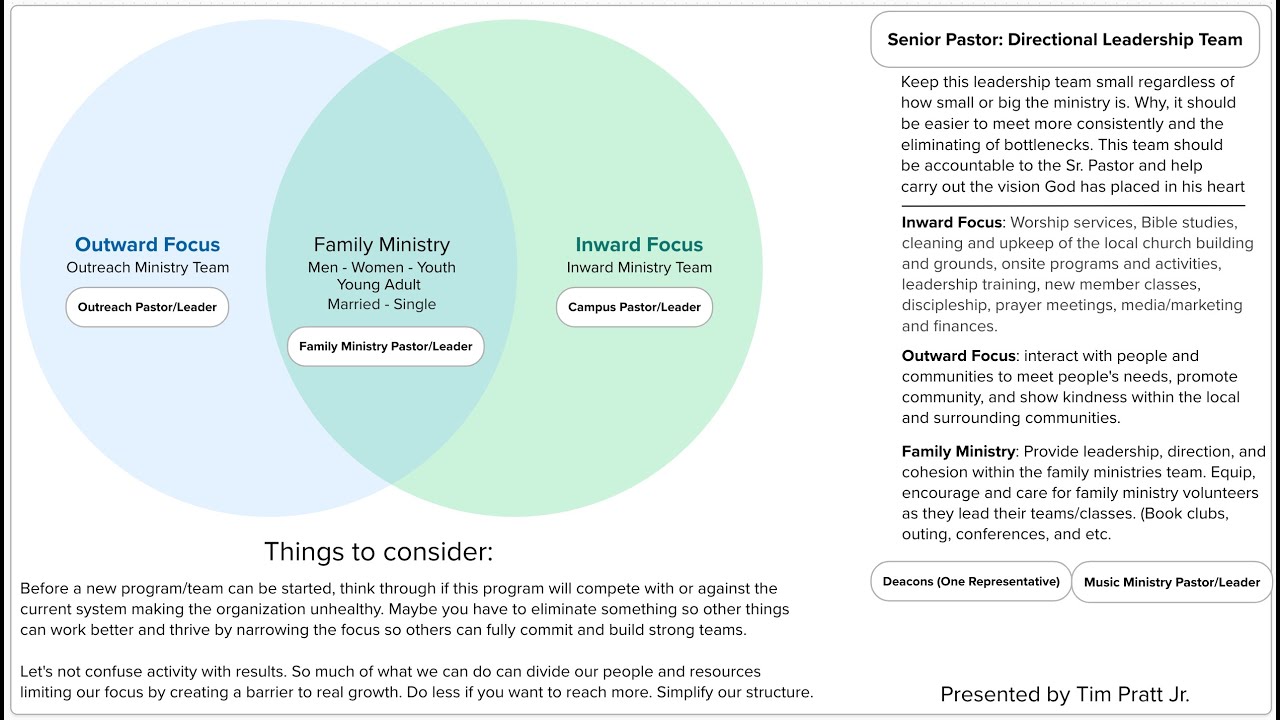
In this 30‑minute solo presentation Tim Pratt Jr. (a 34‑year‑old technology leader turned enterprise Agile coach) shares a practical, low‑overhead framework for small to mid‑size churches that lack the budget for professional consulting. He begins with a personal background to establish credibility, then stresses that every ministry must be viewed through its unique context and limited resources. The core of the talk is a three‑part Venn diagram of focus areas – Family (core congregational ministries), Outward (evangelism and service) and Inward (facility, media, hospitality) – each led by a dedicated leader reporting to a small Directional Leadership Team (DLT) of 3‑7 members under the senior pastor. He outlines the DLT’s purpose, the need to keep it small to avoid bottlenecks, and the inclusion of a rotating deacon representative and a music/media lead. Essential versus tradtional practices are distinguished: biblical essentials (uncompromising preaching, teaching, sacraments) are non‑negotiable, while cultural traditions are optional as long as they don’t contradict Scripture. Conflict is framed as inevitable but healthy when managed with psychological safety, respectful truth‑telling, and a clear decision‑making process. Operational practices include making work visible (Kanban‑style “To‑Do / In‑Progress / Done” board), imposing a Work‑In‑Progress (WIP) limit to prevent over‑commitment, and using SMART goals for each ministry initiative. Meetings are time‑boxed to 15‑30 minutes, facilitated with a rotating leader, and supplemented by quarterly deeper syncs for retrospectives. Coaching and accountability are highlighted as critical: leaders should seek external coaches, mentors, or peer support to accelerate growth, and a culture of accountability (rather than “accountability‑shaming”) is essential. Finally, he offers pragmatic budgeting advice (start small, scale with incremental resources) and encourages listeners to reach out via his Student of Life podcast or upcoming website for further coaching.
Chapters
Hey yo, what's up? So this is Tim Pratt Jr. Uh, and we're going to get straight into this one. So listen, um, I apologize if my audio is a little distorted. I'm actually doing a different setup this time and I'm not running my headphones on, uh, where I can kind of hear the feedback or whatever. Um, so I do have something good for you, but just to kind of give a little context before we get into it. Um, I've been basically— so a little bit about me, and I don't have my resume up here. So I've— I'm 34. I've been in technology since— technology engineering, uh, for about, I think, since I was 21, 22. Um, so in the last 7 or 8 of those years, I've been in more of a leadership dynamic, starting out as a technical project manager, moving into like Scrum Master, um, a little bit of Product Owner here and there. Um, more so Senior Technical Project Manager, Agile Delivery Manager, Senior Agile Delivery Manager. Uh, now I'm transitioning more into like an enterprise Agile Coach or Transformational Leader. Uh, and I'm not gonna get into the details of that, but primarily it's helping teams work better, helping create high-performing teams and balancing out individual and team needs against the organization, just consistently trying to help teams work well together through various things, through mindset, through coaching, through frameworks, and all this type of stuff. So that's just kind of the elevator speech of it. I spent a lot of time in leadership and teams, and I've coached and worked with various leaders from— and I've kind of I've lately been doing this more like a ministry play, more so in the ministry, primarily targeting more smaller to mid-sized ministries that might don't have the resources to hire, you know, a coach or consulting firm. So I just try to bring my expertise and of course, you know, work into work in different circles with doing it. So anywho, that's that. I didn't have that prepared, but just want to kind of share that. But I do have something for you that I've been working on in the background. And I want to just say something, uh, everything is relative. Everything is relative to your context. I even tell this to teams when we work with teams. We have organizational frameworks and structures, but ultimately every team is different. Every team has a uniqueness to it, uh, that every team has a culture to it. And you're again trying to balance this, uh, within the context of the organization. So I wanted you to keep this in mind as you think about your local church, your local leadership team, your local congregation, and just keep that in mind. Like I say, you have a context, you have a uniqueness. But the reason why I wanted to present this is because, listen, I've, I've went to various leadership conferences and a lot of times you don't really have a lot of more so. I mean, you might now, but at one point you didn't really have a lot of leadership conferences that targeted, smaller ministries that don't have the capital, don't have a lot of people lining up to volunteer, you know. And this leads to ministries starting and running 17, 20 ministries, and you probably only have 70 to 100 people consistently coming to the ministry, and some even lower that, and so lower than that. And so when you think about 17 to 20 ministries, um, you're— it's a recipe to burn out. I mean, because oftentimes people are serving across 3, 4 teams, and this is not taking into consideration how structured their life is. Uh, like for example, I look at me, we have 3 kids. Uh, I work a very demanding mental job. I used to like— and every day has its days, but a lot of times I'm spending coaching and conflict resolution, uh, project management, program management, portfolio management, uh, facilitating various things, jumping in, facilitating, uh, standard meetings, facilitating workshops, uh, on top of the things that I do with ministry, of my kids' schedule. You know, I have my oldest plays basketball, my middle plays basketball. I have a daughter that's— she's only 2. My wife and her needs. And, uh, this, this can get like really, really challenging. And that's not, like I say, including, uh, the things that I want to do, the things I believe God is putting on my heart in conjunction with the ministries that I serve, uh, primarily my home-based church. And then I help out a lot with my Father-in-Love Ministry. Um, I work with— not necessarily, but I, you know, I'm kind of engaged with some ministries up here. And then it's, like I say, the things I do on the side with the consulting, the podcast, the coaching. And things of that nature. And so just imagine now if I, if I add on where I'm committed to 3 or 4 ministries— I mean, not ministries, but if I'm committed to 3 or 4, uh, organizations or ministries within that local church, like, it's, it's crazy. So at the end of the day, I'm busy, but like Jim Rome said, busy doing what? Because it's easy to get faked out when we're busy because we think movement is accomplishing, and we think movement is actually, uh, focus when it's not. And I put up a status a while back that it is very possible in this world to be very overcommitted. But busy leaders do not change the world. Focused leaders do. People that are focused and say, I'm going to carry out this commitment and collectively working together as a team. I don't know everything. And if you heard me say this in previous content, when you're in leadership, it is okay to say, I don't know, let me research that, let me get consulted, let me get advice of those natures. That's what I do all the time. But at the same time, I'm committed to knowing, I'm committed to removing impediments. I do this every Every day at my job, an impediment comes up with a team or certain teams. It's like, I don't know how to solve it, but I'm committed to reaching out and coming back to my team and say, okay, this is what we're going to do. I might not even be doing the work. I might not even be the one actually removing impediment, but it's learning how to coach people, how to navigate spaces to help remove that and try to get things going forward. That's what I do every day, a part of what I do every day. And so within the local church movement, let me first say this. Yes, I believe in the Holy Spirit. Holy Spirit. He's all-knowing. He's perfect. And he works through us. But we do have limitations. Although the Holy Spirit doesn't, we have limitations. So no matter how much I want to play the piano or the organ, no matter how many books I read of things of that nature, just no matter how much I want to just get on there and thump those keys, I am not going to be able to produce the sound of a submitted man or woman on those keys. Someone is gifted to do that and then is submitted to do it, meaning that they spend time cultivating in that area a lot. I'm not going to be able to do it. So this is not a limitation of the Holy Spirit. This is a limitation of me because I'm not in it like them. I wasn't graced for that. I wasn't called. Now, can I learn it? Yes. Do I want to learn it now? Probably no, I really don't. I would rather just keep doing things that I believe God has graced me me for. Uh, so we, we have to understand that because sometimes, you know, people, I think they weaponize the Holy Spirit for just a lack of biblical understanding. And, and it's like, well, you can do this too, and you can do that too, and you can do that. And no, I'm not called to do everything. That's why it's one body, many members. And I don't have time to just really, really unpack that, but I just want you to keep that in mind as we filter through this, that you do need certain people to step up. Uh, I'm not going to be able to teach like someone, no matter if I'm gifted, if I'm not also spending time studying, real deal studying, praying and studying, uh, as well as also working on my communication. Some people study their Bible all the time and spend time in the presence of the Lord, but they don't work on their communication. They don't study themselves. They don't study other communicators. Not that they're trying to be like them, but they just don't study. They don't try tweak, try new things of that nature. And that— so they're just not going to improve. So yes, great Bible studier, but they suck at teaching or preaching the gospel because it's just they don't work on the gift of communication. Now, again, hear me out. Yes, the anointing, I believe in all of that. You need the Holy Spirit, especially in spiritual things. But what I am saying is this: you cannot weaponize the Holy Spirit. And just because you have him and you're filled with him, meaning that he's going to allow you to get up and be an effective leader, be a great leader. No, you have to have self-discipline to be submitted to that space. Or to that area that you believe God has called you for. So all of that is done. Now let's get into the meat of what I want to talk to you about today. So let me share my screen real quick here. So let me share. Let me make sure I hit share. All right. So it says I'm sharing. Okay. Let me bring this over here. Right there. Okay, cool. All right. So, uh, one of the things I want to kind of get in, kind of backing up a little bit, is I wanted to introduce a light framework. Uh, don't get too much caught up on the titles per se, but I want to introduce a light framework that I believe, uh, if used correctly and you have people that are leading well, uh, I believe this will help a lot of ministries gain traction, uh, because there is an admin side of means. And I've already seen a typo, I'm just going to fix it later. But I do believe there's an admin side of it, and I don't believe that the pastor per se— not that they are above it, but we can go to Acts and various other things, various, various other chapters in the Bible. I don't believe they should be bogged down with it, but I do believe they should be involved and people should be informing them. But I don't believe they should be bogged down in it because their primary, um, concern is real deal studying the word of God, praying and meditating and feeding the flock. And man, do we need some good food in these days and times. Um, so, um, I'm just going to start here and then you kind of see some things over here that I'll get into, uh, quickly. So this light little, per se, whatever framework or presentation is, uh, basically if you take a senior pastor And this is the shepherd. And of course we know Jesus is the chief shepherd, uh, and some people refer under shepherd and shepherd, but let's say if it's a senior pastor shepherd and then under him are under shepherds. Now that shepherd is an under shepherd to Jesus Christ, of course, um, should be. If he's not, run. Um, but a senior pastor, uh, I'm just going to use the term directional leadership team. So I believe that every pastor, no matter how small or how large that ministry gets, maybe 3 to 5, sometimes 6 or 7. I wouldn't go no more than 7 people. I believe should have a directional leadership team. And you see here, keep this leadership team small regardless of how small or big the ministry is. Why? Because it should be easier to meet more consistently and to eliminate bottlenecks. This should— this team should be accountable to the senior pastor and help carry out the vision God has placed in his heart. Again, when you start to build out big teams and everybody's invited to the inner circle team, typically you're going to start having a lot of bottlenecks. It's hard to keep everybody accountable. And now it's like you're trying to just, truthfully, for lack of better terms, herd cats, herd cats and dogs. I'm not calling people cats and dogs, it's just a metaphor. But it's because I can be in one, it's like, well, no, I can't make this, or no, I got this going on, I don't know, just keep it small because you can spend time really, really— and this is modeled Peter, James, and John with Jesus in the midst of all the disciples. No, it's an inner circle team that you spend time pouring into, and this kind of creates like this catalyst team. Uh, and so you have to— I, I— you should be praying anyway, but asking God, uh, and if it's 3 people, just do 3. If you can get 5, to God be the glory. But if it's only 3, get those 3 and then wait. Just wait. Or maybe have like 2 in a reserve where you're kind of, you know, whatever, however you— however the Lord leads you. Just get a coach or a consultant, and I'm available if you need me. Um, but, um, from there, just hear God and get those 3 to 5 people. And what you want to do, uh, because a lot of times, like I say, sometimes it's good, especially in today's time where a lot of ministries have felt guilty and kind of developed this old school, uh, Burger King menu, uh, when it comes to ministry ministry. It's like a habitual way. Nope, don't want it that way. Want this, want this, want that. I want this, I want that. And then before you know, you look up, you just have a crazy, uh, you just got ministries all over the place and they're not effective. They're just not effective. They do, or they can't be consistent because it's just too many with not enough people. And a lot of, let's be honest, a lot of us are giving our time, like we're volunteering our time competing with other things that we have. And so we just have to take that step back. And I like to say ground zero. And we know that Jesus Christ is the That should be a foundational truth. So I'm not saying starting all the way over in that context. I'm just speaking in the context of the local church from a foundational standpoint, uh, in the context of leadership development and church direction, not removing Jesus, saying we starting all over. So, uh, so I like to say ground zero, and it's okay. I want to look at everything, assess everything we have going on. Um, this is what I like to do when I'm consulting or coaching or whatever. Let me look at everything. I want to see our current state. I wanna, cause I wanna see our current state, our current way of working, our current way of operating, because that's gonna let me know, man, is the operating system overload? Do we need to do refactoring? And all that is, what I mean by that is that, man, we need to clean up a lot of stuff because a lot of times in the operating system that I have just seen working around software developers, when it's like hitting its limits and it's slow, you might hear them say something along the lines of, man, we need to do a little bit of refactoring. We need to figure out how to optimize the code base because it's just moving too slow. It's cleaning up things, refactoring code, cleaner code, and these type of nature. So sometimes we have to take that same mindset in our local church. And that's why I kind of dropped this note here. Before a new program or team can be started, think through if this program will compete with or against current systems— should have been systems— making the organization unhealthy. Great intent by a lot of leaders, but you're adding on things and not taking things off. You're not cleaning up things. And so this is why the next sentence says maybe you have to eliminate something so other things can work better and thrive by narrowing the focus so others can fully commit and build strong teams. Let's not confuse activity with results. I kind of open up with this. So much of what we can do, so much of what we can do can divide our people and resources, limiting our focus by creating a barrier to real growth. Growth. Do less if you want to reach more. Simplify our structure. Simplify your structure. That's essentially what this whole thing is I'm about to get into. And I promise you, this next part, we're going to go a lot, lot more quicker. So what am I saying? So I've kind of developed this, you know, this Venn diagram with just 3 areas of focus. Family ministry in the center. Um, so this is your men, women, youth, young adult, married, single, just pure family ministry. However you want to do it, you can even have young kids, toddler, whatever, just family ministry. Okay, you have outward focus. This is your outreach ministry team, uh, have it being led up by outreach pastor or leader, or, you know, sometimes a husband and wife might lead these efforts or whatever that be. Uh, and then you have an inward focus team because you have to be able to take care of in-house, uh, and you should be taking care of in-house first. And so this is like an inward focus ministry team, mostly times led up by like a campus pastor, assistant pastor, associate minister, or something of that nature. But someone that you can hold accountable. Now again, in these three roles, they are not going to be doing everything, because you probably look over here and say, man, that inward-focused campus pastor, he has to be responsible worship service, Bible studies, cleaning, and the upkeep of the church, the grounds, just new member— no, all of that. No. This person is learning how to lead through other people. So it's going to be a lot of pressure on them. So if someone joins and they say, hey, they joined 2 Sundays ago and they're not in a new member's orientation class, instead of this pastor running around trying to figure out, well, who, who, who— no, you start with the campus pastor or leader because they took the responsibility to be over all things inwardly focused. Media, hey, Hey, why— if you are doing media, hey, why the media wasn't running today? Why this? Why wasn't this a sound check? Don't come before the local church. Bring that leader in and hold them accountable. And I guarantee you, in a matter of time, that person is not going to want to keep being the one standing before the pastor and being held accountable to a degree without learning how to hold other people accountable respectfully. And again, they might need a coach. It's not a dictatorship. It's not a fear tactic. Tactics, but we do have to have accountability. There is an admin side, there is hierarchy. Like, like, let's be truthful, there is— yes, in the kingdom of God there's no big I's, little u's in it, but when it comes to structure, there is order. We all should be accountable to someone. Yes, the senior pastor is accountable to God and Holy Spirit, but what if he's not listening to God and the Holy Spirit and say, hey man, you need to sit down 2, 3 Sundays because you're tripping, you need to get some rest, you should be accountable to an elder board or something. I mean, now we can go to the text, but that's the video for this, but everybody should be accountable to someone or a group of people. Um, same thing with the outreach pastor. Hey, uh, such and such called me and they said no, they were sick and they let the church know, um, and no one did a visit. So now the pastor and his wife or whoever are running and scrambling trying to drive 2 hours or an hour or 15 minutes up the road to go visit. No, this should have been something caught by that outreach pastor leader. And again, This does not mean that the outreach pastor or leader is running to and from. It's just a delegated responsibility. They might have a monthly rotation saying this week is Deacon Such-and-Such's day over. So somebody called, they're going to make contact. The next one, this week, this week. Like you have to have structure in each thing that you do. Same thing with the family ministry. Hey, I don't, I don't see a Man's Sunday. I don't see a man's conference on the calendar. Well, if I'm the senior pastor, I need to talk to the family ministry pastor or leader. Here. That's what I need to be reaching out to. Hey, I don't see anything with women. I don't see us doing anything for the men. I don't see anything with young adults. I don't see anything for the youth. Why, why weren't we organizing and at least at one youth, uh, football game going on, taking our youth to a local football game? Hey, why haven't we done anything for singles or anything? Hey, why, why haven't we had a marriage, a marriage outing? I'm not going to those, uh, the people that's over the marriage ministry. I'm starting with that family ministry pastor and leader because I'm teaching them how to lead and how to drive accountability, respectfully, servant leadership and transformational leadership. So this is like that directional team. And then I say you should have, um, you see, I see deacons because typically most ministries have a plurality of deacons. So, uh, but that's just one representative. Now I know biblically there's no such thing as a head deacon and lead deacon and all that, but from a church, local church structure, uh, perspective, I do believe that you can kind of have someone that's like, uh, maybe not the term head deacon, but they're kind of taking on— maybe this is a rotation, but they're kind of taking on the leadership of the deacons. Like, again, we know the pastor and all that, but this is just administrative stuff, so let's not over-weaponize the Bible. Um, having that key representative say, hey, I'm going to take responsibility this quarter of this year— and again, it can rotate if you work that out. Everything, again, like I said earlier, is based on this local context. But having that, that, that one deacon that's going to be a part of this team that can kind of take this back. And now he, or he can organize the other deacons. And then essentially your minister of music or music ministry pastoral leader, this is another person that's essential. And he's going to work with the, the worship team, choir, praise team, whoever they are. He or she, they are responsible for the musician, uh, the percussionist. And I, I'm not a music, but that whole area right there. So if again, hey, praise worship was off. Now you be led by the Holy Spirit. Pastor and whoever, you know, primarily the pastor can come in and cease things. But instead, again, holding that whole worship team accountable, unless God leads you, bring that ministry of music leader in and say, man, y'all doing too much. It looked like a performance to me, man. It looked like y'all didn't— y'all wasn't rehearsing and practicing. Uh, practicing is a good thing. Like, it is a good thing. And you don't You don't practice at practice. You practice before practice. I tell my kids all the time when they play sports, you should be outside. I should be taking you up to the gym to practice before you get to practice. Practice is a continuation because this is what you love to do. So these are things, like I say, whole nother video for another day in time. But again, you want to have— I believe you want to have that person. Now you can say, what about the Ursas? What about people to cut the grass, just all that type of stuff. Again, outward, inward focus. So anything inwardly, the last time I checked, I believe the ushers and things of that nature, they were on for helping facilitate the local church, like keeping the local church in order, structure, you know, letting people in, making sure you help people assign seats, bring things, all this type of stuff. Inward focus. That's inward focus. So this is just a light framework. It definitely has to be more detailed, you know, maybe drawing up staffing things, expectations and all of that in different roles. You might say, okay, outreach ministry. What about our prison ministry? What about our sick and shut-in, a nursing home? Again, outward focus. We have to have some creativity. Uh, and, and what I mean by that is that I personally, I don't have to have a prison ministry. I can just have an outreach ministry. That outreach ministry can be responsible, say, okay, for the third Wednesday we're going to the prison. Hey, who all wants to go? It's a team collectively. Okay, hey, we went to the prison. If it's consistency there, then let it be consistency. But what I'm also saying is that the next one, it'd be like, Hey, okay, we're going to the nursing home. Hey, we're going to take coffee and donuts to a random place. We're just going to go to XYZ 123 and we're going to just give them donuts and say, hey, on behalf of Church ABC, we just— part of our outreach ministry, we just want to bring you all coffee and donuts or cater to you all. Do for one that you wish you can do for all. I personally wish I can write a check in every ministry that I'm involved with. I would— I wish my wife and I could just write a check and say, here, we wiping it all out, here's everything. But we're not in that situation right now. And I'm saying right now, I believe the Lord is going to provide with some of just the things he's given us. But what I am saying is also to this: do for one that you wish you can do for all. So you might want to say, well, man, don't— don't let me back up. Thank you, Holy Spirit. You might say, man, it would be nice to have a $5,000 budget and just pump people gas and just reach a lot of people because we want the big fish. Okay, well, can you raise $250? Well, then maybe top it out at $20, $25 per person and say, okay, we're only going to be able to do $25 per person or $20 or whatever. And then we're only going to be able to get about 10 10 people. We're going to be able to— so go out there, fill them, say, hey, you know, it's— I trust me, leaders and people do things all the time where they send out like these Starbucks gift cards and they say, use it till it's used up. You can do the same thing. So just with that 10, yeah, we weren't able to reach the masses, but we did for a one or did for a few that we wish we can do for all. Don't let the big things stop you from doing the little things is all I'm trying to say. And so this is what this is about. So again, I will kind of help you unpack this, but I do think it needs to be a cadence and we're kind of going to get into that here shortly. But this is all this is about. And again, I can definitely go deeper into this and answer questions when I bring it before the church. So one thing I just want to make clear real quick, Conflict is inevitable. Like, everybody has their opinion. There are certain traditions that's carried out, and then there's essentials. This area for me is non-negotiable. If I'm the senior pastor or whatever, what I mean by essentials, this will be a Bible-based church. Everything that is clear in scripture, we will honor and do. We will not— or so this will be a Word church. We will preach the word, the uncompromising word of God. We won't sugarcoat it. This will be the word of God church. Essential. Just high level. I can go deeper in this, but for the sake of time, that's essential. This non-negotiable. So if it's like, hey, I don't believe that we should be teaching on sin anymore, let's go to the word of God because the word of God says I have to teach on sin. Hey, I believe that I can just be up here flowing in my gift, uh, but I'm gonna be sleeping or whatever. Like, let's go to the word of God. No, you're going to get sat down, uh, because it's habitual practice. Like, what I'm trying to say is that there are certain things just that are essential. Hey, I don't believe— I, I don't want to hear, uh, the— I don't want to hear the unadulterated God. Nope, you're going to hear the unadulterated word of God because it's essential, non-negotiable. There's no talk. If you want to leave over the essential things, then believe. Uh, now here I have wiggle room. Traditions. Uh, there are certain traditions that's carried out, uh, at certain ministries I have been a part of. Long as those traditions don't contradict the word of God, I have no problem. I have no problem with them. Some places, um, they wear robes, some they don't. Some places they're in skirts, some they don't. Look, that's your tradition, that's your tradition. I personally don't believe it's a huge deal, like I say, long as it doesn't contradict the word of God. Uh, but all traditions aren't bad, and there are some traditions that I do believe and I love. Like, for a prime example, my father-in-law, when they had the, uh, first assistant and second assistant, that service was a very traditional service. You don't really see that a lot anymore. Did not see it on Reformation. Um, when, uh, down at my local church with certain things, when I was affirmed and came into ministry certain tradition. It's fine if you don't like it. If you say, I'm not with that, listen, did it compromise scripture? If it compromises scripture, don't listen. Like, if somebody asks me right now, man, just say for instance some weird tradition, it's like everybody got to pass a cup and drink blood, and they said that's, that's modern and very dark, uh, but I'm like, Brian, with that tradition, I'm out. Sorry, I won't. I'm out. No, I'm not doing it. Uh, but for the most part, like I What people wear, little things that you might feel weird or not, that you're not accustomed to. Does it contradict the word? And if it doesn't, man, just be quiet. It's no point. Whatever, you know, opinions. I look at that. Hey, I want pews. No, I want chairs. Hey, I think the carpet should be blue. I know. I think the carpet should be purple. Hey, I think the carpet should be black. Listen, I understand that, you know, people that are— you have an interior design team and all that type of stuff, and people are way more gifted than I am. But at the end of the day, that's an opinion. Hey, I think we should serve Dr Pepper. No, I think we should serve, um, sweet tea and lemonade. I can't go to the Bible about that. Which one do we want to serve? Like, the Bible is not gonna— now, the Bible is going to conduct how we should behave in that disagreement, but the Bible is not going to solve that disagreement. Opinions. Oh, I think sweet tea is better. No, I think lemonade is better. Opinions. So let's not too much get caught up in those. And again, just very quick, and I want to put this in here because you're going to get into those things anytime you're a team. A team conflict is inevitable. There is a thing called healthy conflict, and a lot of us try to avoid conflict and we don't really get anywhere. So no, voice things and create a space of psychological safety, but be truthful and respectful as you present. And I like to tell people all this. I mean, I like to tell people all this time when I'm kind of coaching people or facilitating meetings, if someone puts something before the group and you don't have anything better, uh, or you can't say, well, hey, can I just kind of sit on it and maybe come back in a day or two? Don't just be disagreeing with stuff just to be disagreeing with it because you want it to be yours. You don't have anything. If you don't have anything better, go with that option, see it through, and try to make it work. Like real deal. And then sometimes I like this little practice instead of thinking, well, I want to do this, but no, say I want to do this and like, can we do this and don't— can we do this, but I don't know, can we do this and, and again, that's another practice because you just continue to like add on and building upon that idea. And last thing here, so make the word work visible, make the work visible. Now you can beat this up. Some people do in review, all this type of stuff, but simple flow to do, in progress, done. And this WIP is work in progress. Have a limit. Maybe you might have something to say, no leader. So like, say, for instance, directional team, if everybody's doing something and has an ECD, you have to have SMART goals because you have to have commitment. But if I say, hey, I'mma launch the children's ministry, what's today? August 18th, I'm going to help drive the launch of our children's ministry by November 1st, 2024. That needs to be clear in this. And then it might be, hey, you can't commit to anything else until this is seen through or we make a decision on it, whatever, whatever reasons is canceled or done. Or it might be two things because typically here we go again. Again, I believe you have to have a WIP limit, work in progress limit. Because we are naturally inclined to overcommit a lot of times because a lot of us have an issue with saying no. And these are just good things to say no. Look, you have one or two, whatever is agreed upon the team, you have one or two things, whatever. Let's just say if it's two. So, hey, now I'm raising up for a third thing. Nope, Tim, you got two things. It's still in progress. You can't pick up something else until we see it on the right side of the board. 'Cause a to-do list could be a laundry list of things. And so that's just make things visible because I don't want to keep coming into a meeting. Hey Tim, how's that children's church ministry going? I don't know. Hey Tim, how's that children's church ministry going? I don't know. Like, man, why are you in leadership? Like, that's just the truth. I don't mean to be mean or anything, but why are you in it? It needs to be, hey, you know, there's some financial constraints. Hey, I was looking through it and got someone to look at it and, you know, it's some concerns there with the little kids where I think we need to kind of tighten it up that area. Hey, it's some coding things going on, like, but this is, and then, okay, how are you working through that? Well, I'm working with, I just worked with the grounds person and they're going to take care of XYZ, 1, 2, 3, and just updating transparency so the team can inspect and adapt because it might be a thing with Tim, we don't have that in the budget. So what else can we do? Now, this is where we collectively come together and say, well, you know, Maybe we won't get new paint in the TV, the big TV for them, but we can do this. Like, we can launch it. We need to make sure it's safe. So maybe that might be the thing. Hey, let's get it up to code, but all the TV, we're just going to get them some toys and some Bible stuff. But the TV and all that stuff will come later, phase 2, phase 3. But let's get it launched first. Like, it's that transparency and inspecting, adapting, accountability. Accountability, that's the word I'm looking for. That's a curse word in the church today. And then have weekly or biweekly syncs and do things on Zoom too. Like these could really be done on Zoom and maybe like once, you know, maybe sometimes on a Sunday and face to face, but just protect the time box. I mean, don't be up there talking about the Lord, you know, the Lord's will, Lord have his way. No, man, no, 15, 30 minutes. Like we're coming in here, people need to come prepared because we're going to let people get back to their families because you don't want people burnt out. You don't want these turning into 2-hour 3-hour meetings. I understand the power of God, but 15, 30 minutes, protect the time box. Have a real strong facilitator of these and just rotate it quickly. Like, prepare. It's going to be a little rough as you start out, but eventually 15, 30 minutes, like, protect that. Have someone, hey, we're at 10 minutes and such and such still has to go. Like, it's not rude because I can— man, do you know how many meetings I walked in and I didn't got going or I didn't seen people give updates and somebody's like, hey, Tim, you're right, because that would be disrespectful. For me to disrespect somebody else where they're here too and they need to share their update, their status of what's going on. So miss me with all of that. And then not trying to be rude, but miss me with all of that, uh, man, you know, we just gonna go, you can't rush, and all that type of stuff. No, 15 to 30 minutes tops. Protect the time box. Get in and get out and make sure it is clear and come prepared. And maybe you might just follow a round robin thing, or like I said, have a facilitator walk the board. Hey, how are you tracking towards your item or items? And is it any impediments or any impediments? Like, what's blocking you? What's stopping you? Make the work visible. And then maybe quarterly having a sync up with 1 or 2 hours where you can kind of go and like refine, like, you know, just really deeply see things, do retrospectives of that nature. So, hey, we had a men's conference, looking back, back, what went well, what didn't go so well, or what can we improve on, key action items, like just little things like that. And again, this is where a qualified coach or consultant facilitator can really kind of help you come in and build something around your local context. That's it. I just believe, like I say, these 3 things here, and again, I would have to kind of unpack and, you know, do this more in a live presentation and answer a lot of questions, but just having something like this, uh, to just really make sure that, of course, most importantly, hearing from God, man, praying, you know, teaching the word of God, teaching and preaching the word of God, but just having something light, man, because there is an admin side of ministry. And, and I share this all the time, there are a lot of people that teach and preach the, uh, the unadulterated word of God, uncompromised word of God, and, and I truly believe they love God and they have been called and they are sincere, but their ministry still have failed because God didn't come to die for a local church. He died for the church. And so what I'm saying is this: most of the time, if you really study and analyze and go back and study these ministries— not all the time, sometimes it just sucks, bad situations— but most of the time it's because they, they neglected the admin side of ministry. Again, not turning into— not coming in with a CEO or business mindset and, and treating God's people like a business, because I do believe we have went too far. And that's another video for another day. I do believe we need to get back to true shepherding of God's people. But there also is a structure and a business side to it, and there should be things going on that we're prayerfully carrying out. The hands and feet of Jesus— it's a collective relationship, a, a collective relationship, a random relationship with the Holy Spirit, like a bike, the front wheel and the back wheel or whatever. He wants to partner with us to keep things moving, uh, where we are the hands and feet of Jesus. We are the body of Christ carrying out the things in this world. And you have to have accountability, you have to have buy-in. And if you don't really have a strong leadership core, bring in a coach. And like, somebody legitimate know how to coach and help people develop Develop. But a lot of times, because we send people to these conferences, we give them a book. I'm telling you, like, I feel like I am a self-driven leader. I love to read. I love podcasts. My wife, anybody that know me, will tell you that. But I'm to this day, I went to a whole nother level in my leadership, personally and professionally, when a coach challenged me and when the company actually paid for it. And outside of that, I used our company budget to get another coach. That same coach. I mean, no, no, another coach. And because that coach had moved on. And so I was like, man, I don't want to lose this. And then so I submitted myself to another coach one session a month and it helped accelerate so much. And I have mentors and I buy in like I even at the areas that they challenge me in because it helps expedite. It's just like sports. LeBron James still has a coach. Tiger Woods had a coach. Russell Wilson coach. And sometimes they don't just have coaches. Coaches, just how we think about LeBron and them on their team. It's like people in their day-to-day life that they have just a personal professional coach. And so just imagine, like I said, sometimes the senior pastor is the person that handles that, uh, or, you know, someone in the church with the admin side, or they can do it. But sometimes people just have to be coached and they have to be put on a real plan, not like a little 15, 30-minute counseling session, uh, then it's like, okay, know, somebody that can really drive them. And there's only two things going to happen, maybe three, but two for sure. Hey, this is not for me. I wasn't called to this. I'm not a leader. Or you're going to see them incrementally rise up and they're going to lead. They might not lead like you, but they're going to lead. And that's another, again, another topic for another day. So if this was helpful or it blessed you in any kind of way, just reach out to me. Let me know. I really did hope it did. But like I said, yeah, if this was helpful or blessful, man, go over to any type of podcast format and go to Student of Life, Student of Life Podcast by Tim Pratt Jr. I'm working on getting my website back out there. I had some issues with Wix, but it used to be www.timothypratt.org. It's not live right now. I'm working on it. But you can go over to the podcast, any type of podcast platform that you use, and the Student of Student Life Podcast by Tim Pratt Jr. And just search through the topics. They're pretty much cut and dry. Like, I'm not that deep, you know, to be real with you. And I have a lot of leadership stuff on there, uh, just a lot of things in general. It's just literally dealing with life, uh, and I just try to present it in a way influenced by the Bible, staying true to the scriptures, but at the same time very, very common. Uh, so I hope this helped again, uh, and if it did, just reach out to me. And if you want to pack, uh, let's look, dig a little bit deeper, man, because I just believe by faith that, uh, every ministry that's operating, man, and truly led by God, I just want to see them win, and I want to see them figure it out, uh, through the power of God, uh, and just through us collectively as a body. Be blessed, man. Love you all.










