Wealth and Money wXavier Waterkeyn Renée Garcia Reality Transurfing Shifting Vadim Zeland Quantum
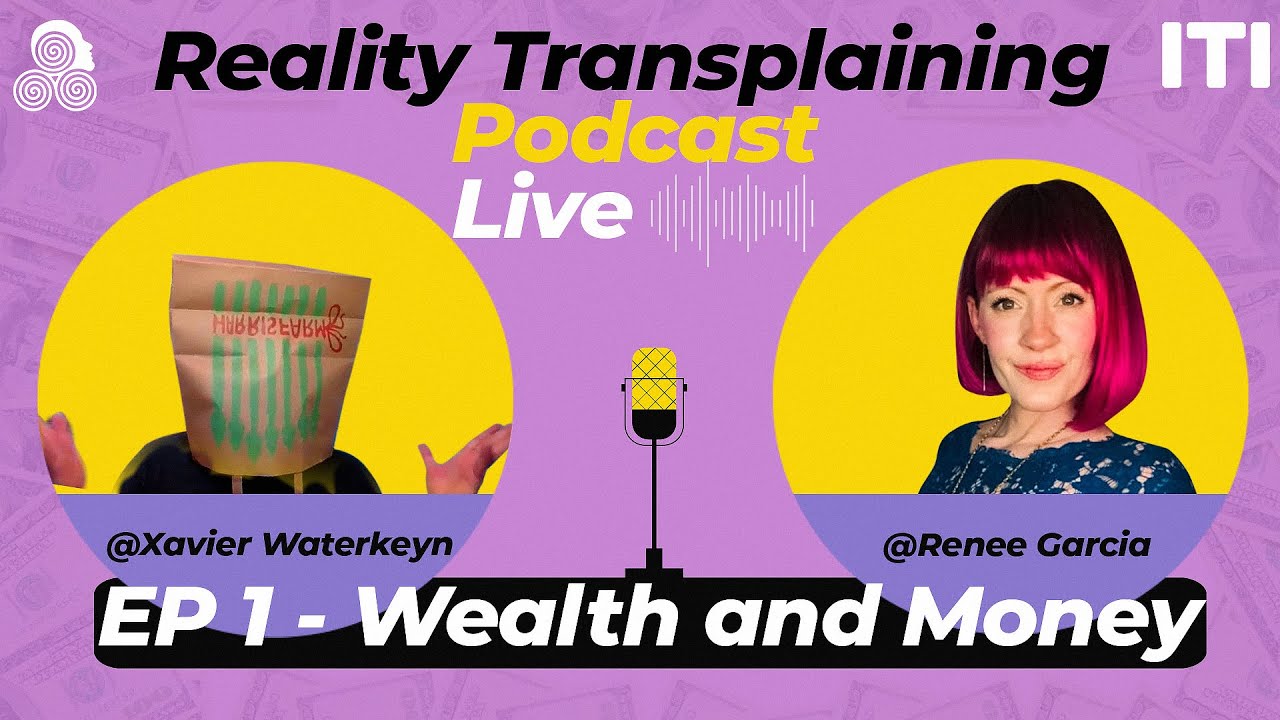
In this inaugural episode of the Reality Transplainin' podcast, host Renée Garcia interviews author and Transurfing practitioner Xavier Waterkeyn about the deep-rooted challenges people face with money and wealth. They explore how societal narratives and childhood conditioning create personal "money stories" that shape one's relationship with finance. Using the analogy of a love map, they explain how these subconscious scripts are formed and reinforced. The conversation delves into Transurfing concepts— the idea that reality consists of infinite potential scripts, and that individuals can shift between them by changing their internal narrative. They critique the common victim mindset and the addiction to suffering, arguing that choices, even in adverse conditions, drive outcomes. A core practical tool presented is the "interrogation" technique: instead of affirmations, ask oneself presuppositional questions (e.g., "Why am I so wealthy?") for 10‑15 minutes daily to create cognitive dissonance that forces the mind to generate solutions. They discuss the need to cut ties with limiting social circles, recognize the role of access versus ownership, and emphasize that wealth is less about owning assets and more about accessing resources. The episode ends with a plan to reverse roles in a future episode and a light‑hearted thumbnail creation exercise.
Chapters
Hello, hello, hello, Transurfers and the Transurfing curious. I'm Renee Garcia and this is Xavier Waterkeyn, y'all. And this is our first episode of Reality Transplainin'. We're gonna Reality Transplain topics or ideas surrounding money today. That's where we've decided to cater. Kick it off. I just launched the Mo Money Course Deluxe Edition, and Xavier is actually writing a book, which I'm going to ask him all about, on money. Unless you don't want to talk about it, like—
I don't mind, I don't mind. It's just not ready yet. So until it's ready yet, well, we can, we can generally talk about it.
Still cooking, huh?
So yes, I've still got that bun in the oven.
Yes. So today we're gonna do a little bit of a different kind of podcast. We're going to actually, since we had a little tug of war, who's going to actually host and who's going to be the guest, we're going to argue about behind the scenes. We're going to, we're going to take turns. So I'm going to, I'm going to ask Xavier questions, his take on Transurfing and money and all things that have to do with wealth. And obtaining higher wealth, and then we'll turn the table and he can ask me a few questions, and we will just go on like that. So yes, um, I haven't had a lot of time to think about this podcast actually, but the one thing, the one thing that I really do Well, I always think about this. Sometimes I come up with a very profound grasp on the answer to this question I have. And then there's other times where it completely eludes me. And the question is, why do people have such a hard time with money? Like, It's even more challenging than health, romantic stuff. Like, it seems to be the number one area in life that people are just— and even if, even if the people, if somebody figures out how to make money, they still have issues with it. You know, it's almost like it's almost like you're damned if you do, you're damned if you don't. We either struggle with— we struggle with getting money, making money, making money with purpose, you know, the way that we make money, feeling fulfilled with that. But then if we have money, then it comes with a whole new set of problems, if you want to call it that. So what, just like from from your perspective and what you understand about wealth. Why, why is that?
Okay. First of all, you're conflating a whole bunch of things together that shouldn't be conflated. Wealth and money are different things. There's also a psychological aspect to money and there is a social aspect to money, but it all boils down to this. Everybody has a money story. It's a bit— and everybody has a money map. Have you ever heard of the concept of a love map?
Mm, I don't think so.
Okay, a love map is basically an idea that is partially conscious, partially subconscious, of the sort of person that turns you on romantically.
Mm-hmm.
Right now, that is acquired over years. Uh, it depends on all sorts of factors, the usual suspect of factors— your biology, your upbringing, your, uh, unique soul's, uh, challenge in this particular incarnation, whatever. All of that's all wrapped up in creating a love map. You will be attracted to particular sorts of people, and you will be not attracted to certain other types of people. There will also be this ideal in your head, and that you're in some— at some level always yearning for, etc., etc. Same thing with money. We have a combination of our own individual upbringings and also what society does to us in terms of money. So what do you want me to talk about first, the individual money story or the society money story?
Let's start with the society money story.
Okay, okay, well, this is something that you know pretty intimately as well, so by all means interrupt while I riff. Society says money is this thing that is of value. It is something that is worth getting. It is something that you need to get in order to achieve certain ends. In fact, in— in my— it— society also tells you that money is the only way that you can achieve certain things. It then becomes this precious commodity that needs to be sought out and sought after. The money— society also tells us that money is held in the hands of people who don't want to give it up. So you have to fight for it, or you have to cajole, or you have to sneak your way to it. Money is a mystery that needs to be solved. Money is a puzzle that needs to be unlocked. But you see, there are all of these money statements floating around around. With all those, that stuff happening, it's not difficult to imagine that you're going to have trouble navigating your way through a sea of these statements and the realities that those statements create. You grew up in poverty, right?
Yes.
So did I. So my question to you is, What were the stories that were being told about when you were young about money?
Yeah, well, I, I did— that's the first area that I tackle in my course because without, without, you know, the each of those stories, no matter if it was a story that had a narrative that was running daily or if it was just like a little a little statement from someone. It was a seed that was planted and it gone unchecked, it just grows its roots and, you know, does all this crazy stuff. And you can't really get away from, you can't really switch your mentality until you rip that tree out by its roots.
Ah, and there you have one of the causes. You said why? Well, one of the, I think key things you just said there is that it's unchecked. We're born into a world having forgotten most of our lives outside of the world, so we come in not exactly as a blank slate, but pretty much as a blank slate for a bunch of different reasons. As we're told the story, as we come into this play that's been going on for thousands and thousands of years, we don't know anything. So we trust that the people telling us these stories are telling us truths. So we swallow the story hook, line, and sinker. And unless we examine those stories, we don't know whether those stories are actually of any use to us, whether they're functional, whether they have any take, if they have any resemblance to reality at all. Now, from a Transurfing point of view, there is no ultimate reality. There is just this endless sea of potentiality. There is an endless realm of stories and scripts in which we can fall into. If we fall into one particular script, we're not told that this is not the— that this is not the only script. We are told this is the script. Yeah, this is your lifetime.
You don't— this is your program. Yeah.
Yes, you don't challenge it until you challenge it. So if you've got a money story that says money hard, money tricky, money only for the special, and you're not one of them, money, um, bad, money evil, only evil people have money, and evil people bad, and you don't want to be evil. All of that stuff, unless you examine it, if that's what you were given, then you're not— and you don't examine it, of course you're going to have problems. Is that being told anything? Transurfing boils down to what story are you being told? Because the story you're being told is the story that's going to be going on in your head all the time. The story that's going on in your head all the time is the story that's going to go on in your heart all the time. The story that goes on in your heart all the time is going to be embodied and it's going to be mirrored in the world because you create an energy. The energy reflects back to you. I frown in the mirror. I'm going to get frowny face back. I frown about money. I'm going to get frowny money energy back. It's like anything else. Why do people struggle? They get told a story, they buy the story, they don't look at their options, that they don't even realize that there are other stories.
There's no objective thinking at all.
The rich get told a story about money, right? That is completely different from the story that a lot of other people get.
Yeah, it's so true. It, it's so true. And I think getting back to that, that original story is like, especially when you're young, you have, you have no ability or insight to be able to understand the that there are different options. Like you said, somebody is telling you the story. So you take the story at face value or you, you buy into the story 100%. You just, you just absorb it. And like, for me, it was very much looking back retrospectively. I can see myself just thinking, oh, well, that's just it, right? There's no, there's no objective thinking. There's no challenging because that the, the, the developmental stage of when you start tuning into certain statements surrounding things such as love or money or self-love or ideas about the world, any of that kind of stuff. You're so young, you have no ability to be able to look at the incoming information objectively and say to yourself, um, you know, do I want to buy into this? So you just—
we tend to, we tend to forget as adults how tricky it is to navigate childhood. You've got a whole bunch of stuff going on in childhood which we forget. We need to learn the language that we're born into. We need a lang— or languages in multicultural households. And we need to know the culture or cultures if we grow up in multicultural households. We need to navigate our bodies. What is this funny thing that we find ourselves in that's probably so different to anything that we have when we're not focused in this funny little fleshy suit? All of these things, with all of that stuff going on, no wonder we need to sleep so much. It's exhausting.
Yeah.
And then we're also being taught. And but the also is that we're also in a state of mind that's very receptive as children. We are in programming mode as children a lot of the time. So as a child, I'm constantly being bombarded with messages which I will take on and become part of my programming. There's something called heuristics, which is basically a fancy way of saying shortcuts. Because we don't have the time, energy, or even the means to work everything out for ourselves, we're told certain stuff and we just have to take that on because otherwise we'd have to think our way through everything when we're just trying to navigate going to the toilet, navigate walking, all that sort of stuff. Human beings are born immature. We're all born We're all born to a certain extent premature. We're all preemies. We come out, we can't— you look at a horse getting born, 5 minutes later it's on its feet.
Isn't that incredible? I always think that that's so amazing. Like, whenever I see that, I'm like, holy shit, why aren't we capable of doing that? It's so— why does it take us 2 years to do that? Or 1 year?
Well, it takes— well, no, well, some kids it takes 6 months. In my case, it took 18 months to 2 years. And apparently it depends on how cautious you are. I was a very cautious child, probably also had a lot of pride, and I wasn't going to be falling flat on my face every 5 seconds. So I preferred to sit elegantly and take in my world. Your nature will determine that inner, that inner core being that is you. Whatever you enter into with this life with is going to determine how you roll. The whole point about, the point about Transurfing is that look at that, just look at it. Because the first steps in Transurfing, in my opinion, should be psychology. Look at your own psychology, look at your own cultural conditioning, because that will determine why you desire what you desire. Transurfing often sells this message that this is a way of getting what you want. However well that might work, you still need to look at why you want what you want. Right now, if you're told a money story that money is the only way to get things, you're going to— you're going to look at everything through that filter. There's a number of different ways that you can acquire things. You can be given something. It can fall into your lap by accident. There are a whole bunch of routes by which you can acquire things, resources, or access to resources, right? You've got a picture on you, behind you. You're on a yacht. You didn't own that yacht. You didn't have to work for it. You didn't have to pay the yacht's maintenance bills, but you got access to it, right?
Well, in all fairness, actually, at this time in my life, I own my own boat. So I hear what you're saying.
You did have that, but not that particular one, right?
That wasn't mine. No, exactly.
But you had access to it.
Yes.
So you had the experience of having it.
Totally. Yeah, very much.
This is the— this is the— but this is the point. Transurfing is all about having access to experiences.
Okay, so let me ask you this, because this is the, this is the question that keeps popping up in my mind as you're talking. It's popped up multiple times. So, so we're talking about, we're talking about programming, we're talking about being, being young, being influenced by culture. Adults, you know, not challenging any information, not being able to look at any incoming information objectively, not being able to access information.
If you're born in a— if you're born in a gutter in Delhi, you're not going to have access to the same information as some kid that's born in a developed country with access to the internet. You just won't.
Okay, but here's the thing, and this is even— it sets my question up even more. So let me tell you, like, what I experienced that started this question in my mind, and I've never quite been able to, to answer this. But so I grew up poverty level, you know, I grew up on the outskirts of Modesto, California, which was, you know, it's like the beyond the hole, right? There was a hole, but it was even beyond the hole.
And did you grow up in trailer trashville?
Grew up in total trailer trashville. Heavy, heavy meth use, you know, rampant meth use. People on welfare, people having way too many kids, all— everything, everything everywhere, dysfunction everywhere of all kinds, domestic violence, and you name it. So I grew up in a very, very similar way that the people around me grew up. Even when we went into town to go to school, there was still a bunch of kids there that were poverty-level kids. And when— so, so when, when I started thinking like thoughts like, well, God, um, you know, even as young as 14, 15, 16 years old, like envisioning this life in the city away from Modesto and being able to support myself, not be on welfare, not have a bunch of kids, just very basic stuff like that. Um, you know, I, I started to break out of this mindset a little bit, and ultimately I really broke out of the lifestyle and I moved to another city and I made money and I, even with no college education, no high school diploma, nothing that you could point to that you could say, oh, well, she, you know, found success because she had these tools. Like, I did it all the super, super hard way, right? But I had this thing in my head that I'm wondering where it came from and why it was there. When I moved back to Modesto and bought my house 6 years ago, the one that I just sold, I would frequently be running around town and I would bump into so-and-so who never got out. Who never did the thing, who never found a path to wealth, who, you know, is working a minimum wage job even though they're in their 40s, living in the trailer park, they never got out of it. And I could ne— and even more shocking to me were the people that I viewed as having so much more than me, the girl whose dad was a doctor. And I was like, oh my God, every year they buy her new clothes before she goes to school. God, that must be crazy. And she ended up becoming a meth addict prostitute, right? And I'm like thinking, okay, so how does this happen exactly? How is it that we essentially switched realities? I, if I had not checked myself, would have been on the path of where she ultimately ended up. I don't even know if she's alive anymore. And here I am, in a position of power, power, having money, being able to live my life, do the things that I want to do, buy the boat, go, you know, decide, oh, I don't want to work for 6 months, and being able to do that, buy whatever the hell I want. How did, how did this happen? So what the programming isn't necess— necessarily like the culprit here, right? Because her program was obviously much better than mine. My program was much inferior to hers. So why did that happen?
Okay. All right. So here's why anything happens. The first book I ever wrote that got published was called Women in Crime. It's still available if you want to buy it. Um, what happens? Okay. What happened there is that I kept asking this fundamental question. What turns an innocent little girl into a guilty adult woman? Right? That was my fundamental question. How did you become who you are? And they would tell me stories like yours. They would tell me stories about growing up in very, very dysfunctional environments. We don't need to go over that ground because people can imagine any number of dysfunctions. What happened was that at some point somebody needs to make a decision and make a choice. The first thing that needs to come into a person's mind— like, I grew up in dysfunction and I had to— and it was more psychological dysfunction. It wasn't as extreme a poverty as yours, but it was relative to the lot of people around me, it was poverty. At some point I made it, and I had an insight. There's got to be a better way. There's got to be a better way. There's got to be a better way. Now you repeat that in your head long enough and your programming starts to change because you just accept the reality there's got to be a better way. So you start looking for that, and things show up that show you that there are better ways. And it may be a very long and circuituous route in order to get to that better way. And the better way is not a destination, it is a road. So you're constantly looking at, there's got to be a better way. Now in the beginning, you're coming at that from This is a completely crappy situation I'm in. There's got to be a better way. As you move on, however long it takes you, you'll get to higher, higher levels of experiencing more and more pleasant realities, whatever that means to you. But even now, you and I and everybody watching this is going to be thinking, even if it's really good, well, there's got to be a better way. It's no longer that it's got— there's got to be a better way. It's more like there's got to be a better way.
It's no longer— and then if you get— and then if you get— if you get super comfortable, then it's like, well, then how can I improve on this? It becomes less—
exactly, it becomes— it becomes the endless road between being a hydrogen atom your very first incarnation to being the god of your own universe, however many trillions of years subjectively that journey takes. The question is always, there's got to be a different, a better way, or even there's got to be a different way, which is another way of thinking about it. I like this really lovely thing that I have, but that doesn't mean I don't want to try something else. Somehow. Okay, so you come back to the question, why did Renee decide at some point there's got to be a better way? Whereas— give me an A name, you don't have to give her— me her real name— of the meth head doctor's daughter. Amy. Amy, right? Why did Amy not make that choice? A number of possible reasons. Amy was in love with her misery is probably the most obvious answer. As the Australian singer Gotye said in his most famous song, you can be addicted to a certain kind of sadness.
Addicted to suffering. I just did a piece on that.
Yeah, yeah, you can be addicted to suffering because It may not be much, but it's making you feel something.
Yep.
We don't know everything behind Amy's story. We don't know why she went there. It might be that her soul inquiry is to, is to experience that, because at some point in our endless journey to our own individual godhoods, we need to experience everything. We need to experience poverty at some point in extreme levels, and at other points in our journey, we experience extreme wealth. We experience extreme love and extreme hate. We experience extreme health and extreme sickness. The fact of the matter is, in, in an infinite universe of infinite possibilities, we will explore quite a long, large range of those infinite possibilities. This videocast is for those people who have decided that perhaps they don't want a particular set of negative infinities and are looking more at a particular set of more positive infinities.
Okay, so this is the perfect place for me to ask you my next question. Reality, transplain me this then. If someone's watching me, if someone's watching this right now, reality, translate me.
I'm channeling, I'm channeling.
Oh, if someone's, some, if someone's watching this right now and let's say they've hit a bad streak, because I've definitely had, it's kind of weird, like I've had two camps, not really any in the middles, which is really, really fascinating. The whole COVID thing has either tanked people's reality or it sent it skyrocketing. It's one of the two. It's— there's no in-between. There's literally— I have not had it gotten easy since.
She's asking me a COVID question.
Okay, so—
The biggest button presser of the last decade. Yes, what?
I'm melting.
I'm melting. Play with the human being, then.
And then COVID came. Okay, so, so let's say, let's say, and you don't have to give away your, your, your top secret stuff, but, but maybe— okay, so, okay, give away your top secret stuff then. Um, so let's say that someone is watching this that COVID tanked them, right? Tanked their finances. A lot of people's businesses went under, all kinds of, you know, insanity and chaos and stuff like that. So from your perspective and from your knowledge base, if you could give someone 3 actionable steps, including shifting of the perspective, right? If you could offer 3 bits of information to help someone get out of a financial hole right now and start ascending to some higher paths of wealth, what would you— what would your advice be? General— generally, obviously each person's circumstances are different, but generally speaking, what would— what would your 3 bits of knowledge be? Reality Transplaining that.
Okay, fine, I will. Um, okay, firstly, as Reality Transplaining episodes progress, I'm assuming that people will want to be asking specific questions of us, which are usually more useful because we can narrow down on specifics that what on the basis of what is most personal is most universal. We can say we can talk about something that seems very specific, but is actually very generally applicable. Since we don't have that yet, because this is also new, here are the general principles. Nothing— Transurfing at its core implies that the individual is the source of power. The individual decides, makes decisions that will lead into action, that will lead into moving between realities to another reality, to another time stream, right? Everything hinges on decisions. What is the first decision a person needs to make in terms of getting themselves out of a financial hole? One of them would be stop looking at it as a financial hole. Because if you look at it as a financial hole, all you're going to do is reinforce it's a financial hole, it's financial hole. While that might be true objectively. We're not talking about the path out of objective horribleness, for want of a better term, is subjective empowerment. The solution for this is the solution, the same solution as it is for something like weight losing, losing weight. Mm-hmm. Stop looking at the external world because the external world only mirrors the internal. Ignore— paradoxically, ignore everything, even if it's for 10 minutes a day. 10 minutes is not going to make a difference to your situation in terms of if you continue to create the same reality over and over again, or to remain in worry and all that kind of stuff. Yeah, exactly. You— nothing shifts until energy shifts. Energy does not shift until feeling shifts. Feelings don't shift until thoughts shift— don't shift. Uh, affirmations won't cut it. They just don't, because affirmations are usually said or stated in such desperate energetic terms that they don't have any power behind them. They don't have any power behind them. Take advantage. This is where you and I had a discussion, and we might go into this in depth later in some future Transplaining episode, but I never do affirmations. I do interrogations. Here is a single very powerful technique. First, I'll explain why it works, and then I'll explain the technique. Have you ever heard of something called cognitive dissonance? Yes. What is, what is your understanding of cognitive dissonance?
It's, it's, it's justifying and explaining to yourself why you have some sort of thought or problem of some kind and why it's necessary for you to have it. Like it's—
well, no, well, no, that's actually rationalization, which actually happens after cognitive dissonance. Cognitive dissonance happens when you have contradictory thoughts going on in your head, right? That's an extremely uncomfortable state for most minds to be in, right? You can't be both rich and poor at the same time. You can't be both healthy and sick at the same time, right?
Got it. All right, give me an example.
Okay, so your mind is going to be wanting to reconcile these two opposites. Okay, let's go with the example of money, right? You're in a terrible financial situation. You're constantly telling yourself, I'm in a terrible financial situation. You're looking at your belt, you're looking at your bank account, you said, this is crap, I'm in debt, I'm in debt, I'm in debt. So what will the affirmation crowd do? They will say 'Oh, I'm not in debt. I'm not in debt,' which is crap. Or if they know a little bit more about affirmations, they'll say, 'I'm wealthy. I'm rich.' If they know even more about affirmations, they'll do this: 'I am wealth. I am richness.' I am abundance. The thing is, to go from I am in a hugely horrible deep financial hole to I am abundance is a pretty big step.
Yeah.
Okay. Don't bite off, don't bite off more than you can chew at once, and it doesn't work anyway. So take advantage of cognitive dissonance by using interrogation rather than affirmation. Interrogation works like— interrogation works like this. Firstly, I completely ignore the mirror because the mirror is only going to reflect back at me, and most people are so accustomed to being reactive that all they'll do is they'll look at the mirror, react to the mirror. The mirror then reflects them. They react, reflect, react, react, react, and you're in this endless spiral. Now, the spiral can be positive or negative, but for many people, they're in trouble because they're in the negative spiral. Crappy reality makes me sad. I look sad. Mirror shows me my sadness. I have more reasons to be sad, more reasons to be miserable. I'm poor. The mirror shows me my poverty. Because the mirror is very compliant that way. I look at the mirror, the poverty in my mirror, it makes me even feel even poorer. Cycle, cycle, reaction, etc. Okay, you've got to step out of that. How do you do that? Okay, take advantage of the cognitive dissonance. Instead of trying to convince yourself that you are abundant, you do this. You interrogate, you say, Why am I so abundant? Why am I so rich? Why do I have so much access to so much money for my personal use? Why am I so wealthy? Why do I have such an abundant lifestyle? You gen— keep generating these questions. The great thing about this is that you don't have to believe the questions.
Mm-hmm.
You don't have to believe in the reality behind the questions or the presumptions. You just ask the questions continually. You make no attempt to believe it. You make no attempt to convince yourself of anything. You just wrote— ask the questions continuously. First major step, do that for 15 minutes a day, preferably before you go to sleep. Like I'm saying, just go through the motions. Nobody's asking you to believe it. Nobody's asking you to buy it. It's just the questions.
And are you answering them yourself?
This is the thing. Your mind, your inner being, will not be able to take the cognitive dissonance. It will say deep down inside, it will say to itself, On the one hand, I'm in a really crappy financial position. On the other hand, I'm asking myself these questions. We're deeply hardwired to ask questions and to seek answers. If we keep asking ourselves these questions, we'll start to want to seek answers. Yeah, we don't even have to try consciously. We don't have to make an effort. The only thing we have to do is go through the motions. Our inner being will then say, well, why am I so, so wealthy? Oh, because I'm very good at finding answers to solutions to financial problems. Why am I so good at finding solutions to financial problems? Oh, because, you know, you have access to— not because you have access to knowledge about money and how it works. Why do I have such good access to good information about money? Oh, because I know people who, um, who have good access to questions about money. Why do you know these people? Oh, because, um, I get around a lot. Why do you get around a lot? Because I'm outgoing. Why are you outgoing? Because I enjoy people's company and I enjoy exchanging information. Why do I do that? Because I have a curious and hungry mind. And you reconnect to your inner child that's hardwired to ask these questions because That's how we're born into the world, asking questions. How do I walk? How do I learn to talk? Everybody around me is doing this stuff. They must know something. I'll ask them. Why do you ask them? Because I like asking questions. But you're shy. Okay, brings up something else. I'm shy about asking, seeking answers. Okay, instead of— you turn that question around. Why am I so— why am I so good at dealing with people? Then you're looking at things that aren't connected immediately to money, but they are. Because if you think about anybody who has ever acquired wealth or access to resources, well, it's all about access, isn't it? It's all about being the gal who's on the ship. She doesn't have to own it. She doesn't have to own the yacht, but she has access to it. Why? Because she knows somebody who is generous enough to let her play with it, play with her, play with his toy. Why does she do it? Because she has an appealing personality. It appeals, it appeals to this person. She, he enjoys her company. Why wouldn't he want to? Why wouldn't he? He makes a friend. Why wouldn't he let his friend play with his toys? It's so much nicer when my when my friend plays with my toys, because then we can play together and we come up with all sorts of stuff that I wouldn't have been able to find out on my own. Do you see how it all builds up?
Yeah. And I realize you—
3 things. I'm giving you one thing.
Yeah.
And it's asked the question, and it's— and it—
I, I can definitely see as you're telling this, I can see— yeah. And I can definitely understand how this idea definitely connected me with my first path to wealth, which was my first business. I sort of thought to myself like, well, you know, these people have it. Why do they have it? Well, because they're showing up to do these things. Okay, well, how can I show up to do these things? So then I show up to do the things, and then I'm like, okay, let me— what are they doing? And then I'm like, okay, well, how can I do— how can I mimic that? And it just started like that, where I got myself in there, I got in the door, and then it was just looking around, observing, asking questions of how I could be more involved, how I could act more like them. And within a few years, I was I had embodied the role, really.
Okay, okay. So now you're asking questions of the nature of, how do I do this? How do I get involved in this action? They know something I don't. How do I find out? Right? So you ask questions, how do I find out? But there's a higher quality of question that already presumes you know the answer. This is a very— this is the second point then. Key insight: ask questions that presume you already know the answer. There's a huge difference between 'How do I get there?' and 'Why am I so good at getting there?' You look at the people that have things that you like, that appeal to you, and you look— you see, you notice that we're not talking about the debt or the hole. We're completely ignoring that. Yes, we've completely, we've completely moved energetically from focusing on the problem to focusing on the reality. Classic Transurfing, right? We're focusing on the reality, we're looking at the end, right? And we're presuming that the end already exists because it does in the infinite space of variations. The end already exists. So we're asking ourselves our questions as, why am I even— you could— why not even do this? Why am I so good at Transurfing? Why am I— why am I so great at being a Transurfer? You don't even have to believe in the question. You just ask the question because it presumes that you already know the the— you already have the state of being. You're just asking yourself how you got there. Notice how this is completely inverting the normal way of doing things. Yeah, people normally want to know how to get there, and then they struggle, struggle, struggle, struggle until they get there. This switches that completely around. It says, I'm already there, I just want to know how I got there. So that instead of it becoming a future projection of steps to take, your mind, your inner being, the whole gestalt, the mind, heart, body, spirit, the whole thing, the whole package starts answering that question. And the projection becomes a memory. See how clever this is?
It is. It's very clever. And then, and then, and then you, and then you start to, you start to go down a path where you're like, You're like, okay, well, I got myself there. I'm definitely capable of taking the next step. And instead of asking what you need to do, you're already—
you presume you already knew, and all you're doing is reminding yourself how you did it. Exactly. Think about your present condition. Why do I speak English so fluently? Why do I speak English fluently? The answer is self-evident. You've been practicing it for over 40 years, but you forgot the steps that you took to get there. You don't remember being 2 years old and learning how the apparatus of making English sounds with your mouth worked. You've forgotten how to create grammatically correct sentences. The only time you're confronted by that maybe was when you're writing and all of a sudden everything that you thought about language goes out the window because all of a sudden you're intimidated by this empty page and you have to fill it up with words that make sense and you write something you think only an idiot could have written that. That's besides the point. Let's talk about money, right? So here we are. We've completely left behind this idea that you're in debt. You're now only focusing on asking yourself questions. Why am I so good at budgeting? How, how is it that I've become so great at managing my time? You can just end up— you can just constantly generate more and more questions. Instead of looking outside at that guy and what he's got and asking yourself, how did he get there? Presume you're already there.
Okay. So let me ask you a question though, because I'm certain this is happening right now to at least one person watching this.
At least one.
At least one.
And if it helps only that one person, then this is all worth it.
Yes, exactly. So, So what if someone is watching this and there's— and they say to themselves, well, that's bullshit, that's not gonna do it for me, um, my problems are much deeper than to just start asking myself some questions and focusing on how I already got to where I am and what I'm capable of by asking questions.
I'm not asking you to focus on anything. I'm just asking you to ask questions that presume that the, that the reality is already there. I'm not asking you to believe anything. I'm asking you to go through the motions. I'm asking you to invest 10 to 15 minutes a day asking you, getting into the habit of asking yourself questions like that. That's all I'm asking you to do. I'm not asking you to believe anything.
So what if someone even says that that's bullshit? What then? What then?
I would argue that you probably need to get into some therapy, because if you're not willing to devote 10 to 15 minutes a day to doing something to change your perspective on something, even if for the other 23 hours and 45 minutes you're in another space, If you can't be going that one, then you deserve your poverty, you deserve your problems.
You've got definitely reality transplaining.
Yeah, because you are so attached to your current view of reality, you don't even want to entertain testimony from people who have done this, for whom it has worked.
So that is solid gold right there, because that is what we were talking about earlier, being addicted to suffering. People that are having chronic issues with money, people that are having chronic issues with romance, people that are having chronic issues with themselves, with their health. This is all what it boils down to.
At some point you have to— okay, we talked about this earlier in other contexts. Let's talk about it here with money. You need to get real with yourself that the life that you have at the moment is a life that is the result of the choices you've made. Now, I realize from a— from many points of view, people feel a sense of victimhood, or, wait a minute, I have had overwhelming forces ranged against me, and that might all be true. I'm not doubting and I'm not dismissing that some people had a really, really hard time and had enormous challenges. I'm not dismissing that for a moment, but I'm saying that in spite of all the darkness in the tunnel, I'm offering this one little point of light. And this little point of light is this. Concentrate on that point of light. Then the way to get to that point of light is to ask yourself questions that already assume that you're surrounded by light. Okay, so transplain your way out of poverty. The first step is—
I don't know why I laugh every time we say transplain.
Transcendence, because it is. It sounds like crap. It sounds like New Age bullshit. It does. It does. I don't blame people for thinking these people are— what are these people on? Can I buy some of it? Because it must be great stuff, right?
I didn't take any drugs. I didn't take—
neither did I. Neither did I. But at some point, I started deeply inquiring into the nature of reality and how it's constructed, because I grew up in a reality that was so crappy. I thought, this goddamn— it really just has to be a better way. I mean, I know that anything will be better than this. Other people are obviously living some life that's so different from my reality. It's obviously— obviously my parents don't know what they're doing, because otherwise they wouldn't be having the life that they're having. Therefore, logically, logically, I can't continue to listen to them. I can't continue to allow my loyalty as a child to these dysfunctional beings to determine my destiny.
Yeah.
That's, and that's a hard rule. It's like losing weight. If you're fat and everybody around you is fat, You can all be surrounded by this obesity and that's your comfort zone. But ask anybody who's ever been serious about losing weight, who is surrounded by obesity all around them, the amount of blowback from that can be incredible. Who do you think you are? You think you're better than us just because you lost a few pounds? You think you're great, better than us? Oh, are we good enough for you anymore? That sort of insidious social programming is incredibly difficult for a lot of people to deal with. You don't love us anymore because by becoming thinner, you're no longer accepting our obesity.
Yeah.
By becoming richer, you're no longer accepting our poverty. It's the same dynamic.
I think that's essentially why I had to cut off a lot of ties with family.
You have to cut ties. You cannot move. You cannot monkey branch your way from one monkey branch to another. I'm just trying to get this so that it frames properly. Unless you let go and swing over to the next one, you have to let go. This is the poverty branch. I'm really attached to the poverty branch. Ah, ah, I refuse to move. I'm the monkey with my hand in the coconut. Right? I can't get out of the coconut because I'm grasping onto my poverty. I am so attached to it because my ego is involved in it. My identity is involved in it. Everybody I love is poor. If I become no longer rich, how am I going to be able to get— if I can, if I get out of poverty, that means I have to dump all of these people that I love, or that at the very least I'm attached to. Even if it's a really negative attachment. I'm in this horrible relationship. I can't be better at relationships without giving up on this person. You might have to give up on that person, or you might have to invite this person to come along with you, pull them into your new reality.
And the other thing is that I've realized in my time Transurfing is Evidence to support all theories, right? There's an infinite amount of information. We choose our theory and we feel regardless of what the theory is, no matter how shitty the theory is, no matter where it's left us, completely poor, abused, whatever.
And the funny thing is, the great irony is that the theory itself does not give a damn. The theories are like book— the theories are the, like the library cards, like the library catalogue that gets us into the library. And the library is an infinite library filled with infinite numbers of scripts. There are all those scripts there, and the scripts are on the shelves. They only exist as scripts until somebody reads them and starts playing them out. Until then, they're just potentials. Right. But there's an infinite number of them, of them. But the scripts themselves, the life tracks themselves, don't give a damn.
No, if they're chosen or not.
The library doesn't. The library book is quite happy to sit there on the shelf forever. That play or that screenplay or that Tilly play, that movie script, whatever you want to call it, that script doesn't care whether you act it out or not. It's, it's completely in and of itself and whole. It does not give a damn.
And on top of it, yeah, exactly, that's the thing is the, the library doesn't give a damn, but then we will go about doing whatever we can to substantiate our choice, our theory, to justify it.
And that's what keeps us stuck because we stay in the energy of justification and we keep— and we're constantly telling ourselves that we need to justify our choices. So that's the third— well, is that the third thing? Maybe the second thing, because these things are the third thing. Okay. Stop justifying your choices. Yeah.
There it is.
Yeah. Right. Stop trying to justify wanting to settle for more.
That's it.
I'm, I'm going to settle for more. I don't give a damn what other people think. I don't give a damn what I think, really. I'm just making a choice. I'm going to make a choice for wealth rather than poverty.
That was me settling for more. I was like, here, um, and it's settled. It's an acceptance.
It is a settling for. It's not this, it's not this, it's not this squidgy, horrible thing filled with yearning and longing. It's just a presumption. Why am I so good at being money and being at making money? Why am I so good at income, at income generation? Why am I so good at finding interesting projects that, that rake in the dough? Why do I find such good people in my life that are willing to pay me lots of money to do what I would be doing anyway for free? My entire career has been based on me satisfying my curiosity about stuff because I'm a curious kid. The little 5-year-old Xavier, little Exie, is still very, very curious about a whole bunch of things in life and wants answers as much as Renee does about stuff, right?
And look at where it's— look at where it's gotten us. Now you're writing a book on wealth, and I'm giving— I'm giving courses on how to make money.
Exactly. Why? Because somewhere in the world we found people who want what we have. And that's true of anybody out there, right? Everybody listening to this, you've all got something that somebody else wants. You've all got something you want. Yeah, right. Stop justifying your choices. Stop apologizing for your choices. If you want to go out there and and I don't know, wear dresses and go out on the stage and mime the songs and get paid for that, good on you. Whether you're a man or a woman, it doesn't matter. It's like, if that's what you want, if that's your shtick, do it. And then ask yourself questions like, why am I such a good singer? Why do I look so good in these— why do I look so good in that sort of clothing? Why do people want to pay me lots of money to do what I love doing? You don't even have to believe in the question. You just have to say it.
Nobody's asked—
this is not an act of— this is not an act of faith. The only act of faith that you require is just to invest 10 to 15 minutes a day of just interrogating yourself without any attachment to the questions. Why do I live in such a beautiful house? You might be living in reality in a dump. You might be living in a caravan that's rusting on its wheels that haven't been pumped up in 10 years. You might be living in the most horrible circumstances, but for 15 minutes a day before you go to bed, in the privacy of your own space— because everybody has at least that, it doesn't matter what your circumstances are in, everybody has 15 minutes before they go to sleep. Where they can just ask themselves questions that presume that the, that the reality in which they're asking the question already exists. Why am I so wealthy? Why do I have so much money in the bank? Why am I so good at making money? You keep repeating the questions. It doesn't matter if it's the same question over and over again. Just ask the question, ask the question, and everything else will move from that point. At some point, you'll start believing your own your own questions, because your mind, your body, your heart, your spirit will seek the answer. And it might be another question, and it might be another— an answer that leads to another question. But then you've started a ball rolling.
Yes. And you're not just stuck, stagnant. You're not accepting the version of reality that you have.
Well, at the end of the day, what's stagnation but choosing the same experience over and over again? Stop choosing the same experience. You don't realize how often you're undermining yourself in the course of a day. You're, you're saying to you, you're telling yourself a story that— and the fact, this thing is, there is another way of— there is a way of looking at this that makes— that presumes a higher power, a higher self that is already in that higher state, and that that higher state version of you already knows the answers and is just trying to bring you along for the ride. But you're not going to be able to hear the voice of that higher self if you're constantly shouting to yourself, I'm drowning, I'm in misery, I'm off, this is awful, I'm afraid. Because all of that might be true, but for 15 minutes a day, Even if you don't believe it, even if you're not in this— I'm not even asking you to be in the same energy state. It's just going through the motion.
I love it.
That's, that's how you get out of anything.
I love it.
Interrogate yourself. Your every part of your being will want to seek an answer. And if you want an answer badly enough, it will come to you. And the path of least resistance will open itself up because you're lowering your— you stop, you stop getting in the way of yourself. You stop creating these barriers, these resistant barriers, because you're moving forward just by asking questions.
So I want to do a fun little exercise before we log off here. We're going to actually do it on the on the video.
Sure.
We need, we need a picture of you for the thumbnail. So why don't you, why don't you try to embody people stuck in their lower thinking about money in your thing? And we're going to use, and we're going to use, and we're going to use that as the thumbnail because that's probably what's going to end up captivating people is seeing the physical embodiment of that.
Okay, let's just hold on a second. This is where editing comes in. Hold on.
Oh my God, it's so true.
Where are the answers? Where are the answers?
Why don't I have any money? Why am I broke? Why am I in debt? Why am I— Yes, it's So good. There you go. There you go. That's it. That's it. You did it. That's the thumbnail. All right, everyone, we're going to wrap this one up.
It was a free plug for Harris Farms too, which aren't in the United States.
It doesn't really matter.
We don't know.
We don't know what that is.
The point is, I think it's interesting that it's got asparagus and all the asparagus is Winding down.
Yes, it's a good one.
You've got it upside down. There's another point about that thumbnail. You've got it all upside down. You've got it all back to front.
It's a good one. Well, thank you for that. That's going to be an intriguing thumbnail. I think people are definitely going to click. Well, thank you so much for watching, everyone. We didn't get time to do the reversal, but Xavier was on a roll, and I just wanted to pass him off the ball. But we'll do— let's do, let's do round 2 where we'll switch the role, and that will be the next one. How does that sound, Xavier?
That's fine. I will interrogate you.
All right.
Yay! Ask you the same question. Are we going to talk about money again, or we're going to talk about something else?
We'll talk about money again. Yeah, so the next one will be money, but it'll be reversal of interviewer and interviewee. So I hope you stay tuned for that. And thank you so much for watching if you watch this to the end, and We'll catch you on the next episode of Reality Transplanin'. Bye y'all!
More from clarissa



Complete interview compiled part ( 1+2)#vadimzeland #vadimzelandinterview #transurfing



Chapter 7 - A Tale of Practical Reality Transurfing | Audiobook by Renée Garcia🐉

Chapter 5+6 | A Tale of Practical Reality Transurfing By Renee Garcia & Lucy Cultrera

CHAPTER 4 | A Tale of Practical Reality Transurfing by Renee Garcia & Lucy Cultrera

CHAPTER 3 | A Tale of Practical Reality Transurfing By Renee Garcia & Lucy Cultrera

CHAPTER 2 | PENDULUMS A Tale of Practical Reality Transurfing By Renee Garcia & Lucy Cultrera

CHAPTER 1 - A Tale of Practical Reality Transurfing By Renee Garcia & Lucy Cultrera