Revocable vs Irrevocable Trust: Which One Should You Choose?
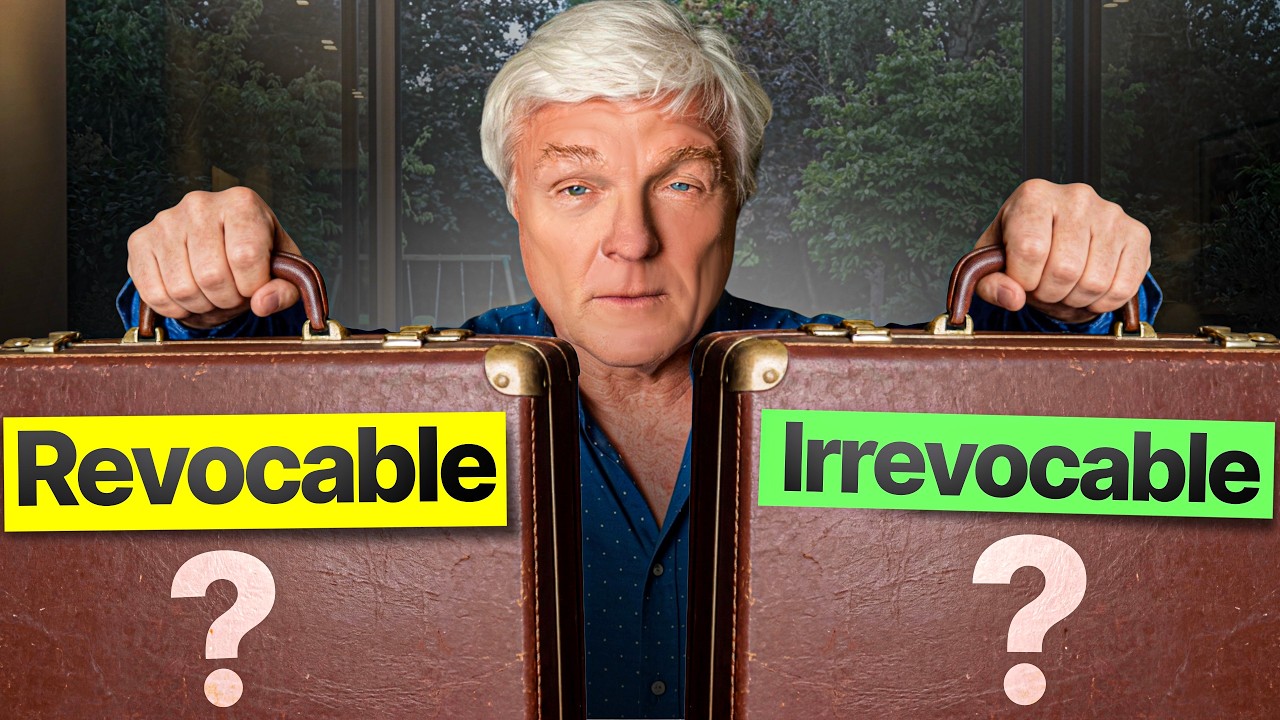
Estate attorney Jerry Taylor compares revocable and irrevocable trusts. Revocable trusts avoid probate and keep assets private; irrevocable trusts shield assets from creditors and plan for Medicaid costs. Most families start with revocable, then add irrevocable for specific protection goals.
Chapters
If you're trying to decide between a revocable trust and an irrevocable trust, listen up, because choosing the wrong one is one of the most expensive mistakes you can make in estate planning. And after doing this for a long, long time as an estate planning attorney, I've watched some families pick the wrong one and either lock up everything they owned with a very, very difficult path to get it back or leave their family completely exposed when they thought they were actually protected. So in this video, I'm gonna walk you through exactly what each one does, each trust, what they do and how they're different. So by the end, you'll know which trust is right for you. So let's get into it. A revocable trust is a legal structure that holds your assets while you're alive. Things like your house, your bank accounts, your investments, your business, and your personal belongings. And that trust tells the world exactly what happens to all of them. When you die. And what revocable actually means is you can change it at any point if you want to. So if you, if you bought a new house and you want to add it to the trust, you can easily do that. If you want to swap out which kid gets which asset, you can do that too. All of those things. And if you decide you don't want the trust anymore, you literally can cancel the whole thing and start over. So you're the one creating it. You're the one running it during your life, and you're the one who can pull assets back out whenever you want to or put assets in. That's why it's the right call for almost every family I work with, because it gives you complete control while you're alive and it just makes sure that everything passes straight to your kids when you're gone. With that one out of the way, here are the 4 things a revocable trust actually does for you and why almost every estate plan I build starts with a revocable trust. The first thing it does, it keeps your family out of probate court, which is the biggest reason why most people set one of these up in the first place. When you die without a trust, the court takes control of everything you own and your family has to wait 9, 18 months or more and pay thousands in legal fees just to inherit what you already left them. So with a revocable trust, none of that happens because the trust already owns your assets. So they pass directly to your beneficiaries within weeks. Weeks instead of years. And the second thing it does is keep your estate completely private, completely out of the public eye. Probate is a public court process, which means everything about your estate becomes part of the public record. It's online. Anybody can find it. The assets you own, the debts you had, who got what, even your family members' contact information. And any nosy neighbor or estranged relative or scammer can pull all of that information up at the courthouse, or usually they can get it online as well. But a trust is a private contract. So the only people who ever see it are the ones who, who you choose to show it to. And the third thing it does is just protect you if you can't make decisions yourself anymore. If you have some incident during life, you have a stroke, you get diagnosed with dementia, or you end up in a coma for some reason, somebody is going to have to take over your finances. And without a trust, your family would have to go to court and get a judge's permission to handle your money for you. And with a revocable trust, the person that you pick ahead of time just steps right in and handles your money without ever going to court. Now, the fourth thing it does is gives you total control while you're still alive. You can sell the house that's in the trust, you can refinance it, you can change who inherits the house, you can add new assets, you can take old ones out, you can cancel the whole thing and start over. So your day-to-day life doesn't change a single bit, you've just got a legal plan in place that automatically will pass everything to your family when you die. Now, irrevocable trust, it's also a legal structure that holds your assets, but the way it works is completely different from a revocable trust because the moment you put something into an irrevocable trust, you no longer own it. The trust literally owns it and you can't take it back. And you can't undo what you've done unless every person that is set to inherit from you signs off on it or a judge orders it. So for example, let's say you put a $2 million rental property into an irrevocable trust and you name your daughter as the person who inherits that property. Once you sign that property over to the trust, you can't sell the property on a whim if you need cash. You can't refinance it. And even if your daughter ends up making bad decisions in life that make you want to leave it to your son instead, You can't make that change without her agreeing or a judge stepping in, most likely. Now, the only reason anybody would give up that much control is because an irrevocable trust does 3 specific things that a revocable trust cannot. First thing is it protects your assets from creditors and lawsuits once it's been in there for a while. Because once you put something like, like a rental property or an investment account into an irrevocable trust, you don't legally own it anymore. So anyone who sues you Can't touch it. And that's why people like doctors and business owners and anyone in a high-risk profession will sometimes set up an irrevocable trust, because one bad lawsuit can destroy everything you've built during your lifetime. And an irrevocable trust makes sure that those assets are completely off limits to anyone trying to come after you. Second thing it does, it lets you plan ahead for nursing home costs and qualify for Medicaid. Nursing homes in this country run $9,000 to $12,000 a month on average, some lower, some higher. And most middle-class families end up relying on Medicaid to cover those expenses. But Medicaid won't pay you a dollar if you have too much in assets. Now, if you put your assets into a type of irrevocable trust and do it at least 5 years before you apply for Medicaid, those assets don't count when Medicaid checks to see how much you have, which means that you can qualify for the help. Without having to sell off your house or other accounts or any other assets that you put into that Medicaid Asset Protection Trust. The third thing it does is keep your estate from getting hit with federal estate tax, but only if you have a very, very large estate. Right now, the federal estate tax exemption is $15 million per person, the highest it's ever been, and $30 million for a married couple. So if your estate is below that right now, this benefit does not apply to you.. But if you're above it, putting assets into an irrevocable trust completely takes those assets out of your taxable estate, which can save your kids millions when you die. And real quick, before I get into the how to best choose between these trusts, if you want to be walked through this the right way to set up your full estate plan in much more depth, I run a free live workshop that's helped hundreds and hundreds of families complete plan. That they're confident will work without hiring a lawyer. If you want to register for that, just click the first link in the description below. Anyway, let's keep going. So for the vast majority of families, the answer is a revocable trust because a revocable trust does everything most families actually need. Keeps you out of probate, keeps your estate private, and gets everything to your kids without having to go through a court fight. That's why I tell almost everyone who walks into my office to start with a revocable trust because the problem most families have, it isn't lawsuits or nursing homes, though a lot of people have issues with nursing homes, is making sure that their stuff goes to the right people without ending up in probate court for a year fighting over it. Now, an irrevocable trust, that only makes sense in a few very specific situations. The first is if you're worried about a nursing home wiping out everything you've spent your life building, creating, 'Cause the average nursing home stay in this country lasts— for long-term care, it lasts about 2 to 3 years. And if you just assume $9,000 to $12,000 a month, that's anywhere from $200,000 to $400,000 of your money gone before Medicaid will pay a single dollar on your behalf. And that's assuming that you only need that 2 to 3 years of care. Some families end up paying out for 5, 6, even 10 years, watching everything they saved get drained one month at a time. So if you set up a Medicaid Asset Protection Irrevocable Trust at least 5 years before you need the care, your house and anything else you want to put in there are out of reach of the nursing home, which means your family inherits them instead of watching them get spent down to zero. That MAPT trust is a very specific kind of trust that you need to see a private attorney to create. Do not try and do one of those online. It's too permanent and too significant to mess it up. So see an attorney to do that. Now, the second reason is if you work in a profession where one lawsuit can take everything you own. Doctors get sued for malpractice. Real estate developers get sued when projects go belly up. Business owners get sued by customers, employees, and competitors, lawyers get sued for malpractice all the time. And the second a court rules against you, anything in your name is fair game. Your house, savings, your investments, even your retirement accounts in some states. But if those assets are sitting inside an irrevocable trust, they're not yours anymore. So the person suing you can't reach them. No matter how big the judgment is against you. And the third is if you're worth more than $15 million per person or $30 million as a married couple, because the moment your estate crosses that line as of today, and that's a moving target, the IRS takes 40 cents of every dollar above it when you die. So if your estate is $25 million, that's going to be $4 million in federal estate tax that your kids have to pay out of your estate before they see a dollar of their inheritance. And they usually have to pay it in cash within 9 months of your death. Which means if most of your wealth is in a business or a piece of real estate or anything that isn't liquid, then your kids might have to sell those things, you know, below market value prices just to pay the tax bill. But if you move some of those assets into an irrevocable trust ahead of time, then they no longer count as part of your estate. So they're not subject to that 40% tax when you die. Now, the fourth reason for an irrevocable trust is if you have a child or a grandchild with special needs who depends on government benefits like Medicaid or Social Security, because if you leave those folks money directly in a will or a regular trust, the government will count that money against them and they can lose access to their government benefits that they rely on for housing and medical care and basic living expenses. So instead of helping them with your inheritance, you can actually end up making their life much, much harder by cutting them off from the support system that they've built their entire life around. But a specific type of irrevocable trust called a special needs trust lets you leave them money in a way that the government does not count against them. So they keep all their benefits and get the financial help that you wanted to give them through that inheritance. Now, some families end up with both a revocable trust and an irrevocable trust, and that's actually pretty common. You might have a revocable trust as the foundation of your estate plan, holding your home and your day-to-day assets, anything you need to live on so that your family avoids probate court when you die. And then you might also have some type of irrevocable trust alongside it for a specific purpose, like protecting rental property from lawsuits or moving assets out of your estate for Medicaid planning. Typically that, that would be your home. So it's important to remember that the The two aren't competing with each other. They do different jobs, and that complete estate plan often will use both. So the right answer really comes down to one question: what are you actually trying to protect your assets from? If your only concern is keeping your family out of probate court when you die, then a revocable trust is all you need. But if you're worried about nursing home costs or a lawsuit, or a federal estate tax bill, that's when you need to bring in an irrevocable trust to do what a revocable trust cannot do. You got that? Now, if you want to make sure that you're choosing the right kind of trust for your specific situation and also build a complete estate plan around it, click the first link in the description to sign up for my free live workshop because you'll walk away knowing exactly what your plan should look like and how to get there in 30 to 90 days without paying $5,000 to an attorney. And if you want to learn why you should not gift your house to your kids and what to do instead, then check out this video next.
More from Jerry

comment workshop.free still need plan to keep people out of court. learn how to in less than an hour









