Conflict Personality Types - Do You Know Yours?
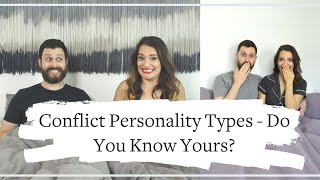
Vanessa and Xander Marin break down eight conflict personality types: Avoider, Firecracker, Teakettle, Peacemaker, Talker, Litigator, Emoter, and Clam. Each type has distinct behaviors and strengths in arguments. Find yours and learn how to handle conflict better.
Chapters
Do you know your conflict personality type?
I don't know.
When you're in the middle of a fight or an argument, what kind of person do you become? We all have one, and you need to know which type you are in order to effectively resolve problems with other people.
Hey, we're Vanessa and Xander Marin. We're married, and we've been together since 2007. Nobody ever teaches you this kind of stuff. So we've made it our life's work to equip people just like you with practice, practical tools you need to create an extraordinary relationship inside the bedroom and out.
In this video, you are going to learn about our conflict personality type model to better understand yourself and your partner in moments of conflict.
Very important.
Very important. So after watching this video, you're going to be able to identify your type and use this information to improve your communication and your relationships, romantic or otherwise. You're also going to learn more about the patterns that you tend to fall into when arguing and how you can change any harmful dynamics that they might create.
So what the heck is a conflict personality type? So it's the side of you that tends to emerge during conflict. It's your personal approach for dealing with conflict and the strengths and the challenges that you bring into an argument. So we've identified eight unique conflict personality types, and we want you to get a sense of which one you are and then which one your partner is. So you'll probably find yourself relating to one of the types. But it's definitely possible to be a combination of two or even three. Maybe you notice that certain kinds of conflicts or certain types of people bring out certain personalities in you.
Oh, yeah.
When it comes to your partner, they're probably a totally different type than you. And there's a high likelihood that your personality types might clash a little bit. That's just one of the ironies of relationships. Opposites attract, and we all seem to attract partners who can easily trigger most of our sensitive issues.
Oh, we know how to push each other's buttons, don't we?
Yeah. So let's get into the eight conflict personality types and strengths and challenges that each one faces.
All right, type number one is the avoider. So if you're an avoider, you really do not like arguments, so you try to avoid them at all costs. But just avoiding an argument doesn't mean that all of the emotions and behaviors behind the argument disappear as well. So let's talk about the strengths of the avoider. So your strategy does end up working out pretty well sometimes because you end up avoiding petty or silly arguments that you naturally forget about in just a few hours or a few days. But when it comes to your challenges, well, not all arguments should be avoided. It's important to be able to talk about issues and challenges with your partner. You can't just avoid your partner for your entire relationship. Your avoidance can also make you seem distant, and your partner may not always appreciate that. In fact, they may even push harder to try to connect with you if they can sense that you're avoiding. Now, sometimes what comes up for an avoider is that you're actually scared of conflict. So you may need to work on learning how to express yourself and knowing that it's safe to do so.
Yeah, I can definitely relate to some aspects of this one. I've been in a few toxic, ish relationships in the past, and I. Not this one. And yeah, I definitely learned in those relations I was burned by conflict. And so there's parts of me that when conflict comes up, I feel like, oh, I just want to do whatever I can to get away. But I'm a recovering avoider. All right, so type 2 is the firecracker. So the firecracker is quick to anger during conflict and can blow up when you're upset. Small things can really just set you off. Your strengths are that you don't bottle things up, which is great. You know, unlike the avoider, you often get over conflict quickly. Once you're able to express yourself, it just may be that you're expressing yourself in a over the top or aggressive, pretty intense way. Yeah, so you might. So obviously you're struggling with expressing yourself in a healthy way. It's one thing to express your feelings clearly, but it's another thing to yell, call names, or be aggressive. And it's never fun for another person to bear the brunt of your anger. Especially if it's a particularly explosive fight, there's a high likelihood that your partner might get freaked out or triggered by your temper. Some firecrackers dominate arguments because they get so big in conflict. You may need to learn how to make space for your partner to have their own more subtle reactions.
Type number three is the teakettle. So with the tea kettle, when things bother or upset you, you tend to ignore them in the moment. But the issue is that all of those frustrations just compound over time. And you eventually hit this point where you've bottled and bottled and bottled things up for so long that by the time you finally blow, it can be just as explosive as a firecracker. So let's Talk about your strengths. Like an avoider, you do end up avoiding some amount of needless conflict. People may sometimes label you as being chill or easygoing, which can feel like a compliment in the moment. When it comes to your challenges, though, it turns out that you are often not being true to yourself. The reality is that things do bother you, but you just won't express yourself until it's gotten really bad. So you need to learn how to address smaller issues so they don't fester. Now, some tea kettles genuinely aren't aware that certain things have bothered them until much later, until after you've had that explosion. So you may need to learn to more in tune with your own reactions in the moment.
Yeah, this has definitely been me in my social like friend relationships.
Oh, I haven't thought about that.
Yeah, so I can, I can really relate with that one. I'm. Once I have identified it, I've gotten a lot better with it. But this used to be me a lot.
I think conflict with friends is so different with conflict with part different from conflict with partners. You know, I think with partners we often can just be a little bit quicker to express it. But with friends it feels really strange to be upset with your friends.
I bet a lot of people can relate to that one when it comes to sort of friend social relationships or work relationships. All right, so let's get into type number four, the peacemaker. So similar to the avoider, you really don't like conflict. You just want there to be peace at all times. But for you, your partner's feelings are more concerning than your own. Your approach is to try to make your partner feel better as soon as possible. So your strengths are that you're really kind and you're caring and you're compassionate and you genuinely like to take care of other people. But when it comes to challenges, sometimes you're overly invested in your partner's experience at the expense of your own. And you might tend to over apologize for things that you maybe regret later. So what can you do better? You need to make more space for your own feelings and reactions during a conflict. You may need to understand that some conflict is healthy and it doesn't always need to be avoided or immediately fixed or glossed over.
That brings us to type number five, which is the talker. So your way of processing your emotions during arguments is by speaking. Sometimes you don't even fully understand how you feel until you've said it out loud. Now, your strengths are that you're generally not afraid of communication. You're thorough and you like making sure you've examined every angle and your challenges. You sometimes talk things to death and struggle to end a discussion. You have to figure out how to wrap things up and actually put an end to a fight. This is something that both of us struggle with at times. Sometimes we just end up talking in circles, saying the same thing over and over again because we're not exactly sure how to just bring it to a close.
Yeah, like I, as I mentioned, I'm a recovering avoider and I recovered into a bit of a talker, you know, so now I'm not scared to express myself or I don't tend to want to avoid everything, but now I can talk things to death a little bit. So, you know, it's all a process of going through different types and learning what you are and trying to improve.
Now with the talker. And this is definitely something that comes up with us sometimes in the process of talking things out. You may say something that you don't mean and your partner may not understand this and take everything that you say literally. This is absolutely what happens with us. A lot of times you say things out loud just as your way of working through it. But I take every step of the process to be what you actually mean. And I can really struggle with, well, wait a minute, but you're saying really different things.
Yeah. So type number six, the litigator. So the litigator is very rational for you. Arguments are about the logistical, the logical details of what happened. And you're determined to convince your partner that your version of events is the correct version. And you diligently present evidence to back yourself up, whatever it takes. So when it comes to your strengths, you're able to clearly and confidently share your thoughts with your partner. You stand up for yourself and your experience and your needs, and you're not scared to express that. And you're also likely very intelligent, too. But what you struggle to recognize is that there's actually three truths to every situation. There's your truth, there's your partner's truth, and then there's objective reality. Your experience is important and it's valid, but your experience isn't objective reality and it's not the be all, end all. So you struggle to be in tune with your emotions as you are with your thoughts, since you default to focusing on the rational or the logical aspects of disagreement. Some litigators can even be so tied to their own reality that they come off as manipulative or cold in moments of conflict.
So I'm definitely a Reformed litigator. In different phases of my life, I've been really focused on feeling like I was right, just wanting to convince other people that I was right. And I definitely came off to a lot of people as being cold and manipulative because I was so focused on the facts. And I'm glad that I've now been able to move past that and realize that my reality is not the ultimate reality and that there are more, you know, other aspects of an argument other than just the logistical details. But, yeah, this is definitely something that I struggled with a lot.
Yeah, I think a lot of us have at points in our life.
Type number seven is. The emoter. So the emoter and the litigator are like two sides of the same coin. So whereas the litigator is overly rational and very thought focused, the emoter leads with your emotions during arguments. So you have strong emotional reactions. And whatever you're feeling in the moment feels like the truth to you. You're in touch with your emotions, and you aren't scared about other people seeing or hearing about them, which is a huge strength. You know what you're feeling, and you're able to express those feelings to your partner, but you lack balance the same way that a litigator does. You struggle to stay in touch with your thoughts and rationality and sometimes can feel lost in your emotions. Your emotions really can feel overwhelming at times. You may get shaky or cry during arguments. It can sometimes feel like your emotions have control over you, and you may also struggle to leave space for your partner to express themselves during conflict.
All right, we're on to type number.
Eight, our final type.
Final type, the clam. You go inward during conflict. You may stop talking and stop making eye contact. Even no matter how hard your partner pushes, you're gonna stay shut down. So the strengths are that you don't lash out at your partner, and you do tend to get over things if you have a bit of time to yourself. But it can be challenging as a clan because you can beat yourself up when you go inward. Sometimes you just feel a flood of intensity and you don't know how to take care of yourself in the moment. You may also struggle with expressing yourself. Even once you've had some time to yourself. Your partner might feel like you're shutting them out and not leaving any room for them to share their side of the story or their feelings.
I am a clam. I am definitely a clam. It's something that I'm working on. But my first instinct nowadays in arguments is definitely just to go straight into shutdown mode. And it's not ever, you know, I'm not ever trying to cut you out or, you know, be disconnected. Sometimes I just feel so overwhelmed. So that's my challenge to be working on right now. Getting out of my little clamshell. So that wraps up our eight personality types. If you like this video, please give us a like and leave a comment down below letting us know what your conflict personality type is or types or types if you liked multiple ones. And please also subscribe to our YouTube channel for more free resources.
Also, we have a free gift for you. If you're excited about improving the communication in your relationship, you're definitely going to want to check out our free guide, the Simple Daily Check in Every Couple Needs to be Doing Right now. We created this guide specifically for couples who are stuck indoors during the coronavirus lockdown, but it's super helpful whether you're stuck together or not. We've been doing it every day and it's been great for our relationship, so click the link in the description box below to download. We're going to be sharing more resources for dealing with conflict just like this, so you're definitely going to want to make sure you're on our email list.
Thanks for watching.
See you next time.
More from Vanessa

Fantasizing about someone you know? Your brain isn’t betraying you, I promise! #marriagetips

If your initiation strategy looks a little like this, we made something for you.



If you’ve been feeling a little lackluster, pick one of these and try integrating it into your life!

Are you still doing THIS in your relationship? #marriagetips #relationshipgoals


Are you a fan of toys, but wondering if it's been affecting your ability to O without one?

To wake… or not to wake… that is the question 😴 #relationshipquestions #relationship #marriagetips

Is your socks life spontaneous? 👀 This is what we have to say... #relationships #marriagetips
