EPISODE 186: Period Sex, Internal Vs External Processors, & Queer In A Straight Relationship
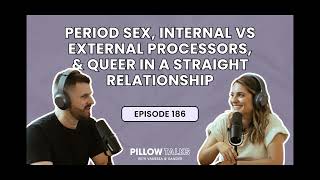
A grab-bag episode of the Pillow Talks podcast (hosts Vanessa and Xander Marin) covering three topics: navigating a non‑hetero identity while in a mixed‑sex relationship (labels, disclosure, non‑monogamy options), attitudes and practical tips for period sex (benefits, hygiene tips, menstrual cups/discs), and relationship communication styles (internal vs external processing) with examples from the hosts' lived experience. The tone is conversational, practical, and sex‑positive, with sponsor ad reads interspersed.
Chapters
You can leave a menstrual disc in and have sex. What? Your partner doesn't even have to know that you're on your period.
What?
Have sex.
Normalize. Keeping periods secret.
Hello and welcome to the Pillow Talks podcast. We're your hosts, Vanessa and Xander Marin. I'm a sex therapist with over 20 years of experience.
And I'm just a regular dude. We share the ups and downs in our relationship while giving you step by step techniques for improving yours.
Make sure you subscribe for your weekly double date full of totally doable sex tips, practical relationship advice, hilarious and honest stories of what really goes on behind closed bedroom doors, and so much more. It's the sex education you wish you'd had. Thank God you're back.
I'm back.
You're back. Don't have to do another solo episode.
That's tough, huh?
It actually was really tough having to talk just you non stop for an hour with no. No engagement. It was a lot. It really was. I'm glad to have you back.
I'm glad to be here. Yeah, it's a lot easier talking to someone else. Yeah. Honestly, the prospect of doing a solo podcast, I don't mean like one episode, but like, you know, just being a solo podcaster.
Insane.
Sounds lonely. I won't go that far to say that, but it sounds lonely.
So. So last week we had our first ever solo episode. Hopefully not to be repeated anytime soon. Today we are testing out another brand new format. So here's the issue that we've had is that for the almost three years that we've been doing this podcast, that's.
Wild to me that it's been this long.
I know, it's crazy, right? So we've had a lot of ideas for episodes, but they haven't been enough for a full episode.
Yeah, there's a lot of cutting room floor episodes. I put episode in quotes. Cause it's like an idea where it's like, oh, there's so much to talk about there, but not a full podcast worth.
Yeah, and it's like we don't want to take a topic and like try to stretch it out. And like, I feel like you can tell when people are. Yeah, you're like, so let's talk about this detail of it.
Did we think about that angle?
Yeah, we just didn't want to do that. So we had the idea recently of what if we did like a grab bag episode where we took all these little topics, that they're still important.
They're not that little. They're big topics. They're just not like hour long topics. Not an hour long, ironically. What will probably happen is we'll start talking about one and we'll be like, oh, man, I think we probably could have talked about this for a whole podcast.
So we're gonna test this out, we'll see how it goes. We have three different topics that we're gonna talk about in this episode because being non hetero in a male, female relationship, period. Sex and internal versus external processing.
Ooh, that last one is a big one. Whenever we talk about this on Instagram.
That'S exactly why we decided to ask questions. Okay, so let's start with being non hetero in a hetero seeming relationship. So you're in a male, female relationship. Most people would look at you and assume, oh, you're both straight, but you are not. You're attracted to not just people of your partner's gender, people of specific genders or all genders. Typically, you might describe yourself as like being bisexual or pansexual. Maybe you just like the more umbrella term of queer.
Maybe you're just questioning. Maybe you're still trying to figure it out. You're like, okay, well, I'm in a relationship with this person and they are of the opposite sex to me and I like them, I love them, I'm attracted to them. But like, you know, I find myself, like, attracted to more than just that sex. So what am I? Cause I mean, that's. That's a very valid situation too. I think a lot of people. There are more people in that situation now than there used to be. Now that there are more options on the table in terms of sexuality, there are more, like, things that are not option.
Yeah, More people are recognizing that.
Sorry, we are. More people are. The options have always been there. It's that, you know, there's more public recognition for these things. And therefore you start hearing about things and you go, oh, maybe, you know, maybe like, this isn't this, like, you know, shameful secret that I need to have. Maybe this is totally fine and normal and something for me that, like, would actually be beneficial for me to, to understand and figure out.
Well, let's start with the idea of being questioning. Like, maybe you've never had an experience with somebody of a different gender, but you find yourself being curious about it or wishing that you had or, you.
Know, dreaming about it or whatever.
Yeah, I mean, so it can be really challenging to have found your person and be in a committed relationship. You know, maybe a lot of times we hear about this, people are married they're like, I don't want to break up my marriage, but I do have this kind of what if feeling in the back of my head.
Lingering thoughts.
Yeah. I'm not sure. Like, I kind of wish that I had explored or experimented a bit more. And honestly, I, like, kind of fall into this category. I mean, I describe myself as heteroish. That's the term that feels like the best, best description for me. I had some very minor experiences with women when I was younger, but you and I met when I was 23.
Yeah, I would. I would categorize us as younger still. I was. I was 22. So I was. I was fresh. It was fresh out of college.
So weird to look back at now and think of being 22 years old.
What the hell.
The person that you're going to spend.
What the hell were.
I don't know. We got really lucky.
I feel really lucky. But also, I mean, yeah. God, I just. Life could have gone so, so different.
Yeah. So I know what this is like to have that feeling of, you know, I kind of wish that I had experimented a little bit more. And there is a sadness and a grief that I didn't. Now, for me, when I weigh it against, hey, I found my person. I happened to be, like, really young and didn't really have the time for experiences. But, like, do I want to be with my person or do I want to explore this other side of me? For me, yes, there was some sadness and grief, but it also felt like, no, I feel really confident and solid, like picking being with my person. And I don't feel like I don't get the sense of, you know, if I didn't explore this anymore, I wouldn't be true to myself or I wouldn't really know myself. Right. So it felt like a straightforward decision for me to make that. I do want to point out that there was some, like, grief and some sadness and a little bit of questioning. I think it's really normal to feel those feelings. And it doesn't mean I made the wrong decision. It just means, like, with any decision, any large decision in life that we make, there's always going to be grief around the decision that we didn't choose.
Now, the good thing is we talked about this a lot early on in our relationship. This wasn't for us. This wasn't a big secret or, you know, something that. That came out later. This was something that, you know, we. We talked about kind of from close to the very beginning, which I think felt really healthy. And I imagine that helped make this feel easier.
Yeah.
For you?
Yeah. I used to dream about us in the locker room, behind the bleachers, in the library. There were times when I felt almost tortured just being around you. Do you still. It's very, very difficult for me to not touch you.
Okay.
If you're like, what was that? What's going on? What happened to pillow talks? But also, I'm excited about this.
Welcome to Dipsy Pillow Talks.
Welcome. Yeah, we need to tell you all about our podcast sponsor, Dipsea. Dipsea is a female founded app for spicy audiobooks and more. Created by women for the female gaze, their app has over a thousand thousand spicy audiobooks, all crafted by a team of professional writers and top tier narrators. I don't know about you, but I was pretty into that accent.
How do I get more of that?
Whether you're looking for a rugged cowboy or a Scottish sailor, Fae royalty, the God of the underworld, you'll find characters you love on Dipsea. With their easy to explore app, you can search for your favorite romance genres like contemporary historical, dark sports, Western, Romantasy, sapphic and more. New chapters are released every week, so you'll always find something new to enjoy. For listeners of the show, Dipsea is offering an extended 30 day free trial when you go to dipseastories.com pillow and if you have never checked out audio erotica before, we highly recommend that you check it out. It is.
That was fun.
That was fun.
I want to listen to more.
I know we were looking at the clips and there's another one called what was it? Lecture me or something.
I can't wait.
I want to know what this one.
We'll save that for the next dad.
Yeah, I mean, it's just such a fun thing to play around with. You might be very surprised by how exciting it feels to you and maybe.
Even both of you.
Yeah. With a 30 day free trial, what's the harm in giving it a shot? So that's 30 days of full access for free when you go to dip sea stories.com pillow dipsystories.com pillow but there are also going to be lots of people who feel like, you know, I actually don't feel right never being able to explore this part of myself. Never being able to express. Express feels like a better word than explore. Explore to me feels like it's like a temporary thing, like, oh, it's just my little queer phase or something like that. But the reality is like that that's just a part of your identity and it's going to be for the rest of your life. So for some people, there is this sense of, yeah, no, I don't feel like I have fully expressed myself. It doesn't feel right to be in this relationship, like, committed for the rest of my life. Like, there's a huge grief. It's too much grief, too much sadness. And in those cases, like, there may be some challenging but really worthwhile conversations to have with your partner where maybe the two of you talk about all the different non monogamy options. Like, would your partner be open to letting you be intimate with other people, letting you date other people? You know, obviously this is going to get really complex and complicated for a lot of couples, but if that really feels like something that's super central to your identity and your expression, I think they're conversations that are worth having.
You might be surprised what your partner has to say about that. Like, I think that way back when, when we were talking about this and I was like, I was like, yeah, I mean, I would, I would be open to at least talking about you exploring that if that was something that was really important because, like, I, I really love you. And the way, where, the way things are looking right now, like, you're the one and, you know, I don't.
The way things are looking right now.
Well, those are early. Okay. Yeah. To be clear, I didn't say it like that this is me looking back. But yeah, you know, I, I was like, yeah, like I, I feel confident in what we have. And you know, it's not sound, you know, it's not sounding like this is something where it's like, I'm not sure about you and I need to go sleep around in order to be sure. It was more of a, like, yeah, hey, big dot. Yeah, that. I can totally understand how that feels like an intriguing or exciting thing, something that you, you know, got to explore a tiny bit, but not really enough. And yeah, I mean, like, I didn't have any. I didn't have an equivalent for myself. But just thinking about that for you, I was like, yeah, I could, you know, I'm not just giving you blanket permission right off the bat, but like, if you're really serious about this, I'm. I'm open to discussing it. And I think that, you know, many partners might. Obviously there, there is the stereotype of men very often saying like, oh, yeah, I know. If you want to go sleep with another woman, I don't care exactly what I was. Which, I mean, I don't know, I struggle with that one. Yes, it is a stereotype but it's like, most men aren't saying that because. Because actually, you know, because they feel like they have to say that, and they're actually super threatened. Like, I think a lot of men are like, yeah, okay. Yeah, well, I don't really care. Men are so keyed in on penises. Like, well, I'm the one with the penis.
Well, I think what. What you're speaking to is that female queerness is much more tolerated than male queerness.
Yeah.
I mean, if you take the average male female and ask the guy, like, hey, would you be open to her exploring with other women? I think a lot of. A lot more men are gonna say, yeah, sure, or even, like, yeah, that's hot. Than if you take a woman and say, hey, your male partner wants to explore with other men.
Yeah.
Like, there's a huge judgment that comes up around that. We've actually had people who are really close to us in our lives, like, be in that situation and just get, like, horribly, horribly treated by their female partners for having that curiosity. Like, oh, you're secretly gay and you don't even want to be with me in the first place. And it's. Yeah, it's really unfair and it's gross and it's cruel, and, you know, it's sad.
It's sad that the idea is that, oh, well, like, women can be bisexual, but men can't. Or. Yeah, like, if men are, then it's secretly something else.
So, yeah, it's. It's for sure tricky in those kinds of scenarios. It shouldn't be any different, but it absolutely is. But I also. Yeah, I'm so nervous about using the word, like, exploring too, because then it makes it feel. It feels very tokenizing. Like, if I think of myself as a queer person, that some straight woman is like, oh, I just want to kind of, like, explore my sexuality. Like, with you, it doesn't feel very good either. Right?
Like, yeah. Yeah. And it's also like. And the reality is, like, if you are going out with the intention of hooking up with someone, like, people hook up with each other all the time with the intention of it just being a hookup, just being sexual exploration. So it's tricky. I mean, yeah, if you're, like, getting on the dating apps and you're like, I'm a straight woman that just wants to explore with. You know, like, if you word it that way, then I guess, yeah, there is sort of the possibility of that. But then it's just tricky, like, from a moral perspective, because it's like, well, we say like, you know, we, in general, we say, you know, from a moralistic perspective. Like, yeah, if you're single or you're, you know, in a relationship where you are allowed to hook up, then, you know, go out and hook up with people. Sure. Like if two contending adults are hooking up with each other.
But then I guess bottom line is just like, just treat people like people. Be kind and generous and nice people to each other. Like, I do think that there is a danger of, you know, when we use the word experimenting. Of. Yeah. Of tokenizing people and not seeing, like their full humanity.
But I think that that gets at. That gets at the reality for a lot of people where it's like, okay, let's just imagine. Let's just flip it. In our case, let's. Let's imagine that, you know, you and I have been married for 13 years and I'm like. And I'm like, I'm like, okay, you know what? Actually, I think I might be bi and I, like, really want to experiment with men. If you were to say, okay, go ahead and do that. Like, I think where the challenge is is that I'm like, okay, now that I'm at the point where I have permission to go experiment with that, like, where do you even start? Like, it's as if I'm like literally a 40 year old virgin, you know, And I'm like, I've never done, you know, how do I, at this age, how do I start doing that without disclosing to someone, hey, I am totally brand new at this. In fact, I'm married. I've been in, you know, I've been married to a woman for all this time. I've never had, you know, never done anything with a man. Like, I think that it's like the rubber starts to hit the road and a lot of people are like, oh my God, I don't even know how to start exploring this in a way that feels like safe or fair to the other person without kind of like outing myself and then outing myself in a way that tokenizes the other person.
Yeah. Okay, we have to talk about something a little gross. Traditional bed sheets can harbor more bacteria than a toilet seat. And that bacteria can lead to acne, allergies, stuffy noses, and it's just gross. Which is why we're very excited to introduce you to our newest podcast sponsor, Miracle Maid. They offer a whole line of self cleaning antibacterial bedding, such as sheets, pillowcases, and comforters that Prevent up to 99% 0.7% of bacteria growth and require up to 3 times less laundry. Their sheets are infused with silver which is the secret to keeping them fresh and cleaner for longer. These fabrics were inspired by NASA. The sheets are thermoregulating, designed to keep you at the perfect temperature all night long no matter the weather and it's good for your skin. Stop sleeping on all that bacteria that's clogging your pores causing breakouts and acne. Miracle sheets are luxuriously comfortable without the high price tag of other luxury brands and feel just as nice as sheets used by some five star hotels. We're about to put this to the test. Our sheets are being rush shipped over to us so we will keep you updated, but we are super excited to try these sheets out. Go to trymiracle.compillow to try Miracle made sheets today and whether you're buying them for yourself or as a gift for a loved one, if you order today you can save over 4 40% and if you use our promo pillow at checkout you'll get a free three piece towel set and save an extra 20%. That is such a killer deal. Miracle is so confident that they are backing all of their products with a 30 day money back guarantee so if you aren't 100 satisfied you will get a full refund. Upgrade your sleep with Miracle made. Go to try miracle.compillow and use the code PILLow to claim your free three piece towel set and save over 40% off. Again, that's try miracle.compillow to treat yourself. Thank you Miracle Maid for sponsoring this episode. Also, you don't need to have experience in order to use a certain label to define yourself. Like I could call myself bisexual or pansexual with zero experience with people of other genders. Like your the labels that you choose to use to describe yourself, they just speak to who you know yourself to be. Not this is the experience that I've had and I think that's a really powerful and important thing to do if you feel like you're non hetero to use that language for yourself to find the words that feel true and authentic to you regardless again of your actual experience with that. But I think being able to honor your own identity and be able to say yeah, I'm heteroish or I'm bisexual, I'm pansexual. Like that's a really powerful experience to have. And it's also a really powerful experience for your partner to validate too. Like we definitely recommend that you share with your partner your true self. You know Even if you're in a relationship, even if you're married, even if you've been together forever, this is your person. Like, being with somebody for life means that they should be able to know and see the entirety of who you are. And if they can't hold that, if they can't accept that, accept that, then they don't deserve to be with you.
Yeah. Are they the right partner for you long term? That's a tough, tough, tough question to ask. But it's also, it's like, yeah. Is my partner's love for me conditional on me having a specific label? Like, that's kind of wild to think about.
Mm, yeah.
So big questions to ask.
So it's important for you to be able to honor and acknowledge your identity. It's important for your partner too. And if there are opportunities for you to do that on a broader basis, that can also be really powerful too. So telling friends and family that that's your identity, participating in the LGBTQ community in whatever ways feel good to you, that really being able to, like, show your full self, you know, when it feels good and safe for you, showing it in a broader context, engaging with your community, like, you still get to be a part of that community, even if you're in a relationship that seems straight on the surface.
Yeah. I mean, another, another, like, vote for coming out to your partner about this, even if you're not intending or wanting at all to explore it. Like, it could open up, up some possibilities for you guys to just to like, talk about it, to play around with it in terms of, like, dirty talk. Like, that could be a really self affirming thing, you know, just like opening the door to, you know, you know, this is kind of then blurs the lines with like, you know, what we, you know, generally say about fantasies where it's like, just because you have a fantasy doesn't always mean that you want to play it out in real life. Or just because you're bisexual or non hetero, like, that doesn't mean that you are, like, gonna cheat or that you need to be hooking up with all kinds of people. But you might find that if my partner is like, open to talking about it with me when we're having sex, like, that could be super hot. It could be super hot for both of you. It's like, who knows what the possibilities are once you come out? Because I think a lot of people kind of like suffer in silence with this because it's like, you know what? Here I am. I don't want to Rock the boat. I don't intend to do anything about it. So, you know, and I think, you know, a lot of people, like, in their minds, are writing a pro and con list, and there's a lot of stuff in the cons list, like, what if, you know, my family doesn't accept me? What if my partner doesn't accept me? What if my relationship falls apart? What if, you know, I feel judged? And so I think a lot of people are just like, oh, it's just. It's just not worth it. I don't stand to gain anything by doing this. And I think that you do stand to gain a lot. It's just like, it's not quantifiable until you get there. Until you can actually experience, like, oh, it feels like such a relief to not have a secret anymore. It feels like such a relief to just be, like, seen for who I am.
Yeah. Okay, I'm gonna cut us off because I could tell that we could keep going. But let's move on to period sex. So we polled our community about this, and I gotta say, I was shocked by the results. If you had to take a guess at how many people have period sex versus don't have it, like, how many people have period sex, I would probably.
Say that a good percentage of people have it. I mean, if I were, like, filtering this through my own experience, I would probably say, like. And we're talking about, like, people in relationships, right? Like, serious relationships. I'd probably say, like 60 to 70%. But I. But what I know of our. Of, you know, the reality of doing.
This is that percentage. But wrong about the answer. 64% of people do not have period sex. That is wild to me. Two thirds of people don't have it.
Yeah, for like, a quarter.
Guys are missing out for like a.
Quarter of the year. Or, I mean, what. How long? I mean, period periods greatly. But yeah, it could be somewhere between a week out of 10 to 25%, 15 to 25% of.
Of crazy. Okay, so let me always say our bottom line is you get to decide what you want to do with your own body. But we are definitely pro period sex over here.
Especially when people are complaining about, like, oh, there's not enough. Not enough hours in the day.
You know, we don't have enough time for.
We don't. We don't have enough time for each other. And I'm like, well, yeah, no shit, you don't have time. Like, you artificially took 25% of the time away.
So here's why I Love period sex number one. Because it's just sex. It doesn't matter that I'm on my period. It's a very minimal thing. It's very normal and natural to be on my period. I actually struggled with having a regular period for a very, very long time. So I probably have a more positive view about my period now that it's regular. You're like, hell, yeah, I love getting my period. I'm like, my body is healthy, it's doing its thing. My period is one of the best signs that I know my body is healthy and happy. So I love my period. Yes, it's annoying and an inconvenience sometimes, but it's also incredibly healthy.
So it's like you also love your period now that your IUD is out because you don't get the cramps that you used to, huh?
Yeah, that is great. So it's like, it's just sexual. Period's totally normal period actually can add a little lubrication. Period sex can feel more pleasurable than sex at other times of the month. And it can also decrease a lot of bad period symptoms. Menstrual cramps, headaches, fatigue, general sense of malaise. Like, having sex during your period can make you feel better.
Yeah, newsflash, Having sex makes you feel good and better.
Now, I want to acknowledge, like, there are of course plenty of people who have really intense periods. They are in a lot of pain. They're like really distressed during that time. So I'm not saying to like, force yourself to do something at a period of period, haha, at a time where you really don't want to, but like, if you're just kind of, you know, you've got an average period. I guess the main takeaway that I want people to take from this section of the podcast is that period sex is totally normal and healthy. There is nothing icky, weird, gross or unusual about it.
One, one idea. If, you know, if you are someone that has a really heavy period or, you know, a lot of cramps, just generally feels yucky or whatever during that period and you've never tried this before? I mean, one, one idea. Because I could, I could totally understand how you're like, well, all right, well, you're telling me I'm going to feel better if I have sex, but the prospect of like, committing to sex sounds like a lot. I mean, I might encourage you to try, like, why don't you like, just try masturbating once? Like no penetration, just like some clitoral stimulation during your period. Maybe just do it yourself so that you're in control. It's not like, you know, it's not, there's no other expectations around it. Once you bring your partner into it, just try it out and see. Does giving yourself an orgasm, like, how do you feel for the next couple of hours, for the next day? Like, does, does it have a positive impact? Because I think like, research tends to show that it actually has a surprisingly positive impact on your well being. And so that might be a way to slowly start being like, oh, huh. Like I, I actually deal with my period a lot better if I'm consistently having orgasms during it. And then that opens the door to like, okay, well, I can give myself orgasms, but also my partner can be involved in that and kill two birds with one stone here. Then we also get to have sex and that's a positive thing. We feel more emotionally connected too. It's a big win win if it works for you.
So we have a fun little life update this Friday, which will have already passed by the time you are listening to this episode. We are hopping on a plane and heading to a very exciting bucket list location. And we are going to be wearing our newest podcast sponsor on the flight Unbound Marino. Unbound Marino was created by three lifelong friends who were looking to solve the age old problem of how to pack light but also look great while jet setting.
So that's hard. That's hard. When you're going on long flights, you're trying to bring a bunch of comfortable clothes. It's always such a struggle for me because I'm like, okay, you know, I've like packed my suitcase and I'm like, okay, how many things do I need for the plane if it's a long plane flight? You know, in the past when we've been on super long flights, you know, I'm like, God, do I need to bring like three different changes of clothes in my backpack? That's so hard.
So unbound clothing is made from merino wool. And I'll be totally honest, when I first heard that, I was like, ooh, that sounds like hot and itchy.
Yeah.
But apparently I have no clue what merino wool actually is because it's moisture wicking, temperature regulating and super comfortable. We ordered a bunch of clothes from them. I've been wearing their shirts everywhere, like not during travel just because they're super comfortable.
I mean, you just travel through life every day, babe.
They're really great and they're just like quality pieces, really timeless, classic design. So they look great, but they're also perfect for travelers. I have definitely been guilty of wearing some real ugly outfits on the plane just because I want to be comfortable. Like, I'm prioritizing comfort over fashion. But now you don't have to that I don't have to. I can look good while still feeling super comfortable. Unbounce clothing allows travelers to pack lighter, save on checked baggage fees, and spend more time focusing on creating travel memories. And they are hooking you up with a great disc discount. Head on over to unbound marino.com and new customers can use our code pillow for 15% off your order. That's unbound marino.com and use our code pillow. The other thing about period sex is that it's actually really easy to deal with. I think sometimes people just get it in their heads that it's this horrible mess. It's just going to get all over the place.
Blood is everywhere, grows.
But we've actually done the math on this before and we should do this live right now because I didn't write down the math. And we've done it in the past. Okay. The average cycle. And again, these are all averages. So of course there are people on the lower and the higher ends of things. But the average cycle lasts about five days. The average amount of blood lost during.
Those full five days.
During those full five days, because there is menstrual fluid, like, contains other fluids other than just blood. But the amount of blood that gets released during that time is two to three tablespoons.
Okay, so, yeah, envision that's less than a quarter of a cup. Like, think about what a quarter of a cup measure is.
Okay, let's use three tablespoons less than that.
Okay, so two thirds of a quarter of a cup.
And let's be really generous here and say that the average amount of time that people have sex is 30 minutes, which is insane. We ran the numbers and it's actually more like five to ten minutes.
Yeah, we're meaning penetrative sex, too.
Let's just say 30 minutes you're having sex. So, okay, that's three tablespoons divided by five days divided by 24 hours.
Divided by two again, because divided by two. Yeah.
Half of an hour is. 0125 tablespoons.
Yeah, you can't even measure that.
0125.
Yeah, that's like a couple drops of blood probably.
I know it looks like more because it's mixed with vaginal fluid.
It's diluted.
Yeah. Mixed with semen. If you have a partner. Like, it can look like there's more for sure. But the reality is there is so very little blood that is actually coming out. It's not that big of a deal. And even then there are really easy and simple ways to deal with it. So turn the lights down or off if you're just worried about it. Maybe one. Like another thing that comes up is some people are just queasy around the side of blood. Some people even pass out the side of blood. That's understandable.
Yeah, that's another. Just, just push through.
Yeah, that's another understandable reason to maybe not do it or use some of these tips for navigating it. But like just turn the lights down. You don't need to worry about it that much. A dark towel or a sheet over your bedding. Like we have white and cream sheets we are conscious about not getting. You know, these are nice sheets. We got a lot of cozy earth stuff here that we don't want to get dirty.
Yeah, no, definitely, definitely put a towel over your cozy earth.
Put a little towel down. It's not a big deal. Like it at all. We just grab a towel, throw it down. Not a big deal.
And also I do want to say the. I feel like I could probably count on one hand the number of times that we've actually made a mess on that towel. Like the towel is just of a piece. Precaution.
Yeah. Oh, I know. We like really never get in because we usually have tissues nearby for quick cleanup. So just grab some tissues. Sometimes people like using washcloths better. Like a dark colored washcloth. That's fine. Just have it nearby for some easy pull out. You can also use a condom if you're in a male female relationship. If your partner.
Just slide that puppy off.
Slide them off. If you don't want to slap it in the trash, that's totally fine too. You could have sex in the shower. The menstrual fluid just washes right away. Nobody will see it. Nobody will be none the wiser. Nobody will be. Nobody will be none the wiser.
Do it in a dark shower.
Do it in a dark shower.
No, that sounds like a real safety hazard.
We're not huge fans of shower sex in general, but hey, like if you.
Don'T have a 1 foot height difference, then perhaps shower sex will work better for you.
Yes.
It doesn't work when she is one foot shorter.
Okay. But here is the real game changer. Menstrual discs. So there are menstrual cups and menstrual discs.
We gotta try one of these. We've still never done this.
I use a cup. I actually haven't used the disc before because I love the cup so much, I haven't felt tempted.
This is just a testament to how big of a deal it is. Whenever we talk about menstrual disc, we're like, oh, we gotta try that. But then it's like we have sex and it's your period and it's like.
Okay, pop the cup out.
Yeah, it's like, whatever. Really? There's really no difference if you. Yeah, it's like once you start talking about sex and initiating sex in, like, a good way, where it's not like, feeling like it has to be this, like, spontaneous spur of the moment thing, because I think that's the other people's big, like, objection to this is that it's like, oh, but then, like, having the washcloth or the towel is, like, super awkward because then it's like, we have to acknowledge that, like, we're gonna have sex. And it's like, okay, if that's what's blocking you, then read our book, do Art of Initiation. Like, there are so many other things that you can do to make that not an issue. Like, honestly, that's just an excuse.
Yeah, okay. But we didn't even say the whole thing about menstrual disc, which is so cool.
No, let's talk more about how we want to try it. No, I'm just kidding.
You can leave a menstrual disc in and have sex.
What?
Your partner doesn't even have to know that you're on your period.
What?
Have sex.
Normalize. Keeping period secret.
No, there's nothing.
Don't let them know. I'm just kidding. I'm just kidding.
But how cool that you have an option to just not have any sort of contact with blood.
Everybody I've talked to says that it works great. So I trust, I trust. Yeah. I don't understand, like, where it goes such that, like, it's not blocking my penis. But yeah, it seems like magic.
It's super thin. It's just a little ring that goes around. It's very thin. Don't worry, there's plenty of room for your penis. Another option is just avoid penetration. Like, we talk a lot about how in male female relationships, too many couples default to intercourse. Like, overly prioritize intercourse. But that's not the only way to have sex. You can use just your hands on each other. You can use toys on each other. You can masturbate together. There are other ways to have sex while you're on your period with zero contact with blood at all, and at the very least, like, maybe you're somebody who has a heavier period. And again, I understand if, like, it's really heavy. It's just unpleasant for you. You don't want to deal with it. I get that. But you could have it towards the tail end of your period when it starts to lighten up, or some people have, like, a really light first day of the period. Like, there are still other times that you can. So I think a lot of people have this tendency to view it in a black and white, or should I say red and white way. It's like, either you have period sex or you don't. But there's actually a lot of gray area where, you know, it's really not that big of a deal. So, again, bottom line, it's your body. You decide what you want to do with it. But please know that period sex is totally normal, and periods in general are totally normal. They are nothing to be ashamed of about. All right, so let's wind things up by talking about internal versus external processing. So this was something that we shared about on Instagram. I think during an. Ask us anything on Sundays. If you're not following us there, definitely come on over. We're at Vanessa and Xander. Xander's with an X. So we shared about it, and people went wild. I don't think people have heard about internal versus external processing that much, which is a shame, because it is a thing for a lot of people in a lot of people's relationships. Okay, so here's how it works in our relationship. I'm an internal processor. Zander is an external processor. So I'll describe what that means for me. For me, I think through everything that I want to say before I say it. And I do a lot of, like, I play things out in my head a lot, and I test out, like, different ways of saying it to find the way that feels, like, the most real and true to me. So I'm definitely somebody who really cares about communication and language. Like, I really. And we both do, to be totally fair, like, we both put a lot of effort into our communication and into just always trying to get better at it. And so I spend a lot of time, like, thinking through and, like, rehearsing in a certain way. Like, the words I'm gonna use, the order of things, the tone, the delivery. So by the time I say something, I really mean it. And especially if we're having, like, a bigger conversation about something that's serious or really important. Obviously, and like a, you know, if we're just shooting the shit with each other, I'm not like, doing all that in my head. But like, if there's something serious that we're talking about, like, I have really weighed that out in my head. And so by the time I say something, that's really what I mean. I mean what I say. I say what I mean.
Now, my brain doesn't work that way. I mean, even just hearing you say, like, oh, I. Or like, I rehearse it in my head, I organize my thoughts. And like, especially once, like, emotions are involved and especially like, you know, the, you know, more heavier emotions, like, that's. That's just like out the window for me. Like, yeah, I could rehearse something, I could organize it in my head, but once I started talking, I can't. I can't keep that organization straight. I don't have, like, a picture of an outline in my head. And I mean, I think that that's something.
Tell us about what is. What is external processing?
Like, so, yeah, I mean, like, for me, I feel like I need to. I need to talk through my feelings and talk through ideas in order to understand them. Like, there's almost like a separation between what it sounds like or what it feels like inside of my head or inside my body and then like the actual expressing of it into words in the English language. And it's like, once I. And it's like I need to have both of those experiences. I need to kind of like, think it through or feel it through and then also say it. And as I'm saying it, then, yeah, it allows me to kind of actually compare and be like, okay, does this properly encompass the thing that I was feeling? Does this actually express what I'm thinking or feeling? Or does it feel like something is missing? And if something is missing, then it's like, oh, okay, then that's probably. Those weren't the right words or those weren't the right ideas. Like, let me try to clarify or think this through. And so, yeah, for me, it's like I can't really have one without the other. I'll sort of. Of like, I need to say it in order to be like, okay, are those all the feelings that I was feeling? Or are there more? Are there less? And. But also like, I, yeah, I need to say it in order to, like, for. To really know if that's truly how I feel.
So this caused really big issues for us early in our relationship, before we understood what was going on. So what would happen is Xander and I would be having a. You know, a serious conversation or even having an argument about something, and Xander would say, like, I feel A. But then, like, as he said it out loud, he'd be like, well, actually, that's not quite it. It's actually, like, more like B. Well, now that I'm saying B out loud, no, I think it's actually, like, something more like C. And often what.
It would be like is, it would be like, I feel A. And then you would say, oh, that really hurts, or that doesn't feel good. And I'd be like, well, actually, maybe it's more like B. Mm. And then. And then you're like, wait, what? Like, you just said, it was this. Now it's that, like, not only one, that the first thing you said hurt, but now two, like, can I believe you?
Yeah, it was this. Like, well, wait, are you changing your mind? Because my feelings were hurt initially. Now, are you, like, maybe going into people pleaser territory? Or is this, like, actually how you feel? But if you really feel B, then why would you even say A in the first place? Like, it took me so long to wrap my head around, like, how could you possibly say A if you didn't mean A? Because that's just not how my brain works at all. Like, I will never say I'm angry. No, actually, I'm not angry. Like, I just. It doesn't work for me. But I want to be super clear. Like, both ways of processing are valid. There are, like, drawbacks and benefits to both. I'm not saying, like, you know, I'm the better communicator or Xander's the better communicator. It's just different. But it took us so long to figure out, like, what is this dynamic that's coming up between the two of us?
Yeah. I mean, and I would feel really shitty about myself and really ashamed. And I would also feel like, well, now I have to justify what I said. And I think early on, like, I was just, you know, I didn't want to be in an argument or a fight. I didn't want to have hurt you. And I feel like, you know, one, I would be reaching for, like. Well, yeah. Why did you say that? Like, you got to figure that out. And then also, like, yeah. And then, like, honestly, I think if I'm being really honest with myself and looking back, like, I was kind of, like, pushing myself to almost, like, come up. Not, like, lie about, but, like, come up with, like, a real reach of a reason why I said something. Because it's something, you know, because Vanessa's asking for an explanation, and I feel like, you know, it seems it sounds reasonable. Like, well, you said this. You. Now you have to say why you said it. And the reality that I've learned is I don't. There is no explanation other than I'm an external processor. This is how my. My. My brain and my emotions.
Yeah.
But it was really hard because it was just, like, it would turn. Things would just spiral out of control. And then it would be like, we'd be so far from the feelings that got hurt from, oh, you said this and that felt a certain way to, like. Like, now I'm, like, justifying, like, why I said something. And honestly, it was more like, I'm justifying, like, now I have to justify, like, why I was an asshole. And it's like, that doesn't feel good. And I. Yeah, I mean, I was really down on myself for a long time about that.
Yeah. And I was just really confused for a long time, too, because, again, the bottom line is, like, we're both going through the process of figuring out how we feel. And that's a very normal and human process. Like, we don't always know. I mean, most of us really struggle to figure out, like, what is it that I'm feeling? What am I actually feeling? Because we don't have enough. Like, we haven't been taught how to deal with our emotions, how to, like, even identify our emotions and know what to do with them. So we're both going through that process of, how is it that I feel? I'm going through, like, do I feel angry? Do I feel hurt? Do I feel annoyed? But I'm just doing that in my head, whereas Xander's doing it out loud. So I'm doing it in my head, and I'm, like, angry. No, that's not it. Annoyed. No, that's not it. But Xander's doing that out loud. But I'm, like, latching onto. Wait, wait, wait. But you said angry out loud. But it's like, you don't. You don't know whether or not you're angry unless you actually say it out loud. And I don't know whether or not I'm angry unless I'm actually checking in with myself. Am I angry or not angry? So it's like, it's the exact same process. It's just. We're doing it in different ways, different places. But one of the things with being an internal processor is because I'm spending so much time trying to figure out what I want to say before I say it. It makes me a very literal person where I'm like, okay, if you said out loud, I feel angry, that means you feel angry. There's no reason why you would have said it unless you didn't actually feel it. And so that's what lent this. This, like, really tough quality to a lot of our arguments. Because I'd, like, pounce on something and say, like, but you said that. Why did you say that if that's not feel? So we had to spend a lot of time working on this. And it ultimately came down to two things. There's, like, work that. That both of us have to do. The main thing was being able to recognize these are just two different styles. There's no right or wrong. There's no better or worse. They're just different. So we, you know, we start with that respect for each other of, like, hey, my partner doesn't function the exact same way I do. But, like, that's normal and that's okay. So for me, the work was learning to not be so literal. So I now have to, like, give Xander space to land where he's gonna land. And so I'm, like, actually talking to myself as he's talking through something where I can feel that reaction of, like, he's saying he feels a. Oh, my God. Now I have to, like, you know, formulate my arguments for a. But I, like, will talk to myself and be like, like, okay, that's just the first thing he's saying. So that's not likely how he really feels. Let me give him some space to figure out what it is that he really feels. So I have to, like, literally tell myself, ignore what he's saying. That's just the first draft of it. Wait a little bit longer.
And then I had to learn how to be more sensitive about, like, what I'm saying out loud and remind myself that. That, you know, hey, like, you know, just like Vanessa was saying, like, she has to learn to be less literal. I'll have to remind myself Vanessa is more inclined to take what you say literally. So, you know, I need to be thoughtful about what I am saying out loud. Or at the very least, trying to just be clear. Like, hey, I'm thinking this through right now. Like, I'm. This is not, like, a final thing. This is me talking about this and going back and forth about it. And also, most importantly, here is, like, stopping and giving Vanessa a little time to participate in the conversation. Because otherwise, if I'm just, like, talking without giving her space Then it's like she hears what I say, and then she's like, okay, well, that must be that rather than, like, you know, us being able to actually talk about it. Because the reality is, is what I'm wanting and needing, the reason why I do it out loud is because that helps me more quickly key in on what am I really thinking or feeling or what do I really want or need. And I need to. And it's like, I want to have a conversation about it with myself, but, like, also, most importantly, I want to have a conversation about it with her. So I need to give her space to be part of that conversation.
Yeah, I mean, I think one of the challenges of being an external processor is that you naturally take up more space in the conversation because you're, like. You're processing things out loud. So you can go for a long period of time of, like, just kind of talking out loud, like, working your way through it. And sometimes because you're so deep in that process of working your way through it, you don't realize that I'm also there, like, having a conversation. You realize that I'm there. But, like, yeah, it's just very easy for you to kind of give this speech, like a long. You know, a long speech. And I'm sitting there like, wait, wait. I want. I want to respond. I'm here, too. And so that's something that we've also had to work on as well. It's like breaking the conversation up a bit more to make space.
Yeah. So, yeah, I mean, it can. Yeah. The reality is that, yes, I can take up more space during, you know, during the conversation. I do think on the flip side, though, as an internal processor, what that can cause, though, is that you can take up more space, but before the conversation occurs, and that can be the big challenge for me, is I'm like, I want to talk about it. I want to talk about it, and I want to figure it out. I want to go through all this stuff and understand how I feel and understand how you feel. And so I'm ready to go. I want to start right now. And Vanessa clams up, and Vanessa's. Because she's processing internally. So I think that's an important thing for you to remember that, like, yeah, you're. You know, I get that you can be annoyed that I'm taking up space when we're talking and think about how it feels for me when, you know, you're. You're taking up a lot of silent space. Like, you know, and. And I get that you need that, you need that just as much as I need the space to be able to, you know, to take up my space when we are processing. So, yeah, I mean, they're, they're. Yeah, I can totally see how. I think it's. In a way, it's kind of like with spontaneous versus responsive sex drive, most people are like, oh, well, when you say them out loud, of course I want the spontaneous one. I think a lot of people are like, well, of course I want the internal processing. But the reality is that as an internal processor, you can come across as cold to other people because you can be like, you retreat internally when you start to feel something and you're not ready to talk about it yet. And you can come across cold. You can come across as like, you know, not. Not willing to engage for some amount of time. And that can be a confusing experience for, for another person. So, yeah, there are definite pluses and minuses to, to both of them.
All right, well, that wraps up our Grab Bag episode. We'd love to know what you think. Since this is a brand new format for us. Should we keep doing these? Are there other topics that you haven't heard us covered yet that maybe we could put into a Grab Bag episode? We'd love to hear all the feedback. So there are a couple of different ways that we can connect. You can answer our poll on Spotify. We post a poll for every episode. We would really love to hear from you. We design so much of our content to meet your needs, so love to hear what you think. You can join our VIP email list. You get all the behind the scenes info, our best sex and relationship tips, our funniest and most heartfelt moments. Those all happen in our emails. So you can go to vmtherapy.com subscribe to join and we will also put the link to that in the show notes and you can follow us on Instagram. Come on over to Instagram, let us know what you thought of this episode. We'renessaandzander.
And finally, you can also leave us a review on Apple Podcasts that goes so far to getting our podcasts in front of other people, letting them know this is a legit podcast. Not only is it legit, but it's loved. And yeah, so we would be so happy if you left us a review. In fact, we do a review of the week giveaway every single week to reward you for leaving reviews for us. The way you do that is you scroll to the bottom of the pillow talks page on Apple Podcasts all the way at the bottom you'll see the rating and review section. Smash that five stars and leave us a short review. It doesn't have to be an essay. And if you hear your review read aloud at the end of the podcast, like, right, like I'm about to do right now, then you have won a free masterclass. And all you have to do is email us@infomtherapy.com or DM us on Instagram and we will get you your prize. So it's like a fun couples date. I'm in a new relationship at 53 years old, and it's the healthiest of my life life. I love listening to your episodes with my Sweetie. We take away lots of creative tips and advice and always have so much fun laughing along with the two of you. Thanks for what you do, Vanessa and Xander. It's a joy to witness your sweet love.
Oh, that's very. It's very sweet and cute. I like when people call each other their sweetie. Call each other sweetie. We say babe. It's not as. It's not as sweet as sweetie.
You could call me sweetie. I don't. I think I'll keep calling you babe. You are my babe. You're babelicious. Oh.
All right. Well, that's all for today's episode of Pillow Talks. Thank you so much for listening. Join us again next week. We have a very special holiday edition of Am I the Asshole? Sam.
More from Vanessa

Fantasizing about someone you know? Your brain isn’t betraying you, I promise! #marriagetips

If your initiation strategy looks a little like this, we made something for you.



If you’ve been feeling a little lackluster, pick one of these and try integrating it into your life!

Are you still doing THIS in your relationship? #marriagetips #relationshipgoals


Are you a fan of toys, but wondering if it's been affecting your ability to O without one?

To wake… or not to wake… that is the question 😴 #relationshipquestions #relationship #marriagetips

Is your socks life spontaneous? 👀 This is what we have to say... #relationships #marriagetips
