Sex Therapist: The Top 7 Questions I Receive
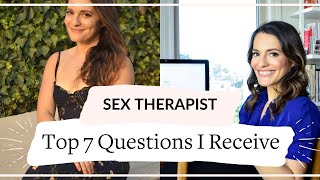
A YouTube video by licensed sex-and-relationship therapist Vanessa Marin outlining the seven most common sex-related questions she receives and providing practical, destigmatizing answers. Key themes include sexual normalcy (no single "normal"), orgasm difficulties (solo and with partners), reviving a stagnant sex life, male performance issues, fluctuating libido, and how to communicate with partners; the speaker also references her courses and free guides for deeper help.
Chapters
As a sex therapist, I hear tons of people's most intimate questions and concerns. But of all of the juicy questions that I get asked on a daily basis, there are about seven that I get asked all the time. Hey there. I'm Vanessa Marin. If we haven't yet met, I am a licensed psychotherapist specializing in sex and relationship therapy. I've spent the last 15 years working with thousands of people, and I've been a featured expert for major magazines and websites like the New York Times, oh, the Oprah Magazine, Real simple, and many, many more. My mission is to equip you with the tools that you need to create an extraordinary relationship inside of the bedroom and out. So in this video, I'm going to be revealing the top seven questions that I get asked as a sex therapist, plus the answers that I give when people ask them. So if you've ever wondered what sex therapy is all about, if you've ever had a burning question about your sex life, or if you're just kind of curious about what goes on in other people's sex lives, this video is for you. Okay, so let's get right into the questions. Question number one. Am I normal? Hands down, this is the most common question I get from men, from women, from couples, you name it. Everyone is so worried that what they do is out of the norm or it's weird or it's something to be concerned about. So I hear it from women who are struggling to orgasm or who can only orgasm in very specific ways. I hear it from men who are struggling with performance issues or have a lower sex drive than their female partners. I hear it from couples who worry that they don't have sex often enough or even that they have sex too much. I hear it from individuals who are worried that their fantasies are over the top or weird or abnormal. Seriously, everybody is worried about whether or not they're normal. So I get this question from every angle. No matter what the circumstance is, people are so concerned that what they do, feel, or think just does not match up with what everyone else feels, does, feels, and thinks. So, fortunately, this is a question that I can answer pretty simply. There is no normal when it comes to sex. And really, there's no use even trying to define normal. The reason that we're all so obsessed with normal is because we think of sex as this embarrassing taboo topic. And it's like we want to find a way to get rid of all of the embarrassment and the shame that we have. So we feel like as long as other people are doing it, it can't be all that weird, right? Like, if other people do it, it kind of gives ourselves this permission. It too. So let me just say, as long as everything is taking place between enthusiastically consenting adults, you're fine. Seriously, you're fine. And if you truly want to explore your relationship with sexuality and get more comfortable with your sex life, with your desires, then definitely check out sex therapy or one of my sex therapy courses. Question number two. I can't orgasm. Is something wrong with me? So this question is kind of similar to the first one, but it's one that I usually hear from women. So the answer to this question is no, there is absolutely nothing wrong with you. It is actually really common to not know how to orgasm. Much more common than you might think. So orgasm is not something that we are born knowing how to do. It's not some inherent skill that we just come out of the womb. Having orgasm is a skill. It's something that takes time and practice to learn, just like any other skill that you might want to get. But we don't exactly take orgasm 101 in school, right? So there are millions of women that are left struggling to figure out their bodies on their own. I've even had my own orgasm struggles. So I totally get the frustration that comes up around this question. So this is the reason that I created my online course Finishing School. I realized that there just weren't great resources out there for women who want to learn how their bodies actually work and what they actually need to reach orgasm. When I was having my own orgasm troubles, I was looking everywhere for some good information and instructions, and I couldn't find a single thing. So bottom line is, if you have never had an orgasm yet, do not worry. Nothing is wrong with you. You're not broken. It doesn't mean you'll never be able to have an orgasm. You just need the proper information and techniques. And you might want to check out Finishing School, but you will get there, I promise. Question number three. Why can't I orgasm with my partner? So this one kind of dovetails off the last one. This is another one that I get a lot from women. So there are a lot out there who know how to get themselves off on their own. But the second they bring their partner into the mix, they just can't figure out how to get there. And there are a lot of women who've never had an orgasm, but they want to, like, skip ahead to the whole orgasming with a partner part. So this is only complicated by the fact that there's a lot of misinformation and confusion about how female pleasure works. So most women who have sex with men expect that they should be able to orgasm from intercourse alone. But in finishing school, I teach that regular old intercourse just, just does not create enough stimulation for the woman to orgasm. So it's perfectly normal to not have an orgasm during intercourse. It's even perfectly normal to not particularly enjoy intercourse that much. Plus, a lot of us ladies have a really hard time taking responsibility for our own pleasure. Like, we're taught to be so embarrassed of our bodies. So most of us just want this partner who can come like swooping in and just give us everything we never even knew that we needed inside and outside of the bedroom. Right? There's that like, knight in white shining armor fantasy that a lot of us have. But that's an awful lot of pressure to put on one person. It's just not realistic. So I hate to break it to you, but your first orgasm is just not going to happen that way. So if you want to learn how to orgasm with a partner, there are two key steps that you need to take. First, you need to learn how to orgasm on your own. You have to figure out how your body works before a partner can get you there. And then second, you want to incorporate the kind of stimulation that you like to use on your own with your partner. So don't just default to intercourse. Don't think that what works for him will automatically work for you. You need to give your body what it needs. And you need to teach your partner what you like too. Question number four. Our sex life has totally disappeared. How can we bring it back to life? So look, let's face it. Prioritizing your sex life and your relationship is not always easy. In fact, it's more often difficult than it is easy. It takes constant, constant work and sometimes just has other plans for us. So I can speak from firsthand experience when I say that at some points your sex life with your long term partner may feel kind of stale. It's totally normal to go through dry spells. My husband Xander and I have definitely been through dry spells of our own too. It's completely normal. So don't feel bad if maybe you've had a stressful few weeks at work and you just don't seem to be in the mood at all. Don't worry if you and your partner have suddenly gone like a few weeks or even a few months without having great sex. It just happens. That is life. So what I like to remind my clients is that while it might feel awful in the moment to know that your sex life has just taken a backseat or just isn't very pleasurable or enjoyable anymore. The great news is that you always have the power to take a step towards a more exciting, more passionate, more fulfilling sex life. You can always start working on your sex life at any point. You can make a change at any point. So I want to take a little second here though, to talk about effing. Now, for most people, like, having to put any sort of effort into your sex life is seen that it's a sign that something is like broken in your relationship, something's wrong that you have to all of a sudden work so hard for it. But honestly, that could not be any further from the truth. Great sex requires great effort. I'm gonna say that again because it's so important. Great sex requires great effort. So if you want an active and satisfying sex life, you have to work together as a to keep it exciting. So start by having a conversation with your partner about where you both stand. Talk about the things that are getting in the way of the two of you having the sex life that you want and the things that contribute to the two of you having great sex together. So for example, maybe you could talk about how your stressful work week, it just hasn't set you up to be in a good headspace. Maybe you can brainstorm some simple ways that the two of you can get back into the swing of things. And if you're struggling to bring up your sex life with your partner, be sure to check out my other video. How to talk to your partner about sex. The do's and don'ts according to a sex therapist. Question number five, why am I having performance issues and how can I get rid of them? So this is a question that I get most often from men. Now, performance problems develop with a kind of ridiculously predictable pattern. So you have an issue getting hard or ejaculating too quickly just once, and then the doubt starts to come creeping in almost immediately. So you start thinking about it all the time. Your anxiety increases, the problems begin occurring with greater and greater frequency. It becomes the worst kind of self fulfilling prophecy. So I think that one of the underlying beliefs that lead to performance issues is this idea that the penis is supposed to operate like a machine. So we are conditioned to believe that men should always want sex and they should always be ready for sex at the drop of a hat, like wherever, whenever, whatever, you should be good to go. So men expect that their bodies should just be under their complexity they should do whatever they want their bodies to do, get hard whenever they want, last as long as they want, have orgasms, everything. But the truth is, we are not robots. And our bodies do not always do what our brains want them to do. So erections and orgasms do not happen in a vacuum. That actually sounds extremely uncomfortable. Right, so there are a lot of different factors that can cause performance issues, health problems, relationship dynamic, communication, anxiety, depression, host of other things. So if you want to get your sexual performance back on track, stop expecting your body to operate like a machine and start getting curious about the specific dynamics that might be getting in your way. Question number six. My sex drive has tanked. How can I get it back now? Most of us think of our sex drive as a fixed value. Like I always want to have sex twice a week. But the reality is that your libido is really sensitive and it gets affected by a lot of different dynamics. So there might be times where you do want sex multiple times a week and you can happily follow through on those desires. But there may also be times when sex is the last thing on your mind and no matter what you do, you just cannot get into the mood. This is totally normal. Well, I created an entire course based on the answers to this question. It's called Rediscovering Desire. If you want to check it out, I'll put it in the description box down below. The best first step is to think about your sex drive as having a reverse mode and a drive mode. So reverse mode are the dynamics that get in the way of you feeling desire. They're like blockages to your desire. Drive mode are the dynamics that actively get you going. So some common reverse mode dynamics are things like medication, stress, depression, anxiety, lack of sleep, big life changes, trauma, how you maintain your space, how much daily screen time you get, your self esteem, whether you have a history of sexual pain. Some common drive dynamics include your partner initiating in certain ways, having the time, space or privacy for sex, doing certain sexual acts, having a good relationship with your body, or taking time to connect emotionally first. So lots of different possibilities, right? So you want to figure out what puts you into reverse and what puts you into drive. And finally we have question number seven. How do I talk to my partner about our sexual issues? So here's the thing that most people get wrong when it comes to talking about their sex life. They start out by talking about the problems in their sex life. Unfortunately, since people are so embarrassed about sex, we all are. Don't worry, you're not alone in this but because of that, we usually only will talk about it when things are really bad or something is wrong. But this only contributes to feeling even more anxiety about talking about sex. Like if you're imagining yourself confronting your partner and telling them all the things that you you don't like about your sex life, of course you're never going to want to bring up the topic. So instead, what I recommend is that you talk about the good stuff first. Not only is this easier and a whole lot more fun, it's also way more effective. Once you get comfortable talking about sex in a positive or even a neutral way, you'll feel so much more confident bringing up the trickier stuff and you and your partner will have this amazing foundation of communication that you can fall back on. So if the thought of bringing up sex with your partner just terrifies you or you need a little help getting the conversation going, I have got your back. Be sure to check out my free guide how to start talking about sex with your partner, even if you never have before. So this guide breaks down it into easy to follow steps. It gives you word for word scripts that you can just copy. Do exactly that with your partner. So I will leave a link to get the guide in the description box down below. All right, so that wraps up the top seven questions that I get as a sex therapist. If you like this video, please give it a like or better yet, comment down below. Let me know if you've ever had one of these questions. Let me know what you think about the answers. Any surprises here? Any other questions that I didn't mention? I always love hearing your questions, so make sure to also hit the red button to subscribe to our YouTube channel. And while you're at it, click that little notification icon too so you can make sure you keep getting all these videos. Thanks for watching and I'll see you next time. It.
More from Vanessa

Fantasizing about someone you know? Your brain isn’t betraying you, I promise! #marriagetips

If your initiation strategy looks a little like this, we made something for you.



If you’ve been feeling a little lackluster, pick one of these and try integrating it into your life!

Are you still doing THIS in your relationship? #marriagetips #relationshipgoals


Are you a fan of toys, but wondering if it's been affecting your ability to O without one?

To wake… or not to wake… that is the question 😴 #relationshipquestions #relationship #marriagetips

Is your socks life spontaneous? 👀 This is what we have to say... #relationships #marriagetips
