EP 85 - Creating A Wholesale Real Estate Marketplace with Paul Wakim of TwnSqr
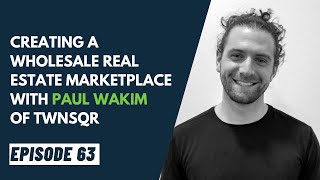
Paul Wakim built Townsquare, a marketplace for off-market real estate deals where investors post properties, manage private buyer lists, and partner on joint ventures. The platform costs $149 a month and includes features like user reviews and KPI dashboards. One user bought a house for $1 through an off-market deal.
Chapters
Welcome to the Collecting Keys Real Estate Investing Podcast with your host Mike DeHaan and Dan Austin.
From wins, losses, horror stories, and tactics for optimizing your business, Mike and Dan take a real, uncensored deep dive into the ins and outs of running a full-time real estate investment and wholesaling business.
What's going on, guys? On this episode of the Collecting Keys Real Estate Investing Podcast, we have Paul Wakim coming in from Bend, Oregon, living the digital nomad life. So he's been an investor in the past, and I'm guessing your motivation behind the platform that you built stems from some sort of frustrations in the past. But he's building a really cool program right now called Town Square. Where we played around with it a little bit before the show, but it sounds like you're trying to solve the problem with disposition and finding buyers mostly for wholesale deals, or is it for deals that are on the market as well? A whole bunch of different things, but either way, trying to bring tech to real estate, which is always challenging in our kind of antiquated business. So Paul, appreciate you having us. We'd love to hear your backstory and kind of what you're working on with this platform you're trying to build.
Yeah, yeah, of course. Thanks, Mike, and thanks, Dan. I, uh, admittedly, I had listened to your guys' show back whenever it first came out, I think, but then I recently got caught up. Yeah, like I, like I mentioned before we got on the, the recording here, I've been out of the like full-on investment game for the last like 2 years or so as I've been trying to build this tech startup in the real estate investing world, but I think that maybe a year and a half or so ago, I was listening to your guys' show and stumbled upon you from my podcast app before everything went to Spotify. But yeah, I'm excited to be here. I know you guys do some serious business. And I mean, as we talk here, I'd love to know what you guys think about our platform and what you think about what we're trying to do in this part of the industry. But before we get into all of that, yeah, my name is Paul Wakim, the co-founder and CEO of Townsquare. I got my start in real estate investing in the Pittsburgh, Pennsylvania market after starting what has become one of the largest real estate photography companies, uh, on the East Coast. So I was the primary photographer for that business, met all of the top real estate agents and all the top real estate investors in that small to medium-sized Pittsburgh, Pennsylvania market. Um, and it dawned on me as I was becoming more interested in real estate investing and real estate agent, that whole life of trying to find deals, that there's no real estate without a real estate investor. So like you, Mike, I taught myself how to code and— or there's no real estate without a seller. Sorry. I taught myself how to code, went out and gathered a bunch of data and tried to build a very, very rudimentary algorithm to predict who was going to sell their house next. And, uh, long story short, I met my co-founder in 2019 and we improved upon that algorithm and got it to be 95% accurate a month before COVID hit and all of the data, uh, okay, went to hell. Yeah, so we've, uh, we've pivoted quite a few times since the middle of 2019, but where we're at is a dispositions platform. You hit the nail on the head. Townsquare is a dispositions platform for off-market properties based around a marketplace. Cool.
I like it. So I guess when you were building that algorithm, trying to figure out, like the way for people that were going to potentially sell their property, I guess what did that look like? Was that using public data? Is that looking at, like seller, like sales patterns in different neighborhoods and sort of trying to project it that way? Are you looking more at individuals? I guess what was that specific algorithm based on?
Yeah, so it was based on publicly available data and, um, data that was on trends, like what was selling in the neighborhood and for what price, uh, what the ARV and what the AVM— the AVM's automated valuation model, um, really just based on a bunch of data that we were scraping and then running our own, um, our own programs on top of. And we were really lucky that CMU, Carnegie Mellon University, is based in Pittsburgh. So all of the data from the county was structured and labeled and perfect because CMU at the time was in a contract with the county to structure all of this real estate assessments data and all of the data that we were using. So we had like a, a team of professional, uh, undergrads working with us that they didn't have any idea they were working on this algorithm with us because they were structuring and doing all all the hard work with the data. Um, and it made it really accessible for us to use and make predictions on. Um, but when it really came down to it, the things that we found are pretty obvious why people sell. It's things like credit card debt, going into foreclosure, uh, violations that the city is marking, uh, a death in the family, a divorce. Those kinds of things were really like the big telltale signs that were heavily weighted in the data. As we were making those predictions. But then, like I said, COVID hit, and in Pennsylvania, the governor shut down all of real estate for 4 and a half months. Like, you couldn't do a closing, you couldn't go to a showing. Um, so everybody that we predicted was going to sell wasn't selling. And then whenever all those restrictions were lifted, everybody that we thought wasn't going to sell ended up selling. So that was our first pivot in the, uh, middle to end of 2020.
Fascinating. What you just described is the off-market world to a T. You know, everything that you think will happen is the opposite of what'll actually happen. And you never know what's gonna happen next, you know.
So that's a lot of opportunity because of that, you know. I think, yeah, the fact that it's so unknown, that we're not in this structured world of the National Association of Realtors applying these strict guidelines like they do to on-market things— like, I'm not, not ragging on the National Association of Realtors and what happens on market, but I think that there's a lot of opportunity in the off-market world to develop softwares like Townsquare and make a lot of money with investing because there's a lack of congruency.
Yeah. And that's one of the reasons that things that gets lost amongst so many people as well. And, you know, so many people have tried to build these different platforms for finding off-market leads, for, you know, talking to sellers, for all this sort of stuff. But you can't get past the people element. You know, like, like we have a— I'd say a friend of ours that is in GoBundance with us. GoBundance is like this millionaire mastermind that, you know, a lot of real estate guys are in. And he's a young guy, he's super smart, but he's trying to build this basically texting platform that is supposed to have conversations with motivated sellers to get them to sell their property at a discount. So like basically AI, you know, sales/lead conversion, right?
Like a bot.
But the thing— Yeah, yeah, like a bot. But the thing is, the thing is, you know, most motivated sellers, especially these days where everyone has so much equity, it's not like you're buying it from some family. You're buying it from some person that, you know, is wearing a tinfoil hat. It's in their basement that hasn't paid their medical bills because they don't want to touch the credit card and get like some sort of laced poison from it, you know, like asinine stuff. And you can't overcome that. Like, no matter how hard you try, technology will never be able to conquer that problem.
Well, and it's not just the real estate. I mean, when you're, when you're selling, salesmanship is like a skill. So there's the real estate we all know is a people to people business. That's how you get deals. That's how you attract buyers. That's how you find sellers. It's people and it's seeking it out. And so So your technology has to account for that. And when Mike and I review other tech platforms, because we're always looking for different things, like the one big element, whether it's a lead gen system or a dispo platform, the one big element like that I look for is like how, how, like I would try to reverse engineer it and say, where's the benefit? If all the benefit is going to the person with the platform, there's, there's no point in using the platform because it's, there's, it's a one-way street. It's like, we're just going to try to scrape as much money from you as we can and then know we're going to have like a 30, 60, 90 day attrition rate. We don't care. And there's enough people out there right now. We're just gonna keep churning. That's not a long-term business model. And there's no value in it for me.
Yep, exactly. Yeah, I have so much to say on the, like, human connection side. But Mike, you struck a nerve with saying it's the guy in the basement with the tinfoil hat. One of my very first deals, one of my very first deals was a deal like that, where my first version of the algorithm predicted that a house needs to be sold down the street from where I was living at the time. And it was this like rundown piece of crap house in Pittsburgh, Pennsylvania. Nobody had lived in it for such a long period of time. We had to get in touch with the, like, family members. Finally got into the place. There were like 4 feet of sewage in the basement. And the guy that lived there lived there by himself without power, without water, without anything for like 10 years. And like, it's, it's a people business. If you don't know how to handle those kind of situations, it's not like I'm gonna send a letter to that guy and he's gonna call me. It's like, I need to get in touch with the family. I need to handhold everybody through the situation. I need to handle all the legalities of it. I need to get the $180,000 worth of medical debt scrubbed off the title. Like, all of that needs to happen, and you can't do it unless it's a relationship that you build and curate over what took me 2 years to buy that house. But I bought it for a dollar and I ended up selling it for $86,000. So it worked out.
Nice. Yeah. Did you actually buy it for a dollar?
I actually bought it for a dollar, man.
I hope you at least gave him like a Snickers bar or something to, you know, make him feel good about that. One dollar.
Yeah.
The situation— the situation was, unfortunately, the individual that owned the house, he had passed away. And his family member who was working with me, she had covered the funeral costs and it was like a whole big thing in their family. And I said, listen, if you work with me on this, tell me what your costs were to, you know, get this arrangement done and off the— off your plate, off your family's plate. And she said $5,000. So whenever we sold the place, I sold it or I bought it for a dollar. But then I paid this family member to work with me so that her her total in the hole was zero rather than $5,000. So yeah, it was an interesting deal. It still made quite a bit of money.
Yeah, that's awesome. That's a huge deal. And at the core, you solved the problem, which is what we always say to people that ask us about wholesale off-market real estate. We teach this very heavily in our Instant Investor program is no matter what you think about the house or kind of real estate in whole or the investment, At the end of the day, if you want to be an off-market investor and you want to create real money and opportunity, you have to solve people's problems. And that's exactly what you did there, which is why you're able to get this house for a dollar, right? Which is truly unbelievable.
Yep. So yeah, yeah, it worked out really well. Um, and then Dan, you were saying about like the, the connections between people and making sure that like there's actually a two-way street where you're providing value to somebody on one of these technology platforms and then they're providing value back to you. Um, at the core of my real estate experience, my real estate business and investing, is the, the connections and the partnerships that I've formed with people that are more experienced than me. Like, I did a pretty nice townhome development with a 60-something-year-old guy that I partnered with, and I couldn't have done it if I didn't partner with somebody more knowledgeable. So As we've been building Townsquare, it's really a marketplace, but it has a bunch of tools on top that help investors do business more efficiently. And one of the primary tools is forming a connection between you and another investor to do business more efficiently. So yeah, I totally agree. So much of it is relationship. As much of a wild, wild west this world of off-market real estate is, it's so much of it's about making connections. Yeah, totally.
Absolutely.
Yeah.
And it's like we always talk about, you know, not we, but like in general in the real estate industry is you've got to have something, whether it's money, you got to have hustle, or you got to have like an opportunity or a deal. And it reminds me of like when I— back when I was in the military in Ranger School, you get your MRE, your meal ready to eat, and you get like one a day and you might get something in there that you don't want or you might need something else to make a really good meal. So you might say, you'd sit there and you'd hold it up, you say, hey, I have peanut butter, I want cheese. And someone says, hey, I have cheese, I want peanut butter. It's a match made in heaven, right? Because now you're— now your crackers, you can have cheese and crackers instead of peanut butter and crackers, right? Um, but that's when you're talking about community and when you're talking about building those connections. You're trying to connect the guy with the cheese that wants peanut butter to the opposite need. And that's where true relationships and true, like, actual networking that can benefit you to grow your, to grow your business or whatever, put a deal together that wouldn't have otherwise happened.
Exactly. Yeah, exactly. Yeah, I was listening to your, your recent episode you guys did, uh, with the power of joint ventures and the partnerships. And yeah, so, so much to say there as it relates to Townsquare. But as it relates to my real estate investing experience, I've only ever really done partnerships and joint ventures. And, uh, I, my, my value was always I have technology or I have the sweat and somebody else had the cheese that was the experience and it all came together really nicely.
There we go. Perfect. Awesome. Well, that's a great transition. I'd love to start diving into Townsquare, kind of what it is and what, what exactly your ultimate vision is it, um, is with it. Because, you know, people have tried these disposition platforms before. Most recently, what's, what's the one that we looked at, Dan? Investor Lift. Investor Lift. And I'm going to just flat out say this. Investor Lift fucking sucks. Like, it's ridiculous in the way that, like, I understand the premise behind it, but I know it's a cash grab. They make you pay $6,000 upfront to get full access to the platform. And basically what it gives you is a glorified mail list that sends the ugliest emails out to everybody. Doesn't discriminate by, you know, who's on the list at all. And I get so many of them now, they just go to my spam. So anyone who's thinking about signing up for Investor Lift, don't freaking do it. You're wasting your money because no one's going to see your goddamn emails anyway. Like, go and make connections with people, which is what it sounds like Townsquare is at the core of it. So first off, if yours is just like Investor Lift, your app—
Totally sorry. Totally not good.
I'm not good.
Yeah.
End of the call now.
End of the call. Yeah. But I guess more importantly, like, what is the base behind it? Sounds like about relationships. And how can people start to benefit from it, benefit in the future? And your, I guess, your thesis behind the whole thing.
Yeah, yeah, definitely. So, uh, I'll give you a little bit of backstory about how we got to where we are today with Townsquare. Um, so like I said, my entire real estate investing career has been based around partnerships with more experienced people. People. Like I said, I did that new ground-up development. I hired really good attorneys that walked me through the process of buying that house for a dollar. Whenever I taught myself how to code, I hired a coach from Upwork to teach me how to code and partner with me on the first thing that I created. And really what we've tried to create at Townsquare is a way for— I don't want to say inexperienced, but less capable or investors with less assets under their belt to connect with other investors that have had more experience or have buyers that they have really good relationships with and connect in a meaningful way rather than just saying, hey, I'm joining this platform, I'm paying a bunch of money and I get access to all of your buyers because you did the same thing. Um, yeah, we, we, we saw what Investor Lift was doing and At first, I thought they were doing the same thing that we were doing, and we were like, oh crap, they're, they're a year ahead of us. Uh, but then we realized that they weren't doing what we're doing, and it was a little bit of a light bulb moment and like a sigh of relief, but then also like, uh, let's go get it kind of moment. Because I do think that we're approaching this concept of sharing buyers and connecting with other investors in the right way. So it's taken us about 3 years to get here since the middle of 2019. Whenever my co-founder quit his job and we created that algorithm, we've gone through a bunch of different iterations to get to where we are today. But at the end of 2020, what we created was a marketplace. At first, it was a retail real estate marketplace, and since then, that marketplace has morphed many times into what you see today on Townsquare. So Townsquare, at its core, It is a marketplace. I like to say it's a marketplace with tools built on top of it for real estate investors to form connections and run their businesses more efficiently. Specifically, when it comes to how we compare to Investor Lift and how we do dispositions, a user can come to Townsquare and they can post their property on the marketplace and hope that somebody comes to them, a buyer comes to them and submits an offer and tries to buy the property. They can also upload their buyers list to Townsquare and send emails from our platform to their buyers. Now, as I say that, you might be thinking, hey, that's the exact same thing that Investor Lift is doing. To the contrary, nobody has access to your buyers on Townsquare unless you allow them to have access. So what does that mean? The third thing you can do on Townsquare is you can go to other users who have identified their buyers as being interested in properties of a certain type in a certain area and say to that user, not to that user's buyers, but say to that user, hey, Mike, Dan, I have a deal in Spokane. It's, you know, 3-bed, 2-bath, built in 1979. I'm asking, or I, I have it under contract for $400,000. I'm gonna ask $425,000 for it, or whatever it is. Uh, and you guys say to me, okay, Paul, let me see who you are, let me see your contracts, let me see the pictures of the deal, show me everything you can, and then maybe I'll send it to my buyers on your behalf. Let's say everything checks out, you guys do send it to your buyers on my behalf as it's your own deal, as if it's your own deal. So your buyers receive it from you with your name on it, and I get to leverage, just like in my past experience as a real estate investor, I get to leverage your experience and your relationships that you've built with your buyers to benefit both of us because you get to JV with me on that deal. So I bring you the deal and you guys get to JV, do a joint venture with me because you bring the buyer to my deal, right? So that's at its core, that's how Townsquare works.
Okay. And does he—
when you do that joint venture, do— does Townsquare provide kind of that like handshake agreement to? Like, hey, once this gets sent here, is like, do you guys provide the documentation for a joint venture or have something within the user agreement somehow to kind of, you know, make people feel comfortable with that?
No. So, uh, we actually don't do that on purpose, mainly because I don't want to get involved in the contracts. I don't want to get involved in the legalities between users and the— sure. Agreements that you guys form. So we'll go down the path of that example where I have a deal in Spokane and I bring it to you guys. If I bring my deal to you and one of your buyers comes back and says, hey guys, I'm interested in this deal, they have no idea that it's really my deal, but they think it's yours. So when that happens, you guys get notified that John Smith, the buyer, has submitted an offer for $430,000 or whatever it is. I, on my side, just see that Mike and Dan have brought a buyer to the table. I can't see the buyer's first name, last name, phone number, email address, anything. You guys have all that information. I don't as the seller. So you guys can release that to me if you want, but only after you sign a JV agreement. Again, if you want, you guys get to keep your buyers under wraps the entire time. Gotcha.
Interesting. So yeah, you kind of took that question right out of my mouth too, Dan, because I was thinking what I always think with this sort of stuff, especially because we've done so many transactions. We have a lot of people that come out and want to do JV things. We've done a lot of JVs ourselves, but the security of the deal, I always think of very heavily. So let's say that we find a deal in, I don't know, Madison, Wisconsin. We don't do business there, but we somehow find a deal there. We go on the town square and we go and we find a potential JV partner there who just happens to be named Scumbag Steve. You know, I don't know why, just look past that. It's a great, you know, I am name. It's hilarious. That's fine. Anyway, Scumbag Steve goes and sees the property and he goes, oh, this person's actually in my CRM already. This is what they have it for. I'm going to go into the backend and try and, you know, affect this deal. So if there's no like legal handshake that takes place, if there's no you know, like financial exchange or anything like that, no smart contracts. Is there any sort of checks and balances to prevent that from happening? Or is that just something— and this is fine if this is the case, it just admittedly comes with the territory because right now it's something that's all handshakes and, you know, cowboy real estate anyway, that's just what it is. But I'm just not sure if you have any security for something like that.
Yeah, so our assumption is that if you have a property under contract, then you have the first right right of refusal to do anything with that property. So somebody could go to the seller and they could try to go back on the contract. But, um, my impression from wholesale deals is that usually the wholesaler who takes their business super seriously, you know, records something with the county or has first right of refusal or has some serious money, some skin in the game to make sure that that can't happen. Um, of course that it could happen if the seller comes back to you, but We don't get involved in the, in the protection in that way. But, um, you bring up a good point, Mike, and I, I'd love to talk to you guys either online or offline about how we might be able to work through that because we've given this quite a bit of thought on how to protect our users and their assets, being their buyers and their deals.
Yeah, I think that's, that's super key for everybody. And I think, and, and maybe it's a community thing, like you do that once, you're, you're not going to be in the you're get— you're on blast, right? Or maybe there's something in your guys' user agreement that has to do with like community rules, and that's where you're going to get kicked off the platform. It's like, you did it once, but was that once worth losing the community?
Yeah. And I think that that's an easy fix for potentially too, even having like reviews. Like you can like do peer reviews for people you've done deals with and things like that, because you know, the legalities of placing, you know, clouding title or putting things on, um, title when you're doing a transaction varies state to state. So for example, in Washington State, we actually can't do that unless we have a good reason to do so. And that's the thing that kind of sucks is that generally we can have a contract, we can be in escrow, but there's not really a whole lot that we can do to force a seller to sell to us. Like we literally had a deal about this time last year, actually, our seller got abducted from closing by another investor. Like he was signing with a mobile notary in his shitty mobile home. And this other investor rolls up in a truck, drags the seller out of the house, throws him in the truck and drives away, and then closes with a different closing attorney like 2 weeks later, you know, and I called, I tried to figure out how we could block it, how we could do anything. And everyone was like, nope, sorry, Washington, you can't do anything here. But like, you know, it gets— that's sort of the nature of the business though, right? Wow.
Yeah.
Yeah. Um, I'm not sure the, the platform could control for abduction via pickup truck, um, but, but I, I hear you loud and clear. And to your point, Dan, about the reviews and profiles and all of that stuff, um, as I think about the roadmap that our developers are working on in the next short period of time, I'll, I'll leave it at that, we are going to have reviews and profiles just as you're describing. So the second you share a deal with somebody, you're able to leave a review on them. Again, building that community where if you guys abduct my buyer in your pickup truck, I can leave the review that says, do not work with these guys, they're going to abduct your buyer.
Yeah.
Or abduct your seller.
Yeah, yeah, there you go. No, that's good.
Yeah, but yeah, it's coming. We, we, we launched this in, uh, the middle of July of this year, so it's been out for a little over 3, 3 months. Um, we have a little less than 800 users on the platform. It's grown pretty quickly, thankfully. Hopefully. And yeah, we've heard a lot of feedback from the MVP, the minimum viable product that we've put out. That's the primary thing that people are asking for that isn't like hardcore tech. It's like how do we build the community? And it is under this umbrella of trust that we're trying to build. How do you trust the deal that's being sent to you? How do you trust the user that's sending you that deal and the contracts and everything that's connected to it? So yeah, it's coming. And it's going to happen fast. We're excited for that trust stuff to hit the platform.
Awesome. So with that 800 people, is that all wholesalers and people that are looking to sell deals? So I guess the question being is if there was somebody who wanted to buy investment opportunities, didn't necessarily want to JV or bring deals to the table, but literally just wanted to be on a general buyers list, is that something they can do with Townsquare? Square?
So in order for somebody to see all of the deals that are available— I'm sorry, I should put it this way. In order for somebody to see a deal that isn't sent directly to them, they have to sign up and pay for the platform. And I'll, I'll explain why that is. But if you just want to join the platform as a buyer and have the deals that are sent to you organized in a really simple way, sign contracts on the platform. We have all that functionality, uh, chat with the sellers that are bringing deals to you. You can do all of that for free as a buyer. Buyers also don't even have to have an account to submit an offer. So if you guys used Townsquare, you sent out your deal to your buyer, your buyer can receive the deal from you, click on the link, and then just click the little contact seller button to submit an offer to you without even having an account. But if they want an account to keep track of all the deals that you've sent to them and all the times they've clicked Contact Seller, then they can do that real quick and easy with, uh, with a free account. Now, if you're a buyer that wants to see all of the deals in a specific area, wants to see all of the deals that aren't just being sent to you, then you have to sign up for a paid membership. And we do that because If I have a deal that I bring to you guys and it's in Spokane again, and I say, hey, will we— can you JV on it? And your buyer gets that message from you guys, checks out Townsquare, and then for free they could see all of the other deals that I've posted or all of the other deals that are in Spokane. Well, then now that buyer can hop off of your buyers list with no consequence and buy those deals directly from me in the future rather than you guys owning that buyer and being able to monetize it through JV. Interesting. So we put up that $150 a month barrier that in order for you to see all of the deals on Townsquare other than the ones that are sent directly to you, you have to pay for a $149 a month account.
Yeah. Okay.
And that's inherently the challenge with off-market real estate is being on a buyer's list comes with a cost, right? And the cost is, is that you don't get access to the deal firsthand from the seller because you didn't pay to market to that person. You didn't pay by, with time and effort, maybe 2 years to get a deal under contract. Um, and so that seems to be kind of that, that is the cost of doing business, I guess.
Yeah. Yeah. It's the, it's the cost of a good deal is how I've heard it said before. You know, if you want good deals, then you can go out and find them yourself, but you got to put 2+ years worth of work into it sometimes and build a system and a process.
Yeah, exactly.
Interesting. And yeah, so a lot of amateurs especially never understand that.
But oh, go for it. Sorry.
Well, I was just going to say that what I'm under— what I'm hearing as you talk, and maybe this is intentional or unintentional, is that the real value continues to be the network of people you hold, i.e., your buyers list or who you can connect to that have deals that you can connect to your buyers list. And the platform Townsquare provides another layer for an investor to create community, to create connections, and just to expand their network.
Yeah, exactly. But it's with the caveat of, or with the improvement of, in the right way. You're expanding your network of buyers without spamming them among 100 other people with really crappy deals. Your buyers, again, if we use that example where I bring a deal to you guys, your buyers are your buyers and buy deals from you because they trust you, and they trust you to vet that my deal's not a piece of garbage and just going to end up in their mailbox. So Uh, yeah, it's, it's meant so that you can have a high quality connection with your buyers and a high quality connection with another user. If I bring a crap deal to you guys, you just click the decline button and you're like, hey man, this isn't even your deal, it's not under contract, you're not direct to seller, or this is— the ARV is just way too low, there's no chance. That all can happen with one click on our platform. Yeah, sure.
Perfect. Yeah, and those, those would be great metrics to be able to tie to people's accounts too. Like, if everyone's like, oh, you know, 80% of the deals this person sends out, they're saying the ARVs are bad. Like, that'd be a great way to, you know, weed through the, you know, iffy wholesalers pretty quick.
Yeah, exactly. That's one of the key metrics. So like, in our new world of trust— I said we're building all these things under the umbrella of trust— we'll have key metrics, kind of like KPIs, that you'll be able to assess a person on, where you'll see, like, I can see from you guys, okay, I send a deal to you, then you send it out to your buyers, and you have 10,000 buyers, but you only have like a 4% open rate on your emails. Okay, well then I might not want to work with you.
Yeah.
But then if it's somebody else where I send it out and there's like 4 buyers, but they get an offer every single time, maybe I want to work with those guys. Instead. So yeah, it's, uh, we're in a very privileged position, I, I won't deny it, to have all of that data, uh, and we want to use it and apply it to our users' benefit, not just hoard it and try to make money off of it.
Yeah, yeah, I really like that too. And I like any time on any platform, anytime a community can police itself. And basically what you're saying is, let's just dumb it down, if you send out crap deals, not only are people going to know it we're going to help you show them.
Yeah, right.
That all of your deals suck. And eventually that person— because if the community is not buying their deals, then they're going to, they're going to self-police and leave the platform.
Yeah.
And if they're trying to do something weird, then the data and the KPIs are also going to expose that to the community for as a benefit of paying for your membership. And again, we'll self-police the community to try to build a high-quality community of investors.
Yeah, yeah, totally. Um, right before we launched this new version of Townsquare, what we were working on was, uh, a platform that aggregates off-market properties for institutional buyers, like the guys that are buying thousands of properties every month. And we had over 1,800 properties being posted to Townsquare every month under that model across the US. And I was forming relationships with these institutional buyers, the people in the acquisition seats at these huge hedge fund companies. And what they said was, hey, we need a higher quality of property. You're sending too many deals that are just low quality. So we went back to the drawing board and we're starting to build out this more community-centric platform so that everybody, including those giant institutional buyers, has access to really only the highest quality people and the highest quality deals. At the end of the day, there's no benefit to me and there's no benefit to really anybody if there's bad deals on the platform.
Yeah, so yeah, I mean, it makes perfect sense. Awesome. I love it. Well, we're running down on time here, um, so I'd just like to dive into, I guess, your, uh, you know, our final couple of questions here.
Sure.
So one question that I always like to ask, especially since it sounds like you have some good, uh, investing experience, is aside from the one you already told us, What is your craziest real estate investing story? And this can be, you know, anything. It can be off-color, it can be a big win, it could be a big loss, whatever it is. What is your craziest real estate investing story?
Yeah, so that one that we bought for a dollar was probably the craziest. But around the same time, the algorithm that I built predicted a sale of another property that my wife and I ended up purchasing. It was a duplex. We ended up renovating and house hacking, and then we ended up selling to our tenants. But as I was going through the whole legal process of buying that first property I talked about for a dollar, we were communicating over WhatsApp with a guy in Qatar or Qatar, however you say the name of the country.
Qatar.
Yeah.
Yeah. We were communicating with this guy in Qatar to buy his duplex over WhatsApp. And he had to go to the American embassy in Qatar to use an American notary to sign the final sales agreement, and everything was done over WhatsApp over like 6 and a half months. And like, I would stay up real late so that I could be on the same time zone as him, and he would call me at like 3 in the morning. Uh, and it ended up working out. We bought the place for like 180,000, put a bunch of money into it. It was like one of the first renovations we did, but then, uh, we ended up selling it to our tenants for for a little over $350,000 and did it off market through Townsquare. So it was a good win for everybody. But selling the property on WhatsApp was nuts.
That is so cool.
That's funny. And that's eerily similar to a deal we did. We did a deal a couple years ago where we had a seller that was in Japan and same sort of thing. He had to like go to the embassy and do all this sort of stuff.
Yeah.
And we ended up buying that property and we sold that property to the tenants as well.
Oh, wow. That is very similar.
It's super weird.
Yeah, that's very weird. It wasn't in Pittsburgh, Pennsylvania, was it?
No, it was just down the street here.
But yeah, yeah, that's super weird. That's, man, that's something.
Yeah, that's funny.
Cool.
So what is— next question is, what is the number one tip you would give to an investor who wants to either take their best to the next level, or I guess start a investing, whether that be mindset tip, business tip, you know, the number one thing you would give somebody that wants to start elevating their real estate game?
Yeah, I think we've talked so much about it already. In my, like, at my core, what I believe to be successful is partnerships. How do you become successful? Form partnerships. You know, uh, you're never going to learn as fast as you would if you went out and dealt with somebody as your partner and gave them a slice of your deal that knows even 2 times more than you do. In my experience, I've worked with people that are 10, 50, 100 times more experienced than I am. And if I didn't do that, I wouldn't have been able to create Townsquare or do those crazy deals that we just talked about. So my advice would be go out and form a partnership, provide some value to somebody else that knows so much more than you do. And even if it feels like it sucks at the time while you're working through it, it'll definitely be worth it.
Yeah, absolutely. I think there's, regardless of where you're at, there's tons of value in going in, you know, connecting and building relations to the people who are like where you want to be, you know, even, even if you're like top to top, you know, like Jeff Bezos, he is as top as you can get financially, but he has leaders in his life that he pays, you know, to help him get in shape. Like, you know, when all of a sudden he got divorced and came out and came out and was jacked. Like, he didn't just like figure that out by himself. He went and found the best guy to get him jacked so he could go and, you know, bang Spanish girls that are 30 years younger than him. And that was his goal, but he went and found that dude, so that's fine.
He partnered with some— he partnered with some men's clinics and some personal trainers, and he's awesome. Good for him.
Yeah, I was hoping you would say it. I was hoping you'd say it. Yeah, awesome.
And then finally, Paul Wakim, where can people find you, um, following with what you're doing, and if they want to sign up for Townsquare. I don't know if you have any sort of like special or anything about that or like a good promo, anything like that you want to plug. That would be great.
Yeah, of course.
Yeah.
So you can find me. I'm not very active on social media. I've kind of had my head deep, deep in the sand of tech startup world since the middle of 2019. So I don't really use social media too much personally, but you can contact me on LinkedIn, just Paul Paul Wakim. Uh, you can find Town Square at twnsqr.com, and if you decide to sign up for an account, you can use the code JOIN25, JOIN25, to get 25% off. Um, a membership is $149 a month or $1,180 a year. Um, trying to make sure that we're in a competitive price point for the new investors that have some promise and the guys that don't want to add a whole bunch of overhead to their business in terms of expenses. Um, and then you can find the company on social media just everywhere at TWNSQR. Uh, you can reach out to me via email anytime at paul@twnsqr.com. Perfect.
And one last question that I realized we didn't cover, but I know people will ask this. Can they use Townsquare in any market right now, or is it like market-specific?
No, no, any market. And we would love for anybody that has— we should have touched on this real quick, and I'll try to make it fast. We would love for anybody that has even one buyer to— in their Rolodex that they can sell deals to, to come to the platform. We don't expect everybody to move all their dispositions to Townsquare. What we'd love is for for people to just come upload their buyers and then be available for other users. Because we have so many small guys coming on the platform all the time that do have good deals. We want you to come on and do what we call host your buyers list on Townsquare and make yourself available to those JVs so that you can really just focus on dispositions and have other people bring you deals and do the acquisitions and the marketing expense to get there. So yeah, anybody in any market you can come on, uh, schedule a demo call, schedule an onboarding call with my team and I to get set up with hosting your buyers list or moving all your dispositions processes over to Townsquare. And that's anybody in the country.
Perfect. Awesome. I love it. So you guys heard it. Regardless of where you are location-wise, regardless of how big your business is, you can definitely benefit from Townsquare. Paul, thanks so much for hopping on. We really appreciate it. And thanks so much for listening, everybody. Talk to you guys next week.
Thanks, guys.
See ya.
Thanks for listening.
Please leave us a review on iTunes or wherever you get your podcasts and check us out at collectingkeyspodcast.com for tips and guides on starting your own real estate investment and wholesaling business.