🔴 Campervan vs Motorhome: Don't Make These Mistakes!
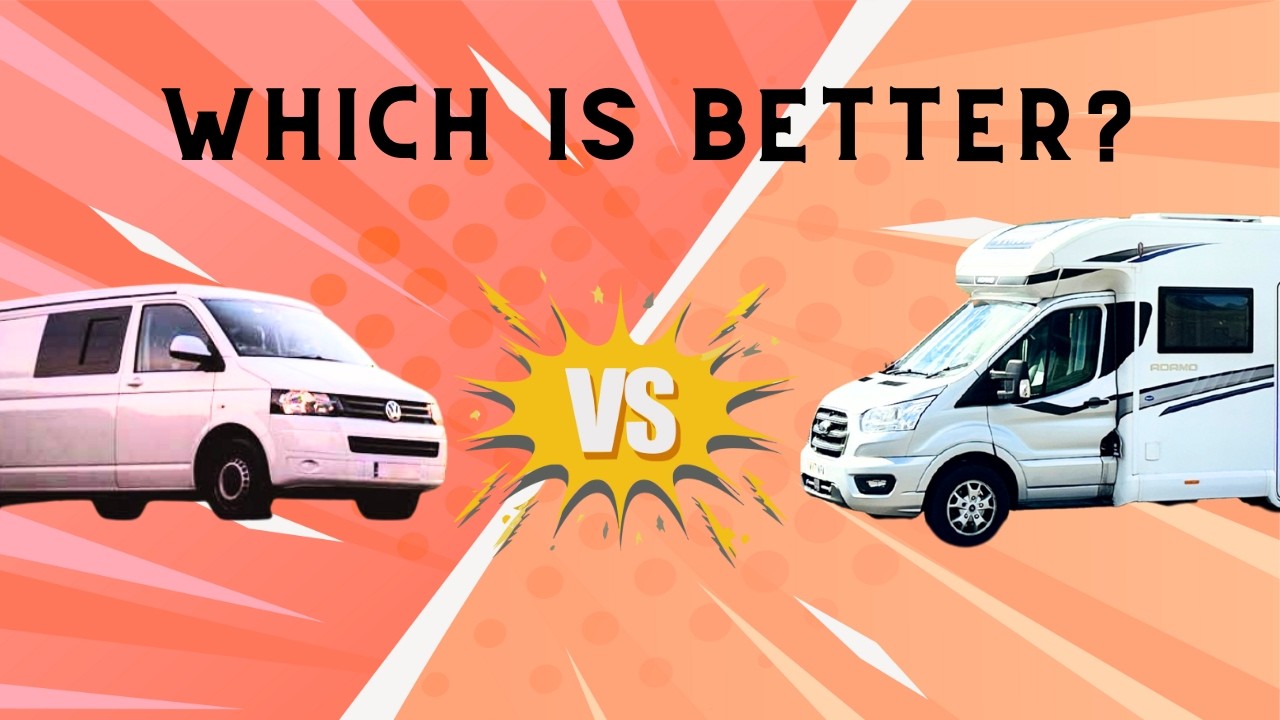
In this YouTube guide, Kat (Kathryn Bird) walks viewers through the process of deciding between a motorhome and a campervan. She shares her personal journey— from divorce and considering downsizing to ultimately keeping a larger motorhome— to illustrate how individual needs evolve. Kat outlines the fundamental physical differences (size, chassis, exterior dimensions, bathroom presence, insulation) and then dives into practical decision criteria: need for a fixed bathroom, berth capacity, height/length restrictions that affect European tolls, parking and storage constraints, and interior layout preferences for day trips versus long‑term living. She emphasizes the importance of considering winter insulation, claustrophobia, and driving confidence, especially for women, recommending test rentals to build skill and confidence. Payload limits, licensing requirements, and storage space are discussed as factors for long‑term travel or using the vehicle as a primary versus secondary transport. Finally, Kat provides actionable resources—a free buying checklist, decision‑matrix tool, and a “Buyer Beware” workshop—plus advice on attending motorhome shows to avoid common purchasing mistakes. The video concludes with encouragement to use these insights to make a tailored, confident purchase.
Chapters
Motorhome or campervan? How on earth are you supposed to decide which one is right for you? And quite frankly, half of us don't even know the difference anyway. Now, if you're watching this video, I know a couple of things about you. One is that you're wondering whether you should buy a motorhome or a campervan. Clever, huh? And the second one is that you are doing your research and you are already far, far ahead of where we were when we bought our very first motorhome. Of course, you could just be bored or indeed curious about whether or not you have bought the right vehicle already. Please let me know which one of those it is below in the comments so I can see if I'm right or not. But if you are looking to either buy your first motorhome or campervan or indeed upgrade and you're not sure which one you should go for, this is the video for you. I'm gonna try and break down a few of the most important differences and why they might apply or be important to some people rather than others, because the The important thing to remember is that there is no one best solution. What's right for me might not be right for you. In fact, what's right for me 5, 7, 8 years ago isn't what's right for me now. So our needs change, our needs are all different, and that's why there are indeed so many different types of leisure vehicle. Before we dive in, if you're new here, hi and welcome. My name is Kat from Wandering Bird. As you can see, I'm not in my motorhome. It's still in the garage, although my sincere hope by the time Actually get around to editing this and putting it up on YouTube is that it will be back with me, but right now it's been in the garage for 2 and a half months driving me insane, thankfully over winter, and I'm hoping that it will be back so I can continue on with my adventures very, very shortly. But my current motorhome is my third motorhome. The first 2 worked at the time but were totally wrong for me at this stage in my life, and actually when I ended up being separated and later divorced from my husband, I actually considered downsizing from a motorhome to a campervan because it was just going to be me and my dog Mac travelling, and I thought the motorhome would be too big for me to deal with on my own. And I went through this whole process of motorhome or campervan. I went and looked at loads and loads of different vehicles and layouts and things, and I made the decision to keep my motorhome and be brave and learn to drive it and figure it all out, but I went through this mental thought process, and I want to go through that with you because, again, what decision I made might not be right for you. You might not be 5'11, need the headroom, and indeed the legroom or length on the beds, and you also might not have done thousands and thousands of miles all over the UK and Europe in a motorhome and so have a little bit of that base knowledge. So let us start with the basic differences. What are the differences between a motorhome and a campervan? Now, for some vehicles, it's very, very obvious. Campervans are generally smaller, And they are based on— they look like a van. Some of them will have beautiful graphics and things on the outside, but if you took all them off, you would be looking at a van. And if you weren't looking at the inside, just walk around the outside, you probably wouldn't see much different from your standard white builder van or something like that. There are a few that blur the line between motorhome and campervan, and then there are, of course, a few motorhomes that are a lot smaller than the standard motorhome, and they blur the line going from motorhome back down into campervan. But Generally, with a motorhome, it's built on the same van chassis. So my motorhome is built on a Fiat Ducato van chassis, but it's slightly wider. So you'll see the body of a motorhome just goes slightly further out. Normally behind the cab, it flares out, or indeed if you're looking at an A-Class, the entire thing is bigger, and they normally— again, big generalisation— but they normally tend to be slightly higher and slightly longer. Of course, there are a few from each category that can cross over, but those Those are the rough generalisations. Not all campervans have the side sliding door. A lot do, but not all of them do. And again, not all motorhomes are built at higher specs. There are some fantastically well-built, well-insulated campervans that have got built-in bathrooms and all of that sort of thing. So it's not a case of a campervan has more basic facilities than a motorhome does. They very much can vary. A lot of that would be based on the price and also on the manufacturer that you look at. So what are the differences? Like, how do you decide? What I would do, rather than focus on, I want a campervan or I want a motorhome, I would focus on the physical attributes that you actually want in your vehicle. So, for example, do you want a fixed bathroom? I know for me that is an absolute must. I cannot imagine doing the thousands of miles and the big journeys that I do and not having my own bathroom and shower space. But for a lot of people, that's not an essential. They're doing shorter trips or weekend or spending time at a beach or on a campsite, and most campsites of course, will have their own toilet blocks and shower facilities, so they don't need it. Fine, not a problem at all. That's the first thing I would look at. Second thing I would look at are berths and bed space. Generally, motorhomes— you get slightly bigger motorhomes, you can fit more people in. So if you're traveling as a family with children, or you want to take your grandkids, then a motorhome may— not always, but may— be better suited for you because you've got those extra belts and berth space. And please remember that a 6-berth motorhome will not necessarily, and probably doesn't, have 6 seat belts properly fitted into it, so you do need to check that very carefully. Then I would also look at height and length restrictions. So by that I mean if you're going to be doing a lot of travelling around Europe, the toll cutoff for a Category 2 vehicle going up to a Category 4 vehicle is 3.05 metres. So most campervans will be under that, and any motorhome that's called a low profile, so it doesn't have The overcab built-in bed. It might have a drop-down bed over the cab, but not the actual bunk bit. If it doesn't have that, most motorhomes are under that 3-meter mark. If you've got an overcab big profile like our very first motorhome have, it's above that, which means it will trigger the toll laser beam and you will be charged more on the tolls. If you're just staying in the UK, not so much of an issue, although of course you have to be aware of low bridges and all of that kind of stuff. But in Europe, it can mean a big difference on the cost of the tolls. Holes as you're driving around. And then of course with length and also width as well, to a little bit, generally motorhomes are wider. Where are you going to store the vehicle when you're not using it? If you are going to keep it on your driveway, do you have a length limit or a width limit that you have to comply with in order to get on your drive or get in a set parking space? If you do, then that's going to be a firm line that you have to then buy a vehicle within. If you can park it wherever, or if you're going to pay to put it in a storage unit, then you, you are free to whatever kind of vehicle that you want. The next thing I would look at is the layout, both for a living point of view but also from a bedroom point of view, and this will come down to how you plan to use the vehicle. If you just plan to go away for day trips or weekend trips, perhaps to visit things like festivals or events, then a smaller, more compact space may not be such a big deal for you. If you plan to do a lot of traveling solo, then having a smaller space where you feel more comfortable in and you can just be and exist in it, then that might not be such an issue. If there are more of you, you might want like a proper dining area with seats around it. You might want a fixed bed that you don't have to make up every single evening. I know my layout that I've got now, I've got a seating area at the front behind the cab, and then I've got a lounge area at the back of the motorhome. But I got so tired of making up that bed every night that I've actually taken the cushions out of the lounge area, had a proper mattress fitted and put in there, and that now stays as a fully made-up bed, which is great. I haven't got a lounge area. I've also got a drop-down bed in my motorhome that I never use because it doesn't drop down far enough for me to sit up in. It drives me insane. So I ended up taking the mattress off that and all the slats, and I now call that my attic, which is a brilliant space to put things like coats and dog towels and the awning mat because I don't have a garage. So that's where all that kind of stuff goes. It's actually really useful. But there are different ways that you can look at these layouts, but it is important to have an idea on how you might use the vehicle, and it might be that now while you're working you're going to use it for day or weekend trips, but your plan is in a year or two to go and live in it for 3 months whilst you tour around Europe, and it can be quite confusing to marry the two. If that's the case, I would go with what you want to use it for now. If you're planning to use it quite a lot now, or if you're like, I'm just gonna get it before the prices go up or whatever, then I would focus on what your plan is and just accept the fact that it might not be suitable for the short term, but that is your long-term goal with it. Another thing to sort of think about is insulation. Are you planning on going to, like, mountains in winter? If you're planning on going motorhome skiing and all that kind of stuff, then that might have a good relevance on the type of vehicle, and normally you will have motorhomes or very top-end campervans who have got that sort of insulation and facilities for winter motorhoming built into them already. Then when you're thinking about the layout, I want you To imagine being in that space when it is rainy and cold and horrible, so you can't sit outside, you can't have your awning out, you don't have any extra room. Is that space big enough for you and anyone that you're going to be sharing it to stay in for a day or two when the weather is rubbish? Because that for me was the biggest reason I didn't downsize my motorhome to a camper van. When I went around all these smaller vans, I sat in it and thought, That's just— it's just not quite right for me now. I'm so used to the space and the living layout of the motorhome that downsizing into a campervan made me feel really quite claustrophobic. Again, my height didn't help with that. Campervans are generally smaller and I needed the longer bed layout and also the headroom. But yeah, that's something to really think about is on nasty days, are you able to be in that space and not feel really too Claustrophobic. And of course, the flip side to that is, if it's too big for you and you're never going to feel comfortable driving it, then get something a little bit smaller. My only caveat to that is, when I separated from my husband, I was stuck on a campsite for 3 weeks. He disappeared and I was just like, I'm too scared to drive this thing. I genuinely don't have the confidence to drive this on my own. I'd never driven the motorhome. He insisted on driving and I was the navigator, which worked for us, But obviously not, and I had to go out at 4 o'clock in the morning— not even kidding— to gain the confidence of driving without a load of other traffic and stuff around me. It was— it sounds ridiculous now when you think that I've gone all around Iceland and I've gone all the way up to the top of Norway and around Ireland and Scotland and all these incredible places I've been lucky enough to visit, but just over 3 years ago I was too scared to drive a motorhome of 6.8 metres. So, So don't think that just because it's a bit scary doesn't mean you can't do it. You absolutely can drive a vehicle of any size once you have enough confidence in it. However, I know particularly for women, we are used to driving smaller vehicles and it can be really intimidating. So what you might want to do rather than rush out and buy a small campervan because you're too scared to drive a bigger vehicle is go and hire one. Just go and hire a bigger vehicle for a weekend. Start with a small campervan. That's exactly what I did. I rented a small camper van. I rented a little campervan for a few days. We went off around Norfolk. It was a good little test run. I realised I needed something a lot bigger. That really helped as well. And then from that, I progressed into driving my motorhome. That was the next big vehicle I had the opportunity to drive. But you could start with a smaller motorhome or a bigger campervan, and at some point you will realise, no, I'm comfortable in this space, that's fine. And that way you're not wasting your money getting a smaller vehicle that in a couple of months you're like, it's too small for me, I now need to sell it and then upgrade. So don't be scared to rent a vehicle and just try it out for a bit. While we're talking about driving and using the vehicle, one thing to think about with much bigger motorhomes is that longer vehicles are harder to find parking spaces for. So I would say most of Europe, things like the Aires and all of the standard spaces— I mean, standard space in a car park is normally like 6 meters, so any kind of motorhome is going to overhang apart from the really, really tiny ones. But if you're going over about 7, 7.5 meters, you're going to have more difficulty finding spaces. So our second motorhome was 7.8 meters and it did make it a lot more difficult to just be able to pop into car parks, supermarkets, even some of the Aires. They were too short for us to be able to park safely, so we had to drive on and then find somewhere else. So that's definitely something to consider. Another consideration, of course, are things like payload. Smaller campervans generally have a lot less payload than bigger motorhomes, but of course if you're having a motorhome that's over 3.5 tons or indeed Over 3.5 tonnes, then you have to consider, can you drive it? Have you got the appropriate licence to be able to drive that vehicle? If you don't know what I mean by payload, this is the video I recommend that you watch. It walks you through all that and what you need to think about. But of course, you can generally get more stuff in a motorhome. They tend to have bigger garages, if they've got a garage at all, more storage space. So if you are going to go and either live in it or go and tour off for months on end, then a motorhome might be the only way to go. I know plenty of people live in their campervans, but if you've got a lot of stuff that you want to take with you, then that extra payload and storage space will be really, really important. And of course, the other thing for that is that if you are going to use it as your main vehicle or as your second vehicle, which a lot of people do— they have a car and then they have a little campervan— if that's your second vehicle, it needs to be smaller and easier to Just go off and do whatever you need to do in it, and then it becomes a leisure vehicle in its spare time and in your spare time. So if its main purpose is your second sort of family vehicle or whatever, then a campervan will probably be better for you than a hulking great motorhome, even though it's got loads of storage. Now, as you can see, it's not a one-fits-all approach. There are pros and cons to all of them, and even if you go, right, I want a 7-metre motorhome, you will find that there are tons of different layouts and weights and things to consider about every single one. If you are going to go to something like the NEC Motorhome Show, which is coming up, or one of the other shows throughout the year, then download the free buying checklist and also decision matrix, which when you are looking around at various options, it will help you narrow down the ones that are best for you. And if you do want some more in-depth help for buying either a motorhome or campervan, the Buyer Beware workshop is available. All the details for that will be in the notes for you. That's coming up very, very soon, so make sure you jump on that if you want an opportunity to learn more before you go to a show. If you are going to show, I recommend watching this video about the mistakes to avoid when you're buying at a motorhome show, and I will see you on the next video. Take care, bye!










