Factories I Used to Make a Polartec Fleece Jacket
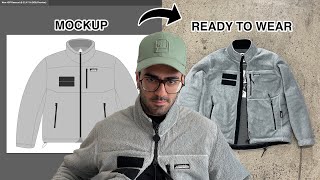
Will Larsy walks through making a limited Polartec fleece for his brand One/Off, inspired by day-trading culture and the Patagonia vest. He sources US-made fleece from Mill Direct Textiles, works with a Montreal pattern maker and IFC Corp for flat-lock stitching, and uses Canadian zipper maker Canzip after YKK backorders. The finished jacket launches with a viral stunt draping it over the Charging Bull statue.
Chapters
Hello YouTube. Today I'm going to be discussing exactly how I designed and manufactured a fleece I made for my brand One/Off. I'll be showing the process from A to Z, exactly how I designed it, all of the manufacturers I used. I truly believe that in today's world, your brand's distinguishing factor shouldn't be which manufacturer you use, but instead the story you're trying to tell with your products. So to give you a little bit of context, One/Off is about taking these themes in pop culture. It could be online school, it could be, uh, the 2020 elections, creating products based off the culture surrounding those themes. OneOf is based on a timeline and each drop that we do is associated to a specific node in the timeline. Our most recent iteration of this was doing a drop all about day trading. We took that iconic Patagonia vest that a lot of people wear on Wall Street, creating our own version of it, but with influences from the current culture surrounding trading. So we added these two patches where you can actually write down what you're currently trading, because we figured if you're gonna tweet about what you trade, why not be able to wear it? We also made it so that the sleeves zip off so it could turn into a vest because the vest version of the Patagonia fleece is what everyone wears on Wall Street. I like to start off by using fleeces that I might already have in mind. In this case, I looked up Capital Boa fleece. I own one of them. I know that they're really nice and I wanted to see what Google can do to show me related images of those kinds of fleeces. I then like to look on Grailed a little bit because Grailed always has a cool selection of fleeces to offer. People have some very unique stuff. And I synthesize all of that and start part 2, which is designing. So what I like to do here is create with the pen tool, just a tracing of the outline and the general shape of the fleece. And then I'll remove the image and that'll show me a little bit of an idea of what the fit is like and the general pattern of the fleece is like. I did that for the Capital and the Patagonia fleece. Then I start going a little bit more into detail. I start adding our own touches to this. So I knew that I wanted to have this patch system. I knew I wanted the sleeves to zip off, and I knew that there was a few other details I wanted to touch up while making this fleece. So I start incorporating them into a new design that I made. I took the shape of the two fleeces and I did a little bit of a blend of the two of them. And that created what I have here. Step 3 is the logos and the trimmings. These are all of the details. So I knew I wanted to rework the Patagonia logo in a way where the mountains would turn into a stock chart. So first I started off with the basic Patagonia logo. I changed the copy from Patagonia to OneOf while maintaining their font that I found online really easily. Then I started doing different versions of the stock chart. I started playing with the colors, and finally I arrived at a version that I was really happy with. This gray, yellow, purple theme. And that was kind of the colors that I moved forward with going into the drop. When it came to zippers, I knew I wanted two-way zippers for the main zip so that I could be opened up a little bit at the bottom if that was more comfortable for people. I knew I wanted cord locks so that the waist could be adjustable, and I kind of thought that I would initially end up using YKK zippers, but those were actually backordered for 4 months and I wanted to progress with this drop. And I was manufacturing entirely in Montreal, Canada, where I'm based. So I decided to use a company called Canzip. Which are zippers that are entirely made in Canada. And they're actually really high quality zippers, very comparable to YKK. And in some instances better than YKK. And so here's their website. This is who I used, super reliable. That's how I moved forward. There was a few other things that I designed, like the neck label. Then I worked on a few more details that would embellish the product a little bit more. Step 4 is making it. So when I was doing a little bit of research, I realized that Polartec, is most commonly the fabric used for fleeces that the best brands are using. And I knew I wanted to use Polartec for my fleece. I've been buying fleeces for a while, and I've noticed that all of the good fleeces that I've owned are made of Polartec. Now Polartec has two grades of fabric, one that's made in China and one that's made in the US. And I knew I wanted to use the American-made stuff because that's just more of a direction my brand operates under. I found out that Polartec has two ways of buying their fabric. Number one is going directly through their website, but the problem is that they were backordered for months, and it was really hard to get their fleeces and the quantities required were way too high. The second way is they have a wholesale distributor called Mill Direct Textiles. And on that website, you could find leftover stock of all sorts of Polartec fleeces. And there's different quantities depending the color, but I came across a quantity and a color I was really happy with. And that's this gray Windblock Polartec fleece. I ordered two swatches, one in gray and one in white. I saw that the gray color was a little bit more of the vibe I was trying to go for. And typically when you look on Wall Street, a lot more people are wearing the gray, uh, Patagonia vest than any other color. So I decided to order my first roll of the gray fabric. For the inside of the fleece, I needed something breathable that felt nice to the touch and that was also durable. So I decided to go with mesh and I noticed that Jound uses a special kind of mesh for their shorts that I really loved. And when I went on their website and I scrolled down through the pictures of the shorts, I saw that there was a woven label that said YMC on it. So I Googled YMC and it turns out Yarrington Mills is a great distributor of mesh. So I ordered a sample from them and that came in. From there, I realized that the gray Polartec fabric I wanted to use was too thin on its own, and I needed to combine it with another fabric in a process called bonding, which is essentially turning two fabrics into one so that it could be a little bit warmer and a little bit thicker. But when I was combining fabrics, I went through a lot of different tests because I wanted to make sure that the fabric I was using still was a little bit drapey and soft to the touch. It wasn't too thick. So initially the idea I had was to combine the gray Polartec with the white Polartec. That was way too thick. And then I tried other fabrics out until I came across this thin fabric, this nice polyester fabric that was all made in Canada, and it bonded really nicely with the gray Polartec fleece. I wanted a custom metal pendant to go with a zipper to give it a little bit more of a finished look. So we designed the Drop logo as we do for every drop. And I wanted to actually turn it into an enamel pendant. So I went on Alibaba and I just looked up metal pendant, started speaking to a few people. And I came across this girl who turned out to be the highest quality manufacturer. I found out one of the manufacturers for cord locks that Arc'teryx uses, they were on Alibaba as well. I ordered from them. Then I found somebody who does pulleys also on Alibaba and all of that formed the basis for what I needed in regards to the trimmings. Next, I needed to create a pattern. So the way I did this is I first brought my Capital fleece and a Patagonia fleece that I had, and I sat down with my pattern maker and we started discussing how we can make them make sense together. It looks like it's small here and wide here, but I made the bottom as your collar and here a little bit smaller. I showed her my new design on Illustrator and I said, these are the proportions I had in mind. So then I needed to get that first pattern turned into a sample. And I knew that I wanted to use flatlock stitching all throughout my garment. And flatlock is a very specialized sewing technique and only a few people have access to that. So I knew one of these guys in Montreal who has a contract with the Canadian Army and he does a lot of very complicated pieces. So I decided to bring a few samples to him. I showed him the Capital fleece, the Patagonia fleece, and I brought him my pattern. And finally he decided to take me on as a client and I provided a lot of value for him by sharing my my woven label manufacturers, embroidery manufacturers, screen printing manufacturers. And so his name is IFC Corp. At the moment, he's not taking on any jobs cuz he's flooded with all of Canadian Army manufacturing, but he was the person I used to sew all of the garments together. This is the first sample. I had the idea of putting green zippers and red zippers on the sleeves because I figured it would be like stock charts. And it was actually just a terrible idea from a design standpoint. All of the zippers I used initially were all made of nylon, which were way too hard to zip. They would get caught all the time and it made no sense. And the fit was overall terrible. When I zipped off the sleeves, it looked like a gladiator vest. So that was definitely a terrible first sample, but it was the first step in getting to where I wanted. For the second sample, I wanted to add a lot of the details of the garment while simultaneously correcting the fit. So what I did is I reworked the pattern with the pattern maker according to all of the issues it had. The shoulders were way too wide out. They were flaring. So I brought the zippers in. The sleeves were way too wide. So I tapered the sleeves. The bottom was too short. I lengthened the bottom. And there was another few details that we went through to get to the— where we wanted for the second sample. Then I had my manufacturer add a sort of black fabric to indicate where all of the patches and woven labels would go to get an idea of what it would look like when it's embellished. But all the labels were terribly placed. And it was a good thing that we ran through this exercise because When it came to the third sample, we were able to get much closer to where I wanted to go. So I went on Alibaba. I ordered all my woven labels with a girl called Sandy. Here's all of her information. By all means, go use her. She makes fantastic labels. We had received the woven labels, so we put the woven label on the chest. We got the placement correct. We started messing around with the Velcro placement, made the correct punch holes, and we finalized the fit that made a lot more sense. We made a 4-sample and I gave them the green light for production. From there, it took about 7 weeks for them to produce it all the way through.
Got a taste of it, never was the same. Trademark on that pussy, trademark in my brand new bitch. Yeah, duh, hold up blood, hold up cuzz, hold up sis. LLC the Glock and I LLC my bitch. Pass me the rock, I go crazy on my kicks. Had to tell my grandma sit back, relax and shit. Make nigga buy her house and car, she's off the list. Fake nigga talking about he rich but barely is. Huh, 8 figures jumping off the stage into the kids. Single out the shooter, take the shooter to the blitz. Drop it out of school, drop deposit on the crib. Popping out on Instagram, I only post my bitch. I don't need your input, get your 2 cents off my pic. Generation money, type of money.
So typically what we do for all products is we vacuum seal them. It looks a little something like this. And I knew I wanted to recreate that for this product as well. So that would require making this header card, which is this cardboard paper up here, taking this vacuum-sealed plastic, but making sure it fits a fleece, which is much bigger than a hoodie and much thicker. And then leaving room at the bottom for all of the extras we wanted to include in the package. Once we were happy with the fleece, it was all about creating a kickass marketing campaign. We had this insane idea of making a fleece fleece the size of the Charging Bull statue on Wall Street and putting it on the bull. And we said, fuck it, let's actually do it. So we got 30 of our friends together, went to New York, and threw the fleece over the bull at 3 in the morning, took a bunch of pictures with it, dropped it on our IG right here, and saw what happened. Then we had an idea of recreating a scene from The Wolf of Wall Street but done a little bit differently. Mm-hmm. Finally, we created this entire campaign called Bunk Bed Billionaires, which showed ordinary everyday people who got rich overnight doing day trading. I use a software called the ReadyMag, which is a front-end web development software. Then I plug it into my Shopify backend, which requires very simple code. And finally, it looks a little something like this. Thank you so much for watching. If you wanna see something more like this, please let me know. And also please ask me any questions you have about manufacturing in the comments, and if I'm able to answer it, I will. If you wanna know about a certain manufacturer, I'll be glad to share them with you. I have no shame in hiding anything in regards to that. And until next time, thank you for watching and I'll see you soon.
Peace. I get the tower, la skida. Swerving through lanes, I am limitless. For the ones down, I said free up. I start to question what freedom is. My uncle put the Chevy on folds. I dripping all black like an emo bitch, but these are not regular clothes. These are the outfits that make a movie.










