Inside a 150 Year Old Wool Factory in Italy
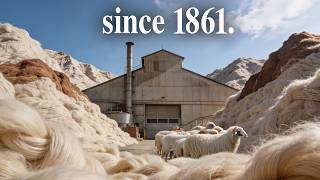
A tour of Lanificio Bottoli, a wool mill in the Italian mountains since 1861, shows how it blends pure sheep wool with cashmere and inspects every meter by hand before washing. The factory runs a full production line from carding to weaving, mixing 1960s looms with €500,000 sampling machines, and takes 75 to 90 days per order.
Chapters
Lanificio Bottoli. We're here in the mountains. It is gorgeous. It's so beautiful. Behind the camera is one of the most impressive wool factories on the entire planet. There are fabrics being produced in here that no other factory could ever come close to. This is truly a once-in-a-lifetime opportunity. Let's get into it.
L'azienda nasce nel 1861.
So you guys literally engineered sheep.
Noi abbiamo localizzato alcuni greggi che ancora mantenevano la razza in purezza, perché negli anni del dopoguerra gli allevatori hanno cercato di usare le razze di pecore che danno l'agnello più grande o il latte maggiore per venderlo, quindi la lana è diventata una materia secondaria. Li abbiamo convinti a privilegiare questo tipo di pecore anziché la pecora sarda o la pecora appenninica o la pecora di altre qualità.
That's crazy, bro.
This is the mixing area. We mix the different types of wool.
Cashmere. So, mélange of extra fine wool and cashmere.
Exactly.
So in this case, we are mixing wool and cashmere to make extra fine fabric for plate. Every wool has a different characteristic, and mixing together make the three-dimensionality of the fabric.
Now we are mixing cashmere and a very, very fine wool. This vacuum, this highly advanced Dyson, if you want to call it, is sucking all of the fabric right up.
We don't care to have one big order one season and then the client disappear. This is what we never did and what we will never do. We prefer relationship, small orders, medium orders. It's something that shows that we are trustful. We can do also small quantities. Then they can do small, but they can do medium. So it's a service that is perfect.
Over here, what goes in is all of the mélange fabric. So that's everything that comes out of the machine from the previous step. What's happening is it's being processed here. It spins through the machine and Through this very long process, many blades are starting to separate the fabric, pull it down to the finest fiber. Once that happens, it's laid out as a blanket and it goes through this process called carding. This is where it's laid out like a pasta machine, as he describes it. It's laying it back and forth, kind of tagliatelle style, and it goes into the carding machine where there's needles that will further separate it.
During this process, it's being spun run, and then those rubber bands over there are separating every single aspect of the fabric to turn it into yarn. Okay, once it goes through, we see the yarn over here. However, if I took my finger and I passed it through this yarn, it would break right away. It's very fragile. The only way to make the yarn tense enough and strong enough for production is by spinning the yarn, and that's what's happening over here. So that yarn, this roll up here, is what is being formed right here. It goes to here, there's wheels that are adding tension. This is turning at about over 1,000 revolutions per minute. It's going hyper, hyper fast and it's creating a lot of tension on the cord. What that does is it makes really tight and strong yarn that's ready for production when it goes to weaving.
So this is the weaving, uh, the every machine does a completely different job. Take it, look how cool is like, uh, I'm Masterpiece of— very cool. You see the different yarns, and for every different color, it's a mix of colors.
Look at how complicated this is too.
They're working on like 8 different colors at once.
It's a very complicated stripe pattern.
So what's happening over here?
Warping. Warping to create the vertical part of the fabric.
So remember, when you're weaving, there's the warp and the weft. Right now they're creating all the fabric for the warp in order to create a consistent weave. This machine is creating that yarn for the warping. And you got these beautiful— wow, these beautiful bouclés. This is bouclé fabric, let's say.
Bouclé.
So what's happening over here is they're creating the warp yarn. These are all the different colors, and what they're going to do is combine all of these different yarns in order to create a new cone that will be the warp fabric. And we can see that when the warp yarn is being spun, it's going all the way around this machine, and we're seeing this now mélange fabric that's over here as a new yarn that's being created. And how much did you say the sampling machine cost?
Could cost easily €500,000.
Do you have a production one here?
Over there.
Okay, naturally.
So it's the big warping machine here, create the vertical part of the fabric. So if a client asks us between 100 to 800 meters, we use this machine.
What we saw over there is for sampling, 5 to 100 meters. What we see over here is for production. It's 100 to 800 meters. This is also a warping machine. It's creating that cone of yarn that is for warping. Over here, all of the yarns are fed. This is done manually. This machine is from the '60s. It's a very old-school way of doing things. And an operator will manually put on each cone here and loop it on to the machine by hand. Very tedious process. How long does it take to set up the whole machine?
Uh, even 4 hours.
4 hours?
Exactly.
What she's doing over here is truly a lost art. There's very few people who still know how to do this craft, especially on such a specific machine from the '60s. We don't know if this is still going to be around 30 or 40 years from now. And we can see it's being spun on this giant wheel here, and it's going to go all the way to the end. And we have these holes where she's tying on the knots to create the fabric. What is your minimum order quality?
Between 50 and 100.
What is your sampling time and your production time?
Uh, depends on the quality, but let's say 10 days. For sample?
For production?
90 days. 75, 90 days.
This tiny little operation here is very impressive because they're doing everything fully vertically. What they're doing on this machine is they're actually checking the fabric prior to washing. This is the first time they're going to check the fabric in the production, and they're going to do it meter by meter. This reflective glass, and you have some LED lights up here that are bouncing the light off of the fabric. What that allows is for more clear vision on all of the flaws and imperfections in the fabric, and they will check meter by meter and correct anything by hand before washing. It's easiest to correct before washing because it's prior to the fabric having any sort of treatment, so fixing can be done in the easiest capacity right now.
It's where we do, handily, the scarves or blankets. So it's like high couture because we do everything by hand.
Everything by hand, and it's all done in real time right there.
This one, that is our original one.
This is heritage, man.
Very heritage. In fact, it's impossible to find.
How old is this one?
At least 50 years.
My God.
This machine that is called the calandra makes finishing very, very, very press, and it's very important It's important because it makes shine the fabric.
It's a finishing machine.
It's a finishing machine.
So the fabric starts over here, it goes over top, and it pans down. It waves into this machine where it starts being steamed. Right now it's being rolled, and then it passes underfoot. Same theme we've seen in the past.
This machine is called Cimatrice. He cut the hair of the fabric.
Understood. So it's a blade that passes over top the fabric and you adjust how tight to the fabric it is. Where is the blade?
Over there.
This is the blade right here. So they're actually able to control how close the fabric is to the blade with this machine. This is an anti-pilling measure. It's to reduce pilling of the fabric as you wear it over time.
Every machine needs to be controlled, of course, with numbers, but you need also to have the sensibility of the operator. That's why it's so important, the human value, because you need to know every fabric, its characteristic, its quality, and that's fundamental to have a perfect product.
A lot of these machines, I've noticed, they just have these very elaborate movements, right?
Many of them, they are personalized by Yes, because you will see from the outside that the space is very small, so we had to personalize all this machine, or many of them, to save space.
Yes. How the hell does he wear linen and you wear this wool vest in 40 degrees in Italy in the middle of July?
Because we still need to be elegant and classic.
Fucking right. That's fucking right. Grazie mille.
Grazie mille.
What an honor.
Grazie, grazie. My God.










