Inside a Clothing Factory in India
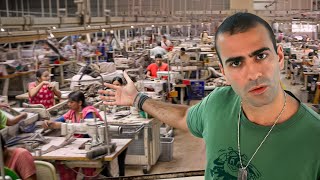
Erwan runs a French-origin garment factory in Bangalore that takes orders for just a few pieces with three-day turnaround. He's cut rework from 40% to under 15% in ten years and refuses clients who burn leftover fabric. The factory uses automated cutting and pattern machines to slash setup time from four hours to one hour.
Chapters
Glass Factory.
What's your minimum order quantity?
Zero.
Zero?
We have customers where we make a few pieces every day. They place orders today and we deliver 3 days from now. We're currently facing a major issue where every single one of our customers wants all of their tech files developed at the same time across the board. We go from making zero samples for the last 3 months to having to make 650 samples in the span of one day. The garment industry is a very harsh business.
Yes, sir. Let it— Purdy Exports factory tour. We're here, we're filming with a factory that is against all NDAs, is against all gatekeeping, produces for VF Group, Moncler, Chloé, a bunch of other brands. We are very excited for this tour. This is going to be a crazy one, so let's get into it.
My name is Erwan. I'm, well, second generation of a family business working in Bangalore.
So obviously you're not Indian, so where are you from?
We're French, originally French. We set up this company to be a one-stop shop for any brand. We are, as a manufacturing unit and as an agent, we make it all. We make it from basic t-shirts to all sorts of knits, as well as in the woven segment, whether bottoms, tops. We started with the basics, so the shirting and the bottoms. And gradually over the years, as we've acquired expertise, we've outsourced into more complex products such as outerwear so that we could provide really a one-stop shop to any brand that is either starting a brand or that has a vast collection of things where we can either work as a factory or as an agent with other factories to ensure that you don't have to deal with too many people to get a full collection out. This is the beginning of the process. It all starts with fabric. Fabric is usually around 40% of the cost, depending on the garment that you're making, the quantities and everything. And then within the other costs, I would say about 30% of my manpower cost is in place to overcome the quality issues of fabric. So fabric costs 30% plus another, I would say, 10 to 20% of manpower just to overcome that. So every fabric that comes here has to be tested. Because we work with smaller quantities, we have hundreds of varieties of fabrics. We don't have a lot of like huge, huge runs except for a few customers. Every single roll has to be tested for shrinkage, shade, and a whole bunch of other things. We do visual inspections to verify which defects are happening, and then we define how much is going to show up on the garments.
All of these little things are inputs that you need to consider, because if you want to reproduce the exact same garment 300 times, it's very, very complicated. One little differentiation in the fabric is going to lead to drastically different results for all 300 garments. And this is something that's really, really overlooked. So this step right now, the due diligence that's done in the very beginning when the fabric comes in, is arguably the most important part of the process.
One of the bigger discussions to be had with brands is to get them to understand that fabric is something that's alive. A lot of brands don't understand this and they want perfection.
Could I ask you a few questions in French?
Sure.
Est-ce que vous êtes ouvert à des marques qui viennent commencer, qui viennent ouvrir, qui sont quand même assez nouveaux dans l'industrie? Qui veulent se pousser avec vous ou est-ce que vous cherchez des marques qui sont un peu plus évoluées, un peu plus établies?
Alors juste dans les 4 derniers mois, j'ai dû contribuer au développement de 6 marques nouvelles. On est un peu hésitant de travailler avec des nouvelles marques, non pas parce que c'est des nouvelles marques, mais parce que ça demande énormément de travail sans aucune garantie d'avenir. Le problème étant qu'aujourd'hui si Si je regarde les gens qui démarrent des marques, sur les 6 dernières marques qu'on a lancées, la plupart des gens ne connaissent pas le produit suffisamment pour nous faciliter le travail. Du coup, ce qui se passe, c'est que nous, en général, on se retrouve avec des gens qui sont là genre j'aimerais bien avoir une chemise Compris. Sauf qu'on se retrouve à devoir leur expliquer tout le processus de développement de tissus de A à Z, quelles sont les contraintes. Donc c'est une industrie où les contraintes sont elles sont réelles. Les ignorer, c'est tuer son business dès la case départ.
As you see, this fabric has been given in roll form, and this is what we call in taka form. Certain fabrics need to be allowed to rest because what happens during the rolling process is the manufacturer, the supplier, pulls on the fabric. Partly because the machinery is there, partly because they want to show you they have more length. The number of reasons is endless, but the result is that your fabric ends up having different shrinkage properties when I take it from the roll and after I leave it to rest for a certain amount of time.
So, pretty standard machine. You have the fabric on top and it's just laying the fabric back and forth. And then they're gonna lay down the marker, which is all the pattern pieces, and they're gonna start cutting. Every single sticker on here represents a different part of the marker. They're advancing it to the cutting section of the machine. It's a blade cutting machine. It has a laser for indication. And it's computer mapped, so it's going to follow all the different markers on the fabric and it's going to cut accordingly.
So this is what we call a mini marker, which is just a small printout of how the garment parts are laid out on the fabric. So here you can see that you have multiple sizes: 8 years old, 5 years old, 14 years old. And we have a marker efficiency of around 80.79%, which means 80% of the surface area of the fabric has a panel which is being cut out of it. So we only—
the other 20% is being wasted.
Yeah.
The other thing to account for here that they've done well with this marker is that the fabric always has to be facing the same direction. So they've laid out the pattern pieces in a way where when it's sewn together, all the fabric is always going to be going the same way. You can't just lay them out however you want and expect the garments to come together beautifully. Yes, theoretically you would get less wastage, but your garment would have fabric that's going all over the place and wouldn't be acceptable to the customer. And also wouldn't wash well because the shrinkage of a fabric happens in the way it's knitted or woven.
We've seen the cutting process, then we come to the preparation work. If a fabric was perfect color, perfect matching things, majority of these people would not have a job. So what we do here is we number every single panel because here you have the variation of fabric shades. So if I put the sleeve of the first layer with the front of layer number 3, the shade goes off. And so I need to make sure that they have a reconciliation tool in their production lines. Otherwise, we reject in the garment form, and that's more expensive.
So they're making shirts. Very typical with shirts, you have cuffs and you have collars. Those are much stiffer. How do they get them to be stiff? They actually put a sort of fabric in between, an adhesive that allows it to get a little bit more shape. That is called fusing. What they actually do that's interesting that I can really appreciate here is for the cuff, they did it in two different segments. So I guess they're doing two cuffs at the same time, right? And they're going to cut it much more efficient that way. It goes into the machine, the machine heats it up and stamps it down. You're going to see that they come out over here and now they've been fused. These two materials are together, so you get that stiffness you're looking for. And that's the process of how they get the cuffs and the collars fused together.
So this is the follow-up of the pre-preparation work, right? We have these machines which are called these automated pattern machines, which allow you to automate certain operations. When you set up a production line, it can take a certain amount of time to set up the machine. When you're making 500 pieces, the time it takes you to set up your production line is about half a day, and the time it takes you to produce it is about a day. So you're looking at a total of 1 day and a half. The efficiency that you can gain in the stitching productivity is near zero. However, we focus on the setting up of the line so that if you spend less time setting up the line, I can change my line setup time from 4 hours to 1 hour.
Gotcha.
Which then brings my total time. That's a big deal. Exactly. That's a big deal. So I focus on this more than the production efficiency itself.
Understood.
Final stage of the production is the finishing department. So normally supposed to be the beauty parlor. More often than not, it's more the intensive care units. Normally what happens is you send a garment for washing and when it comes out, you do a little bit of beautifying. You cut off the few threads that are sticking out and then you label it and pack it. That's in an ideal case scenario, but due to fabric issues, people issues, and whatnot, this is where you end up with the most quality concerns. We've managed to reduce that over the last 10 years. When I first arrived, we had a rework rate of around 40% and a rejection rate of about 10%. Wow. Today our rework rate is at less than 15% and our rejection is at around 1.5%.
That's great.
Yeah.
So every garment goes through the same process of removing the threads, verifying the measurements, making sure that it's conformed to all the product requirements before it is labeled, it is tagged, and it is packed so that it is ready to place in the shelves at the shop. Label, price tag, and everything.
You guys take care of packaging, hang tags, everything as well? Yep.
I mean, my personal belief is we've never signed an NDA with any of our customers. Sure, they give us the normal proprietary this, blah, blah, blah, but I personally believe If you're not going to be transparent about what you're doing, it probably means you're not very good at it. We put it all out there for the world to see. We want the world to know what we know so that it can make our job easier and we can keep working on how to be better. I will not name this company, but in the past there was a company that every leftover of fabric would have to be burnt and on video to prove that we were not using the fabric for anything further. So we decided to stop working with them because that did not resonate with our values. We will always respect your wishes, but if it goes against the people and the planet, then we're probably not on board.
So what's your minimum order quantity?
Zero.
Zero? Okay, that's bold.
We have customers where we make a few pieces every day. They place orders today and we deliver 3 days from now. So we know that this quantity, we bought this fabric, and as and when it's being sold, we produce it. We're talking about cycles, so we're currently facing a major issue where every single one of our customers wants all of their tech files developed at the same time across the board. We go from making zero samples for the last 3 months to having to make 650 samples in the span of one day.
Yeah, it doesn't work.
Doesn't work. The garment industry is a very harsh business.
And so how do you achieve such a high quality of product?
Well, one, that's taken us a very long time. I mentioned earlier, in the last 10 years, we've gone from 40% of rework to less than 15% and 10% of rejection to 1.5% through various different processes and a lot of change management. It's effectively changing the culture, the work culture, the communication culture and everything. Results are never going to be instantaneous. Whatever instantaneous results you get are usually not sustainable and not reproducible because they have no idea how they achieved it. Clear processes and policies are the only things that have allowed us to overcome the communication and management culture in this industry. If we can bring some positive change to the industry, that'll already be a win in itself, right?
Thank you guys so much. Appreciate you. Thank you. ¡Muy bien!










