Inside a Heritage Footwear Factory in Italy
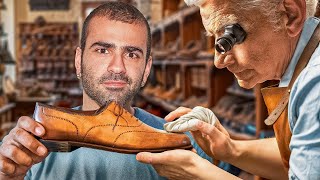
The video is a documentary-style walkthrough of the Di Giuseppe shoe factory in Naples, Italy, hosted by Will Larsy (Speaker A) and featuring Felice Di Giuseppe, a member of the founding family. The tour chronicles the entire shoemaking process from raw leather selection to final packaging, highlighting the company’s heritage (founded 1948), artisanal techniques, and modern adaptations. Key segments include: hand and computer‑aided leather cutting; the spaccapelle (equalization) process to achieve uniform thickness; pre‑stitching preparation; hand‑made eyelet creation and aglet application; lasting and mounting using stretch and Blade Runner machines; nail‑driven temporary fixation; outsole preparation, water‑based gluing, and sanding; hand‑stitched Blake stitching on the outsole; finishing steps such as staining, buffing, and quality checks; and packaging. The narration emphasizes the use of natural materials, the importance of consistency for batch production, the flexibility to produce small orders, collaborations with luxury brands like Ferragamo, and the in‑house brand Romson. Throughout, the host expresses admiration for the craftsmanship and laments that many brands do not document these processes, underscoring the rarity and value of such artisanal luxury.
Chapters
Glass factory. We're at Di Giuseppe. We're unbelievably excited to be here. We went out for dinner last night, had the best pizza in Napoli, uh, according to this guy. We're looking at some of the most artisanal, authentic footwear since 1948, working with brands like Ferragamo, but really so much more, and now with their own in-house brand, Romson. We're at Di Giuseppe. I'm with Felice, and I'm with the entire, entire family tree here, and I'm so unbelievably excited to be here. The beginning of it all.
Yeah, the beginning. The very beginning.
This is Giuseppe.
Yeah, Di Giuseppe Felice, like me.
Di Giuseppe.
He dreamed about shoes.
Wow.
Here are our tagliatori. It means cutter. They cut it by hand or with the press.
So this is all die cut, right? So all of these dies are made by hand?
Yeah, by hand.
Hey, how are you? What's going on? You good?
This is the littlest of the machines that you can find in a shoe factory. This is able to produce 300 uppers a day. I can choose a part of the upper from the computer, from the machine. Oh, okay.
And there's a projector.
Yeah, and there is a projector. This is the last part of the upper. I put it right here, or maybe this is the brillino. It's the part that—
Mudguard.
—profiles.
Every single leather hide is a different shape. Look at this one, right? There's already been some cuts that have been made to it. This was maybe what was salvageable. Once again, we're working with natural materials, so this is not a machine-generated fabric. This is really from nature. So they have to basically adjust every single pattern in order to fit on a given cowhide?
With the computer, I can scan the leather. One of my cutters can see me, "Okay, you have to cut here, cut here, cut here, because the quality is here, here, and here." Essentially, the grain of the leather has a certain direction.
Yeah, yeah. And then the animal itself has veins which follow the grain of the leather. The leather, when you look at it like this, when it just meets the human eye, you think, "Wow, the whole piece of leather looks perfect." In reality, you have to actually stretch it to see all of the flaws, because that's where the real imperfections are revealed. You can see the veins, all of the other natural things that occurred throughout the cow's life. Tell me the story of this factory. When was it founded?
It was founded in 1948 from my grandfather. He dreamt about shoes. He used to work, work, work till the shoe were perfect.
When is this from? '60s. '60s. Yeah. And so your grandfather was in charge of developing Yeah, yeah.
From the ground up, the leather to cutting, making the sole, the packaging.
This is the pre-stitching section, and it's where they're preparing the leather to be sewn. They can't just take it off the machine and start sewing right away. He takes a piece of leather that's unskimmed and uses this machine controlled by foot with the pedal to basically thin out the leather surrounding the parts where there's going to be more leather sewn on. Over here, she's preparing the piping for the shoes. So You can see along the edge there's this really beautiful trim. Look at how microscopic this stitching is. It's perfect. There's no room for error.
What does this machine do? Yeah, equalization.
Equalization?
Yeah, we call it in the Neapolitan way, spaccapelle.
Spaccapelle.
Spaccapelle.
Over here the leather hasn't been equalized yet. You can see on the scale it's reading 1.2. And their goal is to get 1.0. So now if I take a piece of leather that has been equalized and I check, it's exactly 1. Wow. All right, let's move on to stitching. So it kind of goes down the line, right? Yeah. I love seeing the machines with a wheel like this. This is how footwear is made the traditional way. It's much slower, it's much more precise, the needle is much finer.
Before stitching, we have to glue it, the two parts together, and then stitch.
So a lot of this process is about equalizing. Everything needs to be consistent, right? Because you're not producing one shoe, you're producing maybe 100 or a few hundred, maybe even 1,000. So you have to make sure to deliver a consistent product every time. And when you do things at mass, that's where it becomes most difficult. With what they're doing here, they have measures that take a while, but it's to ensure that the product comes out consistent. This is where you make the eyelets. Yeah. And he does that by hand? Yeah, by hand. This is the machine. That's a snapping machine. Yeah. So right now we can see him back manually creating all the holes for the eyelets where the laces are going to pass through in order to tie your shoes. What's your minimum order quantity here?
Minimum order quantity, I don't know. If it's work, it's work. You can even do 10 shoes. It's better for us if there are thousands of shoes because to try to do one model, very, very tough. I prefer sell more but at Let's price it. So this is an occhiellatrice. In this case, this is an occhiello that is nascosto.
So this machine right here is simultaneously enlarging the hole and applying the metal aglets that will make it easier to lace the shoes. This is only done for certain models when requested. Let's go.
This is the process that begins the stretching and the mounting of the shoe. Maybe the Brands give them to us. Sometimes they provide them.
Yeah, they provide it. So right now he's taking the last and he's attaching it to a lasting board.
This is called in Italian, sottopiede. Where do we go?
On the mount. Okay. This process right here, this machine is actually punching this form into the heel of the shoe so that it actually holds up properly. That's what we see over here. And the end result is that this piece of cardboard is actually inside the shoe. And now this has a little bit of structure for the toe, and over there a bit of structure for the heel.
This is a stretch machine.
The uppers are heated up in this machine. The reason they heat up the leather is because it's much more malleable and much more stretchable when it's hot. From there it goes into the Blade Runner machine after it's been mounted to the last and lasting board. The goal of this machine is to actually attach this lasting board we saw in the previous step to the uppers of the shoes. Right now we see that the machine is stamping down the shoe, stretching the leather, and mounting it to the lasting board. And he has all these uppers to work on next because the work never stops.
When nephew was born, my grandfather made a little shoe all by hand. If it's little, it's difficult, you know. He's prepping for the last part of mounting, and this is the old-school Neapolitan way to do shoes, all by hand.
With the hammer and the nail. Yeah. So for this particular model, there's 3 nails that he's gonna put in, one on the footbed at the back and 2 at the top of the heel. It's then gonna advance over here where 3 nails are applied for this particular model, all along the toe of the shoe. From there, we graduate to the next step in the process. These are shorter nails nails, and they're used throughout the shoe. Once finished, it's moved over here. What this machine is doing is it's heating up the shoe. Once again, the theme that when leather is hot, it's much more malleable. That's very important because this machine is stretching the leather and then stamping the, the nails into it. So then they come off here to dry. The process graduates to here. All of the nails that we saw being hammered in in the previous steps in the process are now being removed because we actually have nails that are punched into the shoe all the way. Those other nails' purpose is purely to hold the shoe together so that it could be produced in a proper and consistent way. And then we have this guy who is trimming all of the excess leather from the nails that were just removed. And the end result is this. Notice how the leather is thinned out here. The reason why the leather is thinned out is because glue is going to be applied. This portion of the sole will be thicker. So once again, it's about equalizing, making sure everything is consistent. That's what he's doing. And I really love how they do this process by hand. It shows you the old school and artisanal way of doing things. So in this particular case, the outsoles arrive like this, beautiful, from another Italian factory nearby. And over here, he's getting them prepped for gluing. First thing he's doing is using this water-based glue and spraying it along the perimeter of where the lasting board is going to go. Perfetto. And then he's going to go down the center. So this process is another equalizing process. Process. We can see that it has to be perfectly even before the outsole is applied. There cannot be any excess bumps or ridges, or else the outsole won't adhere properly to the upper of the shoe. So that's this last process, this last sanding that's happening over here. So because of this beautiful sliding mechanism that we see all throughout the factory, we have now the uppers and the outsoles which slide over to this machine. And this is where the uppers and the outsoles are going to be combined to form a shoe.
Heat it up because it's a water glue, so it has to be, uh, drawn, uh, activated.
He lines up the shoe perfectly, makes sure there's no imperfections. Once he's satisfied, he stamps it down and the gluing process begins.
So they take it out from the last to be ready to be stitched.
So right now we're following a little bit of a different model. This is a velvet-based shoe but there still needs to be stitching that's done on the outsole to the lasting board. This is a particularly challenging type of stitching because it's very, very thick. The needle, it has to go all the way through a lasting board, through the base of the outsole. And this is what Di Giuseppe is known for— their black stitching on the outsole, all done by hand, of course. Unfortunately, a lot of brands choose not to document these processes, and I truly don't understand why. This guy has 30 years' experience working on just this machine. He's clearly an expert in his craft, truly an artisan for a very, very precise skill that might be lost. And this is why luxury is luxury.
Made in Italy for me is what I showed you today. It's sacrifice, is working like crazy, knowing that we are the best. This is the artisanal way.
This is made in Italy. So they de-lasted over there. They're re-last thing over here. The reason they're doing that is characteristic specifically of a technique called Blake stitching. This factory does it, and not every factory will offer something like this. Once the last has been applied back onto the shoe, it progresses.
This is how you understand the real— not quality, but the standards are higher because there is no air between the floor and the heel and all the sole. Everything's even. Yeah. And to see a quality shoe, you have to put the finger in it. It has to have the finger here.
The finger has to be able to pass.
This is the last part. It's called the finissaggio or apparecchiatura. These are all the kind of process that gives color to the sole. Leather, vero cuoio italiano.
So they're staining the leather right now? This brings out the color a little bit, a little bit of life to it.
Yeah. And then to cover up all the imperfections, imperfections, we do this one, the rotella, and then put a little stamp. Yeah.
Okay. And that follows the perimeter of the outsole and the perimeter of the midsole. Yeah. Understood. Over here, he's heating up the leather. He heats up certain parts where he applies silicone stone and adhesive. He has the artisanal black staining ink to add a final touch for the shoes where it makes sense. He's running it along the perimeter of the midsole. Over here, he's buffing the shoes, unmounting the last. That's what's happening here. Pressing down the heel and the shoes are ready to be laced. In some cases, no laces needed at all. If we advance over there, these women are cleaning every last little element of the shoe, removing any paper that needs to be removed that was applied during the process, making sure everything is 100% up to standard.
At the level of the sample, I make the model in 48 hours, 5 days to to make the prototype work. To make it really, really good without any problem, I think a month. One month?
Yeah. And in the final step, he opens the box, preps the shoes to be packaged, puts the first piece of paper down, closes up the shoes, adds two dust bags in, one for each individual shoe, a card, puts the lid on it, denotes the box, with all the key information of the sizing. Okay, it's a wrap. Thank you very much, man. I really appreciate it. Thank you, guys. Di Giuseppe Italy Factory Tour 2024. It's a wrap, baby.










