The video takes viewers on a walkthrough of Crazy SRL, a boutique embroidery house in Bologna that serves luxury fashion brands. Host Speaker A and factory representative Speaker B demonstrate the end‑to‑end process, starting with sampling on a single‑head machine, explaining hoop sizes and a magnetic alignment system that centers designs on finished garments. They discuss how complex logos require careful stitch‑order programming to avoid overlapping artifacts. The factory uses high‑speed Tajima multi‑head machines (12‑needle heads, up to 900 RPM, six heads operating simultaneously) capable of producing mega‑embroidery up to 4 m long. A wide palette of threads—including bouclé, gold, silver, and turquoise—enables 3D and heavy‑stitch effects while keeping the fabric soft. Production turnaround is under 72 hours, with one‑day sampling for top clients and no minimum order requirement, though sub‑50‑piece runs carry a higher unit price. Waste threads are recycled into patchwork accessories for clients, showcasing a sustainability practice. Throughout, the hosts convey enthusiasm for the technical capabilities and creative possibilities of high‑fashion embroidery.
Chapters
I'm outside Crazy SRL in Bologna, Italy, and I'm going to show you how this intimate little embroidery house produces for some of the most luxury brands in the world and manages to turn around productions in under 72 hours.
Let's go! Show me where the magic happens.
This is where the sampling begins. It's a single head machine. They're capable of doing larger orders here as well. The hoops determine how much space you have to actually embroider. If you're going to do a very small embroidery, maybe a logo on a t-shirt like this, use a very small hoop. If you're going to do a much larger embroidery, use a much larger hoop like this. And the way the hooping mechanism works, if you look at it, it actually lines up perfectly. They fit into one another. And then over here you have a tightening system. To really clamp down on the fabric. This is for hats, right?
Yes, but if you want, we try.
You want to make a hat?
30 minutes.
30 minutes from now, the hat will be ready? Let's get it rolling. Let's go, let's go, let's go, let's go.
Oh, wow.
Okay, boys, we get to pick a hat. I'm just going to fucking wear this to sleep.
Fuck yeah.
Slate blue. So look, to be honest, I gave them a very hard logo to work with because the Gloss Factory logo is extremely intricate. There's a lot of little details in it, so it's going to be challenging for them, but I think they can pull it off. This guy, you think? You think so?
For sure.
For sure.
Okay.
All right. And just to understand the intricacies, let's talk about this a bit. She needs to decide in what order the machine is going to embroider the logo. This is very important because if there's certain parts of your logo that overlap, you want to make sure it looks really clean and finishing. So you want to have the right part overlap on the logo and you need to program that into the machine.
Questi servono per andare a mettere precisamente la forma del—
Ah!
Questi sono importanti, sono dei telai magnetici che servono per far sì che non rimanga il segno nel tessuto. Lettere, numeri, in base alla posizione della maglietta. Se la vuoi centrale—
This is a magnetic contraption that basically allows you to simultaneously align the center of the collar and the center of where the graphic goes with the actual hoop and accounts for the fact that it's a fully finished t-shirt.
La cosa grossa era che io son partito senza niente, quindi senza esperienza, senza soldi, senza competenza e senza conoscenza del settore. Nasce tutto dalla voglia, quindi voglia di fare, voglia di creare qualcosa, voglia di conoscersi e di ascoltarsi.
Progressing from the setup section, we now get into sampling. You have a huge setup for sampling. This is a really big table. How big can you do for embroidery? Like, what's the largest size you can go up to?
45 centimetri. 45 centimetri.
So 45, yes?
45 and 40.
40 and 40. That's crazy. Whenever they get an order and they just need to test through something very quickly, they have the computer right here where they're doing all the setup for the programming, and they have a sampling machine here so things can happen in very real time. How fast can you make a sample?
For the top client, okay, one day.
Holy shit. Are you sure you want to say that on camera?
Ah, yes.
That's sampling. Let's move on to production because once the client approves, we need to see what you guys do.
This is the machine that produces. I ricami. Quindi prima ci sono le grafiche, poi ci sono i campioni. Quando è tutto approvato si va su queste macchine qua. Ogni macchina, ogni testa ha 12 aghi e anche questo è un fattore aggiuntivo perché altri macchinari hanno meno possibilità di colori. Quando finiscono, quindi quando vengono tolti dal ricamo, vengono buttati via. Noi ora vogliamo fare in modo che questo scarto lo ricicliamo e lo facciamo diventare un nuovo filo. Noi nasciamo per non avere minimi d'ordine, nel senso che sotto 50 pezzi c'è un prezzo un po' più elevato, ma non abbiamo minimi perché io quando nacqui, quando iniziai l'azienda, non avevo soldi, niente, quindi ho sempre apprezzato chi mi ha fatto fare anche un pezzo, due pezzi, dieci pezzi.
With this added extension on every single head of the machine, they're able to make one mega machine in essence. And create a mega embroidery that's like 4 meters long, which is the entire length of this machine, for just one embroidery if they wanted to. All 6 heads can be working simultaneously at the same time on one huge graphic. By setting up this area, you can get very creative with the type of embroidery that you do. Here you have like a bouclé thread, you have gold thread that actually shines, silver thread. And then you have this turquoise thread, so you can get some pretty insane results. Very heavy stitching job on the front, a lot of embroidery. But if I turn it over, look how clean that is. So whoever's wearing it is not going to feel that.
That makes a big difference.
You get to see a little bit of the diversity in embroidery that's possible. So here you have a much more standardized patch with tearaway. Here you have something that's a little bit more 3D, a little bit more intricate on a very delicate jersey. So it's much harder to work with, right? Because that fabric is much thinner, it moves around a lot more than a hoodie. Wow, this is really sick. Very, very creative. So they have like a brush cotton over here. It looks like he's wearing cargo pants. There's the bag, the New Balances. They even did a polar fleece for the crewneck that he's wearing.
Me, Lucia, sta creando un nuovo accessorio, in particolare una shopper. Abbiamo preso tutti gli scarti di una collezione di un nostro cliente, di tutti scontornati a ricamo, e gli scarti invece che buttarli gli facciamo un patchwork.
So you're willing to do this for a client?
Per lo stesso cliente che gli abbiamo fatto il ricamo, lo scarto glielo ridiamo facendo un altro accessorio.
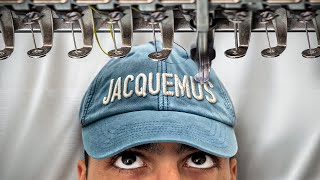
So backing paper goes down. This is what's going to stabilize the hat while it's being embroidered. Then she's going to align the center of the hat with the center of the hoop. There's actually a laser on this machine which will indicate exactly how to center. Our logo is a major pain in the ass. The largest capacity of pain in the ass could be a pain in the ass because it has to cut threads every 2 seconds. You can hear the machine cutting constantly. Every time it cuts threads, it means the machine has to restart. That's kind of the beauty of using a Japanese machine like a Tajima, because they're programmed for that and they cut thread very well. It's operating at 900 RPM, which means 900 stitches per minute. Every time it restarts by cutting the thread, it goes back down to 250 and then ramps back up. It's like running and then stopping and running again and then stopping. That's why it's not ideal that our logo has to cut the thread so many times. And the fact that this actually is coming out very cleanly is quite amazing. It's about to end. This is the last 7 stitches. We're done.