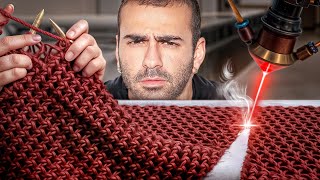
Riad and factory technician Francesco tour an Italian fashion facility that handles everything from fabric cutting to final packaging for luxury brands. Multi-head embroidery machines stitch 15,800 stitches per bag, a 12-head screen-printer runs two-layer curing, and laser cutters prepare panels, all in one vertically integrated operation.
Chapters
Glass Factory.
Allora, ricamo per me è un'arte che può essere industrializzata. Negli ultimi anni a fare un prodotto prodotto verticalizzato sull'abbigliamento. Cioè prendiamo il tessuto e facciamo tutte le operazioni, svolgiamo tutte le operazioni internamente all'azienda, quindi taglio, ricamo, stampa, cucito, applicazione di strass, pietre, fino a consegnare al cliente il prodotto finito, imbustato.
Here the embroidery machine.
What they did here is actually very intelligent because the bag itself has a certain shape. They want to make sure to place it down on the garment production line to fit exactly where it's supposed to go to perform this embroidery. So you can see that they've already done a pre-stitch on the backing, a pre-embroidery that shows the exact outline of where it should be placed. And then over here, it shows where the embroidery lines are are going to be placed on the actual product. In this case, it's 15,840 stitches. It's a lot of embroidery for such a little bag. So right now we're working with an automatic screen printing machine. In this case, I believe it's a 12-head. So the ink has been added onto this screen. The screen is already burnt with the logo that they're trying to imprint onto the fabric. And over here, it's being printed on. In this case, they're doing a two-layer print, so there's multiple machines working to print it multiple times. So as the ink passes twice, it swings onto the next head where it starts drying off. If we follow around the machine, it's actually being cured. So you can see that this machine is flashing it with heat, which helps cure and dry the print so that by the time it comes back around, it can be printed again in a fully dry state.
This is a 6-color serigraphic press that can print up to 6 colors, or it can print in quadrichromia. This machine can print up to 400 copies per hour.
Okay. I've never seen this machine before, actually.
This is a primer machine.
It's making the fabric a little bit moister. I think the goal is for the ink from the digital printer to adhere much better to the fabric.
Okay.
The previous step is extremely important because in this particular case, it's a very colorful graphic that's being printed onto the fabric. And since there's such a mixture of colors, it really needs to adhere well to that fabric. So you need to make sure to prime the fabric properly. And look, as we can see, it comes out extremely colorful, extremely crisp, and that's a really high quality Sicuramente una clientela medio-alta come quella che abbiamo già.
Chiaramente il mercato americano per noi è ancora tutto da scoprire. Che cosa c'hai sotto?
Francesco is very nice today because he doesn't have any production for lasering, but he He's starting up the production just for us. We're gonna get to see in real time what that looks like. So right now they're just queuing up something on the software. That's gonna run up to over here, which is the design we see here, this left panel for the sneaker. We're very, very lucky today because he's doing this with the top open. Obviously they do this with the top closed when they're in production, but he's willing to let us do that because the ventilation is good enough in here and he wants us to get a really cool shot. So it's appreciated. So we get to see in real time what the lasering looks like.
Sopra ci andiamo a ricamare in all over per creare un'altra maglia.
Ah, okay.
There's a few things going on here right now. They're actually embroidering panels for footwear. So what we saw upstairs, the laser cutting, is the first step where they take the fabric and they cut out the panels that they need. Over here, they're actually embroidering them. In this particular case, the customer, a very high-end brand, is seeking for them to recreate the fabric-like texture of beach pads. So that's the embroidery that's going back and forth, and that's actually all being machine done. Typically the fabric would be woven that way for much larger items, but when you're working with such small intricate items, it's much cleaner when it's embroidered. And we can see in real time what's going on on the computer. So it's moving at 800 stitches per minute. In total, there's gonna be 15,892 stitches for this job. I'm trying to figure out how many stitches— here we go. It's at 51,000 out of 100,000. It's an extremely intricate design. The other thing you'll notice is that there's two embroideries happening on the same piece of fabric. This piece of fabric is going to come out of production here, it's going to be cut and then sewn onto whatever garment is being made. So they're able to produce two units at a time, but they need a really large head machine in order to make an embroidery that's that large. How long does it take to do something like this? 4 hours to do this full embroidery. What keeps you motivated to come every day and keep putting out such high-quality products?
Vedere, ascoltare qualcuno che ti porta qualcosa.
Anytime you see a wheel like this, which is something we've been seeing a lot of the embroidery factories in Italy, oftentimes it'll be sequins, stuff like this. They're actually doing rhinestones. So you can see all the holes over here. It's going to extract the rhinestones from there, and there's a little thread attaching each rhinestone which is what's going to actually go into the fabric. In this case, they're doing it directly on backing. Pay close attention to how much slower this embroidery machine is moving as compared to the other ones. When you're working with sequins, when you're working with rhinestones, it has to be careful to ensure it properly adheres and pierces through the fabric. If you go way too fast, especially especially at the speed that these machines are going out, which is like 800 stitches per minute, it's going to be a complete mess. Stones are going to be everywhere. It's going to be a lot to clean up. It's much slower for production. It's much more costly, but it gives a great result. And she's actually weaving together this bag in crochet style. This is all done by hand, one by one.
This is the Italy Factory Tour 2024.
Shout out to Fed who made this all happen. He uses this embroidery to make these t-shirts right here. Thank you so much, Francesco.
Grazie a te, Riad.
Riad, it's the factory tour, Italy 2024, and we're out.