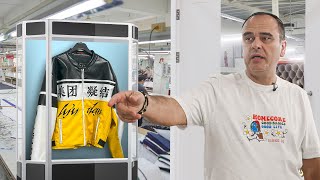
The video features an interview with José Francisco Teixeira Pereira, owner/manager of Texmin (Textile of Minho) in Portugal's Minho region. He explains Texmin's business model, which centers on taking on challenging, custom garment projects rather than mass‑producing standard items. The factory stores client fabrics, offers pattern‑making, cutting, panel‑based printing, and full garment assembly under one roof. Key process highlights include a computer‑controlled cutting machine that lays out fabric panels according to size distribution, a panel‑separation step that enables high‑quality large‑area prints before sewing, and a specialized self‑fabric collar machine that creates collars from the same fabric as the garment body. Workers are cross‑trained master tailors who handle every step of production, supported by good working conditions and competitive salaries. Pereira discusses broader industry pressures: rising wages in Portugal, price competition, and factory closures, warning that by 2028‑2030 higher labor costs could force clients abroad unless prices stay low. He stresses that flexibility, willingness to experiment with materials and construction, and a focus on challenges are what keep his factory viable.
Chapters
What do you look for in a client?
I work for a challenge, you know. If you want to make a t-shirt with a print, come on, you go to IKEA or whatever, they have it. My name is José Francisco Teixeira Pereira.
And what is the name of your factory?
Texmin. Textile of Minho. Portugal is composed by different regions. This one is Minho.
Textile Minho. Texmin.
Texmin.
Oh, that's it? No way, no!
Everything starts here with the client. We sit down, what is the challenge that he comes to us, either it's a basic t-shirt or a pant, a suit, a shirt, a hat, underwear, apart from shoes, whatever he wants to start his own collections, his own brand. After that is settled, we go to the fabrics.
So you're basically storing fabrics for brands, and then they come and they use from those existing fabrics, sometimes add new ones. That's the idea?
Yes.
I gotcha. And you have no problem storing those fabrics here for a while for those brands? That's a service you offer?
No problem.
Bom dia.
Here is the pattern makers. That is where the style is made. And we have different pattern makers separated by my clients because they must know them. So when they come, they already know the fit they want. They already have that knowledge. My father is one of the persons that that set up this company in the '60s. After school holidays, I was always around. I was born on it. We start with a small company of maybe like this, 5,000 meters covered. We pass to 20,000 meters covered, and now we are back again on 5,000 square meters covered. Here is the preparation of the fabrics after the pattern is settled and the fabric is decided. Then we need to go to the cutting part.
The roll of fabric is put on top of the machine. It's laid out and it goes back and forth. The length of this segment of fabric from here all the way to here is exactly the length that's programmed on that machine. That machine follows the patterns that those 3 patternmakers is putting together. So this rectangle over here represents that roll of fabric right there. Then the panels are going to be laid out accordingly, and then it's going to start getting cut. And basically, depending on the number of sizes, the size distribution, right? Sometimes you want 2 mediums, 1 small, 2 larges, 1 extra large, because more people wear medium and large than small. It's going to cut out twice as many mediums and larges as it will smalls and extra larges.
Everything we control at 100%, and if the lady finds a defect, they go back to the cutting, they pick up a roll of fabric, and they and they'll cut it by hand in that case.
Yes.
Here we have a second separation that is for the garments. If they are going to be printed, embroidery, or something else on it, they make a separation.
And the reason for that is because it's much easier to embroider on the panel than it is, for example, to embroider on the fully sewn garment, right?
Especially on the prints.
And when you're doing big prints, it's very difficult, right?
Very difficult to get the quality.
When you're talking about assembling the pieces one by one and being able to control every step in the process, you actually have the opportunity to do a full-size print on an individual panel. So you can really control exactly what that looks like, how large it is, and get a much better result than if you have a fully sewn garment and then have to embellish it. That's a huge advantage of basically manufacturing from scratch. So check this out, these panels have been separated, they were sent off for printing, and now they've come back. This is actually very cool. I haven't shown this in a factory before, but this is really down to the process. If we unspool this, it's a really nice French terry, and we can see that this sleeve has been printed with these two very big hits of embellishment right here. If you think about it, if you have a fully sewn hoodie and you're trying to do a print on a sleeve, it's really challenging because a sleeve is a 360 tubular thing. So to get a print on both sides that comes out even is very, very hard. But to do it before it's sewn together is infinitely easier and leads to a much more consistent and prettier result. So that's why he does this in this way. What does the future of this company hold?
It's going to be a mess. Honestly, I'm not worried about 2024, 2025, or 2026. I'm worried about 2028 and 2030, because here in Portugal, the government either is extreme left or extreme right. The salaries are going to increase a lot. So I need to keep my prices low. If the prices go too high, they're going to have have to go elsewhere.
Customer doesn't have a choice.
But I want to keep it here.
So this machine is very cool. I actually haven't seen this before. It's a machine for making self-fabric collars. So what that means is, if you look at the t-shirt I'm wearing right now, my t-shirt is composed of one fabric that's a jersey and another fabric over here that's a rib. They're two different fabrics. It's not the same. If you look at the t-shirt Francisco is wearing, you can see actually this is rib as well. This is not even self-fabric. Maybe there's a better example. Petro, come here. Petro is wearing underneath a wifebeater, and the body of the wifebeater is made up of this rib fabric, but the collar is made up of the same fabric. It's self-fabric. So the way it's sewn, they use the same fabric for both parts. In this case, what she's doing over here is she's taking this piece of jersey and she's creating this roll of self-fabric. It comes out like this so that when they have t-shirts where the ribbing is actually the same, so the collar is the same as the body, they use the same fabric. So in this case, whatever t-shirt they're making is gonna be composed of the same fabric as, as the body. So once this fabric over here has been rolled up, it would come over to this machine, and on this machine it's hooped onto— what would you call this? Spindle? Spindle is what you're going with? It's a goddamn spindle. So over here they have that self-fabric we were talking about, and it's unspooling slowly. And notice how there's multiple metal pins here to control the speed of the fabric and control the consistency so that it stays flat. It stays aligned. When that fabric gets fed out, it gets sewn directly onto the body of the garment. The Wife Pleaser we just spoke about, self-fabric, it's the same story here. Look at this, self-fabric. They just did the collar. I've noticed with your employees, these women are so talented because they can do every single step of the process. They're like master tailors, practically. Whereas a lot of other factories I go to, they can only sew the collar on a t-shirt very well, but anything else might be very challenging, right? They're very specialized in one step of the process for one type of garment. Over here, they're specialized in all steps of the process for any type of garment.
Yeah.
How did you train them to become such experts, and how do you keep them around?
Good conditions in terms of environment and salaries. Of course, if I want to keep them here, I need to support You need to give a good salary to them. Very good salary to them.
It's the only way.
It's the only way.
But theoretically, she can do exactly what she's doing, and she can do exactly what she's doing. It makes no difference. They're all trained to do everything. Right before our eyes, we're watching an entire garment get assembled in one sitting, in one spot, without being passed around the factory. This is something I have pretty much never seen before. Typically in a factory, the garment is going to be passed around from station to station to basically handle every single different operation that's going to go into making it. She's sewing all the sleeves, all the torsos together, the collar, everything. She's about to build a full garment before us. We've been here for like 2 minutes and she's managed to put together the entire garment. The speed at which she's working at and the quality of the sewing, more importantly, is really impressive.
Here is where we make the real final inspection. If the garments are being hanged, they are going to like these to the client. If not, we put them in boxes.
Okay, so for this process, since these are dresses, the ironing process is a little bit different, right? They have to steam them. When all is said and done, the plastic comes down. It's tearaway. It's already cut to the dimensions. It has the brand's logo printed on it. She rips it off, hangs the dress. It's ready to be shipped to the customer.
That's how it starts.
So do you think the future of Portuguese factories is very challenging? Like, do you think a lot of these factories are going to struggle?
A lot. A lot.
You know, we've spoken to a few factory owners. We've noticed it's a trend. They're saying that a lot of factories have been closing over the last 5 years. Is that something you've seen happen as well?
And will continue.
And will continue.
And will continue.
Why do you think most factories have been closing?
Because they focus on the price. They focus on one product. They didn't create the variety. They are not open to flexibility. I work for a challenge, you know. If you want to make a t-shirt or a sweater, it's okay. But if you want to destroy a sweater, if you want to put gold on the sweater, if you want to make the sweater something different, if you want to make the sweater with iron, okay.
So you like challenges?
I like challenges. To make a t-shirt with a print, come on, you go to IKEA or whatever, they have it. They have it, everybody has that. Just change the print. I don't want that. I want something different. I want you to destroy the garment. I want to put a different wash, different construction, mix, mix the jersey with the woven. When you try garments and you mix, like, the pants with a bit of jersey or weave, it's something challenging. It's really exciting.
Yes.
Very cool. Because it's something that— it's what keeps me here.