Inside a Luxury Denim Factory in Portugal
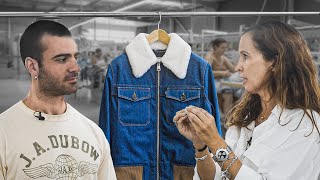
Andrea built a 140-person luxury denim factory in Portugal from scratch eight years ago. The tour shows every step: fabric testing, pattern grading, cutting, sewing multiple styles daily, quality checks, washing, and dyeing. The factory takes orders as small as 200 pieces and tracks every batch to prevent color mismatches.
Chapters
Glass Factory.
It is like a dance. It's like music playing. This is an orchestra, so they are playing instruments and someone is managing, and it's totally like this each day.
I just love dancing. I always had. I love it. My partner also loves it, and now my kids, they also love it.
No kidding?
Yeah, yeah, yeah.
5D started 8 years ago from scratch, from nothing, just an idea, a dream that me and my partner had at that time. We went to Central Europe to start finding some clients, we scheduled some meetings, we went to Paris with a bag full of samples and we went there knocking on the doors, "Can we receive us? We can do this kind of these jeans or these jackets or whatever we did. Our first client appeared like that. It is a very well-known brand. They trust us, they liked us, and we started like that. With that first brand, it starts opening doors from other clients, from other brands. We start growing the company. In the first year, I would say we were like 6 people. On the second year, 12, 20, 40, 80, 100, and now we are 140 people.
Internally. This is where it starts in terms of process. The fabrics arrive, we insert them into our system, and then we must proceed with shrinkage test. This is the way we can control if the fabric is in conditions, if the shrinkage is the same or similar. Because can happen that if the fabric has different batches, we will have different shrinkage. And if we have different shrinkage, we cannot cut the same pattern because it will have reactions during the washing.
Absolutely. So now you're starting to get into real technical territory, but The pattern makers need to be very well trained because based on the percentages written here, they're gonna have to adjust the entire pattern. And it's not as simple as just making everything 4% less because the seams are gonna affect how the garment shrinks and you don't want it to warp and look weird after a wash. So there's actually a lot of technical ability that goes into this and based on what the pattern is, which sometimes could be very complex, especially for the types of projects that they're taking on. The patternmaker really needs to know what they're doing.
So here we control the fabrics and then we can start the process of cutting. On the cutting department, we will have one automatic cutting machine, but we have many things that are cut manually. Okay, because we need— when it's salvaged denim, it must be cut manually because this machine, it sucks the fabrics, but it can have a slight misalignment of the edges.
So she just discussed a couple of things. Number one, She said that the selvedge denim is much narrower. What she means by that is if you look at the roll of fabric over here, you can see it's not really your traditional roll, which is between 57 and 63 inches, right? Like usually the roll would extend all the way until here, but this is much narrower. That's just because of the nature of how selvedge denim is woven. And the other thing is if you look along the edge here, there's a selvedge line. And if you look on the other side, there's a selvedge line here as well. When you make denim like this, unfortunately, there's a lot more fabric consumption because there's very limited part of the denim that could be used to represent the leg since it has to have the selvage line. So because of that and all of these other factors, this needs to be cut by hand. If it's cut by the machine, the machine could have some inaccuracies because when it vacuums and the blade comes in, sometimes it moves a tiny bit. Those little millimeter mistakes are not noticeable and are okay if you're making a hoodie or a t-shirt. But when you're talking about making something that needs to have an exact selvage line that follows all the way down, especially to the standard of how they're producing, they're gonna have to cut by hand to ensure that there's no mistakes.
So what she's doing, she's marking everything from each roll, each part of the garment, so we don't mix on the same garment different rolls or batches. And when the seamstresses are sewing and parts together, they must pay attention not to follow or not to mix different colors, which means different rolls.
Right, because even for the same garments, the roll could have a slight differentiation in color. That is, that is a very fine-tuned detail. Amazing.
This is an accessories department. We have 5 people working here. Because for each item of accessory, of trims, button, label, rivet, hang tag, you name it, we must control the quantities we received, the quantities we need for that specific piece or production, and the quantities we have in stock. We will not start that production if it's missing 5 rivets.
It will not enter the sewing line.
So that's so you can run at maximum efficiency. Yes, there's no pauses.
That's it. Than no pockets.
Wow.
Once the productions arrive, they are placed here, and once they enter the line, they are prepared, and the planning director will work and understand where it will be placed. Our MOQ are 200 pieces per style, which is a very low MOQ, and to feed all these lines, many times we have different styles being sewed on the lines. Okay, we can have until 3, 4 different styles in the same day. All our seamstresses And our production lines are very flexible and versatile. They are doing one jacket in the morning, jeans in the afternoon, in the middle one skirt. They know how to operate in different machines, which is not very common in factories that do 5-pocket jeans.
Okay.
So it is like a dance. It's like a music playing.
So just looking around right now, I can see that it's like the bags being made in this section. Yes, yes.
On these machines here are jeans, applying the back yoke with a back leg. And so go on. This is an orchestra, so they are playing instruments and someone is managing, and it's totally like this each day.
There are always problems, there are always issues, not every production but on a lot of them. So we must find solutions, and our mindset is always, okay, this happened, what can we do? How can we improve? What can we talk— let's talk with the client, let's arrange a video call, let's go there. Many times we catch a plane and go to wherever we need Finding solutions is the mindset.
What's it like being a mother and a factory owner at the same time, especially when you start a factory the same year you have your first?
Oh my God, it's been difficult years, the first years, why? I did not have the structure I have nowadays. So I have to give a lot of my time to this company and not spending so much time with them at the beginning. From that point when I realized that, when I had my third boy, and I said, okay, I must, me and all my team, the girls I have here, the moms that are here, they need more time. If someone does not have a good balance between private life, family life, and work, they will not be able to reach their maximum potential during the hours they are working.
We try each year, okay, part of our budget is to invest on the people internally, okay? People around know about this. So people are coming, and I think, and once they come, we don't have many people leaving. If there is some seamstress on the production that is very good, that wants to learn more, she will go there and she will spend 6 months learning how to operate in all the machines. And step by step with the people that are there that already know how to do all the machines, she will learn.
It's like a little school. Yeah, very cool. So this, this is the sample So all the pieces are cut and they came here.
Yes, we have the cutting pieces, the cut pieces that will do the garment, the technical file with the care label instructions so we know all over the process which part of the process it is, all the trims that we will need, and the detailed technical file with all the information. And at the end, this is very important, here the seamstress will make comments. If she thinks that we need to change something for the product, She will add this information here. This is a designer, and they must discuss. If there is something that they are not quite understanding, they will call the designer to come here. And if the designer has doubts, he will talk with the commercial so he can talk with the client. This is a daily base communication and must be really improved. And you can see, okay, they are changing some stitching details and looking at the sample and explaining why.
Live action right now. We're getting it in the cut. I can tell he's in the juice. Yeah.
For me, the most beautiful machine is always the self-seam one.
Yeah, it's cool. It's cool because people see it.
Yeah, I think it's cool.
I get why this is like Andrea's favorite machine. It's very satisfying seeing the fabric get folded over.
It folds like this and you don't see the edges, you don't see any overlock, and it's a beautiful finishing. And you can see here also In a part of the jacket on denim.
So clean. So what she's talking about, notice how this is folded over here, right? This is not just one consistent piece of fabric here. It's been folded as a panel. If we flip it over, once again, we can see that folded over, but it also leaves behind a perfect double needle stitch that follows the line of the denim. This is a jacket in this case. It looks like it's going to be like a Type 1 or a Type 2 jacket. You look at a denim like this and you look at the color and you tell yourself it's going to be a very dark jacket. You put it through washing and this is where the real expertise comes in in denim. It's how well you can wash and you end up with a jacket like this. This piece, this panel right here is this right here. This is the pre-production sample that the client approved. It's ready to go into production. They're in production right now. And look at the result. Look how cool this jacket is. This is sick. If you look at the panels here, this is actually sewn together. These two panels are joined, but the embroidery goes over the panel.
With this suit, it goes to embroidery, goes to washing, comes for sewing and applying the lining and the collar, and then it's finished. So we have many different phases of Sewing, washing, coming to sewing again.
Oh my God, so many steps in making this jacket.
Finishing. Okay, finishing, it will depend so much of the garment itself and on the client. So we can have irons or toppers here, and we have many people doing the inspection. As you can see, all this line, they are opening the jeans one by one, cutting the loose threads and controlling everything. If there is some defect, it will be marked.
So that's what the sticker is, is marking a defect.
Yes, any sticker is to explain that there is a defect on this piece.
Look at how detailed some of the patchwork they're doing is here. Were they sent for embroidery and then you cut them? How did this work?
We have the artwork of this, okay? This is cut because you see you have this and on top of this you have another one, okay? You have laser cut with embroidery on top of denim patch, which is embroidery and also the laser cut and applied here before washing. So after it, we'll have this distressed all around. So we have the front of the jeans cut. We have this artwork. It will go to the embroidery house and they will have to make it in two steps. First, applying these small ones. Okay, laser cut and embroidery on the top of a panel of denim. And then this panel of denim is also laser cut and embroidered on top of the jeans. And it's insane, actually. Here, what they do, they apply the hang tag side by side.
So all these hang tags are applied.
And from here, they are split into these parcels, these boxes, and they go to the—
They go to shipping.
—shipment department.
I gotcha.
This one looks like a very basic outer jacket, and the pocket and the flap must be in perfect position to match the whole, and you don't see a difference on the stripes and squares. And on top of that, this is just one size.
They have to do this over every single size they sell.
All the time.
So they have to grade the pattern to do this every single time.
On the back, the color must match.
Oh wow, that's crazy.
This is painted by hand in this case. Really? Yes. Yeah, it's beautiful.
It really comes out nice. How do you get like that certain strokes of the paint to have a little bit more—
It was requested by the client during the development phase. We test several fabric, several pressures, several thicknesses of ink, and at the end we approve one, so we produce that. During the development, it's very important before the production starts that we study carefully all this.
So like, this is so much work to make. What kind of quantity would you have to do to do a production like this? Because obviously there's a lot of sampling, it's very intensive.
But our MOQ for production is always 200 pieces. Always 200 pieces. So if the client wants, okay, we can produce 200 pieces. If you want to produce 1,000 or 2,000, great, even better.
I understand. Cool.
Most of my clients, when they come here, or any other new client, they come and they, "Hey, I like this." With a Japanese canvas garment dyed, which makes this abrasion look because it's really stiff and heavy, and it's just beautiful. Sometimes the most challenging and the things that we are most proud of are very basic garments, but they are so good in terms of quality, in terms of fitting, in terms of how they fit and looks good on everybody, that we are also very proud to do this.
So this is a— this comes in as a white canvas? Yes, yes. And then you guys send it for garment dyeing, right?
Yes, garment. We manufacture the garment and then it's garment dyed. Understood.
But the fabric came from Japan? Came from Japan. Manufacture the garment, dye the whole garment, get this. Amazing. What is the future of 5D? Where is all this going?
The last 8 years have been years of huge growth and settling the company and the team and the space and the warehouses and the factory itself. Now we feel that, okay, we already have the structure, we already have the team and the space, so it's time to just focus on giving a better service to our clients, to grow with them, a rhythm that is not so rushed, okay? In a more slowly consistent mature way. We have space, we have the greatest team, we have good communications, we can travel and visit them, we have time for our personal lives and to focus on work and do our work the best we can. So it's time to breathe a bit. Keep growing, growing, but in a very natural, natural way.










