Inside a Portuguese Hat Factory
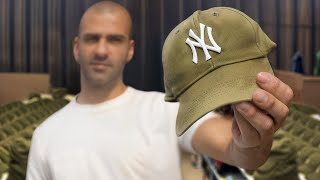
Bibi Global, a Portuguese hat factory founded in 1995, produces high-end caps for brands like Carolina Herrera and Marine Serre. The tour shows embroidery with sequins and beads, laser-cut designs, die-cut visors, and millimetre-level sewing precision. Sample makers master every machine to prototype hats in canvas, organic cotton, leather, and Italian fabrics.
Chapters
Glass factory. Today we toured Bibi Global. It's pretty amazing to see a family business that's turned small roots into something completely new, from embroidery all the way to hats. And now more products in the future.
The idea is to provide the best solution for every customer that we have on the fashion industry. The quality of the product, the quality of the threads, everything is important at the end of the day.
So you didn't always just start off making hats, right? There's a bit of history to this company.
Yes, we, we started in 1995 and we started only doing the programs for the embroidery machines, but at that time the The first embroidery machines were much more simple. They didn't have like we have today, a mix of laser with the sequins, with the beads, everything. If it is embroidered, we do it. Everything that comes in the market that allows us to do more complex and beautiful things, we don't take much time to think about it. We buy it, we use it. You need to be on top of every technique available to provide difficult things for others to copy. This is shoes for Carolina Herrera.
So these are the toe caps, the mudguard. That's sick.
Yeah, we do the embroidery here with the sequins, and then we send them out for the shoes maker to finish.
Yeah, for sewing. Gotcha. Basically, if you come in here, the sequins, they come in a line like this. So instead of embroidering thread, they're embroidering sequins onto the actual mudguard of the shoe. That's very, very cool.
We also can mix different sizes of sequins.
The result is that— look at the back, right? It's all embroidered. This is exactly what embroidery looks like from the back. On the front, extremely clean. You would think it's one consistent piece of fabric, but actually it's all individual embroideries for each sequin.
This is a cap that was just made for checking the precision.
You can see how this panel over here aligns perfectly with this. This was their sample to prove to the customer that they can get it consistently right. And even if we look at the top of the hat, right, notice how each line goes perfectly to the center of where the button is. These little things, they're subtleties. You don't really think about them, but in reality, very, very difficult to execute on. There's a lot of attention to detail in cutting every single panel. Father, son, CEO, director of sales, world's coming together. Really cool. He just showed me his world of expertise. It's embroidery. It's the basis of this whole business. And now Luís is going to take over and show us the rest, show us how the hats are actually assembled. So over here he's die cutting visors, right?
Exactly. Our, uh, the plastic that is being cut here is virgin plastic. Each client has his own cutting model. It already has selected the ones that we are producing, and then you will go there pressing, cutting. This is the best way we can find it now for doing the cutting plastic. This is Natalie, the part where we do QC for the caps and mainly also for our production of embroideries. She's now doing all the threads that are missing out, then it needs to be cut and prepared for the next phase, which will be the sewing part. What's happening is really about joining the panels. This is the first task what you have to do for construction of the panel. it's all done manually. But what she's doing is taking care that each panel is going the right side. Then he has to move forward to the next line. She only does this front panel.
This is her reference sample here. So you can see that the front of the hat is very structured. When we say a structured 6-panel, this is the structure they're talking about, right? They put this piece of fabric in, which is very, very stiff. And when they insert it here, along with the 2 panels that make up the front of the hat, that's how you get this very firm form on the hat. Whereas the other panels don't need that. The other panels are meant to be soft so you can fit it around your head as you please. Something I want to talk about, the precision of the sewing. They're saying that everything is down to the millimeter in this factory, and I believe it. If you look, as you follow along this curve, there's exactly a millimeter of width at every single point in the curve. And the craziest part is that this is for a part of the hat that you're not even gonna see. This is gonna go on the inside, so it's completely hidden. They don't even need to be this precise here. But they choose to be. And that's the attention to detail you're getting when you're doing something at a higher level.
One of the key points too is attach the visor. It needs to have the precise measure too. Like I said, the 1mm makes a difference here in terms of shaping. And attach the visor is one of the most important things too, to get the front panels match the back panels too. So this is a really skilled position to be, so.
One of the hardest parts of the entire process when it comes to making hats is this part right here where the sweatband meets the brim, because that margin for sewing is very, very small. And that's where their 1mm rule comes in. This guy really doesn't have a lot of room to operate and attach that sweatband, and the stitching has to be very precise because it needs to be very well adhered to the hat. So that's what he's doing over and over. Repetitions are the key to getting this right. I really like this process for one specific reason. They are using foam. A lot of sweatbands do not use foam. It's very nice to see foam inside the sweatband. What it does is it creates padding on the inside of the hat, which makes it a lot more comfortable to wear. Another really nice touch here is that they're using a different piece of fabric to separate each section of the Sweatband, and look how clean that stitching is. So I see you worked a lot with Marine Serre. You have this bucket hat over here. How did you develop your relationship with a brand like this?
It takes years to get to know them. We did trade shows, we find that we were actually able to work them by direct contact. We created new models with their fabrics, and then we came out with all these samples over the years.
This definitely caught my eye. How did you make this hat?
So when we go to trade shows, we want to also test the market and catch people's attention. That's something that we provide for brands, but we also want to give ideas to the brands. And what we did here is definitely the cuttings on the, on just the fabric, but also add an extra layer since behind this cutting you'll see another layer of fabric, right? It was a challenge, but I think it was a well done one.
This is wildly different from everything I've seen you do here, and it also indicates that you're able to work with leather, which is something that is not so easy to work with. There's also a lot of attention to detail in this hat, and the sewing is very clean.
This was actually a sample. It didn't actually come out to production. What I know from this phase is that we were actually trying something new for them. We were testing the market and it came out like this. We, we can prove that we can work with leather and we can actually find some really good combinations to actually have a great product here.
A consistent thing I'm noticing with the hats we've touched in this factory is that fabrics are a very strong point. You know, getting a canvas like this that's this soft to the touch while still being canvas, it's almost oily how beautiful it is and how moist it is. Very hard to get. In some of the Asian factories because they're sourcing all of their fabrics from Portugal and Italy. So you get access to those kinds of more premium fabrics that allow you to really get a premium hat here. That's the idea. So the samples are all happening right here?
Exactly.
It's just these two machines?
Two machines, and a few people do samples just because they are more skilled on that side, right, to do the perfection. And then it goes production.
For sample, you need to be skilled in every single aspect. Exactly, exactly.
And you need to know how to operate in any machine we have here.
So that's pretty commonplace that for factories, the sample makers are usually the most talented operators because they need to have skills in many different assets and all different types of machinery since they're going to be assembling a hat from start to finish, where some of the other operators are very skilled in specific parts of the production.
So actually here, what's going on, uh, is aligning the buckle And I also attach the labels. And then from this process, then they have to go to a sector to do all the final QC to see if it's perfect and aligned as it should be. This is the second layer of quality control, which is also really important when the cap is done. It needs to be cut all the threads, the last one, check up all the labels, check up all the buckles if it's really done. If it's not clear that the whole order is done, it goes back again to sewing part to do all the mistakes and it's be correct.
I guess intuitively it makes sense, but you don't really realize that a hat starts off as a flat brim like this, and when it's put into this machine, that's where it gets the curve on the brim. This machine actually heats up the hat so that the plastic is more easily able to bend. That's how you get the curved brim. So what that machine is doing is it's pressing it down on the crown, it's shaping out the hat, and then this fan over here that's going really, really quickly is dispersing all dust, little threads, residue that's left behind on the hat. When it's all said and done, the hats are able to move over from here onto the line where they're going to go through a final inspection. And the end result is a beautiful hat, extremely clean. With the hang tag attached as the customer requested. And I love how this factory lays it out very neatly on the line. It's very visually easy to see what's going on, and it shows they really care about the product they're making. So I see you guys worked with Tekla to make these bucket hats.
What is really interesting on this is definitely, if you see from the inside, we can change the fabrics. It doesn't have to be all the same fabric, right, inside and we reinforce with another layer of fabric and a sweatband at your disposal. It can be in other colors, right? All of this is definitely tailor-made. Even the size of the head, you can change here on the visor. This is called also a visor for the bucket, but this can go up to 20 centimeters.
This is a little bit different, so this is more of like a running hat or a biking hat, if you want.
This one is in a different fabric and also has a cutting here. Yeah, lasers.
This is a sample. Yeah, it's very nice for a sample.
So what I have here, it's one of our models, our winning product for this year, obviously. This is a canvas, organic cotton, but we can offer this, our stock service, which you can buy for 50 minimum pieces, and you have 5 colors. You only need to make sure that you are sending the artwork and we'll broadcast them already, so it will be print on demand. The caps are already made, we just add your logo. And if you are starting, it's good to test the market.
It's been really amazing doing this tour. Thank you so much, Luís. Thank you, Rui. This is Portugal. This is the Portugal Factory Tour 2024. Thank you for watching. Until next time, peace.










