Inside a Sneaker Factory in Portugal
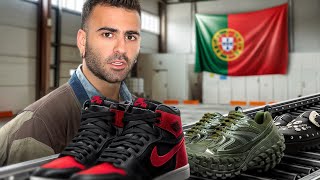
Loïc Fernandes walks through JLS Shoes' Portuguese factory, showing how a sneaker goes from sketch to finished product. The factory cuts patterns with lasers, stitches uppers by hand, and cures soles under pressure. A pair costs €40 to €80 to make, with Italian leather and Chinese Vibram outsoles.
Chapters
Glass Factory.
It's not only about production, it's about product, it's about fashion, it's about design. You know, it's all about millimeters, it's all about proportions. In my opinion, you only get that if you really love the product. So my name is Loïc Fernandes. I own, together with my sister and my father, JLS Shoes in Felgueiras, Portugal.
And what do you think is different about making shoes in Portugal than anywhere else in the world?
I think one of the main aspects of Portugal over the past 30, 40 years has been how competitive we were. We're still quite competitive if you want to compare us to Spain even, or Italy. In that case, we're a bit more competitive. The business is changing, I think, and we're evolving into making more complicated shoes, you know, with more added value in a sense, you know. So, but it's been the beginning of everything Everything has been competitive. Basically everything you see here, this composed of 3 different rooms, is the sample room. So design office is the number 1, pattern making office number 2, and then samples. Pedro, head of design for us at JLS.
Morning.
The idea here is that the client sends a brief, right? So that's technical sheets. You've got some details, medial, lateral views, inspirations for the treatments he wanted and everything. Started with a brief. And then the mood board. We chose the outsole, which was a track outsole. And then the first sketch, which I made on my iPad. And from there, we created the technical design. This is the first one. As you see, modifications. And from there, we went to this. A lot of colorways. We've done a lot of colorways. Very nice. So the process is find the last, either find one that's existing in the factory or create one.
Yeah.
Design an outsole around it, which is that. Send that design to the outsole manufacturer who's gonna do a 3D version of that.
Are you sending that with the last as well?
Correct.
And then based on that, they print this, which is rock solid.
Yeah, that's what they call the maquette.
That's the maquette.
Yeah, okay, it's the mold, the very first one. So that allows you to see a 3D version of what you imagined so far. From here, they go back to 3D design, adjust whatever adjustments you want.
Once it's done, this comes, then you get into the real mold, and that's this. And this is made of rubber. It's nice to see a full story be told, you know. You see shoes on a web page, you're thinking, okay. I think in general, like, as consumers, we're kind of just like on Instagram, we're scrolling, we see finished products, and that's all we see. It's really, it's really, really nice to actually be able to see the process, see the behind the scenes of what you're buying.
Outsole came in, last was created, and after that, design, and after that, it goes to pattern making. When it comes to pattern making, Vittorino is creating what we call a shirt. It doesn't really translate so well, but that's what it is. That's a shirt.
I get it.
I honestly get it. This thing goes on top of the last.
It's a shirt that covers the last.
It covers the last, and that gives you the area you're going to be working with. It has a collar and all that. Makes sense. Exactly.
It's a shirt.
It's a shirt. From that, he takes this. From that, he creates this one, which is the most precise. Now that's to exact scale, exact proportions, exact volumes. And from this, he's going to create all of these pieces here. You can see how complicated it is to actually create a shoe and the amount of pieces that are, you know, that the shoe is composed of, basically. There's tons of things in here that you don't see that have to exist. Toe reinforcement, back reinforcement, eyestay reinforcement, just to make sure that when you pull for the laces it's all right, right? We have the lining part, we have the foams, there's tons of things that you don't see.
So who am I here with today?
Diana, account manager of all the brands on the factory. My job basically is when the pattern making is done, I have the technical files from the design. So I have this, this is a CAD. I have all the materials on the shoe, so I request all the materials, outsoles, mesh, leathers, everything. And I have a system. We put all the materials on the file, explain everything the shoe have, so the George can cut.
So he has all these different pieces that were pattern pieces that were found within an envelope, and he's actually going in and cutting the leather from them. And this is going to form, I guess, the upper of the sneaker.
Entusiasmo e depois é todos os dias coisas novas, sempre a mudar. É diferente do que estar numa produção.
Now we have here Selina. They make all the patterns, okay? The shoe, the pieces on the leather, the stitching, all the things.
Isto agora é totalmente diferente do início, quando eu comecei há 25 anos. Eram clássicos, agora estamos muito nos esportivos, mas é desafiante isto. Porque tem modelos muito bonitos. E quando eram os clássicos, tudo muito parecido, tudo igual. Agora os esportivos são bonitos. E eu gosto de trabalhar em coisas diferentes. Nunca gostei da produção porque era sempre a mesma coisa. Eu gosto de coisas sempre novas.
The shoe has a lot of components. You know, if you have a teacher, you choose the jersey, the fabric. And you put some logos and it's fine. The shoe, no, it has more and more components, so it's very, very difficult to make a pair of shoes.
So how did you get into sneakers to begin with?
My father was into shoemaking, right? It was his business. He was a reseller, a trader in that case, right? Buying shoes in Portugal, selling them in France. So I've been lucky enough to have someone around me, which was my father, which educated me to what the shoe world was. I think we are shoe dogs as well in some sort of ways, you know, but it's like, it's not about the sneakers, it's about, you know, what a real shoe is, about the materials, the outsoles. I was just I was really lucky to have him around me and to have him, I guess, he was feeding me some sort of a passion. I didn't have Nikes when I was a kid. I was really passionate about Nikes. And when I started, you know, working and making a bit of money, this is where I started spending tons of money in sneakers. I think my first pair of shoes that I liked and enjoyed was a pair of Air Max Triaxes. And so Air Max Triaxes were, I think '96 or something. And I can remember I was rocking the shit out of these shoes. Like they were dead, completely dead. And once they were dead, I had no other Nikes to replace them.
How many pairs do you have now? A bit more than 600 pairs.
Sneakers over the course of 15 years. The oldest ones go back to '94, Jordan 1s.
Any other notable sneakers you have?
Yeezy 1 pack, fully deadstock, full, you know, OG, all the Galaxies. I just have— it's hard to keep track, to be honest. So, you know, I've been mentally ill for some years now. The goods go to the bottom of the warehouse. They enter there at the beginning of cutting, go through the cutting line, go through pre-stitch, go through stitching down the line, and then go to lasting. They lasted on this line, finished on the small line up there. So when, when things Materials come in, they either approve them or he's gotta bring them here because of the lights. See the size of that vamp? So if my skin comes in and doesn't have the required quality, I'm gonna have really big problems actually cutting that skin and my consumption is gonna go super high. Consumption goes high, sometimes I'm gonna be out of leather. Then I need to order more leather. They're out of stock. So it stops everything. When it's flat, you feel like it's okay. Put it flat. Do you see something here?
No.
So if I do nothing, I will come here and cut, correct? But then it's stretching. You see that little star line there? You know what I mean? Wow. Every skin is from a different animal. It's got a different story. Depending on the grade of leather, of raw skins that you buy, you can have a better leather or not, you know. Diana, Will Larsy, you've seen her doing the technical sheets and everything, right? What she does also is prepare the orders. So once technical sheets are done, samples are done, everything is approved, we get an order. She'll turn that into an order, confirm Technical sheet is okay, everything is approved, start ordering materials and start placing an order to cutting.
When you're cutting natural materials, you can only cut one mold at a time. But when you're cutting synthetic materials or foams, you can actually cut multiple layers. So you can see over here that he's cutting insoles and there's actually 3 or 4 layers within each stamp that he's making. And that's going to form the insole of the shoe. They're able to be a lot more efficient with this kind of production and you're able to get entire bags like this. So when you're talking about automatic cutting, this is where computers come into play. Essentially, this entire sheet of leather has been scanned, right? And based on the layout of the leather, you can actually see that the outsoles are laid out with a laser on top of the leather. So now, as he's placing them over there on the software, it's triggering what's going on on the leather. The beauty of the automatic cutting machine, especially on a piece of leather that's usable all the way through, is look how little waste there is. Everything is so close together, it's all optimally cut. So when we peel this back, we're gonna see that in fact there's not much left behind.
Right after cutting, you have pre-stitch, and their job here is to prepare the pieces for them to be stitched on the main line. Sandra, in the pre-stitching area, she applies the reinforcement. That's what pre-stitching does.
When you're making a sneaker, the upper sometimes has a lot of different layers, right? So when that happens, if you're to stack all of these things one on top of another, it would be really, really thick. Too thick thick. What they actually do over here, and what she's doing over there, is they're thinning out the leather because they know that another piece is going to be applied right here. So they're able to keep a consistent thickness after that layer has been added. So walking through here, essentially number 1 all the way to number 25 are responsible for sewing in some capacity the uppers of the sneakers. That's what's going on here. And as we walk down the line, maybe for different sneakers at the moment, they're being assembled and they're being sewn together.
So you see, for example, here She's doing the mudguard. So the mudguard is kind of a complicated piece if you look at it, because it's what you see from the top, right? Straight away. So it's got to be well stitched, beautiful stitch line, properly centered as well. You know, because if she does it off, top view is going to be weird. So what she'll do here is she'll go for the machine. It's going to make it flat. Just pressing the edge, making sure you have the thinnest and the cleanest edge on the shoe.
The reason she did that is because now she's applying a piping, and it's much easier to apply that piping when it's a really flat edge. If it's frayed, or it's uneven in any sort, it makes it very challenging. So she's just making her life much easier and she's gonna end up with a much cleaner sewing job. Loïc is a French name. Fernandes is a Portuguese last name.
Correct. So Portuguese father, French mother, born and raised in France, studied in France, girlfriend in France, kids in France. But yeah, we do work in Portugal.
So there's two sides to Loïc Fernandes and there's two sides to JLS. What's it like bringing up a factory with that combination of things?
I think the main difference is gonna be the culture. You know, French, Paris in that case, you know, is like super into fashion. It's not only about production, it's about product, it's about fashion, it's about design. So right now what she's doing is she's applying— that's the heel counter, the back reinforcement, right? That she's gluing on top of the heel, the heels. That glue is a latex glue, right? So it comes in a liquid way and is spread by a kind of a spray paint, right?
You look at a back panel like this, you don't think much initially, but in reality there's a lot of work that goes into this. 3M print over here, another yellow print here, perforation. Perforations all along it. And over here is a mesh window with 3M backing. It doesn't seem like much, but it's a lot of work to actually sew in this mesh, and that's what this little fine line around here is. Have 3M backing as well, have both printing, perforation, an extremely clean finish all around, very well executed, and it's going to make a beautiful heel for your sneaker when you're wearing it. What he's doing here is putting the shoe inside the last. It goes into the machine. The machine is pulling pulling back the suede along the middle together and applying glue and doing the same thing for the heel. First, it's gonna press the middle section down, which is what just happened here, and then it's gonna pull back and it's gonna press the heel together, which is what happened there. After that's all said and done, the shoe comes out. So what he's doing here is sanding off all of the excess material on the outsole to make sure it adheres very smoothly and it's flat when laid on top of the outsole. And now you can see it's good to go.
When he checks, everything's good to go.
Everything's laid flat. He's defining what the limits are with the pen of where glue could be applied. And it's all done with invisible ink. With that layer of invisible ink applied, he now knows the limitations for gluing and he's ready to move on to the next step.
It's gonna go into an oven that's gonna reactivate it. It's a glue that only works once it's reactivated. So you have to apply the glue, let it dry, reactivate, and glue. It's kind of a weird process. Boom. Take the outsole, place it center, Check the height, check the heel, and pressure machine. So what the pressure bag is going to do, it's going to press the shoe 360 degrees. So the bag is going to pressurize the whole shoe and outsole. It's going to take off all the air between the outsole and the upper, and it's going to ensure a proper 360-degree gluing, basically. And that is still a hot shoe, remember, it's coming out of the oven, right? So what he's going to do is going to take the glue off and he's going to put it in the freezer to block everything, fix everything.
So The shoes just came out of essentially a freezer, which locks everything in place. And now he's taking the last and he's placing it onto this machine. And he actually removes that last. The shoe can finally breathe again. And now they're ready to be taken to finishing.
What we're going to be doing now is putting the outsoles in, as you can see. So foam, molded foam, basically insoles to try to have a bit of comfort. Insoles, laces, filling paper, take off the glue, apply some extra water repellent treatment, for example. And quality control. That's what's going to happen here. And that's all going to happen before it goes in the box. What he's going to do now is going to apply some color enhancer. So the idea is that the shoe has been through a lot of hands, right? The suede has been touched so many times. Sometimes it gets a bit dry, a bit matte. We want to give it a bit of a shine, a bit of love, a bit of depth. So each of the shoes go in a plastic bag, recycled plastic, by the way. First layer of paper, second layer of paper, third layer of paper. Dust bag, and we're done.
Okay, look, you've run us through your factory. Now I want you to help us out and give us a little bit of an idea of how much things are. And something like this, a little bit more of like a skate fat Lanvin style sneaker.
Yeah, correct. So shoe like that, of course, tons of work, tons of material consumption on this one. You see there's tons of different pieces, plastic TPU inserts, heat sealing again. I mean, this one is pretty special, hard to make as well.
As well.
That's a shoe that's going to be, uh, we're going to be pricing around €60 to €65.
200 units MOQ. Something like this, more of a Doc Martens style, uh, what is the price looking like?
Uh, shoe like that, uh, probably around €40. Yes, a boot like that shows that we also do more of the classical and formal and traditional, you know, shoes in Portugal. Um, on that shoe, the special aspect is really going to be the leather, this polido, you know, high shine leather. Something like this, shoe like that Fully made out of leather, out of Italy. Outsole is Portuguese.
It's all Italian leather on the other one.
All Italian leather on this one. Portuguese outsole, fabric lining. The box on this one is pretty special, so it brings the price up. That's a shoe that we sold, I think, around €55 base price, 200 pairs, MOQ.
These sneakers over here, something really more on the simple side, you know, existing outsole mold, simple upper. What would something like this cost?
Anywhere between €40 and €45, depending on how you want to treat your packaging. Basically, the unboxing experience is gonna dictate how expensive these are. So we still use premium materials for those, you know, special logoing and everything, you know. So it's kind of cool. It's a simple shoe, like you said, so it's probably gonna be €40-45.
Okay, a shoe with a Vibram outsole but a little bit of a simpler silhouette.
Correct. So the idea of this is to show you that Vibram doesn't always mean very high price in terms of factory pricing. So that's a shoe that has a Vibram outsole, that's costing us close to €320, right? Lenda in Portugal.
Portugal.
So the outsole is very expensive itself. That's probably a shoe that we're going to be selling around €55 to €60.
€55 to €60? Yeah, because the outsole costs you €20 or so.
€20, that's cost price.
That's insane. Yeah, but it makes sense, it's shipped from far.
Another example of Vibram outsole. So again, an outsole that costs you around €20 landed in Portugal. The outsole is made in China, we airship them from China to Portugal. So it's quite expensive to make these shoes. On top of that, that That shoe has got a very special and very complicated upper, tons of treatments and embellishments, tons of logos. It's a very special shoe that's probably going to be between €75 and €80, MOQ 200 as well.
Very nice.
On a daily, I think it is very important for us to be passionate about the product because that's what's helped us. This is why we're like so sharp about the products. You know, it's all about millimeters, it's all about proportions, you know, and you only, in my opinion, you only get that if you really love the product. If you are passionate about what you're doing, this is the only way for you, in my opinion, to achieve something that's kind of great.










