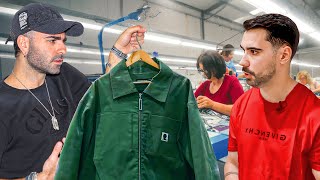
The video is an on‑site interview with Carlos Eduardo Simões, owner/manager of the Portuguese streetwear factory Cimetex. Carlos explains that the company, founded six years ago after his mother’s previous factory closed post‑2008 crisis, now operates a flexible, full‑service garment production facility. He describes the factory’s cutting area with numerous pattern boards, an automatic spreader, and a capacity of about 3,000 units per day for delicate styles. The workflow includes creating first samples, client‑driven adjustments, and moving pieces through three production lines that can start at different stages (e.g., top‑stitch, jacket, t‑shirt). A key strength is the highly skilled seamstresses (average 30 years experience) who can handle a wide range of garments, from blazers to thousands of t‑shirts, and operate all necessary sewing machinery. Materials are sourced primarily (80‑90 %) from Portuguese suppliers, with additional inputs from Italy, Greece, and occasionally Asia for technical outerwear. The factory employs garment‑dye and spray techniques to achieve uneven wash effects, and uses water‑soluble embroidery backing that dissolves during washing for a cleaner finish. Carlos emphasizes flexibility, strong client communication, and fair employee treatment as the secret to success, especially in a Portuguese manufacturing climate where many factories struggle due to rigid regulations. Cimetex positions itself as a one‑stop shop, offering full service from pattern making to final product, aiming to keep clients from needing multiple factories.
Chapters
Glass Factory.
So you really believe in what you do?
I'm totally passionate for my company and my business. If you don't trust your product, you will have problems at certain points because you know that you are doing something wrong. It's much better if you trust this product is 100% correct, this product is great. After that, it's just selling. Full name is Carlos Eduardo Simões and name of factory is Cimetex.
How long has Cimetex been around for?
6 years. I'm operating with, in a familiar company 11 years ago that starting after the crisis of 2008. The company where my mother working closed and after this my mother picked some people from this industry and create their own company.
I'm seeing an infinity amount of patterns on this wall. Can you kind of just tell me what's going on over here? Tell me about the machine.
This is just the regular client that we have and we cut here inside. This is the current can carryover styles that we have. This is the less used. The most used is on the accessible part for the cutter. Here we have an automatic spreader that we use to cut more delicate production. Here we can cut like around 3K units per day.
3,000 units?
Yeah.
So from, from a production standpoint, this is the absolute foundation. This is the soil of the production. All of these patterns shows you the history they have in making the different types of products they want to make. There's obviously a lot of expertise stacked over the years when you have a million different patterns on this wall lined up and ready to go. And Edu is using these patterns every single day. And then over there are the patterns that are less frequently used because naturally some orders come in more than others.
Right now we are doing a swim short. Manuel is our cutter, is preparing the pattern or checking the construction of the article before starting cutting. And since it's a very delicate style, not appear when you pick, it's like, yeah, very simple one, but have some details. And especially on the type of sewing, you need to be very carefully. And, uh, yeah, right now are preparing checking the construction, and only after we will start spreading the woven end.
This is a first sample, and you guys are doing a second sample? Is that the idea, or was this approved?
No, this one is the first sample. That's why you check here, some tape is everything notes that client have made with their adjustments.
Understood.
Yeah.
And so now she's adjusting the pattern to essentially make the second sample, right?
Correct. But even this one going for production too, we have attention on this kind of details to be efficient. So here we have 3 different lines of production. Each garment can start on a different way. For example, right now we are doing one article that starts here on the topstitch area. It's a particular jacket that we are doing, and this is our strongest line of production. Totally focused on this part because cut and sew, everyone can do it. This is our specialty.
So what makes this so special for you guys?
Here is really the nice sewer that we have.
Very high quality seamstresses.
Absolutely. This appears to be a simple operation, but it's not so simple because the fabric is not too easy to work. All the process is very tricky.
So your sewing is really your strong suit.
Yeah, yeah, absolutely. This is our strongest point. We have a cut and sew, and all these sewers can do cut and sew too. We are very comfortable, and that's why we can offer to clients a very huge range of clothing. We can do blazers here, or we can do 1,000 t-shirts here.
So in this case right here, So here they're assembling what, a polar fleece jacket?
Yeah, we are starting in the same way that we produce t-shirts. Start sewing the shoulders and creating the structure of the article, and after we go for the details like creating the hood, the bottom part, applying the zipper is the last time. We need to apply the lining on this one too, that it will be a very special lining, a very nice touch. As you can check here, this is one sample that we are doing.
This is crazy.
Yeah, this is our hardest job.
What is this fabric? Kind of a wool mix.
Mix with a polyester. It's more the effect, but it's crazy to work and it's a crazy result. We have this sample here just to note that everything mentioned here are being applied during production.
And so in this particular case, how did you achieve this unevenness in the wash?
On this particular article, this is two techniques. It's garment dye article, and after we apply spray technique. To create this white effect is called with spray. They're very good.
They're very good at what they do. When you work with the right partners, it's easy. In this particular case, right, this order, these are all PFD garments prepared for dye. All of these pieces here are heading to Quintas en Santos, which is the unbelievable dyeing factory we visited last week. Are you guys printing and embroidering before or after dyeing?
It depends. For example, we have here t-shirt that is already embroidered.
These t-shirts have already been embroidered?
Yeah, this one will be embroidery after the dye.
So also in this particular case, they left behind the, uh, what we call the tearaway prior to dyeing. So they're going to tear it off after dyeing so that the embroidery holds up much better in the dyeing process.
And this one is like water biodegradable. Since we dye, this disappears.
It's water-soluble.
Yeah.
So when you put it in the wash, it just dissolves.
Absolutely. It's quite expensive than the regular one, but the result is much better.
For sure. You're gonna have a much cleaner finish on the back.
Absolutely.
It's the little things to account for, because when you're wearing that t-shirt or that hoodie, whatever it is, you don't want the inside paper to be rubbing against your chest, right? It's very uncomfortable. So when you have something that's fully water-soluble, it takes away all that backing and it's actually just soft and comfortable to wear as if you were wearing something without embroidery altogether. Why should people make products in Portugal?
Portugal has great quality with the most fair prices and with the most fair rules for the employees. This factors mix is the one way to do you go good in the industry.
So you believe the ratio of quality to price is very, very good?
And your employees don't work 18 hours per day.
They're well treated, they're happy.
They are paid fair.
Yeah, you compensate them.
Compensate for the hardest work that they do.
So obviously you're a Portuguese factory, proud to be Portuguese. The fabrics that you use for the most part, are they from Portugal?
80 to 90%, yeah. The ones that we is not made in Portugal is clients that buy and send direct to us. It's usually from Italy or from Greece. Sometimes when it's outerwear technical, we We receive from Asia too, but majority is from these countries.
In the last few years in Portugal, maybe the last 5 or 6 years, there's a lot that's happened in the manufacturing scene. 2019, 2020, 2021 were all great years, but the last couple of years have been very rough and we're seeing a lot of factories close. True. Why do you think that factories are struggling in Portugal right now?
I think they have the problem that I identified some years ago. They are too strict on the rules. Nowadays you need to be more flexible. We have this kind of flexibility, and the one thing that we implemented and being very strict on that, nice communication with clients.
So really great communication and flexibility.
For me, it's the best skill that I have on the manufacturer part. I believe that's the secret of success.
So over here, in this particular case, we're seeing the placket being sewn onto the jacket. As we continue down the line, we're seeing In this case, she's working on the sleeve. So basically, as we go down the line, they're just working on this product right now. This is the product that's on the line. She's working on the cuffs. She's working on another panel. This is a natural flow, so it goes from sewer to sewer.
Correct.
Understood.
Correct.
And so these seamstresses, they know how to use all the different machines?
All our sewers have like 30 years know-how. Yeah, so we are very comfortable doing all the articles, and that's why I'm telling you, if you ask me 100 t-shirts for tomorrow, I can do this because I have here— you have the setup. I, and I, I'm prepared for this. I prefer avoid this situation, but if we need it, we have all type of machinery here. The all machinery that I know for sewing, we have it.
So you're always willing to grow and innovate with the clients?
Since clients stay with us, We don't want that client getting different options or trying, I need this, I need to find one factory for that. We do this for you. We take the client and we do, we provide everything that he needs. That's the biggest goal that you have.
Full service.
That's it.
Brother, I have nothing else to say, nothing else to ask. This visit's been really cool, really wonderful, eye-opening. Thank you, brother. Appreciate you.