Inside a Sweater Factory in India
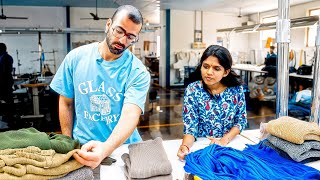
Tour of Classic Apparel, an Indian sweater factory that makes flat-knit garments from organic fair-trade cotton. Sushma and Ram Prakash walk through the entire process: yarn sourcing, machine programming, panel cutting, button attachment on Juki machines, quality inspections, and washing. The factory runs on solar power and costs €15-30 per garment with a 50-300 piece minimum.
Chapters
Glass factory.
Oh shit, here we go again.
So this is where we attach the button.
I'm Ram. Ram. Ram Prakash.
I takes care of all the production.
My name is Sushma. I am 25 years old and I've been working with Classic Apparel for 3 and a half years now. We focus mainly on sweaters, but it's flat knit, so we have flat knitting machines.
When we step into this room right here where all these flat knitting machines are, it's a very well-maintained temperature. There's a lot of air conditioning blasting in there. And the reason why is because these machines require a very specific temperature in order to operate perfectly. If it's too hot, it's very hard for these machines to work. The needles get caught. A lot of problems arise, right?
Yeah.
The machine basically malfunction.
This is truly an Indian factory tour because we're not wearing any shoes right now. So that's cool.
This is a single color. It's making plain fabric.
These are dishcloths.
So what this machine is doing right now is this is the feeder and this is called the carriage. The box, the gray box is called the carriage. So the carriage takes the feeder from needle 1 to needle number 30 and brings it up and back and forth. And the needles are selected in the structure that we need.
So that's the result.
This is a little cutting that we give so that when we send this panel to washing, it doesn't unwrap.
So look at this Jacquard fabric.
This is a tubular Jacquard, so there are 2 layers. So if you pull any one color, you'll see that the front is a different color and the back is a different colors, right? Gives kind of a nice soft cushiony effect. So if you can see in the machine, only for tubular jacquard you have two feeders running simultaneously. So the front feeder is the black and the back feeder is the white.
So do you have different machines for different effects, or can you program any machine to do it?
You can program any machine to do a certain, you know, type of structures, but there are always some limitations. You can do intarsia on these machines as well. But the minus is that the knitting time would increase and there's a limitation on colors. So these machines have only up to 7 feeders that are accessible, whereas an Intarsia machine would have 24 to 30 feeders. So you can get more colors in that.
Do you have Intarsia machines here?
Yeah, we do.
Okay. What's important to know with Intarsia is the machines can run like 20+ colors. You said 24 to 34? So 24+ colors at once, whereas other standard flat knit machines are only running up to 7 colors. Intarsia are running 24+.
So imagine doing this throughout for an entire sweater.
So imagine the amount of work that goes into making something, right? When a machine has to stop and switch colors, it takes a lot of time, especially if it has to do it this frequently. And they have to do this for every single size that the customer wants to offer. So if the customer is offering 4 different sizes, they need to set up 4 different Intarsia machines, or they need to set it up 4 different times in order to knit just the right size. In this case, this is a sleeve, right? They would have to do it for 4 different sleeves because the sleeve on a size small is going to be very different than the sleeve on a size large. Say what's up to Mayank. He's the one who set up this whole factory tour. The reason we're at Classic Apparel today is because of him.
Thank you so much.
Thank you so much for believing in the company.
Bro, of course. Are you kidding me? Thank you for having us, man.
I initially came here for my graduation project and I just loved sweaters, so I decided to just continue on. So it's been a great journey.
This is for the upcoming season for SKFK.
So it's all detachable?
Yeah, it's all detachable.
It takes so much time and so much separately. So there you can remove it halfway, or you can just make it a cropped shoulder, or you could do anything with this. So for the skirt, we attach a separate waistband with elastic so that if you're wearing the skirt alone, then it's comfortable. Yeah, so any part of this garment can be worn separately.
Wow.
Yeah, so much work.
It's been 15 years since Classic Apparel was founded, and from the beginning they've always had a very clear set of ethics that they have always wanted to follow. So Classic Apparel tries to be as sustainable as possible. It's not possible for anyone to be 100% sustainable, but we take one day at a time and we try to improve as much as possible.
So I wanted to ask you about that. You installed solar panels on the roof so that you can have renewable energy, right?
Yeah, of course. Now these days it's getting more common actually.
And it was important for you guys to take that initiative?
Yeah, of course it is.
Great. It's all organic cotton, this one?
Yeah, it's all organic fair trade cotton.
Beautiful. So this is the flat knitting, this is the beginning.
Yeah. Which is what the programming— So we have a set of 4 programmers who design all of these garments.
So this is— there's absolutely no cutting in this garment. So this, the neck is finished.
So this is a fish.
Yeah, the neck is finished on the machine. You just have to link. There's no overlock, there's no cutting at all.
They can't actually make each individual panel and sew them together, which means that the production can't happen simultaneously. The production has to happen one step after another to get to the end because they have to first make the collar, then they have to make the first portion, then they have to make the second section, and they have to link every single time in order for that to happen. So it takes a lot longer. That's why I understand your production time is so long. Yeah, I get it. So something like this, right?
It's like a beautiful knit sweater.
What's the minimum order quantity for something like this?
We can do anything from 50 pieces to 200-300 pieces. So the price would definitely vary based on that, and it's not because it's a small quantity, but when you go to purchase yarn for such a small quantity, then, you know, the price automatically increases for the raw material. This is 100% organic fair trade cotton.
Okay, so organic fair trade cotton. So where do you get all of your yarn from?
We get most of our cotton yarn from Maral Overseas Private Limited. It's located in northern part of India, and they have all the certifications that clients usually need.
Most of your yarns come from India, or all of them?
Everything comes from India, unless and until the client requests for certain trims and accessories from anywhere else.
Understood.
Each and every single panel is checked before the washing is done. So we have total of 3 stages of checking. So first is the primary checking, which is done as soon as the knitting is complete in panel form. And then once the garment is made, we do a secondary checking to see if there are all the seams are properly finished. If there is any error in the computers, we'll— yeah, save it. Skip.
Yeah, so.
Even here I see, look, they used the little red arrow. That's very typical to indicate that there's errors spraying around the collar, which is not acceptable.
So this is where we attach the buttons. It's a Juki machine and it's ISO certified. And we set the tension so that everything passes the pull test and the quality is, you know, perfect.
This is the buttonhole machine. This is for this garment. So again, this garment is also— you can either wear it as a long top or a crop top.
Beautiful.
So if you decide to remove the button, so they're just adding the buttonholes, and based on where the buttonhole are, they'll mark the buttons on the garment and they stitch the buttons as well. So this is the washing machine.
Can I just say, this is like one of the cleanest washing facilities I've ever seen in my life. At the washing facilities I walk into, usually it's like flooding with water here. I'm standing barefoot in a washing facility. That's insane to me. So very clean, straightforward, simple process. They wash, they dry, they press, but it's all very calculated. It's so hard to get the washing just right. If you wash for too long, there's too much shrinkage. If you don't wash for long enough, you don't get enough shrinkage. You don't get the garment just right. There's so much they have to account for when they're making something, down to the yarn that they used, the amount of tension in the fabric, the weight of the garment. All of these factors are going to determine exactly how long a garment needs to be washed. And it changes every time.
Yeah, it changes based on the raw material.
What would something like this cost roughly?
It depends upon the weight of the garment. It would cost somewhere between €25 to €30.
This is all knit by hand?
Knit by hand.
This is all organic cotton?
Yep. This is all hand cut. Again, for this client, we go for even 100 pieces.
100 pieces is acceptable?
Yeah.
Wow. This is, this is made by machine, right?
Yeah, this is made by machine.
Understood.
Because of the pointillism design.
Exactly. So something like this, it's what, around $20 to $30? Yeah, something like this. Understood. And so something like this, what would be the cost for something like this?
$15 to $20.
$15 to $20, and you can do as many sizes as needed?
Yeah.
So how did you make this? I mean, this is like a There's like layers to it.
Yeah, this is called a float jacquard. So on the back side, you can see that the yarn that is not running in the front is floating in the back. So all of these come in the same range. It depends upon the number of colors that we're using in the garment.
This is not like many other factories I've ever seen because, you know, if you kind of take a walk around the campus, I understand that you guys have made a big effort to make it very pretty. Everybody on the inside of the facilities takes their shoes off and it's incredibly clean. All of the yarns could be swept without a speck of dust. Why was it important for you to do that?
You know, it's very simple. When they are happy, we'll be happy. It's very simple. It's not like you can't go force them to work. You can't go force them to be here. You have to show them this is their place. You have to provide them everything. We provide them electricity, water, living. Sometimes the other, like, When they have to travel to Tirupur, we use our own, we send our own vehicles. We have drivers here who can drop them, pick them up. So we have to give them the feeling of being at home.
Thank you so much, guys. Yeah, thank you, thank you so much. Thank you, thank you, thank you, thank you so much.
I really appreciate it.
Thank you so much.
Thank you.
Take care.
Thank you so much.
Classic Apparel, go check them out. It's alright.










