Inside an Artisanal Clothing Factory in India
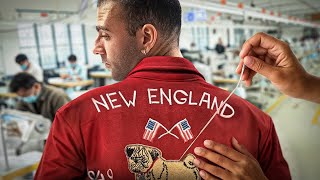
The video is a walkthrough of CR International, a family‑run clothing factory in India that produces men’s and women’s garments using a blend of hand and hand‑machine embroidery techniques. Host SPEAKER B interviews Mitesh, the owner/manager, who demonstrates a range of products – silk shirts, polyester patchwork jackets, wool jackets with viscose lining, recyclable‑thread jackets, linen shirts, nylon cord‑embroidered shirts, and reversible cotton‑print jackets. The discussion covers the materials (silk, viscose, wool, polyester, linen, nylon), specialized stitching methods (chain stitch, zigzag, double‑stitch, cording, water‑soluble backing, 3‑D twisted embroidery), and the labor‑intensive nature of the work (36–46 hours per piece, up to 1000 pieces produced). Mitesh highlights sustainability efforts such as upcycling waste thread, using water‑soluble backing that dissolves, and recycling excess fabric. The factory emphasizes fair, livable wages, the cultural heritage of multi‑generational artisans, and a slow‑fashion ethos that contrasts with fast‑fashion production. The conversation also touches on market positioning – premium pricing for customers who value craftsmanship and ethical production – and the challenges of changing perceptions of “Made in India” garments.
Chapters
Glass factory.
Spicing it up today, boys. Who am I here with today?
My name is Mitesh. I'm Pranjal.
What's the name of this factory?
CR International. We are into manufacturing of men's and women's clothing. We specialize mainly into woolen jackets, cotton Indian shirts, which are more based on the hand embroideries and hand machine embroideries. It's a family business. We have been doing this since the '90s. And so a lot of experience has gone into it.
Walk me through what these different pieces are.
This is a shirt which has been made from 100% silk. The cord of this shirt is using the 100% silk and the yarn is of viscose. The uniqueness about this shirt is it's all hand-sewn.
And you can see the precision in his process. One by one, he has to apply the needle to create all the linkages throughout the garment. And upon being presented to water, once it interacts, The fabric, the base fabric we see over here is going to dissolve and leave us with this right here. Beautiful, beautiful garment. All made by hand. I just want to point out Mitesh went out of his way to take 6 or 7 pieces we selected a couple of hours ago and start them up in the factory to show us how real-time the process is because he actually has all of the artisans on site working on these projects all the time.
This is the patchwork jacket. Which is made from the 100% poly fabric. The uniqueness of this jacket is we have used 20 different type of techniques of embroidery in it. It has a multicolor fabric, multicolor embroidery, and that this is all zigzag and machine embroidery on it. If you see, the person is doing the zigzag embroideries, like, just to enhance the patchwork.
I can't emphasize enough how challenging this is, and this is specifically challenging because the fabric is made of polyester, which means that when you're actually sewing, the fabric doesn't lay flat and stay still. It tends to shake a lot, so it's very hard to get that fabric to stay stiff and to get a perfect zigzag going throughout. But this operator has so much experience that he's able to do it consistently. You can see the beauty of the job he's completed. This is absolutely insane. Also very heavyweight.
Yeah, the uniqueness of this jacket, it's like a dual chain of the jacket, and it has a beautiful embroidery on it. And that to a double stitch. It's like more of a blanket stitch kind of a thing.
How long does something like this take to make?
Something like this, for the embroidery, it takes around 36 hours.
Wow. And you can see that this is all hand machine embroidered. But if that wasn't clear enough, then here he is on a base of black fabric. And you could see that this is truly chain stitching done the traditional way because as he's operating the machine, His hand is actually underneath cranking it in that chain motion, which is why you get those circular stitching patterns. That's what chain stitching is. So when you look at a jacket like this, you would never assume that the fabric underneath is black, but they leave those little details there just to let you know the level of craftsmanship that went into making a jacket like this. And this black fabric is fully gonna be converted into a full chain stitch jacket over here as a finished result. Beautiful. This is absolutely stunning.
This is 100% wool jacket with the viscose lining. The uniqueness about this garment, it's all the patches are being hand cut and it's been sewn by the hand machine. And we have even used the hand embroidery over to highlight the pieces. If you see the workmanship behind this jacket, each and every single patch which we have stitched it on the jacket, it's all manually cut by the hand.
You can see she's taking the wool fabric. They actually have a few different tracings that they do. It's like a pattern. Instead of using scissors, which is what you would expect for this kind of job, they're actually using what you use to trim loose threads on fabric, which is insane. That means that this is going to take like 800 times as long, and that's to get that level of precision that they're looking for in order to carve out these very precise shapes and these very precise little curves, because with scissors it would actually be really hard to achieve. And they're willing to go that extra step to do that kind of project. It's very interesting to see the level of detail you're able to approach things with in this factory. This is truly slow fashion from the way it's made all the way to the way it's worn. So this definitely caught our eye.
This is our recyclable thread jacket. In this jacket, the uniqueness about this jacket is we are upcycling every waste of the stitching yarn from our factory. We are utilizing each and every wastage of the threads which we use for the stitching of all our garments, and we are making a beautiful jacket out of it.
It's, it's actually pretty genius what they're doing. So it's extremely subtle and not noticeable to the naked eye, but they're actually using transparent thread. They're sewing in one direction. The fabric itself, all this recycled yarn, is so hairy that it's able to cover the work that's been done, so you'll never actually notice it. And on the inside, they add a liner so all of the work is covered. But the way they do it, the way they're able to create this, is once again with the same water-soluble concept. Which is something I have not seen much of. It's really quite clever. And you can see that over here, he's going back and forth creating that panel, that base, and the water-soluble fabric that's backing the panel is going to dissolve upon interacting with water. And I guess you guys are going to create a sort of full panel that's made up like this.
Yes.
And then sew together. And there's what, 4 panels total?
3 panels actually.
3. One big back panel and then 2 small front. Beautiful. So this shirt is a lot more than meets the eye. It's actually fully see-through here.
Yeah, it's made on 100% linen fabric and it's completely all hand done, and it takes around 46 hours to produce one of this kind of shirts. The embroidery is very unique. It has a beautiful, like, roots in it with small leaves.
So yet another technique, intended result, all hand embroidery. And this is not like other hand embroidery. Most hand embroidery, the thread goes into the fabric and out of the fabric. In this case, in order to create these little balls of thread that are beautiful and very 3D, he needs to actually employ a sort of twisting technique, which is really, really impressive. And he's creating these sort of branches of thread. Really difficult and precise work. And all of those little blue invisible ink outlines are exactly what he's following. And it's very precise to follow that kind of thing because how do you know how many times to twist the thread? How do you know how much thread to give it so that it'll cover that region precisely? It's really hard to know. It's just a matter of having a lot of experience, but his execution is flawless. No way to do this with a machine. This has to be done by hand, and this is actually a technique I've only seen in India of the 39 countries we've traveled to so far. So it's beautiful.
When the product has been produced by the machine, it has certain limitations. You cannot engage a lot of workers in it. People love the handwork from India. When we are producing by hand, it will give more feeding to their houses also, and the number of labors involved in the handwork is much volume.
This piece is maybe a masterpiece of pattern work.
In this jacket, we have used around like 10 meters of fabric in one jacket.
No way!
Every single line of this jacket has been machine stitched. This jacket has been inspired from the vintage blankets, which we call a log cabin blankets. And the best feature of this jacket is this is all reversible. We have used a beautiful cotton print inside this jacket. So you can wear it both ways. These are the patch cuttings which we have to sew to make these kind of small hankies. And when we make these kind of small hankies, then we convert into the panels. And from this panel, we cut the parts of a jacket, like one sleeve, one back, one front. When we have the panels ready, then we create these kind of jackets out of the panels.
Just for reference, a jacket like this would typically require maybe 2 meters of fabric, 2.5 with a liner, maybe 3. And he's talking about 10 meters of fabric, so over 3 times the typical quantity. And the reason why is because, as opposed to just sewing exactly what needs to be used for this jacket, they actually have to create a base of fabric. They have to create a full sheet of fabric from which they're going to cut the panels for the jacket. And from there, there's even further waste because the placement of each panel is very precise. They want to make sure that this pocket is placed exactly this way with the square over here every single time to get a beautiful aesthetic on the jacket. So because of that, they actually have to waste a lot of fabric, and then that wasted fabric is then recycled again and used for the next garment, and that cycle kind of continues. So it's really impressive what they're doing. This certainly caught our eye. It seems like everything here has been painted by hand.
Yeah.
Could you explain a little bit more?
This is an inspiration which has been taken from the Australian vintage map, and one of our ladies in-house, she doing all the hand works for us. She is doing like a hand painting and hand embroideries also.
So how does it work? I mean, it's— I guess it can't come out exactly the same every time for every jacket, right? It's a little bit different.
It depends on the precise— how precise the worker is. Every jacket is a unique one. Oh, She's doing the hand painting.
So you can see that the panel on the right over there is actually being painted by hand. And this is really done piece by piece, panel by panel. Very tedious process, requires a lot of precision. And she's got it. She's got it figured out.
She's master for her job.
How long does it take you to do something like this?
For that one? 2 days.
2 days? Yeah. How many have you done like this?
More than 1,000 pieces.
More than 1,000 pieces? That's insane. What does it take for a customer to become a client of CR International?
So in the market, there are bad customers and the good customers. It's important that who understand us better to do business with them only, right?
And so understanding you means understanding the workmanship, the craftsmanship, paying wages?
Because when they see the products done in front of him, then they understand the workmanship behind it. Our focus is not to just provide the wages, but to provide livable wages so that they can have a healthy life.
So the customer has to be ready to account for a more premium pricing. Yes.
This is a beautiful shirt which is made on 100% nylon fabric, and we have done a beautiful cording embroidery on a textured fabric. If you see the embroidery technique, it is again done by an all-hand machine. and it's called as a cord. There is a small insertion of threads and a cord in it.
If you see how beautifully he is doing this work, the level of precision going on here to do the outline of this leaf that he's actively doing right now. You can see him turning the chain stitch back and forth to change the direction in which the needle is operating, and you can see that happening in real time. This is actually the direction. It's kind of like a compass that's going crazy. And he can't really make a mistake. If he makes a mistake, it's going to be extremely obvious on this mesh-based fabric. You see the circular piece of wood, that's where he's sewing. It's called a hoop, and that is used to make the tension on the fabric within it much tighter so that when the machine is sewing, it's able to consistently apply the same amount of pressure as opposed to having some looseness in the fabric and getting inconsistencies. The level of precision Once again, very skilled operator behind this kind of machine, and this is just beautiful work.
The uniqueness about this jacket, it's all the vintage Japanese stamps. So since we were trying to exhibit our products in the Japan market, we thought, why don't we use Japanese stamps? We have done hand machine embroidery with the wool thread just to give it a more beautiful look.
So right now he's working on the zigzag stitching. He's doing the hand embroidery. So he set up the hoop very similar to the chain stitching machine, but this is really one at a time. You can see that section by section he's doing the zigzag by hand, and it's not like a preset zigzag where the distance is already determined. He's really got to do this by eye and assume what the best zigzag length is for every single stitch. The way this kind of embroidery works is very unlike most embroidery that we've seen. There's actually a yarn here that he's holding onto, and the machine is precisely pressing down on that yarn. It's puncturing it in real time. So he needs to control where the yarn goes, whereas most embroidery machines actually control where the yarn goes themselves. Much more challenging to do embroidery like this. Where do you find the labor? Where do you find these people?
We have to move out from the metro cities to find people who have been doing this since 30 years, 40 years. We know some places that people have been doing this since, uh, their 3 or 4 generations. A lot of inspiration is drawn itself from the villages that the work has been done.
So the culture is very important behind what you do.
Yes, definitely. He is doing the QC for the patchworking so that the stitches are not left open.
Take a look at the COVID stitch work. Look how beautiful and precise that that is. This is like such precision work, and it's infinitely more challenging on patchwork than anything else because you have a lot of bumps, a lot of unevenness to go over, and then it's even compounded by the fact that this is done on silk. There's been a lot of stigmas around Indian culture. A lot of people cast judgment over Made in India, maybe because a lot of fast fashion is is produced in this country, and we think what you're doing is changing that narrative. How do you deal with that?
Every brand is running after the fast fashion. They don't care about the workmanship or handwork because everyone is running after the price tags. So it's very difficult to make them understand that the uniqueness about the handwork is very important, and if you just do everything by the machine, you will at the end of the day You will kill the pockets of the needy persons. Yeah, well said. It's not just a necessity of a time, because if you are keep on running after the fast fashion, it's a need of a time that you should switch from the fast fashion to the slow fashion, because you are producing a masses of wastage for the world.
Absolutely.
So one day you have to switch back, and it is the time. Agreed.
It's— we're past the time.
I've seen this guy play, right?
I'm not kidding you, this is Punjab BMC talking to you.
I've been around the world, 2006, really.
Fucking shame. I have to say, Glass Factory, it's 2024 and it's going to be fucking massive.










