Inside an Italian Denim Factory
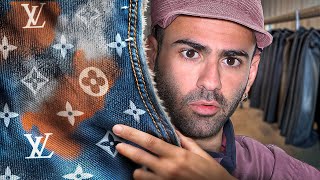
Beatrice, Federico, and the Blu Fashion team walk through their Italian denim factory, showing how they make jeans from sample to production. You see 3D whiskering on mannequins, laser engraving, stone-wash effects, and a wastewater treatment system that recycles water. The M3 dyeing facility uses infrared simulation and automatic dosers to get colors right.
Chapters
Glass factory.
I mean, how much do you care about this hat? Glass factory tour, Italia 2024, Italy factory tour. We're inside Blu Fashion. I'm with Beatrice, I'm with Federico, I'm with Kishan, Petro. The glass factory team is here. We're making magic happen inside a dyeing factory, and we're taking a really cool tour today.
No, no, no. We are working when we working.
It's what it is. Yeah. It's what it is. Okay.
Yeah, we do the manual treatment with the mannequin.
So you dress the mannequin before inflating it, right? Yeah.
By having the color be pink, which is a color that's going to show up on most other colors in general, it's very easy for the operator to know exactly where they've sprayed and And it's also very easy when doing 100 of these products to overspray on one area, so they need to be very careful not to over-dye certain parts of the garment. And this is how they ensure that the color comes out just right.
This is the machine for the 3D whiskers.
Oh, when you're doing the dremel.
Yeah, making this.
Okay, ready, ready.
Whiskers.
This machine does all the 3D whiskering. So how do you achieve this?
You put the jeans on, you inflate, and then before you spray your resin, you make this form that you want. You choose the form.
From there it goes into this oven. It's very hot, and the resin dries off. Once the resin dries off, the remaining result is this, and it's ready to go to washing.
There's tons of whiskering, and no matter how I hold it, it's retaining the shape.
I mean, look at the leg. It's not even drooping. So those are their washing machines for sampling when they need to show a customer a quick prototype. This is where they make it happen. There's two machines. One can handle 10 kg and one even a little bit less. I mean, depending the type of garment, sometimes that a little bit less can mean only one or only two.
It depends, uh, on the type of garment. Because Balenciaga garment, I, I can wash one or two.
So heavy and so big. For sure, it depends.
And here is the same washing machine that you see for the sample, but much larger. I know that you can wash 200 garments.
It's a 100-kilo machine ready for production. Right now it's in production, it's washing. What's it washing right now, jeans?
Yeah, it's washing this.
So these have already been washed?
It's finished, yeah, it's finished. The steps are raw denim, okay, stone wash, per farlo più chiaro, okay. You use the bridge. This is a special washing machine for sustainability.
Invece che utilizzare l'acqua corrente come sta utilizzando adesso, perché comunque può essere utilizzata anche in maniera normale, utilizza il nebulizzo, si chiama. Quindi l'acqua viene nebulizzata e ovviamente essendo nebulizzata non hai la quantità di acqua che viene usata normalmente. Credo che questa sia la scuola migliore che una persona che uno possa avere per entrare nel mondo della moda e soprattutto nel mondo della lavanderia, che è strano anche vedere una ragazza nel mondo della lavanderia perché non è proprio un mondo così pulito, così— sembra tutto molto bello, tutto faccio moda, ma c'è un dietro che è molto tosto, però mi piace molto, sì.
You're the one who's doing all the work in finding out exactly the ingredients for the wash and to get the special effects, and they're just designing and saying, "I want this, I want that." Yeah, they all think what they want, and then I—
it's difficult sometimes. For sure, for sure. I love the dyeing, I love the denim, I love the denim because it's the only fabric that can change in a lot of ways.
Denim is resistant, it could take a beating.
Yeah, and every day I want to find another way.
They want to show us lasering, but all the pieces for production have been lasered, and now she's scrambling to find— all right, there we go. It's not a wash shirt, but She found some unwashed raw denim. So in this case, this was the logo they were lasering, and that's the process of it happening in real time. So what's so cool about lasering is you can get something like that. You can also get something like this, which is a beautiful floral detail design. You can get monograms. So for this next segment, they're going to take the monogram and we're going to run it down Petro's leg. He's going to get Spring Summer '24 on him. So what's she doing right now?
She is making wet the laser.
Okay, and so does this make the laser a little bit more subtle, or like what's the reason to do it by hand instead of putting it back in the machine?
Togli solamente la polvere del laser, della bruciatura.
Okay.
Così ci togli solo il laser, perché devono fare delle borse, quindi le borse poi non andranno lavate. Okay. Quindi li togli solo la polvere della bruciatura.
Now I'm taking over this segment of the video to show you Blue Fashion's other facility, which is M3.
It's a dyeing factory, M3. It's another reality of Blue Fashion. And yeah, so we're in the factory, in the capo, basically.
So let's see how they do with the dyeing, the garment dyeing especially.
Let's go!
È la prima fase per riprodurre questo campione qua, che poi ha un trattamento. E quindi prima si fa questo e poi si va a fare la tintura in capo e il trattamento finale.
Prendiamo il cilindretto con la nostra preparazione e simuliamo un 5 grammi di tessuto per arrivare a quella tonalità lì. La chiudiamo bene. E questa qui è la macchina infrarossi. Mettiamo—
inserire qui nel suo alloggiamento.
Si ferma la macchina, io apro.
Eccolo qui, questo è il risultato.
E adesso sempre qui da M3 ci troviamo con Leonardo Giglio, commerciale della M3, della Blue Fashion.
E che cosa vedremo adesso in questa parte di M3?
Vediamo la fase di iniziato di una tintura e il passaggio in asciugatura. Qua sono praticamente le acque reflue delle tinture che vengono convogliate qua in questo pozzo e poi viene fatto un passaggio di prima filtrazione in questo filtro e poi andranno al depuratore dove verranno depurate e rimesse un'altra volta in fiume. Qua invece siamo al dosatore automatico che va a dosare su ogni macchina.
La fine del ciclo di puntura. Ora la macchina scaricherà i tappi.
So I think right now we've seen everything here in M3.
Giusto?
Abbiamo visto tutto?
Yeah, yeah, yeah.
E niente, ora torniamo su Blue Fashion.
Let's go back to Blue Fashion. Let's go, let's go, let's go.
What kind of printing is this?
Is a wash in In Italiano.
Okay.
It's a denim print.
Stamped. Stamped. We've taken the graphic of a denim print and stamped it. It's a production that we've done for a Diesel show. It's nice to see because it's very realistic.
This is supposed to be done on denim. They're doing it on a piece of white cotton ripstop as just an example. But what they're doing right now is a realistic print that basically reflects as if the jeans were really used or washed out. They're gonna print an entire pair of jeans right now. What motivates you to keep innovating every single day?
Ogni giorno mi viene richiesto qualcosa di nuovo. It's crazy, because yesterday this was new, and tomorrow it's not new. So I take inspiration from everything, there's not one thing, but also when Vado in montagna a camminare, vedo una cosa che mi può sembrare una cosa che posso riprodurre. E così, la mia vita ormai è questa.
Normally it's used for making logo, but I don't like to make normal things, so—
Oh, this is transfer paper?
Yeah, this is transfer.
Okay, understood. Now the transfer paper is done being printed, it goes to this basin over here. Where powdered glue is being applied onto the fresh ink. For production, they would put it in this machine and that would be applied automatically, but since it's only for a sample, they do it manually. From there, it goes into this oven where it heats up a lot in order to activate all of that powdered glue and have a reaction with the ink. Once that's done, that transfer is now carried over and they take the pair of jeans. In this particular case, it's a very small pair of jeans. It's actually not for kids. They just use a smaller pair of jeans because it would be a waste of time if they used a huge pair of denim if they end up not being happy with the results. And to really seal in everything that just happened, it's taken to the press. On the press machine, it stamps the transfer paper onto the denim and really secures it in place. The timer is gonna go off for 15 seconds. Since there's multiple segments of the denim, they're gonna have to stamp twice on the front. They're also gonna stamp on the back to make sure it gets hit from both sides. Once that's done, they let it dry off for a couple minutes, and finally we're able to see the reveal. Oh shit!
And then we have to repress.
And then you have to repress. Oh shit, this is sick! You had to learn how to do everything around here, eh?
Yeah, yeah.
A tutto questo, che comunque non è poco.
Per esempio, this is— oh wow, this is a foil, reflective foil. Yeah, so if you make a photo with flash, that's so sick.
So side by side, both of them have foil to make it reflective, but this is a lot more subtle. This is a lot more apparent.
Yeah.
Oof, those are hard.
Oh, this is black dyed denim, and then we spray this new product that we use a lot. That's Corrose. Corrose?
It's a— yeah, Corrose.
And color in the same time, so they fat This is old dye. It's called old. Tintura old.
Tintura antico?
Sì, esatto. Perché viene fatto con una resina e la particolarità è che si sollecitano le—
Uses up around the edges where the stitching is. Is there stonewash?
Yeah, and then stonewash.
Stonewash, understood.
The stone is everywhere.
Everywhere.
Oh, let's talk about this. This is crazy.
This is crazy.
Yeah.
Okay.
Why is this crazy?
Why is it crazy?
Because a lot of time.
Yeah, you can see all of the unevenness and the scrunching from the stonewash and the marble wash.
And marble wash, yeah. Then we spray by hand this product that, uh, fa l'effetto muffa.
Muffa?
Muffa. Uh, mud. Before I put on this and I make all this stitching because I wanna that— I want to— that the mood factor stay in, in the fabric as well.
Thank you so much for having us here. Seriously, it's been amazing. You're like so knowledgeable and passionate. We love it.
Okay, fucking sick.
Thank you.
Thank you.
Thank you.










