Inside an Italian Tailoring Factory
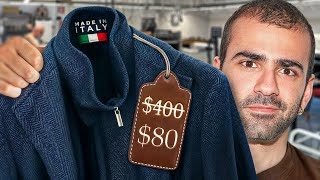
A tour of a family-run Italian tailoring workshop shows how garments move from pattern to finished piece. The factory cuts fabric by hand and machine, uses specialized equipment for invisible seams and buttonholes, and turns around samples in 3 to 5 days with a 100-piece minimum order.
Chapters
Oh yeah, we're all ready for business. Little leaf factory tour.
Style is collegated to made in Italy for me. Only in Italy you can see this quality. Another gift.
Oh, beautiful fabric over here.
This is like, like the church for me.
It's like the church. Yes. The pattern for this coat is being made right now. Beginning of the equation, right now they are currently printing the patterns onto the pattern paper, and this is going to be transferred over to cutting where we will begin the process of manufacturing products. So right now we are in the sample room. Campione? Yes. La sala de campione. We'll try to navigate it as best as we can because it is a tight room, but that's the nature of a sample room. You have your 5 machines you need to pretty much do everything you'd ever want. Right now he's working on a single needle machine. You might even have— yeah, a second single needle machine over there. You have your serger machine here, and then you have your double needle over there. There's another single needle over here. You have your cutting table for all samples. They're going to be cutting by hand, and then when they go to production where they have the pattern paper, they'll be cutting on an automatic machine. So this is an interface fabric. They put bonding on the back. Since it's a collar in this particular case that they're working on, they want to give it a little bit more structure, which is why they use an interface fabric to begin with. This is probably the most skilled sewer in the entire factory because they have to be able to work on any type of product, whereas other people who are sewing are going to focus on one specific task.
Uh, this is our client from Canada.
I've never seen anything like that before, actually. Oh wow, and the buttons inside too. That is a serious pattern. Very, very challenging pattern for this. And it's all— wow, look at this. This is sick. What a concept. That's a very unique product, I have to say.
And my uncle.
How are you?
We got the same name as your name, me and him.
The exact same. But what happens if somebody yells your name?
You guys both turn your head? Yes, yes, yes. Every day, every single day.
So they have two options for cutting. They have their automatic cutting machine, and when it comes out the other side, you get all of your cut panels that are ready for production. That's option number one. So the second option for cutting is cutting by hand using this machine. So I like that they have both options here because it gives them a little bit more flexibility. Certain products are better cut by hand. So his first step is stapling the pattern paper to the fabric to ensure it doesn't move around too much. And from there he begins cutting. He's gonna follow the outline to take off all of the excess, all the trim, and that's gonna leave behind exactly what he needs. So this guy right here is your uncle? Yes. And that's your cousin?
Yes, this is my cousin. The same.
The same. Uguale.
Uguale.
How long does it take to develop a sample?
When we are not busy 3 to 5 days. For production, it depends from the pieces, but maybe 2 weeks.
Right now we're standing in front of a bonding machine. So what this does is it combines 2 fabrics, and it's going to be placed onto the machine. If you want to show us. And over here we see them coming out one by one. And when we take it off now, it's one consistent fabric. They are bonded together till death do them part. What's your minimum order quantity?
Parliamo di 100 pezzi. 100, 120 pieces minimum. But it's not a problem if you make a big production, but—
Yeah, you have a full collection.
Full collection, yes.
You have multiple styles, you can do a little bit less quantity for each. Quadrato, unlined. I'm gonna try on. Bit small. It's built for an Italian.
If you want it, I give you this. It's a gift from me.
Oh, uh, the Queen. This is the Queen?
Yes. Mama!
He's so shy. Love you, chidi. She's responsible for doing the quality control of every single product that goes through this factory. It's one of the most important steps, which is why they put the queen in charge of it. And she has to be very, very careful to review everything. This is a small part of the production over here. The queen is doing the quality control, but the rest of the production is actually happening in their other facility, which we're going to take a look at as well.
Like military, like that.
This is the uncle.
Another uncle. Yes, uncle. Brother of my father.
Okay. So right now he's working on a single needle machine. I love how the family is operating the machines as well. It's a really nice thing to see out of the factories. Oftentimes with these family facilities, all the family is always in the administrative positions and then it's strangers for the other positions. So this is really, really cool to see, very refreshing. And this is Fede over here, the reason that we're here today. He's the one who set this up. Thank God. Shout out to Garment Workshop, shout out to Fede, shout out to Francisco, shout out to his cousin. Who doesn't have the same name, but his other cousin does. So right now he's doing the interliner, which is going to be made out of a polyester fabric. They also do silk, so it really just depends what the customer is looking for. So this machine over here is rigged up to automatically make the pockets. The base fabric goes down, the actual silk for the pocket goes in, or in this case, it's a high-quality polyester, and it's all automatically programmed to create that welt pocket. And just like that, she's created a welt pocket seamlessly. Over here, he's operating a single needle machine. He's working on different elements of the jacket. This pocket, particularly difficult to execute on because all the pocket is folded inward, so he has to work very, very carefully in order to do that. And he just did the chest pocket as well. They have a 3D appearance to them. All of the stitching is invisible from the outside, which is particularly beautiful. Leaves a really, really nice finish. Of course, these threads are going to be cut in QC. Here he's applying a tape along the perimeter of the fabric in order to reinforce it for the following steps. Everybody's working on a different step of the process.
Yeah, different step.
Gotcha, gotcha. For this machine, she's finishing up the process we saw earlier on the automatic machine. She's taking care of finishing the pockets right now. So this machine over here is an invisible sewing machine. It doesn't actually pierce all the way through the fabric so that the end result is invisible. A traditional single needle sewing machine, you have the a full cone of thread that's hooked up to the actual foot of the needle. And as you sew, it gets unwound and the thread gets taken from the cone. With this machine, the way it operates is she actually pulls off a segment of the thread in advance, and based on the length of that segment, that's the amount she's able to sew in order to skip the stitches every second stitch. See how she just cut the thread? She's going to take a portion of the thread, advance it, and pull it out. This distance over here that she just pulled out is what she's going to be able to sew. So over here he's doing all the buttonholes. He's using a standard buttonhole machine and it follows the shape of the line. This one is interesting because it's actually manually operated. So in this section, two things are happening. On one end we have hand sewing for the parts that need to be done in a very specific way, and on the other side we have quality control. So over here he's going through the garment He's going to trim the loose threads and he's going to graduate to the next part of the garment. Over here we're experiencing ironing. He's going through every single segment of the garment. Now obviously there's different fabrics here. Certain fabrics are more sensitive than the others. Right now he's working on the thicker fabric so he can have direct contact. Especially in Italy, ironing is going to happen at multiple steps in the process. This jacket is unfinished, right? There's a bunch of parts that still need to be sewn. Ah!
This is the brother of my father.
This is your uncle?
My uncle.
Another uncle?
The biggest uncle.
The biggest uncle.
He's the brother of the—
It's because of all the protein, right? Yes.
He going to the gym.
He's getting buff, this guy. It's filled with buttons, so it's their button container because this is a buttoning machine. So what this does is it automatically assembles buttons onto the jackets.
It's a pleasure for me.
Come on, bro! The pleasure is mine. Are you kidding me? Numero uno!
Quando vuole venire qua, questa è casa sua.
This is your home. You're my G. You're my G. You're my G.










