Inside China's Largest Sneaker Factory
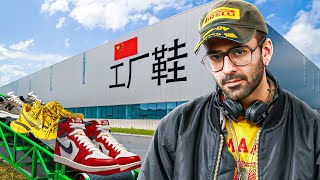
Belle Footwear, one of China's largest sneaker makers with up to 100,000 staff, produces standard shoes for $25 with a 150-unit minimum order and 45-day lead time. Custom designs cost $10-$20 per unit, require a 10,000 RMB mold fee, and take 60 days. The factory handles everything from leather scanning to final quality checks, shipping worldwide.
Chapters
Nice to meet you. Nice to meet you.
I'm at Belle Footwear where they produce some of the coolest sneakers, even some with Vibram outsoles, but they really make the full range of products. They have leather sneakers, they have more basic styles, something a little bit more casual, they have the dress shoes, and then you get into the really fun stuff. These kind of Adidas Samba feeling shoes, these Balenciaga mega shoes, and even the injection mold special. So I am really excited to show you exactly what they're doing, and we're going to show you how they actually manufacture all of the shoes because we're stepping into their facilities. And I'm with the one and only Joyce. What's up?
How are you?
I'm fine.
Okay, I know you are.
Good. They have streets.
You literally need streets to navigate from point A to point B. How many employees does this factory have?
8,000 people.
8,000 people right here?
Yes.
And you say you have 7 more? Yes.
Is there 8,000 in each of the 7 more?
No, this is the biggest?
More or less.
More or less?
Yes.
So in total, how many?
100,000 people. Here is 8,000. 100,000?
Yeah.
100,000 people work for Belle Footwear?
Yes.
I see included the staff in the shops. It also for the manufacturer.
Is it the biggest factory in the world?
Yeah, maybe.
So what is this machine for?
It's for the zipper tester.
So what is it doing right now?
It's doing the test for zipper pulling. We're pulling it like 3,000 times.
Sometimes do you use YKK zippers?
Yes.
So what is this?
It's for abrasion tester for some mesh.
Leather.
And what are you gonna do with this mesh?
To do the test for the abrasion.
What does this machine over here do?
Abrasion for the test of sole.
So you put a piece of rubber from the outsole and then you see what the left behind residue is?
Yes.
Okay, very cool. These are shoes that people have sent in and you guys are cutting them up to test what materials are there and you're gonna recreate elements that people like?
Yes.
Okay, understood. Very cool.
Sure. This is the compound.
This is the mega little—
It's our digital house.
Digital house.
Okay, cool.
In this meeting, we can see all the sales data for all the shops, all the area in China.
This building is dedicated to leather cutting.
So like what they're doing here is they're scanning the leather for quality control, making sure there's no blemishes. And if it's good to go, they use it for production.
We need to use this leather, do not waste it.
So they look at the piece of leather and based off the scan, they determine exactly where they're going to cut each piece so that they waste the least amount of leather possible. That's the idea.
This room is dedicated to production of boxes for sneakers. Check it out. The sneaker factory starts from the base. First part is cutting the molds for the upper. So we start with my man here who's cutting everything with what's called a die. So this is die cut, and all of these pieces that we get over here are what are used to sew onto the uppers of the sneaker. I'm about to show you how a pair of shoes goes from looking like this to actually having an outsole like this. So the first step is slipping the last, which is this piece right here, onto the actual upper. So that's what he's doing right now. So now he's gonna take the shoes that have the last inside them and he's gonna hammer them all around to really make sure that that last adheres well. So he's gonna take the shoe with the last, put it on the machine, and that machine's gonna make sure it's tightly fitted to the shoe. And just to ensure a little bit further, he's gonna take the hammer and he's gonna nail all along where the outsole is and a lot of the glue is about to go. Once that's all said and done, he takes a look at the sneakers and he passes them on to the next part of the line. Over here, they're put in this basin where they start being steamed. This is to let the bottom of the shoe become ready for gluing. And over here, she's taking the outsoles of the shoe and tracing them along the upper with a pen that's invisible ink, but under blue light it shows so that they're able to see where to glue it in the next segment. So she's tracing it along the base of the shoe right now with the invisible ink. So now he's taking a Dremel and he's running it along the base of the shoe so that it's much smoother when they're gluing it to the outsole. And it actually properly adheres. So this is the part of the factory where they start gluing, and you can see they're wearing masks because they just want to be extra cautious. So over here, they're running the glue along the outsole and along the upper of the shoe. And you'll notice that this whole section is done under blue light because they're looking for that invisible ink from the section before. Over here, the gluing continues. They're gluing onto the main part of the upper and the main part of the outsole. And this is where the soles are actually being glued onto the upper. So my man here is carefully running this blade through the sneaker to make sure that it fully sticks on to the soles. So now the shoes are passed off to this guy right here who's running a final line of glue along the shape of the outsole, and he's really following along. Finally, the shoes are taken and they're moved into this machine where they start drying off. Now the shoes come out of the machine and he's gonna start running the hammer along them to really reinforce that the glue is in the right place. They're taking a lot of steps of caution to really make sure that these shoes are well glued to the uppers. They will not come off. After that drying machine, he's gonna run an extra blast of air and heat along it to really remove any specks of dust while also adhering the glue to the upper more. Those sneakers are moved along here and they're passing the machine where they get one last blast of air. In the final stages, the workers are using a brush to pass along all the crevices of the shoe and remove any dust. You can see that little red arrow on the shoe right there. That's where there's a blemish. The glue mark doesn't look good. She's going to make sure that they fix that before it goes into the box. Now she's checking that the sneakers look good. It's a final quality control test, and sometimes if everything goes well, they're moved on to here where the shoes are picked up, put into a box, and shipped off to their respective stores and retailers. This is what a footwear production looks like for an UGG-like sneaker. Takah! Over here they're laying out the zippers. All adhesive is being set up so that they can be sewn on easily. This is where all the zippers are being sewn onto the upper So the finished result is an upper that looks like this, that zips up. So this is where they're die-cutting fur liners. In this case, those are the insoles, and then this is the actual upper that's gonna be sewn onto the shoe. So they take this fur upper now and they start folding it in. So she's gonna invert it inside the shoe. This machine is steaming all of the shoes so that the glue heats up and is used and ready to adhere to the materials. And from there, they're We're gonna glue the soles onto the shoes, and you're gonna have a finished pair of sneakers.
The carpet, what feels like—
Well, either outside is solar. What's the minimum order quantity for shoes and sandals and sneakers?
Actually, we have no request if you open the new mode, but if you select the styles from us, normally we request 150 per SKU.
And when you say styles from you, you mean that you have existing styles that customers can choose from?
Yes, we have a lot of existing styles they can choose.
The Adidas Samba has been a very popular sneaker recently, so I definitely have to ask about these. What is the cost for a shoe like this?
Uh, this shoes is around $25.
$25. And so what would be the minimum order quantity?
150.
150 units for something like this?
Yes.
And it cost $25?
Uh, yeah.
Wow.
And how long would it take to receive a sample 10 days. And could you do it in any color you want?
Yes.
So you could change the materials? If you want to change the design here, you could do that?
Yes, no problem.
You guys do it fully custom? Even the insole, if I wanted to change?
Yes.
And if I wanted to change suede from leather to suede, you could do?
Yeah, we could, we could do.
You guys could do anything? Anything I want?
Uh, yes.
Wow, okay. And how long does production take?
45 days.
45 days. So 150 units And the cost is $25.
Yeah.
Wow. You're amazing. Thank you. I see you have these foam— a little bit of a Balenciaga inspiration. If I take, like, for example, a sneaker like this, what's the minimum order quantity for a product like this?
150— 5,000 pairs.
5,000 units. Okay, so much higher quantity for something like this.
Expensive mold to inject these shoes.
Would you be willing to do less if people paid more?
Uh-huh.
Okay, so you're always flexible.
Yes, we have no request. If you pay the mold charge, we open a new mold for you and no MOQ.
And what's the mold charge?
10,000 RMB per size.
Okay, 10,000 RMB. So depending how many sizes you want to offer, you have to cut that many molds. So if people want to order exactly like this, they could?
Yes, but for example, this one is have some—
Okay, so you put your own— you could put somebody else's logo on it?
Yes.
How much would it cost to make something like this?
It's around $10. $12, $20.
$20 per unit?
Yes.
What would be sampling time for something like this?
This one, we need to open the mold, so 20 to 30 days. Sample, 15 days.
15 days for sampling, amazing. And then for production, how long would it take?
Around 1 month.
Wow, you guys are fast.
Production is 60 days.
60 days? Yes. And so I have a question, you guys ship anywhere in the world?
Yes, we ship to America, Europe, Asia, Anywhere. I finished.
That's it.










