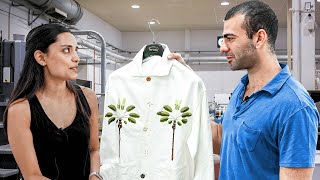
The video follows hosts (Speaker A and B) as they visit Blank Studio, a woman‑run, small‑scale luxury clothing factory near Bangalore. Owner Shivangi explains the entire production pipeline—from sourcing silk habutai and eco‑dyeing (shibori, block printing) to hand‑cutting, stitching, machine‑hand embroidery, ironing, quality control, and packaging. She details the labor intensity (e.g., a complex jacket takes ~3 days to stitch, 2–3 days for embroidery, up to 9 days total for a single piece) and pricing (cut‑and‑sew £10‑£15, finished garment £30‑£60, high‑end silk pieces $70‑$80). The factory emphasizes transparent, ethical manufacturing, paying fair wages, and avoiding child labor. Shivangi runs a training academy that up‑skills women in stitching, machine operation, and plans to teach pattern‑making, aiming to create dual‑income families and preserve Indian artisan heritage. The factory offers a one‑stop solution for designers, handling fabric sourcing, cutting, sewing, embellishment, and QC, while collaborating with artisans and international markets.
Chapters
This is incredibly impressive. This UGZ job is so hard, bro.
We've managed to escape the madness of Bangalore. I feel incredibly peaceful this morning. Right now we are outside this little factory called Blank Studio. It's a woman-run factory with an amazing initiative. Let's jump into it. Shivangi is the owner of Blank Studio. We've heard a thing or two about this factory from a few other people we've spoken to throughout India, so I'm kind of excited to see what you have going on in here.
Yeah, come on in.
Let's go.
So we have a strength of about 25-30 people. Over here is our cutting tables, the two cutting tables. This is our pattern master. We're currently layering fabric for a piped cord pant. Most of the times we're usually doing single piece cutting because we usually tend to work with much smaller quantities. We're mainly into small scale. Production, we don't land up having a large table because it's mainly hand-cut. We have about one pan that's going to fit in, so he puts the pattern and then he cuts it. This fabric is a silk habutai. We sourced it from Karnataka from a silk weaver. This was then sent to 2Up 2Down Textiles to do eco-dyeing and eco-printing. So this is actually It's actually a shibori technique. What they do is, you know, sort of tie rubber bands in clusters and kind of dip it in ink. Then we get the fabric and then we cut and stitch. And this is, you know, we're doing like 2 pieces in a small and 2 pieces in a medium. That's it.
Do you feel like you need to teach a lot in this process?
Oh, 100%. Because most of the designers that come to us don't really understand manufacturing as well. So, you know, like assistance with tech packs, what fabric can work with which silhouette and what can't. Like a silhouette like this wouldn't do too well with like, say, a twill or a tencel. You know, it's just a very flowy dress. So, you know, silks work well. What kind of silk, what weight. So those kind of decisions we do land up helping designers on. And that's what kind of makes the process a lot more fun. And fortunately, we've been lucky enough to work with designers that are very open to ideas and are open to hearing people out. So it's fun to work with them.
Amazing.
Amazing.
So do you want to do stitching first? What he's stitching right now is a jacket. This is a fairly complicated jacket with multiple panels. It's got a hoodie. He's been a tailor for almost 15 years. There's no assembly line process. And approximately takes him like a day to stitch this jacket because it has a lot of intricate details. He's going to be putting that trim on, sort of like attaching the buttons, then it sort of goes for embroidery. So I would say overall it takes about 3 days to make a jacket like this.
Wow, 3 days for one person?
Yes, because cutting one day, stitching one day, and then finishing with the buttonhole and the embroidery takes about a day. So this is organic cotton drill fabric. This has been dyed and then block printed on it. And this particular piece has various components to it. This is a dual-colored one, so this had to get dyed. This is again, uh, goth dyed. And then there are various trims on this. There's a hoodie at the back, there's a runner which is an organic twill tape. The buttons are kind of sewn into the tape and then, you know, it's buttonholed. And then there are these large pockets on it. So it's a fairly complicated piece. It takes about 1 to 1.5 days for a tailor to stitch this.
So how much would something like this cost? Full finished garment?
Full finished garment would be about £50 to £60.
£60.
Yeah, the need for transparent manufacturing is growing a lot more. Consumers want to know where your product's made. You know, you want to ensure that it's made at a factory that is giving the workers a good working environment and, you know, paying them well. You're not employing people less than 18. The scrubbing marks that you see is what they've done to kind of imprint the embroidery onto the fabric. What he's doing currently is machine hand embroidery. It kind of reduces the amount of time and cost from hand, but it's still fairly intricate because, you know, a piece like this would take him about 2 to 3 days to do, and then it's 2 to 3 days on hand.
A lot of, you know, factory owners we've spoken to said it's hard to find skilled labor in India that wants to stick around. And I think you've done a really good job with culture of, you know, getting people involved.
I don't think you find great labor. It's really hard. I think what every kind of factory or every institution, I feel like, even if it comes with like accounts or engineering or medical, like you need to spend time to train people. That's kind of like a fundamental change that we've sort of done. We have a small academy that trains about 5, 6 people. If people want to stitch at home, we're happy buying a machine for them. The idea is just to kind of build capability amongst people where they can kind of become dual-income families because in India most families are single-income families. After machine, the piece comes here. He's basically filling in all the gaps from machine. What you see right now is half of the garment.
So 3 days and 3 days just on embroidery and then another 3 days to assemble the garment itself.
Yeah.
So 9 days total for one piece.
Yeah.
Of constant labor.
Yeah.
That is insane.
That's crazy.
Let me speak a little bit more about this. So this piece over here, Story MFG, the fabric It's block printed?
It's block printed. It's a '60s poplin. This has been block printed by Tarangini. And then we get the fabric and then we cut and we can do this in about 2 days. 2 to 3 days.
And what would be the cost for something like this?
Just cut and sew would be about £10 to £15.
And full finished garment?
Full finished garments would be about £30.
£30. Understood.
We have 3 ironing stations. They kind of use this as mid-process ironing as well, but they also use this for finishing iron. And this is also the ironing spot where all our packaging happens. He's currently working on a bomber jacket. This goes to Australia, so winter there, so we're doing more like jackets and heavy material dresses for them. Before a garment is being cut, the rolls of fabric that you see here, so these are just kind of stocked here to get cut. The ironing happens here, then it goes on the cutting table, then stitching, then kind of comes back, and then the final iron happens here, and then we do QC. Satish over here does our QC. It's usually Satish and Archit that do one round of QC, and then I do the second round of QC. So pretty much I would say we do about 2 to 3 rounds of rounds of QC before we pack and ship out a product. A lot of times we also get the master to do the QC because they're very tiny details, like to check, you know, measurements and finishing, comparing it to the sample. So I would say the first 5 to 10 pieces that come out in production from each of the tailors, the master does it as well.
If a customer comes to you, you guys have the full supply chain set up.
We do.
So because you, you can kind of provide a one-stop solution.
I mean, that's the intention behind it as well. I mean, we're happy to work if designers sort of want to source their own fabrics and just send off for cut and sew, we're fine with that. But it's a lot more fun when we get to do the entire process.
I agree. So like if a designer comes to you with a full jacket idea, you'll take care of everything from there?
We'll take care of everything.
Understood.
Yeah.
You know, you work with a lot of artisans.
Yeah.
Why?
The little exposure that I had in the international market, I kind of realized that Indian art has a very high perceived value, but not a lot of people know what India is really capable of in terms of their their artisans. So in this, the fabric is really expensive because it's all pure silk, it's eco-dyed and then stitched in small quantities. So the costing would be anywhere about $70 to $80. What we're planning to do next is in that training institute also figure out pattern making because a lot, a lot of people are not interested in just stitching, right? They kind of want to make a garment from scratch. So we're sort of looking at how do you kind of educate women to become pattern makers because in India that's, it's an anomaly. The idea is to just build capability amongst women.
Thank you so much. Thank you for having us. Can I give you a hug?