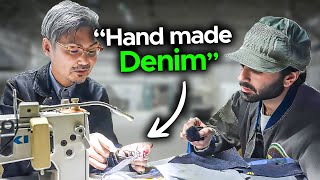
The video follows the narrator and traditional denim artisan Kanek on a hands‑on journey through Japan’s denim heartland. It begins with a brief history of Japanese denim, noting the dwindling number of skilled makers and introducing Kanek, a former Big John employee who now hand‑makes every pair of his jeans. The team visits Okamoto Textile in Okayama, where they select a dense 12‑ounce selvedge denim, then tour a nearby factory housing over 30 vintage shuttle and projectile looms to see how the fabric is woven. Kanek drives to his modest workshop in Kojima, where he demonstrates the entire construction process: laying out pattern pieces vertically to preserve weave direction, reinforcing pockets with a blue fabric wave motif, using double‑needle stitching for the waist and reinforced belt loops, and performing 32 successive indigo dips for deep color and distinctive fading. After turning the jeans inside‑out, they are washed, button‑holed, and fitted on the narrator’s friend Will, who tries them on for the first time. The video concludes with the narrator purchasing a pair of Kanek’s jeans, a gray cotton work jacket, and a denim‑dyed sweater, and provides a link to lconnectjeanslab.com for viewers to buy the handmade pieces. Throughout, the narrative emphasizes the rarity of the craft, the meticulous hand‑made techniques, and the cultural significance of Kojima as Japan’s denim capital.
Chapters
It has now been 3 generations since the dawn of denim making in Japan, with fewer and fewer artisans picking up the skill as time goes on. Japan has the oldest population in the world with very little potential to pass down traditional skills. Very few artisans are left today, and one of them is Kanek. Kanek worked for Big John, and Big John was the first company to ever develop denim in Kojima in 1968. Big family, Big John! Kojima is the denim capital of Japan with the highest concentration of denim denim makers in the entire country. Traditional denim makers learned highly sophisticated skills from their ancestors. Today I'm going to make a pair of jeans with a traditional denim maker in Kojima, Japan. I'm going to show you the process behind how the highest quality jeans are developed. Kanek is going to make a pair of jeans for my friend Will, who has never owned a pair of denim before. We're starting off at Okamoto Textile where Moriya is going to help Kanek select fabric. Okayama Tekki-san? Okamoto Tekki-style. Okamoto Tekki-style. We're currently at Okamoto Tekki-style, and this right here is in Okayama, which is the denim capital of Japan. And we're going to pick up some fabrics that he's going to use to make jeans. Is there any other popular brands that you make for nowadays? This is what we're trying to stop. No more secrets. What kind of denim are you looking for? So he's looking for For the next season, it's going to be warmer, so it's looking for the soft and movable. Hi. And you make every single pair by hand? Yes. So everything in your store, you made yourself? 60% Wow. Wow, sugoi, sugoi. But if we want to better understand why Kanek chooses certain denim, we need to dig a little deeper. Moriya was kind enough to bring us to his factory nearby where all of the denim is woven. Where do you get the denim from? This little tucked away factory contains over 30 vintage shuttle loom and projectile loom machines. Every day, these loud old-school machines run for 10 hours. Maria showed us the intricate process behind weaving yarn into selvedge denim fabric. Maria was so grateful to have us visit that he gifted me a traditional denim wooden loom shuttle as a gift for coming all the way. This one is broken, but according to Maria, a functioning one is worth over $30,000 because it is no longer produced and very difficult to repair. The result of our visit is a beautiful 12-ounce denim that Kanek picked up. This fabric is extremely dense and requires a high level of skill to work with its rigid nature. Kanek has been driving us for over 2 hours from Kurashiki and is now taking us to his workshop in Kojima. All of his signature denim is made in his workshop located on the side of his home. This little garage is where every single pair of L. Kanek jeans is made. So notice here how the pieces are laid out. The fabric, when it's woven, it all goes in one direction. So when he's laying out the pattern, he lays them out so that the jeans always have the fabric going vertically. Because in reality, he can just club all the pieces together like this and place them however he wants. But then the direction of the weave on the jeans would be different throughout the pair of denim. So in order to have it consistent, everything has to be laid out so it's going vertically, always. Okay, so right now he's putting together the back of the jeans and he's adding that blue fabric to reinforce the pocket so that the pocket doesn't rip off easily. This is supposed to represent a wave, like the ocean, because this factory is on the seaside. It's right next to the ocean. And the second line here at the end represents a connection to the people. So that's consistently how he finishes his signature on every single pair of jeans. Double needle stitch all the way throughout to create what's going to be the waist for the jeans. The belt loops are much thicker denim. It's been folded over, so it needs to be reinforced further. So because of that, it requires a thicker stitching. Wow. Wow. How many times is the denim dipped in indigo that you use? 32 times. But that means that the yarn 32 consecutive times is dipped and then dries off and dipped again and dries off again. And that is a really long, really strenuous process, but it's the reason why the denim uses up and fades so beautifully. Oh, big moment, big moment. He's turning them inside out. Wow. Okay. Oh my God, finished denim. My man, my man. Thank you. Wow. That's real handmade craftsmanship. Beautiful. Kanek is going to wash the jeans and we'll catch him tomorrow at the store to try them on. Final moment, going to see my jeans. We're very excited about seeing the jeans. Okay, wow, arigato gozaimasu. Okay, okay, and they're washed and everything. Look at the buttonhole. Oh yes! Wow, wow, these are so cool. And then green for Sprout. They look really good on you. You've never seen me in denim. Will in jeans, bro, they look amazing on you. I feel like you. Yeah. Hey, look, that looks sick on you. Yo, it's probably a bit small. Will was so happy with this pair of jeans that I needed to pick up some stuff as well. First thing I bought, and I had to remain classic, was a pair of jeans that he made. This is 12 ounce indigo denim, and it's using up so beautifully beautifully, but what really sold me on it was the 2 years aging sample. And then I also picked up this beautiful gray work jacket made of this heavy cotton. Later, I went back to visit some factories with Kanek, and he was so generous that he gifted me this denim and corduroy work jacket and the sweater I'm wearing right now, which is indigo dyed. A special thank you to Kanek. If you want to buy his jeans, they're entirely handmade by him or his friends. And they're available on lconnectjeanslab.com. I'll put the link in the description. Thank you so much for watching, and I'll see you on the next one. Thank you.